



Abstract
The relevant working group of the German Diabetes Society, as well as the professional association itself, has identified a number of areas where action is possible and necessary to improve sustainability. This includes organizing and holding events and conferences. These events are important for advancing scientific discourse and medical progress, but they also require considerable resources. This statement discusses a number of concepts, options, and problems that are relevant in this context for changing the situation. These activities, some of which are contradictory, require a structured and systematic approach to make diabetes conferences more sustainable in the future.
Introduction
The working group on diabetes, environment, and climate (DUK) of the German Diabetes Society (DDG) has published a position paper identifying several areas for action in which the DDG, as an organization, and other associated groups intend to take action in line with the objectives of this working group. 1 When we make demands that affect other structures, we (i.e., diabetologists and their professional associations) should also consider what we can do ourselves in terms of sustainability.
Since the organization and implementation of events and conferences (these terms are broadly defined, as there are various types and forms of such events) involves considerable effort, with a focus on environmental issues, one of the areas of action in the position paper is “Conferences & Events.”
The DDG regularly organizes events and holds conferences twice a year with thousands of participants. Such events are important for promoting scientific discourse and medical progress through mutual exchange. Nowadays, such events also take place as purely online or hybrid meetings, although from a resource-saving perspective, the effort involved is not really any less (or at least it appears that way): the additional organization of streaming and recordings involves additional support (technical, personnel) and significantly higher costs. Hybrid events involve additional environmental impacts (electricity, server capacity, etc.) on top of those associated with in-person events.
When organizing an in-person event, there are a number of resource-saving options available, that is, such events can be held with less impact on the environment and climate. This article aims to examine these options in more detail in order to initiate development in this area and to critically discuss general aspects in this context.
Activities of the DDG and Other Professional Associations
The DDG has already been very active in this regard in recent years, and there is a whole range of relevant information on the congress website. 2 This concerns, for example,
Travel. Participants are asked to use environmentally friendly options, such as rail and local public transport (ÖPNV). Low-cost ÖPNV tickets are regularly offered, if agreed with the event venues.
The amount of printed paper. This is being significantly reduced in favor of digital solutions, for example, by eliminating printed conference programs, conference tickets, attendance certificates, and so on. Much of the information provided by a conference program, for example, can be covered by a “conference app,” which can be updated as needed.
Conference materials, such as bags, promotional gifts, exhibition stands, and so on. These are evaluated from a sustainability perspective and have been gradually reduced in recent years.
Catering. Reusable tableware is used, and plant-based dishes are primarily offered.
The European Association for the Study of Diabetes (EASD) has also taken a similar stance on its conference website on sustainability. 3 In contrast, the American Diabetes Association (ADA) and the Advanced Technologies and Treatments for Diabetes (ATTD) do not make any statements on this subject on their websites. This is in line with a certain ignorance of environmental issues among medical associations and similar organizations, such as those representing manufacturers of medical devices. 4 Another player in this context, namely, trade fair operators, is active in such aspects (at least outwardly), for example, Messe Berlin. 5
Sustainability Concept—General Considerations
Ideally, every event organizer should have a sustainability concept and actively implement it. Such a strategic approach should serve to use resources in such a way that future generations still have access to them and the environment is protected. Such a concept is expected to contain descriptions of the current and target situations and to analyze these critically to be able to define individual fields of action and steps and to back these up with measurable values (key performance indicators [KPIs]). According to an ISO standard, such “objectives should be specific, measurable, achievable, realistic, and time-bound” (ISO 20121).
Such a concept should be designed to answer the following questions:
What is the starting point for the planned event?
What criteria, format, and orientation were considered when choosing the venue, catering, transportation, technical equipment, personnel, procurement, event program, communication, and accessibility?
In addition, you should indicate which criteria are to be implemented in the future to ensure that the event is sustainable. Goals and key figures should be formulated (e.g., “In the future, 80% of transportation to the event should be by train”). There are various sample examples of such concepts on the Internet (include links?). The German government has published a 100-page (!) “Guide to the sustainable organization of events” as part of the federal government’s sustainability action program for the federal administration from 2020 6 and from the federal government from 2021. 7
Sustainability Concept—Focusing on Your Situation
In our opinion, it is necessary (also critically/self-critically) to define the following when creating a sustainability concept: What are our immediate, medium-term, and long-term goals, and which of these can “we” (really) influence ourselves? Where is there potential for improvement?
In this context, there are several “conflicts,” that is, conflicting factors, such as fire safety versus sustainability. The use of wooden chairs would be sustainable, but fire safety requires a certain type of impregnation, which in turn is rather harmful to the environment. The same applies to lunch boxes and catering (see below), where the health department requires that everything be individually packaged, which is not a sustainable approach.
One advantage of creating a sustainability concept is that it forces you to deal with such issues and provides a common thread and structure for the tasks involved in preparing a “green” conference. Such a concept can also motivate everyone involved to position themselves more strongly and effectively on the issue of sustainability.
It is difficult to check the specifications in this concept. How can you ensure that certain specifications are implemented, that is, in line with the agreed KPIs? It is important to avoid “greenwashing,” that is, making statements about actions that are not adhered to in practice. On the contrary, overregulation and excessive documentation should be avoided, and implementation should be practical. Is documentation required for all or only certain requirements? How thoroughly must it be ensured that waste is handled and disposed of? A good balance probably needs to be found here.
When it comes to sustainability (as with many other aspects), there are several (sometimes complex) details and interrelationships to consider. So-called “sustainability scorecards” are used to review KPIs. These are more or less detailed checklists that are used to tick off which points have been (verifiably) complied with, which external third parties (e.g., service providers) have been committed to what, and how this has been verified (e.g., by submitting a written confirmation or voluntary commitment), and so on.
The implementation of the activities outlined in the sustainability concept requires a considerable amount of lead time and organizational effort, which should not be underestimated. This concept should also be made available to the sponsors of a conference at an early stage, so that the manufacturers—and the exhibition stand builders commissioned by them—can familiarize themselves with it and take care of the concrete implementation.
The Attitude of Manufacturers Who Are Active at Such Events
Manufacturers of pharmaceuticals and medical devices have, in many cases, already developed sustainability concepts for the manufacture of their products and the conduct of their companies. In many cases, they have a keen interest in the topic of sustainability and are able to communicate effectively on this subject. As far as we can tell, manufacturers are displaying less information material at their stands in the industry exhibition, much of which previously had to be disposed of after the conference. Another option for avoiding waste is to refrain from giving away promotional items.
A difficult point in this context is that parts of the conferences (e.g., the industry exhibition) are often completely outsourced by the trade fair operators, so that the conference organizer has no influence, or at best only very indirect and limited influence, on sustainability issues in general and specifically.
Concrete Steps for Organizers
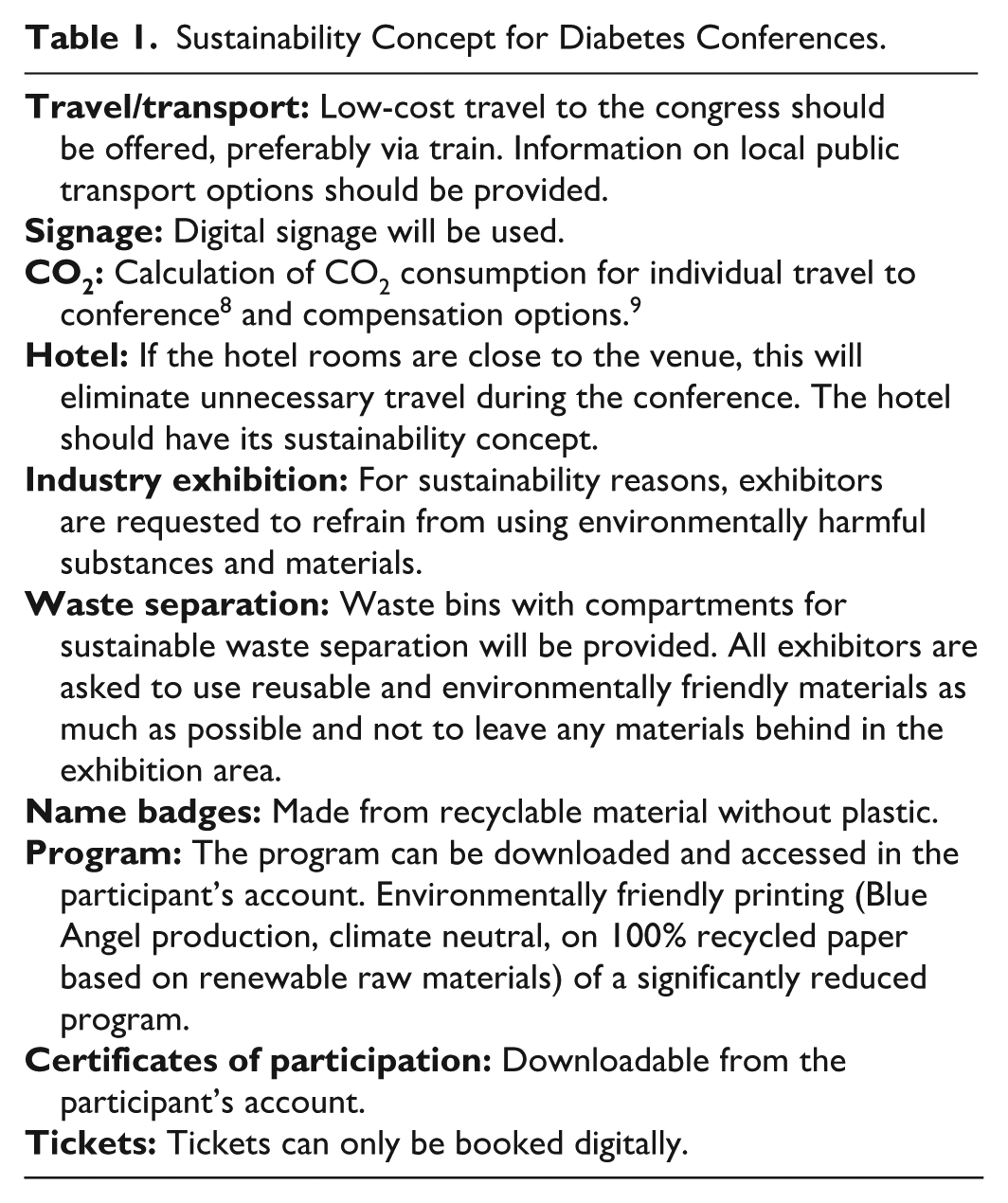
If “someone” wants to organize a “diabetes conference” and wants to implement and take into account the aspects and requirements outlined here in their sustainability concept, they should (Table 1):
- send their sustainability concept to the conference organizer(s) and any external third parties involved at an early stage,
- inspect the conditions on site,
- have an appropriate checklist (sustainability scorecard) and maintain it (see below), and
- formulate clear “SMART” goals and parameters for themselves and any third parties involved in the checklist, and also check and monitor their compliance/achievement.
Such a scorecard is an additional tool that takes time to complete, thus costing time and money. To avoid this, basic rules could be established, such as that the sustainable solution should always be the preferred option within the scope of comparable costs.
Sustainability Concept for Diabetes Conferences.
Catering
At industrial exhibitions, but also at some conferences and symposiums, “lunch boxes” are distributed. These are usually quite large cardboard boxes containing various individually packaged foods and beverages. These are intended to be taken away and are elaborately packaged for both practical and hygienic reasons, for example, water in beverage cartons (e.g., Tetra Packs), fruit in plastic packaging, coffee in coffee-to-go cups, lunch packages in paper bags and plastic blister packs, and so on. Presumably, all of us have been annoyed by these huge packages, which are handed out as a kind of service. Another disadvantage of these “bundles” is that they are completely pre-made and handed out as a whole. This means that individual participants cannot choose and take the items that they want or like at that moment. This often leads to individually packaged components from the bundle being discarded unused and in their original packaging. This promotes both food waste, which must be avoided at all costs, and the problem that the packaging of uneaten food cannot be recycled but must be incinerated with the rest of the waste.
It is important to bear in mind that this type of catering involves considerable costs for the organizers. These costs are naturally passed on to the conference participants or covered by the stand fees paid by the manufacturers. It is difficult to estimate the extent to which “surplus” food is “disposed of” after the events, but a significant amount is not unlikely.
If no packaged food is served but buffets are offered, reusable tableware should be used instead of disposable tableware. However, there are also a number of regulatory requirements to be observed here, particularly with regard to hygiene. It should also be noted that the products must be individually packaged. From a planning perspective, it is difficult for the organizer to estimate in advance what will be popular and what will not.
The type of food offered (e.g., vegetarian food) is at the discretion of the organizer. The problem is that freely available catering services have minimum order quantities. The organizer can only hope that enough food is sold, but they have to pay for it regardless. If there is food left over, it must be disposed of. A basic requirement would therefore be that food is produced regionally and organically, for example.
Related to this, there is often no possibility for conference participants to dispose of the waste they produce separately, that is, there are no adequate disposal facilities, or the system for separate collection is poorly implemented or even nonsensical (e.g., if the separate collection containers are not next to each other but so far apart that it is impossible to collect waste separately), so that the right idea is not effectively put into practice. As a result, everything ends up unsorted in trash cans or is (inevitably) sorted incorrectly by the participants and therefore also ends up in the residual waste. However, even if separate disposal containers are available and a separate collection concept is implemented sensibly, this does not mean that further handling is adequate. According to our observations, separately collected waste is mixed again after the individual containers have been emptied, or the different bags are placed in the same container. The option of suitable waste disposal is an important requirement for a suitable event location.
Appropriate Waste Disposal
The sustainability concept should require the use of a three-component collection container (packaging, paper and cardboard, and residual waste) with appropriate information signs. Following a conference, a trial sorting of the waste could be carried out to collect concrete figures on what type of waste is produced and how the concept has worked. This can provide information for further concrete actions, including the quantities of secondary raw materials that could be saved from incineration and returned to the material cycle. In this context, it is probably useful/necessary to contact the local/regional municipal cleaning services to find out what options are available.
Further Aspects
At industrial exhibitions in particular, there are exhibition stands—some of them impressively large and grandiose—that look best when they are new at every trade fair or congress. As is so often the case, the sales and marketing interests of manufacturers conflict with sustainability considerations. Nowadays, due to high transport and storage costs, these are usually no longer stored, but disposed of and rebuilt again and again. This is cheaper and allows current requirements to be taken into account. After a conference, the stands often show signs of wear and tear, which also prevents them from being reused. Storing stands requires adequate storage facilities, for which there is hardly any capacity. Carpets are usually disposed of, as they cannot be reused after a few days of conferences.
For similar reasons, it often does not make sense to rent the furniture required for the stands (especially chairs and tables); it is simply much cheaper to buy new furniture and dispose of it after the conference (or give it away).
Costs of Implementing the Sustainability Concept
From a cost perspective, it is probably cheaper not to worry about sustainability at present. However, there is public support for the planning and organization of conferences that have a sustainability concept, so that it is worth inquiring with the trade fair company (or relevant organizations). Some cities are specifically aiming for “green trade fairs” or want to be a “zero-waste” city or move in that direction. 10 For example, the “Berlin CityCube,” where the DDG’s spring conference is held and which is part of Messe Berlin, writes: “With innovative solution concepts . . . we will gradually reduce the amount of waste during events to a minimum by . . . (for example) reusing materials and recycling recyclable materials.” The first bullet point below reads: “Separation of recyclable materials and return to the recycling cycle..” 11
In the future, in addition to the legal requirements that already exist to a considerable extent (e.g., the Commercial Waste Ordinance, the legal obligation to separate waste, the National Circular Economy Strategy), there will be a whole series of further requirements at both the European and national levels that will at least partially affect the holding of conferences.
Communication
In general, it is important to make conference participants aware of how complex and time-consuming conferences are and how many aspects need to be taken into account. Many conference participants also have little knowledge of the aspects and requirements relevant to sustainability. Some participants are also unwilling to change their habits, and there have been complaints at conferences when only an app with the program is offered instead of a program booklet. Some participants prefer to leaf through and make notes rather than use digital media. Some participants are unable to use the app, which means that the event organizers’ staff have to spend a considerable amount of time assisting.
Therefore, there should be appropriate information available that explains all relevant aspects concisely and appealingly, that is, explaining why and how things are done. It is important to establish appropriate communication of all activities in accordance with the sustainability concept on the organization’s website, in its information materials (which should not be printed), before and during the conference, and toward the media/press. Appropriate materials should be prepared and made available to anyone interested. Many conference participants are likely to be interested in such information and would feel better about attending the conference if they knew that the relevant aspects were covered. This can be verified by surveying participants after the event, where they can also make further suggestions for improving sustainability.
Discussion
Taking sustainability aspects into account when organizing and holding a diabetes conference is considered a necessary development; that is, in the not-too-distant future, no such events should be held without a sustainability concept. Perhaps it would be an incentive/motivation for this effort if, for example, the DDG awarded a “green label” for this and the respective organizer used it for advertising purposes?
Footnotes
Acknowledgements
The authors would like to thank Ms Vité and Ms Gundlach from the DDG office for their helpful comments.
Abbreviations
AG DUK, working group on diabetes, environment and climate; ADA, American Diabetes Association; DDG, German Diabetes Association; EASD, European Association for the Study of Diabetes; KPI, key performance indicator; MmD, people with diabetes; ÖPNV, local public transport.
Declaration of Conflicting Interests
The authors declared no potential conflicts of interest with respect to the research, authorship, and/or publication of this article.
Funding
The authors received no financial support for the research, authorship, and/or publication of this article.
