



Abstract
We report the risk of hypoglycemia following prolonged temporary target (TT) cessation during rapidly correcting hyperglycemia while using the Minimed 780G insulin pump and SmartGuard algorithm through a case report.
A 21-year-old woman with type 1 diabetes and fear of hypoglycemia was seen for follow up after switching to the 780G system with hybrid-closed loop algorithm from a 770G not connected to a continuous glucose monitor (CGM). Since the change, she reported new recurrent hypoglycemia in the evenings following use of prolonged TT during the day. The algorithm target glucose was 100 mg/dL, active insulin time (AIT) was four hours, and total daily dose (TDD) was 59.9 units.
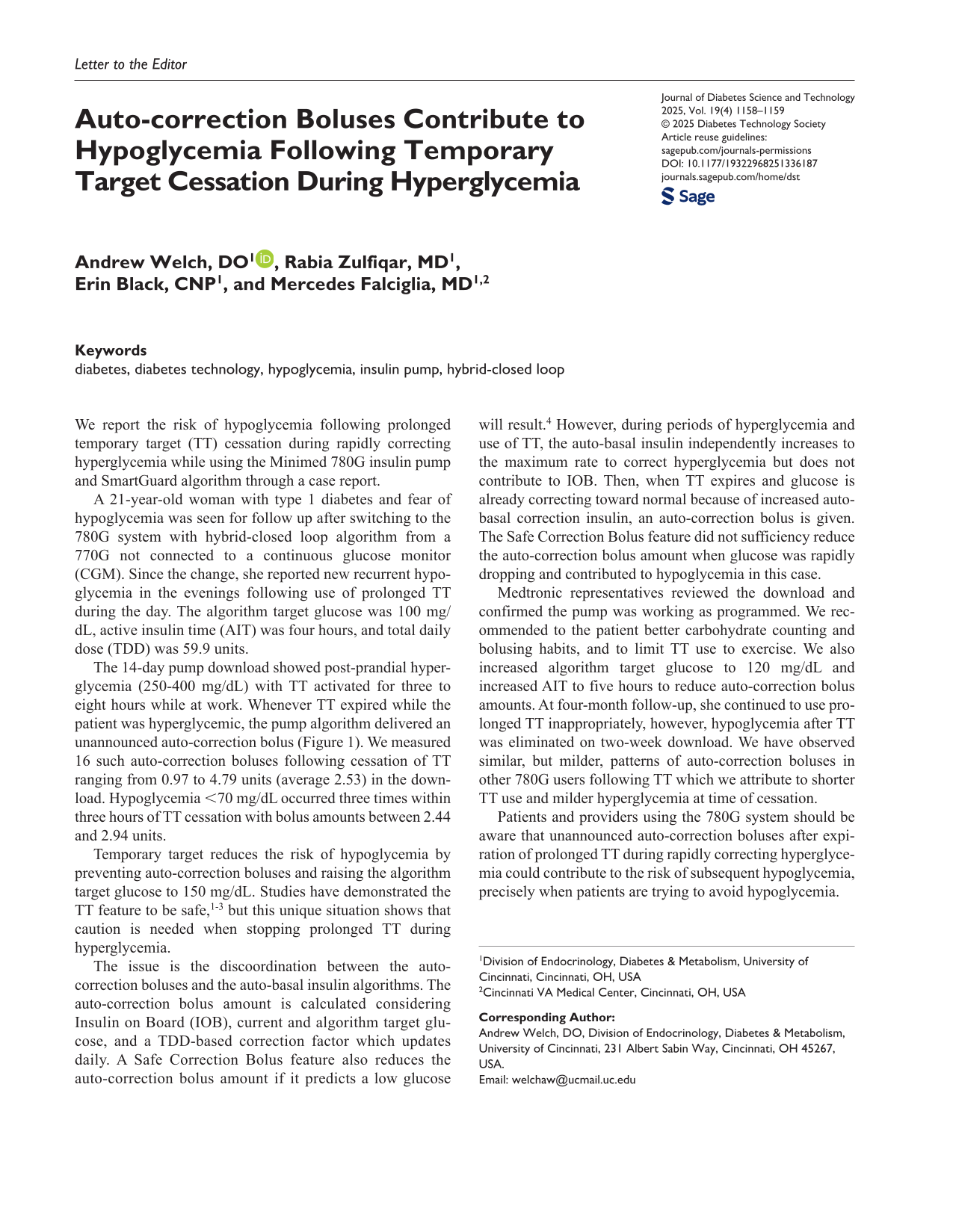
The 14-day pump download showed post-prandial hyperglycemia (250-400 mg/dL) with TT activated for three to eight hours while at work. Whenever TT expired while the patient was hyperglycemic, the pump algorithm delivered an unannounced auto-correction bolus (Figure 1). We measured 16 such auto-correction boluses following cessation of TT ranging from 0.97 to 4.79 units (average 2.53) in the download. Hypoglycemia <70 mg/dL occurred three times within three hours of TT cessation with bolus amounts between 2.44 and 2.94 units.

This is a modified image from the pump download showing representative examples of pump and glucose reactions following TT cessation. Arrow A shows TT cessation while glucose is in the target range resulting in minimal insulin delivery. Arrow B shows TT cessation while hyperglycemic resulting in 3.19 units of auto-correction bolus insulin delivery with the comparative height of the insulin delivery shown by the height of red bar. This did not lead to hypoglycemia. Arrow C shows TT cessation leading to 2.47 units of auto-correction bolus insulin delivery while glucose was trending down which contributed to hypoglycemia. Note that units of insulin on board are represented by the lavender shading and are represented on a different height scale than the pink basal insulin delivery. Glucose values are represented in mg/dL.
Temporary target reduces the risk of hypoglycemia by preventing auto-correction boluses and raising the algorithm target glucose to 150 mg/dL. Studies have demonstrated the TT feature to be safe,1-3 but this unique situation shows that caution is needed when stopping prolonged TT during hyperglycemia.
The issue is the discoordination between the auto-correction boluses and the auto-basal insulin algorithms. The auto-correction bolus amount is calculated considering Insulin on Board (IOB), current and algorithm target glucose, and a TDD-based correction factor which updates daily. A Safe Correction Bolus feature also reduces the auto-correction bolus amount if it predicts a low glucose will result. 4 However, during periods of hyperglycemia and use of TT, the auto-basal insulin independently increases to the maximum rate to correct hyperglycemia but does not contribute to IOB. Then, when TT expires and glucose is already correcting toward normal because of increased auto-basal correction insulin, an auto-correction bolus is given. The Safe Correction Bolus feature did not sufficiency reduce the auto-correction bolus amount when glucose was rapidly dropping and contributed to hypoglycemia in this case.
Medtronic representatives reviewed the download and confirmed the pump was working as programmed. We recommended to the patient better carbohydrate counting and bolusing habits, and to limit TT use to exercise. We also increased algorithm target glucose to 120 mg/dL and increased AIT to five hours to reduce auto-correction bolus amounts. At four-month follow-up, she continued to use prolonged TT inappropriately, however, hypoglycemia after TT was eliminated on two-week download. We have observed similar, but milder, patterns of auto-correction boluses in other 780G users following TT which we attribute to shorter TT use and milder hyperglycemia at time of cessation.
Patients and providers using the 780G system should be aware that unannounced auto-correction boluses after expiration of prolonged TT during rapidly correcting hyperglycemia could contribute to the risk of subsequent hypoglycemia, precisely when patients are trying to avoid hypoglycemia.
Footnotes
Abbreviations
AIT, active insulin time; CGM, continuous glucose monitor; IOB, insulin on board; TDD, total daily dose; TT, temporary target.
Declaration of Conflicting Interests
The author(s) declared no potential conflicts of interest with respect to the research, authorship, and/or publication of this article.
Funding
The author(s) received no financial support for the research, authorship, and/or publication of this article.
