



Abstract

Keywords
Continuous glucose monitoring (CGM) systems have revolutionized diabetes management by providing real-time blood glucose tracking. However, there is a need for free, easily accessible tools for analysis of CGM data in relation to specific events like meals or exercise, allowing improved understanding of the effects of lifestyle factors and physiological changes on glucose control. Currently, the complexity of such analyses often requires extensive technical skills, thus restricting use among the majority of researchers and clinicians. Developing user-friendly web applications to facilitate this analysis could significantly broaden accessibility and utility.
To address this, we developed Diametrics, a web-based application designed to make CGM data analysis both accessible and user-friendly. This platform supports a variety of CGM devices and data formats, offering a flexible platform suitable for diverse clinical and research needs. Its intuitive interface allows users to navigate and analyze data with ease, without requiring extensive technical knowledge. The application is free to use at https://diametrics.org and is accompanied by comprehensive documentation and instruction videos. All underlying code is publicly available at https://github.com/cafoala/diametrics-webapp.
As well as having the standard features available across existing online CGM analysis tools, the platform incorporates a number of novel features (Figure 1). These include capacity for simultaneous upload of multiple CGM files, customizable analysis options that can cater to specific research or clinical questions, and interactive data visualizations. Beyond simple extraction and analysis of clinical CGM metrics, it has the unique capacity for custom integration and analysis of glucose data related to specific events such as meals, exercise, or medication intake. This functionality not only enhances the usability of CGM technology but also opens new avenues for personalized diabetes management and research by significantly improving our understanding of glucose dynamics at points of interest. A case study demonstrating the functionality of the web app is available at https://youtu.be/bfiQRGhCLh4.
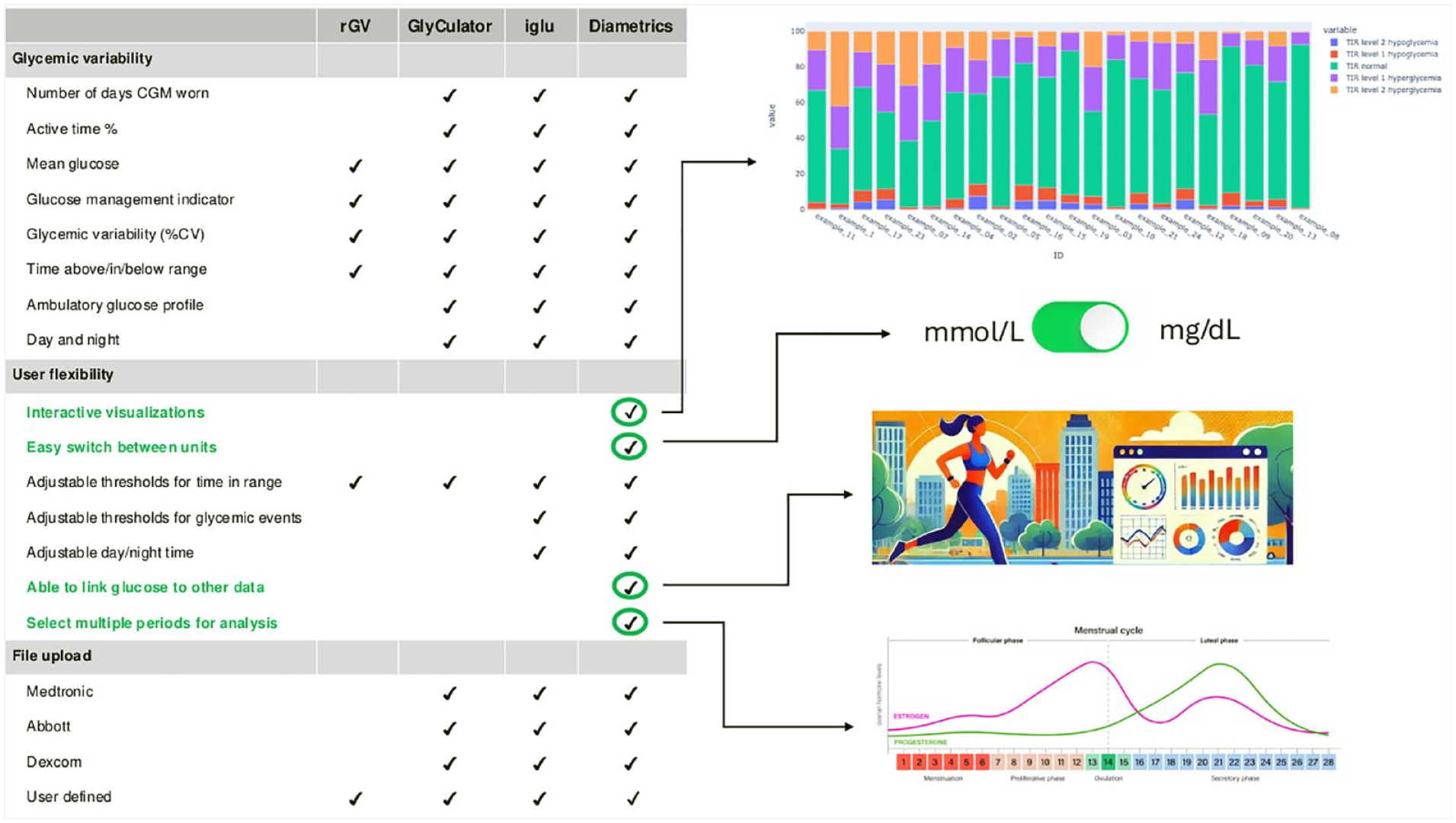
Comparison of Diametrics with other web apps. This infographic shows how Diametrics compares to web apps rGV, Glyculator, and iglu in terms of glycemic variability metrics, user flexibility features, and file compatibility.
We validated our application through a comparative analysis with the iglu R package, a well-established tool for CGM data analysis. 1 Utilizing data from 418 participants from three studies,2 -4 we examined agreement between the two platforms in computation of metrics recommended by the American Diabetes Association (ADA), 5 including average glucose levels, time in ranges, and glycemic variability indices. We observed high concordance, with very high correlation (r > 0.999) and near-perfect agreement for all metrics. 6 This high level of concordance underscores the accuracy of our application in replicating essential CGM metrics, validating its efficacy.
In conclusion, Diametrics represents a significant advancement in the field of diabetes technology. By simplifying and democratizing the analysis of CGM data, it holds the promise of enhancing diabetes management and research, making advanced data analysis accessible to a broader audience. This platform has the potential to be a valuable tool for both clinicians and researchers, facilitating better outcomes in diabetes care and fostering further research into personalized diabetes management strategies.
Footnotes
Acknowledgements
We would like to thank the participants of the T1-DEXI, T1-DEXIP, EXTOD, and MOTIVATE-T2D trials who provided data on which to test Diametrics. We would also like to thank Emily Paremain and Katie Finch for technical support in building the app and Nick Jones and Joséphine Molveau for testing and feedback on the app. This study is based on research using data from the Type 1 Diabetes EXercise Initiative (T1-DEXI) and Type 1 Diabetes EXercise Initiative Pediatric (T1-DEXIP) studies that has been made available through Vivli, Inc. Vivli has not contributed to or approved, and is not in any way responsible for, the contents of this publication. This study/research is funded by the National Institute for Health and Care Research (NIHR) Exeter Biomedical Research Centre (BRC). The views expressed are those of the author(s) and not necessarily those of the NIHR or the Department of Health and Social Care. This research was supported by the Exeter Centre of Excellence in Diabetes (ExCEeD). For the purpose of open access, the author has applied a Creative Commons Attribution (CC BY) license to any Author Accepted Manuscript version arising. During the course of preparing this work, the authors used ChatGPT and Copilot for the purpose of summarizing research papers, text editing, and providing code snippets. Following the use of this tool/service, the authors formally reviewed the content for its accuracy and edited it as necessary. The authors take full responsibility for all the content of this publication.
Abbreviations
ADA, American Diabetes Association; CGM, continuous glucose monitoring.
Declaration of Conflicting Interests
The author(s) declared the following potential conflicts of interest with respect to the research, authorship, and/or publication of this article: M.J.A. receives research funding from the National Institute for Health Research (NIHR) Applied Research Collaboration, South West Peninsula. C.L.R.’s PhD was supported by the Expanding Excellence in England (E3) fund. R.C.A. has received remuneration from Novo Nordisk, AstraZeneca, and Eli Lilly for conducting educational talks on diet and exercise for healthcare professionals. Funding and support was provided by the Royal Academy of Engineering (RAEng), London, UK, through a research fellowship in medical AI to N.V.
Funding
The author(s) received no financial support for the research, authorship, and/or publication of this article.
