



Abstract
Keywords
Although advanced insulin delivery (AID) systems can help to optimize postprandial glycemia management in patients with diabetes, 1 there are little data on the management of high glycemic index (GI) meals using technology. 2
Rice is the most consumed food in the world. Although we previously showed that consumption of boiled black rice results in better postprandial glycemic excursion than risotto, 3 risotto is the rice dish of choice of many Italians. To our knowledge, there has been no study of the best meal bolus strategy when eating risotto. We therefore evaluated the glycemic impact of two different insulin boluses (standard vs extended bolus) after eating white rice risotto in children and adolescents with type 1 diabetes using an AID system (Tandem Control-IQ).
Eighteen type 1 diabetes subjects (11 males, aged 11.8 ± 2.6 years, HbA1c 6.4 ± 0.8%) (Supplemental Table 1) using an AID system for at least three months were enrolled. White risotto (Gigante Vercelli, Slow Food Presidia, Ideariso, Vercelli, Italy) was prepared by the same cook for all patients. Half of the patients used an extended bolus (70%/30% in 2 hours), whereas the other half used a single bolus. All meals of risotto with zucchini (one serving 80 g of rice, 50 g of zucchini, 20 g onion, 5 g of butter, 10 g of parmesan cheese, glycemic index 72), grilled chicken breast with spinach, and fruit salad were served as dinner at 7.30 pm. Glucose values were downloaded on the Diasend platform and continuous glucose monitoring (CGM) metrics were evaluated for 12 hours after dinner. Total automated basal and bolus insulin (IU/kg) were assessed. The Ethical Committee of Novara (protocol number 108/2022) approved the study, which was conducted according to the Declaration of Helsinki.
We found an optimal postprandial glycemic control using either the extended bolus or the single one, without any significant difference either just after the meal or during the follow-up period (P = .30). There is a significant time effect independent from group (P = .04) and an overlapping trend in the two group of patients (Supplemental Figure 1 and Table 1). There were no differences in time in range (TIR), time below range (TBR), and time above range (TAR) during the 12 hour observation period, nor were there regimen-specific differences in automatic basal rate or automatic bolus insulin deliveries by the AID system (Table 1). No differences in the automatic basal and bolus insulin rate delivered during the study were observed.
Glycemic Trends After Consumption of Risotto White Rice Over the Following 12 Hours in Children With Type 1 Diabetes.
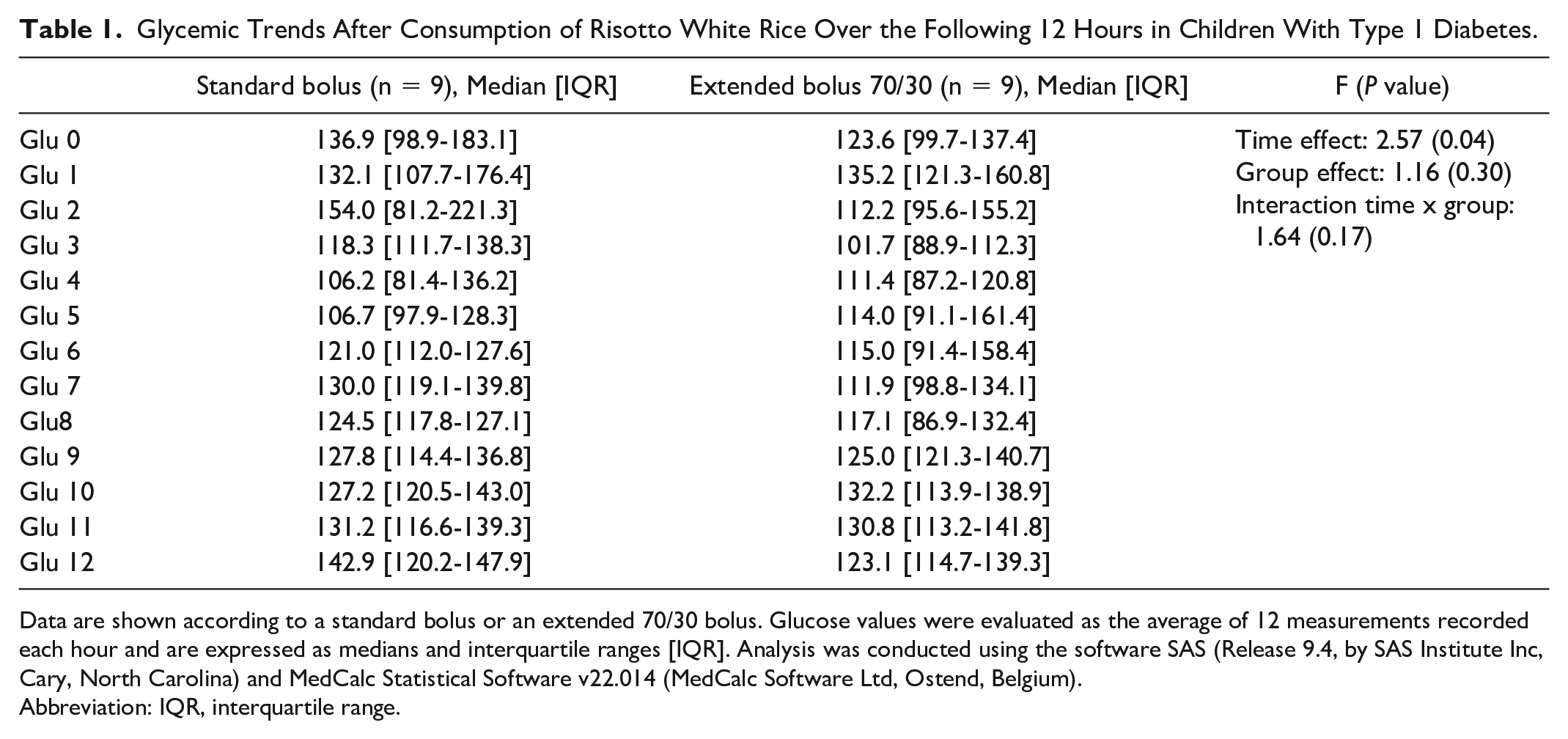
Data are shown according to a standard bolus or an extended 70/30 bolus. Glucose values were evaluated as the average of 12 measurements recorded each hour and are expressed as medians and interquartile ranges [IQR]. Analysis was conducted using the software SAS (Release 9.4, by SAS Institute Inc, Cary, North Carolina) and MedCalc Statistical Software v22.014 (MedCalc Software Ltd, Ostend, Belgium).
Abbreviation: IQR, interquartile range.
Our findings suggest that while using an AID system, an extended bolus is no more mandatory, even when eating difficult meal like the Italian risotto. These findings seem to conflict with the results of a meta-analysis which evaluated the effects of low and high GI foods on metabolic control in patients with type 1 diabetes, 4 where low GI foods were more favorable. In this meta-analysis, many of the cited trials were several years old and employed outdated technology. Newer AID systems administer automatic boluses when in or trending toward hyperglycemia. Using an AID system in our study confirmed that postprandial glycemia can be easily managed irrespective of the bolus regimen.
Even though adequately powered, this study was limited by the relatively small sample size. Nevertheless, our findings may be valuable for people with type 1 diabetes struggling to manage foods such as pizza and rice, suggesting different approaches to minimize their glycemic impact. Further studies are now necessary to understand how best to manage tricky foods and limit glucose variability according to the different AID systems on the market.
Supplemental Material
sj-docx-1-dst-10.1177_19322968241246205 – Supplemental material for Extended Bolus Is No More Needed for Risotto Meal in Children With Type 1 Diabetes Using Automated Insulin Delivery System: A Cohort Study
Supplemental material, sj-docx-1-dst-10.1177_19322968241246205 for Extended Bolus Is No More Needed for Risotto Meal in Children With Type 1 Diabetes Using Automated Insulin Delivery System: A Cohort Study by Silvia Savastio, Carlotta Gorla, Erica Pozzi, Valeria Castorani, Raffaella Di Tonno, Andrea E. Scaramuzza, Antonio Colasanto, Jean Daniel Coïsson, Marco Arlorio, Daniela Ferrante, Riccardo Bonfanti and Ivana Rabbone in Journal of Diabetes Science and Technology
Footnotes
Acknowledgements
The authors thank all children and their families who gave their time to help us run the study.
Author Contributions
SS, IR, and RB designed the study and wrote the first draft of the manuscript. CG, EP, VC, and RDT collected data and critically discussed the manuscript. AES critically discussed results and wrote the final draft of the manuscript. AC, JDC, and MA cooked the meals and assessed meal composition. DF analyzed the data. All authors reviewed patient charts, collected data, critically revised the manuscript for important intellectual content, and approved the final version of the manuscript.
Authors’ Relationships and Activities
The authors declare that there are no relationships or activities that might bias, or be perceived to bias, their work.
Declaration of Conflicting Interests
The author(s) declared no potential conflicts of interest with respect to the research, authorship, and/or publication of this article.
Funding
The author(s) received no financial support for the research, authorship, and/or publication of this article.

Supplemental Material
Supplemental material for this article is available online.
References
Supplementary Material
Please find the following supplemental material available below.
For Open Access articles published under a Creative Commons License, all supplemental material carries the same license as the article it is associated with.
For non-Open Access articles published, all supplemental material carries a non-exclusive license, and permission requests for re-use of supplemental material or any part of supplemental material shall be sent directly to the copyright owner as specified in the copyright notice associated with the article.
