



Abstract
During an artificial intelligence (AI)-assisted diabetic retinopathy screening event, we performed a survey on patients´ perceptions on AI. Respondents were individuals with diabetes, mostly followed in primary healthcare with a low education level. While 49.6% of participants said they knew what AI was, only 14% reported good or expert knowledge of AI. The vast majority reported positive feelings towards AI in healthcare. We highlight the importance of understanding patients´ views regarding AI in health in a real-life situation and emphasize the importance of digital education.
Understanding patients’ attitudes is crucial for the successful integration of artificial intelligence (AI) in healthcare, but patients’ perceptions on this matter have been seldom studied.1-4 As AI is currently applied for diabetic retinopathy (DR) screening, our objective was to evaluate patients’ perceptions on AI during a DR screening event.
During an AI-assisted DR screening event, 5 patients were briefly told that their retinal images would undergo automatic evaluation and then were invited to answer a questionnaire while waiting for retina exams; questions assessed the respondents’ technical affinity and the perception of different aspects of AI in healthcare. 1 Very little additional information about AI was provided before applying the questionnaire, so that their existing opinion about AI would be changed as little as possible. 1
Questions were answered by 121 individuals (56.0 ± 14.5 years old, 50.4% women, diabetes duration 10.9 ± 9.8 years); 71.9% were followed in primary healthcare, and 55.8% had education level of elementary school or lower. Individuals currently holding job positions totalized 64.1%, while 32.5% were already retired; 3.3% were students. Regarding the use of electronics, 91.7% owned a smartphone, a tablet, or a computer; 88.4% had internet access; 56.2% used the internet as a source of medical information; and 82.6% used electronic devices daily. When asked if they had heard of AI before, 30 individuals answered “no”; 31 said “yes but I don’t know exactly what it is”; 43 answered “yes and I know somehow what it is”; 16 said “yes and I could explain well what it is about”; and one said, “yes and I would consider myself an expert in that field.” Respondents of the former two options were younger (P = .037) and had a higher level of education (P = .007), but their perceptions on AI were not significantly different from those given by the ones poorly familiarized with AI. Most participants (66%) declared “very positive” or “positive” feelings toward the use of AI in medicine. Main results are displayed in Figure 1.
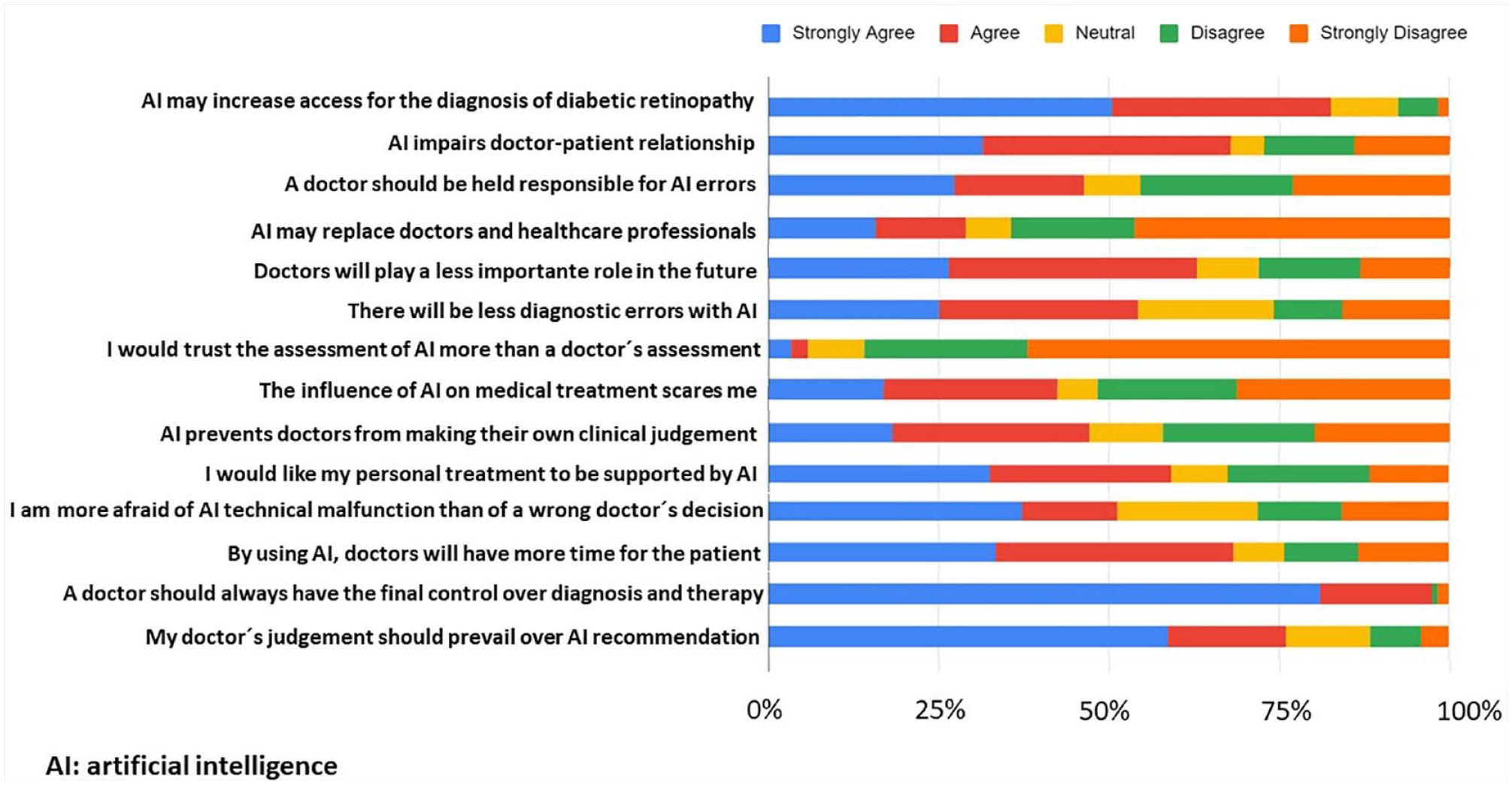
Patients perceptions of AI main results.
Answers on AI perceptions should be interpreted under the assumption that most participants (86%) were not familiarized with AI. Nevertheless, by collecting answers on-site, during an actual (as opposed to hypothetical) situation, and reporting patients’ perspectives on AI, we believe our research brings robust and original information and helps shedding light onto this very important but often neglected stakeholder.1-3 The answers were given in the realm of a specific application, as opposed to a general approach of AI in health. 1
While only 14% reported good or expert knowledge in AI, most had positive views of AI in health but prefer a cooperation of AI and human physicians, in line with other reports.1-3
Future research should involve larger samples and explore effective communication strategies to improve receptiveness toward AI deployment. 3 Longitudinal studies tracking patients’ evolving views on AI as familiarity grows are recommended. 2 Efforts to enhance health literacy and communication strategies should accompany the adoption of AI technologies in healthcare.
Footnotes
Abbreviations
AI, artificial intelligence; DR, diabetic retinopathy.
Declaration of Conflicting Interests
The author(s) declared no potential conflicts of interest with respect to the research, authorship, and/or publication of this article.
Funding
The author(s) received no financial support for the research, authorship, and/or publication of this article.
