



Abstract
Technological advances in devices, such as continuous glucose monitors (CGMs) or intermittently scanned continuous glucose monitors (isCGMs), do not necessarily by themselves translate to improved clinical outcomes or quality of life. Human-centered design (HCD) is an accessible, flexible process that could contribute to reducing the gap between current challenges and more optimal future solutions, by continuing to refine crucial considerations, such as usability. Starting with understanding the unmet needs of patients, cultivating novel and different collaborations, and applying humility to humanize technology are three facets underlying this approach. Human-centered design can help expand our perspective to serve as another essential tool to help further refine diabetes technology.
Keywords
To advance diabetes technology, we must first step back, and look around. Human-centered design (HCD) can facilitate developing more seamless, inviting, and engaging devices. Studies have demonstrated that technology has significantly improved clinical outcomes for patients living with diabetes (PWD): for type 1 diabetes (T1DM) on both continuous glucose monitors (CGMs)1,2 and intermittently scanned CGMs (isGCMs) (also termed flash monitors) 3 ; CGM for type 2 diabetes (T2DM) 4 ; and diabetes-specific quality of life measures for participants with T1DM. 5 Yet, paradoxically, uptake remains suboptimal. Setting aside the vexing challenges with access to CGM, flash monitors, and insulin pumps, especially for disadvantaged individuals—cost and insurance coverage in the United States—barriers persist for many. Uptake can be a concern, even in nations offering subsidies. The most recently available data reveal that of 1662 patients in the T1 Exchange Registry, 27% to 41% of PWD discontinue CGMs- within one year of starting, 6 and 12.5% of those using isCGM- discontinue after one year. 7 What are some of the other causes of decreased satisfaction with devices?
The HCD process (Figure 1) starts with empathy: deeply understanding the patients’ needs.8-10 We may be confident we are well-versed on the problem, but may later learn that this is not the case. After defining needs, design thinkers question their assumptions to create a wide range of ideas, some of which will inform low-, then high-fidelity, prototypes. Multiple rounds of testing of these will elicit feedback, which will help shape what will ultimately be the final product.
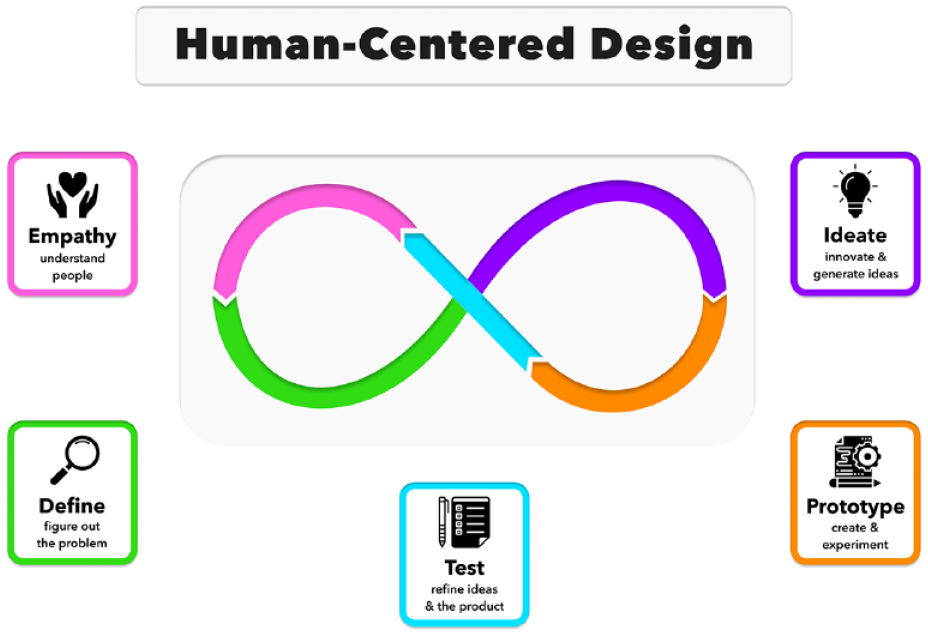
HCD expands perspective. To humanize technology, we must start with the individual using the device daily, involve them at all stages of development, and expand our efforts to include improving their experience with devices; widen the team of collaborators; and humanize technology through humility.
Technology can outpace our ability to thoughtfully and proactively steer, harness, and refine it. We must keep at the forefront vital considerations, including data security; how HCD could help PWD and HCP best manage and interpret CGM and isCGM data; and sustainability of devices. Artificial intelligence (AI) importantly helps and will continue to have a significant impact on health care and other facets of life. HCD offers a flexible, accessible framework that can guide us in our efforts to keep humans at the center, to best engage with AI, as well as future technological breakthroughs While HCD is certainly not a one-size-fits-all panacea, I am confident that HCD will help us strike a balance between cutting-edge advances and a humane outlook—the best of both the science and art of medicine—to continue improving diabetes technology for all involved: patients, caregivers, and health care professionals.
The most cutting-edge device serves no one if it sits on a shelf, unused. HCD must be part of an effort that cuts across traditional boundaries to unite the patient, the caregiver, the designer, the engineer, - the physician, and health care team members. To arrive at new solutions, we must continue cultivating curiosity, viewing the current landscape with fresh eyes. We must be open to experimenting, learning from these efforts, and implementing technology that is worthy of our patients’ resilient daily efforts. We must recast what technology can do and move beyond helping collect information, or providing reminders, to include facilitating engagement. Human-centered design embodies the excitement of discovery. Together with our patients, using the diverse insights we have gathered, let us take the next step to continue to refine the unending path to help them thrive.
Footnotes
Acknowledgements
The author thanks his patients, whom he has the privilege of serving and learning from each day, and his colleagues at the UCSD Diabetes Design Initiative and the UCSD Center for Health Innovation.
This publication is the result of work supported with resources by the Veterans Administration San Diego Healthcare System; the contents do not represent the views of VA or the United States Government.
Abbreviations
DM, diabetes mellitus; HCD, human-centered design; CGM, continuous glucose monitor; isCGM, intermittently scanned continuous glucose monitor; PWD, patients living with diabetes.
Declaration of Conflicting Interests
The author(s) declared no potential conflicts of interest with respect to the research, authorship, and/or publication of this article.
Funding
The author(s) received no financial support for the research, authorship, and/or publication of this article.
