



Abstract
Introduction:
Diabetes Technology Society virtually hosted the first meeting of the Integration of Connected Diabetes Device Data Into the Electronic Health Record #2 (iCoDE-2) Standards Project on May 31, 2023, via Zoom.
Methods:
Clinicians, patients, data aggregators, informaticists, manufacturers, attorneys, and cybersecurity experts discussed dosing data currently available from insulin delivery devices and data aggregators and the types of information that patients and clinicians want to see. This information along with technical and regulatory aspects of (1) data standards and (2) integration into the electronic health record (EHR) are the basis of iCoDE-2.
Results:
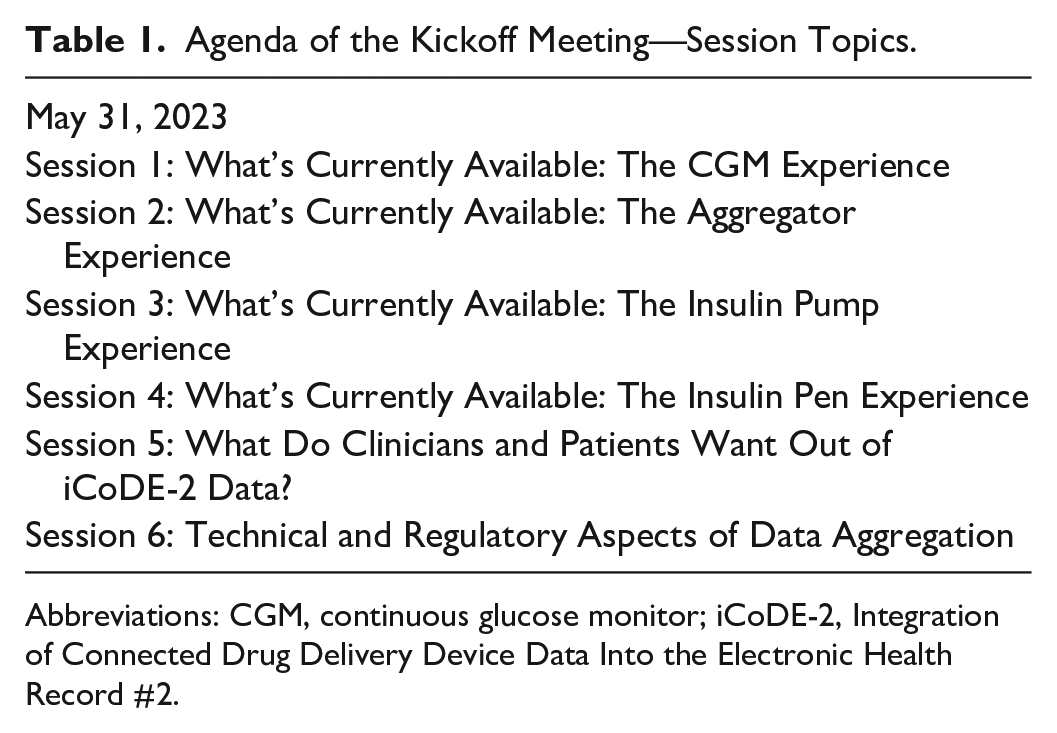
Six sessions were hosted discussing themes including (1) What’s Currently Available: The Continuous Glucose Monitor Experience; (2) What’s Currently Available: The Aggregator Experience; (3) What’s Currently Available: The Insulin Pump Experience; (4) What’s Currently Available: The Insulin Pen Experience; (5) What Do Clinicians and Patients Want Out of iCoDE-2 Data?; and (6) Technical and Regulatory Aspects of Data Aggregation.
Conclusion:
Additional working group meetings to discuss data standard and clinical workflow will be held to create additional technical specifications and clinical workflows to aid in insulin dosing data integration into the EHR. A mid-project meeting will convene in the second half of 2023.
Introduction
The Integration of Connected Drug Delivery Device Data Into the Electronic Health Record #2 (iCoDE-2) Standard Project has created a steering committee of key stakeholders to develop guidance toward the standardization of insulin dosing data from connected devices and integration into the electronic health record (EHR) (Figure 1). This article describes the initial launch meeting held on May 31, 2023. The preceding standardization project, Integration of Continuous Glucose Monitor Data Into the Electronic Health Record #1 (iCoDE-1), highlighted the importance of addressing continuous glucose monitor (CGM) data integration barriers through both technical and operational standardization. 1 iCoDE-2 will build upon this foundation by developing (1) technical specifications to integrate insulin and other metabolic peptide dosing data for inclusion in the EHR and (2) workflows and guidelines to facilitate data integration efforts. 1
iCoDE-2 standard project logo.
Insulin dosing patient data are currently available from device manufacturers and data aggregators via proprietary mobile apps or online personal portals. Including these data in the EHR will allow for improved documentation, shared decision-making, treatment modifications, and self-management practices. The complexity behind data acquisition, analysis, standardization, storage, and protection poses many hurdles for this project. The various insulin delivery devices used for diabetes management do not currently present universal dosing metrics for both the patient and health care professionals (HCPs), increasing the potential for errors in documentation and data analysis.
iCoDE-2 consists of various stakeholders, including endocrinologists, primary care physicians, diabetes educators, patients, data aggregators, information technology experts, informaticists, device manufacturers, attorneys, and cybersecurity experts with expertise in developing universal, accessible, scalable, and repeatable processes for data integration and implementation. The members of the iCoDE-2 Steering Committee are from the United States, Australia, Canada, Denmark, Germany, Japan, Norway, Singapore, and Sweden and are divided into two working groups to facilitate discussion and advance (1) data standards and (2) clinical workflow processes.
The launch meeting was organized by the Diabetes Technology Society and co-chaired by Juan C. Espinoza, MD, of Lurie Children’s Hospital and Northwestern University and David C. Klonoff, MD, of Mills-Peninsula Medical Center and University of California San Francisco (UCSF). The event was divided into six sessions covering the CGM integration experience, medical data aggregators, insulin pens, insulin pumps, clinician needs, patient needs, and technical/regulatory requirements for this project (Table 1).
Agenda of the Kickoff Meeting—Session Topics.
Abbreviations: CGM, continuous glucose monitor; iCoDE-2, Integration of Connected Drug Delivery Device Data Into the Electronic Health Record #2.
Session 1: What’s Currently Available: The CGM Experience
Viral N. Shah, MD
Barbara Davis Center for Diabetes, University of Colorado Anschutz Medical Campus, Aurora, Colorado, USA
AJ Shah, MD, MPH
Abbott, Alameda, California, USA
Josephine Wong
Dexcom, San Diego, California, USA
An increasing amount of health care data is available from diabetes technology manufacturers and platforms; however, there are obstacles to delivering the right data to the right person and in the right format. The gap between CGM data collection and seeing the data in the EHR is a challenge for physicians when prescribing CGMs.
Dr. AJ Shah from Abbott (Alameda, CA) discussed the ways the company is continuing to innovate and stressed the importance of making CGM data accessible within provider workflows for the benefit of patients, caregivers, and care teams. He indicated the benefits of improving insulin delivery and diabetes management by providing a single view of both CGM and insulin dosing data and shared how the FreeStyle Libre platform and reports do this today.
Josephine Wong from Dexcom (San Diego, CA) discussed the desire for data integration into the EHR from both HCPs and people with diabetes (PWD). Increasing engagement with the collected data will also ease clinician workload. CGM data review can be a time-intensive process, especially with the variety of available devices, but with automatic integration into the EHR, HCPs and patients will benefit. There is a companywide emphasis on “efficient, accessible, and adequate data,” and the creation and implementation of data and integration standards will help refine this process toward a more user-friendly experience.
Session 2: What’s Currently Available: The Aggregator Experience
Viral N. Shah, MD
Barbara Davis Center for Diabetes, University of Colorado Anschutz Medical Campus, Aurora, Colorado, USA
Allan Green
Steno Diabetes Center Copenhagen (SDCC), Copenhagen, Denmark
Rayhan A. Lal, MD
Stanford University, Stanford, California, USA
Mark A. Clements, MD, PhD
University of Missouri—Kansas City School of Medicine, Kansas City, Missouri, USA
Jordan Messler, MD, SFHM, FACP
Glytec, Waltham, Massachusetts, USA
Stenopool (Copenhagen, Denmark) a data aggregator for the Steno Diabetes Center in Copenhagen, Denmark, has collected data from all the patient devices, used at their diabetes center, including insulin pumps, manual blood glucose monitors, and CGMs. Stenopool provides a wide range of visualization options for their patient population of 11,000, which eliminates the need to access multiple platforms. Implementation of this unified data aggregation tool has provided access to patient device information. In collaboration with Tidepool (Palo Alto, CA), but unique to the Steno Diabetes Center, Stenopool utilizes Tidepool’s open-source code to create a comprehensive and unified tool for clinicians to access patient data. The Steno Diabetes Center hopes to establish partnerships with additional companies to leverage application programming interfaces (API) that will allow them to integrate patient data uploaded from home rather than at their outpatient center. With rapid expansion of this data aggregation service, a data warehouse will be needed for more advanced data applications, such as risk stratification and quality assessments.
The open-source system, Tidepool, prioritizes transparency and collaboration for over a half million people who are using over 80 different medical devices. This platform includes individualized data views, a population health patient list, and elements of insulin data including total dose data, basal rates, overrides, time in specific device modes, device settings, and infusion site changes. Tidepool emphasizes the importance of secure API-level data access and strives to enable patients to passively upload their raw data to be analyzed and summarized. However, it is difficult to determine the best metric for summary statistics in order for physicians and patients to understand the algorithms used. Data integration, with different levels of abstraction, is necessary to cater to various EHR platforms, physicians, devices, and stakeholders. Tidepool, in combination with Nightscout (Denver, CO), allows access to relevant collected data.
Nightscout is a community-driven open-source platform, and it was among the first data aggregators. It has enabled significant innovation and data logging in the open-source community and has served as the CGM data source for the Open Artificial Pancreas System (OpenAPS) project.
Dr. Mark Clements began by presenting the Rising T1DE Alliance led by Children’s Mercy Hospital in Kansas City, Missouri. This alliance focuses on improving the quality of diabetes care through better predicting and implementing innovative strategies for better self-management of the disease. To achieve this, they have built a cloud-based data platform that ingests data from multiple diabetes devices, the EHR, and patient-reported outcomes and allows for sophisticated risk stratification and population health management. An article by Joyce Lee, MD, MPH, and colleagues presents six different pediatric self-management habits illustrating how focusing on self-management practices can empower PWD to take their care into their own hands. 2 Inspired by these six self-management habits, Dr. Clements’ team also built the MyCare Diabetes mobile app to collect patient-reported data that can also be integrated with the EHR. This can support remote patient monitoring (RPM), severity stratification, and clinical outcome forecasting.
With the challenges that present with intravenous and subcutaneous insulin administration in the hospital, Dr. Jordan Messler of Glytec (Waltham, MA) demonstrated how the Glucommander insulin dosing software aims to use data from the EHR to personalize insulin dosing, preventing instances of hypoglycemia and hyperglycemia. This program optimizes real-time data usage and creates a retrospective data analysis to forecast glycemic outcomes. Overall, the goal is to improve access to data, ordering for clinicians, and discharge protocols in hospitals.
Session 3: What’s Currently Available: The Insulin Pump Experience
Jane Jeffrie Seley, DNP, MPH, MSN, GNP, BC-ADM, CDCES, FADCES
Weill Cornell Medicine, New York, New York, USA
Ian Welsford, PhD
EOFlow, Republic of Korea
Samir Shah, MS, MBA
Medtronic Diabetes, Minneapolis, Minnesota, USA
Dr. Ian Welsford from EOFlow (Seoul, South Korea), a company that produces wearable automated insulin delivery devices, highlights the careful consideration needed in data integration when it comes to global ecosystem of personal medical information. There is significant variation in insulin dosing data across different devices. Many manufacturers do not disclose their specific automatic delivery algorithms for dosing, which can make effective management of diabetes more difficult. There are other possible applications of data integration, for example, to predict kidney health risks in PwD, suggesting the power of connecting an insulin delivery device to the EHR.
Medtronic’s (Minneapolis, MN) products for diabetes managements include insulin pumps, smart pens connected to a CGM, and standalone CGMs. Samir Shah highlighted the variability between EHRs and even among instances of the same EHR, suggesting that integration into one EHR platform does not guarantee integration to others. There are various platforms and data-viewing options, making standardization difficult to implement. Another challenge (further discussed in Session 6) is the legal issues behind consent and privacy when it comes to raw patient data. Medtronic suggested the implementation of a universal API in the future.
Session 4: What’s Currently Available: The Insulin Pen Experience
Jane Jeffrie Seley, DNP, MPH, MSN, GNP, BC-ADM, CDCES, FADCES
Weill Cornell Medicine, New York, New York, USA
Jim Malone, MD
Bigfoot Biomedical, Milpitas, California, USA
Mick Davidson, DO
Eli Lilly and Company, Indianapolis, Indiana, USA
João Fernandes, MSc
Novo Nordisk, Bagsværd, Denmark
Felix Lee, MPharm, MSc, MBA
Sanofi, Paris, France
The next speakers discussed insulin pen technology and initiatives that these insulin delivery device companies are taking to improve the connection between PWD and HCPs. Bigfoot Biomedical (Milpitas, CA) allows their users to update settings, access summary reports, view glucose level history, and receive hypoglycemia alerts. The Bigfoot Biomedical app also presents CGM data from the Abbott FreeStyle Libre 2 because Abbott is Bigfoot Biomedical’s CGM partner. Eli Lilly recently launched their smart insulin pen and the accompanying Tempo™ Personalized Diabetes Management Platform for people with type 1 or type 2 diabetes over the age of 18 years. Using this platform and technology, the company is building upon their simple disposable pen model to eliminate some of the complexities behind insulin dosing. Novo Nordisk has similar intentions to support better diabetes management by delivering insulin dose data to patients and HCPs. With many partnerships, including Abbott, Glooko, Medtronic, Dexcom, and Roche, they want to create an open ecosystem to facilitate the best possible data integration into the EHR. Many of the mentioned insulin pen manufacturers are adding some form of smart cap to connect insulin delivery to CGM data. For example, Sanofi has begun to implement a SoloSmart accessory for their insulin pens. This will ideally show manually administered doses and increase effective and meaningful documentation and communication between patients and HCPs.
Session 5: What Do Clinicians and Patients Want Out of iCoDE-2 Data?
Kong Y. Chen, PhD, MSCI
National Institute of Diabetes and Digestive and Kidney Diseases, National Institutes of Health, Bethesda, Maryland, USA
Cari Berget, MPH, RN, CDE
Barbara Davis Center—Anschutz Medical Campus, Aurora, Colorado, USA
Jay Shubrook, DO, FAAFP, FACOFP
Touro University, Vallejo, California, USA
[Patient 1]
[Patient 2]
Current clinical workflow in diabetes management includes using various software programs and devices that are generally selected because of availability, cost, and insurance coverage. The typical process for viewing patient-generated health data (PGHD) in most health care settings is complex and includes downloading the data from the device, generating a report, adding the report into the EHR, and then manually reviewing the report. This time-consuming process would be streamlined with direct data integration into the EHR. Not only would this save time, but it could improve documentation and charge capture. Cari Berget stated that diabetes devices generate a significant amount of data that require interpretation and called attention to the need for summary statistics and visual displays of aggregated data. Dr. Jay Shubrook who works in a Federally Qualified Health Center (FQHC) discussed the difficult reality of caring for PWD in the face of federal government regulations, 3 constant staff changes, and the need to print hundreds of pages of patient records. With data integration into the EHR, the medical record reviewing process would be simpler and more efficient and would allow more time for patient discussion and higher quality care. Annotating reports during asynchronous review would also be helpful and streamline clinical encounters.
Patient input and perspectives are critical to designing and implementing successful integrations and clinical workflows. Patient 1, who was diagnosed at a young age, is now heading to college. This PWD expressed great appreciation for his physician who is able to interpret the complex graphing systems but would urge data integration to include “down-to-earth” visuals and data for patients. He wishes to see a breakdown of the day’s total daily dose, basal rate, and other informative data that a PWD can understand and communicate to their physicians. Even with over seven years of living with his diagnosis, the new platforms and viewing methods create a constant learning curve. Patient 1 is optimistic that data integration into the EHR can help close the gap between the patient and clinician.
Patient 2 cannot remember life without a diagnosis of diabetes. She currently uses an insulin pump and is rarely able to put the raw data into context, highlighting the importance of comprehensive and understandable data for better self-management and dosing. Patient 2 views data integration as an avenue for identification of glycemic trends in addition to potential emergency management. Having access to both raw data and data trends when an emergency occurs can allow for better real-time assistance and also can allow a clinician to identify factors that contributed to the emergency situation. Patient 2 recounted how difficult managing diabetes is when playing different sports. If previous data from previous seasons of that sport was available, then it would be able to see which doses provided good glycemic control and inform the best practices for the upcoming sport season. Both patients considered the opportunities data integration has for eliminating errors any time they manually enter glycemic data for their physician. Generating a summary report that will automatically be uploaded to the EHR will allow for more clear and effective communication between the patient and HCP.
Session 6: Technical and Regulatory Aspects of Data Aggregation
Elizabeth Bauer, MD
Naval Medical Center San Diego, Chula Vista, California, USA
Mark A. Clements, MD, PhD
Glooko, Mountain View, California, USA
Nick McKenzie, BA
Redox Engine, Madison, Wisconsin, USA
John Giantsidis, Meng, JD
CyberActa, Boston, Massachusetts, USA
Bryan Cunningham, JD
University of California, Irvine, Irvine, California, USA
Diabetes devices generate hundreds of data elements. Compliance with the Health Insurance Portability and Accountability Act (HIPAA) regulations is crucial for patient privacy. Additional cybersecurity expectations and regulations must be considered when exploring EHR data integration. Dr. Mark Clements from Glooko (Mountain View, CA) discussed the importance of intended use when it comes to Software as a Medical Device (SaMD). SaMD is defined by the US Food and Drug Administration (FDA) and the International Medical Device Regulators Forum (IMDRF) as “software intended to be used for one or more medical purposes that perform these purposes without being part of a hardware medical device.” 4 Any changes to the software may cause significant changes that could alter the safety and effectiveness of the device and therefore change the intended use of the software and device. Quality management, design and production control, and product surveillance are also integral to the both the success and implementation of the device.
Nick McKenzie from Redox (Madison, WI) emphasized patient privacy concerns for data integration, including accessibility, submission frequency, geolocation data, and bidirectional communications between HCP and patient. John Giantsidis with CyberActa brought attention to the “My Health My Data Act,” 5 which was recently passed by the state of Washington to improve health data protection. This law requires one of two legal reasons to collect and process patient health data: either consent or necessity. A regulated entity must obtain consent, or else it must adhere to the same standard of necessity in order to share the data. 4 It goes beyond HIPAA compliance, driven by consumer consent regulation, and includes expectations for businesses from state regulators. Bryan Cunningham from the UC Irvine Cybersecurity Policy & Research Institute focused on the core of the Hippocratic oath: “First, Do No Harm,” which can be violated with various types of cybersecurity threats. Managing the flow of data is integral to maintaining the security of patient information. From do-it-yourself (DIY) hackers to targeted threats, there are multiple points where the security of medical data can be breached. Best practices for securing patient data include encryption at rest and in transit, storing data in appropriately secure environments like the EHR, and adhering to cybersecurity standards like Institute of Electrical and Electronics Engineers (IEEE) 2621, 6 the only cybersecurity standard created specifically for assuring security for medical devices. Resilient cybersecurity protection measures must be put in place to ensure the privacy, security, and usability of data integration into the EHR to monitor patients’ diabetes.
Conclusion
The May 31, 2023, kickoff meeting for iCoDE-2 convened experts and stakeholders in order to establish a baseline of knowledge and help set expectation for the project. Integration of insulin dosing data into the EHR will help address a number of pain points in diabetes care today. Patient privacy and data protection are key considerations for successful data integration. Several manufacturers of insulin delivery products, data integration services, and other devices, as well as clinical and EHR experts from the regulatory and academic sectors, have agreed to serve on the Steering Committee to contribute their informed opinions. Two working groups (technical and clinical) have been created to allow experts on both the technical and clinical sides of the project to first develop data standards and technical specifications for the data and then to select which data should be included and how workflows should be developed for integrating insulin delivery data into the EHR. The ultimate goal of this project is to facilitate accessible data, effective communication, efficient report reviews, and improved self-management of diabetes through data standards and best practices for data integration.
Footnotes
Acknowledgements
The organizers of the iCoDE-2 project would like to thank Andrea Yeung and Cynthia Huang for their assistance in execution of the kickoff meeting and summary report. In addition, the organizers of the iCoDE-2 project would like to thank Annamarie Sucher for her expert editorial assistance. The organizers of the iCoDE-2 project would also like to thank Viral N. Shah, MD, AJ Shah, MD, MPH, Josephine Wong, Allan Green, Rayhan A. Lal, MD, Mark A. Clements, MD, PhD, Jordan Messler, MD, SFHM, FACP, Jane Jeffrie Seley, DNP, MPH, MSN, GNP, BC-ADM, CDCES, FADCES, Ian Welsford, PhD, Samir Shah, MS, MBA, Jim Malone, MD, Mick Davidson, DO, João Fernandes, MSc, Felix Lee, MPharm, MSc, MBA, Kong Y. Chen, PhD, MSCI, Cari Berget, MPH, RN, CDE, Jay Shubrook, DO, FAAFP, FACOFP, Elizabeth Bauer, MD, Mark A. Clements, MD, PhD, Nick McKenzie, BA, John Giantsidis, Meng, JD, and Bryan Cunningham, JD, for their participation in the meeting and helpful advice in preparing this report.
Abbreviations
API, application programming interface; CGM, continuous glucose monitors; DIY, do-it-yourself; EHR, electronic health record; FDA, US Food and Drug Administration; FQHC, Federally Qualified Health Center; HCP, health care professional; HIPAA, Health Insurance Portability and Accountability Act; iCoDE-1, Integration of Continuous Glucose Monitor Data Into the Electronic Health Record #1; iCoDE-2, Integration of Connected Drug Delivery Device Data Into the Electronic Health Record #2; IEEE, Institute of Electrical and Electronics Engineers; IMDRF, International Medical Device Regulators Forum; PGHD, patient-generated health data; PWD, people with diabetes; SaMD, Software as a Medical Device.
Declaration of Conflicting Interests
The author(s) declared the following potential conflicts of interest with respect to the research, authorship, and/or publication of this article: D.C.K. is a consultant for Better Therapeutics, EOFlow, Integrity, Lifecare, Nevro, NovoNordisk, Sanofi, and Thirdwayv. J.C.E. receives federal funding from FDA, NIMHD, and NCATS and is a consultant for Sanofi. R.E.A., T.T., A.M.Y., and J.H. have no disclosures.
Funding
The author(s) disclosed receipt of the following financial support for the research, authorship, and/or publication of this article: The iCoDE-2 project is supported by grants from Abbott, BetaBionics, Bigfoot Medical, Dexcom, Eli Lilly, EOFlow, Glytec, Insulet, LifeScan, Medtronic, NovoNordisk, Sanofi, Tandem, Terumo, and Ypsomed.
