



Abstract

Patient manipulation of insulin pump features to modify insulin delivery is not uncommon. We analyzed pump data from an inpatient with type 1 diabetes (T1D) who experienced severe hypoglycemia. Our analysis focuses on the manipulation of the fill cannula function on the MiniMed 780G insulin pump to administer insulin, highlighting the associated safety concerns and identification challenges arising from the existing pump software and data report structure.
A 29-year-old woman with a history of T1D was admitted to a university teaching hospital for further investigation of cyclical vomiting syndrome. Throughout her hospital stay, she managed her diabetes using the insulin pump, Guardian 4 continuous glucose monitor (CGM) (Medtronic Inc, MN, USA) and Smartguard algorithm (Medtronic Inc, MN, USA). During her admission, she experienced two episodes of severe hypoglycemia with loss of consciousness. Initially, the cause of these events was unclear, and the patient was unable to provide insight into their occurrence.
We conducted an analysis of the patients’ pump data using the Carelink (Medtronic Inc, MN, USA) software. On the adherence analysis page, we noticed an excessive number of cannula fill events/amounts and excessive tube fill amounts that did not align with routine infusion set changes. During the review of daily graphs showing matched CGM and insulin delivery data, we observed a higher-than-expected frequency of suspended delivery periods, which preceded drops in glucose levels. This raised our suspicion that the patient may have been exploiting the fill cannula function to administer insulin.
We analyzed the daily history log on the pump at the bedside and cross-referenced it by time and date with the Carelink data. The instances of suspended delivery we had previously noted corresponded to fill cannula events. This is due to the pumps’ data logging software, which records a spontaneous fill cannula event as a sequence of “Suspended”, “Cannula fill” and “Basal Resumed”. Consequently, it mimics the “suspend all delivery” command on daily review graphs.
When presented with the data, the patient stated she had been using the fill cannula and tube fill function while still connected to her infusion site to intentionally overdose with insulin.
In addition to manually reviewing the daily history log on the pump, we later learned it is also possible to confirm this method of pump manipulation by reviewing the Carelink comma-separated values (CSV) data file (Figure 1).
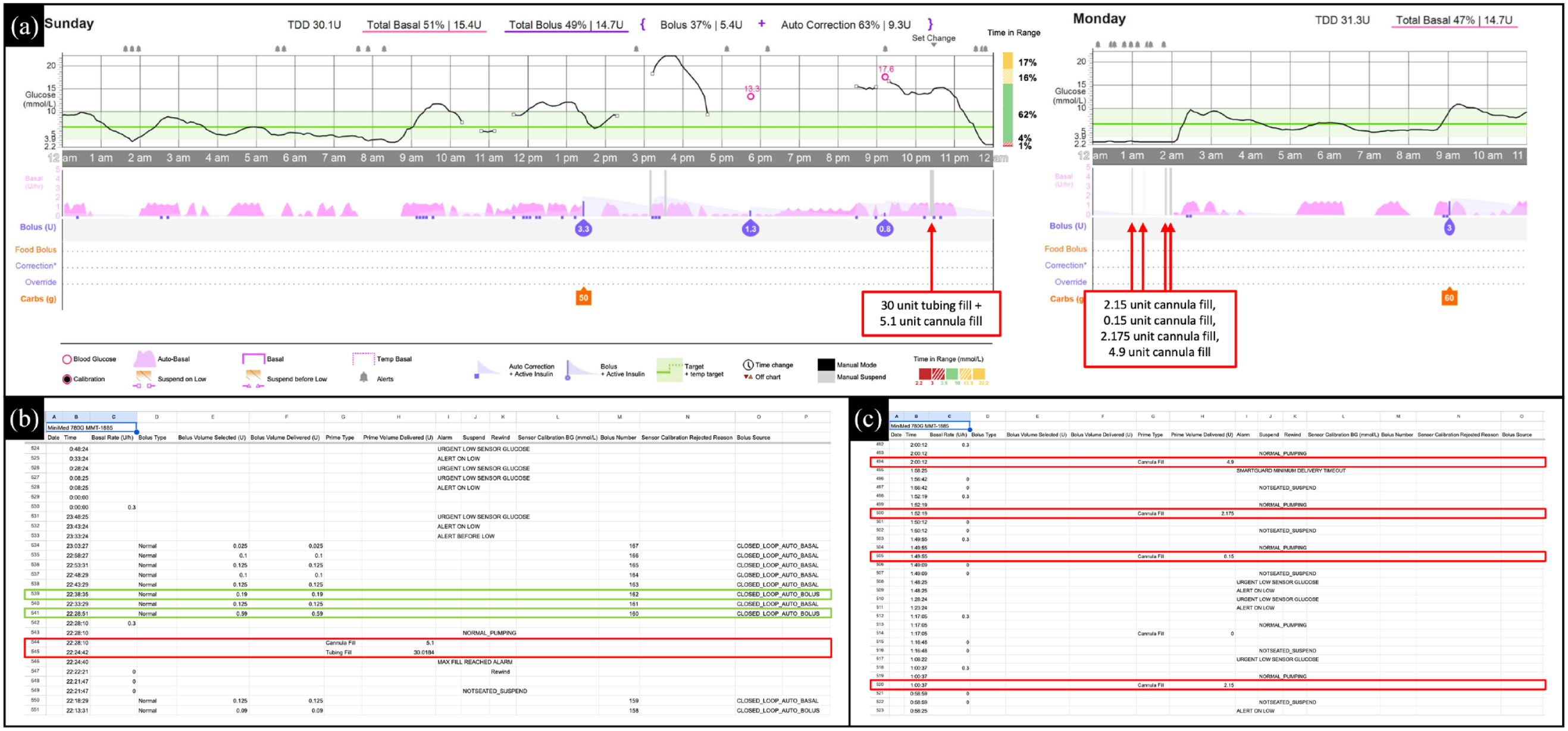
(a) The first severe hypoglycemic event daily review graph showing matched CGM and insulin delivery data with cannula and tube fills events/amounts indicated by red arrows. (b, c) The corresponding CSV file data showing the excessive tube and cannula fill events indicated in red boxes with Smartguard auto bolus doses indicated in green boxes. Abbreviations: CGM, continuous glucose monitor; CSV, comma-separated values.
There is scope for future development to mitigate the existing risks associated with fill cannula manipulation. To confirm this practice, a review of the Carelink CSV data file or the pumps’ daily history log is required. Developing pump data analysis software that displays fill cannula events and their corresponding amounts within the daily review graphs would significantly assist prompt identification. Furthermore, it is crucial to consider development aimed at reducing the maximum fill cannula amount. Currently, the fill cannula amount can be increased to 5.1 units. This value greatly exceeds what is required for this pump function and enables users to administer repeated doses of up to 5.1 units without limitation.
Footnotes
Acknowledgements
Figures from the data download of the patients’ device.
Abbreviations
ACHL, advanced hybrid closed loop system; T1D, type 1 diabetes; CGM, continuous glucose monitor; CSV, comma-separated values.
Declaration of Conflicting Interests
The author(s) declared no potential conflicts of interest with respect to the research, authorship, and/or publication of this article.
Funding
The author(s) received no financial support for the research, authorship, and/or publication of this article.
