



Abstract
In recent years, there has been a growing recognition of the significance of open data and its potential to accelerate scientific progress across various domains. The sharing and reuse of data sets have become pivotal in fostering collaboration, transparency, and innovation in research. As such, the scientific community has witnessed a commendable surge in the availability of data sets for public and scientific reusages. In 2021, we wrote a letter 1 titled “Data Sharing of Continuous Glucose Monitoring Data: The Need for a New Paradigm?” stating that despite the positive strides made in open data sharing, the domain of continuous glucose monitoring (CGM) data remains relatively unexplored. The limited availability of CGM data sets for public or scientific reusages stifles the potential for cross-disciplinary collaborations and hinders the ability of researchers to leverage existing data to develop innovative approaches and interventions which could help improve diabetes care, for example, to develop and validate algorithms for prediction of future glucose levels and hypoglycemia.2,3
By capitalizing on the lessons learned from successful open data initiatives in other domains, we did establish a compelling case for encouraging researchers to embrace the practice of publishing their CGM data sets.
Since the initial correspondence, there has been an observed rise in the publication of data sets containing CGM data pertaining to various forms of diabetes and individuals without the condition. The presented Table 1 showcases the selected data sets. Notably, a recent publication called the ShanghaiT1DM and ShanghaiT2DM data sets 4 features a substantial sample size (n = 100) of patients with type 2 diabetes. This data set includes information on CGM, meals, medication, and blood test outcomes. It is a significant advancement because publicly available data on type 2 diabetes patients are disproportionately scarce, despite this group representing the largest population of individuals with diabetes.
A Selection of Data Sets That Have Been Made Publicly Available in Recent Years.
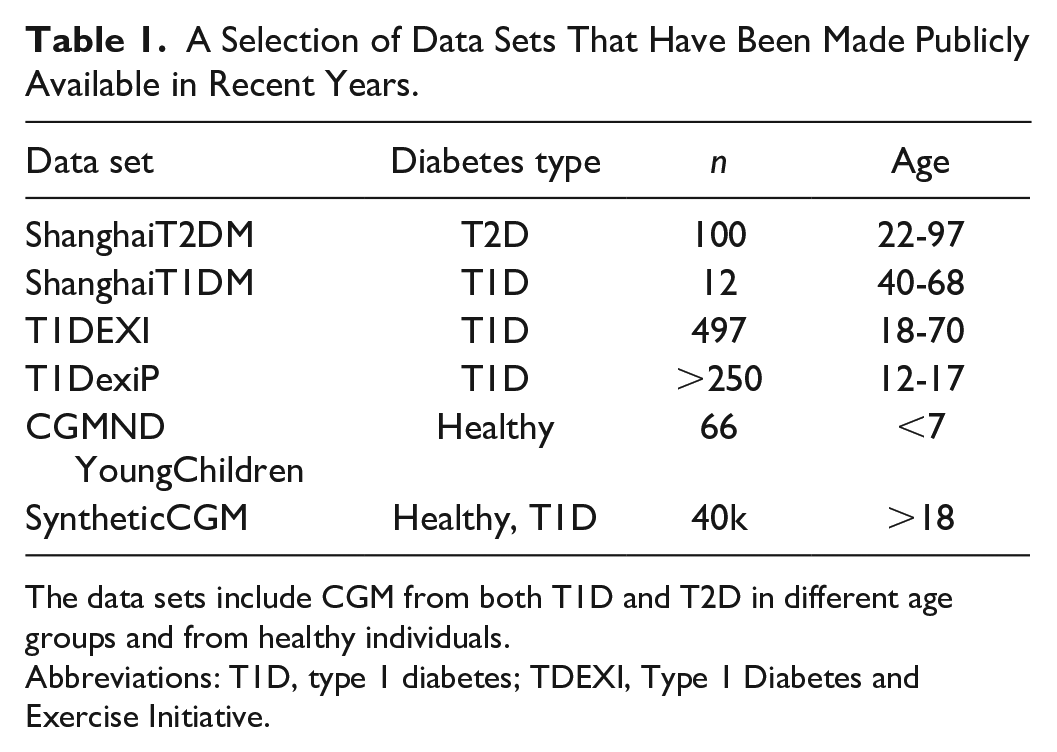
The data sets include CGM from both T1D and T2D in different age groups and from healthy individuals.
Abbreviations: T1D, type 1 diabetes; TDEXI, Type 1 Diabetes and Exercise Initiative.
Another noteworthy endeavor is the Type 1 Diabetes and Exercise Initiative (T1DEXI), 5 which investigates the immediate glycemic effects of different types of structured exercise sessions in individuals with type 1 diabetes within a real-world context. This initiative is sponsored by the Helmsley Charitable Trust in collaboration with Vivli, an independent nonprofit organization dedicated to promoting, coordinating, and facilitating the sharing of clinical research data worldwide through a global data platform. The T1DEXI data have been made accessible for further research through this partnership. The data set encompasses 497 adults with type 1 diabetes who were monitored using CGM, and it also includes information on physical activity.
Another study of interest is the Type 1 Diabetes Exercise Initiative Pediatric Study (T1DexiP), which plans to incorporate more than 250 pediatric patients. Once the primary analysis is conducted, this data set will also be made publicly available. In addition, 940 000 hours of synthetic CGM measurements has been made publicly available, covering a variety of patients with different hemoglobin A1c (HbA1c) levels. 6
These initiatives serve as examples of a positive trend that is expected to continue in the upcoming years. The collective efforts to provide high-quality study data for scientific research purposes are vital for expediting diabetes research concerning technology and care.
Footnotes
Abbreviations
CGM, continuous glucose monitoring; T1D, type 1 diabetes; T2D, type 2 diabetes; T1DEXI, Type 1 Diabetes and Exercise Initiative; T1DexiP, Type 1 Diabetes Exercise Initiative Pediatric Study.
Declaration of Conflicting Interests
The author(s) declared no potential conflicts of interest with respect to the research, authorship, and/or publication of this article.
Funding
The author(s) received no financial support for the research, authorship, and/or publication of this article.
