




Abstract

The clinical efficacy of real-time continuous glucose monitoring (RT-CGM) is well established. The Dexcom G6 RT-CGM mobile app allows access to several features, including a “High Glucose” threshold alert (programmable between 120 and 400 mg/dL). The presence of alerts as in RT-CGM systems is associated with improved glycemic outcomes compared to intermittently scanned CGM (IS-CGM) systems which lack alerts. 1 Lower glucose thresholds for hyperglycemia alerts have been associated with improved glycemic outcomes. 2 However, some users experience alarm fatigue. 3 In this analysis of real-world data, we explored the impact of permanently disabling this alert in a large cohort of Dexcom G6 users.
A random subsample of 500 000 U.S.-based users was obtained with a first glucose upload date between July 1, 2020 and June 30, 2022. In this subsample, 46 159 users (11.5%) disabled the high-glucose alert. Next, we identified 3674 users who disabled the high-glucose alert after having it initially enabled (DHG) and 3674 case-matched users who never disabled the high-glucose alert (NDHG). Rigorous case-matching was employed with respect to the time between the first most recent upload dates. The index date was defined as the date that the DHG user disabled their high-glucose alert. Glycemic control and number of initial high-glucose alerts were compared between the DHG and NDHG groups.
The DHG group experienced a clear deterioration in percent time in range (%TIR) in the days leading up to the index date and a striking decrease in %TIR on the index date before recovering to a new, slightly lower steady state (Figure 1a). Average percent time above range (%TAR) and mean glucose followed a similar, but inverted, pattern (Figure 1b and c). Interestingly, aside from a few days before the index date, the DHG group received fewer initial high-glucose alerts on average (Figure 1d).
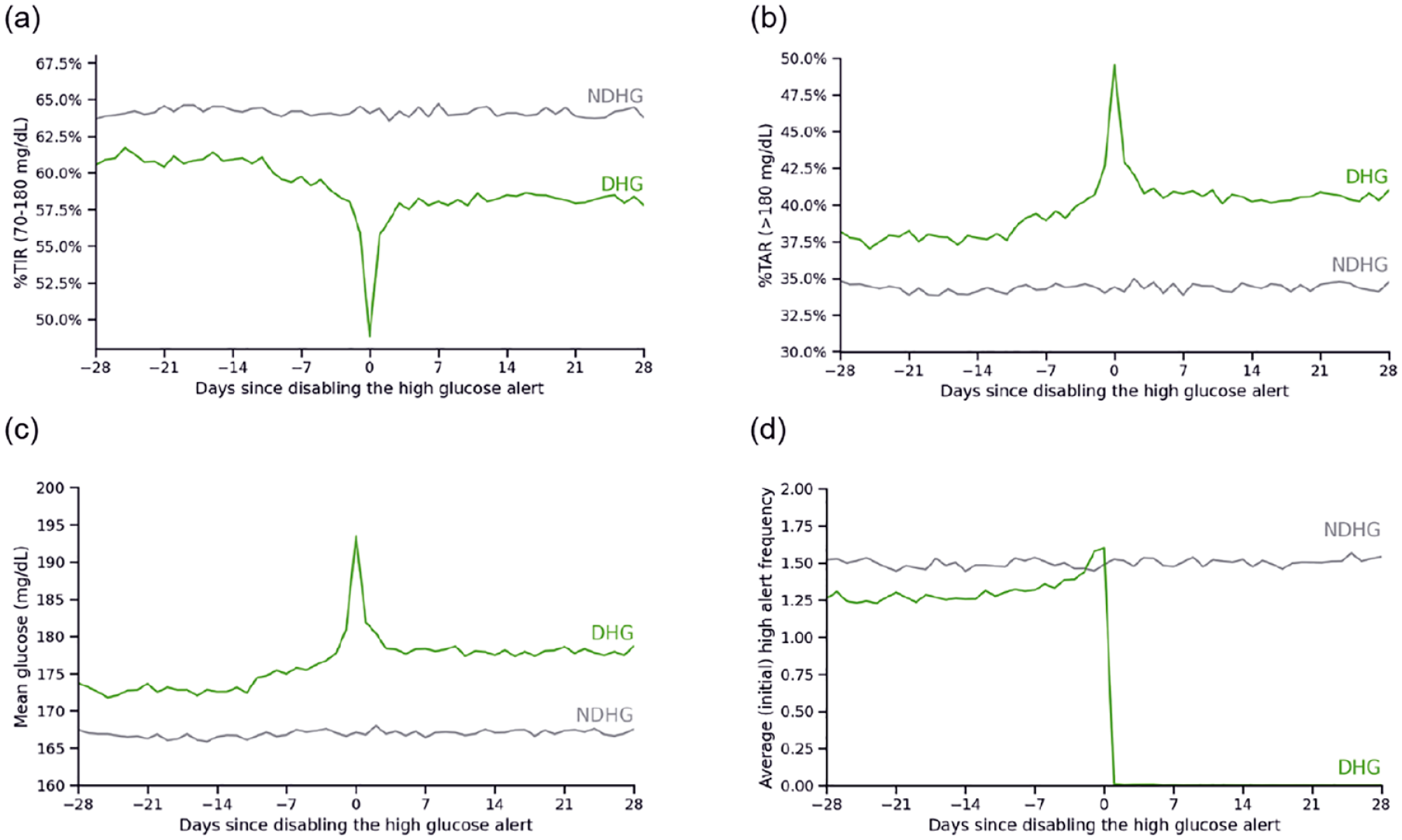
Glycemic control and alert frequency in users that DHG or NDHG. (a) Average %TIR (70-180 mg/dL). (b) Average %TAR (>180 mg/dL). (c) Average mean glucose. (d) Average number of high glucose alerts per day. Abbreviations: DHG, disabled the high-glucose alert; NDHG, never disabled the high-glucose alert; %TIR, percent of time in range; %TAR, percent of time above range.
Our analyses showed that DHG individuals experienced acute and subacute worsening of glycemic control following disablement of the high glucose alert. In the ALERTT1 randomized controlled trial, RT-CGM users achieved a 6.85 percentage point greater increase in %TIR versus IS-CGM users, 1 and the difference was maintained in an optional extension phase. 4 A 4.4 percentage point increase in %TIR was also observed in RT-CGM users versus IS-CGM users in a recent real-world study. 5 The presence of alerts in RT-CGM systems was hypothesized to contribute to these differences.
Limitations to this study include the analysis of only U.S.-based users and the lack of information regarding user demographics, diabetes type or duration, or medication regimen. We also cannot conclude that the glycemic differences we observe are strictly caused by disablement of the high-glucose alert. While we do not know why DHG users disabled the alert, alarm fatigue is likely, and healthcare professionals are advised to explain the importance of enabling glucose alerts and suggest alternatives to those experiencing alarm fatigue. This could help prevent permanent disablement of the high-glucose alert and the resultant deterioration in glycemia.
Footnotes
Abbreviations
CGM, continuous glucose monitoring; DHG, disabled the high-glucose alert; IS-CGM, intermittently scanned continuous glucose monitoring; NDHG, never disabled the high-glucose alert; RT-CGM, real-time continuous glucose monitoring; %TAR, percent of time above range; %TIR, percent of time in range.
Declaration of Conflicting Interests
The author(s) declared the following potential conflicts of interest with respect to the research, authorship, and/or publication of this article: All authors are employees of Dexcom, Inc.
Funding
The author(s) disclosed receipt of the following financial support for the research, authorship, and/or publication of this article: The work was funded by Dexcom, Inc.
