



Abstract

Keywords
A 29-year-old female patient with type 1 diabetes mellitus of 18-year duration presented with eczema located on an Omnipod insulin pump site (after five years of uneventful use of this device) compelling her to stop using it. At the same time, the FreeStyle libre 2 glucose sensor was well tolerated. She had previously used other devices to control her diabetes for ten years before the implementation of the pump, without any substantial difficulty apart from an eczema triggered by the Free Style libre 1 glucose sensor.
Patch tests with standard series, acrylates, and glues series were all negative with the notable exception of a strong reaction to N,N dimethylacrylamide (DMAA) and dipropylene glycol diacrylate (DPGDA) (Figure 1). Further chemical analysis indeed showed the presence of DPGDA in extracts of both adhesive of the pump and the pump itself with estimated concentrations corresponding to a total amount of 10 µg DPGDA in adhesive patch and 20 µg in the pump. No DMAA was present in any of the extracts.
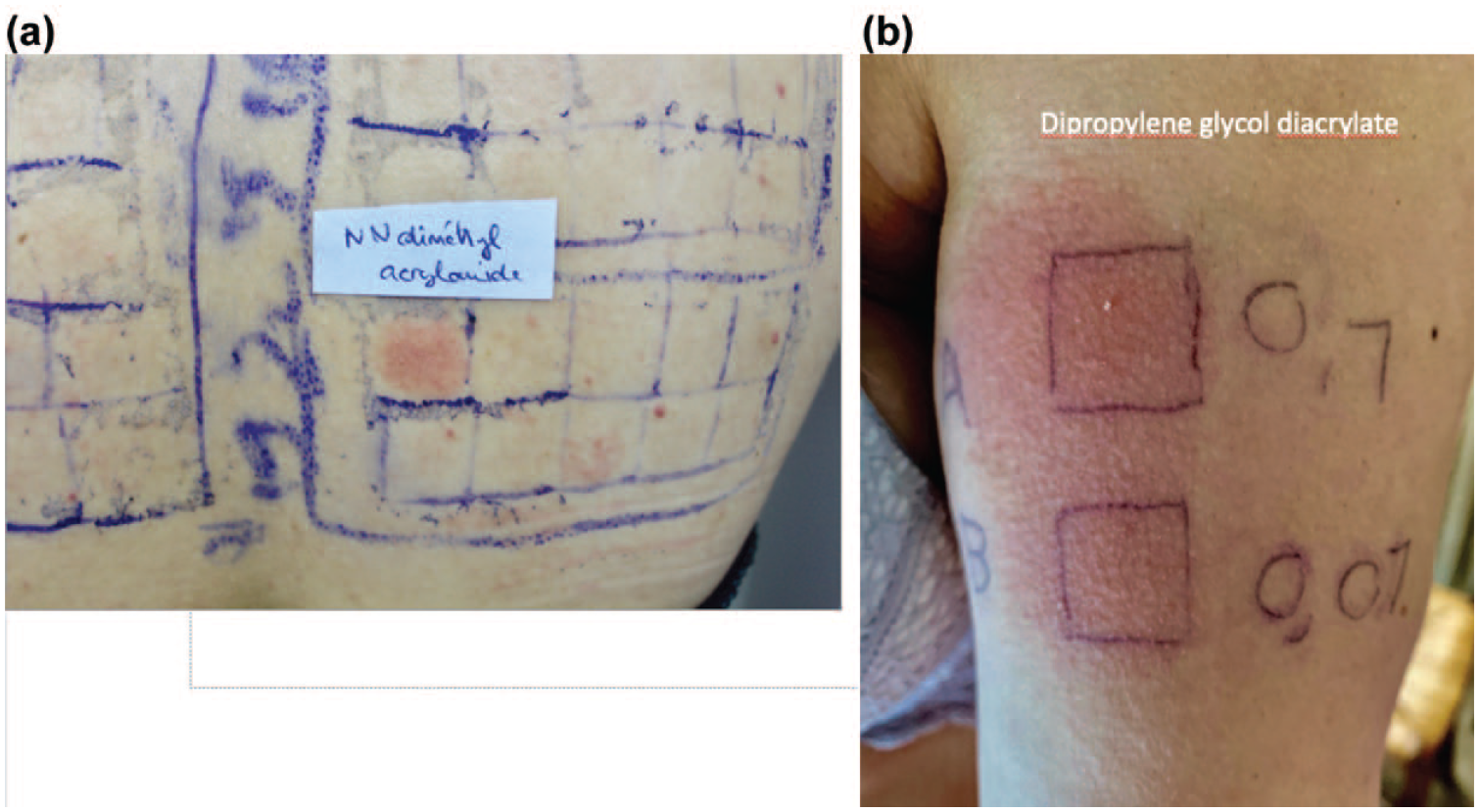
(a) Positive patch test reaction to N,N dimethylacrylamide 0.1% pet (++ D4). (b) Positive patch test reactions to dipropylene glycol diacrylate 0.1% and 0.01% pet (+++ on D4).
Adverse skin reactions to insulin pumps and continuous blood glucose rate monitoring devices are currently well described. 1 Isobornyl acrylate (IBOA) is considered as the major culprit allergen in both Omnipod insulin pump and Free Style Libre 1 glucose sensor.2,3
N,N dimethylacrylamide has also been detected in both devices.4,5 Numerous concomitant reactions to DMAA and IBOA have been observed and are probably explained by simultaneous exposure to both substances when using FreeStyle Libre sensor and/or Omnipod insulin pumps. Conversely, cross-reactions between IBOA and DMAA seem unlikely owing to different chemical structures. Furthermore, a patient with an eczema on every skin site in contact with a peculiar insulin pump had a positive patch test to rosin (included in the Italian standard series), and the device’s manufacturer confirmed the presence of rosin in this pump. 6
In the case reported here, positive reactions were observed for DMAA and DPGDA, but only DPGDA was identified in extracts from both the adhesive patch and the pump. Accordingly, we may hypothesize that given the fact that DMAA was present in the Omnipod pumps released earlier than the more recent DPGDA-containing pumps, our patient might have been sensitized to DMAA contained in Omnipod pumps from an earlier batch or possibly when using first-generation FreeStyle Libre.
More recently, DPGDA was identified in Omnipod pumps, and patch tests with DPGDA were positive in three patients with contact dermatitis to this pump. No IBOA was detected in the Omnipod pumps in which DPGDA was found. 5 Dipropylene glycol diacrylate was also identified in the pump used by our patient, rendering it very likely that she suffered from contact dermatitis caused by DPGDA and that she had been sensitized to this substance when using the Omnipod pump. As a consequence, the patient could no longer use the latter device despite the interposition of different protective pads and is currently using a new insulin pump without any skin reaction.
The increasing number of allergic contact dermatitis related to such diabetes medical devices should lead manufacturers to avoid strong sensitizing components such as acrylates, especially in case of prolonged / repeated applications of these components under skin occlusion. A detailed labeling of the composition of these medical devices would help patients with known allergic contact dermatitis to one of the components avoid further skin reactions.
Footnotes
Abbreviations
DMAA, N,N dimethylacrylamide; DPGDA, dipropylene glycol diacrylate; IBOA, isobornyl acrylate.
Declaration of Conflicting Interests
The author(s) declared no potential conflicts of interest with respect to the research, authorship, and/or publication of this article.
Funding
The author(s) received no financial support for the research, authorship, and/or publication of this article.
