




Abstract
Introduction:
The use of serious games is a popular approach to help children with Type 1 diabetes (T1D) learn how to self-manage. Many different game mechanisms exist. However, it is unclear which game mechanisms a serious game should include to teach self-management to children with T1D. Therefore, the aim of this scoping review is to map and describe the game mechanisms used in serious games that teach children with T1D how to self-manage and explain how they contribute to teaching self-management.
Methods:
A systematic scoping review was conducted to map and describe the important game mechanisms published before 23 September 2020. A comprehensive search was performed in the PubMed, CINAHL, Embase, PsycINFO, Scopus, and Education Database. Relevant literature was selected, synthesized, and reported.
Results:
Of the 800 articles identified, 18 were included in this systematic scoping review. The game mechanisms used in serious games that teach self-management included narrative contexts, feedback, avatars, simulations, goals, levels, and social interactions.
Discussion:
This review identified 7 game mechanisms used in serious games that teach children how to self-manage. A serious game is most effective in teaching self-management when it is T1D-oriented and when multiple game mechanisms are combined. However, the most effective combination of game mechanisms has yet to be determined.
Introduction
Type 1 diabetes (T1D) is one of the most common chronic diseases diagnosed in children younger than 15 years of age.1,2 Living with T1D requires a high degree of self-management,3,4 which is tasks an individual must undertake to control the disease and/or minimize the risk of short- and long-term complications.5,6 For T1D self-management is complex and includes constant balancing of food (carbohydrates), physical activity, and insulin.2,7 Due to the complexity of self-management, children may not be able to comprehend it.2,8 However, involving children in self-management from preadolescence (aged 8-14) is crucial for maintaining optimal glycemic control.1,2,7,9 For this to happen, he/she needs to learn how to self-manage, which involves the acquisition of knowledge, skills, self-efficacy, and motivation. 10
Serious games, which are defined as digital games in which design element characteristics are used in nongame contexts, 11 are increasingly used as a learning platform for children with T1D in T1D education.12 -15 Serious games are an effective tool because they are particularly appealing and engaging13,16 compared to traditional methods for education which rely heavily on written materials. 15 Serious games stimulate problem-solving, reflections on behavior, and improvements in short- and long-term memory.12,14,17 -19 Studies have demonstrated that serious games developed for children with T1D entail a significant learning gain 17 and induce the acquisition of knowledge, skills, self-efficacy, and motivation, which teaches children self-management.18,20
When developing a serious game, game mechanisms (GMs) are used to entertain players as they educate and change behavior.15,16,21 -23 GMs are mechanisms that relate to games. GMs can be implemented in a given thing or activity and thus make it playable. 24 GMs can be treated as building blocks, 11 and a wide variety of potential GMs exist. To the best of the authors’ knowledge, no previous study has examined which GMs a serious game should contain to teach children with T1D how to self-manage. Therefore, the aim of the present scoping review is to map GMs used in serious games that teach children with T1D aged 8 to 14 how to self-manage. Moreover, it aims to provide a description of the mapped GMs and explain how they contribute to teaching self-management.
Methods
Protocol
A systematic scoping review was conducted to provide a comprehensive narrative synthesis of the previously published literature regarding the GMs used in serious games that teach children with T1D aged 8 to 14 how to self-manage. Both Green et al 25 and the PRISMA statement were used as guidelines throughout the review process. 26
The Search Strategy
The PubMed, CINAHL, Embase, PsycINFO, Scopus, and Education Database were systematically searched for eligible articles published before September 23, 2020. Combinations of the following search terms were used: (1) children, (2) diabetes, (3) learning/education, and (4) (serious/video) games. To broaden the search, synonyms and near synonyms were included. The search terms included a combination of thesaurus terms and additional, appropriate free-form text. An additional chain search was conducted, including a search in Web of Science.
Study Selection
This systematic scoping review includes articles on GMs and descriptions of these in serious games that teach children with T1D (aged 8-14) how to self-manage. No methodological restrictions or date limitations were applied to include all known literature. Publications in the English and Scandinavian languages were included. Articles were excluded if the full text was not available (Table 1).
In- and Exclusion Criteria.
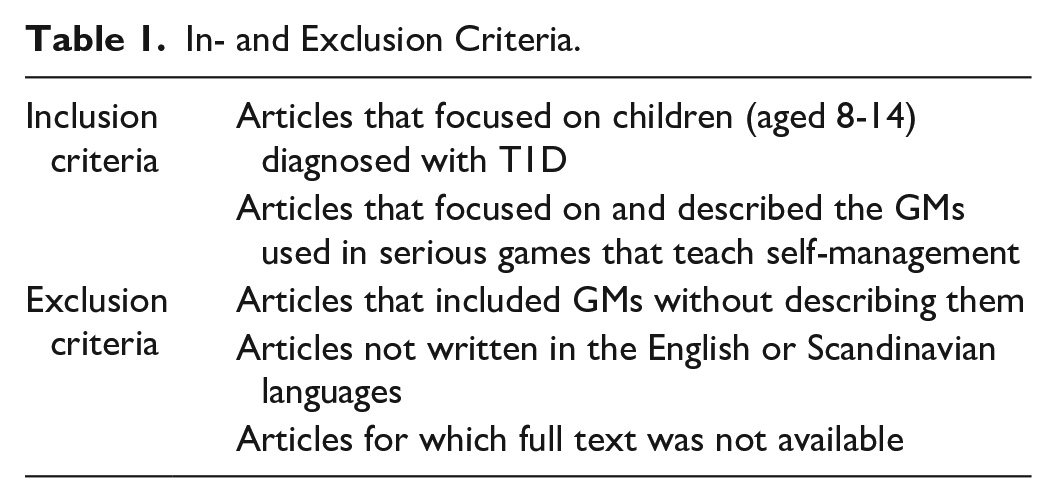
The study selection process encompassed multiple screenings by 3 authors (JN, KS, and CD). First, all of the eligible literature was identified, followed by a manual removal of duplicates. Next, the titles and abstracts of the remaining articles were screened to clarify their relevance. If neither the title nor the abstract treated serious games or GMs and self-management, the article was excluded. In uncertain cases, the article was included for full review. The remaining articles were included for full critical review. If an article was excluded during the full review, the reason was registered. All cases of disagreement between the authors during the study selection process was resolved through discussion.
The Synthesis
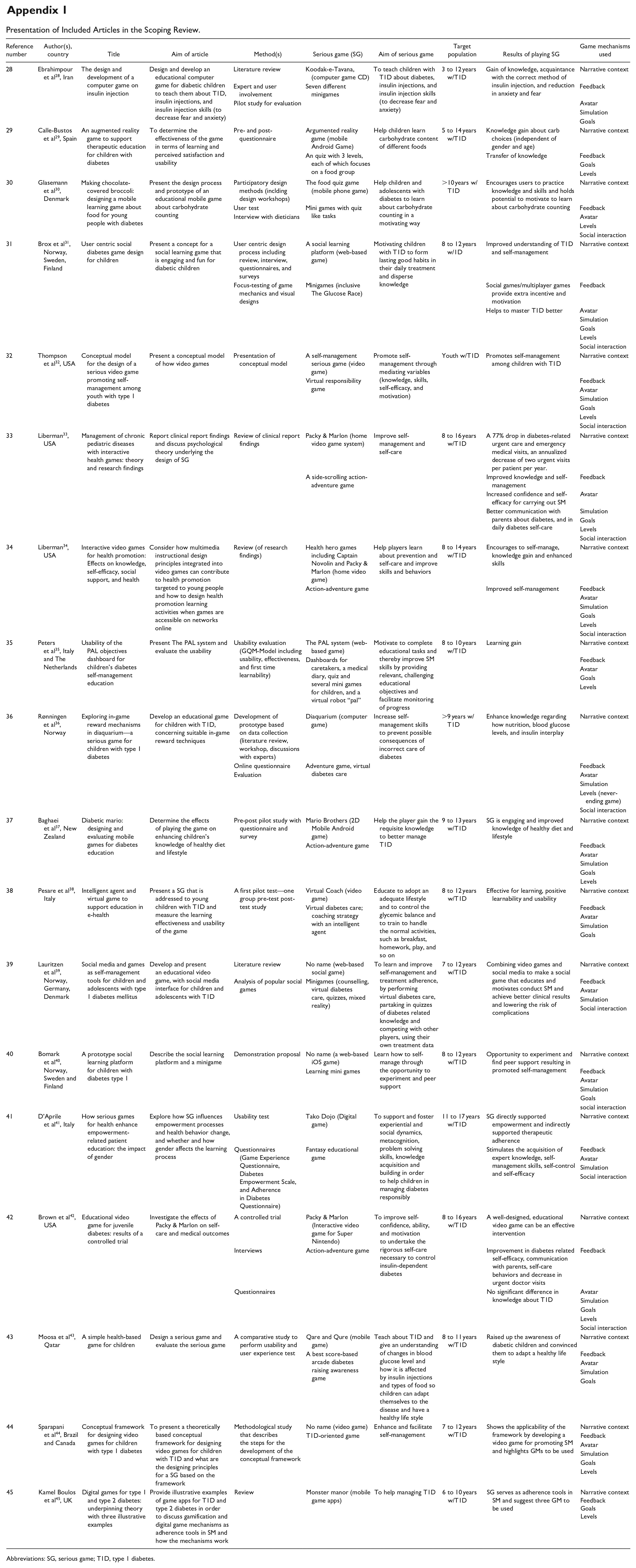
Three authors (JN, KS, and CD) validated and thoroughly read the final sample. Notes on the aims of the articles as well as the names, types and aims of the serious games; the target populations; the results; and the GMs used were organized into a table (Appendix 1). GMs described in the articles were identified and discussed until agreement was reached among the 3 authors (JN, KS, and CD). Each identified GM was described and the related effect on self-management was summarized.
Results
As illustrated in Figure 1, 800 articles were identified and screened. Subsequently, 87 articles were excluded as duplicates, and 638 articles were excluded after reviewing the titles and abstracts, leaving 75 full-text articles. A final sample of 18 articles was included (Appendix 1).
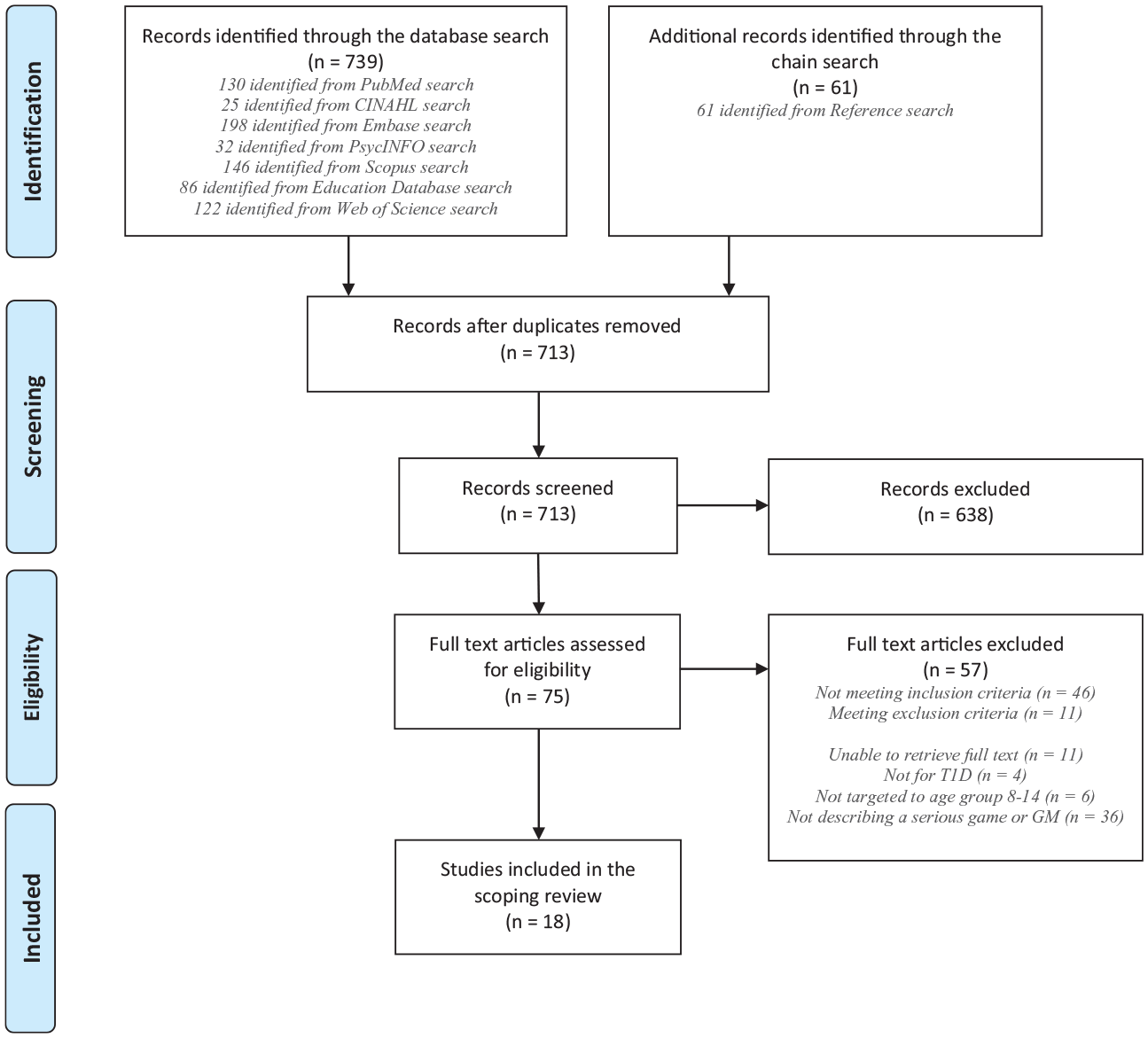
Selection of articles. The process included several steps leading to the final sample of articles (n = 18) included in this systematic scoping review.
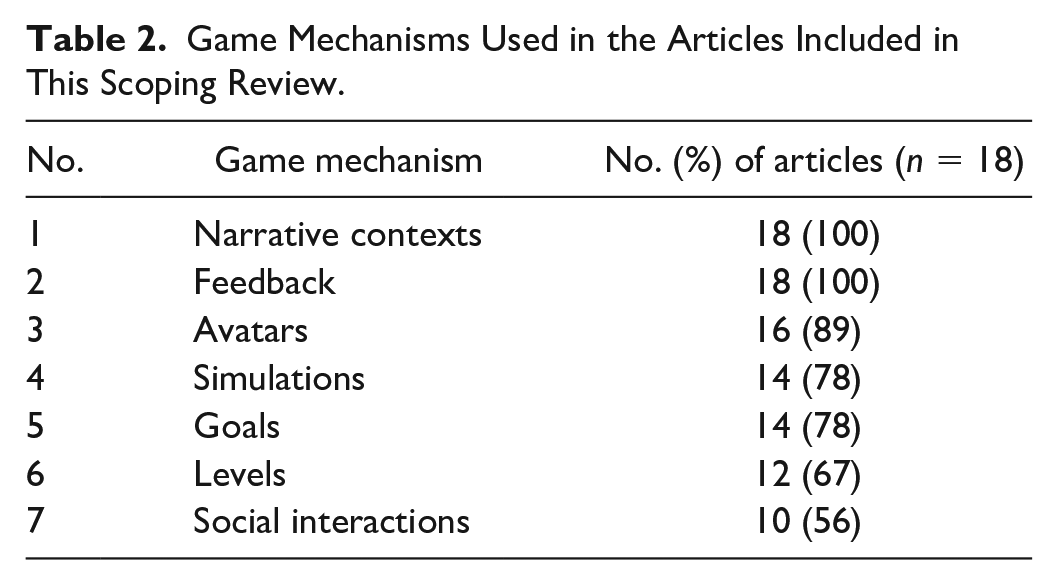
Based on the synthesis of the reviewed literature, 7 GMs emerged: (1) narrative contexts, (2) feedback, (3) avatars, (4) simulations, (5) goals, (6) levels, and (7) social interactions. The GMs are presented in decreasing order according to the number of articles including a given GM (Table 2).
Game Mechanisms Used in the Articles Included in This Scoping Review.
Narrative Contexts
Narrative contexts were described in all 18 articles (Table 3). Narrative contexts are stories that form the background of the game. 27 These revolved around T1D and simulated meaningful and recognizable self-management situations28 -45 and were attractive, funny and happy.28,41,44 Settings were described as both realistic medical28,39 and fantasy themed.31,33,34,36,37,40 -42 In more than half of the articles, the narratives revolved around helping a character with T1D self-management.30,32 -34,36,37,39,41 -43 In other articles, the narratives were about a health professional who helps patients with T1D.28,38,39 Health-based narratives were also designed as either action-adventure31,33,34,37,40,44 or more realistic.28 -30,39
The GM Narrative Contexts. Description of the GM, Its Effect and Specifically How It Contributes to Teaching Self-Management.
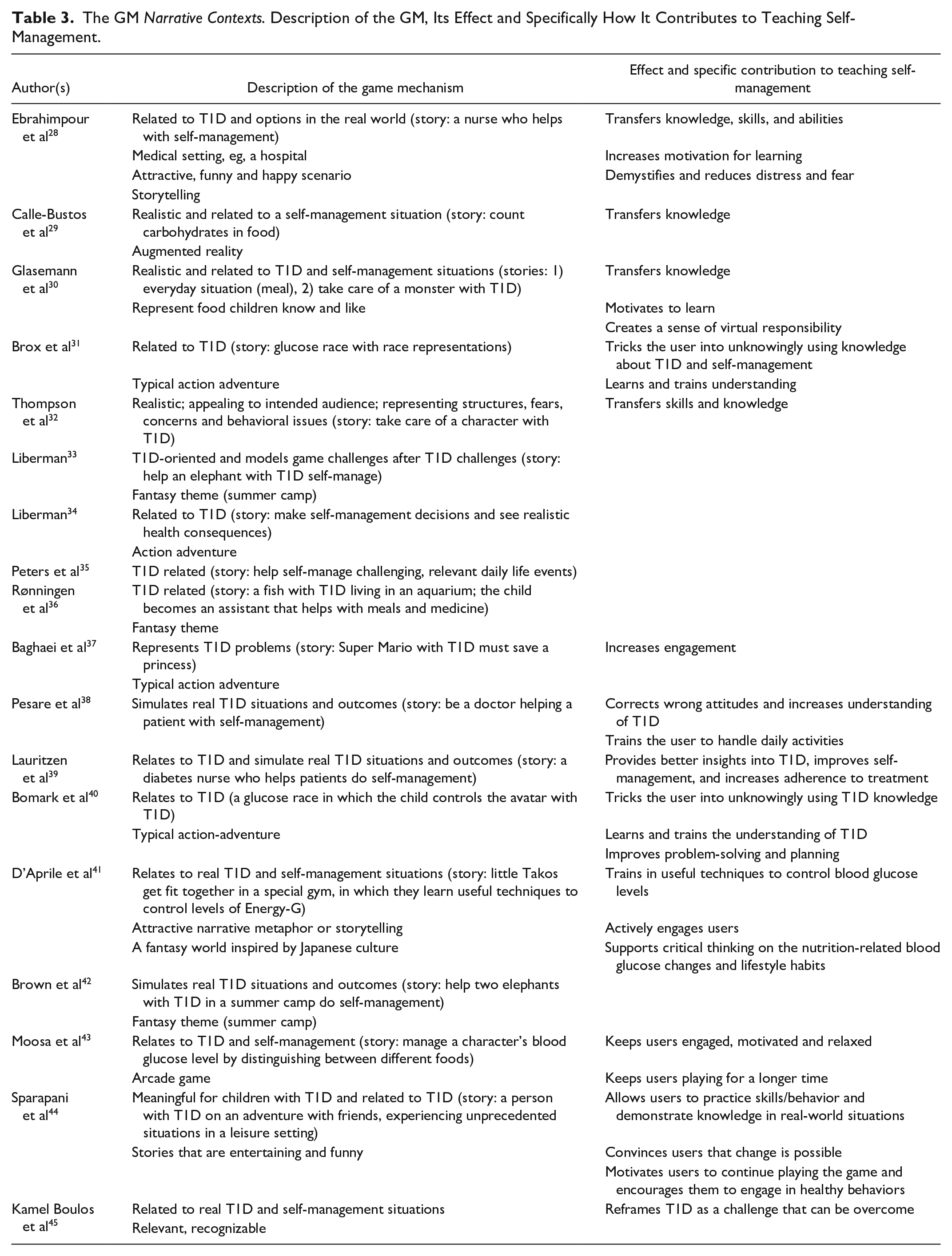
The outcomes of T1D-oriented narratives were demystification, 28 increased understanding of self-management,31,38 -41 and an easier transfer of knowledge and skills from serious games to real-world situations.28 -30,32,38 Furthermore, they contributed to engagement and motivation. 45
Feedback
Feedback was included in all 18 articles (Table 4). Feedback is all kinds of output from the game, which informs about progression and/or performance. 27 Feedback was given on performance28,32-34,37,42 and/or the (correct/incorrect) choices and actions made.28-30,33,34,36,44 Feedback was informative and explanatory30,33,44 and served as updates on progression.34,35 Feedback assumed various forms, including (a) rewards28,30,31,34-37,39-45; (b) encouragement and acknowledgment29,32,35-37; (c) onscreen performance indicators36-38,42,43; (d) character interactions,32-34,37,44 eg, facial expression changes 36 ; realistic health consequences for the character34,36,44; (e) message boxes36-38,43; and (f) voice messages.28,36
The GM Feedback. Description of the GM, Its Effect and Specifically How It Contributes to Teaching Self-Management.
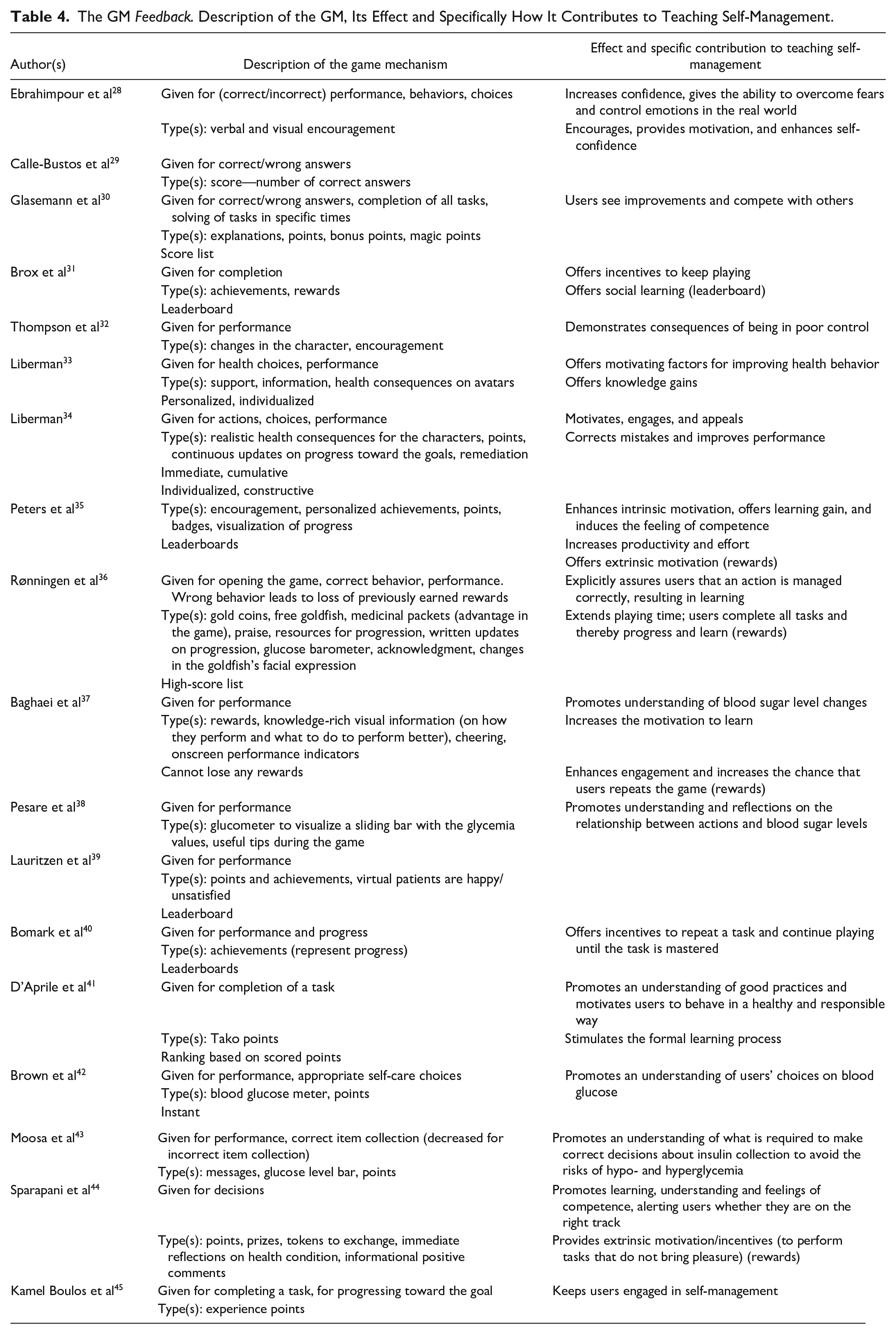
Feedback contributed to learning, reflection, understanding of T1D and self-management, and it corrected misunderstandings.33-35,37,38,42-44 Furthermore, feedback led to increased confidence, induced the feeling of competence28,35,36,44 and increased the motivation both to play, learn, and engage in self-management.28,33-35,37,44,45
Rewards
Rewards emerged as a subcategory of feedback. Different types of rewards were included: (a) points,30,34,35,39,41-45 (b) badges, 35 (c) coins, 36 (d) prizes, 44 (e) tokens, 44 (f) advantages, 36 and (g) praise. 36 Rønningen et al 36 also included rewards when the game was opened to motivate players to play repeatedly. In 2 articles, it was argued that earned rewards should be lost when the character does something wrong,36,43 while Baghaei et al 37 were opposed to losing earned rewards. The accumulation of rewards, especially points, was used to place users on a high-score list,30,31,35,36,39-41,43 which motivated them to improve performance.30,40
Rewards primarily served as motivators to extend play time and thereby gain intended learning.28,31,35-37,40,44,45 Other outcomes included explicit assurance that an action was managed correctly,36,41 enhancement of confidence, 28 and understanding of what was required to make correct decisions. 43
Avatars
Avatars refer to a (virtual) representation of a person controlled by the player. 46 The GM was commonly identified28,30-44 (Table 5). The majority of the articles described avatars as (fantasy) characters with T1D30-37,39,41-44 who demonstrated appropriate self-management32-34,36,37,39,41,42,44 and thereby served as trustworthy and positive role models.32-34,42,44 Role model avatars increased the likelihood that the child would emulate the avatars’ behaviors, making it easier to learn self-management.32-34,44 Avatars could also be a health professional taking care of a person with T1D.28,38,39 These types of avatars taught the concepts of T1D and T1D-related skills28,39 and helped resolve misunderstandings while correcting incorrect behaviors.28,38
The GM Avatars. Description of the GM, Its Effect and Specifically How It Contributes to Teaching Self-Management.
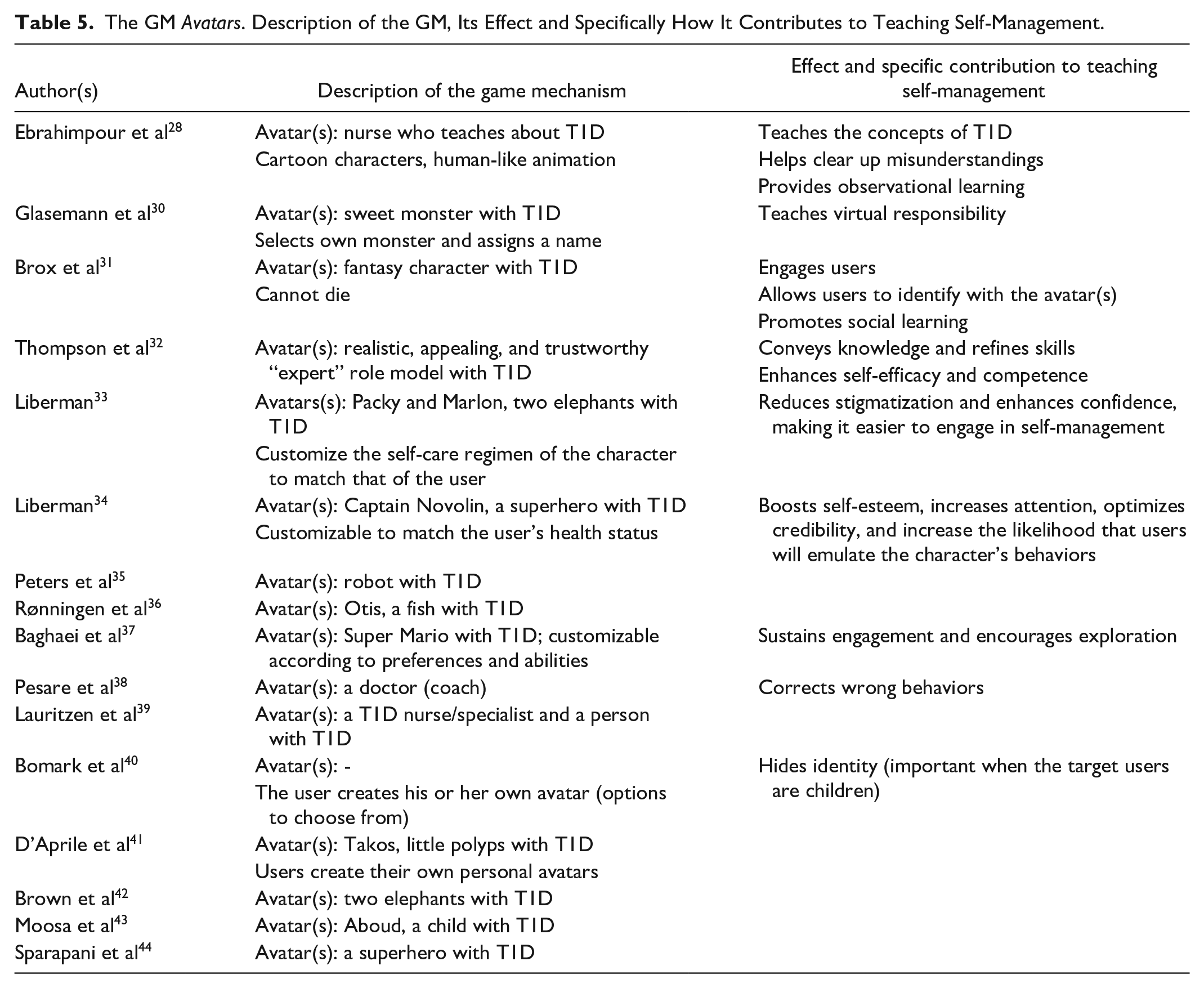
Avatars’ appearances could be customized and personalized according to the user’s preferences.30,33,34,37,40,41 Customization enhanced the enjoyment and individualized the learning experience.33,34,37
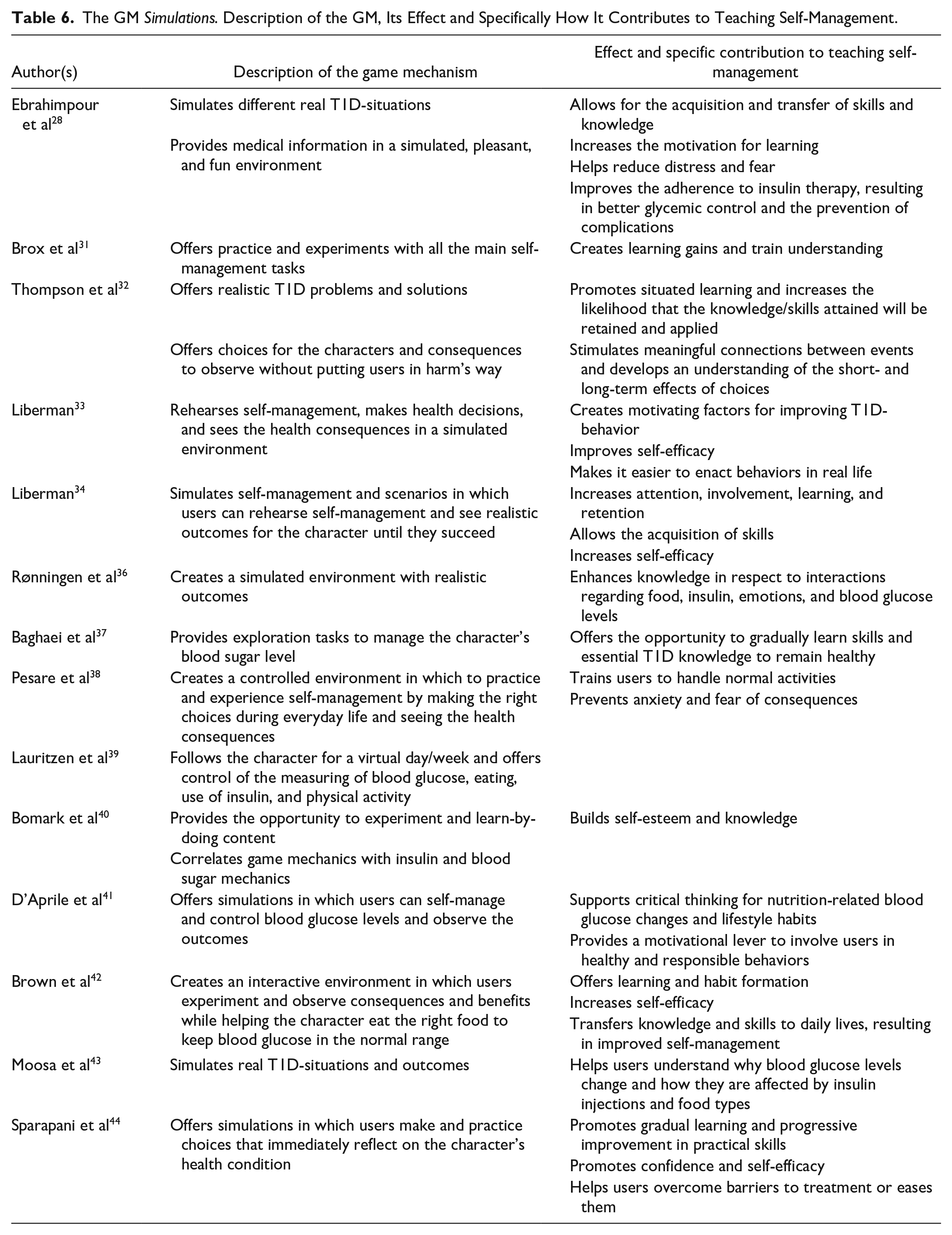
Simulations
Simulations were included in 14 articles (Table 6). Simulations refer to exploration and experimentation in a risk-free, controlled, and simulated environment. Simulations made it possible to practice (and master) different self-management situations28,31-34,36-44 and observe realistic outcomes without real-life consequences.32-34,36-39,42-44 This mechanism helped users make meaningful connections between events and understand the effects of one’s choices31,32,34,36,38,41,43,44 and thereby increased the likelihood that the knowledge and skills attained would be retained and applied in real-world situations.28,32,33,37,42,44 When experiencing successful outcomes as a result of the users’ decisions, confidence and/or self-efficacy increased and promoted the intrinsic motivation to self-manage.33,34,40,42,44
The GM Simulations. Description of the GM, Its Effect and Specifically How It Contributes to Teaching Self-Management.
Goals
Goals define a direction and set up the challenges that the player faces 47 and were described in 13 articles (Table 7). Goals were designed as meaningful learning goals related to T1D and self-management28,29,32-35,37,38,42-45 and represented the desired end state of attaining specific knowledge, skills, or attitudes.29,32-36,43 Learning goals were broken into incremental, progressively small steps 45 and were short term. 28 Simple learning goals were embedded early in a serious game, and complex goals were reserved for later. 37 Goals were adjusted to match the child’s T1D knowledge. 37
The GM Goals. Description of the GM, Its Effect and Specifically How It Contributes to Teaching Self-Management.
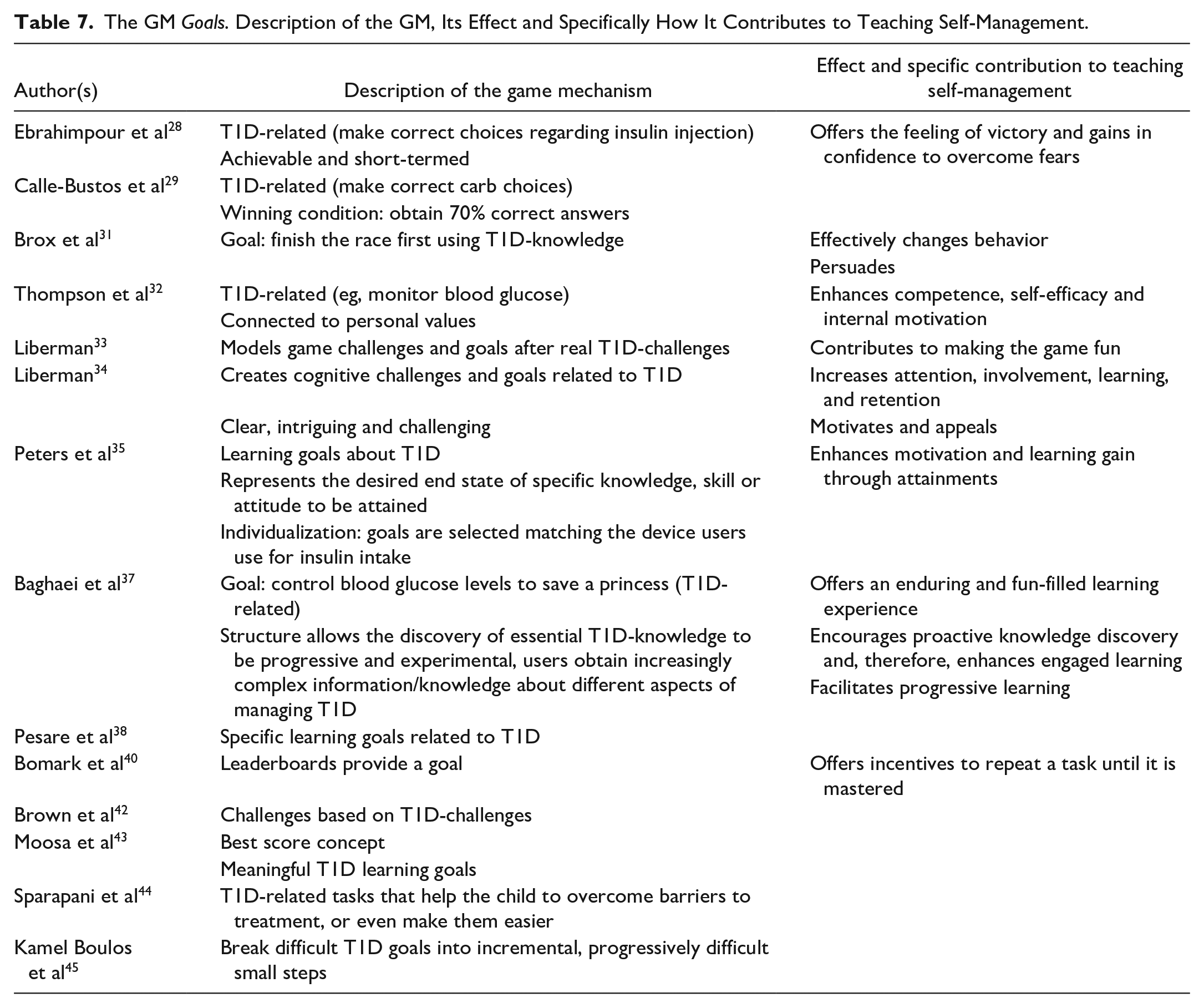
Achieving T1D-related goals made the child feel victorious and caused gain of knowledge and confidence to overcome barriers in self-management.28,32,34,35,44 Furthermore, achieving a goal enhanced the internal motivation for learning32,35,37 and contributed to making the game fun and engaging.33,34,37
Levels
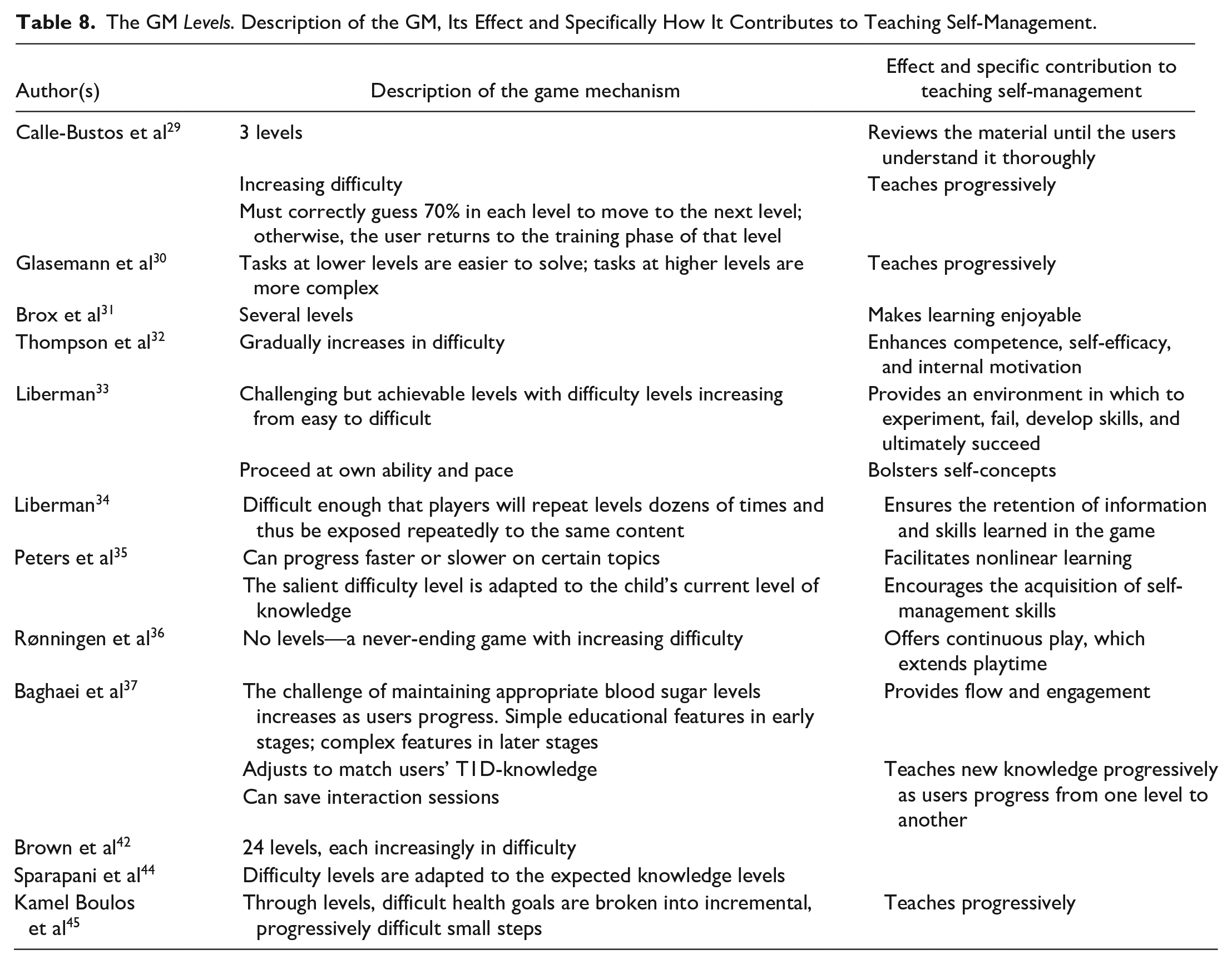
Eight articles outlined levels (Table 8), which includes information about the stage of the game and/or the player’s skills. 27 Rønningen et al 36 suggested a never-ending game with no levels to extend playtime, while other articles used several levels, each becoming increasingly more difficult to complete.29,30,32,33,37,42 The level of difficulty could be adjusted to match the current or expected level of T1D knowledge.33,35,37,44 Through levels, difficult health goals were broken into incremental, progressively difficult small steps allowing the progressive gain of new knowledge.29,30,35,37,45 A level should be achievable 33 but challenging enough so it will be repeated and the child is exposed to the content until it is understood thoroughly,29,34 ensuring that the information and skills learned in the game were retained. 34 Experimenting, failing, and ultimately succeeding resulted in enhanced competence, self-confidence, and internal motivation.32,33,35 Baghaei et al 37 noted that a serious game should include the ability to save progression, so a child will not have to start from level 1 each time.
The GM Levels. Description of the GM, Its Effect and Specifically How It Contributes to Teaching Self-Management.
Social Interactions
Social interactions were described in 10 articles (Table 9) and include communication and/or interaction. 27 The included articles described social interactions as communications or chats30,31,34,36,40,41 with other children with T1D,31,36 health professionals, family, and/or friends. 41 Communications consisted of context-sensitive predefined dialogs either to enable cross-language communications between players 31 or to reduce the risk of bullying and foul language. 40 The GM resulted in (a) social learning,30,31,41 (b) peer support, 40 (c) the building of self-esteem and knowledge,34,40 (d) enhanced personalization and interactivity, 36 and (e) the stimulation of discussion and collaboration. 30
The GM Social Interactions. Description of the GM, Its Effect and Specifically How It Contributes to Teaching Self-Management.
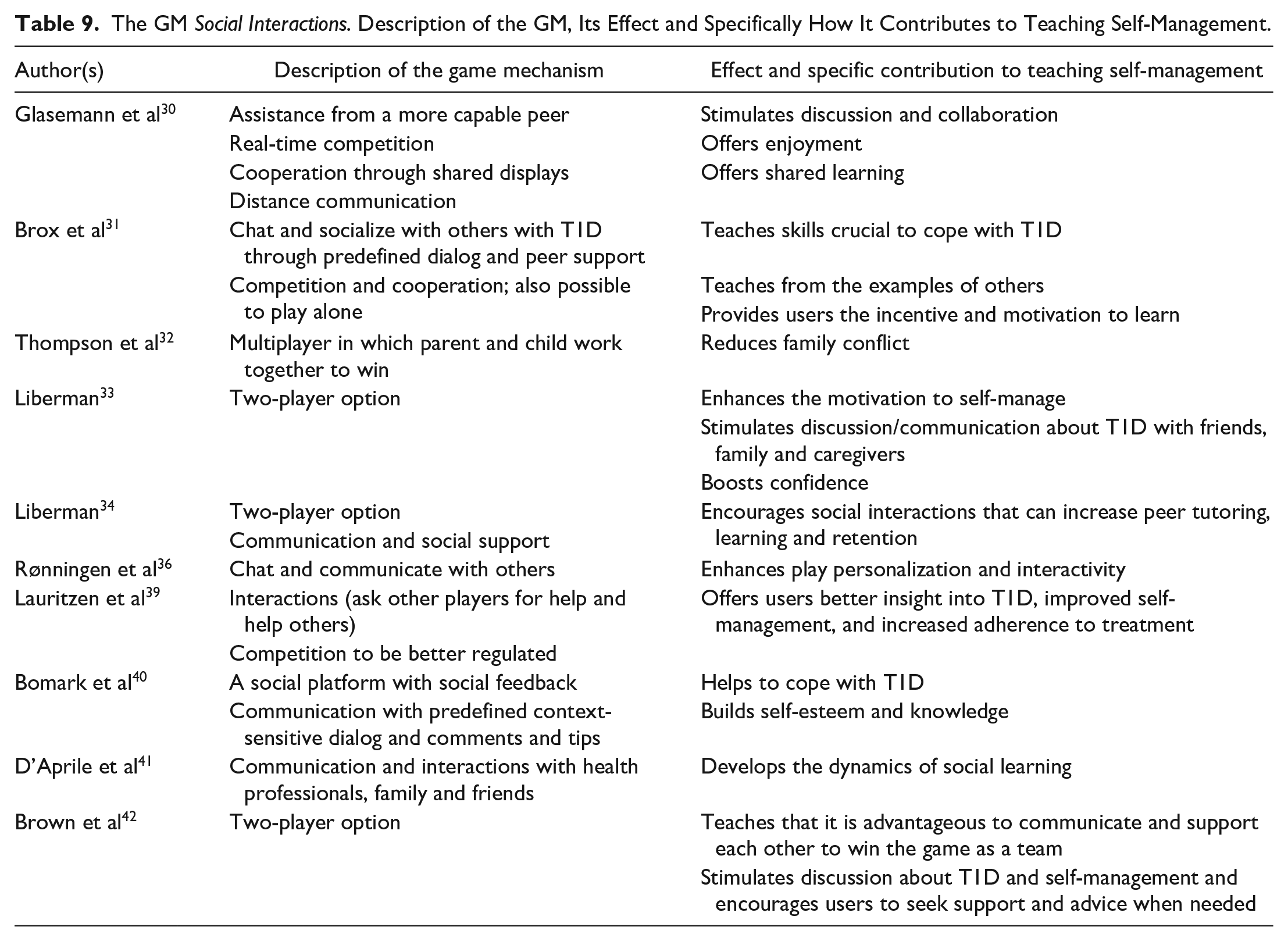
Social interactions were also described as multiplayer options in which players competed against each other30,31,39 and/or cooperated to win.30-33,39,42 The outcomes of competition and cooperation included (a) stimulation of discussions about T1D,30,33,42 (b) better insights into T1D and increased adherence to treatment, 39 (c) enhanced motivations to improve health behavior and for learning,31,33 (d) boosted confidence, 33 and (e) reduced conflict. 32
Discussion
This scoping review aimed to systematically map the GMs used in serious games that teach children with T1D how to self-manage and to provide a description of the mapped GMs, including an explanation of how they contributed to teaching self-management. Seven GMs were identified: (1) narrative contexts, (2) feedback, (3) avatars, (4) simulations, (5) goals, (6) levels, and (7) social interactions.
Each GM can be treated as a building block, 11 and according to Swartwout et al 46 serious games are most effective when multiple GMs are combined. However, since this review does not examine how the GMs are interrelated, no GMs should be dismissed at this point without a study of their impact. Future research should determine which GMs are best to combine for teaching self-management. Furthermore, as suggested by Deterding et al 11 game genres are associated with the use of GMs. Avatars are common in action and role-playing games but not necessarily in strategy or card games. Therefore, the inclusion of GMs in a serious game to promote self-management should align with the game genre. 11
To ensure the effective transfer of knowledge and skills from a serious game to the real world, a serious game and its GMs should be related to T1D and self-management. This fact is consistent with previous findings.18,19,46 When combined with risk-free trial-and-error simulations in which the decisions and actions match the choices available to a child with T1D, players are more likely to learn self-management skills.18,46,48 Furthermore, several studies have found that children gain knowledge and develop skills simply by observing avatars that model behaviors, making this an effective approach for learning how to self-manage.46-51
The GM social interactions was the least used in this review (n = 10) but should be a key feature, according to Klopfer 52 and previously published literature.46,53,54 Social interactions allow a child with T1D to socialize with other children with T1D their own age, which many children do not otherwise have the opportunity to do. Increased social networking and support have been associated with promoted self-management in children with T1D.46,53,54 Furthermore, D’Aprile et al 41 described communication with health professionals. This factor is supported by studies by Zang et al 55 and Åsand et al 56 because it prompts the child to become an active participant in self-management. However, Glasemann et al 30 found that children do not like health professionals to check up on them. Therefore, it cannot be confirmed that a serious game would be more effective if such features are included.
Levels were the only GM with conflicting findings. Rønningen et al 36 described a never-ending game without levels, while the remaining articles used levels.24-35,37,42,44,45 Both solutions resulted in the promotion of self-management, which is why using levels in serious games seems to be optional. However, according to Zichermann and Cunningham 57 (pp. 45-49), using levels where complexity transitions from one level to the next has proven extremely engaging. Well-designed levels result in confidence and experience gains, so they may be beneficial in a serious game.
Engagement and motivation are important aspects when designing a serious game to help the child learn from the game. 36 According to the results of this review, feedback (including rewards), narrative contexts, and goals are key components to motivate and thereby extend play time and increase the likelihood that serious games result in learning.28,31,35-37,40,44,45 This finding is supported by similar findings,16,58,59 which show that these GMs lead to increased engagement and motivation, reducing the risk that the child stops playing and thereby misses potential learning.
A limitation of the present scoping review is that only articles in English and Scandinavian languages were included. A general limitation of using the scoping review is that the included articles were not assessed for quality, which is why the strength of the articles was not considered. 60 However, this scoping review was conducted based on the guidelines of Green et al 25 and the PRISMA statement 26 in the systematic literature search, which ensured a systematic methodological approach that contributes to the strength of the results. Another strength is that the search of the literature was performed in 6 databases using an extensive number of search terms, which makes the literature search systematic and exhaustive. Additionally, the validation of the sample by 3 authors contributes to further increasing the strength of this scoping review.
Conclusions
The findings of this review suggest that 7 GMs can be included in serious games to teach self-management. Serious games seem most effective in teaching self-management when they are T1D-oriented and when multiple GMs are combined. However, the ideal combination of GMs has yet to be determined and serious games may also teach self-management when not all game mechanisms are included. The game genre influences the choice of GMs. Future studies could focus on determining which combination and/or genre is the most effective in teaching children with T1D self-management.
Footnotes
Appendix
Presentation of Included Articles in the Scoping Review.
| Reference number | Author(s), country | Title | Aim of article | Method(s) | Serious game (SG) | Aim of serious game | Target population | Results of playing SG | Game mechanisms used |
|---|---|---|---|---|---|---|---|---|---|
| 28 | Ebrahimpour et al 28 , Iran | The design and development of a computer game on insulin injection | Design and develop an educational computer game for diabetic children to teach them about T1D, insulin injections, and insulin injection skills (to decrease fear and anxiety) | Literature review | Koodak-e-Tavana, (computer game CD) | To teach children with T1D about diabetes, insulin injections, and insulin injection skills (to decrease fear and anxiety) | 3 to 12 years w/T1D | Gain of knowledge, acquaintance with the correct method of insulin injection, and reduction in anxiety and fear | Narrative context |
| Expert and user involvement | Seven different minigames | Feedback | |||||||
| Pilot study for evaluation | Avatar | ||||||||
| Simulation | |||||||||
| Goals | |||||||||
| 29 | Calle-Bustos et al 29 , Spain | An augmented reality game to support therapeutic education for children with diabetes | To determine the effectiveness of the game in terms of learning and perceived satisfaction and usability | Pre- and post-questionnaire | Argumented reality game (mobile Android Game) | Help children learn carbohydrate content of different foods | 5 to 14 years w/T1D | Knowledge gain about carb choices (independent of gender and age) | Narrative context |
| An quiz with 3 levels, each of which focuses on a food group | Transfer of knowledge | Feedback | |||||||
| Goals | |||||||||
| Levels | |||||||||
| 30 | Glasemann et al 30 , Denmark | Making chocolate-covered broccoli: designing a mobile learning game about food for young people with diabetes | Present the design process and prototype of an educational mobile game about carbohydrate counting | Participatory design methods (inclding design workshops) | The food quiz game (mobile phone game) | Help children and adolescents with diabetes to learn about carbohydrate counting in a motivating way | >10 years w/T1D | Encourages users to practice knowledge and skills and holds potential to motivate to learn about carbohydrate counting | Narrative context |
| User test | Mini games with quiz like tasks | Feedback | |||||||
| Interview with dieticians | Avatar | ||||||||
| Levels | |||||||||
| Social interaction | |||||||||
| 31 | Brox et al 31 , Norway, Sweden, Finland | User centric social diabetes game design for children | Present a concept for a social learning game that is engaging and fun for diabetic children | User centric design process including review, interview, questionnaires, and surveys | A social learning platform (web-based game) | Motivating children with T1D to form lasting good habits in their daily treatment and disperse knowledge | 8 to 12 years w/1D | Improved understanding of T1D and self-management | Narrative context |
| Focus-testing of game mechanics and visual designs | Minigames (inclusive The Glucose Race) | Social games/multiplayer games provide extra incentive and motivation | Feedback | ||||||
| Helps to master T1D better | Avatar | ||||||||
| Simulation | |||||||||
| Goals | |||||||||
| Levels | |||||||||
| Social interaction | |||||||||
| 32 | Thompson et al 32 , USA | Conceptual model for the design of a serious video game promoting self-management among youth with type 1 diabetes | Present a conceptual model of how video games | Presentation of conceptual model | A self-management serious game (video game) | Promote self-management through mediating variables (knowledge, skills, self-efficacy, and motivation) | Youth w/T1D | Promotes self-management among children with T1D | Narrative context |
| Virtual responsibility game | Feedback | ||||||||
| Avatar | |||||||||
| Simulation | |||||||||
| Goals | |||||||||
| Levels | |||||||||
| Social interaction | |||||||||
| 33 | Liberman 33 , USA | Management of chronic pediatric diseases with interactive health games: theory and research findings | Report clinical report findings and discuss psychological theory underlying the design of SG | Review of clinical report findings | Packy & Marlon (home video game system) | Improve self-management and self-care | 8 to 16 years w/T1D | A 77% drop in diabetes-related urgent care and emergency medical visits, an annualized decrease of two urgent visits per patient per year. | Narrative context |
| A side-scrolling action-adventure game | Improved knowledge and self-management | Feedback | |||||||
| Increased confidence and self-efficacy for carrying out SM | Avatar | ||||||||
| Better communication with parents about diabetes, and in daily diabetes self-care | Simulation | ||||||||
| Goals | |||||||||
| Levels | |||||||||
| Social interaction | |||||||||
| 34 | Liberman 34 , USA | Interactive video games for health promotion: Effects on knowledge, self-efficacy, social support, and health | Consider how multimedia instructional design principles integrated into video games can contribute to health promotion targeted to young people and how to design health promotion learning activities when games are accessible on networks online | Review (of research findings) | Health hero games including Captain Novolin and Packy & Marlon (home video game) | Help players learn about prevention and self-care and improve skills and behaviors | 8 to 14 years w/T1D | Encourages to self-manage, knowledge gain and enhanced skills | Narrative context |
| Action-adventure game | Improved self-management | Feedback | |||||||
| Avatar | |||||||||
| Simulation | |||||||||
| Goals | |||||||||
| Levels | |||||||||
| Social interaction | |||||||||
| 35 | Peters et al 35 , Italy and The Netherlands | Usability of the PAL objectives dashboard for children’s diabetes self-management education | Present The PAL system and evaluate the usability | Usability evaluation (GQM-Model including usability, effectiveness, and first time learnability) | The PAL system (web-based game) | Motivate to complete educational tasks and thereby improve SM skills by providing relevant, challenging educational objectives and facilitate monitoring of progress | 8 to 10 years w/T1D | Learning gain | Narrative context |
| Dashboards for caretakers, a medical diary, quiz and several mini games for children, and a virtual robot “pal” | Feedback | ||||||||
| Avatar | |||||||||
| Goals | |||||||||
| Levels | |||||||||
| 36 | Rønningen et al 36 , Norway | Exploring in-game reward mechanisms in diaquarium—a serious game for children with type 1 diabetes | Develop an educational game for children with T1D, concerning suitable in-game reward techniques | Development of prototype based on data collection (literature review, workshop, discussions with experts) | Diaquarium (computer game) | Increase self-management skills to prevent possible consequences of incorrect care of diabetes | >9 years w/T1D | Enhance knowledge regarding how nutrition, blood glucose levels, and insulin interplay | Narrative context |
| Online questionnaire | Adventure game, virtual diabetes care | Feedback | |||||||
| Evaluation | Avatar | ||||||||
| Simulation | |||||||||
| Levels (never-ending game) | |||||||||
| Social interaction | |||||||||
| 37 | Baghaei et al 37 , New Zealand | Diabetic mario: designing and evaluating mobile games for diabetes education | Determine the effects of playing the game on enhancing children’s knowledge of healthy diet and lifestyle | Pre-post pilot study with questionnaire and survey | Mario Brothers (2D Mobile Android game) | Help the player gain the requisite knowledge to better manage T1D | 9 to 13 years w/T1D | SG is engaging and improved knowledge of healthy diet and lifestyle | Narrative context |
| Action-adventure game | Feedback | ||||||||
| Avatar | |||||||||
| Simulation | |||||||||
| Goals | |||||||||
| Levels | |||||||||
| 38 | Pesare et al 38 , Italy | Intelligent agent and virtual game to support education in e-health | Present a SG that is addressed to young children with T1D and measure the learning effectiveness and usability of the game | A first pilot test—one group pre-test post-test study | Virtual Coach (video game) | Educate to adopt an adequate lifestyle and to control the glycemic balance and to train to handle the normal activities, such as breakfast, homework, play, and so on | 8 to 12 years w/T1D | Effective for learning, positive learnability and usability | Narrative context |
| Virtual diabetes care; coaching strategy with an intelligent agent | Feedback | ||||||||
| Avatar | |||||||||
| Simulation | |||||||||
| Goals | |||||||||
| 39 | Lauritzen et al 39 , Norway, Germany, Denmark | Social media and games as self-management tools for children and adolescents with type 1 diabetes mellitus | Develop and present an educational video game, with social media interface for children and adolescents with T1D | Literature review | No name (web-based social game) | To learn and improve self-management and treatment adherence, by performing virtual diabetes care, partaking in quizzes of diabetes related knowledge and competing with other players, using their own treatment data | 7 to 12 years w/T1D | Combining video games and social media to make a social game that educates and motivates conduct SM and achieve better clinical results and lowering the risk of complications | Narrative context |
| Analysis of popular social games | Minigames (counselling, virtual diabetes care, quizzes, mixed reality) | Feedback | |||||||
| Avatar | |||||||||
| Simulation | |||||||||
| Social interaction | |||||||||
| 40 | Bomark et al 40 , Norway, Sweden and Finland | A prototype social learning platform for children with diabetes type 1 | Describe the social learning platform and a minigame | Demonstration proposal | No name (a web-based iOS game) | Learn how to self-manage through the opportunity to experiment and peer support | 8 to 12 years w/T1D | Opportunity to experiment and find peer support resulting in promoted self-management | Narrative context |
| Learning mini games | Feedback | ||||||||
| Avatar | |||||||||
| Simulation | |||||||||
| Goals | |||||||||
| social interaction | |||||||||
| 41 | D’Aprile et al 41 , Italy | How serious games for health enhance empowerment-related patient education: the impact of gender | Explore how SG influences empowerment processes and health behavior change, and whether and how gender affects the learning process | Usability test | Tako Dojo (Digital game) | To support and foster experiential and social dynamics, metacognition, problem solving skills, knowledge acquisition and building in order to help children in managing diabetes responsibly | 11 to 17 years w/T1D | SG directly supported empowerment and indirectly supported therapeutic adherence | Narrative context |
| Questionnaires (Game Experience Questionnaire, Diabetes Empowerment Scale, and Adherence in Diabetes Questionnaire) | Fantasy educational game | Stimulates the acquisition of expert knowledge, self-management skills, self-control and self-efficacy | Feedback | ||||||
| Avatar | |||||||||
| Simulation | |||||||||
| Social interaction | |||||||||
| 42 | Brown et al 42 , USA | Educational video game for juvenile diabetes: results of a controlled trial | Investigate the effects of Packy & Marlon on self-care and medical outcomes | A controlled trial | Packy & Marlon (Interactive video game for Super Nintendo) | To improve self-confidence, ability, and motivation to undertake the rigorous self-care necessary to control insulin-dependent diabetes | 8 to 16 years w/T1D | A well-designed, educational video game can be an effective intervention | Narrative context |
| Interviews | Action-adventure game | Improvement in diabetes related self-efficacy, communication with parents, self-care behaviors and decrease in urgent doctor visits | Feedback | ||||||
| Questionnaires | No significant difference in knowledge about T1D | Avatar | |||||||
| Simulation | |||||||||
| Goals | |||||||||
| Levels | |||||||||
| Social interaction | |||||||||
| 43 | Moosa et al 43 , Qatar | A simple health-based game for children | Design a serious game and evaluate the serious game | A comparative study to perform usability and user experience test | Qare and Qure (mobile game) | Teach about T1D and give an understanding of changes in blood glucose level and how it is affected by insulin injections and types of food so children can adapt themselves to the disease and have a healthy life style | 8 to 11 years w/T1D | Raised up the awareness of diabetic children and convinced them to adapt a healthy life style | Narrative context |
| A best score-based arcade diabetes raising awareness game | Feedback | ||||||||
| Avatar | |||||||||
| Simulation | |||||||||
| Goals | |||||||||
| 44 | Sparapani et al 44 , Brazil and Canada | Conceptual framework for designing video games for children with type 1 diabetes | To present a theoretically based conceptual framework for designing video games for children with T1D and what are the designing principles for a SG based on the framework | Methodological study that describes the steps for the development of the conceptual framework | No name (video game) | Enhance and facilitate self-management | 7 to 12 years w/T1D | Shows the applicability of the framework by developing a video game for promoting SM and highlights GMs to be used | Narrative context |
| T1D-oriented game | Feedback | ||||||||
| Avatar | |||||||||
| Simulation | |||||||||
| Goals | |||||||||
| Levels | |||||||||
| 45 | Kamel Boulos et al 45 , UK | Digital games for type 1 and type 2 diabetes: underpinning theory with three illustrative examples | Provide illustrative examples of game apps for T1D and type 2 diabetes in order to discuss gamification and digital game mechanisms as adherence tools in SM and how the mechanisms work | Review | Monster manor (mobile game apps) | To help managing T1D | 6 to 10 years w/T1D | SG serves as adherence tools in SM and suggest three GM to be used | Narrative contextFeedbackGoalsLevels |
Abbreviations: SG, serious game; T1D, type 1 diabetes.
Abbreviations
GM, game mechanism; GMs, game mechanisms; T1D, type 1 diabetes.
Declaration of Conflicting Interests
The author(s) declared no potential conflicts of interest with respect to the research, authorship, and/or publication of this article.
Funding
The author(s) received no financial support for the research, authorship, and/or publication of this article.
