




Abstract

Keywords
The monetary impact of treatment costs for people with diabetes mellitus (DM) and the related comorbidities is a challenge for the healthcare system of the Russian Federation (RF). The 2019 atlas of the International Diabetes Federation estimated a prevalence for DM of 6.1% in the adult Russian population (20-79 years). 1 In a study on the economic burden of DM for RF, it was shown that the annual costs for type 1 DM per person in 2016 were 81.1 thousand Russian rubles (RUR- ) (1239.3 USD [$]/1143.76 Euro [€] current exchange rate) and for type 2 DM 70 859.47 ($1083.24/€999.73 current exchange rate). The direct costs for treatment and indirect costs, for example, for loss of employment were included. 2 Costs are increased by threefold if individuals with DM have associated complications compared with those without. 3 Coronary heart disease and myocardial infarction (MI) are frequent complications of DM. By preventing the complications and the resulting costs, cost savings are possible.
According to a study on the potential cost savings of five European countries, we have conducted an economic analysis for the Russian healthcare system, through the regular utilization of a blood glucose meter (BGM) with a color range indicator (CRI). 4 The ACCENTS study, a randomized controlled trial which evaluated the effects of BGMs with CRI (One Touch Verio Flex [Flex] and the OneTouch Verio [Verio]; LifeScan, Wayne, PA, USA) showed an improvement in metabolic control. 5 The decrease in glycated haemoglobin (HbA1c) ranged from 0.24% (Flex) to 0.45% (Verio) (Table 1). These data were used to estimate the 10-year risk of MI for people with diabetes (UKPDS risk engine). This risk reduction was the basis for calculating potential cost savings, including cost and prevalence data provided by the Institute for Health Economics at Higher School of Economics Russia.
Cost Savings Per Patient and All Insulin-Treated People With DM in Russia Resulting From a 0.5%, 2.4%, 2.0%, and 2.1% Risk Reduction in Myocardial Infarction in the Next 10 Years.
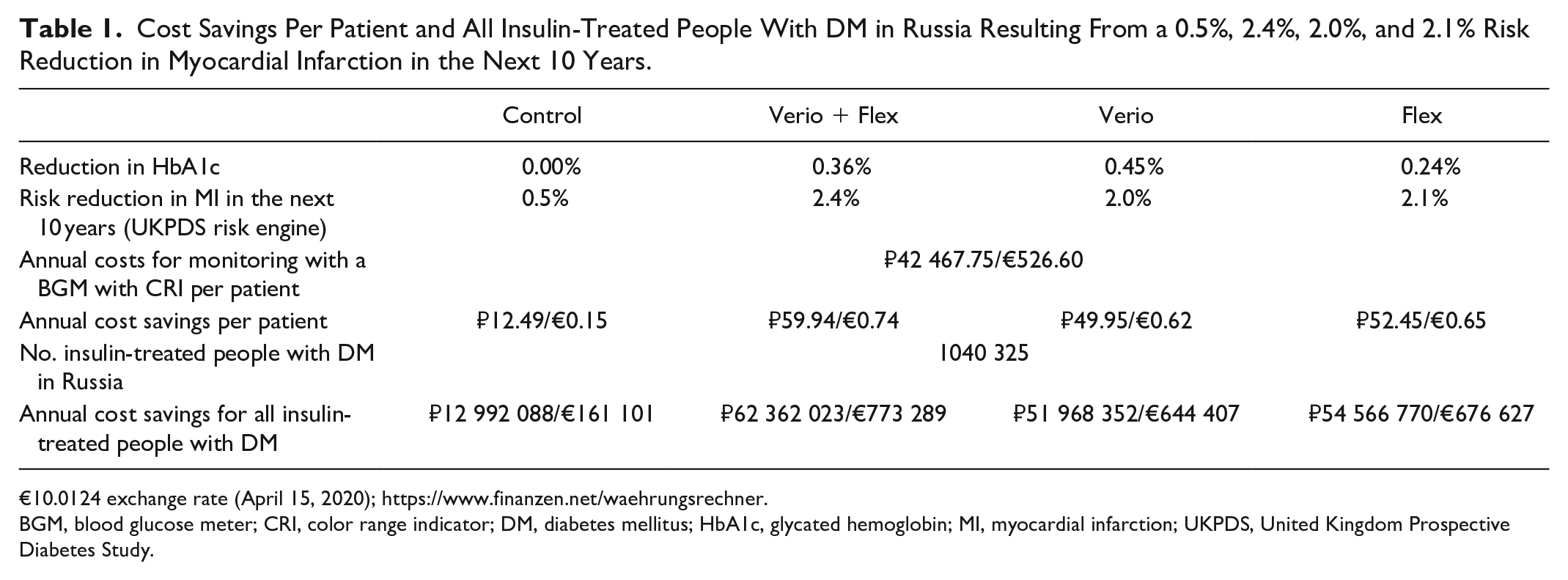
€10.0124 exchange rate (April 15, 2020); https://www.finanzen.net/waehrungsrechner.
BGM, blood glucose meter; CRI, color range indicator; DM, diabetes mellitus; HbA1c, glycated hemoglobin; MI, myocardial infarction; UKPDS, United Kingdom Prospective Diabetes Study.
According to the UKPDS risk engine, the above-mentioned improvement in glycemic control could result in a reduction of the 10-year risk for MIs of 2% (Verio) and 2.1% (Flex). Improvement of HbA1c values of 0.36% for the aggregated systems Flex + Verio could potentially result in a risk reduction for MI of 2.4%, in the following 10 years. 6 Adopting these specifications to the economic model, cost savings per year for the Verio group were estimated to be 51 968 352/€644 407. Potential cost savings of 54 566 770/€676 627 and 62 362 023/€773 289 per year for the Flex and for the Flex + Verio group, respectively, are possible for the healthcare system of the RF with 1040 325 insulin-treated patients with DM (Table 1).
It was shown that an improvement of metabolic control through the utilization of a BGM with CRI reduces the risk for MIs. These prevented MIs can result in cost savings for the healthcare system of Russia.
Footnotes
Declaration of Conflicting Interests
The author(s) declared the following potential conflicts of interest with respect to the research, authorship, and/or publication of this article: JAG and KF have no conflict of interest. LP and SS are employees of the Institute for Health Economics at Higher School of Economics Russia. HA, AM, JV and YH are full-time employees of LifeScan Inc. OS has acted as member of advisory boards and given lectures for companies which are involved in blood glucose monitoring; and is CEO and founder of Sciarc GmbH.
Funding
The author(s) disclosed receipt of the following financial support for the research, authorship, and/or publication of this article: This study was supported by LifeScan Inc.
