




Abstract

Keywords
Self-monitoring of blood glucose (SMBG) is essential in diabetes management. The Contour Next One glucometer is one of the latest glucometers, which provides blood glucose results through an instant color indicator that warns users when the blood glucose is at a critical level, either high or low. This study evaluates the effects of implementing blood glucose meter (BGM) featuring a color range indicator (CRI) on the clinical characteristics and glucose monitoring satisfaction (GMS) in patients with type 2 diabetes (T2D).
This prospective study conducted among 63 adults with T2D (aged 30-70 years, mean age 45.1 ± 7.2 years, and 50.8% females). These individuals normally utilized the conventional BGM (without CRI) to self-test their glucose levels at least twice daily or more. During the first study visit, demographic data, hemoglobin A1c (HbA1c) level, and hypoglycemic events were collected, and the study participants were given a BGM with CRI feature (Contour Next One glucometer). In light of assessing the degree of openness, emotional burden, behavioral burden, and trust, we used the T2D version of the glucose monitoring satisfaction survey (GMSS) questionnaire.1,2
Upon enhancing the blood glucose monitored by the spotlight-based glucometer, a significant improvement was evident in the factors of the GMSS subdomains openness (P = .0001), emotional burden (P = .0001), behavioral burden (P = .0001), trust (P = .0001), and total GMS score (P = .0001) at 12 weeks when compared to the baseline (Figure 1). Earlier studies had also mentioned that the CRI and wireless BGMs raised the levels of patient satisfaction. 3
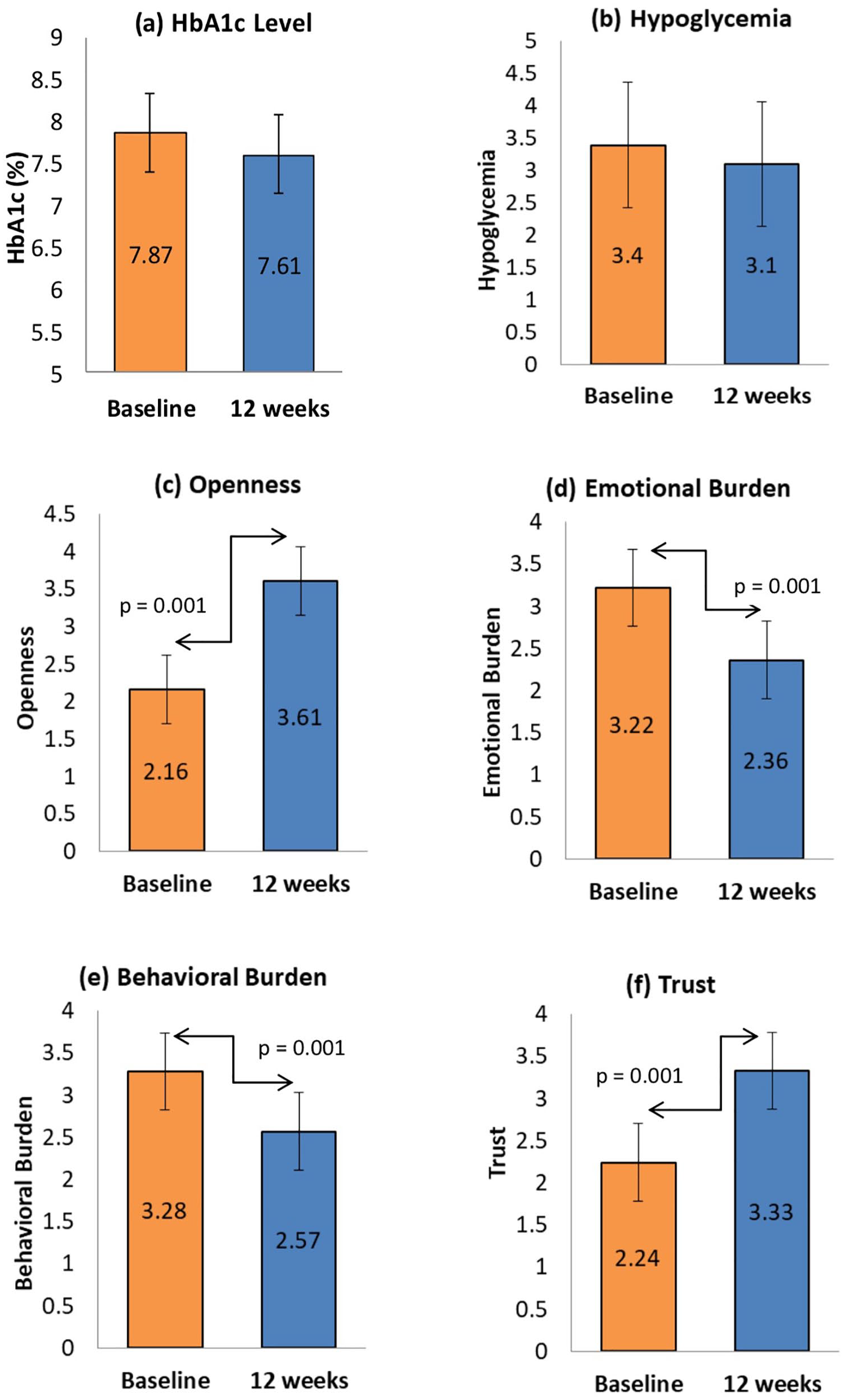
Influence of Contour Next One glucometer on (a) HbA1c, (b) hypoglycemia, and glucose monitoring satisfaction subdomains (c, d, e, and f).
It was evident that switching patients to BGM featuring a CRI, induced heightened glycemic control compared to patients using the BGMs without a CRI.4,5
However, in this present study, we noted a better HbA1c level (baseline 7.87% and at 12 weeks, 7.61%) and frequency of hypoglycemia (baseline 3.4 and at 12 weeks, 3.1 episodes/month) at 12 weeks, although they were not statistically significant (Figure 1). These findings may have been caused by the brevity of the study period and the fewer numbers of patients tested. However, it must be noted that the frequency of self-testing among the study population was 2.73 times/day at the baseline, while it was clearly higher in those using the one with CRI feature, that is, 3.14 (difference of 0.41 times per day). The literature revealed that the SMBG frequency recommended and will enhance glycemic control. Furthermore, from a study done in Germany, it became evident that the SMBG frequency showed a significant relationship with improved metabolic control and a lowering of the HbA1c by 0.20% for every single additional SMBG per day. 6
Conclusively, the findings clearly demonstrated that the use of a BGM featuring a CRI can raise the GMS subdomains, but not statistically significant differences on the HbA1c level and hypoglycemia. However, definitely, further studies are needed to establish whether the long-term and regular use of the CRI-based BGM will produce improved results in the GMSS.
Footnotes
Acknowledgements
The authors wish to acknowledge all the individuals who agreed to participate in this study.
Declaration of Conflicting Interests
The author(s) declared no potential conflicts of interest with respect to the research, authorship, and/or publication of this article.
Funding
The author(s) received no financial support for the research, authorship, and/or publication of this article.
