




Abstract
Background:
The primary objective was to determine if exposure to radiation has an effect on insulin pump function.
Method:
Four donated insulin pumps were filled with saline and set to identical program modes. They were attached together with a dosimeter and exposed to repeat CT scans.
Results:
Insulin Pump 1 experienced a “Prime” alarm and a darkened screen during CT scan radiation exposure; this pump was removed from further radiation exposure after 6 CT scans. Insulin Pumps 2, 3, and 4 all continued to receive 34 more consecutive CT scan exposures with no significant alarms, failures, or malfunctions. Insulin Pump 4 experienced “Low Battery” and “Stuck Button” alarms, both of which were easily fixed. Insulin Pumps 2, 3, and 4 received a total of at least 8576 mrem from 34 CT scans worth of radiation without any significant alarms, malfunctions, or failures. Insulin Pump 1 was monitored after being removed from the study and continued to function normally with the darkened screen.
Conclusions:
It cannot be determined whether Insulin Pump 1 had minor malfunctions due to repetitive use as a demonstration model or due to the radiation exposure. Insulin Pumps 2, 3, and 4 were monitored for 2 additional months following radiation exposure and continued to function normally. Further research studies with a larger number of insulin pumps are warranted to determine the true effect of radiation exposure on insulin pump function.
External insulin pumps are a mainstay of treatment for diabetes mellitus types 1 and 2. Persons with diabetes have various comorbidities and other problems that require radiographic diagnostic evaluation. Insulin pump manufacturers’ user guides state to “always remove your pump, sensor, transmitter, and meter before entering a room that has X-ray, MRI, diathermy, or CT scan equipment,” to prevent damage by the radiation in the vicinity of this equipment. 1 However, removing insulin pumps is risky for patients with diabetes and may lead to hyperglycemia and even diabetic ketoacidosis, a potentially life-threatening complication of diabetes. Furthermore, the research on insulin pump exposure to radiation is lacking, and these user guide recommendations are not based on researched data. Rather, they are precautions “assumed” to protect the patient from insulin pump malfunction.
According to the US Food and Drug Administration, there have been only a small number of reported adverse events that occur during computed tomography (CT) scan while patients are wearing insulin pumps. 2 These events, which include fainting, hypertension, heart failure, seizures, dizziness, and hypoglycemia, among others, could not be directly linked to insulin pump malfunction caused by CT radiation. 2
After a thorough review of multiple scholarly databases including Medline and CINAHL, we found the closest related research studies to be those involving intrathecal infusion pumps, implantable cardioverter defibrillators, and pacemakers. Furthermore, there is minimal proven research involving the effects of radiation on these devices as well.
In 2007, Wu and Wang reported one of the earliest cases of alarm and failure of an implanted programmable intrathecal pump in turn-off status after 20 daily radiation treatments with cumulative radiation doses estimated to be 28.5-36 Gy. The recommended cumulative radiation dose limit by the manufacturer at the time was 5 Gy. The Medtronic manufacturer technical pump analysis showed that the contents inside the pump remained unchanged without visible evidence of damage; however, the electronic circuit of the pump was damaged and the battery completely depleted. During the patient’s radiation treatment, the intrathecal pump was turned off but remained connected to the patient. No clinical or pathological damage to the patient was noted by the device being exposed to high-dose radiation. 3
In 2010, a systematic review was performed by Hudson et al to determine what current research was occurring to help explain the effect of radiation therapy on pacemakers and implantable cardioverter defibrillator (ICD) devices. This thorough systematic review included 23 articles between 1994 and 2008. The conclusion ultimately stated that radiation-induced device malfunction is rare, and data to support the current radiation precautions are lacking. 4 More studies and trials are needed to adequately determine the effects of radiation on these devices. Until then, precautions to protect patients need to be utilized.
Moreover, a 2013 study in Pain Medicine evaluated patients with implanted intrathecal drug delivery systems receiving radiation therapy. The cumulative dose of radiation the intrathecal pump received ranged from 5 to 45 Gy, and the devices were monitored for a median follow-up of 4.5 months. The results from the study showed that pump failure from external beam radiation therapy was a rare occurrence. The authors thus concluded that there is no need to limit radiotherapy in patients with intrathecal drug delivery systems as long as the device is checked for functionality after the completion of radiotherapy. 5
Having identified an untouched area of clinically relevant research, the authors set out to investigate whether the exposure of radiation to insulin pumps causes insulin pump malfunction. A secondary objective was to determine the level of radiation required to cause malfunction, if malfunction occurred. Ultimately, we expected these results to potentially translate from bench to bedside in preventing diabetic ketoacidosis and other sequelae caused by interruptions in insulin delivery during inpatient and outpatient radiographic evaluation.
Material and Methods
This research study was conducted in the department of Radiology, in close collaboration with the departments of Internal Medicine and Endocrinology, at a single campus of a large, multicampus, tertiary care health care network located in southeastern Pennsylvania. Because no human subjects were involved in this research project, it was deemed exempt from Internal Review Board oversight at our institution.
Four insulin pumps were donated for this study from 2 of the major insulin pump companies: Animas (Johnson & Johnson, West Chester, PA) and Medtronic (Medtronic, Minneapolis, MN). For the purpose of this article, these pumps will be referred to as Insulin Pump 1 (Animas Ping, used previously as a teaching model), Insulin Pump 2 (Medtronic 523), Insulin Pump 3 (new Animas Ping model), and Insulin Pump 4 (Medtronic 630 g). Each pump was filled with fresh identical saline (simulating insulin) and new batteries. The control state of each pump was based on the data documentation provided by the major insulin company brands that describe the baseline expectations of pump functioning. Each pump was used as its own control in the experiment, as no level of malfunctioning is acceptable for an insulin pump. The insulin pumps were allowed to run for 3 days prior to receiving radiation as a baseline of insulin pump function. All of the insulin pumps were set to identical programmed basal and bolus modes to ensure consistency and control (Table 1). Every 3 days, as is done for real patients, the tubing and reservoir sets were changed on the pumps. The insulin pumps continued to receive radiation until either a failure occurred or at least 30 CT scans of radiation exposure were endured, whichever happened first for each insulin pump.
Preprogrammed Modes of Insulin Pumps.
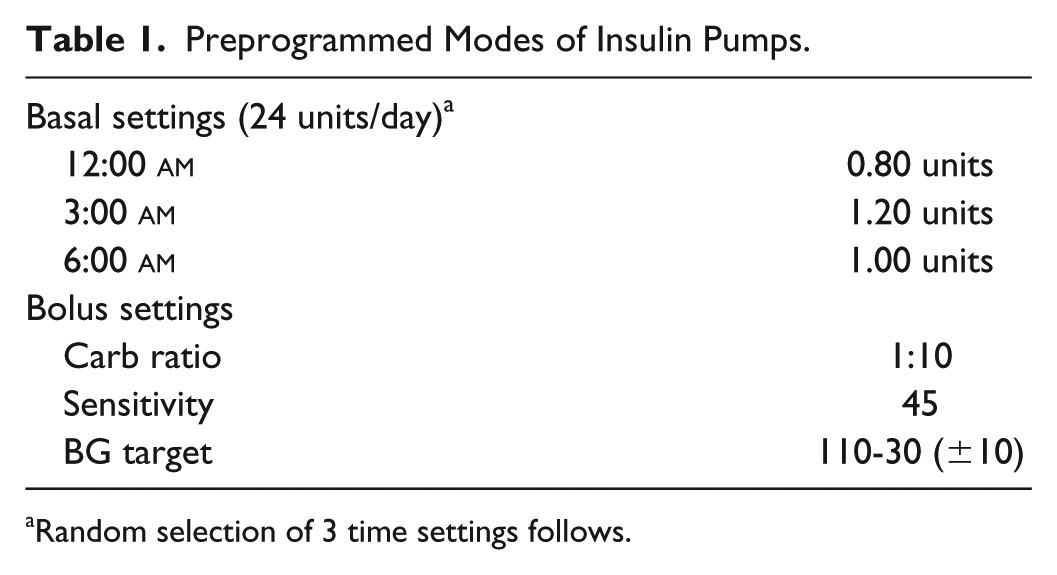
Random selection of 3 time settings follows.
The insulin pumps of each brand were treated equally during the duration of the experiment. The insulin pumps were attached together by rubber bands, placed on the table of the CT scanner, and received radiation from regular use of the machine (Figure 1). The insulin pumps were placed either above the patient’s head or at the level of the patient’s hip, depending on the type of CT scan and on the ideal pump placement for which the pumps would not interfere with the diagnostic imaging results. As a result, each insulin pump was exposed to radiation at the same time and, therefore, received the same dose of radiation without interfering with diagnoses or harming patients. Insulin Pumps 1 and 2 were subjected to 6 CT scans on 2 separate days. After this initial group of exposures, Insulin Pumps 3 and 4 were donated by the 2 companies to restart consecutive radiation exposure attempts. Insulin Pumps 2, 3, and 4 were exposed to multiple scans per day for 3 consecutive days to obtain an excessive amount of radiation exposure. Because Insulin Pump 1 showed a “Prime” alert along with a very darkened screen after 6 radiation exposures, it was excluded from this second group of radiation exposures. All of the insulin pumps were kept in suspended mode between radiation exposures.
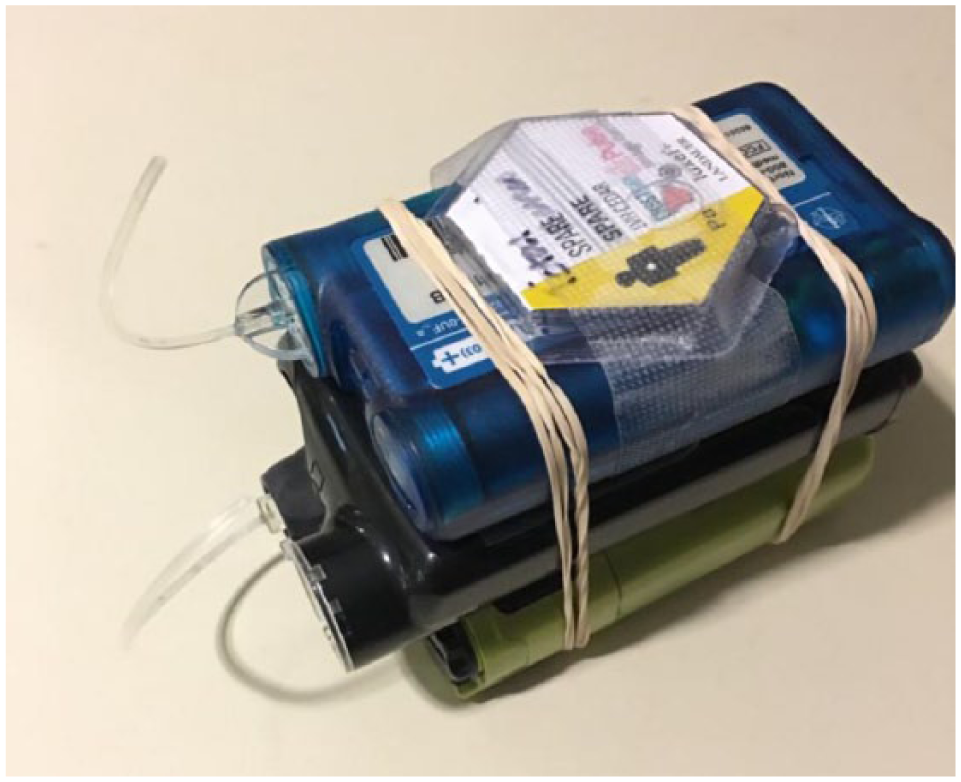
Image of dosimeter attached to insulin pumps during exposure to radiation.
Two dosimeters were used to allow radiation exposure to be measured and calculable. The first dosimeter went through a single CT scan of the abdomen/pelvis without contrast and then was sent for analysis to determine the amount of radiation in one CT scan of the abdomen/pelvis. The second dosimeter was attached by tape to the insulin pumps and remained with the insulin pumps for the duration of the radiation exposure, to calculate cumulative radiation exposure (Figure 1). The second dosimeter provides an accurate measured dose of cumulative radiation that Insulin Pump 2 received. The total radiation exposure for Insulin Pumps 1, 3, and 4 was then calculated using the data from both dosimeters.
To ensure continued proper functioning, insulin pumps were exposed to one CT scan, removed from the scanner, and tested by experiment personnel prior to being replaced in CT scan for further radiation exposure. All insulin pumps were checked for functionality, programmed insulin modes, abnormal bolus history, clock, and basic abilities in between each CT scan radiation exposure.
The programmed mode utilized for each insulin pump was identical (see Table 1). All settings, including basal rates, clock settings, carbohydrate coverage ratios, and so on, were checked on each insulin pump daily to ensure that no data were erased or altered due to radiation exposure. The bolus history was checked daily to ensure no unscheduled boluses were delivered. Insulin pump–associated, computer-based downloads were performed weekly to further analyze the insulin pump function and data storage abilities. Following exposure to radiation, the pumps were stored and monitored for an additional 2 months. Reservoirs were changed regularly. Functionality was confirmed weekly by assessing programmed insulin modes, abnormal bolus history, clock, and basic abilities.
The primary endpoint for the experiment was pump malfunction from baseline expectations compared to the manufacturers control expectations guidelines. Pump malfunction was determined by a pump not maintaining its programmed insulin mode, inaccurate bolus history, or not maintaining preset settings including time and date. The secondary endpoint was battery failure or alarms. The pumps were checked before and after each exposure to CT scan radiation to assure proper functioning.
Results
The documented types of CT scans, dates, times, and alarms for scans during which the insulin pumps were exposed to radiation are recorded in Table 2, which shows the date, type of CT scan imaging, and whether or not contrast was administered during the CT scan. In the event of an alarm, it also shows which insulin pump experienced the alarm and what type of alarm occurred. Dosimeter results were used to calculate the total cumulative radiation amount received over the entire course of radiation exposure.
CT Scan Radiation Exposure Raw Data Collection.
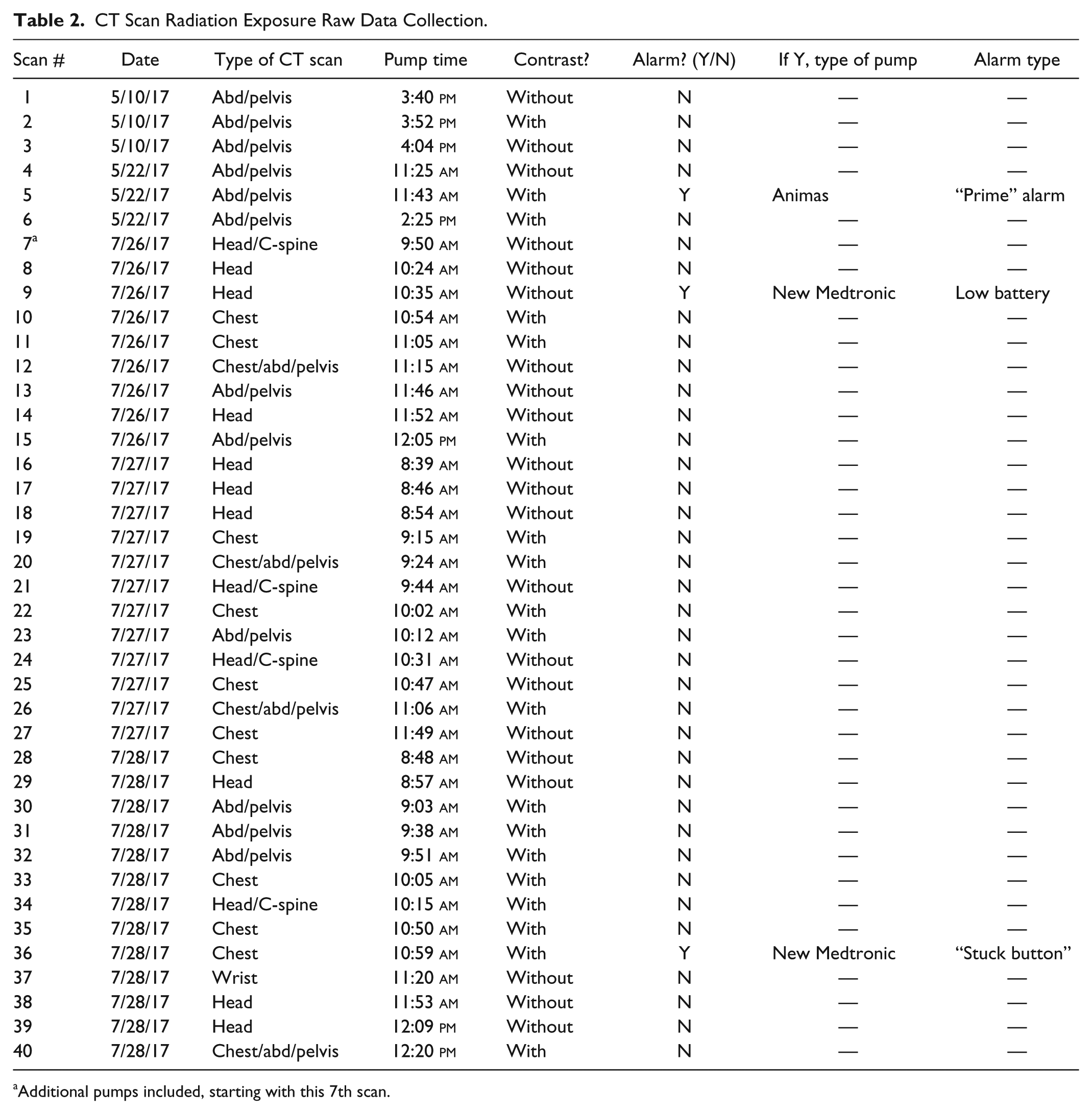
Additional pumps included, starting with this 7th scan.
As recorded by the second dosimeter, the total dose of radiation received by Insulin Pump 2 was 8612 millirems (mrem), or 0.08612 grays, over 40 CT scans. Insulin Pump 1 received a calculated amount of 36 mrem, based on the amount of grays measured by the first dosimeter, which received 6 mrem radiation from 1 CT scan of the abdomen/pelvis (without contrast). This number was then multiplied by 6 to reflect the number of CT abdomen/pelvis scans experienced by Insulin Pump 1. Insulin Pumps 3 and 4 experienced a total of 34 CT scans of varying types and a collective radiation dose of 8576 mrem—calculated by subtracting the estimated amount of mrem in the 6 CT abdomen/pelvis scans (36 mrem) from the total radiation recorded by the dosimeter that experienced all radiation (8612 mrem).
Insulin Pump 1 experienced a “Prime” alarm during 5th CT scan radiation exposure and was subsequently removed from the experiment after the 6th CT scan radiation exposure when a darkened screen was noted. Interestingly, this pump quickly underwent battery failure; after a battery change, the darkened screen did not improve. Insulin Pump 2 received 40 total CT scans exposures (varying types of scans) without any alarm, battery failure, or malfunction. Insulin Pumps 3 and 4 received radiation exposure from 34 CT scans of varying types without malfunction.
Insulin Pumps 2 and 3 did not require battery replacements at any point during the experiment; however, Insulin Pump 4 experienced 2 alarms—1 for battery level and 1 for “Stuck Button.” The low-battery alarm was easily remedied with a new battery, after which the pump resumed normal function. The “Stuck Button” alarm was due to the adjacent positioning of the insulin pumps, which caused one of the buttons to be pressed for an extended period of time. This alarm resolved and did not recur or lead to any additional problems. For 2 months following completion of the radiation exposure, all exposed pumps functioned normally on both manual inspection and serial computer pump download.
Discussion
Through this research study, we illustrate the first known attempt to determine the effects of radiation on insulin pump function by purposefully exposing them to radiation. These insulin pumps were exposed to far more CT imaging studies than any one person will experience in a brief period to push the limits of radiation exposure. Insulin Pumps 2, 3, and 4 received a collective total of at least 8576 mrem of radiation. In considering that the average person receives 350 mrem per year in background radiation exposure from cosmic and terrestrial sources, the amount of radiation to which the insulin pumps were exposed was considerable for the short duration of this study time period.
Insulin Pumps 2, 3, and 4 did not experience any malfunctions or failures during actual radiation exposure or in the subsequent postexposure period. A total of 3 alarms occurred throughout the research, one of which was critical in that the insulin pump needed to be primed. Given the age of Insulin Pump 1, it is possible that the “prime” alarm was reflective of the repetitive use of a “demonstration model” and not truly related to radiation exposure. Because no persistent level of malfunction is appropriate for an insulin pump, Insulin Pump 1 was removed from the experiment and no further data were collected for it.
Based on our findings, it is inconclusive whether Insulin Pump 1 malfunction occurred secondary to radiation exposure. Insulin pump companies should be urged to conduct similar simple studies with larger number of insulin pumps to reach further conclusions regarding the necessity of removing insulin pumps while undergoing radiographic diagnostic testing. Current manufacturer safety guidelines should be followed until larger studies, using insulin pumps of all ages and models, can be conducted to confirm the safety of insulin pumps after exposure to radiation.
A limitation of this study is embedded in the nature of the study: there is a low likelihood that a patient would have this concentrated radiation exposure over a 3-day period. Furthermore, although the insulin pumps were programmed to mimic normal function, they were not actually in use for bolus purposes. We also did not evaluate the accuracy of saline delivered during the basal mode. In addition, the use of saline in the pumps rather than insulin does not accurately reflect a functioning insulin pump. This small study focused on only two brands of insulin pumps and did not compare all commercially available insulin pump brands. Last, the prior history of use for each donated insulin pump could not be accounted for and therefore may have impacted the study results. Overall, this small pilot study can be used as a starting point to look at high frequency short-term radiation effects on insulin pumps.
Conclusion
Through this research, we demonstrate the first known purposeful exposure of insulin pumps to radiation to determine the effects of radiation on insulin pump functionality. On the basis of these study results, no conclusions can be made regarding insulin pump safety during radiation exposure. Further research with a larger number of insulin pumps should be conducted to determine the true effects of radiation on insulin pump function.
Footnotes
Acknowledgements
The authors are grateful to Jacqueline A. Grove, Medical Editor, for manuscript editing and formatting.
Abbreviations
Abd, abdomen; C-spine, cervical spine; CT, computed tomography; ICD, implantable cardioverter defibrillator.
Declaration of Conflicting Interests
The author(s) declared no potential conflicts of interest with respect to the research, authorship, and/or publication of this article.
Funding
The author(s) received no financial support for the research, authorship, and/or publication of this article.
