




Abstract
Dear Editor,
Adherence to blood glucose testing regimens can be challenging for adolescents with type 1 diabetes (T1D), compared with younger children whose parents assist them with testing.1,2 Mobile health technologies have been recommended for improving diabetes management among young people, 3 but not enough is known about acceptability in this population. In a cross-sectional survey, we assessed perceived barriers to diabetes management and beliefs about mobile health in children and adolescents with T1D.
Participants were recruited at diabetes clinics during routine office visits. A brief survey, adapted from previously developed instruments,4,5 assessed diabetes management, barriers to testing, and willingness to use a mobile app to manage diabetes. Eligibility criteria included a diagnosis of T1D for at least six weeks, age ≤22 years, English speaking, and willingness to provide consent/assent. Patients ≥12 years completed the survey. For patients <12 years, the parent/guardian completed the survey.
Between October and November 2016, 279 patients ≥12 and 131 parents/guardians completed surveys. A total of 66% of patients ≥12 years reported checking their blood glucose at least 4-6 times a day compared to 96.9% of parents of patients <12 years. HbA1c was below 8% in 43% of patients ≥12 years and 56.1% of younger patients.
In patients ≥12 years, 23.7% reported being too busy to test and 18.4% reported forgetting to carry testing supplies. In patients <12 years, 6.4% of parents reported their child being too busy and 9.9% reported their child forgetting to carry supplies. Over 45% of older patients, and 30% of younger patients, reportedly became distracted and forgot to test. Finally, over 57% of patients ≥12 years reported testing their blood glucose as much as they should, compared to 84.6% of younger patients.
Over 92% of patients ≥12 years reported carrying a cell phone daily, while 27.6% of parents reported their child <12 years carrying a phone (Table 1). Less than 25% of older patients reported regularly using a phone app to manage their diabetes compared to 23% of patients <12 years. However, 75% of adolescents and nearly 69% of parents of younger patients were at least somewhat willing to use a phone app for diabetes management. In addition, 67% of patients and 58% of parents/guardians thought a phone app could be somewhat helpful in improving blood glucose control.
Cell Phone Use and Attitudes on Mobile Health: Survey Responses from 279 Patients ≥12 years and 131 Parents of Patients <12 years in a Large Pediatric Diabetes Clinic, October-November 2016.
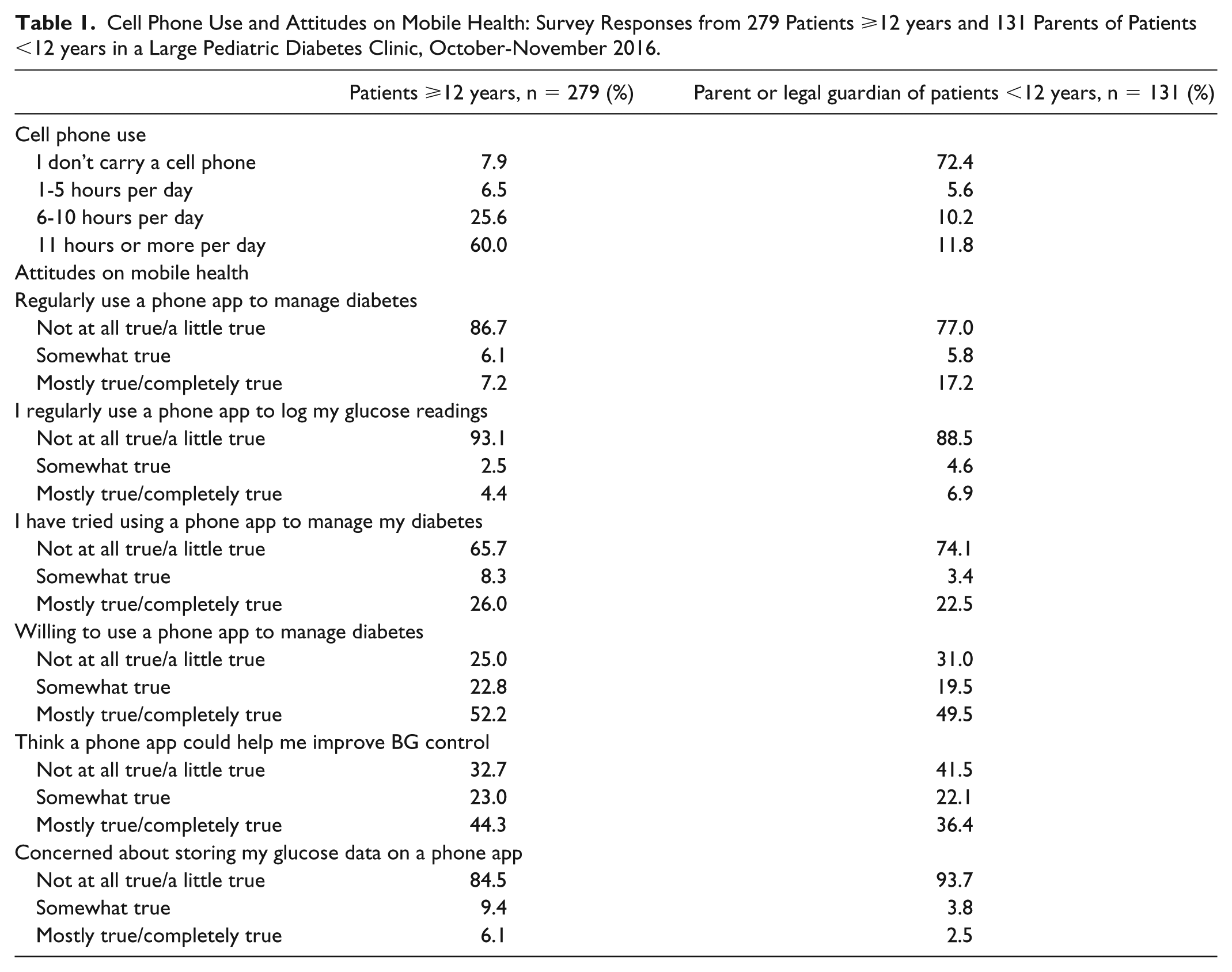
Our findings suggest that pediatric T1D patients often are too distracted or busy to test their blood glucose. Only two-thirds of adolescents tested at least the recommended 4-6 times per day, versus nearly 97% of children <12 years. This disparity between patients under and over 12 years, although potentially biased due to parental report, highlights a potential drop in adherence as children grow older and parents take less responsibility for their children’s diabetes management. A decline in self-monitoring from childhood to adolescence was noted by Miller et al. 2
Our finding of openness to app use should be followed by research on actual adoption of mobile health technology for T1D. There may be opportunities to incorporate patient perspectives while leveraging mobile health for interventions to improve adherence and outcomes in this population.
Footnotes
Acknowledgements
The authors would like to extend our thanks to the children and families who participated in this study, and to the staff who made the study possible: Lindsay Nicol, RN, CDE, Michele Borgstrom, RN, CDE, Jayne Chatterton, RN, CNP, and Jesse Hemphill, MBA, RD.
Abbreviations
HbA1c, hemoglobin A1c; T1D, type 1 diabetes.
Declaration of Conflicting Interests
The author(s) declared no potential conflicts of interest with respect to the research, authorship, and/or publication of this article.
Funding
The author(s) received no financial support for the research, authorship, and/or publication of this article.