



Abstract

Diabetes prevalence is high in long-term care facilities for dependent old persons. 1 Its control is difficult in insulin-treated residents since near half of them present with an increased risk of severe hypoglycemia because of a lack of awareness of warning symptoms and a loss of coordinated response. 2 Hypoglycemia is observed whatever diabetes control or HbA1c level 3 and is difficult to detect by 4 daily glucose readings or symptoms. 4 Increased blood glucose (BG) measurements is not desirable since several finger sticks/day are painful, annoying, and a burden for the medical staff. Therefore continuous glucose monitoring (CGM) could be relevant.
Thirteen residents (6 women, 7 men, mean ± SD age: 85.6 ± 8.6 years) were prescribed FreeStyle Libre (FSL-CGM; Abbott France S.A.S. Abbott Diabetes Care, Rungis, France). All suffered from type 2 diabetes and received daily insulin multiple injections. The study was in compliance with the World Medical Association’s Declaration of Helsinki and was approved by the State Geriatric Center Ethical Committee. Informed consent was obtained from all subjects or legal guardians. The sensor-based FSL-CGM was inserted under the posterior face of the arm and changed every 2 weeks for up to 10 months. It was scanned before each insulin injection and meal and at 10
CGM-FSL was well accepted in 9 residents and withdrawn by 4, with no difference in cognitive impairment or dementia. Comparing 302 paired BG and IG measurements revealed a tight correlation (linear regression: r = .955, P < .0001, IG = 1.022BG – 19.06); mean IG was significantly lower than mean BG with a mean absolute relative difference (MARD) of 19.7%. Out of 144 IG lower than 70 mg/dL, 74 (51.4%) were associated with BG equal or higher to 70 mg/dL. In our group of false hypoglycemia, IG was significantly lower than BG (56.8 ± 8.7 vs 89.6 ± 15.6 mg/dL, P < .0001, Wilcoxon paired test). Mean IG was significantly lower than BG for the 70-180 mg/dL BG group, with a MARD of 25.5%, and did not differ from BG in the >180 mg/dL BG group, with a MARD of 11.4% (Table 1).
Differences Between Blood Glucose (BG) and Interstitial Glucose (IG).
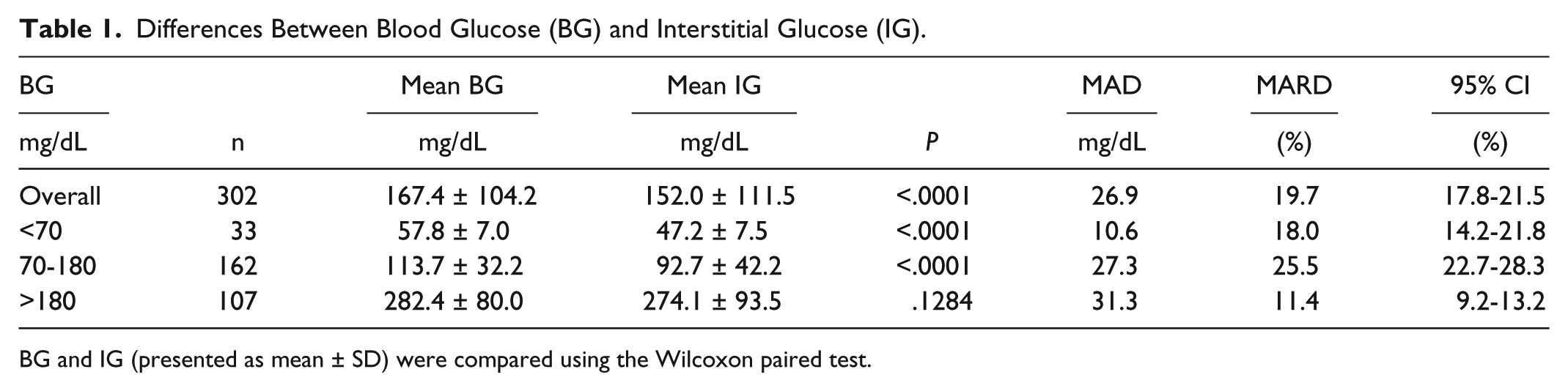
BG and IG (presented as mean ± SD) were compared using the Wilcoxon paired test.
Inaccuracy of FSL-CGM in the lower glucose values, which could be due to age-induced skin changes, 5 is therefore a strong limitation in the detection of hypoglycemia risk in older residents in our study. IG lower than 70 mg/dL in the absence of clinical signs needs capillary BG measures, thus reducing FSL-CGM benefit on resident comfort. Improvement of FSL-CGM performance in the low and middle IG range is of clinical relevance for reliable detection of hypoglycemia and better evaluation of diabetes control. The ability to fix the upper target glucose at 200 mg/dL instead of 180 mg/dL should also be included since 100-200 mg/dL is the BG target range in this population. 6
Footnotes
Acknowledgements
The authors thank doctors D. Frant, L. Mari, F. Masseboeuf, I. Moussa and the nurses of the State Geriatric Center for their contributions to the study.
Abbreviations
BG, blood glucose; CI, confidence interval; FSL-CGM, Freestyle Libre continuous glucose monitoring; IG, interstitial glucose; MAD, mean absolute difference; MARD, mean absolute relative difference.
Declaration of Conflicting Interests
The author(s) declared no potential conflicts of interest with respect to the research, authorship, and/or publication of this article.
Funding
The author(s) disclosed receipt of the following financial support for the research, authorship, and/or publication of this article: This study has been performed with a grant of ARARD (Association régionale d’assistance respiratoire à domicile), 100 Avenue des Templiers, 13400 Aubagne, France.