




Abstract

Glucose meters differ from many other analytes since for some time, glucose meters have had accuracy performance standards for patient samples. The ISO 15197 standard of 2003, while for home glucose meters, was adopted by the Clinical Laboratory Standards Institute (CLSI) C30-A2, to specify glucose meter performance for point-of-care testing (POCT) meters. I critiqued these standards1-3 since, among other things, they left 5% of the results as unspecified.
In 2013, CLSI issued an updated standard which had more narrow limits but still left 2% of the results as unspecified. 4 This prompted another critique, 5 and in 2014 the Food and Drug Administration (FDA) issued a draft guidance that had a remarkable statement: “FDA believes that the criteria set forth in the ISO 15197 standard do not adequately protect patients using BGMS devices in professional settings, and does not recommend using these criteria.” FDA also issued performance limits for 100% of the data.
But now, in 2016, FDA has released an updated guidance, 6 which is no longer a draft, which again leaves 2% of the results as unspecified!
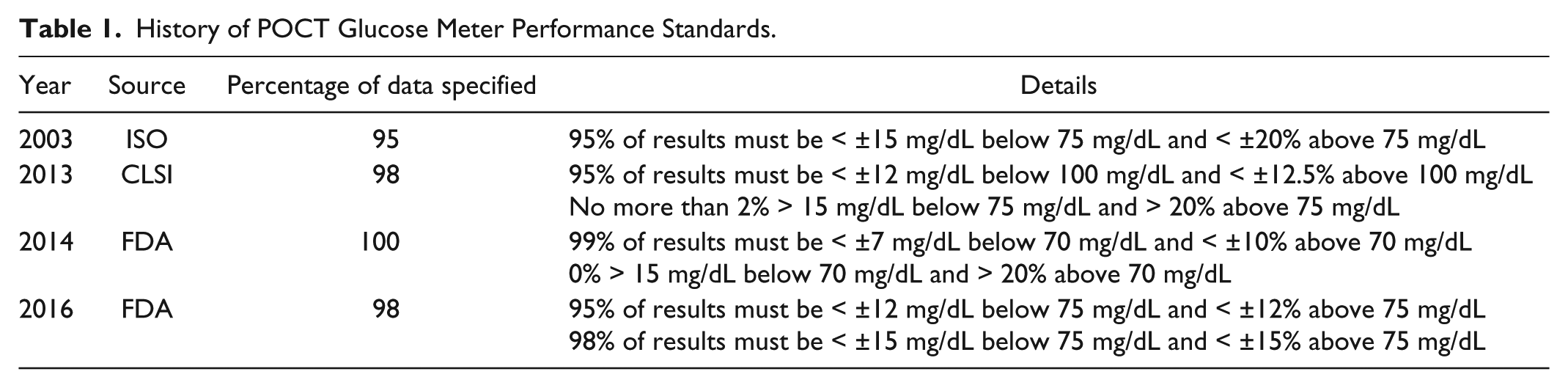
A summary of the performance limits is listed in Table 1.
History of POCT Glucose Meter Performance Standards.
One argument that has surfaced is that one can never prove that 100% of the results will fall within limits. While this is true, it is illogical to use this fact as a reason to exclude a percentage of results from being specified. Nor does one see this in other medical arenas. Thus, one does not hear that 98% of surgeries should be performed on the correct site.
A simple remedy is to use an error grid for 100% of the data.
Footnotes
Abbreviations
CLSI, Clinical Laboratory Standards Institute; FDA, Food and Drug Administration; POCT, point-of-care testing.
Declaration of Conflicting Interests
The author(s) declared the following potential conflicts of interest with respect to the research, authorship, and/or publication of this article: JSK is an employee of Krouwer Consulting.
Funding
The author(s) disclosed receipt of the following financial support for the research, authorship, and/or publication of this article: This work was funded by Krouwer Consulting.