




Abstract
Next June will see the 10th anniversary of the launch of the iPhone. Without a doubt the impact of the smartphone has been enormous, and for the diabetes community the continued growth in smartphone use has major implications going forward—for example, more than half of patients/consumers now say that they want to be able to interact with their clinicians through smartphones and mobile apps. 1 Furthermore, “liquid expectations,” when favorable experiences with consumer products (such as the iPhone and the anticipation of new versions each year) raise expectations in another industry (health care in this case), are raising the pressure on health providers to modernize and embrace consumer technologies.
Interest in and adoption of digital health is biased toward younger individuals (more than half of 18- to 34-year-olds report owning at least one health-monitoring device). However, increasingly people with diabetes see themselves as consumers and appear to be enthusiastic about their own ability to monitor their health. Effective health monitoring will require progressively better data integration and sharing. In the United States many large hospitals are providing apps but less than 2% of their target populations use them because of a combination of poor experience, unappealing design and inept functionality. 1 Ignoring the needs of individuals and building technologies that try to cover all possibilities is a guaranteed failure—the needs and expectations of millennials, generations X, Y, and Z are very different from older populations and the technologies will need to take this into consideration. A one-size-fits-all medical app will be an expensive dud.
The Federal Communications Commission has already posted five questions to “ask your doctor about digital health.” 2 Being unable to answer them will not be perceived as up to date.
I’ve heard that digital tools can help me get healthier or stay well. What can you tell me about digital health?
Are there any digital health tools that would be particularly useful given my diagnosis?
Does your practice have a patient portal?
Does your patient portal include e-visits?
What are the best sources of health information for patients on the Web?
In June 2016 the US Food and Drug Administration (FDA) published guidance for the medical device industry (which will presumably include developers of smartphone applications) indicating that “manufacturers may share patient-specific information recorded, stored, processed, retrieved, and/or derived from a medical device with the patient who is either treated or diagnosed with that specific device.” 3 The challenge for industry is the specific recommendation that the information should be “interpretable” and “useful” by patients.
Current Use of Diabetes Apps
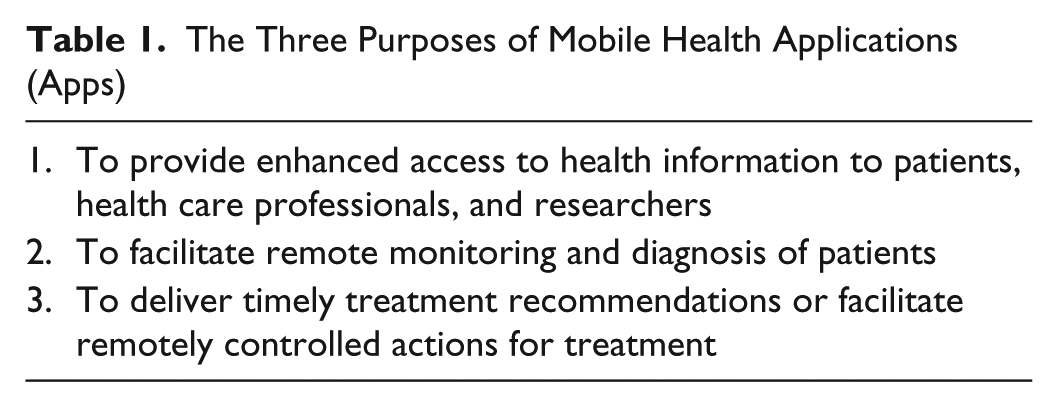
The three purposes of mobile applications are listed in Table 1. Although it is almost a cliché to say “There’s an app for that!” 4 the reality is that the majority of people with diabetes have not adopted apps as an aid in the management of their diabetes. For those individuals who have access to a smartphone or other mHealth-capable device—only 1.2% had used a diabetes app by the end of 2013. 5 However, the same article predicted that by 2018 uptake of apps would be up to 7.8% of patients with diabetes. More recently another report has indicated that for apps provided by US hospitals (66% of total), a paltry 2% of their target audience actually used them due to a combination of poor experience, unappealing design and inept functionality. 1 Furthermore professionals remain cautious in their recommendations of health apps and some have labeled them as “pure snake oil.” 6
The Three Purposes of Mobile Health Applications (Apps)
Development and Adoption of Diabetes Apps
Four factors are expected to drive increased use of apps for health: (1) the increasing number of people with diabetes, (2) the evolution of mobile apps from standalone products to bundled products that leverage the app as a tool to sell devices (eg, glucose monitors and wearable glucose sensors) and services (eg, remote monitoring and consultation), (3) an increasing total supply of apps that adapt best practice guidelines, and (4) a trend toward reimbursement of diabetes app costs by payers in countries with high expenses for diabetes patients. 7 For developers of smartphone the current greatest roadblocks to adoption and use of smartphone applications can be summarized:
Failure to define the target population
Failure to define the metrics of success
Failure to create a reliable business model
The evidence that mobile apps can provide meaningful clinical benefit is almost nonexistent. There are certainly clinical and regulatory concerns over the safety of mobile applications serving as insulin dose calculators. 8 Consequently, few apps stand the test of time. Without evidence of proper architecture, quality control for the safety of therapeutic recommendations, standardized metrics for assessing mobile health care and outcomes, and evidence of improved outcomes in peer-reviewed medical journals, payers are reluctant to support apps and clinicians are distinctly reluctant to suggest them to people with diabetes.
A recent review article of diabetes mobile applications focused on commercially available diabetes applications with one of three features: (1) an association with published data of recent clinical outcomes in the peer-reviewed literature defined as between 2011 and 2015, (2) clearance by the FDA in the United States, or (3) receipt of a CE Mark by the European Union (EU). Only 14 such applications were identified that met even one of these three criteria. These applications provided either guidance for insulin management via a dose calculator, feedback based on BG pattern analysis independent of the health care team, and/or a capacity for data sharing with family and health care professionals. 9 There is a great opportunity to develop sound mobile applications for improved outcomes that meet any of these three specified features.
The Digital Diabetes Ecosystem
New digital technologies, including wearable and implanted sensors and effectors now comprise part of a new digital ecosystem of data-driven tools that can link patients and their care teams and can enable precision management of diabetes. 10 These devices will increasingly provide physiologic, behavioral, and contextual data that will be measured, transmitted, stored, and analyzed. Typically, data collected for a mobile application will be transmitted to a mobile device (to be analyzed on a chip) or to the cloud. There the mobile application data will be analyzed, stored, aggregated with other data streams from multiple sensors by way of sensor data fusion techniques, 11 converted into useful information, and presented to the device user. This information will be organized into patterns that will provide knowledge about the patient’s current situation. The final step in processing of digital diabetes data from devices is one of three outcomes that will result in actionable information. First, the data can be sorted out into specific labeled patterns that can assist patients to make treatment decisions based on self-management principles. (The patient decides and the patient acts.) Second, the data can be assimilated into recommendations by the application for specific actions based on preprogrammed clinical guidelines and treatment algorithms. (The device decides and the patient acts.) Finally, the patterns can be inked to an effector that will automatically act based on a preprogrammed treatment algorithm, and this is what occurs with a closed loop artificial pancreas system. (The device decides and the device acts.)
Usability
Five major hurdles must be overcome to facilitate widespread adoption of digital diabetes technology, including demonstration of the following: (1) privacy to satisfy legal regulators of personal information (eg, US Department of Health and Human Service’s Office for Civil Rights), (2) security to preserve safety and satisfy product safety regulators (eg, US FDA), (3) clinical benefit to satisfy clinicians, (4) usability (which can be defined as a combination of effectiveness, efficiency, and satisfaction 12 to satisfy patients), and (5) economic benefit to satisfy payers. Digital health for diabetes is making rapid strides and is expected to be a transforming technology that will be the next big thing.
The usability obstacles with some mobile applications can be particular problematic with older diabetes patients. 13 Their main difficulties appear to be (1) poor understanding of the functionality of the apps, (2) poor understanding of the menu navigation/labeling, (3) small fonts and figures, and (4) difficulties in recognizing and pressing touch-sensitive areas. Many potential users also report that existing apps lack individually important functions or contain functions that are unnecessary for personal needs. The most important functions of a helpful diabetes app in this population include (1) the ability to add remarks to measured values, (2) definitions of thresholds for blood glucose values, (3) highlighting of deviating values, and (4) a reminder feature for measurements and medication use.
The Digital Diabetes Meeting
At Diabetes Technology Society we believe that Digital Diabetes Health DOES have a future and offers a tremendous opportunity to reduce the burden of diabetes and health care costs by permitting greater self-management. The result can be more timely decisions without a patient having to wait for an every three- or six-month visit. At the same time, mobile apps can be developed to allow either real time or delayed communication between patients and health care professionals without the need for an office visit.
Diabetes Technology Society will launch the Digital Diabetes meeting in 2017 in San Francisco, California. The meeting will cover the following “Diabetes Digital Dozen” topics related to mobile applications for diabetes:
Pathway to regulatory approval
How to create a successful app and the metrics of success
Defining the populations
User interface/user experience including the role of gamification
Social media
Promoting adherence
What an investor looks for
Business modeling
Value added opportunities for pharma and devices
Data streams from multiple sensors
Cybersecurity and privacy
Integration into the electronic medical record.
We believe this is an excellent time to bring together developers and users of mobile applications as well as stakeholders from the clinical, scientific, industry, entrepreneur, regulator, and payer communities to promote development of better modern communication tools for diabetes patients.
Footnotes
Acknowledgements
The authors thank Annamarie Sucher for her expert editorial assistance.
Abbreviations
EU, European Union; FDA, Food and Drug Administration.
Declaration of Conflicting Interests
The author(s) declared the following potential conflicts of interest with respect to the research, authorship, and/or publication of this article: DCK is a consultant for Ascensia, Lifecare, Sanofi, Tempramed, and Voluntis. DK is an advisor to www.Glooko.com and creator of www.Excarbs.com and www.Diabetestravel.org. He has also received honoraria from NovoNordisk and Sanofi for speaking on the subject of Digital Health. You can follow him on Twitter  .
.
Funding
The author(s) received no financial support for the research, authorship, and/or publication of this article.