




Abstract

The use of technology for managing obesity is receiving much attention, and there are hundreds of smartphone applications (apps) that allow users to quickly determine the calorie content of food and tally energy intakes.1,2 Calorie needs can be adjusted based on physical activity, and some apps generate personalized text messages to further motivate users. Several studies have demonstrated the efficacy of smartphone apps for weight loss; 3,4 however, the level of sophistication and detail needed to produce successful outcomes are not known. We recently demonstrated that significant weight loss was achieved simply by tracking dietary intakes. 5 Possibly, effective self-monitoring of diet may be achieved using simple modalities. The aim of this research was to examine the feasibility of using food photography via a smartphone app to lose weight.
Thirty healthy adults who desired to lose weight (<60 years and body mass index > 24 kg/ m2) were stratified and randomized into 1 of 3 smartphone app groups: the MyDietitian app (PIC), which encourages users to track daily dietary intake by taking pictures of foods and beverages ingested each day (MyDietitian, LLC, http://www.mydietitian.com); the MyDietitian app with the added feature of daily feedback from a registered dietitian (PIC-RD) (a 2- to 3-sentence text or video message was sent to the user daily commenting on the food intake that day); or the MyDailyPlate app (PLATE), which encourages users to follow the USDA’s MyPlate guidelines (eg, the plate’s food groups graphically filled as foods were entered; GigaChef, LLC, http://cookingdistrict.com/mydailyplate). These apps did not provide detailed feedback regarding caloric intake or caloric expenditure; rather, these apps used only food photography or food graphics to track diet.
At trial weeks 0, 4, and 8, participants were weighed and waist circumference and blood pressure were measured. In addition, a fasting blood sample was collected to measure C-reactive protein, blood lipids, hemoglobin A1c, glucose, and insulin. The study was approved by the Institutional Review Board at Arizona State University.
App adherence (number of days that the app was used for diet tracking divided by 56) was 53%, 61%, and 69% for the PIC, PIC-RD, and PLATE groups, respectively (P = .529). The 8-week change in body weight did not vary significantly between groups or over time (Figure 1). However, across all diet groups, the 8-week change in body weight was significantly related to percentage of adherence (r = –.554, P = .004) (Figure 1). Self-reported physical activity (kcal· kg−1· wk−1) did not differ significantly between groups or over time. Biomarkers did not change significantly between groups during the study; however, 3 biomarkers improved significantly (P < .05) when data were combined for all groups: high density lipoprotein (+3.10 ± 5.5 mg/dL), hemoglobin A1c (−0.14 ± 0.19%), and waist circumference (−2.8 ± 2.5 cm).
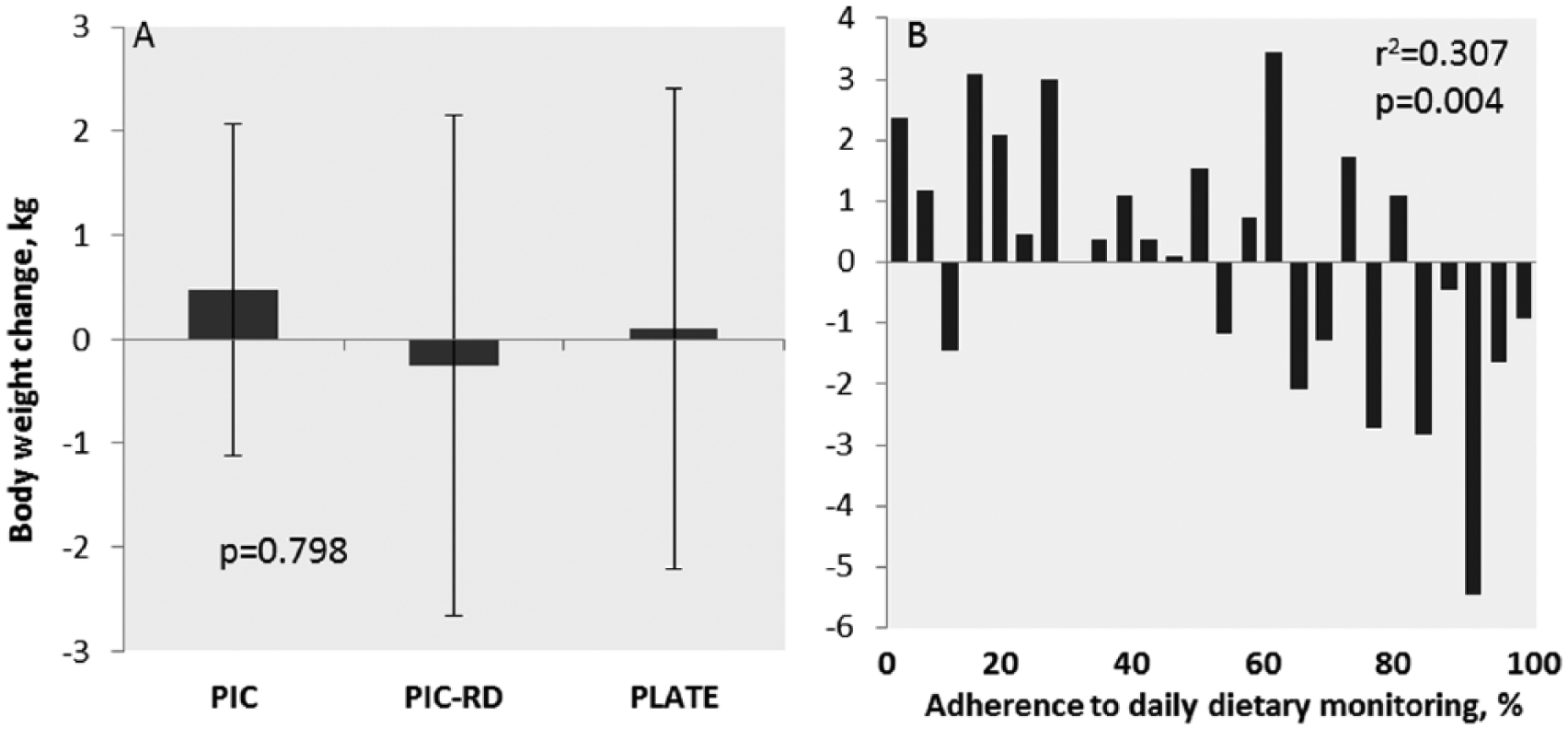
Eight-week change in body weight by (A) diet app group, mean ± SD, or (B) individual participant as a function of daily diet tracking adherence. Intention-to-treat analysis followed; N = 26 (n = 8, 8, and 10 for the PIC, PIC-RD, and PLATE app groups, respectively). Mean data analyzed using 1-way analysis of variance, and the partial correlation analysis controlled for diet app group.
We suggest that focusing on diet details, such as calories and energy expenditure, may not be necessary for behavior change and weight loss; rather, regular diet monitoring (>60% of days) by any technique may be the key component for successful weight loss. A food photography protocol for promoting awareness of eating behavior may prove a useful self-monitoring technique for weight loss.
Footnotes
Acknowledgements
The authors thank Darren Snyder, MS, RD, Ginger Hook, RN, and Cassandra Smith, RT, for excellent technical assistance.
Abbreviations
PIC, MyDietitian app; PIC-RD, MyDietitian app with added function of daily feedback from a registered dietitian; PLATE, MyDailyPlate app; RD, registered dietitian.
Declaration of Conflicting Interests
The author(s) declared no potential conflicts of interest with respect to the research, authorship, and/or publication of this article.
Funding
The author(s) disclosed receipt of the following financial support for the research, authorship, and/or publication of this article: Funding for this research was received from the Graduate and Professional Students Association and the Office of the Vice Provost for Research at Arizona State University. Dr Michael Tingey, CMO MyDietitian, provided a monetary gift to support blood analyses for this research.