




Abstract

A growing body of evidence suggests that continuous subcutaneous insulin infusion (CSII) therapy with tubed insulin pumps improves glycemic control in patients with type 2 diabetes.1-4 Although recent studies have demonstrated improved glycemic control and treatment satisfaction among type 1 diabetes patients using a tubeless patch pump,5,6 use of this technology in individuals with type 2 diabetes has not been well studied.
We report findings from a multicenter, retrospective study that assessed glycemic control in type 2 diabetes patients after 3 months treatment with a tubeless patch pump (Omnipod®, Insulet Corporation, Billerica, MA) compared to previous treatment with multiple daily injections (MDI). The primary outcome was change in mean HbA1c level from baseline at 3 months post–patch pump treatment initiation. Secondary outcomes included change in mean total daily dose (TDD) of insulin, shifts in HbA1c to target levels (American Diabetes Association [ADA] and Healthcare Effectiveness Data and Information Set [HEDIS]) and change in the frequency and severity of hypoglycemic episodes per week.
A total of 81 patients with type 2 diabetes previously treated with MDI therapy were included in the study. Baseline characteristics were (mean [SD]) age 52.9 (10.6) years, 49% female, 6.2 (3.3) years diabetes duration, 9.1% (1.8) HbA1c, and 1.3 (2.2) reported hypoglycemic events per week.
In our analyses, patients treated with the patch pump showed a significant (P < .001) reduction in mean HbA1c level of −1.2% (1.4) from baseline on MDI therapy at 3 months (Figure 1A). A significant decrease in TDD was also observed (Figure 1B). This decrease of nearly 30% in total daily insulin requirement with patch pump treatment compared to MDI has important potential clinical and economic impact for patients with poorly controlled type 2 diabetes, particularly those with high insulin requirements.
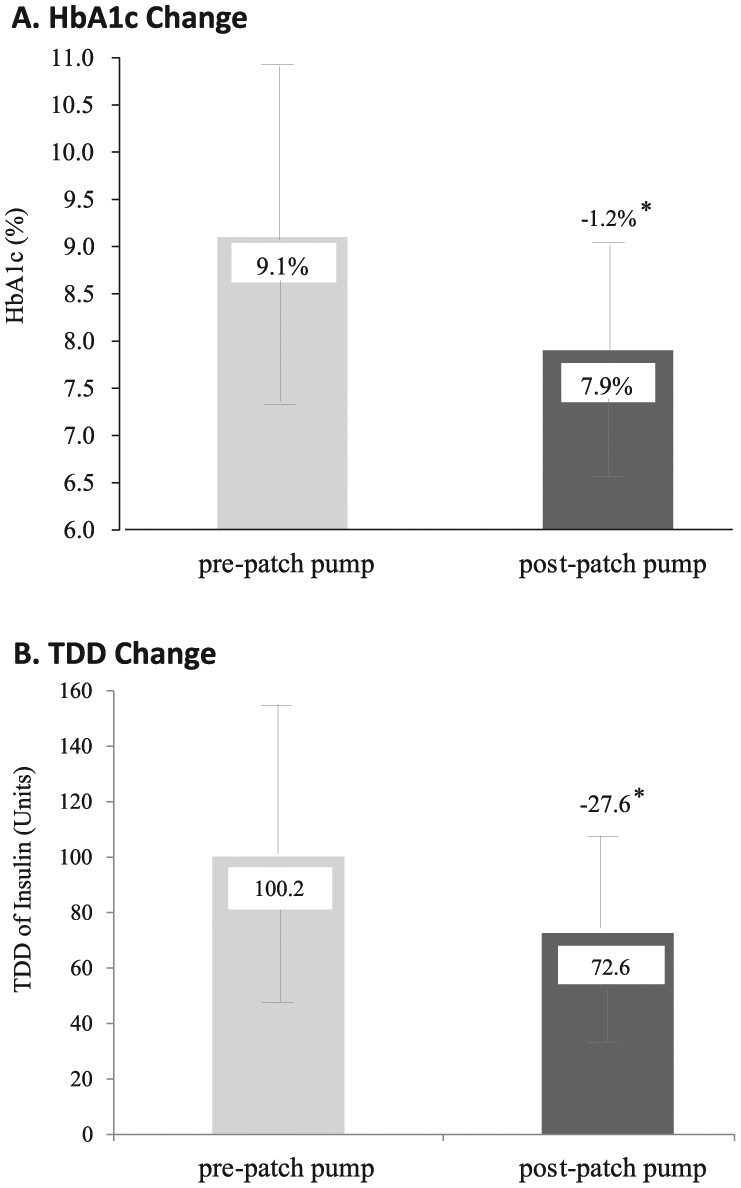
Change in HbA1c level and total daily dose (TDD) of insulin from baseline on MDI therapy at 3 months post–patch pump treatment initiation. (A) Decrease in HbA1c level (mean ± SD) of 1.2% ± 1.4% (–13 ± 15 mmol/mol) from baseline on MDI therapy (pre–patch pump) versus post-patch pump at 3 months. (B) Decrease in TDD (mean ± SD) of 27.6 ± 30.9 units of insulin from baseline on MDI therapy (pre-patch pump) versus post–patch pump at 3 months (n = 80). *P < .001.
There was an 18.8% change increase in the number of patients achieving a target HbA1c level of <7.0% and a 71.4% change increase in the number of patients achieving an HbA1c level of 7% to 8%. Decreases were observed for the proportion of patients in the higher HbA1c categories of 8% to 9% and ≥9%. Similarly, significant improvements (P < .001) in HbA1c levels were also observed at 3 months as categorized by HEDIS measures of adequate glycemic control.
Importantly, study patients reported a 46.2% reduction in the number of hypoglycemic episodes per week following 3 months of patch pump use, from 1.3 (2.2) to 0.7 (1.0), P = .004. Patients also reported statistically significantly reductions in the severity of hypoglycemic events from 1.7 (1.6) to 1.4 (1.4), P = .008.
In summary, use of the patch pump was associated with clinically meaningful and statistically significant improvements in HbA1c, reductions in daily insulin requirements, and reductions in the frequency of hypoglycemic events in patients with type 2 diabetes previously treated with MDI.
Footnotes
Abbreviations
ADA, American Diabetes Association; CSII, continuous subcutaneous insulin infusion; HEDIS, Healthcare Effectiveness Data and Information Set; MDI, multiple daily injections; TDD, total daily dose.
Declaration of Conflicting Interests
The author(s) declared the following potential conflicts of interest with respect to the research, authorship, and/or publication of this article: JEL and HZ are employees of Insulet Corporation. CGP has received consulting fees from Dexcom, Inc, Insulet Corporation, Roche Diabetes Care, and Sanofi.
Funding
The author(s) disclosed receipt of the following financial support for the research, authorship, and/or publication of this article: Funding for this study was provided by Insulet Corporation.