



Abstract
Background:
Apps using digital photos to track dietary intake and provide feedback are common, but currently there has been no research examining what evidence-based strategies are included in these apps.
Methods:
A content analysis of mobile apps for photo diet tracking was conducted, including whether effective techniques for interventions promoting behavior change, including self-regulation, for healthy eating (HE) are targeted. An initial search of app stores yielded 34 apps (n = 8 Android and Apple; n = 11 Android; n = 15 Apple). One app was removed (unable to download), and other apps (n = 4) were unable to be rated (no longer available). Remaining apps (n = 29) were downloaded, reviewed, and coded by 2 independent reviewers to determine the number of known effective self-regulation and other behavior change techniques included. The raters met to compare their coding of the apps, calculate interrater agreement, resolve any discrepancies, and come to a consensus.
Results:
Six apps (21%) did not utilize any of the behavior change techniques examined. Three apps (10%) provided feedback to users via crowdsourcing or collective feedback from other users and professionals, 7 apps (24%) used crowdsourcing or collective feedback, 1 app (3%) used professionals, and 18 apps (62%) did not provide any dietary feedback to users.
Conclusion:
Few photo diet-tracking apps include evidence-based strategies to improve dietary intake. Use of photos to self-monitor dietary intake and receive feedback has the potential to reduce user burden for self-monitoring, yet photo diet tracking apps need to incorporate known effective behavior strategies for HE, including self-regulation.
Rates of overweight and obesity remain high among US adults. 1 Chronic diseases such as type 2 diabetes, cardiovascular disease and hypertension are significantly associated with being overweight or obese.2,3 Evidence-based behavioral change techniques exist for promoting healthy eating (HE) and physical activity (PA) for weight loss. Mobile health (mHealth), which is the use of mobile devices to monitor health behaviors and improve health outcomes, is a rapidly growing method of implementing behavioral interventions,4-7 as smartphone ownership remains prevalent among US adults (64%). 8 The use of mobile devices to access health information has risen dramatically in recent years, with 52% of smartphone owners now using their devices to access health information. 9 Moreover, minority populations including Latinos and African Americans are more likely than non-Hispanic whites to access health information using their smartphones. 9
Current estimates are that one-fifth of smartphone users have ever downloaded and used at least 1 health-related app, and that diet, PA, and weight loss apps remain the most popular among those apps available. 9 While mobile apps for weight loss are prevalent, most do not include evidence-based strategies and there is poor integration of these apps in weight loss interventions.10-15 Adherence to diet self-monitoring is a key component of weight loss.16,17 Previous studies have demonstrated that frequency of self-monitoring is significantly associated with weight loss6,16 and that frequency of and adherence to self-monitoring is more important for weight loss than accuracy of nutritional data tracked. 18
While adherence to self-monitoring is important for weight loss, most weight loss apps that include diet self-monitoring could be perceived by users as burdensome, as they require users to search for the calorie content of individual food items and beverages consumed or scan a barcode for tracking purposes.19,20 Furthermore, users tend to underestimate portions consumed when self-monitoring diet, which could pose problems for those managing their diets to achieve weight loss and reduce chronic disease (eg, type 2 diabetes). 21 The use of smartphone cameras to instantaneously record diet (just-in-time reporting) helps to address these barriers.21,22 Recent studies of photo-based dietary assessment methods found that photos taken with a smartphone can provide a valid assessment of dietary intake among adults and adolescents.21-23
Dietary assessment, however, differs from dietary self-monitoring in that self-monitoring requires the immediate provision of feedback to help users regulate dietary intake for weight loss. To be accessible for diverse populations (eg, low-income, low-literacy), methods of self-monitoring must be cost-effective and easy to use. Crowdsourcing, which includes soliciting information provided by several sources as a low-burden approach to garnering feedback, has been used in the past to rate dietary quality of foods self-monitored via photo using a mobile app. 24 A crowdsourcing approach could potentially be used to provide feedback and social support to users regarding diet quality of foods photographed via mobile app to promote weight loss in a cost effective manner to diverse populations.
To our knowledge there have been no content analyses conducted to examine photo diet tracking apps available for weight loss. In addition, to our knowledge there have been no analyses that examined the health behavior change features present in these types of apps. This present analysis includes a content analysis of the currently available mobile apps (Android and Apple) for diet self-monitoring via photo, including general descriptive information and whether evidence-based techniques for promoting HE behaviors, including self-regulation, are targeted. 25
Methods
The protocol for this systematic review was adapted from a systematic review of pediatric apps for childhood obesity prevention. 12 Search terms to identify relevant apps were selected by authors to imitate the search terms a user might choose to identify apps to track their diet for weight loss through the use of photos. Apps for this review were identified from both the Apple App Store and the Google Play App Store. The Android Google Play Store yielded a maximum of 250 results per each search term. The following search terms were entered into the search bar of the Apple App Store and the Google Play App Store and yielded the following results: weight loss and photo (yielding Android n = 250, Apple n = 41 apps); diet and photo (Android n = 250, Apple n = 58 apps); food and photo (Android n = 250, Apple n = 293 apps); weight loss and picture (Android n = 250, Apple n = 31 apps); diet and picture (Android n = 250, Apple n = 60 apps); food and picture (Android n = 250, Apple n = 245 apps). The initial search of both platforms was conducted on September 30, 2015. A supplemental search was conducted using the Google search engine (www.Google.com) to ensure no relevant apps were missed in our previous searches, yielding no additional apps included in this review.
Once all apps were identified using the previously described protocol, the first author reviewed all apps identified via keyword searches and excluded those apps that met the following exclusion criteria: 1) did not target diet tracking, 2) did not include taking or posting pictures of food for the purpose of self-monitoring diet, and 3) not in English. The first author compiled a list (on October 6, 2015) including all of the relevant apps meeting inclusion criteria from each of the search terms used (Supplemental Table 1). The number of relevant apps (n = 34) by platform included: 4 apps available for both the Android and Apple platform (each of these apps were reviewed separately on both platforms for n = 8); 11 apps available exclusively for the Android platform; and 15 apps available exclusively for the Apple platform. One app (Android) was removed as the reviewers were unable to download this app, and other apps (n = 4) were unable to be rated as these apps became unavailable for use during the review period. Remaining apps (n = 29) were downloaded, reviewed, and coded by 2 independent reviewers (trained in nutrition and health promotion) between October and December 2015.
The reviewers gathered general information about the apps including: the current version, behavior targeted (eg, diet), available platforms, user satisfaction score (average number of stars received on a 5-point scale with 1 as the worst and 5 as the best), ability to connect to social media (assessed as ability to link posts with a social networking site such as Facebook), and the number of downloads (available for Android apps only) using the App Store description page. Both the App Store description pages and the apps themselves were used to determine how feedback on foods posted was provided to users including: crowdsourcing (eg, allow users to rate other users’ food photos for healthiness) or collective feedback from other users (eg, in the form of a comment or message), professional feedback (provided via a health coach or registered dietitian nutritionist [RDN]), or no feedback provided. Two reviewers independently coded each app, and each reviewer used the apps for 1 week to determine the presence or absence of review criteria. The reviewers coded each app to determine the number of self-regulation techniques and other behavior change techniques (selected from Michie et al) 25 that were included in the apps reviewed (coded as 1 for the presence, and 0 for the absence of each technique). Self-regulation techniques were examined separately from other behavior change techniques, given findings from Michie et al, stating that these techniques, along with self-monitoring of behavior, should be included in interventions promoting HE. 25
The self-regulation techniques (from Michie et al) 25 examined included )1) prompt intention formation, including prompts to use the app in certain ways to make a specific outcome more likely (eg, track food via rated photos to eat fewer calories and lose weight); (2) provide feedback on user performance, such as providing comments regarding use of app features (eg, frequency of posting photos of meals consumed and posting pictures of meals containing healthy foods including fruits and vegetables); (3) prompt self-monitoring of behavior, including in-app or third-party (eg, e-mail) notifications (either customizable or not) to use the app and post pictures of meals consumed; (4) prompt specific goal setting, including encouraging users to set goals related to HE (eg, consuming a specific number of fruits and vegetables each day; goals could be preset, customizable, or participant-generated); and (5) prompt review of behavioral goals, such as prompts designed to encourage users to review their progress toward any type of goal related to HE.
The other behavior change techniques examined in this review included (1) provide information about others’ feedback, this included whether users were able to view how others interacted with their posts (eg, comments, shares, likes/favorites, ratings of a post, such as a photo of a meal) and whether users were notified of how others interacted (including rated) their posts (ie, photos); (2) prompt barrier identification, such as prompting or encouraging users to recognize potential barriers to HE, regular self-monitoring, and/or app use (eg, suggest reminders to post pictures of meals consumed); (3) provide general encouragement, specifically whether users were able to provide and receive positive feedback to/from others through the app (eg, like/favorite, tag, message, or provide encouragement in some way to promote healthy diet); (4) provide instruction or prompts designed to teach use of the app components or provide instruction for a healthy diet; (5) model the target behavior (eg identify what specific foods comprise a healthy diet); (6) provide incentives (contingent rewards) to promote HE behaviors (eg, achieving a HE-related goal); (7) use of follow-up prompts (eg, prompts to encourage users to self-monitor diet or to alter diet behavior); and (8) if there were follow-up prompts included in the app, did the app teach to the user how to use these prompts (ie, were there instructions provided)?
Once the coding was completed by raters individually, the raters met to compare their coding of the apps, calculate interrater agreement, resolve any discrepancies via discussion, and come to a mutually agreeable consensus regarding the inclusion of self-regulation and other behavior change techniques included in the apps reviewed (range of possible scores = 0-13). Initial interrater agreement calculated by behavior change technique was 89% (range from 74-100%). Final discussions led to 100% agreement by raters, with the exception of 2 apps that were only reviewed by a single author due to their removal from the app store prior to the second rater reviewing the app.
Results
General characteristics of the apps reviewed can be viewed in Table 1. All of the Android apps reviewed were free of charge whereas several of the Apple apps (n = 7, 39%) had a cost associated with their download (maximum cost = $3.99). The average user satisfaction score for the apps reviewed was fairly low (3.8 stars out of 5 possible stars) as was the number of apps available for both the Android and Apple platform. The number of apps that allowed users to connect their posts with social media (59% of apps reviewed), used some type of rating system (eg, stop-light method) for posts (31% of apps reviewed), and provided some type of feedback to users based on their posts (40% of apps reviewed) was also fairly low.
General characteristics of apps reviewed (n = 29).
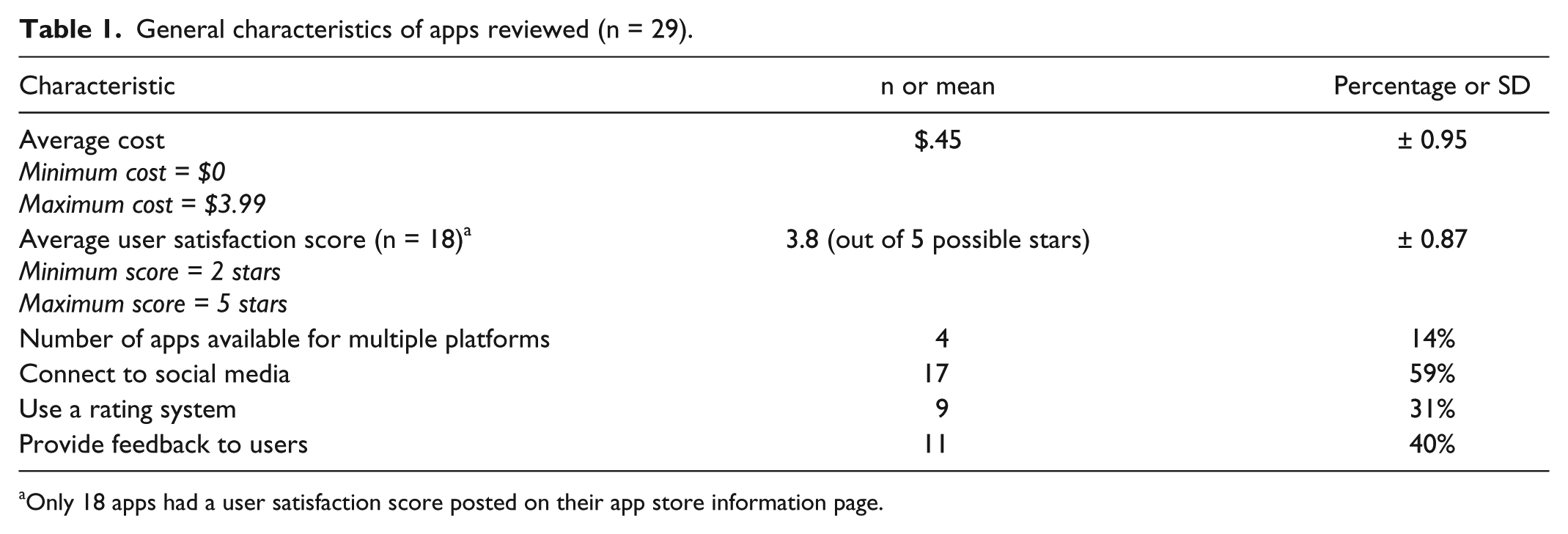
Only 18 apps had a user satisfaction score posted on their app store information page.
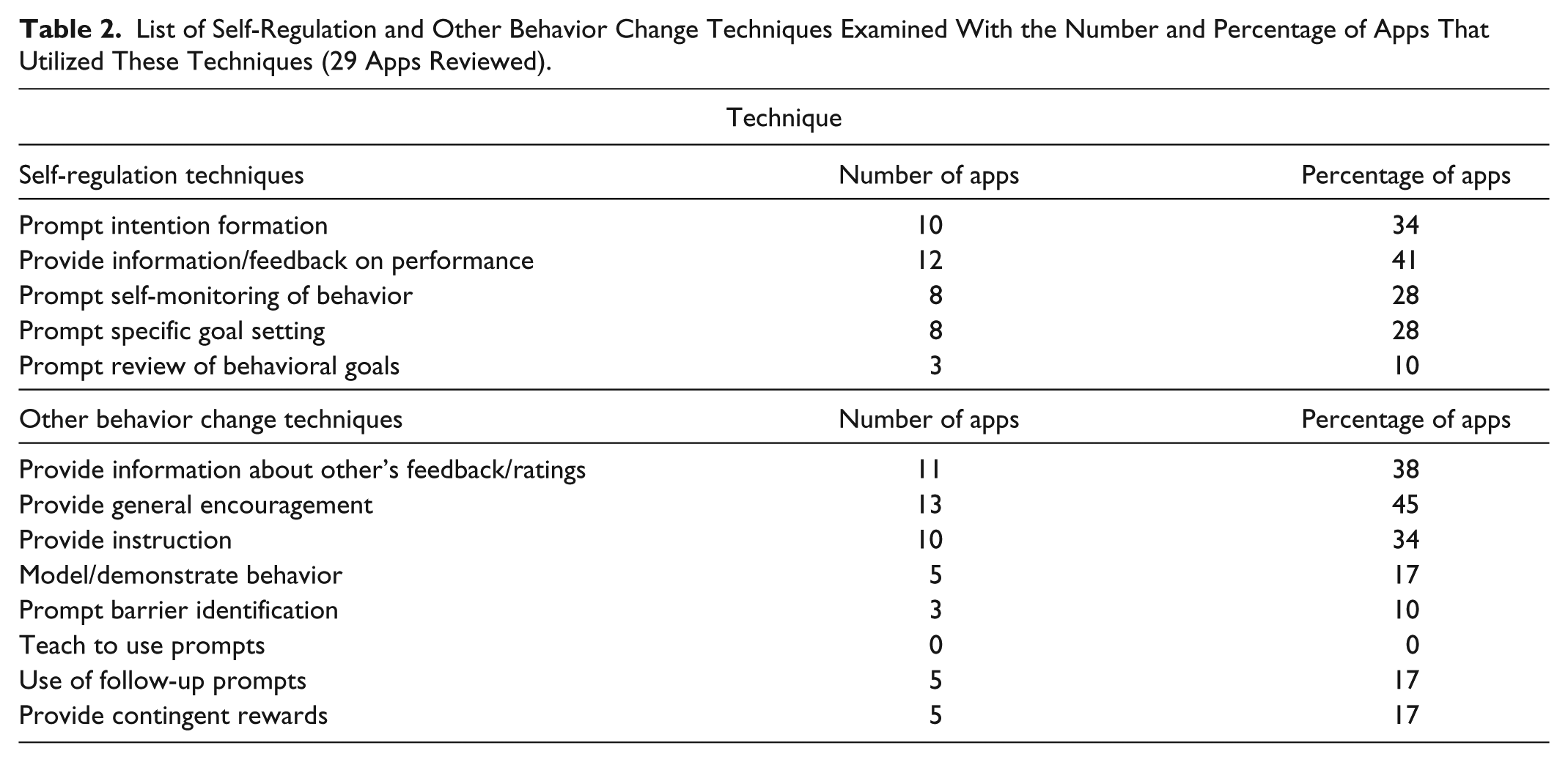
The most self-regulation techniques and other behavior change techniques used by an app was 11 (out of 13 techniques examined) by You Food for Android and Food Feedback for Apple. The most frequently used behavior change techniques included: provide general encouragement (n = 13), provide information/feedback on performance (n = 12), and provide information about others feedback/ratings (n = 11). Teach to use prompts was the only technique that was not included in any of the apps reviewed. Table 2 presents a summary of the techniques and the number of apps reviewed that used these techniques for behavior change. Of the total number of apps reviewed, 6 apps (21%) did not use any of the self-regulation or other behavior change techniques examined (Table 3).
List of Self-Regulation and Other Behavior Change Techniques Examined With the Number and Percentage of Apps That Utilized These Techniques (29 Apps Reviewed).
Method(s) of Providing Feedback to Users, Healthy Eating Self-Regulation and Other Behavior Change Techniques Score, and Total Score by App Reviewed (n = 29).
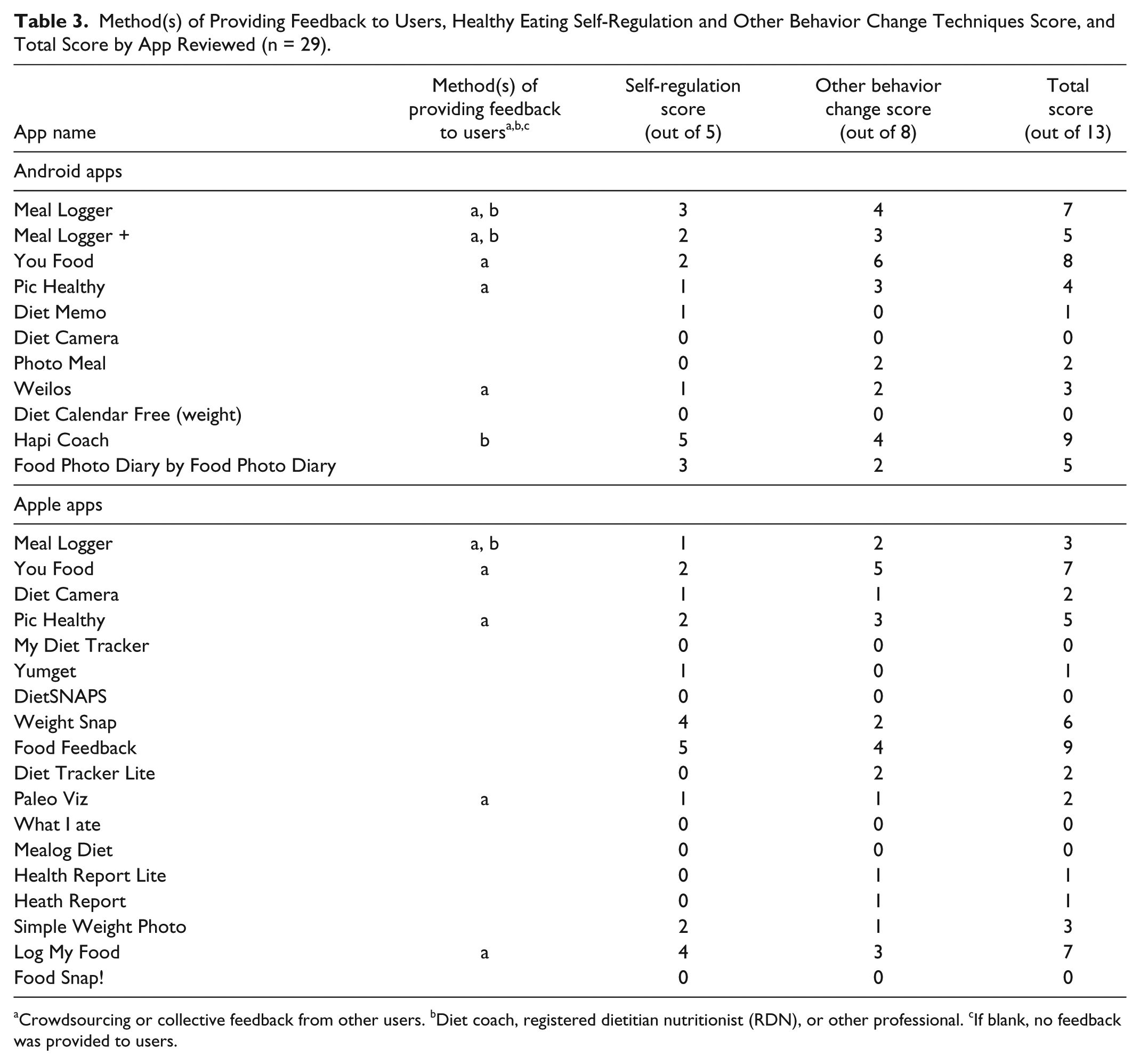
Crowdsourcing or collective feedback from other users. bDiet coach, registered dietitian nutritionist (RDN), or other professional. cIf blank, no feedback was provided to users.
Three apps (10%) provided feedback to users via crowdsourcing or collective feedback and included the option of connecting to a professional (eg, RDN or health coach) for dietary feedback. Seven apps (24%) used just crowdsourcing or collective feedback to provide feedback to users, 1 app (3%) used just professionals to provide feedback, and 18 apps (62%) did not provide any feedback to users based on their posts (Table 3).
Discussion
Overall, few of the mobile apps reviewed for photo-based diet tracking contained self-regulation and other behavior change techniques (range from 0-45%) shown effective in behavioral weight loss interventions. Of the apps reviewed 21% of apps did not include any of the behavior change techniques examined. These findings are similar to findings from other reviews suggesting that few evidence-based techniques are included in the most popular weight loss apps for adults11,13-15 and in HE and PA apps for children. 12 Findings from this and other studies highlight the continued need for inclusion of more evidence-based techniques promoting HE behavior, including self-regulation, in an effort to better ensure the efficacy of these types of mobile apps for weight loss and reduction of chronic disease.
Of the techniques examined, teaching use of follow-up prompts (eg, prompts to encourage users to self-monitor or to alter diet behavior) was not included in any of the apps reviewed. This feature may not have been used frequently due to overall low use of prompting features (17% of apps). It could be important for app developers to consider better integrating cues within their apps to teach users how to use prompting features (eg, reminders to self-monitor meals) as well as including features to prompt users to self-monitor, as this is regarded as essential in behavioral treatment for weight loss. 26
Information about performance and feedback about behavior change in dietary interventions is an integral component for successful weight loss outcomes. 25 While more of the apps reviewed for this analysis utilized this technique than almost any other technique examined (0%-45%), less than half of the apps reviewed (41%) actually utilized this technique. The use of crowdsourcing to provide feedback to users presents a low cost method to improve diet quality but was not well utilized in the examined apps. A possible limitation of crowdsourcing is that other users provide dietary feedback rather than a professional, such as an RDN. A previous study, however, found that untrained users of a crowdsourcing photo app could rate foods as “healthy” or “not healthy” with similar accuracy to trained raters. 24 Some of the mobile apps examined offered professional feedback from an RDN (eg, Meal Logger) for a fee or offered a professional version of their app to RDNs for use with their clients. Another popular app (Rise) requires a monthly subscription fee and includes a tailored diet plan with feedback from a coach. While receiving tailored feedback has potential benefits, there is no mention that this feedback is from an RDN, and the monthly fee makes this app less accessible for some populations (eg, low-income populations). Another currently available app (Oviva) was not found during our systematic search for photo diet tracking apps but does include diet self-monitoring via photo as one of its features. Oviva includes plans for dietary feedback from an RDN that can be purchased on a monthly basis (basic plan at $79/month or the premium plan at $159/month). 27 Because of these barriers (ie, lack of reputable feedback and high cost of feedback provided by an RDN) and evidence that crowd-sourced dietary feedback can provide a reliable and inexpensive method of providing feedback to users, future research should include development and testing of crowdsourcing techniques to provide this type of information about performance to users.
Finally, user satisfaction scores were also examined for both Android and Apple apps reviewed. On average, user satisfaction score was fairly low (3.8/5 stars); however 1 of the apps that earned the highest rankings for the number of self-regulation and other behavior change techniques included (You Food for Android) had a user rating of 4.5 stars (out of 5). While satisfaction score might reflect users opinions about apps (eg, quality), these scores do not actually reflect the effectiveness of health and fitness apps for improving diet quality or weight loss outcomes. It would be beneficial to both users and developers to have a better method of evaluating the efficacy of mobile apps that is accessible to both consumers and health practitioners working with people who are overweight and obese.
There were some limitations to this study, including difficulty finding relevant Android apps using the Google Play Store. Each search of the Google Play Store returned a total of 250 results, some of which were unrelated to the search terms used. In addition, the constantly changing app environment proved difficult, as some apps became unavailable and apps were constantly being updated with subsequent versions. There could be apps currently available that were not found in the systematic search for photo diet tracking apps included in this content analysis. There was also considerable variety in the quality of the apps reviewed, and some apps were very poorly designed making it difficult to use them. A strength of this study was that apps from multiple platforms (Android and Apple) were used by raters and then reviewed. The authors also used a set of established behavior change techniques, including self-regulation, to score currently available photo diet tracking apps. 25
Conclusions
Few currently available photo-based diet-tracking apps use behavior change techniques, including self-regulation, that are efficacious for HE and weight loss. While using photos of dietary intake has the potential to reduce user burden, for effective dietary change to occur, these photo diet apps need to incorporate evidence-based behavior strategies for HE. While most apps have a user satisfaction score posted on their information page in their respective app store(s), it would be beneficial to both users and developers to have a better method of evaluating and communicating the efficacy of the currently available mobile apps for weight loss. The inclusion of instructions within these apps could also prevent potential technical challenges that users might face when using photo-based diet-tracking apps.
Footnotes
Abbreviations
HE, healthy eating; mHealth, mobile health; PA, physical activity; RDN, registered dietitian nutritionist.
Declaration of Conflicting Interests
The author(s) declared no potential conflicts of interest with respect to the research, authorship, and/or publication of this article.
Funding
The author(s) disclosed receipt of the following financial support for the research, authorship, and/or publication of this article: This study was funded by the Academy of Nutrition and Dietetics Foundation Amy Joye Memorial Research Award (PI: Turner-McGrievy).

References
Supplementary Material
Please find the following supplemental material available below.
For Open Access articles published under a Creative Commons License, all supplemental material carries the same license as the article it is associated with.
For non-Open Access articles published, all supplemental material carries a non-exclusive license, and permission requests for re-use of supplemental material or any part of supplemental material shall be sent directly to the copyright owner as specified in the copyright notice associated with the article.
