




Abstract

Keywords
Real-time continuous glucose monitoring (RT-CGM) generates abundant data which patients may find challenging—current glucose level, direction and rate of change, retrospective data—all needing to be properly interpreted according to the different events of a single day (meals, snacks, physical activity, sleep). These findings led us to the development of a mobile application, Insulin Pump Real-Time Advisor (IPRA©), designed to translate RT-CGM technology into an efficient self-management tool for diabetic patients using sensor-augmented insulin pump (SAP) therapy, aiming to help them with safety and insulin adjustment decisions. The objective of this study was to assess the acceptance and reliability of this mobile application.
The application algorithm takes into account current sensor glucose values and trends, on-going activities and time elapsed since previous meal. Six type 1 diabetic patients already using SAP therapy tested it for 2 weeks. Before advice was delivered, they had to specify their own spontaneous attitude (blinded evaluation). They then had to assess advice delivered and to suggest an alternative response if needed (unblinded evaluation) (Figure 1). Joint-probability agreement was used to assess agreement between the application and the patients’ response in blinded and unblinded conditions. Rates of unblinded agreement according to the situation (time since last meal and relation to bedtime, glucose level, glucose trends) were compared with the Fisher test. Satisfaction was assessed.
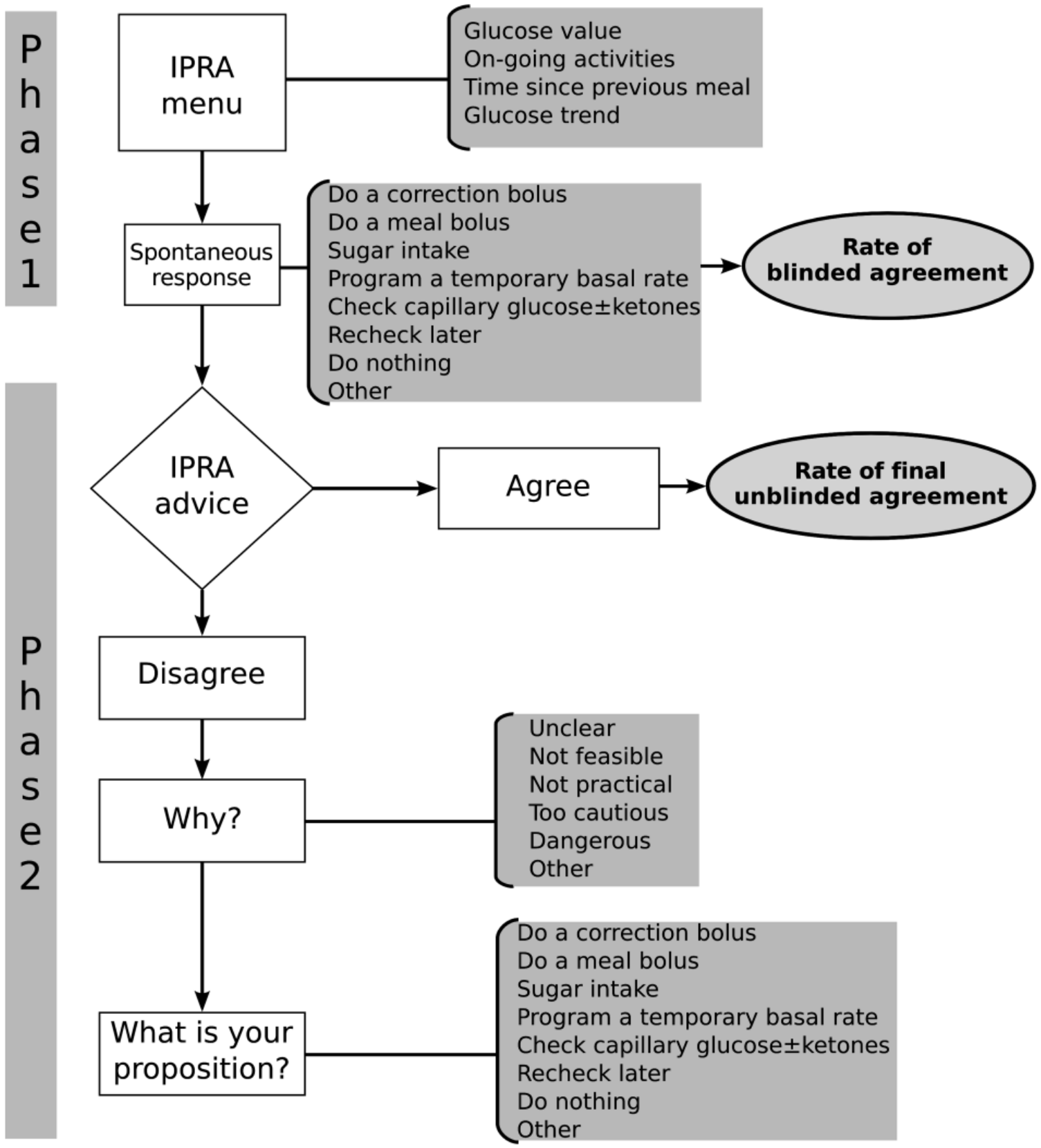
Study design.
A total of 238 situations was generated. Advice could combine various proposals, for example, “sugar intake or reduce basal rate to 50 or 70% of usual rate for 1 or 2 hours,” “check sensor glucose level in 30 minutes.” Rate of blinded agreement was 46% (125/270). Final unblinded agreement rate was 93% (250/270). Neither glucose level nor glucose trends had a significant impact. Unblinded agreement was lower for advice delivered at bedtime (82% vs 96% before a meal and 89% after a meal; P = .02). Mean satisfaction score was 4.2/5 (usefulness 4.7/5 ± 0.39, ergonomics 4.7/5 ± 0.29, impact 3.6/5 ± 0.95).
The algorithm was approved by patients. Satisfaction was high, with a high final unblinded agreement rate contrasting with a rather low initial blinded agreement rate. Among the discrepancies, the patients’ judgment was considered right in 7 cases, mostly consisting in patients suggesting checking of blood glucose, and application advice will therefore be updated. On the other hand, in 43 other situations, the spontaneous decisions of patients were considered to be inadequate behaviors, which would have been ill-adapted or dangerous. Such inappropriate reactions have been reported in STAR 1 study, 1 possibly attributable to a misuse of RT-CGM. These findings suggest that such an application could help to prevent inadequate behaviors and be used as a real-time educational tool. It might be especially useful at initiation of RT-CGM, as suggested by the results of Jenkins et al study.2,3 An upgraded version is being developed, including a bolus calculator taking insulin on-board into account, information on food carbohydrate content for glucose counting, and modulation of advice if exercise is planned. A prospective study at initiation of RT-CGM is needed to assess impact on metabolic parameters, behavior, and satisfaction.
Footnotes
Abbreviations
IPRA©, Insulin Pump Real-Time Advisor; RT-CGM, real-time continuous glucose monitoring; SAP, sensor-augmented pump.
Declaration of Conflicting Interests
The author(s) declared no potential conflicts of interest with respect to the research, authorship, and/or publication of this article.
Funding
The author(s) received no financial support for the research, authorship, and/or publication of this article.