




Abstract
Severe hypoglycemia (SH) is a common problem in type 1 diabetes (T1D). Annually, nearly 1 of 5 persons with long-standing T1D will have SH. Though injections of glucagon are effective in treating SH, liquid formulations of glucagon are biochemically very unstable. For this reason, available preparations of glucagon are lyophilized; the powder and the diluent must be mixed at the point of care prior to administration and any remaining drug must be discarded. The process of mixing and delivery is complex. Coupled with the emotional stress of the caregiver, errors in glucagon delivery are very common. For these reasons, workers at Enject, Inc are in the process of developing a device that addresses the shortcomings of this currently approved method of glucagon delivery. The Enject device will store the glucagon powder and the diluent in separate compartments and will rapidly mix and inject the components only upon activation of the pen at the point of care.
Severe Hypoglycemia: The Problem With Currently Available Treatments
Thanks to the T1D Exchange investigators, who amassed a data base of over 7000 adults with type 1 diabetes (T1D), we have a growing body of information about severe hypoglycemia (SH) and its predisposing factors. These investigators found that SH was much more common in those with long histories of T1D than those with short durations. In fact, among persons with diabetes duration over 40 years, 19% reported an SH event in the previous year. Furthermore, they found an increased risk of SH in those with A1C values under 7% or over 7.5%, the latter factor undoubtedly due to a high A1C being associated with less attention to self-management. 1 SH is associated with many severe symptoms, including automobile accidents, 2 several types of seizures, 3 and stupor or coma, especially in those with hypoglycemic unawareness. 4
Glucagon’s use in the treatment of SH is well known and documented.5,6 Due to its rapid absorption, the pharmacokinetic and pharmacodynamic effects of parenterally injected glucagon indicate very fast onset, and recently a comprehensive pharmacokinetic model has been published. 7 Glucagon has been historically sold as a 1 mg vial of lyophilized powder accompanied by a syringe prefilled with 1 ml of diluent (see Figure 1). The powder and diluent are intended to be reconstituted immediately prior to use. The instability of glucagon in a liquid form is also well known.8,9 The current gold standard for the treatment of SH has been the emergency kits marketed (in the United States) by Eli Lilly and Novo Nordisk. Shelf life is 24 months from date of manufacture. Storage temperature is “room temperature” or approximately 72°F. According to people with diabetes and their caregivers, use of the existing kits is problematic (it has been pointed out that intravenous dextrose, the alternative to the use of glucagon in a health care setting, is also problematic and requires location of suitable intravenous access). 10
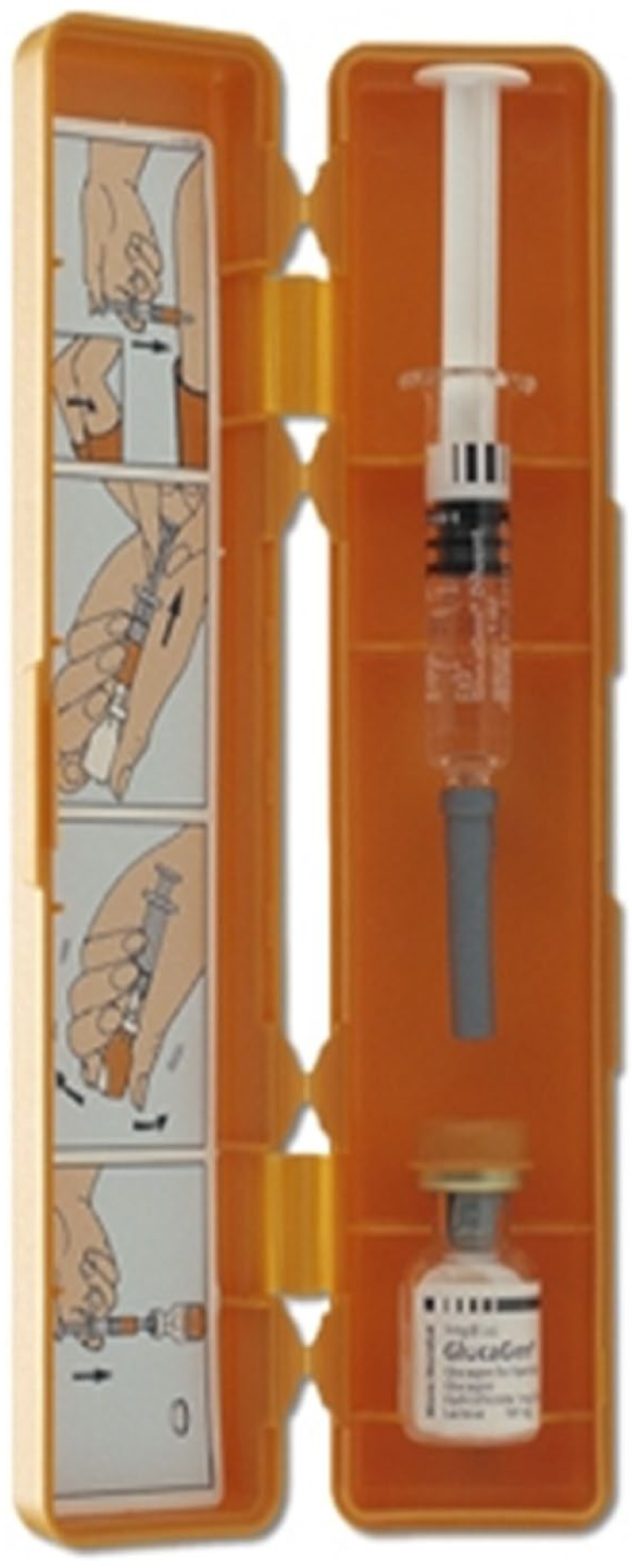
Existing severe hypoglycemia (SH) kit. Emergency kit for the treatment of SH (GlucaGen, Novo Nordisk).
During an SH event, the patient is either semiconscious or comatose and thus is unable to prepare an injection of glucagon for self-administration. Therefore, someone else must prepare and administer the injection (thus the definition of SH, which specifies “requires the assistance of another”). A second party (friend, teacher, coworker, spouse, parent) needs to know the kit exists, locate it, and go through the large number of steps (10-12) necessary to prepare and administer the injection, as well as dispose of the used needle. Another major problem is the poor level of awareness regarding glucagon among the people who need it most. Though usually effective, the use of glucagon to treat SH in T1D is markedly underutilized. Many patients and caregivers are not aware of this treatment, probably in part because their health care team fails to recommend it. 11
Errors in using the existing kits are common and occur for a wide range of reasons including needle damage, dropped materials, secondary needle stick, and fear of giving the injection (seeing the needle), all due to user anxiety and situational pressure. While there are no published data, physicians and certified diabetes educators (CDEs) estimate that 25-30% of the attempts fail. Out of fear, many second parties won’t even attempt to use the current kits, and call 911 instead. For all these reasons, people with diabetes and their caregivers have been asking for a better solution for decades.
Researchers and companies have been trying to develop a stable liquid glucagon for decades. A stable formulation would eliminate the need for reconstitution prior to injection. For use in SH, glucagon needs to be stable at a wide range of temperatures due to the need for portability. Placement in a briefcase, purse, or backpack, carried on the person, in an auto glove compartment and similar situations could range as high a 40°C for extended periods of time. In addition, the product should be able to withstand harsh handling and transport to ensure integrity. To date, no company has submitted to the FDA or obtained approval for a stable liquid glucagon.
The Concept of Mixing Lyophilized Glucagon and the Diluent at Point of Care
Given the challenges of creating a stable liquid form of glucagon, the best solution, at this time, may be to continue to use lyophilized glucagon and reconstitute it just prior to administration . . . but with a better delivery system. Enject, Inc has been developing GlucaPen® and GlucaPen Jr® to improve the ease of use and safety of an emergency glucagon injection. As part of the device design process, a set of goals was established:
Temperature stability equal to or better than existing preparations
Rapid dissolution and simple mixing
Pen-style device with a preattached needle
Safety needle, hidden at all times
Single-use disposable; unusable after 1 injection
Lowest possible cost
The first step was to search for existing cartridge and pen technologies that would help meet the goals. A company was identified that, at the time, was the only one in the world making a dual-chambered glass cartridge for commercial sale that could house lyophilized glucagon in one chamber and a diluent in a second chamber. This allows the lyophilized glucagon to maintain a moisture level less than 1%, which is key to maintaining a long-term stability profile. 12
A proprietary formulation (patent pending) that allows reconstitution of the glucagon powder in 10 seconds or less with no agitation, was developed. Stability testing to date shows it meets existing standards for currently marketed products. 13 Existing glucagon kits instruct the preparer to “gently swirl” and not agitate or shake (reconstitution may take up to a minute). Enject’s formulation allows the preparer to move rapidly toward injection.
A company was identified that had designed a pen-style device that would hold the cartridge and also have an attached shielded safety needle. That company has designed a unique one-of-a-kind pen that allows for mixing, priming, and administration with a hidden safety needle. The entire process of mixing to injection is projected to occur in 20 seconds or less.
The pen houses the dual-chamber cartridge (see Figure 2 for a cutaway view and Figure 3 for a concept drawing of the pen). Turning the base of the pen causes the diluent and lyophilized glucagon to mix (which can be seen in the side window). Rotating the cap (needle cover) 1 full turn activates or “primes” the pen. The caregiver would then press the needle end against a region such as the shoulder, thigh, or abdomen and hold for a count of 5 to administer the glucagon dose. As the pen is pulled away from the skin, the shield extends and locks into place so it cannot be used again. It is anticipated that the instructions will be on the device housing depicting the 3 steps in graphic form. Final configuration, colors, and instructions will be determined in a human factors study to be completed.

Example of dual-chamber cartridge. Cutaway view of the dual-chamber pen designed for rapid mixing of lyophilized glucagon and its diluent.

Example of device. Concept drawing of the Enject pen that rapidly mixes lyophilized glucagon and its diluent upon activation.
GlucaPen will come in an adult version containing 1 mg of glucagon and a pediatric version, GlucaPen Jr, which will deliver 0.5 mg of glucagon. (Both doses follow the existing package insert approvals of currently approved products.)
Extensive market research with physicians, diabetes educators, school nurses, and fire departments has been conducted to better understand their needs and the concerns of patients. The consensus from discussions with impacted parties suggests an improved delivery system would be well received and may increase the use of glucagon while subsequently reducing 911 calls.
The author, due to confidentiality constraints as well as potential competitive situations, is limited as to the specific details that can be shared prior to NDA submission.
Footnotes
Abbreviations
A1C, hemoglobin A1C; CDE, certified diabetes educator; SH, severe hypoglycemia; T1D, type 1 diabetes.
Declaration of Conflicting Interests
The author(s) declared the following potential conflicts of interest with respect to the research, authorship, and/or publication of this article: DR is an employee and stockholder of Enject, Inc.
Funding
The author(s) received no financial support for the research, authorship, and/or publication of this article.