




Abstract
The concept of bioreactors in biochemical engineering is a well-established process; however, the idea of applying bioreactor technology to biomedical and tissue engineering issues is relatively novel and has been rapidly accepted as a culture model. Tissue engineers have developed and adapted various types of bioreactors in which to culture many different cell types and therapies addressing several diseases, including diabetes mellitus types 1 and 2. With a rising world of bioreactor development and an ever increasing diagnosis rate of diabetes, this review aims to highlight bioreactor history and emerging bioreactor technologies used for diabetes-related cell culture and therapies.
Bioreactors
Traditionally, bioreactors are utilized for various biochemical engineering applications and bioprocesses. Such an example is bioreactor supporting microbial growth, establishing a vessel to convert nutrients that organisms extract from the culture media into biological compounds. Concerns include quantifying energy production and monitoring biosynthesis and product formation.
In 2006, Bilodeau and Mantovani defined bioreactors in tissue engineering and regenerative medicine as “any apparatus that attempts to mimic and reproduce physiological conditions to maintain and encourage cell culture for tissue regeneration.” 1 Through recent advances within the biomedical arena, bioreactors have been applied to create a cell culture environment more physiologically representative than 2-dimensional cell culture.2-10 Traditional cell culture typically involves plating the isolated cells on a flat surface, usually a Petri dish or tissue culture treated flasks, and supplementing the cells with a nutrient media. Cells are stored, statically, at 37°C with exposure to 5% carbon dioxide.
Opposed to 2-dimensional static culture, cells can be differentiated into 3-dimensional tissue structures within a bioreactor, making possible several possible applications including microgravity environments11,12 and long-term tissue culture, 2 attributes that are further described in this review and used as a defining characteristics of a “bioreactor.” Several classes of bioreactors exist in the biomedical field, and applications vary with bioreactor classification, as bioreactor design influences tissue formation and behavior. The “E-Cube System” from Corning may allow the culture to be explanted and incorporated into an in vivo model. Dynamic perfusion bioreactors deliver continuous, dynamic perfusion of nutrients and gas exchange to the tissue growing within. 13 The dynamic perfusion bioreactor has been used to culture various tissue types, including cartilage, 14 bone, 15 adipose, 2 and neuronal. 3 Cells in dynamic perfusion bioreactor cultures grow and attach to an interconnected network of porous, polymeric fibers inside the bioreactor chamber while the nutrient medium is continuously recirculated throughout the system. 13
In addition to cell culture, the dynamic perfusion bioreactor has served as a “bridge to transplant” for patients on the ever-growing transplant lists. Irgang et al developed an extracorpeal bioartificial liver support system in a 3-dimensional, hollow, fiber-based bioreactor to successfully treat patients with porcine liver cells before liver transplantation with no known negative immunologic responses or infection. 16 Dynamic perfusion bioreactor studies in the same German bioreactor laboratory are ongoing with Miki et al and include differentiating human embryonic stem cells into human hepatocytes within the 3-dimensional culture system, further addressing drug discovery, toxicology studies, and bioartificial liver support systems. 17
For other tissue culture models, a more simplistic spinner flask model is commonly used. The spinner flask bioreactor consists of a bottle of culture medium, well mixed by a magnetic stir bar, with the tissue matrix fixed to needles attached to the top lid or floating in the media suspension. 13 Bioreactors with rotating wall vessels involve angular movement of polymeric cylinders within an encasing while the tissue sits between the cylinders on biomaterial scaffolds. Alternatively, rotating bioreactors involve movement or rotation of the entire bioreactor system as a whole. Rotation of the system introduces continuous free fall to the culture, improving nutrient transport to the tissues as well as a more homogenous tissue growth. 13
The requirements for engineering a rotating bioreactor vary based on the tissue to be studied and clinical need to be addressed. Korossis et al stated that “the overall goal is to have systems that reliably and reproducibly form, store, and deliver functional tissues that can sustain function in vivo.” Biomolecularly, variables include metabolic activity of the tissue, biochemical growth factors, and oxygenation to the tissue matrix. Regarding bioprocesses, considerations of a rotating bioreactor include angular velocity, angle of rotation, removal of cellular waste products, time points, and which phase of culture the bioreactor should rotate. Each consideration is a function of the dimensions of the tissue, including concentration of cells at initial inoculation; complexity and, therefore, the physiological environment required of the tissue; and stages of cellular differentiation and maintenance. In addition, the consideration of continuous perfusion to the system contributes complexity to the system, particularly when scale-up is in question. 13 Bioreactors are also commonly utilized in tissue engineering to mechanically precondition tissue and biomedical devices before implanting in vivo.18-20
Diabetes Mellitus
While exact mechanisms of diabetes mellitus are still under speculation, it is widely accepted that both type 1 and type 2 diabetes are characterized by the transport of glucose from blood to cells, a consequence of β-cell failure in the pancreas. 21 Simply, β-cell apoptosis in type 1 diabetes mellitus is activated, in part, by cytokines produced by invading immune cells. Type 1 diabetic patients closely monitor insulin levels throughout their entire lifetime, and, while an inconvenience, glucose levels in type 1 diabetic patients are relatively manageable. Alternatively, β-cell death in patients can result with type 2 diabetes mellitus occurs more gradually. β-cell dysfunction of type 2 diabetic patients results from elevated levels of glucose and free fatty acids (FFAs) and, along with other factors, eventually leads to β-cell apoptosis. 21
Patients diagnosed with type 2 diabetes mellitus are instructed to monitor their blood glucose levels through blood glucose monitoring devices in combination with lifestyle adjustments and management. If the diabetic symptoms progress, oral medication, and possibly insulin, is prescribed. Type 2 diabetes is often associated with cardiovascular disease risk factors, including elevated blood pressure and cholesterol levels, gall bladder disease, degenerative arthritis, gout, infertility, restrictive lung disease, stroke, and various types of cancers.22-27
According to the Centers for Disease Control, diabetes mellitus affected 29 million (9.3%) US residents in 2012, a national burden of $245 billion. 26 As diabetic diagnoses and associated symptoms continue to escalate in industrialized countries, further understanding of the disease becomes more significant. The purpose of this review is to provide discussion and awareness of bioreactor technology devoted to type 1 and type 2 diabetes mellitus.
One of the first known groups to establish a microgravity environment for cell culturing purposes was a group within the National Aeronautics and Space Administration (NASA) Johnson Space Center in the late 1980s. The NASA team removed almost all shear forces traditionally applied to a cell culture system, forcing the cells to assemble in suspension and form a 3-dimensional tissue matrix. 28 VivoRx, a Santa Monica–based pharmaceutical company, licensed the rotating vessel bioreactor technology in the early 1990s for therapeutic and diagnostic commercial applications. Due to short supply of pancreas cadavers, VivoRx intended to use the device to grow sufficient volumes of human islet cells as an answer to the expanding diabetic market. In 1997, the company reported commencement of FDA-approved phase I/II clinical trials. 29 The license was later retracted by NASA, and Synthecon currently owns licensing rights and the rotating wall vessel (RWV) is commercially available and widely accepted as a 3-dimensional culture condition option. In a 2012 update, Barzegari and Saei specifically outlined microgravity tissue engineering and diabetes applications. 30 The reviewers explained that microgravity has been proven to enhance survival and proliferation of beta islet cells in addition to reducing immunogenicity.31-33
The RWV system has since provided inspiration to many 3-dimensional bioreactor culture models useful in diabetes mellitus applications.33-37 A horizontally rotating high aspect ratio vessel was described by Murray et al to improve structural and functional viability of isolated human islet cells within the microgravity environment. 34 Throughout a 10-day period, structural integrity and glucose-stimulated insulin release were maintained in islets cultured within the system, compared to islets cultured under conventional standards. Islets cultured conventionally were reported to exhibit progressive fragmentation and a rapid loss of secretory function. Furthermore, the authors noted that islets cultured within the microgravity environment were able to reaggregate and exhibit enhanced secretory capacity. 34
Samuelson and Gerber 35 applied the microgravity concept to a pancreatic progenitor cell population in a 3-dimensional culture system. The researchers developed a RWV bioreactor consisting of a pivoting platform to rotate around a fixed point, with motor-controlled rotation power and revolution speed. Cell cultures were contained in transparent fluoroethylene propylene closed culture bags with Cytodex-3 microcarrier beads along with beta-TC-6 cell lines added in culture media suspensions. Bags were continuously rotated on the bioreactor platform and nutrient media was manually changed 2 times per week. Cultures were maintained for 5 and 12 days within the RWV bioreactor, and the pancreatic cell line proliferated robustly with enhanced transcriptional signaling and improved translation of the insulin gene. The authors proposed a future for the novel device in the potential cell-based therapy for treatment of diabetes. 35
Tanaka et al more recently described optimization of a cell culture technology using a simulated microgravity generator to induce development of a large amount of pancreatic beta-cell spheroids. 36 Via the described methods, 100 spheroids of 250 micrometer diameters per 1 ml of culture media are produced. The spheroids were transplanted in vivo into the portal vein of streptozotocin-induced diabetic mice and lowered glycemic levels were observed over 28 days. 36
Besides the RWV bioreactor, hollow fiber bioreactors38,39 have been developed to address type 1 diabetes mellitus therapeutics as well as spinner flask bioreactors with islet cells in suspension. 40 Hoesli et al developed a mammalian cell immobilization in alginate-filled hollow fiber bioreactors for large-scale batches. 38 The model was successfully applied to primary neonatal pancreatic porcine cell culture for 10 days. The authors described potential future study directions that include donor-scale immobilized mammalian cell culture with cell recovery, such as in vitro culture of islet-like clusters for use in islet transplantation. 38
Due to the vast mechanical and pathological difference in the cause of type 1 versus type 2 diabetes mellitus, it is only logical for therapy and treatment of the 2 diseases to also vary significantly. Since type 2 diabetes mellitus is typically tied to other health complications, many tissue engineers have taken to bioreactor technologies to address the diseases’ symptoms and characteristics, including diabetic retinopathy 41 and foot wound ulcers.42,43 Dutt et al applied the horizontally rotating bioreactor developed by NASA to establish a coculture of human retinal cells and bovine endothelial cells incorporated onto laminin-coated Cytodex-3 microcarrier beads over 36 days. 41 The bioreactor was reported to accelerate capillary formation as well as differentiation of retinal precursor cells. With such neovascularization modeling, the bioreactor system could provide an ideal 3-dimensional platform to study retinal diseases, including diabetic retinopathy. 41
One common precursor to diabetes mellitus is the metabolic syndrome, which is influenced by obesity and characterized by abdominal, visceral adipose deposits, causing an “apple shape.” 27 Adipose plays a dominant role in diabetes mellitus as adipocytes contain FFAs and release hormones that even further increase FFAs, high levels of which are toxic to β-cells and lead to dysfunction. As adipocytes increase in size and mass, macrophages accumulate and cause inflammation, increasing a patient’s risk to develop diabetes. 44 In muscle and adipose tissues, glucose transporter 4 (GLUT4) is responsible for the transportation of glucose from intracellular stores to the plasma membrane. 45 Therefore, metabolism and blood glucose monitoring are widely studied. 46
Two particular studies observed the stomach as a bioreactor.47,48 Kanner and Lapidot simulated possible reactions that could occur in the acidic pH environment of the stomach that could affect lipid peroxidation. 47 The study hypothesized that prevention of overall lipid peroxidation in the stomach could have an important impact on health and may aid in explaining health benefits of diets rich in polyphenolic antioxidants. Acidic pH of gastric fluid amplified lipid peroxidation and incubation of heated muscle tissue in simulated gastric fluid enhanced hydroperoxide accumulation by 6-fold over 2 hours. The authors suggested that human gastric fluid might be an excellent medium for enhancing the oxidation of lipids and other dietary constituents. 47 Similarly, Gorelik et al evaluated hydroperoxide and malondialdehyde levels of the stomach during and after digestion in rats. 48 Rats were fed either (1) red turkey meat cutlets or (2) red turkey meat cutlets and red wine concentrate, and stomachs were analyzed 90 minutes after feeding. The study tested the hypothesis that the stomach can act as a bioreactor, in which lipid peroxidation of partially oxidized food (such as red meat and red wine) could occur, resulting in accumulation of lipid peroxidation products. Results indicated that stomach hydroperoxide and malondialdehyde concentrations both dropped substantially 90 minutes after meals, and the addition of red wine polyphenols enhanced hydroperoxide reduction by 3-fold. The authors concluded that the addition of antioxidants such as red wine polyphenols to meals may reduce potentially harmful effects of oxidized fats in foods. 48
Other additional work has been conducted on lifestyle management factors for patients with diabetes.49,50 Jung et al optimized a stable cell culture condition within a packed-bed bioreactor for production of tagatose, a novel bulk sweetener that tastes similar to sucrose with potential to be used as a low-calorie sweetener in foods, beverages, health foods, and dietary supplements. 49 Ho et al developed a long-life capillary enzyme bioreactor for highly sensitive determination of blood glucose concentration. 50
Conclusion
Bioreactors pose influential and pivotal roles in tissue engineering and restorative medicine, providing a longer, more accurate in vitro cell culture, shaping drug discovery and tissue explants. Every bioreactor system is unique, and several biomolecular and bioprocess parameters must be taken into consideration prior to each tissue engineering application.
With diabetes mellitus on the rise in developed countries, countless studies are being conducted worldwide to address treatments and therapies for both type 1 and type 2. Table 1 describes the studies discussed in this review. Several pieces of work incorporating bioreactors into type 1 diabetes mellitus research include pancreatic cell line development and culture within a 3-dimensional microgravity environment for long-term maintenance and assembly. On the other hand, bioreactor studies addressing type 2 diabetes mellitus appear to focus on lifestyle management and the side effect diseases associated with type 2 diabetes.
Bioreactor Technologies Described in This Review, Organized by Year.
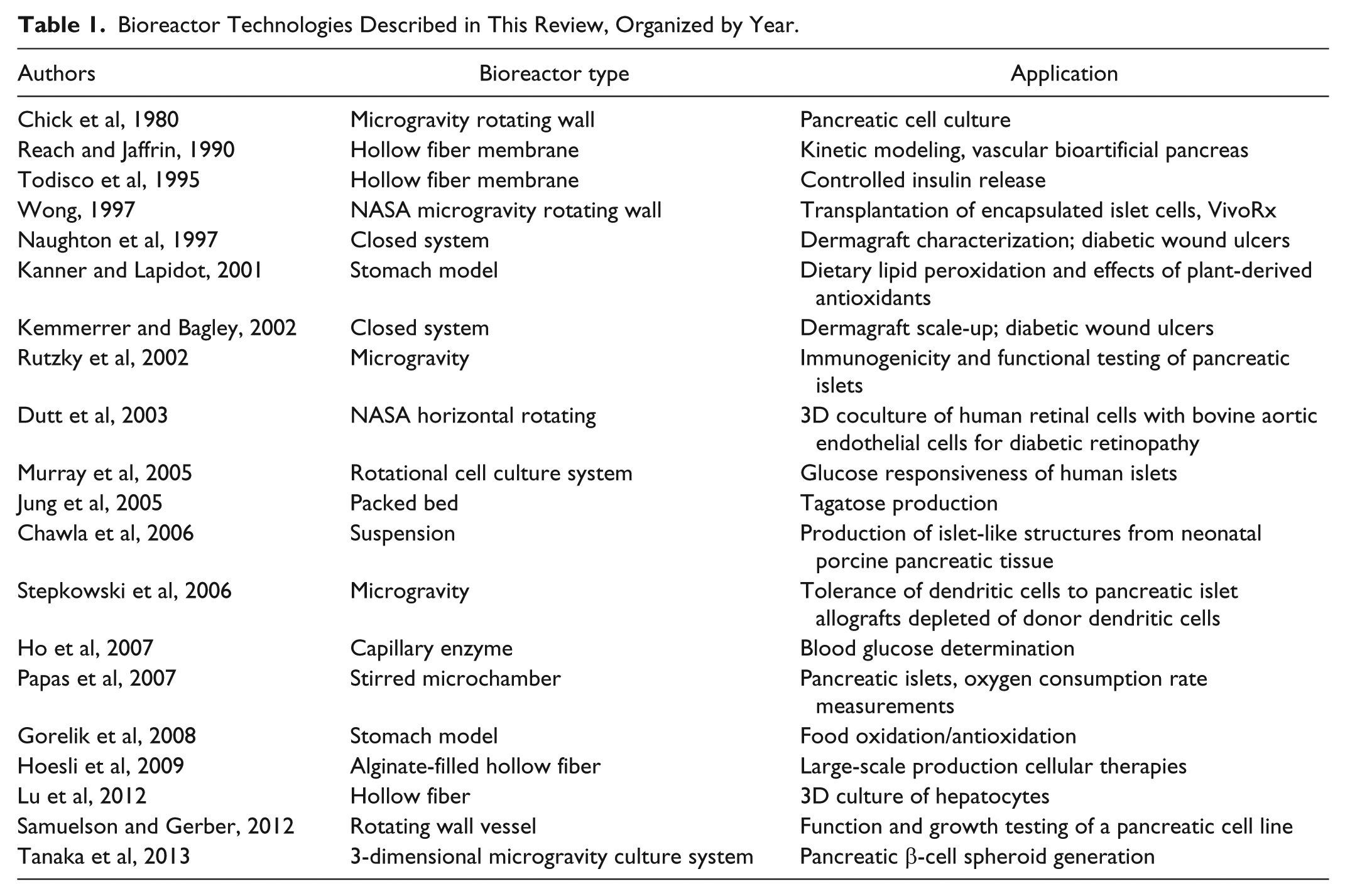
While the use of bioreactors for pancreatic cell culture dates back to 1980, 51 the field has been validated, modified, and optimized over the past few decades, including kinetic modeling, 52 mass transfer of insulin and glucose, 53 and oxygen consumption rate of islet culture, 54 to list only a few. Indeed, much room for advancement continues to exist in the field, fusing alterations on a classic biochemical engineering tool and the fundamental yet constantly growing biomedical issue of diabetes mellitus.
Footnotes
Abbreviations
FFA, free fatty acid; GLUT4, glucose transporter 4; NASA, National Aeronautics and Space Administration; RWV, rotating wall vessel.
Declaration of Conflicting Interests
The author(s) declared no potential conflicts of interest with respect to the research, authorship, and/or publication of this article.
Funding
The author(s) received no financial support for the research, authorship, and/or publication of this article.