



Abstract
Several studies have drawn attention to frequent user-error sources in self-monitoring of blood glucose (SMBG), for example, obtaining an inadequate blood volume, neglecting hand washing, applying blood incorrectly onto the test strip, or using expired test strips.1-3 However, there is no sound scientific evidence as to whether the time the patient requires to apply the blood onto the test strip affects measurement results. We investigated, with 3 different SMBG systems, if a time delay between the generation of a blood drop and the application onto the test strip affects glucose measurement results.
The investigation was performed by trained personnel at the Institut für Diabetes-Technologie Forschungs- und Entwicklungsgesellschaft mbH an der Universität Ulm, Ulm, Germany. The protocol was approved by the Ethics Committee, and the competent authority was notified.
Glucose measurements on capillary blood samples from fingertips of 89 subjects (49 male, 40 female; 26 with type 1 diabetes mellitus, 43 with type 2 diabetes mellitus, 20 without diabetes; mean age 59, ranging from 21 to 76 years) were evaluated. Measurements with each system were consecutively performed on 4 blood drops with a diameter of approximately 1 mm. The first and the fourth drops were measured immediately (0 s); the second and third drops remained on the skin surface for 10 and 25 s, respectively, before being measured. The drift between the first and the fourth measurement was checked to be ≤0.56 mmol/L (≤10%) for blood glucose concentrations ≤5.6 mmol/L (>5.6 mmol/L).
For each system, the relative deviations between the glucose value at 0 s (mean value of the first and the fourth measurement) and the glucose value after a delay of 10 and 25 s was calculated.
All 3 systems showed increased glucose values after a time delay between the sampling and the measurement procedure with mean relative deviations between 0.7% and 2.1% after 10 s and between 0.1% and 4.7% after 25 s when compared to immediate measurements (Table 1). An additional evaluation based on linear interpolation between the glucose concentrations at immediate measurement was used to exclude a possible influence of glucose instability effects (data not shown).
Relative Deviations Between the Glucose Value Measured Immediately After Sample Collection (Time Delay of 0 s) and the Glucose Value Measured After a Delay of 10 and 25 s
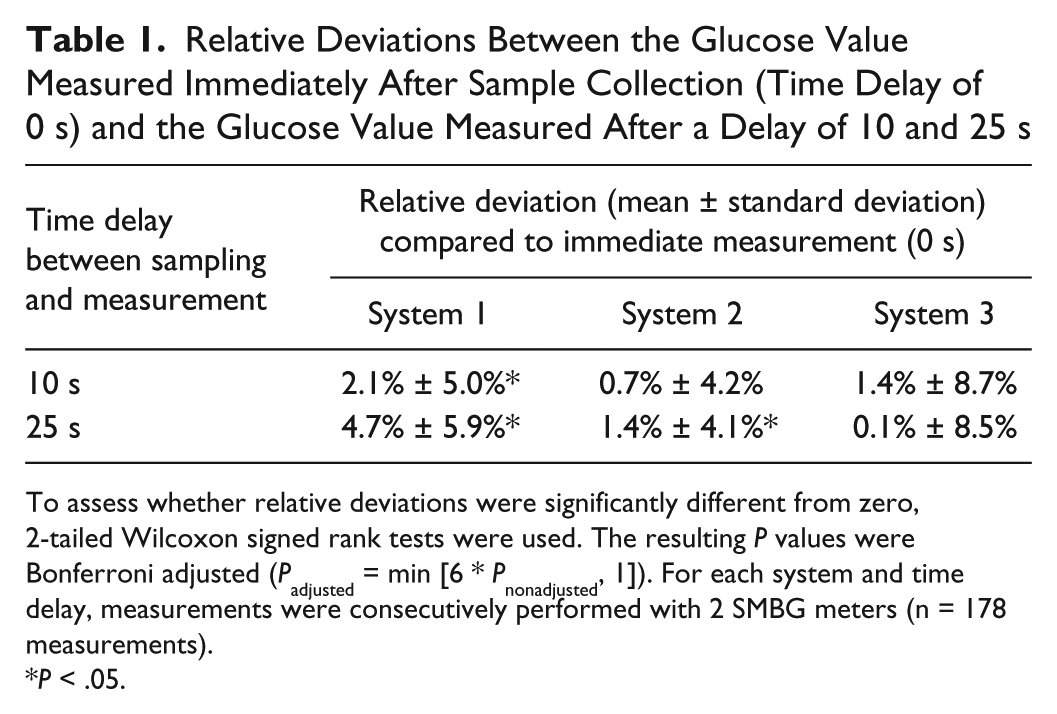
To assess whether relative deviations were significantly different from zero, 2-tailed Wilcoxon signed rank tests were used. The resulting P values were Bonferroni adjusted (Padjusted = min [6 * Pnonadjusted, 1]). For each system and time delay, measurements were consecutively performed with 2 SMBG meters (n = 178 measurements).
P < .05.
The amount of time that the blood drop is exposed to air can affect glucose measurements with some SMBG systems. The architecture and/or electrochemical composition of several test strips might also be prone to changes in the blood drop, for example, by evaporation, coagulation, or increase in pO2.4,5 Such changes in the blood drop over time might be particularly relevant in small drops with a higher surface-to-volume ratio (many systems require a sample volume less than 1 µL) or with long air-exposure times before the measurement, for example, when patients do not adequately prepare the measurement. Although further investigations are required to support the clinical relevance of our findings, patients should be advised to perform glucose measurements on capillary samples as quickly as possible.
Footnotes
Abbreviation
SMBG, self-monitoring of blood glucose.
Declaration of Conflicting Interests
The author(s) declared the following potential conflicts of interest with respect to the research, authorship, and/or publication of this article: All authors are employees of the Institut für Diabetes-Technologie Forschungs- und Entwicklungsgesellschaft mbH an der Universität Ulm (IDT), Ulm, Germany. GF is general manager of the IDT, which carries out studies evaluating blood glucose meters and medical devices for diabetes therapy on behalf of various companies. GF/IDT received speakers’ honoraria or consulting fees from Abbott, Bayer, Berlin-Chemie, Becton-Dickinson, Dexcom, Menarini Diagnostics, Roche Diagnostics, Sanofi, and Ypsomed.
Funding
The author(s) received no financial support for the research, authorship, and/or publication of this article.