



Abstract
Past research has indicated that teachers’ use of relational power directly influences students’ sense of empowerment and that students who feel empowered are more likely to be motivated. This phenomenological, retrospective study investigated gifted high school students’ perceptions of power and empowerment within their classrooms and the relationship of these to motivation. Specifically, I explored the impact of different power dynamics, including teachers’ utilization of various relational power bases (i.e., reward, coercive, legitimate, referent, expert) on gifted high school students’ sense of empowerment and motivation to engage in learning. The students in this study described experiences with all of the social power bases; however, the most positively impactful of these were referent power and expert power. Students felt most empowered when they could personally connect with teachers who knew how to teach, who were content experts, and who could manage the classroom to ensure learning could happen for all students.
Introduction
Lovorn and colleagues (2012) contend that “as the world becomes more informationally, economically, culturally and educationally interdependent, it becomes necessary for teachers to develop critical understandings of power, classroom power dynamics and the power-related roles of stakeholders in the learning process” (p. 71). Schrodt et al. (2007) further advocate for continued research on power use as “an important means of achieving individual and educational goals in the classroom” (p. 309). Power can be broadly defined as having access to necessary resources and having the capability to make or influence decisions that impact others (Dartmouth Office of Pluralism and Leadership, 2020). Empowerment is a psychological construct that results from perceived control, perceived competence, and goal internalization (Menon, 1999).
The concepts of power and empowerment have been researched in both K-12 and undergraduate classrooms (e.g., Frymier et al., 1996; McCroskey & Richmond, 1983). Studies in this area consistently suggest that students who feel empowered are more motivated to engage in the classroom and to take ownership of their learning (Frymier & Houser, 2000; Nichols, 2006; Nichols & Zhang, 2011). Conversely, students who do not feel empowered tend to be less motivated (Nichols, 2006) and to withdraw from learning situations (Balfanz et al., 2007; Fredericks et al., 2019). Research further suggests that students’ sense of empowerment is directly influenced by power dynamics in the classroom, including the type of power teachers utilize (Frymier et al., 1996; Schrodt et al., 2008).
Power
As stated above, power can be defined as having access to necessary resources and having the capability to make or influence decisions that impact others (Dartmouth Office of Pluralism and Leadership, 2023). Power is relational and may be utilized to persuade others to conform to one's wishes regardless of what they otherwise would have done (Weber, 2013). The concept of power encompasses not only verbal and nonverbal communication strategies, but also behavioral patterns (McCroskey, 1998).
Power in the Classroom
While classroom success is often attributed to individual characteristics such as a student's work ethic, intelligence, and motivation, instructional communication research has consistently found that power in the form of teacher behaviors is a significant predictor of student success outcomes (Houser & Frymier, 2009). French and Raven (1959) proposed that communication through five distinct power bases (i.e., reward power, coercive power, legitimate power, referent power, expert power) mediates the influence of power over other people. Although the initial research on these power bases related to employer–employee dynamics, theorists and researchers in the field of education have since utilized these typologies to discuss teacher power in relation to students (see Schrodt et al., 2007, 2008; Turman & Schrodt, 2006).
In the classroom, reward power encompasses the use of positive or negative reinforcements to influence an outcome and is witnessed when students perceive that the teacher has the ability to deliver positive, tangible or psychological rewards, such as extra credit or public recognition (Schrodt et al., 2008), or to remove something unwanted (McCroskey & Richmond, 1983), such as homework. Coercive power is witnessed when an individual seeks compliance through threats of punishment (French & Raven, 1959), such as disciplinary measures or the decrease in a grade (Schrodt et al., 2008). Legitimate power is granted to an individual based on the perception of that person as someone in a socially accepted position of authority (French & Raven, 1959), such as when students acquiesce to the teacher's perceived right to guide and direct individuals and activities in the classroom (Schrodt et al., 2008). Referent power is developed through building relationships with others (French & Raven, 1959) and is witnessed when a student in some way identifies with a teacher (Schrodt et al., 2007, p. 310). Finally, expert power exists when a person is believed to be credible in a certain area. The degree of expert power varies in strength with the perceived degree of knowledge of the individual (French & Raven, 1959). In an educational context, expert power is based on students’ perceptions of the strength of the teacher's content knowledge and competence (Turman & Schrodt, 2006).
According to Schrodt et al. (2008), extensive research in the 1980s indicated that pro-social forms of power (i.e., referent, expert, and reward) were “generally positively associated with cognitive learning, affective learning, and student motivation,” while antisocial forms of power (i.e., coercive, legitimate) were “negatively associated with these same learning outcomes” (p. 183). More recent research involving undergraduate students indicates that referent power may be the single most significant mediator of learner empowerment (Schrodt et al., 2008). Specifically, Schrodt et al. (2008) employed structural equation modeling to test “two theoretical models of learner empowerment as a potential mediator of teacher power use and students’ ratings of instruction” (p. 180). They found that 66% of the variance in learner empowerment could be attributed to teacher use of referent, reward, or legitimate power.
Power in Relation to Gender, Race, Class, and Culture
According to bell hooks (2003), a feminist activist and author, questions of power and authority in the classroom deeply shape the engagements, perceptions, and motivations of students, especially when they relate to gender, race, class, and/or culture. It has long been established that power is understood and experienced differently by individuals in different social positions (e.g., Lukes, 1994). Regarding power as exhibited through teacher behaviors, recent research has established that at the undergraduate level, there are varied effects of faculty-student interactions when disaggregating student data by gender (e.g., Cohen, 2018; Sax et al., 2005), race/ethnicity (e.g., Kim & Sax, 2009; Lundberg & Schreiner, 2004; Park et al., 2022), social class (e.g., Jack, 2016; Kim & Sax, 2009), and first-generation status (e.g., Kim & Sax, 2009). It would logically follow that similar differentiated effects of instructor–student interactions might be evidenced in K-12 classrooms, with the outcomes of these interactions impacting marginalized students differently than students from traditional, system-normed, White, middle-to-upper class, North American households.
Empowerment
Although empowerment is generally understood as a psychological construct that results from perceived control, perceived competence, and goal internalization (Menon, 1999), it has been conceptualized somewhat differently depending upon the field in which it has been studied (e.g., politics, education; You, 2016). For example, empowerment has been defined both from a sociocultural perspective, where the focus is on a process whereby an act of empowering by others can increase that individual's personal, interpersonal, or political power (Gutierrez, 1994), and from an internal psychological factors perspective, where it is conceptualized as a multifaceted motivational construct that increases task motivation (Spreitzer, 1995; Thomas & Velthouse, 1990).
From a sociocultural perspective, empowerment is a social process that fosters one's power to make decisions on self-determined important issues that allow individuals control over aspects of their lives, communities, and society in general (Page & Czuba, 1999). From a psychological empowerment perspective, the focus is on management by others that increases individuals’ positive responses in relation to their work roles (Spreitzer, 1995; Thomas & Velthouse, 1990), emphasizing an “internalized commitment to the task itself” (Thomas & Velthouse, 1990, p. 667). Utilizing a constructionist perspective, this empowerment process is described through a cognitive model of intrinsic task motivation that identifies specific cognitions necessary for worker empowerment (i.e., impact, competence, meaningfulness, choice).
Empowerment in the Classroom
The concept of learner empowerment is an extension to an educational setting of the psychological empowerment perspective (You, 2016). Within an educational context, empowered students experience a sense of competence in the classroom, are more inclined to participate, believe the assignments and activities have an impact on their learning, and feel that what they are being asked to do is meaningful (Frymier et al., 1996).
To measure the construct of psychological empowerment in an educational setting, Frymier et al. (1996) developed the learner empowerment measure (LEM). Utilizing this instrument with undergraduate students, they determined that significant indicators of learner empowerment included competence, meaningfulness, and impact. Competence is defined as the ability to (Thomas & Velthouse, 1990) and belief that one can (Frymier et al., 1996) perform a task well. Meaningfulness is defined as the personal value of a goal, and impact is defined as the belief that a behavior makes a difference. When appropriated to the instructional context, learner empowerment is defined as “a student's feeling of competence to perform a task that is meaningful and has an impact on the situation” (Frymier et al. as cited in Houser & Frymier, 2009, p. 35). This definition varies slightly from the earlier definition proposed by Thomas and Velthouse (1990), which also included the dimension of choice as a necessary component for empowerment.
Empowerment in Relation to Gender, Race, Class, and Culture
Similar to the discussion of power, what impacts perceptions of empowerment for students from historically marginalized groups in educational settings may vary, as the idea of power lies at the heart of the concept of empowerment (Page & Czuba, 1999). Inequities and discrimination within schools continue to impact learning opportunities for marginalized groups (see Allotey et al., 2023), including students with cultural differences and/or knowledge gaps (Akin & Neumann, 2013), students experiencing racism, students who are unhoused (Duchak, 2014), and students impacted by poverty (Allotey et al., 2023; Duchak, 2014). According to Kagan and Burton (2005), disempowerment is one of the key dimensions of marginalization. Empowering historically marginalized students to “become actively engaged in the teaching and learning process” has the potential to mitigate some of the impact of the disempowerment inherent in marginalization (Allotey et al., 2023).
Power and Motivation in Gifted Education
The relationship between teacher's use of power and student motivation has not been thoroughly investigated in gifted education literature; however, it is probable that issues of engagement and motivation for gifted students are complicated by a variety of factors that may not impact other students. For example, most classroom teachers have had limited to no training on understanding giftedness and how it manifests in the classroom or on effectively meeting the needs of gifted students (Callahan et al., 2013, 2014; Farkas & Duffett, 2008; Purcell & Leppien, 1998; Rinn et al., 2020, 2022; Tomlinson et al., 1996). This lack of training likely influences teachers’ use of power in their interactions with gifted students, thereby impacting gifted students’ motivation. A byproduct of this situation may be student disengagement (Hertberg-Davis & Callahan, 2008).
Additionally, educators are sometimes hesitant to focus time and energy on a group of students often believed, inaccurately, to be able to “make it on their own” (National Association for Gifted Children, n.d.). Yet, in the majority of school districts across the United States, gifted students are expected to receive programming to address their academic and affective needs within the regular classroom (Rinn et al., 2022; Stanley & Baines, 2002). Too often in these circumstances at the secondary level, students report boredom (Hertberg-Davis & Callahan, 2008) and disengagement (Washor & Mojkowski, 2014), potentially leading to academic outcomes as dire as dropping out of school (Bridgeland et al., 2006; Ritchotte & Graefe, 2017; Washor & Mojkowski, 2014).
Another programming concern for gifted students is the frequent use of heterogeneous grouping strategies in the classroom, where the primary goal often becomes socialization of students rather than acquisition of individual learning goals or the pursuit of academic growth (Stanley & Baines, 2002). Because of this, numerous professionals in the field of gifted education question the appropriateness of grouping gifted students heterogeneously, especially when the goal is scholastic improvement (e.g., Feldhusen & Moon, 1992; Gallagher et al., 1993; Huss, 2006; Rogers, 2007). This practice also potentially negatively impacts gifted students’ motivation to engage.
Empowerment and Motivation in Gifted Education
The concept of empowerment is periodically addressed in the gifted education literature. Recent contributions refer to empowerment in the context of community engagement projects (Donnison & Marshman, 2019), anxiety in gifted children (Gaesser, 2018), gifted students who identify as gay, lesbian, bisexual, transgender, queer, questioning, and other (Sedillo, 2018), gifted girls (Broome, 2017; Ford et al., 2019), culturally and linguistically diverse gifted students (Ford et al., 2019; Lee, 2018), and twice-exceptional learners (Wang & Neihart, 2015).
More prevalent, however, than literature on empowerment in gifted education, is literature focused specifically on student motivation. This includes, for example, the discussion of the construct of motivation as an area of giftedness (Gottfried & Gottfried, 2004) and research regarding motivation as it relates to science, technology, engineering, and math for gifted students from different socio-economic backgrounds (Paz-Baruch & Hazema, 2023); fostering motivation for gifted students in regular classroom settings (Hornstra et al., 2020); and the important role of curriculum (Little, 2012) and technology (Housand & Housand, 2012) in motivating gifted students.
Additionally, self-determination theory (SDT) (Deci & Ryan, 2008a, 2008b; frequently referenced in educational psychology with connections to gifted education) and the Achievement Orientation Model (AOM; Siegle, 2013; Siegle & McCoach, 2005; Siegle et al., 2017; developed within the field of gifted education) both theorize positive student outcomes associated with increased levels of motivation and provide frameworks within which to examine aspects necessary for gifted students to feel motivated.
Self-Determination Theory
SDT is a theory of human “motivation, development, and wellness” (Deci & Ryan, 2008b, p. 182) and is concerned with the development of intrinsic motivation, that is, the desire to engage in an activity for reasons situated within one's self (e.g., personal interest, enjoyment). SDT posits that intrinsic motivation results from a situation in which an individual experiences a sense of competence, autonomy, and relatedness. Competence refers to an individual's sense of effectiveness or mastery within an environment (i.e., self-efficacy; Ryan & Deci, 2000). Autonomy is the degree to which an individual acts from freedom of choice that is congruent with their sense of self (Deci & Ryan, 2008a), and relatedness denotes a sense of belonging or connectedness to others (Ryan & Deci, 2000). When these psychological needs are met, individuals can fully engage in self-directed behavior (Deci & Ryan, 2008b).
In recent years, SDT has been applied directly to the field of gifted education to examine, for example, the effect parents have on gifted students’ academic motivations (Al-Dhamit & Kreishan, 2016; Garn et al., 2010), the differences between how students with average and high-academic ability utilize their inner resources through the lens of SDT (Szymanski, 2016), gifted underachievement in the transition from high school to college (Almukhambetova & Hernández, 2020), and how teachers can better foster motivation of gifted students in regular education classrooms (Hornstra et al., 2020).
Achievement Orientation Model
The AOM (see Figure 1) was developed to explain gifted students’ motivations for academic success (Siegle, 2013; Siegle and McCoach, 2005; Siegle et al., 2017). Based on this model, gifted students who possess the skills required to successfully complete a task and who have positive attitudes regarding self-efficacy (i.e., confidence in ability to perform the task), environmental perception (i.e., expectation of success within a supportive educational setting), and goal valuation (i.e., task meaningfulness) will be motivated to self-regulate and achieve that task. Conversely, negative attitudes toward any of these may result in lack of self-regulation, disengagement, and underachievement. Interactions with family, teachers, and peers also influence this process.
Siegle et al. (2014) did connect the AOM to the concept of empowerment when examining the academic motivations of college freshman participating in an honors program by asking them to reflect on their high school experiences. They found that teachers can positively influence student motivation by incorporating the different aspects of the AOM into their instruction and interaction with students and that the most effective teachers also had the ability to empower them in their learning.
Achievement Orientation Model by Del Siegle and D. Betsy McCoach.
Note. Reprinted with permission of Del Siegle. 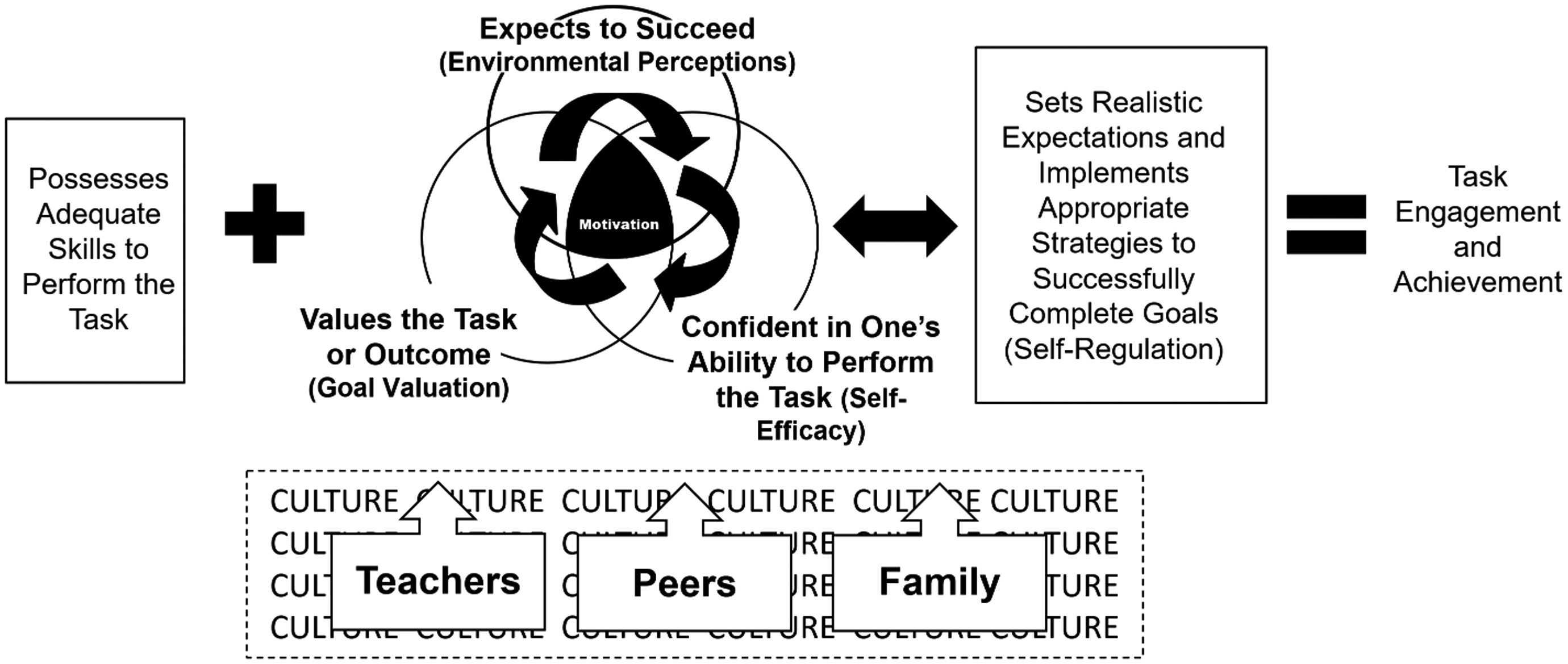
Power and Empowerment in Gifted Education in Relation to Marginalized Groups
Comparable to the studies discussed earlier regarding the impact of teacher power on learner empowerment, students from historically marginalized populations are identified and served in gifted and advanced programming much less frequently than would be expected based on their overall percentages in K-12 schools (e.g., Ford et al., 2008; Peters, 2022). This often has been attributed to a large extent to an inherently racist educational system that traditionally has prioritized the design of gifted services with only “White, middle class, English as a first language, cisgender, heterosexual, able-bodied, neurotypical students as its model” (Barnes, 2022, p. 119). Additionally, some research has indicated that without targeted interventions, teachers, who by far identify as White (i.e., 80%; National Center for Education Statistics, 2023), are no less likely to hold pro-White and explicit racial biases (Starck et al., 2020) and that Black and Hispanic/Latinx students are identified as gifted less frequently when their teachers are White (Grissom & Redding, 2016; Nicholson-Crotty et al., 2011; Rocha & Hawes, 2009). While not discussed explicitly using the terms power and empowerment, these all likely influence or are probable outcomes of that dynamic.
Purpose of the Study
As no research was found directly examining gifted students’ perceptions of the impact of classroom power dynamics, including teachers’ utilization of various relational power bases (i.e., reward power, coercive power, legitimate power, referent power, expert power), on their motivation to engage in learning and their overall sense of empowerment, the purpose of this study was to explore these relationships. The research questions were:
How do gifted high school students perceive the power dynamics within their classrooms? How do gifted high school students’ perceptions of classroom power dynamics relate to their sense of empowerment and/or motivation to engage in learning?
Positionality Statement
I identify as a cis-gender White woman, a parent of gifted children, a spouse, an educator, a researcher, and an advocate for gifted learners. I have worked with gifted students for over 25 years, including as a teacher of advanced/honors courses, as a building-level gifted education coordinator, and as a university professor. I believe that building relationships where gifted students feel valued, respected, and empowered is foundational in motivating and engaging them.
When I completed this study, it was my eighth year teaching in the summer program in which I collected data. Many of these students were in my leadership class the previous summer, and one of them attended the high school in which I was working, but I was not one of her classroom teachers. I hoped that this familiarity with students in the study would foster an environment in which they felt comfortable sharing openly with me but also recognized that I had potential biases associated with this research and these students. I attempted to lessen the impact of my biases through an in-depth process of establishing credibility (i.e., peer debriefings, member checks, triangulation of data), transferability (i.e., in-depth descriptions, participant quotes), dependability (i.e., audit trail, reflexivity), and confirmability (i.e., audit trail, reflexivity; see “Trustworthiness” below for more detail).
Theoretical Frameworks
Two theoretical frameworks were utilized in the design of this research study. One was learner empowerment, where “empowerment is conceptualized as a form of motivation” (Frymier et al., 1996, p. 181). Previous research determined that learner empowerment is positively and significantly related to state motivation, indicating that learner empowerment can be influenced by the classroom environment (Frymier et al., 1996). Additionally, relevance behaviors and teacher immediacy were positively and significantly associated with teacher communication variables, suggesting that teacher communication behavior influences learner empowerment (see literature review for further discussion).
A second theoretical framework was French and Raven's (1959) conception of power as rooted in communication-specific, relational power bases (i.e., reward coercive, legitimate, referent, expert). The utilization of pro-social forms of power (i.e., referent, expert, reward) have the potential to positively impact student motivation and learner empowerment (Schrodt et al., 2008), while the utilization of antisocial forms of power (i.e., coercive, legitimate) have the potential to negatively impact student motivation and learner empowerment (see literature review for further discussion).
Methods
Crotty (1998) states that it is necessary for the social researcher to examine four specific elements: epistemology, theoretical perspective, methodology, and methods. I utilized constructionism as the epistemology for this research, which asserts that the construction of meaning is undertaken by individuals as they engage with and make sense of their world (Crotty, 1998). The theoretical perspective provides the “philosophical stance” (p. 66) around which a methodology is chosen or designed. I employed interpretivism as the theoretical perspective, which seeks first to understand and then to explain social and human reality.
The methodology flows from the choice of epistemology and theoretical perspective and determines the way in which the researcher collects and analyzes data (Creswell, 2013). Phenomenology requires one to “engage with phenomenon in our world and make sense of them directly and immediately” (Crotty, 1998, p. 79), through questioning what is already known and being open to a new perspective. It is directly influenced by one's culture and focuses on describing, reporting, and making meaning of common subjective experiences of the participants. Phenomenology is the methodology I utilized to explore the phenomena of power dynamics and empowerment within high school classrooms from the perspective of gifted students who had experienced it.
Research Participants and Setting
Prior to beginning the study, IRB approval was received; the summer program gave permission for the study to be completed on site; caregivers signed consent forms giving permission for their child to participate in the study and for me to collect additional notes to be utilized as data sources (e.g., from student discussions, reflections, and journal entries); students also assented to participate and for additional notes to be recorded and utilized. The participants in the study were a convenience sample of 29 of 30 high school students 1 attending a 2-week, summer, residential leadership program designed for gifted and talented students on a mid-sized university campus in the Rocky Mountain region during a summer pre-Covid. 2
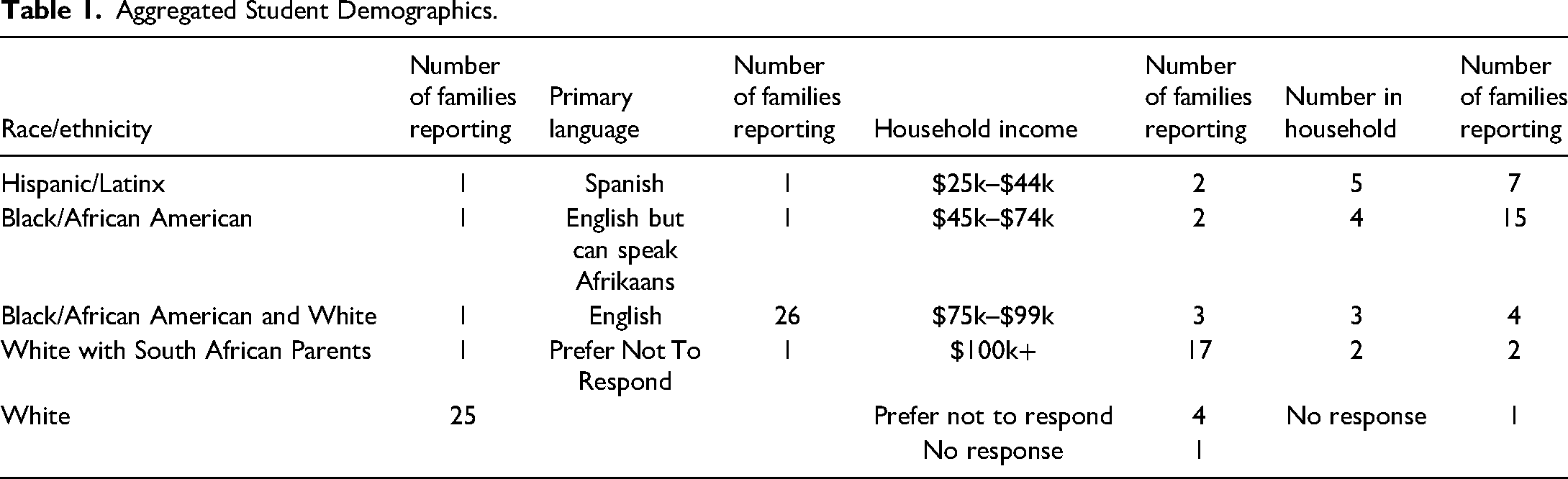
The students attended the leadership program from eight different states, 3 and the majority identified as White and reported incomes in the middle SES range (see Table 1). Twenty-seven self-reported that they had been identified as gifted in their districts, and one student reported participating in talent pool programming. Twenty-six of these self-reports were confirmed by guardian(s) via the guardian demographic form (see Table 2). Three families did not respond to this question on the demographic form (one was the family of a student who attended in a state where districts did not identify for gifted programming).
Aggregated Student Demographics.
Student Demographics.
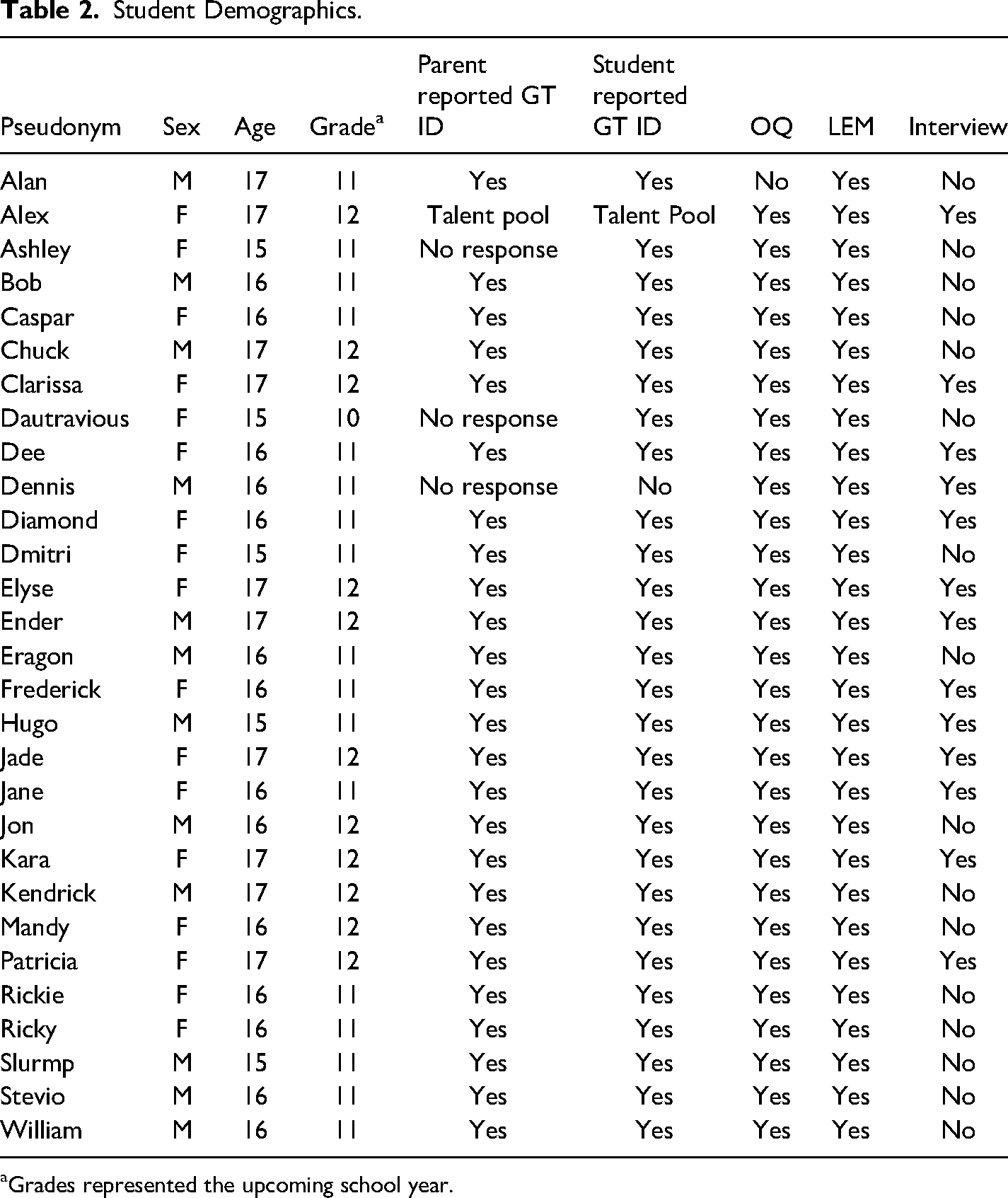
Grades represented the upcoming school year.
Research Instruments
Data collection included completion of (a) guardian and student demographic forms, (b) an Opinion Questionnaire (OQ) that allowed for open-ended responses from the students regarding their personal experiences with power structures within their high schools (see Appendix A), (c) the LEM (Frymier et al., 1996), consisting of statements that required a Likert-scale response (used to establish context, develop interview questions, and select interview participants; see Appendix B), and (d) in-depth, semi-structured interviews (see Appendix C). All 29 students completed the demographic form and the LEM; 28 students completed the OQ. One student did not complete the OQ due to high levels of anxiety around this activity. Additionally, I took detailed notes on relevant conversations students had with me and others during the leadership program.
Demographic Forms
The guardian demographic form requested: (a) total number in household, (b) household income range, (c) highest level of education for each guardian, (d) child's race and ethnicity, and (e) child's area of gifted identification. The student demographic form requested: (a) pseudonym, (b) age, (c) grade, (d) sex, (e) race/ethnicity, (f) home language, (g) area of gifted identification, (h) with which guardian(s) they lived, (i) number of siblings, (j) number of people living in the home, (k) guardians’ jobs, (l) nearest public library (a potential indicator of poverty), (m) number of books in the house (a potential indicator of poverty), (n) number of years attended the leadership program, (o) means by which the attendance fee was paid, (p) state where attending high school, (q) high school size (in numbers), (r) GPA, (s) number of students in class, (t) types of learning activities/courses in which they participated (e.g., AP, IB, honors, community service), (u) favorite class in high school and letter grade in that class, and (v) least favorite class in high school and letter grade in that class. Questions on both the guardian and student demographic forms that might be considered sensitive had the option of “Prefer not to respond.” Information from the guardian demographic forms and the student demographic forms were used to help establish context within the study and to select a demographically diversified sample of students (e.g., different geographic regions, both male and female participants) for the interviews.
Opinion Questionnaire
I developed an OQ that asked for short, open-ended responses to questions about teacher and learning situation preferences (see Appendix A). For example, a teacher preference question was, “Who has been your favorite teacher so far in high school and why? What grade were you in?” A learning situation preference questions was, “What learning situations make you feel the most competent and capable?” The OQ was administered after the demographic forms were completed but before students responded to the LEM so that statements on the LEM did not influence responses to the OQ.
Learner Empowerment Measure
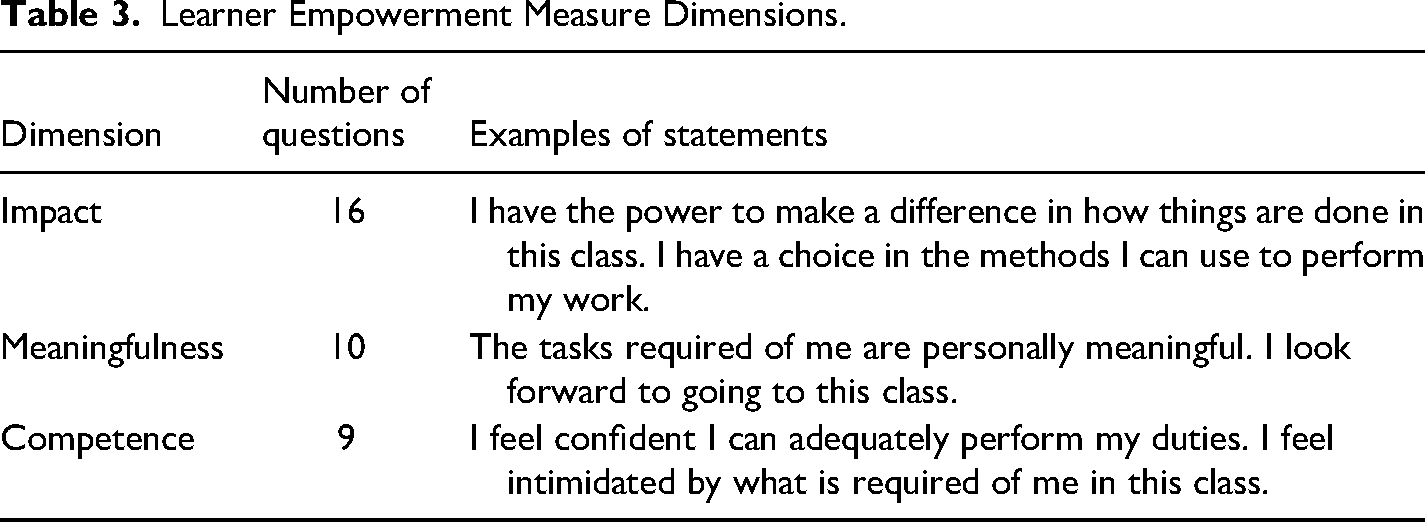
The LEM was selected for this research because of its high reliability and because it was normed on students fairly close in age to the students in this study. The LEM (Frymier & Shulman, 1994; Frymier et al., 1996; see Appendix B) was developed to help researchers and practitioners “understand the role of communication in the process of empowerment” (Frymier et al., 1996, p. 181) in undergraduate classrooms. Participants responded to 35 statements on a four-point Likert scale (i.e., 0 = “never” to 4 = “very often”) that focused on the empowerment dimensions of impact, meaningfulness, and competence (see Table 3). Impact had an alpha reliability of .95; meaningfulness was .94; and competence was .92 (Frymier et al., 1996). The overall empowerment measure had an alpha reliability of .89. To further establish validity, empowerment was correlated with trait motivation (i.e., motivation based on individual characteristics), state motivation (i.e., motivation based on interest in current activity), relevance, and affective learning. No correlation was found to exist between trait motivation and empowerment; however, all three dimensions of empowerment (i.e., impact, meaningfulness, competence) significantly and positively correlated with state motivation, relevance, and affective learning.
Learner Empowerment Measure Dimensions.
Students in the current study were asked to respond to the statements on the LEM twice, once thinking about their favorite high school class so far and once thinking about their least favorite class. This allowed me to obtain often very different perspectives on students’ high school experiences. Students had the opportunity to also comment on each of the statements in addition to responding to the Likert scale.
Semi-Structured Interviews
Creswell (2013) recommends identifying a group of 3 to 15 individuals to interview who have experienced the phenomenon of interest. Thirteen students (see Table 1) were selected for individual interviews via purposive sampling to produce maximum variation from a somewhat homogeneous group (Merriam, 2009). Students chose pseudonyms to be utilized when discussing their responses. 4
The semi-structured interviews included open-ended questions asked of all students (see Appendix C) based on the majority of students’ responses on the LEM and the OQ. Some additional interview questions were specific to a single student based upon their response to a question on the OQ. I asked follow-up questions, as applicable, based on students’ responses to the interview questions and to other topics or ideas that arose within the context of the interview. This format allowed me to obtain specific information from all students while remaining open to information individual students felt was important to share.
Interviews took place in person and ranged in length from approximately 25 minutes to approximately 60 minutes, with the majority lasting 45–60 minutes. Most interviews could have extended beyond this timeframe, but because of the constraints of the leadership program, they were abbreviated. Several students offered to meet and talk more about the topic later, and multiple participants emailed me about the topic after the leadership program ended. Member checks of the interview transcripts were completed via email for all but one student, as that student did not respond.
Interviewee Profiles
Thirteen of the 29 students provided the majority of the in-depth information through interviews, informal conversations, and follow-up emails. This section provides contextual information to help the reader become more familiar with their stories.
Alex
Alex would be a senior when school began in the fall. She anticipated about 200 students in her graduating class next year. She had been accepted into her high school's arts magnet program and reported her unweighted GPA as a 3.4. Her favorite classes had been all three of her dance classes (her area of particular talent), and her least favorite class so far had been Chemistry. This was her second year at the leadership program, where she was able to attend through a combination of scholarship money, donations from GoFundMe, contributions from her grandparents and parents, and money she made working.
Alex's high school had been identifying students for gifted programming in intellectual and academic areas for years but was just beginning to identify in the area of visual and performing arts. She had been identified for the talent pool and participated in advanced programming in the areas of dance and choir, while the school continued to collect a body of evidence to assist in formal gifted identification. “I was given that opportunity [to choreograph a dance] my junior year, and it really gave me my moment to create art, create my art, and display it in front of an audience, which was how my teacher recognized that I was gifted in dance and that creative aspect of like creating formations and movement through music” (Interview, August 30).
While Alex had taken advantage of both honors and Advanced Placement (AP) classes at her high school, she described experiencing significantly more enjoyment and satisfaction in her arts classes than in her academic classes. This sentiment was reflected in her LEM responses, where positive statements (e.g., statements dealing with choice, contribution, ownership) for her dance classes were all marked “very often” and negative statements (e.g., “not important to me,” “waste of time,” “boring”) were all marked “never.” Alex later responded, “Thank you so much for letting me be a part of this project. I am so excited to hear more about your research” (Email, September 8).
Clarissa
Clarissa would also be a senior next year. She reported 184 students in her graduating class and a GPA of 3.94. Her favorite class had been AP Biology, and her least favorite class had been Pre-Calculus. Clarissa was also involved in multiple clubs and sports at her school and enjoyed volunteering. This was her second year attending the leadership program.
Clarissa had attended a small, private K-8 school, where she said she was advanced in all of her classes but was only accelerated in mathematics. “We were an entire year ahead of them [in math], so we were using a different textbook, doing all that type of stuff, but it was just me and one other girl, and so we really taught ourselves.” (Interview, July 20). She transitioned to a public high school after eighth grade, where there were more programming options available, including advanced academic classes in subjects other than mathematics. It was during her sophomore year that she was formally identified for the gifted program. Now I’m in the gifted program, but it doesn’t do anything…it's like this one lady who's awesome, and I love her, but she's only one person, and she can’t really do that much. She meets with you sometimes and is like, “Hey, how's it going?” You’re like, “Good,” because if you say “Bad,” there's not really anything she can do. (Interview, July 20)
Clarissa had a full schedule as a high school student but had learned to efficiently manage her time. “I really know my schedule. I schedule every hour of my day out. I love my planner” (Interview, July 20). She also seemingly loved everything biology related and eventually wanted to research vaccinations, majoring in Biology and minoring in Political Science so she would have the option to “go into the political side of the vaccines” (Interview, July 20).
Dee
Dee reported that she would have about 600 students in her junior class. Her favorite class so far had been Earth Science, and her least favorite class had been Biology. She had a 3.9 GPA and had been selected for a program for low-income, high achieving students. This program had provided the funding for her to attend the leadership program for the first time that summer.
Dee had moved between elementary schools several times growing up, and in middle school was bullied and never felt like she fit in (Conversation, July 20). At the high school, however, she was determined to take full advantage of every opportunity and stated that she had “taken almost every class honors” (Interview, July 20) since beginning high school, as well as the only AP course that had been available for freshmen to take (Interview, July 20). One thing she especially appreciated about her high school was that students could participate in advanced programming without being formally identified as gifted. Within those classes they treat you as if you have taken that test and been identified, but you weren’t, which I really like because a lot of people feel like they can’t get into those classes because they feel like they have to be identified. For us, our school, it's really open and understanding and accepting of that, so everybody gets a chance to feel like they can succeed in those areas. (Interview, July 20)
Dee's success in her advanced coursework to date, however, had come with challenges that many others do not face. I think a lot of it has to do with the way I learn. I’ve never been diagnosed with a learning disability, but my brothers have [dyslexia], and I feel like I do have a learning disability because I can read a story and not understand what I just read, so I have to reread it three times to understand. For me, it's just processing what I just learned- not that the teachers are lacking in teaching it to me or that I’m not engaged. It's just that I really most of the time don’t understand. (Interview, July 20)
Additionally, Dee felt that education was not a priority overall in her school system and that many students in her school were dealing with drug problems (Conversation, July 20). She, on the other hand, did value education and was involved in advanced academics and multiple clubs at her school. She also worked. She lived with her grandmother but had supported herself for the last year, earning enough money to purchase a car, while still maintaining her grades. She said she never got to sleep before 1:00 or 2:00 a.m. and was up by 5:00 a.m. every morning. She had had to give up her job in order to attend the leadership program but felt that taking advantage of this opportunity was more important. She would begin looking for another job later in the summer. Dee was the only participant who reported that English was not the primary language spoken in her home.
After the interview, Dee thanked the interviewer, “Thank you for choosing me and talking to me. I think I might have had a different perspective than some other people. I like being able to represent the perspectives of people who think like me” (Conversation, July 20).
Dennis
Dennis was preparing to begin his junior year at a large high school, where he would have approximately 1,100 students in his class; this was his first year of attending the leadership program. He was involved in band and participated in multiple math clubs and competitions. He reported his GPA as somewhere between a 3.8 and a 4.0, and his favorite high school class had been AP Calculus BC. His least favorite class had been Freshman English.
Dennis said he vaguely remembered being pulled for advanced mathematics’ in elementary school, which at his school was K-4. That acceleration continued into middle school (i.e., fifth and sixth grades) and junior high (i.e., seventh and eighth grades). Also in middle school, he participated in advanced reading programming at lunch but didn’t enjoy that nearly as much as the math. Junior high also provided the option of accelerated programming in science, and at the high school, Dennis had multiple advanced academic options, including honors and AP courses. He described himself as a “math person” (Interview, July 18). “It is really interesting to me and super elegant….I speak math much better than I speak English—to the point where I can spew math at people, and it makes perfect sense to me, and they’re like, ‘Can you say that in English please?’”
Diamond
Diamond anticipated approximately 500 students in her junior class in the fall. This was her first year attending the leadership program. Her favorite high school class had been Geography, and her least favorite had been AP World History. She had also taken some honors classes. She had a 3.6 GPA and was attending the leadership program for the first year through a scholarship program in her district designed to support students from low-income households who were high achieving.
Diamond was aware and appreciative of the opportunities available to her and embraced the notion that it was up to her to take advantage of those in order to achieve the future success she desired. She spoke of feeling connected to and being impacted by historical events that had shaped her understandings and expectations, and she appreciated the diversity she was surrounded by in her high school and the opportunities that diversity afforded her. The school I go to is really, really diverse….People who go to school often want to know about other cultures and want to know about other people…, so the school itself feels welcoming, and then you kind of feel safe to do other things….I think it also allows you to go into different subjects, different clubs. You could be really sporty, like tennis, and then you can do something like the play at the same time, and no one's going to judge you. (Interview, July 17)
Diamond was involved in multiple extracurricular activities at her school, including Student Advisory Council and a new club, whose mission was to “diversify AP and Honors courses and help double the amount of the people of color enrolled in these courses by the end of the year” (Email, March 12). Diamond, whose parents came from Nigeria, also spoke of being deeply connected to her family, finding motivation in them and their achievements (Interview, July 17).
Elyse
Elyse had just finished her junior year and anticipated approximately 500 students in her graduating class; this was her second year attending the leadership program. Her favorite classes had been AP United States Government and AP Comparative Government. Her least favorite class had been Personal Finance. Elyse reported a 3.9 unweighted GPA (4.4 weighted) and was attending her second year of the leadership program.
Elyse spoke of a “very solid gifted program” (Interview, July 14) growing up. “The whole gifted program—I felt like that was an important part [of what I wanted to talk about] because it definitely shows how and why I can get where I’m going” (Interview, July 14). She was identified for gifted programming in first grade. During elementary school, she attended a special school for gifted students one day a week, where each morning the students participated in a class (same class for an entire semester) that focused on a different topic or concept (e.g., architecture, feeding the world), incorporating creativity and cross-curricular connections. In the afternoons, students were able to choose to participate in a class that teachers at the school had designed around their own interests. In her middle school, gifted students had the opportunity for an hour and a half every other day to participate in gifted programming, with courses structured similarly to the courses that had been available at the elementary. In high school, the focus had shifted more toward advanced coursework, but students also had additional support. In high school you get more choices of how advanced your classes are, but we have two gifted counselors at our school, and…we talk to them twice a semester. They keep us very updated. They make sure we know what our goals are, and one of the teachers is a teacher at…my high school, our gifted teacher, and she moves with us. (Interview, July 14)
At that point, Elyse was hoping to attend Rice University, which would allow her to continue to focus on interdisciplinary studies, double majoring in bio-medical engineering and political science.
Ender
Ender was a senior during his second year in attendance at the leadership program. Ender attended a private, boarding school, where he played rugby and fenced. So we wake up; we all go to breakfast because we board there, so we all live there, too. We go to breakfast; go to classes; go to lunch; go back to classes; and then we go to sports right after, and everyone has to either participate in a sport or participate in some integral activity…then after that, we eat dinner, and then we have required two hours of homework time…and then after that we go to bed, and we do it all again. (Interview, July 19)
He would have approximately 200 students in his graduating class. His favorite high school class thus far had been AP United States History, and his least favorite class had been Honors Physics.
Ender stated that he had been consistently accelerated in mathematics since elementary school and that his continued achievement during middle school would have played a significant role in determining the programming options available to him at the high school had he stayed in the public school system. However, he chose to go a different route. “Just for middle school to high school, the high school will look at your record from middle school and that plays a much bigger part in the selection for Advanced Placement, honors and all that. For me…, how I performed… decided whether I got into the private school or not” (Interview, July 19).
After the interview concluded, Ender thanked me for taking time to listen. “I’m really passionate about education. I could talk about this for days. I want to be a teacher, so I’m always thinking, ‘What would my students need of me?’” (Conversation, July 19).
Frederick
This was Frederick's first year in the leadership program. She reported she would have approximately 180 students in her junior class next year. Frederick had participated in both honors and International Baccalaureate (IB) classes but had left traditional high school and entered a charter school program where junior college classes counted both toward a high school diploma and an Associate of Art's degree. In this setting her favorite class so far had been Shakespeare and her least favorite class Economics. She had a 3.8 college GPA. This was her first year in the leadership program.
Frederick said she remembered being identified as gifted early—maybe even in Kindergarten. At the elementary level, programming consisted primarily of giving the gifted students more work. “It was still easy; it was just a lot more of it” (Interview, July 17). She continued to take the most challenging courses available in middle school but also continued to dislike school. “I have always kind of hated school. It was more for social reasons when I was in elementary school (I was constantly getting picked on), but in middle school it started to be like I just hated the work and stuff” (Interview, July 17). Her freshman year, she began the IB Program but eventually decided that it was not a good fit for her. “That was like the worst year of my life. I hated it so much. It was so, so much high-level work and high-level studying and stuff, and I’d never really ever been taught how to prepare for any of this because, you know, [they assumed] I just knew how to do it already, and that's not true” (Interview, July 17).
Between her freshman and sophomore years, she did her own research and learned about the charter school. “You can just jump right into college and not worry about it, not worry about any more high school” (Interview, July 17). Music is her passion, but instead of continuing her plan to drop out of school to tour with her band, she now had long-term educational goals that included a master's degree in Live Music Production.
Hugo
Hugo would be a junior when school began in August. He had participated in honors and AP courses, was heavily involved in the music programs, and had a weighted GPA of 4.23. He anticipated that his junior class would have about 150 students in it. His favorite class so far had been Chamber Choir and his least favorite AP United States History. This was his first year attending the leadership program.
Hugo had been identified as gifted in early elementary and was grade accelerated from first to third grade. In first grade, I think it was around end of semester one…up until that point I had been complaining…to my parents that I was really bored in class. I would finish my work and be done and be helping other kids instead of focusing on things. I would always be getting in trouble with my teacher. My teacher thought I was just a really obnoxious kid because I would just speed through my work so fast and get everything done. (Interview, July 18)
He said academically the move had made things better, but he was still struggling a little with “fitting in”—things like not getting his driver's license at the same time as his classmates, but at the time that the decision to accelerate was made, “I was like, ‘I just want one less year of school to do’” (Interview, July 18). Hugo also spoke about the stress the label of “gifted” can cause for students. “Oh, I’m gifted. That means I have to succeed in everything. That means that kids are going to be looking to me and being like ‘Oh, he's the gifted one. Let him do it’” (Interview, July 18).
In the early elementary grades, Hugo had received advanced programming in math and science. Beginning in fifth grade, he was pulled from his regular classroom for special gifted classes, which he found frustrating because he felt the rationale for these gifted classes was simply, “Instead of more quality or high-level education, we’re just going to give you more work on top of what you’re already doing in class” (Interview, July 18). At the middle and high school, gifted programming had been honors and AP courses—some of them good but some similar to his fifth-grade experience of same rigor, more work.
Once he got to high school, however, Hugo realized that giftedness could encompass artistic and creative strengths, which resonated with him because of his talents in the musical arena. He participated in his high school theater program and school choirs and joined a community choir to further explore his passion for singing (Email, March, 15). His career goal at the time of the interview was to become a cognitive neuroscientist. Hugo thanked me for undertaking this study (Email, March 6).
Jade
Jade would start her senior year in the fall. She anticipated about 300 students in her graduating class and had a weighted GPA of 4.61. Her favorite high school course had been AP Psychology, and her least favorite high school course had been AP Chemistry. She had also participated in honors classes and was involved in student government at her school. This was her second year attending the leadership program.
Jade attended a small K-8 school prior to beginning high school. She was identified as gifted in third grade, but no programming was provided for students until fifth grade. Unfortunately, by the time Jade reached fifth grade, they had cut the program. “It was a really good program, but because it was cut, we didn’t really do anything with it, so I’m officially in the program, but nothing is ever being done about it” (Interview, July 17). She was accelerated in math in fifth grade, attending classes at the middle school, but that was difficult for her because “they taught at a different time in the middle school than they did at elementary school; I ended up missing like the first two hours of the day, and that's when they did like all of their other stuff. And then when I came back, that's when they were doing math” (Interview, July 17). She said she spent most of that year working in the library because she got tired of reading by herself at the back of the classroom—although she did have an art teacher who voluntarily worked with her in the afternoons. Jade would read a classic book, and then they would collaboratively design an art project related to it. Later in the conversation about her elementary school, Jade laughed, I was one of those kids where I knew I was smart, and I decided everybody else had to know it, too. I actively acknowledge it. I 100%, like I wouldn’t say I deserved it, but I understand why I was so ostracized at the time. It didn’t really matter all that much to me, but like looking back on it…, I think it would have been better if maybe I had been shown how to [interact]…you know, growing up in such a small town and such a small school, there wasn’t anybody else like me. (Interview, July 17)
Jade transitioned to a larger, charter school for middle school and was attending a public high school, where she had access to advanced programming, “but basically the only difference, in my school at least, between the honors and the normal class, is that our A ends at a 92 and theirs ends at a 90” (Interview, July 17).
Jade later thanked me for taking the time to interview her. “Thank you for listening. It's rare to have the opportunity to rant about this in a safe environment” (Conversation, July 17).
Jane
This was Jane's first year to attend the leadership program. She was going to be a junior at a small high school of about 400 total students. “We don’t read what typical schools would read for literature classes, and we teach with the more philosophical way, but there's a word for it: the classical order. It's like rhetoric. We’re taught in a very rhetorical way” (Interview, July 17). She had taken advantage of honors courses at her high school and reported a 3.5 GPA. Her favorite class in high school so far had been Rhetoric and her least favorite Chemistry.
Jane stated that she “enjoyed performing and singing” (Interview, July 17), and while she appreciated that her high school allowed her to capitalize on these strengths, the limited diversity in her high school was concerning to her. She stated that she was one of only two “ethnic people” that attended and that she didn’t always feel as though she could relate to the interests and concerns of other students in the school.
Prior to moving to her current state, she had been raised in the South by her aunts. Her self-reported information differed from that reported by her current guardian because she was living with her girlfriend in their own apartment, and they were supporting themselves, which also differentiated her from others at her school.
Kara
Kara would be a senior at a private high school in the fall and would have approximately 70 students in her graduating class. While Kara had taken honors and AP classes in high school, her favorite class had been Studio Art, and her least favorite class had been Banned Books/Visual Texts. Kara had a 2.11 GPA and was attending her second year of the leadership program.
Kara was identified as gifted in first grade. “In elementary school, the gifted and talented program was occasionally we’d meet in the library, and we’d have an extra project to complete or something” (Interview, July 17). In middle school, the gifted programming consisted of honors classes, but because of the other students in the classes, Kara felt it wasn’t a good fit for her. “I thought the honors kids were bad. They were malicious and mean spirited” (Interview, July 17). In addition to these challenges, Kara was dealing with issues outside of school, which negatively impacted her further. I was a very good student in elementary school. In sixth grade I would get a B a quarter, but other than that it was all A's. Then in middle school I started strong in my seventh-grade English teacher's class- I had a hundred plus at some point. But I was struggling through some things…, and that just killed any motivation I had in school. (Interview, July 17).
However, she continued with honors and AP courses through her freshman year in high school, where again, she felt her needs were not being met. “I hated it….I just don’t ever want to take an AP class again. I understand that there is a lot that aren’t like that, and it was probably just a bad class, but it just seems like a whole lot of hype for something that isn’t really necessary” (Interview, July 17). At that point in her educational career, she and her family began researching other options and eventually decided on a private school. “It was a very liberal, a very progressive school, but it was still school” (Interview, July 17), and although sophomore year had still been somewhat of a struggle, by her junior year, she had connected with a few students at the school, had found a niche that capitalized on her creative talents in art and writing and allowed her to better express who she was, and was experiencing more academic success. “I still don’t do as much homework as I should, but I do still do it” (Interview, July 17).
Patricia
Patricia would be a senior and would have approximately 550 students in her graduating class; this was her second year attending the leadership program. Her favorite class had been AP United States History, and her least favorite class had been Geometry. Her current GPA was a 4.2. on a 4.0 scale. Patricia was very involved in visual artistry courses at her school, focusing on sculpture and ceramics, and outside of school she danced competitively. This was her second year attending the leadership program.
Patricia was identified as gifted in first grade but did not begin receiving services until third grade, when she was then pulled from her regular class a couple of times a week. “Then they give you extra work to do in class [on top of what you’re already supposed to be doing]. I always forgot to do it, but you were supposed to do it. They would have us analyze songs and do extra math worksheets” (Interview, August 10). However, gifted programming was cut in fifth grade, so “we had pretty much nothing” (Interview, August 10). In middle school, there was again a gifted program, but Patricia lamented the lack of advanced classes. “You basically just met with the gifted coordinator at the beginning of the year to set goals for yourself and at the end of the year to say you achieved those goals you set. It didn’t actually have any impact on what you were taught” (Interview, August 10). In high school, she had been able to take advantage of honors and AP courses and some advanced coursework in visual art. At that point, Patricia was planning to major in Physics or Engineering in college.
While different from each other in many ways, these gifted students all evidenced not only a willingness, but an enthusiasm to share stories about their high school learning experiences. Five of the students thanked the interviewer for exploring this topic and for the opportunity to participate. Throughout the process they were thoughtful and articulate, and even though, at times, they expressed frustration with the system, they were respectful of the efforts put forth by their teachers and, overall, still excited about the prospect of learning.
Data Analysis Procedures
Open-ended responses from the OQ (29 students) and individual, semi-structured interviews (13 students) were the primary sources of qualitative data used to derive meaning. Reflexive thematic analysis (Braun & Clarke, 2019, 2020) was utilized with the phenomenological methodology (Chang & Wang, 2021; Sundler et al., 2019) to organize into themes the common patterns of meaning the participants shared about their lived experiences regarding classroom power dynamics. The LEM responses, demographics information, conversations with students, and email communications were utilized to provide context and to support information obtained from the OQs and interviews.
Demographic Forms
I utilized information from the guardian demographic forms and the student demographic forms to help establish context for the study and to select a demographically diversified sample of students (e.g., different geographic regions, both male and female participants) for the interviews.
Opinion Questionnaire
I aggregated responses (i.e., all responses for each question listed together) from the OQ to identify patterns across all participant responses (e.g., majority of participants feel strongly about a particular statement topic, similar sentiments expressed) and unique individual responses (e.g., a relevant response not offered by other participants). I selected students who represented a typical respondent from this group as well as individuals who answered very differently from other students in the study.
Additionally, I analyzed each OQ individually to get to know the 29 participants better and to begin looking for possible themes (see explanation of inductive analysis below). Examining the questionnaires in two stages (i.e., individually and aggregated), allowed me to look for themes within individual responses and for similarities and differences in themes across student responses.
Learner Empowerment Measure
I also aggregated responses from the LEM to look for patterns within individual responses (e.g., neutral response on all Likert-scale statements, scoring one section of items all 4s), patterns across all participants’ responses (e.g., similar Likert-scale responses on the same statements), and extreme responses (e.g., scoring one section of items all 4s) or unique (e.g., a single student with very different responses to statements). This process assisted me in learning more about each of the students, in developing interview questions, and in selecting participants to interview who could represent the majority response as well as some who might provide varied responses to the interview questions.
Semi-Structured Interviews
Analysis of the interview data was ongoing, beginning with notes taken and reflections recorded during the interviews. After the interviews were transcribed, I employed reflexive thematic analysis of the students’ responses, a recursive process of inductive analysis that requires a researcher “to reflect on their assumptions” as part of the process of deriving meaning from the data (Braun & Clarke, 2020). Inductive analysis allows “research findings to emerge from the frequent, dominant, or significant themes inherent in raw data without the restraints imposed by structured methodologies” (Thomas, 2006, p. 238) and includes close reading of the text, the creation of categories, and ongoing refinement of categories as text continues to be read and reviewed.
I read the transcripts from student interviews multiple times and coded them based on significant phrases or sentences found within the text that pertained to gifted students’ perceptions of and experiences with classroom power dynamics and empowerment. Notes were recorded in the margins of the transcripts to facilitate comprehension of and connections between coded sentences and phrases. These phrases and sentences were then clustered into themes common to the research participants’ responses. (This same procedure was utilized for inductive analysis of the OQ completed by the students.) The themes continued to evolve over many weeks as groupings were refined and re-conceptualized based on continual analysis and reflection.
I then developed subthemes based on students’ responses in a similar fashion and identified examples of student statements that supported the themes and subthemes. I shared this information with an expert in qualitative research, an expert in gifted education, and a veteran, high school teacher familiar with the characteristics of gifted students. Each was asked to determine if themes, subthemes, and supporting statements aligned, and discussion continued until there was consensus.
Additional Data
I kept notes on conversations with students regarding attitudes about learning, engagement, motivation, empowerment, and power dynamics within their high school classrooms. I also pulled relevant information from emails from the students after the leadership program ended. These data were used to support the development of themes and subthemes.
Trustworthiness
Complete trustworthiness of a qualitative study is impossible (Lincoln & Guba, 1985); however, it is important for the researcher to be able to convince others that “the findings are worth paying attention to” (p. 329). This hinges on the qualitative researcher's ability to persuade the reader of the credibility, transferability, dependability, and confirmability of the study.
Credibility
Credibility is concerned with how well the findings from a study represent the reality of the participants (Merriam, 2009) and is often established through peer debriefings, member checks (Thomas, 2006), and triangulation through “multiple methods of data collection” (Merriam, 2009, p. 216). Peer review and debriefing of this study (from development of initial interview questions to vetting of the findings and conclusions) took place with professionals with expertise in these areas (see section “Semi-Structured Interviews”). I employed member checking by asking the participants via email to review and correct or add to their interview transcripts prior to analysis; to review and provide feedback on their biographies; and to review the themes, subthemes, and supporting quotes to determine if they felt the information accurately represented their perspectives. Ten of the 13 students responded to these requests. None expressed that the themes and subthemes did not represent their experiences. Three of the students did not respond to several attempts to obtain a response. I triangulated using data from: (a) OQ, (b) LEM, (c) semi-structured interviews, (d) conversations during the leadership program, if applicable, (e) email conversations after the leadership program, if applicable, and (f) review of relevant literature.
Transferability
Transferability refers to how well findings can be applied in other settings with different individuals (Merriam, 2009). This is facilitated through enough “rich, thick description” (Merriam, 2009, p. 227) to allow the reader to decide if and how the information is applicable. Additionally, “maximum variation” (Merriam, 2009, p. 227) during participant selection enhances the possibility that transfer occurs. I provided in-depth descriptions of the participants’ thoughts, feelings, and reflections on the topics of classroom power dynamics and empowerment, utilizing their own words as much as possible through direct quotes (Qutoshi, 2018) that attempted to capture the essence of their experiences. Additionally, efforts were made to diversify the sample of students selected for interviews to obtain maximum variation (Merriam, 2009).
Dependability and Confirmability
Dependability refers to how well findings from a study can be corroborated by others and is established through thorough examination of “the data, findings, interpretations, and recommendations” (Lincoln & Guba, 1985, p. 318). Detailed records about the research process should be maintained that allow future researchers to repeat the research; although, it is not expected that they will attain the same results. Confirmability is concerned with whether the findings from a qualitative study represent the experiences and thoughts of the participants (Shenton, 2004).
A research audit in which findings and interpretations are compared with the original data to determine if they are consistent (Thomas, 2006) can be utilized to support both the dependability and confirmability of a study (Lincoln & Guba, 1985). An additional component in establishing dependability is reflexivity, or critically reflecting on one's self as a researcher (Lincoln & Guba, 1985). Reflexivity allows the reader to better understand how a researcher's biases, assumptions, experiences, etc., may influence how the data is interpreted.
To establish dependability and confirmability, I maintained an audit trail (Lincoln & Guba, 1985), recording how and when information was collected, thoughts and questions that emerged during the process, how categories were decided, and how pertinent decisions were made regarding the analysis of data. To address reflexivity, I elaborated on my positionality, assumptions, and biases regarding the topics, revisiting these during different phases of the research project to mitigate their impact.
Findings Regarding Perceptions of Power in the Classroom
Two primary themes regarding gifted students’ perceptions of power dynamics as they relate to interactions with their teachers are discussed in this section: (a) positive teacher power and (b) negative teacher power (see Table 4). An overview of the participants’ conceptions of power is shared initially to provide context.
Themes and Subthemes.
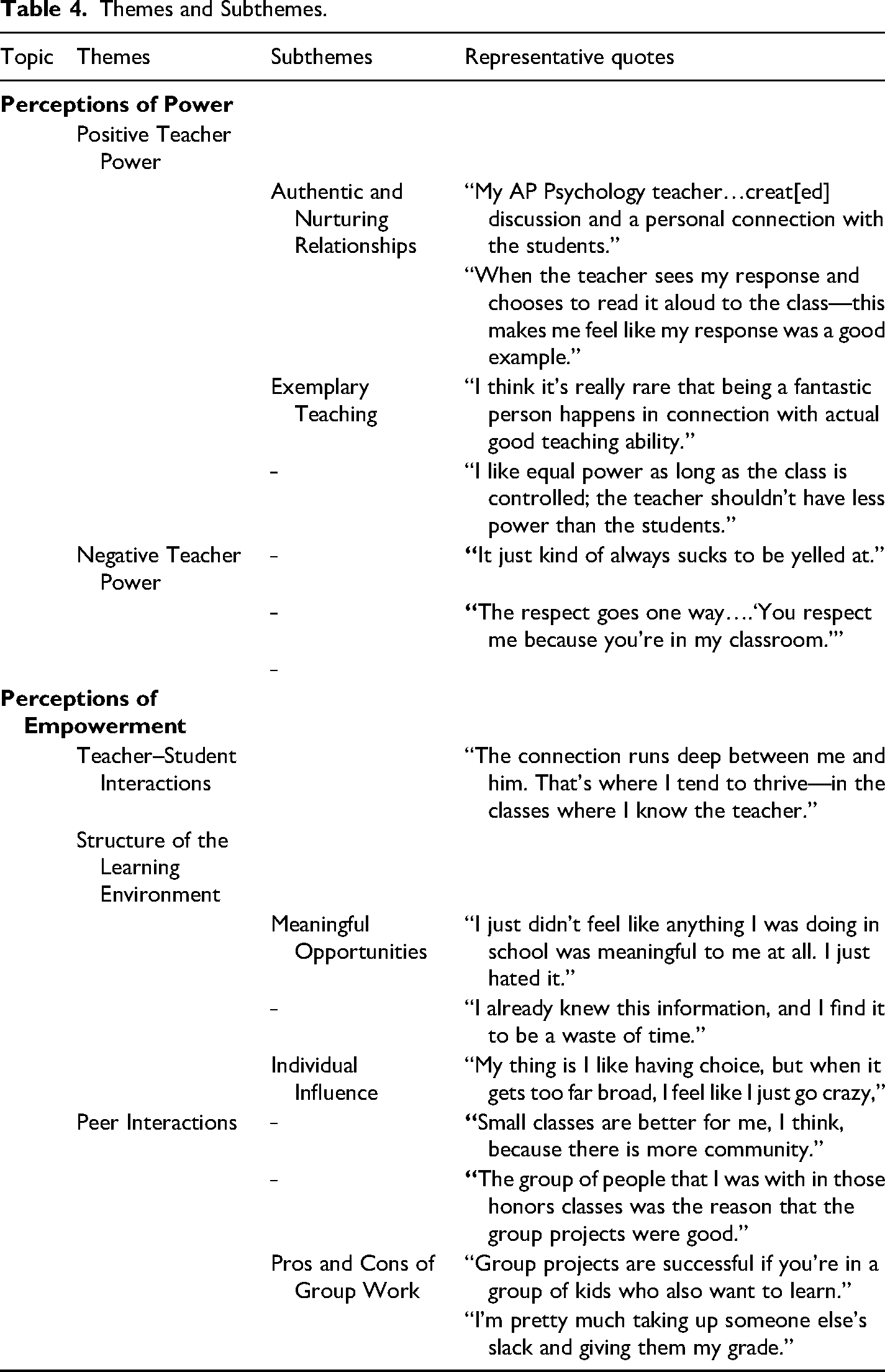
What is Power?
Students in the study operationalized power in terms of who controlled the learning environment. For example, Jade stated, “[Power is] the authority to shape how the class goes and the authority to shape discussions” (Interview, July 20). Participants acknowledged that, while students could have power, teachers had it the majority of the time. They also noted that the degree and type of teacher power could be situation specific. For example, Elyse said, “Definitely it depends on the… classes. I feel in the language arts and my government class you have a lot more power because it's more up into interpretation and how you can add to this knowledge” (Interview, July 14).
All students in the study reported experiences with what they perceived as both positive and negative teacher power. Jade reflected, I think the difference between good and poor teachers is whether they use it [power] for positive or negative influence, because oftentimes the teacher will use it to shut students down or use it in a negative way and not encourage positive action. Whereas, other teachers will use that authority to encourage proactive engagement and all of those other things that really make the classroom environment much better. (Interview, July 21)
Positive Teacher Power
The first primary theme in this section was the perception of positive teacher power. Teacher power was perceived as positive when it was utilized to facilitate personal relationships and positive classroom climates that fostered student learning. In these instances, teachers were able to effectively influence the class because students believed that they had something in common with the teacher and/or that the teacher cared about and was personally invested in them as learners and as individuals. Included under the theme of positive teacher power are the subthemes of (a) authentic and nurturing relationships and (b) exemplary teaching.
Authentic and Nurturing Relationships
When students perceived a teacher to be authentic and nurturing in their interactions, the power of that teacher was enhanced, and students were more likely to “grant” them the authority to lead. Students felt connected to their teachers when they could relate to the teacher (or the teacher could relate to them) on a personal level. For example, Dautravious said, “She [choir teacher] was…about nine years older than me, and it was really nice to have a teacher who could relate to my problems” (OQ, July 12).
Use of appropriate humor and fun also served to build rapport and nurture the teacher–student relationship. Dee stated, “My favorite teachers…, on the first day of school…make their class funny or fun… I feel like when teachers do that…, students respect them more because it's… making a personal connection” (Interview, July 20).
Additionally, students perceived that they had a positive relationship with their teachers when they felt supported or sincerely acknowledged by them. Kara shared such an example: My art teacher has always been very supportive of me… she always had my back. She knew what I wanted to do, and she encouraged that. She encouraged developing my own vision. She also encouraged me to explore a bit deeper than I was planning on doing. (Interview, July 17)
When the gifted students in this study sensed that their relationships with their teachers were authentic and nurturing, teacher power was perceived as positive.
Exemplary Teaching
Students also perceived teacher power as positive when they felt the teachers were knowledgeable about what they were teaching and were also accomplished educators, adept at managing all aspects of the classroom. Clarissa specifically spoke about the importance of organization: [With] my favorite teacher, my biology teacher…, I knew when everything was. I knew when the quarter ended. I knew when the semester ended. I knew when every big event was happening… she managed to fit that into her teaching. She… was able to keep the whole class organized… She was also really organized, and so that… just made my life easier. It made everyone's life [sic] easier. (Interview, July 20)
Beyond strong organizational and classroom management skills, students perceived teachers who knew their content well as having positive teacher power. According to Chuck, “The most meaningful learning situations are when a teacher is an expert” (OQ, July 12).
In addition, participants perceived that teacher power was positive when teachers could effectively employ the pedagogical methods necessary to teach their students well. This was different than knowing their content well. Ender stated, “That's the mark of a good teacher- being able to analyze and read what your students need and… to provide it for them” (Interview, July 19). This included a teacher's ability to effectively share power in the classroom. Patricia explained, Better teachers usually… develop that relationship where it's the 50-50 early on, and then it's just maintained throughout the school year. In classes that aren’t as great, the teachers usually have most of the power… they don’t worry about maintaining a relationship. (Interview, August 10)
This perception of shared power as positive teacher power surfaced in the majority of conversations with students. It was important for them to feel as though their teachers entrusted them with aspects of their own learning.
Exemplary teaching for these students included strong organizational and classroom management skills and expertise in teaching methods and content. All contributed to a sense of positive teacher power.
Negative Teacher Power
Students also described specific examples of when teacher power was in some way detrimental to the teacher–student relationship. The primary examples of negative teacher power were ones in which the learning environment felt psychologically unsafe. Jane elaborated, “With certain teachers, you don’t express your opinion because they will take it out on you if it's different from theirs…they hold the power over your grade and over your high school experience” (Interview, July 17). Clarissa shared a different type of example: I would go into her office hours [for help], and she would be like, “Sorry, I’m not your tutor. I can’t help you with that.” It was hard for me because usually a lot of stuff comes easy to me. It was hard for me asking for help in the first place, and she just kept continuously shutting me down.” (Interview, July 20)
The majority of students interviewed spoke about instances where they did not feel safe because teachers yelled or expressed hurtful opinions, and they considered this a negative use of teacher power. Additionally, a couple of students mentioned that teachers used control of their grades (e.g., threatening to lower a grade in order to gain compliance) as a negative example of teacher power, and Clarissa talked about teachers exerting power by sending students to the principal's office (Interview, July 20).
Students also discussed situations in which teachers seemed to have the expectation of power (and compliance from students) simply because of their status as teacher; from those teachers’ perspectives, it seemed it was not necessary to be exemplary or to develop relationships. Hugo said he felt it was “a superiority thing. Like, ‘I’m the teacher. I’m in control of the classroom.’…It's… condescending… The respect goes one way. ‘You respect me because you’re in my classroom… it's all rules and… my expectations’” (Interview, July 18).
While not always perceived of as personally harmful by students, these interactions were associated with negative teacher power in that they did nothing to build a positive teacher–student relationship or to foster respect from the student.
Findings Regarding Perceptions of Empowerment
Themes in this section centered on students’ understanding of the concept of empowerment and how this was fostered or hindered in their high school classrooms. Within discussions of empowerment, students also spoke of motivation, often interchangeably. As with power, an overview of participants’ understanding of empowerment is initially shared to provide context for this section.
What is Learner Empowerment?
Students operationalized empowerment as the perception that they understood a situation and had some degree of influence over the process or the outcome. Elyse's response was specific to the educational setting. “Empowered to me just feels like you’re really… confident and… like you know which direction you’re going in that class” (Interview, July 14). Jane spoke in more general terms about her understanding. “Empowered to me is being able to read and accept your situations but not letting them define you” (Interview, July 17).
Like the concept of power, when students felt empowered tended to be class and teacher specific. For example, Patricia stated, “Especially in AP and honors classes, you experience that [sense of empowerment] a lot” (Interview, August 10). While several participants spoke of feeling empowered in their high school classes fairly frequently, the majority of participants felt that they were empowered much less regularly. Frederick, for example, mused, I don’t ever feel that empowered in a classroom. It's… not that sort of environment for me. I don’t really like classroom learning too much. No matter the subject, it's just not really my thing. I don’t really like school very much. (Interview, July 17)
Students’ sense of empowerment was directly impacted by classroom power dynamics and is further discussed through the themes of (a) teacher–student interactions, (b) structure of the learning environment, and (c) peer interactions (see Table 4).
Teacher–Student Interactions
The first major theme in this section expands on the earlier idea of positive teacher power, looking specifically at how students’ perceptions of their interactions with teachers either positively or negatively impacted their sense of empowerment and motivation to engage in learning.
When students perceived that their interactions with teachers resulted in personal connections or close relationships, their motivation to engage in learning increased. For example, Hugo's said, “If you know that teacher…and you have that connection with them, you’re more engaged in what they’re trying to say. You’re more interested and you respect them… if they don’t distance themselves” (Interview, July 18). Similarly, Clarissa commented, “I need to connect to the teacher to really learn from them” (Interview, July 20).
Students also believed there was a connection between their relationships with their teachers, the degree of shared power in the classroom, and their sense of motivation and empowerment. Patricia explained, Classes where you don't have power, you feel less motivated to contribute; you don't really want to because you don't really care about the teacher, about the information as much. In a class where you have more power, you want to contribute; you want to maintain that relationship with the teacher…. The more power the teacher has, the less they really care about the students it feels like. (Interview, August 10)
In general, in situations where students felt connected to their teachers, they reported feeling motivated to attend to learning. In situations where students felt connected and power was effectively shared, students reported feeling not only motivated to engage in learning, but also more empowered in their learning. Likewise, when students felt they had a poor relationship with their teachers or limited to no power in the classroom, their sense of empowerment and motivation were negatively impacted.
Structure of the Learning Environment
Students also recognized that the way in which teachers structured the learning environment often communicated power and impacted their sense of empowerment and motivation to engage in learning. Students repeatedly spoke of the desire for meaningful activities and assignments and for opportunities to exercise a degree of control over their environments. Subthemes within this theme are (a) meaningful opportunities and (b) individual influence.
Meaningful Opportunities
Students often talked about wanting what they were asked to do in the classroom to be relevant and applicable and to provide them with opportunities to make meaningful connections. Clarissa spoke excitedly about the impact that making meaningful connections had on her. I just love eureka moments. That’s why I love biology. My favorite part is when you realize how everything connects because everything connects to biology, and you’re looking at something and you’re like, “Oh my gosh, I finally understand this! I thought I understood, but I don’t. I didn’t, and now I do! Now I know how these things all connect.” It’s crazy, and it’s so much fun, and you just feel so smart and so good, and your brain is so happy. That’s definitely where I feel most empowered- when something just clicks and I’m like, “I get it. I know what’s going on.” (Interview, July 20)
Activities were also perceived of as meaningful when the learning environment was compatible with students’ preferred modes of learning. For example, Jane commented, “I enjoy taking notes and repeating writing steps, as well as watching videos. I’m a very visual learner. I enjoy having sound, too, because it helps me focus, as well as moving my legs or hands” (OQ, July 12). Several students talked about finding their own ways to deal with the inconsistencies between their learning preferences and the ways in which teachers presented material so that they were able to stay motivated to learn and to gain a better understanding of the content. For example, Hugo explained, Everyone learns in different ways. I’m not an auditory, or a read/write learner, or a visual. I’m a kinesthetic learner… I’ll listen to your lecture, and all that. I can take my notes, but when I go home or whatever, and I’m studying, I have to think about it kinesthetically. (Interview, July 18)
Finally, the way in which teachers chose to prioritize the use of time in the classroom impacted meaningfulness, and therefore, overall motivation for these students. This applied not only to the content of lessons, but also to the pacing. When students felt their time was not utilized productively by teachers, the learning experience was less meaningful to them, and they often expressed frustration. While some commented on teachers moving through material too quickly and not allowing enough time for them to delve in-depth into topics they found interesting, more frequently, students commented on the pace of instruction moving too slowly. Hugo lamented, A problem I’ve had with honors classes is questions. I’m a really inquisitive, curious person. I would always ask questions, and I’ve had teachers tell me, “Slow down. You’re going too fast. I’m going to get to that.” Or “That’s too complex of a thing for what we’re looking at here.” I was like, “I understand that you’re trying to work with the class. Can we talk after about it?” They're like, “No, I don’t have enough time.” It’s like, “I get that you need to work on the whole class, and if I’m slowing down the class, I understand that, but I also want to further my education individually as well.” (Interview, July 18)
In general, when teachers provided meaningful learning opportunities for students, it positively impacted their sense of empowerment and motivation to engage in learning. This included taking into consideration their learning preferences and strengths and providing opportunities for them to make relevant and applicable connections to the real world.
When students could not derive meaning from what they were being asked to do or felt like the activities lacked relevance and applicability, their sense of empowerment and motivation to engage in the learning declined. For example, Slurmp wrote, “Situations that are boring and have no real life applicability for me, I see no use in going through” (OQ, July 12).
Individual Influence
The second subtheme in this section focused on individual influence. Students in this study were clear about their desire to contribute to and have legitimate influence in the learning environment. Frederick attempted to explain the need for this, “You know, kids start to mature a lot and start to develop their own opinions and need to have their own freedom sooner than people think” (Interview, July 17).
Multiple participants spoke of their desire to be able to utilize their personal strengths to positively impact those around them. For example, Diamond spoke of the satisfaction it gave her to help others in her classes. “I feel I’m able to impact and help others… if they’re struggling more than I am…. I do feel like I’m able to make a difference a little bit” (Interview, July 17). While students did not appreciate the expectation that they would teach or tutor other students, some found this opportunity to be meaningful because they felt that their expertise was truly needed and valued and they could draw upon it in some way to positively impact their peers. This increased their sense of empowerment. They wanted to be able to “make a difference.”
Additionally, when these students were allowed some degree of choice and control in the classroom, their sense of empowerment and motivation to engage in learning was enhanced. For example, Rickie wrote, “I feel the most competent when we have a lot of choice in what we do and time to do things that are interesting” (OQ, July 12).
The positive impact on students’ motivation and sense of empowerment extended to choosing classes. Clarissa commented, “For me, personally, my favorite classes have been my AP classes because if you’re in an AP class, you are making the choice to be in that class… Classes that are by choice are definitely better than classes that are required” (Interview, July 20).
Additionally, several students commented on how having the choice to incorporate creativity into assignments and activities also positively influenced their sense of empowerment and motivation. For example, Alex's favorite classes were those where “I was allowed to explore creativity” (OQ, July 12), and Kendrick shared, “I feel most capable in situations where I’m required to be creative and throw my ideas out” (OQ, July 12).
Although students repeatedly expressed the desire for choice and control, they also recognized that too much freedom could actually inhibit their sense of empowerment and motivation. Freedom within the confines of some degree of structure seemed to be the most constructive option. Clarissa commented, Once I’ve made my choice, I definitely want more specific instructions just so I know I'm doing the right thing because the most stressful thing for me is waking up in the middle of the night before a big project's due and being like, “Oh my god. I know I did something wrong.” (Interview, July 20)
The desire to influence their learning environment through options for choice and control was strong for these students. However, at least in the context of school, where there typically was some type of evaluation or judgment tied to the outcome, these students preferred a degree of guidance as opposed to completely open-ended options. Whereas too much freedom served to stifle their motivation and left them feeling uncertain, freedom within well-defined parameters served to create an environment in which it was safe to explore. This situation increased their sense of empowerment and motivation.
Peer Interactions
This theme examines how students’ perceptions of the outcome of their interactions with peers impacted their sense of empowerment and motivation to engage in learning. In general, they valued the opportunity for beneficial interactions with peers. For example, Diamond stated, “If you're in a class where everyone's really motivated and excited, that sets the bar for other people and allows them, even if they weren't feeling it that day, to maybe try more, try harder, and be more engaged” (Interview, July 17).
Interactions were perceived as beneficial, and therefore positive, when they contributed to students feeling connected to peers through a sense of community. This often happened when they felt they had something they valued in common with other students. Hugo commented, “Chamber Choir was my favorite class because I was able to forge a true connection with an amazing group of people over a passion we all loved—music” (OQ, July 12). As students shared stories about their classroom experiences, it became evident that feeling like an integral part of a larger community that was focused on a common interest was a positive influence on their sense of empowerment and motivation to engage in learning.
Additionally, when these students perceived that the peers with whom they were working were willing to put forth the same effort and cared as much as they did, this was a beneficial interaction, and it increased their sense of empowerment and motivation. For example, Ender spoke of the positive impact quality collaboration in his AP U.S. History class had on him. The students in my class…collectively pushed me to do better because I was with them. I was in a positive atmosphere where people really cared, and they really wanted to do well, and so just indirectly it made me want to perform at their level. (Interview, July 19)
When discussing the power dynamics of peer interactions within the classroom, both a sense of community and quality collaboration contributed to students’ motivation and sense of empowerment. While a sense of community focused more on feeling connected to peers in some way, a sense of quality collaboration occurred when students felt a similar commitment from their peers.
Pros and Cons of Group Work
A specific type of peer interactions about which students frequently spoke was group work. At times, working in groups was a positive experience for the students and increased their sense of empowerment and motivation to engage. In other situations, it was a negative experience, serving to diminish their sense of empowerment and motivation to participate in that setting. Alex talked about the impact of a shared sense of responsibility that came with a positive group experience. “With Dance IV, I’m motivated to go because…we’re all working as a team. I have to be there because if I'm not there, other people are going to feel that. It’s going to be detrimental” (Interview, August 30).
Patricia said, Group projects are successful if you’re in a group of kids who also want to learn; it's usually in more advanced classes you experience that—where it's a group of kids who want to contribute and want to get to that goal. If you're with a group of kids who don’t really care, you end up with less of that motivation to work and one kid does all the work. (Interview, August 10)
When students felt as though others in their groups were not as invested, it became a stressful situation for them. For example, Frederick wrote, “If everyone will just do their part…, great. When my group won’t cooperate, though, I feel very out of control” (OQ, July 12). Dee's response was similar, “I don’t like the fact that we all get the same grade, not individual grades… I’m pretty much taking up someone else's slack and giving them my grade, and I think a lot of teachers don’t understand that” (Interview, July 20).
In general, as much as most of the students valued the opportunity for quality peer interactions, when they felt these interactions were disadvantageous, their sense of empowerment and motivation to engage in learning was negatively impacted. When they perceived their peers were taking advantage of them or when they were forced to work with others who did not care or contribute as much as they did, they felt frustrated and like the situation was out of their control. When faced with these situations, many expressed a desire to just be allowed to complete the work individually.
Discussion of Findings
As the gifted students in this study spoke about the power dynamics they had experienced in high school, it was obvious that their sense of empowerment and motivation to engage in learning were impacted by their perceptions of how teachers utilized power in the classroom. When directly asked about the concepts of motivation and empowerment, students in this study clearly differentiated between the two. However, during the conversations, they frequently used the terms empowered and motivated synonymously; hence, those terms were often both utilized when discussing findings.
Experiences with Power
The students in this study described some degree of experience with all of French and Raven's (1959) social power bases (i.e., reward, coercive, legitimate, referent, and expert). However, the most positively impactful of these were referent power and expert power. It often felt necessary for students in the current study to develop and maintain relationships with their teachers (i.e., referent power) in order to fully engage in the learning. They also greatly desired to learn from teachers with expert power. Although French and Raven's (1959) definition would seem to limit the understanding of expert power to knowledge in a particular subject matter, these students offered insights that would extend this definition to also include competence in pedagogy and classroom management. This was more consistent with Turman and Schrodt's (2006) findings that expert power also encompassed a teacher's degree of competence.
Ultimately, students felt most empowered when they could personally connect with teachers who knew how to teach, who were content experts, and who could manage the classroom to ensure learning could happen for all students. This supports research by Kanevsky and Keighley (2003) that “teachers who cared about their teaching and their students were admired and valued [by gifted students] for their professional integrity and commitment” (p. 25). Additionally, Siegle et al. (2014) found that for students in their study, the relationship with the teacher and the teacher's expertise were very important. This included the teacher's capability to make both broad and deep connections to other content, personal stories, or current events. The teacher's ability to help them effectively learn the necessary material was important to the students in this study, too.
Reward power was also discussed by several students, who commented that their motivation in certain classes increased when teachers highlighted something that they had done well. The use of referent, expert, and reward power was considered positive teacher power, as it led to perceived positive learning outcomes for these gifted students and satisfied their need for authentic and nurturing relationships with their teachers and their desire for teachers to be exceptional educators and classroom managers. This finding closely aligns with the work of Schrodt et al. (2008), who referred to referent, expert, and reward powers as pro-social forms of power, positively associated with learning and motivation.
The remaining two power bases (i.e., coercive and legitimate) have been described as antisocial forms of power that negatively impact learning and motivation (Schrodt et al., 2008). Regarding coercive power, students in this study primarily spoke in terms of psychological “punishment” imposed through means such as yelling or refusing help when students needed it. The concept of legitimate power was predominantly focused on students’ perceptions that some teachers believed that they should have power simply because they were in the role of teacher. These gifted students were generally unwilling to recognize teacher power, or did so begrudgingly, in these situations and considered the use of both coercive and legitimate power to be negative forms of teacher power, which hampered their motivation to engage in learning and thus, their sense of empowerment.
Relationship Between Empowerment and Motivation
When asked directly, the gifted students in this study understood empowerment as feeling like they not only understood a particular situation and the associated expectations, but that they also had some degree of choice in or control over their learning and were confident they could succeed (i.e., competence) and/or could in some way positively influence the process or the outcome of the situation (i.e., impact). There were instances where students could feel motivated without feeling empowered, but in situations where they felt empowered, they were also more motivated to engage in the learning.
It was evident from the conversations that when these students were able to engage in activities they felt were meaningful (i.e., meaningful opportunities), they were more motivated. Meaningful to them meant that the activity had relevance and applicability to their lives and that they could connect with it in some way. Further, when they were given the opportunity for supported choice, or when they perceived that they could affect some type of control over their learning environment (i.e., individual influence), tasks were also perceived as more meaningful, and students were more likely to feel empowered and therefore, motivated. This aspect of meaningfulness aligns with Kanevsky and Keighley's (2003) findings that choice and control are necessary for gifted students to engage and produce. Facets of this are also supported by the research from Siegle et al. (2014) in which students expressed a desire for meaningful learning situations where they felt the task was appropriately challenging and had relevance, where they could delve deeply into a topic, and where they could move at a pace appropriate for their learning.
It seems evident that for the gifted students in the current study, empowerment included the same three dimensions of competence, impact, and meaningfulness found in Frymier et al.'s (1996) definition. Slightly inconsistent with their definition of empowerment, however, was a desire to specifically influence the situation or the environment through choice and/or control. The inclusion of choice and control makes their understanding of empowerment more consistent with Thomas and Velthouse's (1990) definition of empowerment, which, in addition to the components of meaningfulness, competence, and impact, included choice.
Relationship to Achievement Orientation Model and Self-Determination Theory
As stated earlier, the words “empowerment” and “motivation” were often used interchangeably in students’ responses, which is not surprising given empowerment is closely tied to the construct of motivation (Thomas & Velthouse, 1990). While neither the AOM (Siegle, 2013; Siegle & McCoach, 2005; Siegle et al., 2017) nor SDT (Deci & Ryan, 1985) directly address the concept of empowerment, there is a close relationship between aspects of the AOM and SDT and what the students in this study described when discussing both motivation and empowerment.
The construct of task meaningfulness within the AOM aligned with students’ need for meaningful learning experiences, and self-efficacy was related to their desire for teacher competence, that is, teachers who could help them to feel confident that they could succeed. Further, students’ desire for authentic and supportive relationships with master teachers fits within the construct of positive environmental perceptions in the AOM. Also consistent with the AOM framework, it seems that these gifted students did not necessarily need choice and control to feel motivated and to engage in tasks (but choice and/or control increased their motivation and were important for them to feel empowered).
It is important to note that this does not necessarily indicate that the motivational components of the AOM do not lend themselves to empowering gifted students. It is likely that while choice and control are not specifically addressed in the AOM, for some students, these may be represented in the model's external factors of family, peers, and teachers as additional influences that have the potential to enhance both motivation and sense of empowerment. In fact, Siegle et al. (2014), in their research regarding the AOM, found that students felt empowered when teachers instilled a sense of pride in doing quality work and increased students’ confidence in their own ability by helping them become competent in the subject content. Teachers changed the way students saw the world and helped them make connections while recognizing and facilitating the development of students’ interests. All of this contributed to students’ sense of empowerment and, therefore, motivation to achieve. It is probable that the AOM, when implemented thoughtfully by educators, can not only serve as an achievement motivational model but also as an empowerment model for gifted learners.
According to SDT, intrinsic motivation develops when an individual experiences a sense of competence, autonomy, and relatedness. Competence in SDT is basically synonymous with competence in Thomas and Velthouse's (1990) conceptualization of empowerment and with self-efficacy in the AOM. Autonomy is defined as acting from freedom of choice congruent with a sense of self (Deci & Ryan, 2008b) and, therefore, is closely related to the definition of choice in the concept of empowerment. Relatedness in SDT is defined as a sense of belonging or a need to connect with others (Ryan & Deci, 2000). While relatedness was not explicitly delineated in either the AOM or the conception of empowerment, it potentially aligns with the AOM's external factors of family, teachers, and peers and may also be encompassed in the positive environmental perception component of the model (e.g., trust that is developed in the student–teacher relationship). This idea of relatedness (i.e., connections) was clearly evident in the responses of the gifted students in this study when discussing motivation and empowerment.
Impact of Connections
An interesting finding of the current study was the importance of connections and the relationship of that concept to motivation and empowerment. For the gifted students in this study, it seemed as though “connections” was an umbrella under which motivation and empowerment occurred. They repeatedly talked about the importance of three different types of connections that influenced their motivation and sense of empowerment: connections to (a) teachers, (b) peers, and (c) learning.
Connections to teachers occurred when students felt understood and supported by teachers they genuinely liked or when they identified with a particular teacher in some way. Connections to peers happened when students felt part of a community within the classroom and/or when they were able to have quality interactions with other students who they believed cared as much as they did, were willing to work as hard as they were, and were equally committed to a quality outcome. They also spoke of feeling connected to peers who shared a common passion.
Additionally, students spoke of the importance of being connected in some way to what they were learning. This included connections to content either because teachers were able to help make the content meaningful for students or because the students brought their own passion for the content to the classroom.
In general, the more areas in which the students in this study felt connected, the more motivated and empowered they felt. When connections were lacking, the students’ motivation and sense of empowerment decreased. This finding is supported by prior research on the important role connections play in keeping gifted students engaged in their learning (Landis & Reschly, 2013; Ritchotte & Graefe, 2017; Zabloski & Milacci, 2012) and aligns with the assertion of relatedness as a necessary component of intrinsic motivation in SDT (Ryan & Deci, 2000). These gifted students’ need for connection in the educational setting may also be encompassed in the AOM's external factors of peers and teachers (Seigle, 2013; Siegle & McCoach, 2005; Siegle et al., 2017).
Limitations and Directions for Future Research
A primary limitation of this study is the limited geographic, demographic, and economic diversity among the students (see Tables 1 and 2). Particular considerations are that previous research (see Kim & Sax, 2009) has indicated that, at least at the undergraduate level, the impact of the same type of instructor–student interactions may vary significantly, depending upon the student's gender, race, or social class, and that gifted education outcomes for K-12 students from traditionally underrepresented groups of gifted learners may vary depending upon the race of the instructor (Grissom & Redding, 2016; Nicholson-Crotty et al., 2011; Rocha & Hawes, 2009). While these were not evident in the responses from this group of students, results may have varied with a broader, more diverse sample of participants. It is likely that, although not directly discussed, power dynamics would have been experienced differently by students with teachers who did not identify as White, and interview responses might also have varied if I, as the researcher, was not White.
Additionally, the sample for this study was comprised of gifted high school students attending a summer leadership program. This may mean that their perspectives differ somewhat from gifted students who would not have met the qualifications for this program or did not have the desire to attend.
A third limitation is the retrospective nature of the study. Students were asked to report their recollection of different types of classroom power dynamics within their high schools and the impact those dynamics had on their motivation and sense of empowerment at the time. Anytime retrospective data is utilized there is the possibility of recall bias.
All of these factors potentially decrease the transferability of the results of this study. To address some of these concerns, future research should incorporate student voices besides those in a leadership program and might include triangulation of teachers’ reported use of power, gifted student's perceptions of teacher power (and its impact) in real time, and classroom observations in order to further clarify the relationship between power, empowerment, and motivation for gifted students. Further, additional research with a focus on gifted students’ perceptions of the impact of implementation of the components of the AOM on their sense of empowerment has the potential to provide educators with structure and support needed to better meet the needs of gifted students in the classroom.
Finally, and maybe most importantly, extending this research to better glean the perspectives of historically marginalized groups of gifted learners regarding their experiences with teacher power and learner empowerment is crucial if the field is to move forward with its work toward equitable representation of and practices for historically underrepresented groups of gifted learners. Future research is needed to expand this research to a more diverse population of K-12 gifted students in order to better understand these students’ experiences with classroom power dynamics and the potential impact on their sense of empowerment in the classroom and their motivation to engage with the learning.
Implications for Educators
This research supports prior findings in the field of instructional communication regarding the impact of relational teacher power on student empowerment and expands it to gifted education. The results from this study suggest that while gifted high school students may be motivated to engage in learning without necessarily feeling empowered, feeling empowered enhances their motivation to engage and to take ownership of their learning. Based on student responses, incorporating appropriate, structured opportunities for choice may be one of the simpler ways to positively impact students’ sense of empowerment, and thereby, increase their motivation as well.
Further, the opportunity to make connections to teachers, peers, and learning was very important to these students. This suggests that educators can play a significant role in helping gifted high school students to feel motivated and empowered by developing and maintaining authentic relationships with them, by working to make their learning relevant and applicable to their lives, and by facilitating opportunities for them to make meaningful connections with peers who have similar interests. Additionally, when structuring opportunities for collaboration and group work, it is important for teachers to take into account the value these students placed on the opportunity to interact with peers who cared and contributed as much as they did.
Finally, if our goal is (and it should be) commensurate growth and learning for all students, it seems necessary that current and pre-service educators, especially those from the White, dominant culture, have opportunities, if not requirements, to receive training regarding the nuances of power dynamics. It is important for teachers to recognize the type of relational power they employ with gifted learners and the impact this can have in the classroom on student motivation and empowerment.
Conclusion
There is recognition that “the U.S. has been wasting a huge amount of human capital and squandering enormous amounts of human potential at the very moment we need more of it—and much of that wastage is among groups that have for far too long seen their opportunities limited and their potential squandered” (National Working Group on Advanced Education, 2023, p. 3). To complicate this further, educators across the nation continue to deal with significant learning loss since the pandemic that has impacted every group of learners, including the “highest potential students” (Coffey & Tyner, 2023, p. 7), with the largest learning loss seen in marginalized populations. Learning loss is being exacerbated by chronic absenteeism that was increasing before the pandemic but has risen to record levels since (Office of Elementary and Secondary Education, 2023). Because of this the U.S. Department of Education is calling for “urgent, collective action to improve regular school attendance” (para. 1) through means such as focusing on engagement. It is imperative that we revisit and expand on what we know about motivating and empowering our gifted learners in order to keep them engaged in our classrooms so that growth and development can occur and so that we can support the “enormous amounts of human potential” (National Working Group on Advanced Education, 2023, p. 3) in all groups of gifted learners.
By better understanding gifted high school students’ perceptions of the various power dynamics they experience and the impact these have on their willingness to fully engage within their learning environments, researchers and educators gain information that may be utilized to enhance the quality of the educational experiences for these students. Further, a shift to focusing on empowering gifted students in the classroom has the potential to not only motivate them to engage fully in the learning process and positively influence their academic growth and achievement, but also to positively impact their sense of well-being and purpose. Ultimately, if we are to support all gifted students in maximizing their full potential, educators must consistently recognize the significant impact classroom climate has on their students’ sense of empowerment and strive to create classrooms that support meaningful engagement in learning.
Footnotes
Declaration of Conflicting Interests
The author declared no potential conflicts of interest with respect to the research, authorship, and/or publication of this article.
Funding
The author received no financial support for the research, authorship, and/or publication of this article.
