



Abstract
We employed a mixed methods research design using survey data to examine gifted students’ perceptions of implicit theories of intelligence, giftedness, need for cognition, and goal orientations. Eighty-one gifted middle-school students completed the Mindset Assessment Profile (MAP) plus open-ended questions concerning giftedness, expectations, challenges, and personal goals. Results indicated that giftedness and intelligence were viewed as somewhat related (r = .19, r = .31), but gifted students also perceived giftedness as less malleable than intelligence (g = −.39) on some MAP items. Many perceived both intelligence and giftedness as malleable constructs that could develop through effort and opportunity. The majority expressed preference for making a good grade rather than being challenged, though many also reported a need for cognition, supported by participation in gifted programming. Participants not only provided positive connotations of giftedness, understanding its connection to challenging curricular opportunities, but also conveyed limited descriptors of giftedness such as “being smart,” providing a need to communicate domain-specific giftedness from a talent development perspective.
When considering students’ giftedness, the focus should not only account for their measured ability but also how gifted students perceive their abilities. Since the start of the study of gifted education, measured ability has been of focus (Hollingworth, 1926; Terman & Oden, 1959). Identification using measures of intelligence began and persists as a primary means to assessment and qualification. Measures of global intellectual ability have been used to place children in advanced programs and opportunities with an eventual goal to actualize high levels of achievement. However, a high level of intelligence alone is not sufficient to support student growth to their maximal potential. Beyond measured intelligence, students’ perceptions of giftedness and its connotative expectations are important to understand in order to optimally support students to actualize their abilities.
With concerns about the gifted label promoting pressure to perform (Dweck, 2012; Klimecká, 2023), it is important to know if gifted students have positive or negative perceptions of their abilities, how gifted students perceive challenges and expectations of others, and if they perceive a stigma attached to the label of giftedness. In this research, we examine intellectually gifted students’ self-beliefs regarding giftedness and their reasoning for such beliefs. This examination is applied through a talent development perspective (Subotnik et al., 2011), which includes an emphasis on the deliberate cultivation of psychosocial skills (Olszewski-Kubilius et al., 2014; Subotnik et al., 2011). We examine self-beliefs and motivation for performance through the constructs of implicit theories of intelligence, need for cognition, and goal orientations as factors relevant to a student's talent trajectory.
Review of Relevant Literature
Giftedness and Talent Development
Through the lens of talent development, giftedness is understood as specific to a domain and developmental in nature (Dai, 2020a; Olszewski-Kubilius et al., 2014; Subotnik et al., 2011). Through this paradigm, giftedness is defined as, “the manifestation of performance that is clearly at the upper end of the distribution in a talent domain even relative to other high-functioning individuals in that domain” (Subotnik et al., 2011, p. 4). Ability is understood as malleable, meaning capable of change, and developmental; ability can develop in response to appropriate opportunities and sustained training. Thus, though a child must first be recognized for precocity or potential, as valued, relative, or recognized by the cultural context (Dai, 2020a), the talent development paradigm espouses that such recognition is only the first step in nurturing ability into eventual creative productivity (e.g., Subotnik et al., 2011). The area of potential must be nurtured through appropriate opportunities with advanced learning environments, content, or mentoring. Dai (2020a) argues that a child's potential is enhanced by their interactions with internal and external opportunities that may facilitate opportunities for greater mastery and development. These views differ greatly from the gifted child paradigm, which historically directed the field and those qualified to be a part of it; the gifted child paradigm has led to the creation of exclusive classifications of giftedness based upon fixed, innate abilities operationalized by elevated test scores devoid of context (Dai, 2020b). There have been several recent articles focused on the controversial nature of the term or label of gifted (Gentry, 2022; Sternberg & Desmet, 2022; Sternberg & Karami, 2022) across the context of models. Dai and Chen (2013) present a comparison of these two paradigms (gifted child and talent development) and include the differentiation paradigm model, which assumes individuality of student needs, targeting specific strengths and supporting needs in the context of the learning environment. Due to such flexibility, the differentiation model can actually be implemented in combination with the other two paradigm models (e.g., gifted child and talent development; Dai, 2020b).
The Talent Development Megamodel (Subotnik et al., 2011) is a comprehensive model that takes into account the development of talent in childhood, adolescence, and adulthood and brings attention to signs of potential talent. This model is based on the following principles: “abilities matter, domains of talent have varying developmental trajectories, opportunities need to be provided to young people and taken by them, psychosocial variables are determining factors in the successful development of talent, and preparation for eminence is the aspired outcome of gifted education” (Subotnik et al., 2012; p. 181). Relevant to the current study, this model includes intentional focus on psychosocial skills development, relaying that the cultivation of psychosocial skills promotes both talent development and academic achievement. Such skills include resiliency, self-efficacy, confidence, and managing self-identity among others. These vital skills can be cultivated through growth mindset-focused messages from teachers while providing appropriate learning environments that support students to experience academic risks, opportunities, and challenges (Subotnik et al., 2011, 2012).
When gifted students are engaged in learning environments that require them to cultivate psychosocial competencies, not only do they benefit from the growth in mastery in the specific areas of potential but gifted students also gain transferable psychosocial skills that will support them to succeed when faced with competition, challenge, or disparate ideals. Giftedness is not universally understood as a benefit or a drawback. Truly, it is an educational label not unlike so many others that are used by educators and others to describe the specific learning needs of a student. However, as described recently, the label and field of gifted education have not advanced as many federally recognized educational labels that better prescribe learning needs and interventions specific to the identified label (e.g., dyslexia, specific learning disability in numeric processing; Matthews & Jolly, 2022). The perceptions that are carried with the gifted label may require students to develop mental skills to manage setbacks, navigate high expectations, and develop self-awareness, all important psychosocial skills needed to maintain a trajectory to advanced scholarship.
Perceptions of Giftedness
In order to receive services or supports for their high abilities, oftentimes, gifted students must first be identified and grouped or labeled in some way that distinguishes their differences as high-ability learners and needs for differentiated instruction and resources (McClain & Pfeiffer, 2012; National Association for Gifted Children, 2020; Tennessee Department of Education, 2018). As noted by the National Association for Gifted Children, in many states, a label of giftedness is required to access high-level curriculum or opportunities specifically designed for gifted students that support talent development (2020). Accordingly, for these students, the label of gifted provides access to resources and opportunities that may not otherwise be available to them. This is especially true for twice-exceptional learners, who often are identified for their secondary educational label (e.g., ADHD, ASD, and SLD) only or have no educational label at all due to masking (Adams et al., 2021; Cannaday, 2017; McClurg et al. 2021; Neihart, 2000). Gifted students become aware of the difference, grouping, or labeling that allows them access to the curriculum and support opportunities that they need for growth. With this awareness, gifted students must also manage personal and perceived expectations for acceptance into and maintaining membership in a group of advanced learners, perhaps labeled as gifted (e.g., Sternberg, 2020). Gifted students know the high levels of achievement that are required to remain in the group and maintain the label.
However, it is questionable if the label provides value or benefits to offset potential baggage carried with the label. There are several sources that have noted the potential stigma associated with labeling a child as gifted (Cross et al., 2014; Matthews & Foster, 2008). Cross and colleagues’ (2014) research indicated that adolescent gifted students did not mind being known as academically inclined, but they did not want visible markers of the differences that set them apart from peers. Other research has suggested that the gifted label may put students at an increased risk for experiencing stigma from their peers (Freeman, 2014; Kosir et al., 2016). Similarly, in a 2021 study of 492 French 6th and 10th grade students, 66 labeled as gifted and 426 who were not labeled as gifted, researchers found that labeled gifted students earned significantly lower mean peer connectedness and life satisfaction scores compared to their general education peers (Guignard et al., 2021). The authors extrapolated that carrying the gifted label may indeed have social consequences, corroborated by earlier studies (Coleman et al., 2015; Rimm, 2002).
Personal Gifted Identity
As noted in literature, gifted students have various perceptions of the gifted label. Gifted students often identify as smart or different (Berlin, 2009; Ely, 2010; Henfield et al., 2014; Wood, 2017), which is not unexpected based upon common criteria used for identification of giftedness. Among two eighth-grade classrooms, 25 identified-gifted students agreed to participate in focus groups regarding perceptions of giftedness (Meadows & Neumann, 2017). Gifted students perceived giftedness as associated with being part of a “club” of sorts for those who met certain criteria. Gifted students also desired additional depth or assignments and perceived giftedness to imply a different way of thinking. On the other hand, among 90 gifted students from the United States, France, Ireland, South Korea, and the United Kingdom, personal perceptions of giftedness included themes of coping, stigma, and social experience (Cross et al., 2019). Gifted students in all five countries included response patterns of confusion over peer responses to giftedness, feelings of comfort around other gifted students, concern for others’ feelings, and awareness of high expectations from others associated with being gifted in addition to response patterns of avoiding bragging or hiding giftedness, perceived jealousy, peer rejection, and awareness of others knowing they are gifted. Gifted students were aware of differences that existed when comparing themselves to nongifted peers. Gifted participants reported coping by hiding giftedness, conformity, helping others, and focusing on self, which echoes previous research from Rudasill and colleagues (2007), who found themes of helping others, conformity, and hiding giftedness when surveying a group of middle and high school American gifted students about social aspects of giftedness.
Tied to the perceptions of giftedness are expectations. The label of giftedness may coincide with personal or perceived expectations of living up to lofty academic standards. Rosenthal and Jacobson's (1968) seminal work in this area demonstrated that educators’ expectations of group of students impact student performance levels. Students in the group that were labeled as a high-performance group did, in fact, perform more strongly regardless of starting performance levels. Further, gifted students’ perceptions of their teachers’ and others’ expectations can influence their actualized performance. Such expectations are not only learned and shared verbally but also acquired through social and academic interactions (Rubie-Davies, 2015; Zichichi, 2018). An ethnographic study of six gifted second-grade students revealed that when teachers established positive relationships, norms, and appropriately challenging opportunities for learning, gifted students attained expected levels of academic performance, which were high levels of performance (Zichichi, 2018). Accordingly, Ryan's 2013 thesis promoted that gifted students’ learning environment and perceptions of ability are factors that mediate the benefit or detriment of being labeled as gifted. When the gifted label provided access to appropriate programming and cognitive peers, positive findings were reported. However, if students felt that they had to choose between social acceptance and academically appropriate environment, gifted students noted the struggle and the desire for acceptance.
Self-Beliefs and Motivation for Performance
Students’ perception of their abilities is of interest to educators and researchers because perceptions have an influence on how students are motivated to achieve (summarized in American Psychological Association, 2017). In the sections that follow, we review research about implicit beliefs about intelligence and motivational factors related to pursuing challenges (i.e., need for cognition and goal orientations).
Implicit Beliefs About Intelligence
Beliefs about one's intelligence play a role in the development of individuals’ goals, attributions, effort beliefs, affect, self-regulation skills, performance, and intrinsic motivation in the face of challenges (Dweck, 2000). Mindset is described as individuals’ beliefs about their own abilities, including effort beliefs and perception of challenges. According to Dweck (2000), having a growth mindset is the belief that attributes can be developed through challenge and effort. Having a fixed mindset is the belief that attributes are stable. Cultivating a growth mindset is cited to be beneficial for student success using the premise that individuals with a growth mindset are resilient in the face of setbacks (Blackwell et al., 2007). However, recent research studying the effects of growth mindset interventions on student achievement shows that growth mindset is not necessarily a magic bullet for promoting positive student outcomes (Sisk et al., 2018).
Researchers from a number of studies report nonsignificant results between mindset and academic outcomes (Costa & Faria, 2018; Foliano et al., 2019; Li & Bates, 2019; Rienzo et al., 2015). Additionally, how mindset is assessed has also presented controversy. For example, the Mindset Assessment Profile (MAP), often used to determine outcomes in pre-posttest interventions, has recently been criticized by Burgoyne and Macnamara (2021) as measuring constructs other than mindset. Results of a factor analysis in their study show that the major factors assessed by the MAP include implicit theories of intelligence, goal orientation, and need for cognition.
Implicit theories of intelligence are the core of growth and fixed mindset belief systems; however, the focus of implicit theories of intelligence is more targeted toward incremental (beliefs that intelligence can change) and entity beliefs (beliefs that intelligence is static) and do not necessarily include beliefs about challenge and effort. Relevant to the field of gifted education, it has been of interest to know if gifted students have incremental or entity beliefs about their high cognitive functioning based on the idea that if one believes that intelligence is malleable, one will more readily persevere through challenges. Dweck has even cautioned against using the label “giftedness” as it could promote entity beliefs (Dweck, 2012). However, research is not entirely supportive of this assertion.
Mofield and Parker Peters (2018) found that gifted students did not have higher fixed mindset beliefs compared to advanced students (not labeled as gifted) or typical students. Most of the literature suggests that gifted students generally have incremental views of intelligence (e.g., Esparza et al., 2014; Guskin et al., 1986; Kerr et al., 1988; Snyder et al., 2013). For example, gifted middle school students were more likely to agree with the idea that intelligence is malleable compared to general education students when given a pretest prior to a growth mindset intervention (Esparza et al., 2014). Further, Snyder et al. (2013) found in a study of college students that no observable differences were found between identified and nonidentified gifted students when examining links between identified giftedness and implicit theories of intelligence. They conclude “this is consistent with prior research in that gifted students seem to largely endorse incremental beliefs” (p. 252).
However, other research has shown that secondary students identified as gifted compared to students not identified as gifted held more entity views of intelligence (van Bemmel, 2015). Additionally, Tan et al. (2019), using a sample of 52, eighth-grade students (identified gifted and not identified as gifted), found that more students not identified as gifted (81%) believed their intelligence could grow compared to identified gifted students (50%). However, 50% of the identified gifted students believed intelligence could grow from learning and hard work compared to 42% of students not identified as gifted.
Perceptions of Malleability of Giftedness
The Talent Development Megamodel (Subotnik et al., 2011) includes an emphasis on the malleability of ability. Through this lens, opportunities for enrichment and challenge should be offered and taken by students to maximize their potential. Therefore, it is relevant to consider what gifted students believe about not only the malleability of intelligence but also of the malleability of giftedness. It is also important to know if gifted students perceive giftedness as a stable trait or as something to be developed over time with intentional effort and practice.
Given Dweck's (2012) claim that the label of giftedness might promote entity views of intelligence, Makel et al. (2015) aimed to study how gifted adolescents perceived implicit theories about giftedness compared to implicit theories of intelligence among gifted adolescents who had attended a three-week summer program. They found that generally, these constructs were related, yet distinct. Their patterns revealed that participants viewed intelligence as more malleable than giftedness. Overall, their study challenged the assumption that “implicit beliefs about giftedness and intelligence are synonymous and that giftedness automatically and uniformly connotes fixedness” (p. 208). In Tan et al.’s (2019) previously mentioned study, they also found that most participants (consisting of both identified and nonidentified gifted students) endorsed an incremental view of both intelligence and giftedness, though more of their participants held incremental views toward intelligence than giftedness. They also found that nonidentified gifted students had more incremental views of both intelligence and giftedness than gifted students.
This aligns with some older research in the field that has also shown that gifted students show an incremental view of giftedness. For example, Guskin et al. (1986) found that over half of their participants (ages 9–15) believed that giftedness could be developed with hard work. Similarly, Kerr et al. (1988) found that more gifted students perceived giftedness as performance based (64%) than as a trait (9%). However, other studies show the contrary. Manaster et al. (1994) found through open-ended questionnaires that more gifted students (72%) perceived giftedness as a trait more than performance (9%), while some (13%) considered it a combination of trait and performance.
Need for Cognition
It is of interest to understand if gifted students have positive perceptions of cognitive challenges, since how one perceives a challenge will influence how the challenge will be approached (Ridgley et al., 2022). The pursuit of these challenges relates to motivational factors including the need for cognition. In 1955, Cohen and colleagues defined the need for cognition as the need to meaningfully structure and integrate ideas as a means to understand an unstructured world. Individuals who are high in the need for cognition enjoy thinking in terms of organizing, analyzing, and evaluating information (Cacioppo & Petty, 1982); these individuals are motivated by activities that require deep thinking (Cacioppo et al., 1996; Cazan & Indreica, 2014). This may be parallel to the experience gifted students have when they are learning in a heterogeneous environment and offered a curriculum that does not require a deep level of thinking (Coleman et al., 2015; Ridgley et al., 2022). Within the regular classroom setting, this is exemplified in self-stimulation, in which gifted students find a way to challenge their thinking by manipulating the environment, engaging in self-imposed perfectionism, or changing the requirements of a given activity (Clark, 2001; Elliot, 1999; Mofield & Chakraborti-Ghosh, 2010; Ridgley et al., 2022; Schuler, 2000).
In contrast, among both elementary and middle school age gifted students, the academic challenges presented by gifted programs and classes have been noted as advantages of being a part of such programs (Kitsantas et al., 2017; Middleton et al., 1992; Moon et al., 2002). In these studies, when asked about the advantages of participating in courses or programs for identified gifted students, respondents consistently acknowledged the academic challenges presented by such programs or courses in a positive light. Students perceived that their cognitive needs were met when offered a higher, more appropriate level of curriculum.
Cacioppo and Petty (1982) completed a series of studies with college students to validate the construct of the need for cognition in addition to a scale of the same name. The consistent theme among Cacioppo and Petty's work demonstrates that individuals who are high in the need for cognition prefer tasks that exercise thinking capacities. This finding is affirmed by Cazan and Indreica (2014), who also found that college students who were high in the need for cognition more often employed critical and deep thinking strategies. The authors noted that the need for cognition is related to the level of effort and performance required by challenging activities. This is further substantiated by Petty et al. (2009), who indicated that need for cognition, while moderately correlated with measures of cognitive ability, is more closely aligned with cognitive processing or metacognitive thinking (p. 320), which often are employed in high-level learning experiences.
Goal Orientations: Mastery vs. Performance Goals
The motivation behind one's goals can affect how individuals pursue them. It is important for gifted learners to craft goals that lead to improvement or mastery in their areas of strength and interest, academic, and otherwise. Students’ goals are generally organized as either mastery or performance oriented (Dweck, 1986; Elliot, 1999), with educators and researchers often espousing that maintenance of mastery goals supports positive academic outcomes. Students with a mastery goal orientation have an intrinsic interest in growing and developing knowledge (Liem & Chua, 2021). Conversely, students with a performance goal orientation may have an interest in demonstrating skills relative to others (Liem & Chua, 2021), such as receiving recognition for being best. Mastery goal orientation is generally preferable to performance goal orientation, as mastery goal orientation has been linked to intrinsic interest, engagement, enjoyment of learning (Elliot, 1999; Liem & Chua, 2021; Wigfield & Cambria, 2010). Further, the articulation of mastery goals has been found to play a role in the association between intrinsic motivation and actualized performance (Cerasoli & Ford, 2013).
As such, educators and other supporters of gifted students may seek to support mastery goal orientations in gifted students (Burney, 2008). Educators want gifted students to enjoy learning at high levels and enjoy the growth of knowledge more so than an abbreviated thrill of high marks on an assignment or assessment. Gifted students’ strong abilities are a paramount factor in determining both appropriate content for learning and learning goals, as abilities drive the need for supports and opportunities (Gubbins et al., 2021; Johnsen, 2023). Curricular content presented to gifted students must include sufficient rigor and challenge to provide opportunity for gifted students to create mastery learning goals to increase such students’ capacity of knowledge.
A mastery goal orientation can be promoted by focusing on the joy present in the process of learning rather than on associated assessments or rankings (Liem & Chua, 2021). Such an orientation may be a culture shift in the classroom or school building, especially coming out of the pandemic. With the consistent focus on test scores and achievement (Lee & Lee, 2020), the joy of learning or engagement, though connected to higher levels of performance (Reyes et al., 2012), may not shine as the primary area of focus in the classroom. Further, in order to support gifted students to create and sustain mastery goals, it is important to recognize their ability strengths in the context of talent development and provide opportunities for advanced instruction and demonstration of abilities (Olszewski-Kubilius et al., 2018; Subotnik et al., 2011). This model includes abilities as an important factor of giftedness yet also acknowledges the importance of developmental opportunities for advanced instruction and demonstration of abilities. Educators must acknowledge that students’ abilities matter and that these abilities are malleable, which can be understood in the development of mastery goals. As previously mentioned, the Talent Development Megamodel additionally includes a focus on developing psychosocial skills (Subotnik et al., 2011), which include supporting students in developing and pursuing appropriate goals. When gifted students are provided opportunities, appropriate resources, and encouragement to create mastery goals that fuel their interests in learning, personal values, and abilities, a growth cycle can be supported (Subotnik et al., 2011).
Purpose and Research Questions
Only a limited number of studies report how gifted students perceive their abilities. Though studies have explored what students think about the development of intelligence, we sought to understand what students believe about the development of giftedness. Much of the literature on perceptions of giftedness is old (e.g., Guskin et al., 1986; Kerr et al., 1988; Manaster et al., 1994), and new research is needed in the context of newer paradigms in the field (e.g., talent development). We were also interested in gaining a greater understanding of how gifted students perceive high-level learning opportunities that require them to employ their advanced cognitive abilities. Further, literature provides impetus for supporting gifted students to create and sustain mastery goals as a part of their continued talent development. Therefore, our aim is to add to the literature on what is known about gifted students’ self-beliefs through the lens of implicit theories of intelligence, need for cognition, and goal orientations to examine perceptions of giftedness.
The following research questions guided the present study:
How do gifted students’ implicit theories of intelligence and beliefs of the malleability of giftedness compare and relate to one another? What are gifted students’ perceptions of implicit theories of intelligence, giftedness, need for cognition, and goal orientations?
Methods
We used a mixed-methods design, using both quantitative and qualitative data to answer our research questions (Privitera & Ahlgrim-Delzell, 2019). Specifically, we used a nonexperimental correlational approach (an examination of the degree of association between two variables; Aron et al., 2022) in examining survey data to determine the relationship between beliefs about intelligence and beliefs about giftedness. Additionally, we employ a case study design (Yin, 2016) by examining the perceptions of middle school students within one district.
Sample
We invited a population of 170 identified gifted middle school students from a suburban district in the Southeastern United States to participate. We employed purposive sampling with this district, as we had an existing relationship with them from previous research involvement. Our invited sample included all gifted education middle school students in the district, as identified as intellectually gifted students as defined by the state. This includes a matrix of scores comprising qualifying scores on individually administered measures of cognition, academic achievement, and creativity or gifted characteristics (Tennessee Department of Education, 2018).
To recruit participants, we asked gifted education teacher in each middle school to explain the purpose of the study to students by using a script we provided. Teachers distributed a recruitment letter and informed consent for parents. The participating sample (students who returned parental informed consent forms and noted personal assent) included 81 middle school students (grades 6–8) from seven middle schools. The district's population has a mean household income of $73,500 (United States Census, 2022). Forty participants (49%) identified as male, 39 (47.5%) as female, and two did not identify their gender. Approximately 88% (n = 72) of participants identified as White. Three (3.7%) participants identified as Hispanic; two (2%) participants identified as Black; and one (1%) participant identified as Asian American. Forty percent (n = 32) of participants were in sixth grade, 34.5% (n = 28) in eighth grade, and 18.5% (n = 15) in seventh grade; six participants did not report their current grade level.
Data Collection
Student participants (n = 81) completed both the MAP survey (Mindset Works, 2012) and additional open-ended questions intended to elicit additional information regarding students’ perspectives of giftedness, expectations, perceptions of challenges, personal goals, and if they hide their giftedness. Participants completed their responses to the survey and open-ended items in 20–30 min. Though the participants represent only 47.6% of the accessible population, the demographic characteristics are representative of the school and district population.
Mindset Assessment Profile
Implicit theories of intelligence, goal orientations, and need for cognition were measured using the MAP (Mindset Works, 2012). This scale is made up of eight questions using a Likert-type scale ranging from “Disagree a lot” (1) to “Agree a lot” (6). Additionally, we added two questions that mirror the questions about malleability of intelligence, replacing the word “intelligence” with “giftedness.”
According to a recent analysis of the scale by Burgoyne and Macnamara (2021), the instrument yields a low Cronbach alpha for an overall score (.63). Their findings from an exploratory factor analysis suggests the MAP measures three different constructs (malleability of intelligence, goal orientation, and need for cognition) rather than a unidimensional measure of mindset. Therefore, for the present study, Cronbach's alpha was not calculated for questions 1–8, rather, it was calculated for each factor. We reverse scored items 2, 4, 6, 8, and 9 so that high scores reflect high perceptions of malleability of intelligence, need for cognition, learning goal orientations, and malleability of giftedness. Table 1 shows the questions associated with each factor and the associated Cronbach's alpha.
Items on MAP and Cronbach's Alpha.
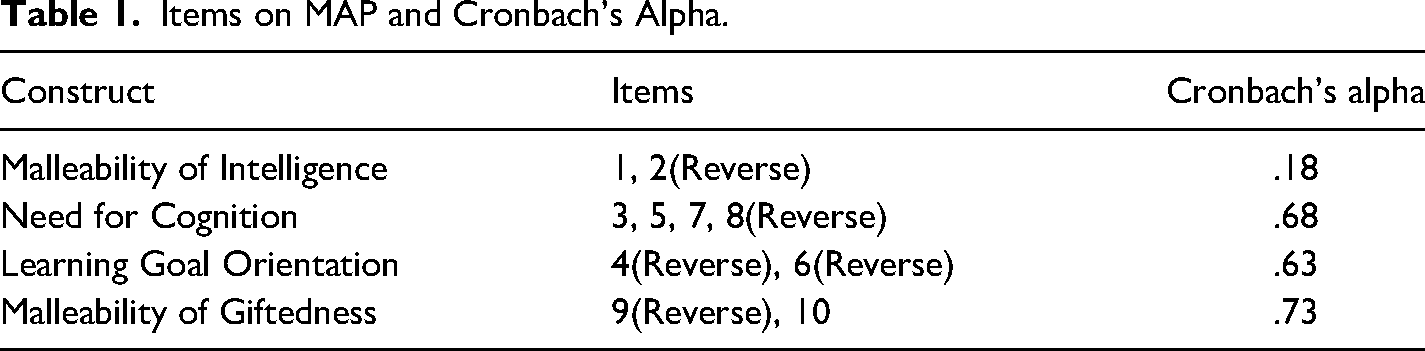
Results of finding the internal consistency of these factors suggested by Burgoyne and Macnamara (2021) produced considerably low (.18 for malleability of intelligence; .63 for learning goal orientation) to acceptable (.73 for malleability of giftedness) reliability coefficients. Because these reliability coefficients are not sufficient across constructs, the data are presented and analyzed per item rather than by factors.
Open-Ended Questions
All participating students (n = 81) responded to nine open-ended questions after completing the quantitative survey items from the MAP. Six of these questions were presented in a series (See Appendix A), and three were follow-up questions to some of the MAP Likert-type scale responses. The same prompts were provided to all student participants. The qualitative prompts asked participating students to consider the malleability of giftedness and intelligence, others’ expectations, perceptions of challenges, personal goals, and if they hide their giftedness.
Data Analysis
Quantitative Data Analysis
To analyze quantitative data, we ran descriptive statistics to analyze central tendencies and variability in the data (Aron et al., 2022). A t-test for dependent means was used to determine the extent to which beliefs about intelligence and giftedness differed while Pearson r correlations were conducted to determine the relationships between these variables (Aron et al., 2022). We reported Hedge's g since it removes small sample bias with a correction factor (Lin & Aloe, 2021).
Qualitative Data Analysis
To analyze qualitative data, we employed open and axial coding methods (Corbin & Strauss, 2014; Gall et al., 2007) to create Level 1 and Level 2 codes for analysis (Yin, 2016). More specifically, we analyzed the qualitative data by identifying themes, employing an emic approach (Gall et al., 2007) of thematic analysis. First, we read through the open-ended responses and identified initial codes and categories in the data. For example, some of the actual codes that were identified include being smart, feeling different, having opportunities, and identifying malleability of giftedness. Some of the identified categories included beliefs about abilities, perceptions of giftedness, and perceived expectations.
Second, we continued to identify codes and categories while actively comparing findings across participants, using the method of open coding. Then, we organized categories using axial coding (Simmons, 2017). We compared data to continue to reveal codes, categories, and subcategories to represent the voices within the collected data. We each presented found categories to the other for consensus, employing thematic analysis. The intercoder reliability was deemed acceptable, 90% or greater (Cofie et al., 2022), across responses and identified categories.
Last, we discussed any discrepancies and developed finalized categories based upon the most salient themes found among both authors’ analyses. Some of the discrepancies related to how specific quotes were related to specific categories, which led to a discussion concerning what was meant by some of the key words, such as “gifted identity.” We discussed how some of the identified codes were defined. We also had a discussion of not creating themes simply based on the main constructs, instead using inductive analysis (i.e., we did not seek to find the constructs of malleability, need for cognition, and goal orientation).
Researcher Positionality
We are both White, female first-generation college graduates and each hold experiences of “high achieving” adolescents (first author formally identified as intellectually gifted; second author not formally identified when in junior high school) with high goals for school performance which potentially influence interpretation of data. Parker Peters participated in gifted programming herself, while Mofield participated in advanced courses, though not a specialized gifted program. Mofield had been formally employed as a gifted education teacher by the district from which the sample was selected. To address these potential biases, we coded the data separately and also requested that another researcher with experience in qualitative analysis review the codes and themes. We both have experience conducting research on social and emotional needs of gifted students. Parker Peters's motivation for this research is derived from her role as a psychologist, consulting with families and children. Mofield's motivation and experience for conducting research on these topics relates to her personal experience as a teacher where she saw students avoid learning for fear of failing.
Elements of Trustworthiness
To ensure trustworthiness of the qualitative data, we reviewed and employed Lincoln and Guba's (1986) four criteria (credibility, dependability, confirmability, and transferability). To establish credibility, we acknowledge the knowledge and skills needed to analyze the qualitative responses, as noted above in the positionality statement. To ensure dependability, we used the open-ended responses directly; there was not a need for transcription or translation of the data reviewed. We measured coding accuracy and interrater reliability and created an audit trail to ensure transparency. We compared the qualitative data with the quantitative data analyzed the two in conjunction to support confirmability, along with presenting our positionality statements, above. Finally, we provided a description of the sample and context, such as how we employed purposive sampling by selecting identified gifted students for the context of the study and the demographics of the sample, to provide transferability to other gifted middle schools with similar populations.
Results
Descriptive statistics are presented for each item on the MAP in Table 1. As previously noted, some items are reversed scored (items 2, 4, 6, 8, and 9) to reflect high perceptions of the constructs. Of the 81 participants, only 78 completed the MAP items (i.e., three participants answered the open-ended questions but did not fully complete the MAP), while all 81 responded to the open-ended questions (Table 2).
Descriptive Statistics: Responses from Mindset Assessment Profile (n = 84).
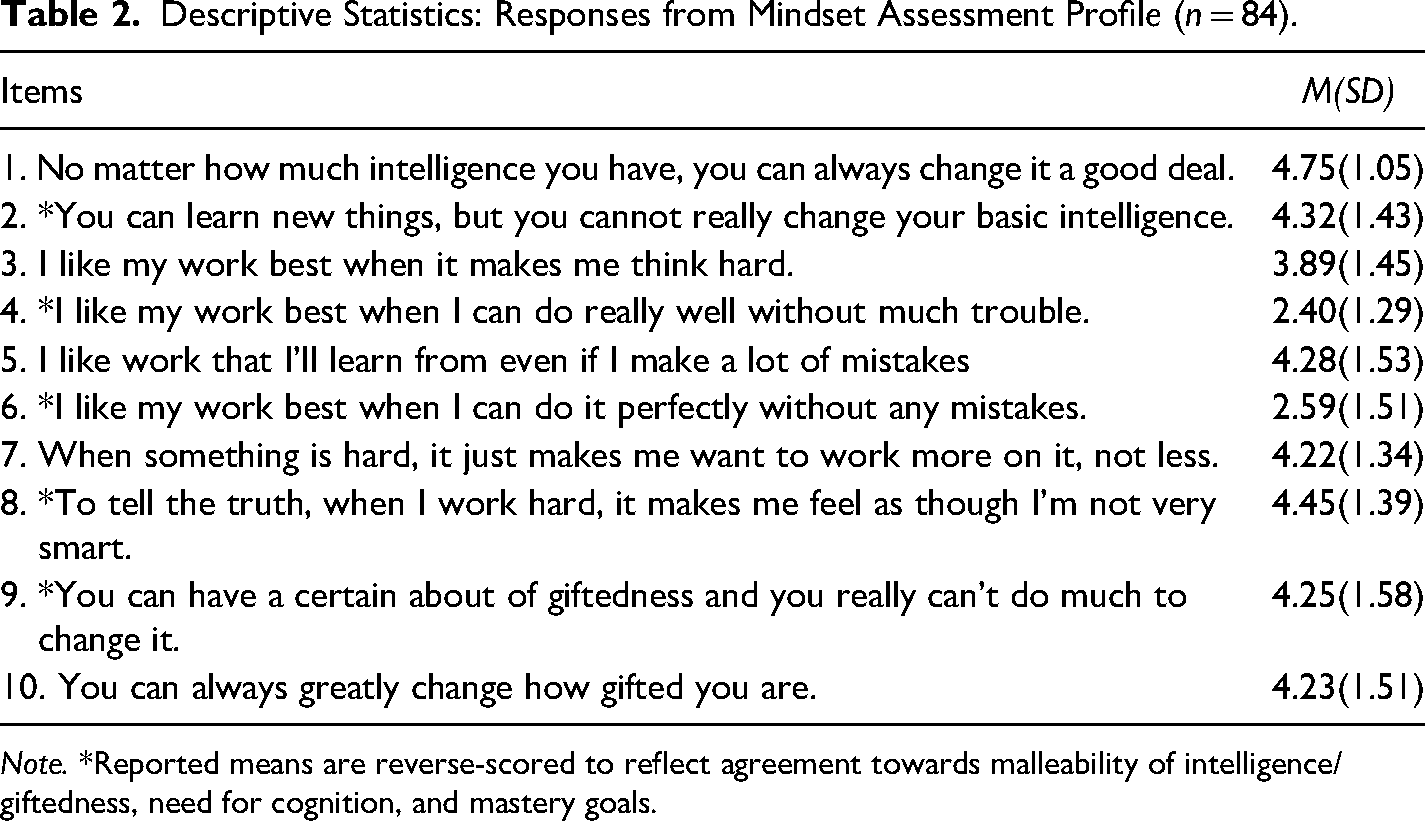
Note. *Reported means are reverse-scored to reflect agreement towards malleability of intelligence/giftedness, need for cognition, and mastery goals.
Results indicated a weak relationship (Cohen, 1988) between malleability of intelligence (Item 1) and giftedness (Item 10), r = .19, p = .010, r2 = .036. However, these variables were statistically significantly different with lower beliefs in malleability of giftedness (M = 4.23, SD = 1.57) compared to malleability of intelligence (M = 4.76, SD = 1.10), t(83) = −2.65, p = .010, to a moderate degree (g = −.39). The correlation between Item 2 and Item 9 was much stronger, r = .38, p < .001, revealing a small–moderate relationship. No statistically significant differences were found between malleability of intelligence, item 2 (M = 4.32, SD = 1.48) and malleability of giftedness, item 9 (M = 4.22, SD = 1.63), t(83) = −.49, p = .69.
When examining the frequencies of the data for malleability of intelligence vs. giftedness, 88.46% of participants rated a 4 (“agree a little”) or higher (to “agree a lot”) for agreeing you can change intelligence (item 1), compared to 63.94% for agreeing you can change giftedness (item 10). Results also showed that 88.31% of disagreed (rating a 3 “disagree a little” to 1 “disagree a lot” before reverse scored) that you can’t change your intelligence (item 2), while 79.12% of participants disagreed that you can’t change really do much to change your giftedness (rating the item as 3 or lower).
A number of categories emerged from the responses to the open-ended questions. Categories were organized by linking data among participant responses, finding commonalities and patterns among responses, and researcher interpretations. See Table 3 for categories, subcategories, and sample responses.
Open Response Categories, Subcategories, and Sample Responses.
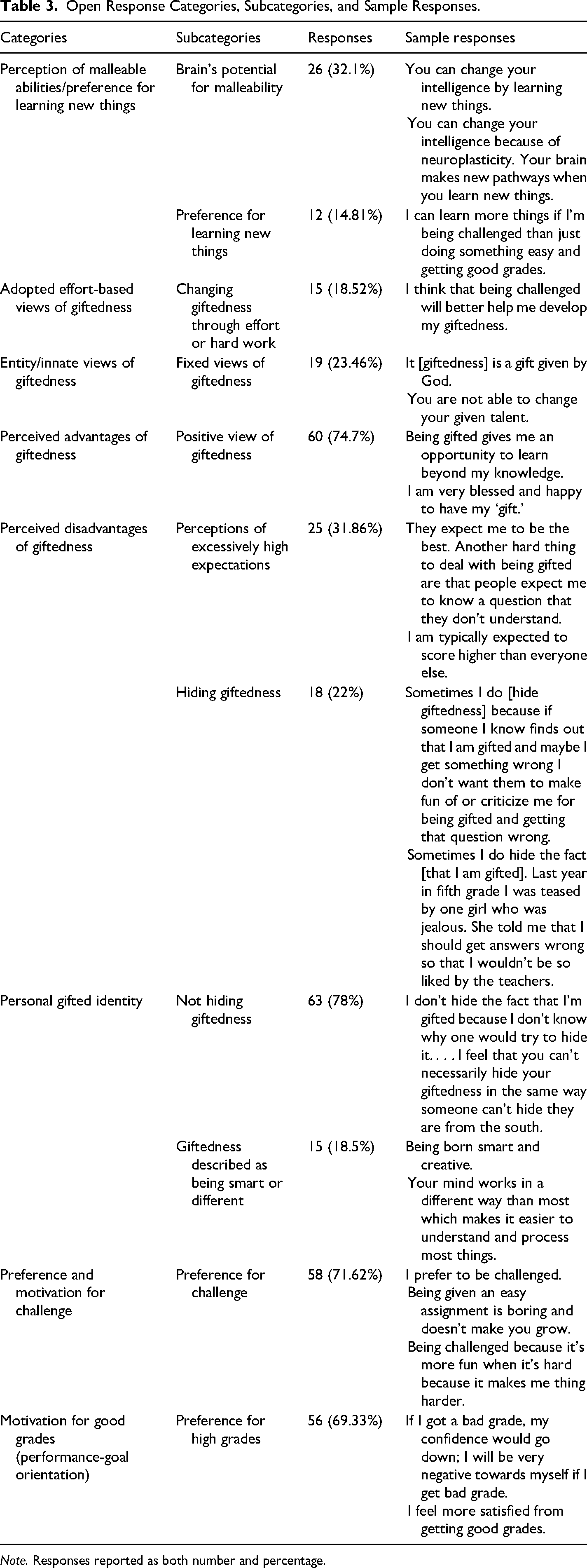
Note. Responses reported as both number and percentage.
The following thematic categories emerged from the qualitative data: perception of malleable abilities/preference for learning new things, adopted effort-based views of giftedness, entity/innate views of giftedness, perceived advantages of giftedness, perceived disadvantages of giftedness, personal gifted identity means smart and different, preference and motivation for challenge, and motivation for good grades (performance-goal orientation). No theme represents an individual participant's point of view, and all themes represent numerous responses in the same category.
Perception of Malleable Abilities/Preference for Learning New Things
Among the open-ended questions, there was a common theme of preference for learning new things or the potential for malleability of ability among responses. Sixteen (19.75%) participants noted the role of effort in changing intelligence, and 26 participants (32.10%) expressed that learning and gaining new knowledge is associated with changing intelligence. This is consistent with 27% of participants (n = 22) who affirmed that intelligence can change. Sample responses included, “You can change your intelligence by learning new things” and “You can change your intelligence because of neuroplasticity. Your brain makes new pathways when you learn new things.” Eleven participants (13.58%) specifically mentioned neuroplasticity or the brain's capacity to grow (e.g., “You can always change your intelligence because your brain doesn’t run out of space.”). In addition, when asked about being offered academic challenges, 12 participants (14.81%) indicated they preferred to be challenged because it would allow them to learn more (e.g., “I can learn more things if I'm being challenged than just doing something easy and getting good grades”).
Adopted Effort-Based Views of Giftedness
Fifteen participants (18.52%) articulated effort-based views of giftedness by alluding to changing giftedness through effort or hard work. Thirteen participants (16.04%) indicated that you can change your giftedness because you can learn and gain new knowledge. In describing what giftedness means (in response to other questions), two students explicitly noted giftedness as an effort-based construct (e.g., “[gifted means] they worked hard enough to be gifted which means that they have become smarter than others”). In explaining why they prefer challenges or good grades, some comments reflected incremental views of giftedness (e.g., “I think that being challenged will better help me develop my giftedness and it will help me pay more attention in class and not daydream”).
Entity/Innate Views of Giftedness
Some participants noted entity views and innate views of giftedness. Nineteen (23.46%) participants explicitly stated fixed views of giftedness in their responses to “explain why you can or cannot change your giftedness.” Ten participants (12.34%) indicated the idea of “being born” with giftedness or “it is a gift given by God” as a reason giftedness is not changeable. For example, one participant responded, “You're born with it, so you're stuck with it until you die.” In another example, one participant noted, “You are not able to change your given talent.”
Perceived Advantages of Giftedness
Participants’ responses indicated a theme of recognizing the advantages of intellectual giftedness. Sixty (74.07%) participants noted that giftedness was “good” or “mostly good,” while 14 (17.28%) indicated that it was both “good and bad.” No students indicated that giftedness was only “bad or mostly bad.” When student participants were asked to respond to, “What are some good things about being gifted? What parts about being gifted are hard to deal with?” Many students (n = 9, 11.11%) referred to the opportunities they experience because they are gifted (e.g., “you can explore new experiences and have fun and see cool things”). References to “opportunities” were also evident in the overall analysis of all responses (e.g., “being gifted gives me an opportunity to learn beyond my knowledge.”). Nine participants (11.11%) noted that the challenges presented in their gifted classes were beneficial with comments such as, “We think differently and are challenged in our gifted classes.” Ten participants (12.35%) noted that learning was easier because they were gifted with comments such as “Schoolwork is easier if you are gifted” and “Learning in regular classes is easier if you are gifted.” Eleven comments were made about completing schoolwork “faster” or “more quickly” in various open-ended responses overall (e.g., “It is helpful to be able to learn faster than average”).
Other advantages of personal giftedness noted by participants indicated positive emotions or self-esteem because they are gifted. For example, a participant noted, “[being gifted] gives me the mindset that tells me to do things other kids can’t. That boosts my self-esteem” and another noted, “I am very blessed and happy to have my ‘gift.’”
Perceived Disadvantages of Giftedness
On the other hand, disadvantages of giftedness were also observed as a pattern among responses, though no respondents noted disadvantages without also noting benefits of giftedness. Twenty-five participants (31.86%) shared that they perceived higher expectations from others. For example, a participant responded, “whenever you have a problem doing something or can't help someone they always use ‘you're supposed to know this; you're gifted.’” Another responded, “They expect me to be the best. Another hard thing to deal with being gifted are that people expect me to know a question that they don't understand.” Some noted how this affects how they feel about themselves (e.g., “one bad thing is that you and those around you have very high expectations for you, and if you don't meet the expectations you feel like you're a let down”).
Accordingly, when asked if others, such as parents, teachers, and friends have different expectations for them because of their giftedness, 86.5% of participants (n = 70) indicated they perceive that these groups do have different expectations for them due to their giftedness. Participants provided examples of how they perceived different expectations from these groups (e.g., “I am typically expected to score higher than everyone else. I am always aiming to score above average.” “They expect me to be smart.” “I feel like my expectations are higher than the other kids in and out of school because of being gifted.” “If I ask my mom for help, she responds, ‘You're the kid in XXX Gifted program’”).
Participants were also specifically asked if they ever hide their giftedness. Approximately 22% (n = 18) of participants endorsed the notion that they do or have hidden their giftedness from others. Several of those who agreed that they hide their giftedness referenced social pressures or potential bullying as reasons for hiding their advanced abilities. “Sometimes I do because if someone I know finds out that I am gifted and maybe I get something wrong I don't want them to make fun of or criticize me for being gifted and getting that question wrong.” Another participant noted, “Sometimes I do hide the fact [that I am gifted]. Last year in fifth grade I was teased by one girl who was jealous. She told me that I should get answers wrong so that I wouldn't be so liked by the teachers. She also told me that being smart was just a ‘phase.’”
Personal Gifted Identity Means “Smart” and “Different”
Several students made statements regarding their understanding of personal identity as it relates to giftedness. Considering personal identification of giftedness, 78% (n = 63) of respondents conveyed that they do not hide the fact that they are gifted. Several participants described how giftedness was a part of them, such that it could not be hidden (e.g., “I have no idea how somebody would hide it”). One participant responded: I don’t hide the fact that I'm gifted because I don't know why one would try to hide it. I prefer not to bring it up in conversations because I feel like I'm bragging and I don't like to tell a lot of people for that reason. I feel that you can't necessarily hide your giftedness in the same way someone can't hide they are from the south. People who are from the south generally speak with a similar accent and use certain words, similar to how a gifted person may make certain analogies, puns, or use references others may not get.
As students considered what it means to be gifted, the terms “smart” and “different” were often used in their descriptions. When describing what giftedness is, 15 participants (18.5%) associated giftedness with being “smart” (e.g., “Being born smart and creative. It is very good”; “to be smarter than the rest”). Across all responses, the word “smart” was used 76 times. Ten (12.34%) students associated that giftedness means thinking differently (e.g., “Your mind works in a different way than most which makes it easier to understand and process most things”). A students relayed, Difference in the way that we think so there are advantages in our learning ability. Being gifted is good because you have a gift that lets you think differently and it gives me a mindset that tells me that I can do things other kids can't that boosts my self-esteem.
Preference and Motivation for Challenge
A preference and motivation for challenge was evident in a number of responses throughout the questionnaire, mainly through an expression of an enjoyment of learning and challenge. When asked, “Do you prefer classes and assignments that are challenging and stretch your abilities or classes and assignments that are easy?” 71.62% (n = 58) preferred challenging classes and assignments. In other open-ended responses, only 11 (13.50%) participants made statements reflective of enjoying challenges in explaining why they prefer challenges over getting good grades. Responses include the following: “I prefer to be challenged. Being given an easy assignment is boring and doesn't make you grow.” “I like challenging assignments because they allow me to have to think and help me self-assess what I know on the subject.” These statements often reflected a need for cognition met through a challenge (e.g., “I prefer being challenged over being bored”; “While I currently don't have any advanced classes, I do prefer challenging myself”) and related to an element of “fun” (e.g., “I want to have fun in class and have a challenged,” also “being challenged because it's more fun when it's hard because it makes me thing harder”). Nine participants (11.11%) noted that the challenges presented in their gifted classes were beneficial with comments such as, “I need a challenge, more than just 8 + 5.”
Motivation for Good Grades (Performance-Goal Orientation)
When responding to the question, “If I had to choose between getting a good grade and being challenged in class,” the majority (69.33%) chose getting a good grade while 30.77% chose being challenged. Nine participants (10.97%) also expressed that grades were important to their future (e.g., scholarships to college). Eleven (13.25%) expressed that getting good grades is associated with their sense of confidence or self-worth (e.g., “If I got a bad grade, my confidence would go down; I will be very negative towards myself if I get bad grade;” “[getting a good grade] boosts self-esteem and I wouldn't get grounded”). Sometimes comments were related to avoiding a negative emotion (e.g., “challenges make me stress and good grades make my parents proud” and “I don't like to get stressed. I just like to chill”) or feeling a positive emotion from the grade (e.g., “I feel more satisfied from getting good grades”). This contrasts with participants who had noted a preference for challenge in their responses; zero of these students made comments about positive self-worth or confidence in conjunction with their preference for challenge. Their statements were only related to the benefits of “fun,” “learning,” or not being bored.
Discussion
A recent emphasis on developmental views of giftedness in the context of the talent development paradigm presents a need to understand if and to what extent students perceive giftedness as malleable. Further, it has been purported that giftedness is associated with entity beliefs (i.e., Dweck, 2000, 2012), though giftedness may be perceived differently from intelligence (Makel et al., 2015; Tan et al. 2019). Thus, we sought to extend the current literature and explore how implicit theories of intelligence and giftedness compare and relate to one another. We also examined gifted students’ perceptions of intelligence, giftedness, need for cognition, and goal orientations given that such beliefs can influence how students pursue challenges and respond to failure. In light of the mega model of talent development, these beliefs can play a critical role in the motivational processes that affect various stages of talent development (Subotnik et al., 2011). Providing an updated understanding of how gifted students view their abilities can guide the field in understanding how to promote positive attitudes toward challenge and support students in pursuing high levels of achievement.
Regarding research question 1, participants reported incremental views of intelligence and giftedness, showing averages above a 4.0 (“agree a little”) on all items. Participants showed slightly higher incremental views of intelligence vs. giftedness (when comparing Items 1 and 10), and results showed a moderate relationship between them (r = .38; items 2 and 9). Though we found statistically significant differences and relationships for only some of the items, it is somewhat consistent with the findings from Makel et al. (2015), who found that these constructs were related, yet distinct. Our findings imply that students view the concept of intelligence different from giftedness. Though students showed lower scores for “you can always greatly change how gifted you are (item 10)” compared to “no matter how much intelligence you have, you can always change it a great deal (item 1),” it is notable that the average for item 10 is still 4.23, indicating agreement.
In answering research question 2, the qualitative data also showed results consistent with recent, developmental views of cognition (e.g., Subotnik et al., 2011); many gifted students perceive abilities, both intelligence and giftedness, as malleable constructs that they can nurture and strengthen through effort and potential opportunity. For example, on the MAP, most participants agreed (“A little” to “A lot”) (88.46%) that you can change your intelligence (item 1), and 63.94% agreed (“A little” to “A lot”) that you can change giftedness (item 10). This is a promising finding; if gifted students believe that their abilities can further develop and change, then they may also be able to perceive the value of challenge and opportunity that will allow them to achieve such growth.
Some gifted students recognized the advanced curricular opportunities that are available to identified gifted students, which, in turn, provide the setting for engaging with cognitively challenging material, designed to push the limits of ability. Similarly, Ryan (2013) demonstrated that gifted students’ perceptions of ability and learning environment regulate the advantages or disadvantages of possessing the gifted label. Though the majority of participants regarded giftedness as a malleable quality, we should note that many students (23%) described giftedness through an entity lens (Dweck, 2000) when asked why gifted was or was not changeable. Our findings continue to reiterate those from previous research (Makel et al., 2015; Mofield & Parker Peters, 2018), that educators should not assume that gifted students adopt entity beliefs, and educators should understand that student beliefs regarding the malleability of intelligence and giftedness differ to some degree.
In regard to goal orientations, a sizable number of participating students expressed preference for achieving extrinsic, performance-based goals, with almost 70% of participants indicating that they would prefer a “good grade” over being challenged. Further, the MAP results showed low means scores of agreement toward mastery goal orientation (item 4, M = 2.41; item 6, M = 2.61). However, related to mastery orientation, it was evident that many students did indeed enjoy learning and challenges, similar to past findings linking mastery goal orientation to intrinsic interests and engagement (Elliot, 1999; Liem & Chua, 2021; Wigfield & Cambria, 2010); this was especially noted as they endorsed a need for cognition, indicating a preference for “thinking hard” and “working hard.”
For MAP items related to need for cognition, participants noted agreement with the construct (with mean scores ranging from 3.99 to 4.45). Further, the open-ended responses revealed that almost 72% of participants desired challenge and wanted opportunities to use and stretch their abilities (when given a choice between challenging assignments vs. assignments that are easy). Several participants acknowledged that their gifted classes presented opportunities to think more deeply about advanced ideas and content and that they needed these settings and challenges. These gifted students perceive that they can develop their skills further and know that it takes challenging opportunities to facilitate such growth. Hence, a need for cognition is expressed in the need for higher level content, and a mastery goal orientation is apparent in the preference for growth over simplicity. These findings mirror some of the findings from Ridgley et al. (2022), who found that students hold positive student perceptions of academic challenges in gifted programs. Our findings are indicative of a positive attitude of how these cognitive “needs” are met within gifted programming, and this is especially important since the perception of a challenge influences how such challenges are approached.
Our study shows the importance of examining the MAP responses by individual items and factors (rather than full mindset composites) to understand how both need for cognition and performance goal orientation are evident in the patterns of responses. There is not a clear dichotomy between mastery and performance orientations since there is low agreement on mastery orientation but high agreement on need for cognition. Furthermore, open-ended responses revealed that many noted that they not only enjoyed being challenged but also expressed they prefer getting good grades because grades were important to their future success. Perhaps, they see the grade as more important to the steps toward attaining long-term goals compared to the advanced content gained from the challenging learning experience. As noted by Cerasoli and Ford (2013), the articulation of mastery goals is important to the connection between intrinsic motivation and actualized performance.
We also recognized some favorability in performance goals (preference for good grades) because these coded responses included comments regarding self-worth, confidence, or expectations regarding grades (e.g., “challenges make me stress and good grades make my parents proud”). On the other hand, when making statements related to more mastery orientation within the theme “preference and motivation for challenge,” no comments were made to relate to self-worth, experiencing positive emotions, or avoiding negative emotions (though, the word “fun” was associated with mastery orientation). These findings reveal the role of emotion as it relates to goal orientations, providing insight into why preference may be given to performance goals, such as “getting a good grade.” The enjoyment or “fun” is a logical fit with mastery goal orientation since it relates to intrinsic interest in growing and developing knowledge (Liem & Chua, 2021). This is also suggestive of how some students perceive self-worth to be tied to achieving success in reaching a future goal. We see somewhat of a paradox in these findings. For many students, they desire a challenge, but they may feel they have to avoid the challenge; because, in doing so, they can experience a positive outcome (e.g., good grade, confidence, self-worth, making others proud).
Our findings show that giftedness was mostly viewed positively. No participants regarded giftedness as only negative, though some participants viewed both positive and negative aspects of giftedness. While we acknowledge that this finding may be due to the way our questions were presented to participants (see limitations), this contrasts with some literature (Coleman et al., 2015; Cross et al., 2014; Matthews & Foster, 2008; Rimm, 2002) that suggests that the label or construct of giftedness is held in a negative light. Perhaps, as these students view giftedness as a malleable construct that requires challenge and opportunity to experience actualized growth, the students understand the need for their gifted placement and programs that will provide them with such opportunities. Many noted the gifted class as “fun,” “challenging,” and an opportunity to engage in special activities. Without the label or gifted placement, the need for cognition would not be as readily fulfilled. These findings reveal that gifted students generally perceive giftedness in a positive light regardless of the documented stereotypes that may come with the label. Though the gifted label remains generic (Matthews & Jolly, 2022), gifted students in this study viewed the label and the access to gifted supports in a positive light, providing rationale to maintain the label and programming that is provided in tandem with the label.
While many advantages were noted about giftedness, similar to findings from the literature (Coleman et al., 2015; Cross et al., 2019), many students noted a disadvantage of higher expectations associated with “being smart.” Over 86% of participants stated that they perceived that others have different expectations of them because they are gifted. Some explained that they hide their giftedness so that there is not an expectation for high performance. Our findings mirror those found in past research (Cross et al., 2019; Rudasill et al., 2007), indicating that gifted students may attempt to hide their abilities. Our findings imply a need for teachers, parents, and other practitioners to dialogue about the connections between “being smart” and the expectations they perceive from others. As noted by Flett and Hewitt (2002) in describing causes of perfectionism from research, when self-worth is contingent on performance or meeting expectations imposed by others, a child can experience an increased sense of helplessness and hopelessness.
Implications for Practice
Given that gifted students do perceive giftedness as more fixed than intelligence, we reiterate messages from previous literature (Makel et al., 2015; Tan et al., 2019) that educators and practitioners should consider the importance of communicating a developmental view of giftedness in educational settings. Our findings indicated that students associated giftedness with being “smart” and “different” and reveal how students perceive giftedness as a general rather than specific view of ability. Though our questions asked about general giftedness (not specific abilities or skills in domains), it is interesting to note that no participant noted specific giftedness or talent beyond using the general term “academics.” It would be beneficial for educators and practitioners to guide students to develop self-awareness of what it means to be “gifted” beyond a broad nonspecific label (Matthews & Jolly, 2022) so they can understand their own specific strengths and what it takes to develop them. Given that “being smart” is a vague descriptor for giftedness, teachers and parents might have conversations about what giftedness means from a talent development perspective (e.g., developed competency in a specific domain) along with how talent is developed with skill, effort, and opportunities taken (Subotnik et al., 2011). Further, as stated by the first principle of psychology from the American Psychological Association on teaching creative, talented, and gifted students, “Students’ beliefs or perceptions about intelligence and ability affect their cognitive functioning and learning” (American Psychological Association, Center for Psychology in Schools and Education, 2017, p. 6). Therefore, if students are taught that giftedness continues to develop through skills and focused effort, they may endorse more mastery goal orientations in their pursuits.
Much of this discussion is related to how gifted students are identified for gifted programming in the first place. The sample from the current study included students identified as gifted based on a combination of criteria (e.g., academic achievement, cognitive ability, and creativity), but identification procedures based on identifying potential abilities in domain-specific areas would provide avenues for creating contexts that promote an understanding of “gifted” as emerging talent that develops from opportunities, mentors, and advanced instruction. Given that most participants in the sample indicated a preference for performance and some associated their self-worth with achieving goals, educators may consider ways to build supportive educational environments characterized by warmth, support, acceptance, and connectedness (Reyes et al., 2012) that promote positive emotion and joyful learning in the context of pursuing challenges, deemphasizing the value of the grade, and emphasizing the value of the learning.
The majority of participants noted a disadvantage to giftedness includes a perception of different expectations from others because they are gifted. Some expressed they hide their giftedness so that there is not an expectation for high performance. To address perceived pressure to perform, students may be taught to be self-advocates, using assertive skills to address the pressure they feel, such as using “I-messages” (as used in affective interventions; Mofield & Chakraborti-Ghosh, 2010). Beyond helping students to productively “cope” with the perceived expectations from others, it is also important for advocates in gifted education to continue to communicate the needs of gifted students so that assumptions are not made to equate giftedness with automatic high achievement.
Limitations
Though our study reveals perceptions of giftedness, the findings are only representative from a sample of gifted students identified with state-established criteria of intellectual giftedness. Our findings are not generalizable to diverse populations since the current sample is limited by ethnicity and socioeconomic status representation. Findings should also be interpreted in light of the relatively low response rate of 47.5%.
Further, we were not able to combine MAP items 1 and 2 to compare to items 9 and 10 because the Cronbach’s alpha for each factor was too low. The comparisons and relationships were instead analyzed by item. This limits our ability to make a consistent inference about the comparisons and relationships between the malleability of intelligence and giftedness since we found statistically significant differences and relationships between some items, not all.
Participants were prompted to think about implicit theories of general intelligence and giftedness, though implicit theories of intelligence are applicable across specific domains and areas of talent. Our study does not allow us to understand if students might associate intelligence and giftedness with specific domains (e.g., math, science, art). Further, it is quite possible to have incremental views about one domain and entity views about another (e.g., Chiu et al., 1997).
Though we were able to come to consensus with the qualitative themes, there is a level of subjectivity inherent in qualitative research, influenced by our individual biases. The self-reported data provided by survey and open-ended responses that guided our findings were also impacted by personal biases and interpretations of the participants. Lastly, some of the open-ended questions on the instrument might have been leading (e.g., “is it mostly good or mostly bad”) and impacted the way participants responded.
Future Research
Future researchers might employ person-centered approaches to data analysis to more closely examine patterns of beliefs about intelligence and giftedness within data. For example, not all students who have incremental views of intelligence have incremental views of giftedness and vice versa. Using a person-centered approach to the analysis rather than a simple comparison of means would allow for more nuanced interpretations of discordant and concordant beliefs of giftedness and intelligence (see Snyder et al., 2021). Further, though the current study provides context for gifted students’ perceptions of intelligence and giftedness as flexible constructs, the findings do not include explanations of how such perceptions are developed; future research might shed light on the factors that influence how these perceptions are developed, how they are influenced, and how perceptions of various domains are related to cultivating domain-specific abilities.
Conclusion
Our findings suggest that the participants in this sample do not have uniform beliefs about the constructs of this study (perceptions of giftedness, need for cognition, and goal orientation). Our data revealed variability in how gifted students perceive their own abilities. In general, they viewed both intelligence and giftedness as malleable, though more students agreed that you can change your intelligence (88.46%) compared to giftedness (63.94%). Participants largely had positive perceptions of giftedness, noting opportunities, and positive emotions associated with its advantages while noting high expectations from others as a major disadvantage. Accordingly, perceptions around gifted identity were mainly positive (e.g., being proud to be gifted), with many noting that to be gifted means to be “smart” or “different.” Many of the gifted students in our sample had general perceptions of their giftedness, as they did not indicate specific areas of talents in their responses. Finally, though many expressed a desire for challenge and noted advantages of being gifted include accessing these challenges, performance goal orientations were prominent.
This illuminates that orientations toward giftedness may not exist as a dichotomy. Even though gifted students expressed that they enjoy working hard and have a high need for cognition, gifted students view future pursuits with such importance that the performance goals of “getting a good grade” were preferred to being challenged. To further promote a positive perception toward giftedness, our findings illuminate the need for practitioners and educators to guide students in developing self-awareness about their own strengths and domain-specific talents (beyond an understanding that gifted means to be “smart”). Finally, educators and practitioners can shape a growth-oriented learning environment that provides intellectually stimulating experiences that recognize and nurture gifted students’ individual talents and address their expressed need for cognition.
Footnotes
Authors’ Note
The research hypotheses and study plan were preregistered with OSF Open Science.
Declaration of Conflicting Interests
The authors declared no potential conflicts of interest with respect to the research, authorship, and/or publication of this article.
Funding
The authors received no financial support for the research, authorship, and/or publication of this article.

About the Authors
Appendix A
After number 2—Explain why you think you can or cannot change your intelligence.
After number 10—Explain why you think you can or cannot change your “giftedness.”
If you had to choose between getting a good grade and being challenged in class, I would choose (circle A or B):
getting a good grade being challenged
Explain why