



Abstract
Creativity is increasingly seen as a key human capability that can be deliberately developed. Correspondently, a proliferation of tools, techniques, and methods are available in the academic and popular literatures. Creative problem-solving (CPS) is one framework among these, and has a 70-year history of research and development. This essay overviews this history and the key stages of its continuous development, as well as the rationale for the changes and improvements that have been made. Foundational work established the Osborn–Parnes paradigm for CPS. Initial efforts were aimed at enhancing this approach. Then came work to stretch the Osborn–Parnes approach, and ultimately to break this paradigm. Understanding these major stages of development should better differentiate contemporary CPS approaches from the variety of earlier versions. Future research and development are also highlighted that will move our understanding, learning, and application forward.
Introduction
Creativity was historically seen as the province of the lone genius. More recently, creativity has been considered an important natural human characteristic—something we all possess in varying degrees. This corresponds with the recognition that creativity is required to help us meet the challenges of today and tomorrow. The broad and increasing interest in creativity is illustrated by a Google search done while writing this article. I found over 760 million hits when using “creativity” as the search term. Browsing through the many pages of results, I observed a plethora of tools, techniques, and methods aimed at increasing individual and group creativity.
If we are interested in the development of creative potential, we need to know when, how, and with whom to apply these tools. This is the power of having a process framework, as it links the tools and techniques to a purpose. Typically, these purposes can include obtaining an improved understanding of the problem; having many, varied, or unusual ideas to solve those problems; or taking an idea forward by strengthening it and getting it ready for implementation. Creative problem-solving (CPS) is one such framework that has withstood the test of time.
Yet, I found over 360 million hits when I Googled “creative problem-solving.” Again, I found a surfeit of tools and techniques, as well as a wide variety of frameworks, methods, and models.
The purpose of this article is to focus on one major tradition that spans 70 years of consistent research and development: the Buffalo-based CPS framework. Further, I will highlight the key areas of collaboration and outcomes produced by Donald J. Treffinger, myself, and colleagues. I will also identify a few future possibilities that can continue the journey.
On a personal note, Don Treffinger and I shared 40 years of friendship and collaboration. Don's community of practice centered on education for the gifted and, more broadly, developing talents within the context of education (Houtz & Selby, 2021; Treffinger et al., 2013). Mine was focused on preparing future and current professionals in business organizations (Dorval, 2021; Isaksen, 2020a). We shared a passion for improving the deliberate development of creative potential and saw great value in the tradition of CPS we inherited. We also shared an interest in and commitment to pursuing research and development aimed at improving our understanding and development of creativity.
On the Deliberate Development of Creativity
When Don and I started studying creativity, it was not widely accepted. In fact, a dean on the campus where we were professors of creative studies called our unit “a cult on campus.” It is gratifying to see that creativity is now broadly considered an essential twenty-first century skill (e.g., Lucas & Venckuté, 2020; Marshall & Kinser, 2012; World Economic Forum, 2020).
There are numerous reasons why deliberately developing creative thinking and problem-solving skills are important. First, and foremost, is the unprecedented pace of change and complexity we all face in the world in which we live. For example, we are facing a level of velocity of the doubling of knowledge we have never seen before. It took 25 years to double our knowledge in 1945—and now some assert that it doubles every 12 hours (Fuller, 1981; Chamberlain, 2020). We live in an increasingly VUCA (volatile, uncertain, complex, and ambiguous) world that demands new and useful solutions and responses. It has never been more important that children learn how to develop creative thinking and problem-solving skills rather than simply memorize information.
Secondly, there is more than sufficient evidence that creative potential can be deliberately developed (e.g., Puccio et al., 2006; Puccio et al., 2020; Rose & Lin, 1984; Scott et al., 2004; Torrance, 1987). Our current compendium of evidence supporting the learning and application of the Osborn-Parnes tradition of CPS (and its modifications) contains more than 1200 studies and citations (Isaksen, 2022a).
Finally, there is increasing evidence that when we nurture and develop creative talent, the quality of peoples’ lives improves (e.g., Karwowski & Kaufman, 2017; Lucas & Venckuté, 2020; Perry & Karpova, 2017). Creativity is increasingly understood as something worthwhile and productive, that everyone possesses and can manifest to some degree (e.g., Richards, 2007; Sawyer, 2012), and that doing so has many positive outcomes.
Don and I, along with our colleagues, shared a belief in the power of process – particularly CPS – and invested a large portion of our professional lives in advancing this cause. Our colleague, Ruth Noller (1979; p. 4–5) defined CPS by focusing on each of the three main words: creative, problem, and solving:
By creative we mean: having an element of newness and being relevant at least to you, the one who creates the solution. By problem we mean: any situation which presents a challenge, offers an opportunity, or is a concern to you. By solving we mean: devising ways to answer or to meet or satisfy the problem, adapting yourself to the situation, or adapting the situation to yourself. creative problem-solving or CPS is a process, a method, a system for approaching a problem in an imaginative way resulting in effective action.
CPS has a unique history and has undergone numerous developments over its 70 years, reflecting an integration of academic research with an eye toward practical application. This is explained in more detail below.
The Dynamic Nature of Creative Problem Solving
We can point to one transformative individual who broke the prevailing paradigm of ‘creativity is something you are born with or without’ it would be Alex F. Osborn (AFO). He is well known as a founding partner of Batten, Barton, Durstine, and Osborn (BBDO), a global advertising agency, and as the author of Applied Imagination (1953), and the initiator of the ubiquitous brainstorming approach. Osborn established a new paradigm that laid the foundation for deliberate efforts to develop creativity.
The Foundations
Although most people may consider AFO primarily as a creativity practitioner, fewer may know that he was also quite a scholar. He earned a graduate degree in psychology from Hamilton College in 1921. In a precursor to Applied Imagination, Osborn (1952) decried the general lack of psychological literature on the deliberate development of human imagination. He also identified some of the more influential scholarly works that influenced his thinking (e.g., Conant, 1947; Dewey, 1933; Dimnet, 1928; O’Connor, 1945; Spearman, 1931; Wallas, 1926). He wrote in a very accessible style and drew on a wealth of experiences and contacts, avoiding a ‘heavy’ academic style. Osborn's pioneering efforts left a legacy that included the founding of the Creative Education Foundation, the Annual Creative Problem-Solving Institutes (CPSI), and the creation of a unique academic program in Buffalo, New York.
As the first to outline explicit and deliberate stages of the CPS process, Osborn himself considered it to be a dynamic process. For example, he originally outlined seven stages in the first edition of Applied Imagination, but he condensed these to three stages in the 1963 version (Osborn, 1963).
Osborn's protégé, Sidney J. Parnes, had already conducted studies on the efficacy of brainstorming (e.g., Meadow & Parnes, 1959; Parnes, 1961; Parnes & Meadow, 1959, 1960), and conducted a major study of the effects of CPS utilizing a five-stage model (Parnes, 1966; Reese & Parnes, 1970). These early efforts culminated in a two-year experimental study to examine the effects of deliberately developing creativity called the Creative Studies Project (Biondi, 1971; Parnes, 1987; Parnes & Noller, 1971, 1972a & b; Reese et al., 1976). These efforts created the basis for the Osborn-Parnes CPS approach, and was the key framework for the academic program, as well as the annual Creative Problem-Solving Institute (CPSI) for the 1960's and 1970's (e.g., Noller et al., 1976; Parnes et al., 1977). The Osborn-Parnes CPS model (see Figure 1) included five stages including: fact-finding, problem-finding, idea-finding, solution-finding, and acceptance-finding.

The Osborn-Parnes model of CPS.
The Creative Studies Project was well received and provided important empirical support for the efficacy of attempts to deliberately develop creative potential, as well as the academic program (Isaksen & Parnes, 1985). Yet, as with all research, some interesting questions emerged. Parnes and Noller (1973) reported some intriguing personality differences between those experimental subjects who completed the four-semester study and those who dropped out. My own experience with one of those drop outs of the experimental program prompted Don and I to reflect on the curriculum itself. This young man was one of the most creative people I’ve ever met. He went on to write TV shows and receive awards for his creativity. When I asked him why he dropped out of creative studies, he told me: “Scott, I have loads of ideas. I don’t need any help with this! I need help figuring out what to do with my ideas.”
Bringing Balance to CPS
It became clear that our program was focused heavily on divergent thinking when we examined the sequence of courses and the instructional materials within the program. We believed that effective problem-solving required a delicate and dynamic balance between divergence (generating many, varied, and unusual options) and convergence (screening, selecting, and supporting novel options)—both creative and critical thinking. The eclectic creative studies program already included specific guidelines and many tools and techniques for generating, but lacked those resources for productive focusing and convergence.
This provided our initial efforts to build upon the Osborn-Parnes tradition of CPS. We reviewed the academic literature, visited numerous other creativity development programs, and reflected on our experiences in order to create appropriate guidelines and an initial suite of tools and techniques for convergence and focusing (e.g., Firestien & Treffinger, 1983a & b; Treffinger et al., 1982; Isaksen & Treffinger, 1985a & b). Appendix One and Two provide a listing of a basic set of CPS tools for generating and focusing.
The guidelines for focusing and converging complement those for generating and diverging. A primary guideline for generating is to defer judgment. The corresponding one for focusing is to apply affirmative judgment—aimed at identifying positives and strengthening alternatives. Other guidelines for generating include: strive for quantity (as quantity breeds quality); freewheel (set your imagination free); and build on options that others contribute. Other guidelines we developed for focusing included: be deliberate (have an intentional way to screen, select, and support options); consider novelty (choose new options and make them stronger); and stay on course (ensure you meet the challenge or problem upon which you are working).
Deliberate CPS Process Management
By bringing some balance to CPS, we recognized that not everyone contributed to, or benefitted from, the same things from the process. Further, when we observed Sid Parnes applying CPS outside the academic program we noticed that he was doing things that were not actually included within our instructional program. Sid was clearly a world-class facilitator, but it was difficult to make what he was actually and intuitively doing explicit, deliberate, and repeatable—it was hard to repeat the “magic” (e.g., Parnes, 1981, 1985).
Despite admonitions to the contrary, we also observed many of those we taught CPS applied the process as though it was a linear, predetermined series of stages to be ‘run through.’ Our initial response to these observations was to add an additional stage to the Osborn-Parnes CPS model called Mess-Finding. This stage included orienting individuals to their preferred approach to problem-solving, deliberately generating desired outcomes and challenges that stood in their way of making progress, examining their outlook surrounding the situation, and checking for their ownership of the task upon which they wished to apply CPS. We referred to these as the 5 O's (Orientation or characteristics of individuals or stakeholders; Outcomes and Obstacles; Ownership, and Outlook or the context surrounding the task) of Mess-Finding (Isaksen & Treffinger, 1985a & b; Treffinger et al., 1982). This was our initial attempt to link people and place with process, and clearly started to “stretch” the Osborn-Parnes paradigm of CPS.
In addition to making this modification to CPS, we also began work on improving our understanding of the art and science of the different roles involved in facilitating the process (e.g., Isaksen, 1983; Treffinger et al., 1983). The facilitator was responsible for managing the process along with a “client” who owned the content and outcomes from the process. The resource-group was responsible for providing input and suggestions. Detailing these roles and specifying aspects of Mess-Finding (the 5 O's) seemed to bring some clarity that helped with learning and applying the Osborn-Parnes tradition of CPS (Firestien & Treffinger, 1983b; Treffinger & Firestien, 1989).
Departing from the Osborn-Parnes Tradition
The new process modifications (adding more explicit emphasis on the “front-end” of CPS) and the addition of the three social roles of facilitator, client, and resource group, made it nearly impossible to “run through” the entire process in one setting. Concurrent with the departure of the Creative Education Foundation from our campus, Don focused on a new outlet for disseminating our work through the Center for Creative Learning. I started working with the Center for Creative Leadership and founded the Creative Problem-Solving Group-Buffalo (CPSB). Working through these organizations provided opportunities for us to share our developments, as well as engage in reflective practice with our clients, each other, our students, and our colleagues (e.g., Isaksen et al., 1993a; Isaksen & Treffinger, 1991; Treffinger et al., 2003).
We were also able to capitalize on these applied engagements by conducting, supervising, and reviewing numerous studies of the real-world impact of CPS (e.g., Isaksen & Treffinger, 2004; Treffinger & Isaksen, 2005). Don was also able to help conduct numerous evaluations of other programs that relied on learning and applying CPS like Destination Imagination, Future Problem-Solving, Camp Invention, and Lost Prizes (e.g., Place et al., 2000; McCluskey et al., 1998; Treffinger et al., 2012; Saxon et al., 2003). I was able to conduct proprietary impact studies on the use of CPS in helping organizations meet their innovation challenges (e.g., Isaksen & Lewandowski, 1997; Isaksen, & Puccio, 1988; Isaksen, & Murdock, 1990; Isaksen et al., 1991).
Along with our colleagues, we were able to combine and synthesize our learning from these experiences, and this resulted in some major changes to our approach to CPS. First, impact studies clearly indicated that those applying CPS did not use the entire linear five or six-stage model. Instead, they often used the six stages independently, based on their personal assessment of how the stages and tools might naturally help them to deal with a certain task or challenge. As a result, it appeared that people used CPS flexibly to clarify their understanding of problems, generate ideas, and/or plan for taking action.
The result was the development of a new “management” component of CPS that we called Planning your Approach (Isaksen et al., 1994, 2000, 2011). This component was different from the other three. It involved deliberate “thinking about thinking” or metacognition, and was influenced by emerging research into constructivism (e.g., Phillips, 1995; Vygotsky, 1978). Planning your Approach included two stages: Appraising the Task, and Designing the Process (Isaksen, 1995). This CPS component, and its stages, are described in more detail later. A more detailed description of the current approach to CPS is provided below.
The Current Approach to CPS
Our current approach builds on the rich Osborn-Parnes tradition, but departs from this history in some meaningful ways. We are gratified that the changes and improvements we endeavored to make have been adopted and adapted by many who teach, train, apply, and facilitate CPS.
We see CPS as a broadly applicable framework for organizing specific tools, guidelines, and language to help people develop new and useful outcomes. It includes a balanced set of guidelines and tools to foster both generating (divergent thinking) and focusing (convergent thinking). It provides a general, open, and dynamic system for understanding and framing opportunities, problems, and challenges; generating many, varied, and unusual ideas; as well as evaluating, developing, and implementing potential solutions. The current approach provides problem-solvers support in navigating their journey so that they can consider the people involved, the situation or context for their efforts, as well as determining the best fit between CPS and their desired outcome (Isaksen et al., 2011). This framework can also provide teachers and trainers, who may be uncertain about how to develop creative thinking and problem-solving skills, productive guidance in doing so.
The current CPS framework helps to achieve clarity, generate ideas, and take action. Since these are three distinct choices and areas into which the tools, guidelines, and language of CPS coalesce, problem-solvers need to be able to navigate their way through its various components and stages. Navigation is obtained by a component called Planning your Approach. Clarity is achieved by Understanding the Challenge. Many, varied and original ideas are obtained by a component called Generating Ideas. The Preparing for Action component includes strengthening potential solutions and developing plans of action. These main components of CPS are described in more detail below (see Figure 2).
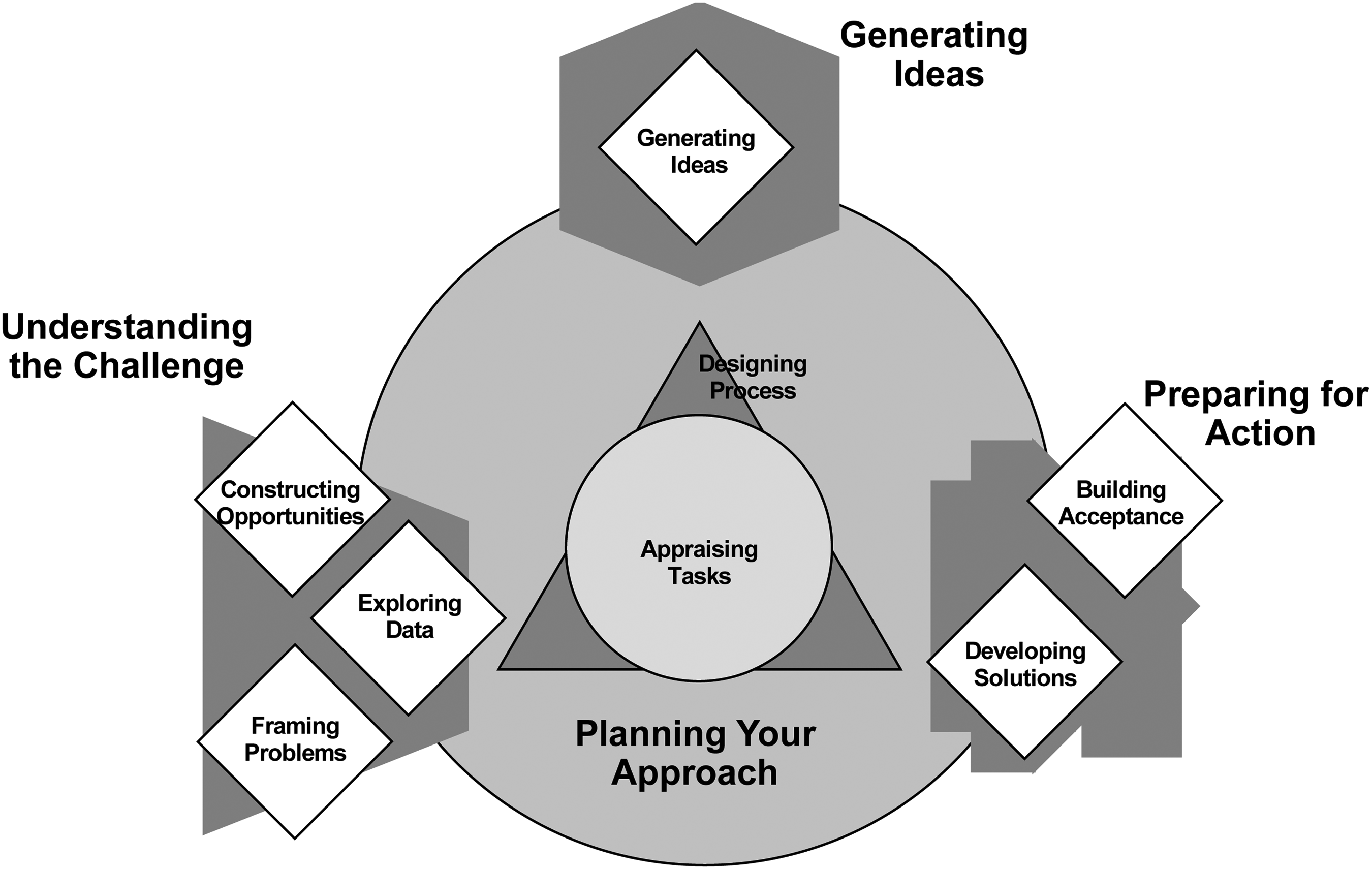
The current CPS framework.
Planning Your Approach
The current version of CPS includes a unique management component called Planning your Approach that focuses on producing the desired results, as well as consideration of the people involved, the climate within the organization, and designing the appropriate process approach. The purpose of this component is to help you navigate your way through the application of the CPS process.
Planning your Approach contains two main stages: Appraising Tasks and Designing Process. These stages deal with the deliberate management of the other components within CPS. Since problem-solvers need to be able to personalize and customize CPS for many different applications, these stages help them determine if CPS is an appropriate method and, if it is, to design an effective application of the components, stages, language, and tools.
When appraising a task, problem-solvers consider:
People – A key part of the system is to ensure that the proper level of ownership (interest, influence, and imagination) and sponsorship is in place. Engaging people in CPS without clear and legitimate ownership can be a waste of time, energy, and resources. A key decision point when appraising a task is to insure that you are working with a client – someone who owns the task. It is also helpful to understand the abilities, motivations, skills, and styles of the people who will be involved in CPS.
Place – The climate, working atmosphere, and culture are important factors influencing your approach to CPS. Considering the context can help you understand if the context is ready, willing, and able to use a particular method. Since CPS takes an investment of energy, appraising tasks helps to determine the level of priority that should be assigned to a specific task. A great deal of research has been done to understand the climate that supports creativity and innovation, and climate assessments can be used to supplement your understanding of the context (more on this later).
Desired Outcomes – Having a clear image of the desired results is key to successful application of CPS. Attention is focused on the domain-relevant knowledge of the current reality when appraising a task. This is where having a client with appropriate content expertise is important. By understanding the desired outcome or need, problem-solvers are in a much better position to validate the need for novelty. Afterall, if there is no real need for newness, there is no need to apply CPS.
The current approach to CPS requires the development of an explicit written task summary that clearly points out the need for originality and the requirements for the outcomes, including key background information. This statement guides the specific application of the tools and language and helps everyone understand the purpose of the session, project, or initiative. Task summaries act as springboards for effective problem-solving and ensure delivery of desired outcomes, and are helpful when applying CPS in-person, or through some form of digital collaboration. Having and using explicit task statements can also support formative assessment for teachers and facilitators to ensure that groups stays on the right track.
Methods – Since CPS is an open system, it allows for the integration and use of a number of alternative methods. The information gained from an improved understanding of the people, context, and outcomes guides the choice to use CPS or integrating other methods within the approach. CPS is best applied when problem-solvers are approaching a novel, complex, or ambiguous situation for which there is no solution currently available.
Once the scope and level of application for CPS is determined, problem-solvers need to decide if the need is for clarity, ideas, or action. These are the main purposes of the three main process components of CPS. In some cases, a gap may exist between current reality and the desired future, but no clear understanding of the opportunity or problem exists. In this case, problem-solvers may benefit from the clarity component: Understanding the challenge. If there is a clear statement of the problem, but a lack of ideas to address the problem, then the generating ideas component would be a good fit. If there is a tentative solution that needs to be strengthened for implementation and acceptance, the planning for action component would be appropriate.
Understanding the Challenge
The Understanding the Challenge component includes a systematic effort to define, construct, or focus problem-solving efforts. This component deals with the natural structural tension (Fritz, 1993) that arises when there are discrepancies between what you want or desire, and what you have – or current reality.
Understanding the Challenge includes the three stages of Constructing Opportunities, Exploring Data, and Framing Problems. Constructing Opportunities involves generating broad, brief, and beneficial statements that help set the principal direction for problem-solving efforts. We use invitational stems like “Wouldn’t it be great if . . .” or “Wouldn’t it be awful if . . .” These statements are framed at a rather high level of abstraction to point out the boundaries of the domain (e.g., Floridi, 2008; Ogden & Richards, 1927; Upton, 1941). This is an example of the deliberate and careful integration of language into the CPS process (e.g., Noller, 1971). This stage focuses on helping to identify broad goals at a strategic level phrased as both opportunities and obstacles. This helps you identify your vision as well as key barriers or discrepancies to accomplishing it.
Exploring Data includes generating and answering questions that bring out key information, feelings, observations, impressions and questions about the task. This emphasis on information processing helps problem-solvers to develop an understanding of the current situation. Exploring Data helps you obtain a deeper understanding of the current reality within the context of the opportunity or problem space.
Framing Problems involves seeking specific or targeted questions (problem statements) on which to focus subsequent efforts. The questions are framed using language like “How to …” or “In what ways might we . . .” as invitational stems. Framing Problems is related to the concept of problem finding which is well described in the creativity literature (Dillon, 1982; Getzels & Csiksentmihalyi, 1976; Runco, 1994).
Generating Ideas
When you have a well-defined problem space but lack ideas to address the issue, the Generating Ideas component and stage helps you come up with many, varied, or unusual options for responding to the problem. During the generating phase of this stage, problem solvers produce many options (fluent thinking), a variety of possible options (flexible thinking), novel or unusual options (original thinking), or a smaller number of detailed or refined options (elaborative thinking). The focusing phase of Generating Ideas provides an opportunity to examine, review, cluster, and select promising ideas. Although this stage includes a focusing phase, its primary emphasis rests in generating or the commitment of extended effort to seek creative possibilities (Basadur & Thompson, 1986; Parnes, 1961).
Brainstorming is the most widely known, and also likely the most misunderstood aspect of CPS. Many think that brainstorming is equivalent to CPS, despite the fact that it is only one generating tool within the broader CPS framework. Some of our colleagues have referred to brainstorming as ‘the tail that wagged the dog’ given its widespread use and eventual controversy.
After its introduction by Osborn, early evidence supported the efficacy of brainstorming (Parnes & Meadow, 1959; Parnes et al., 1959). Yet, researchers at Yale published a study aimed at answering: Does group participation facilitate or inhibit creative thinking (Taylor et al., 1958)? They compared nominal (individuals working alone) versus real groups instructed to brainstorm, and concluded that group participation inhibited creative thinking. This study initiated a rather public argument pitting the value of individuals versus groups involved in CPS. For Osborn (1953) brainstorming was never meant to exclude individual ideation. In fact, he encouraged participants who were to be involved in brainstorming sessions to generate ideas before and after working within the group. Brainstorming was designed to help creative collaboration in groups in order to address real challenges and opportunities requiring new ideas—as a supplement to individual ideation.
Individuals working independently do not face the many barriers, trip-wires, and challenges associated with actual social interaction. Hundreds of studies have helped us understand the many obstacles when groups work together to generate ideas. Some of these barriers include uniformity pressure (e.g., Diehl & Stroebe, 1987), social loafing (e.g., Paulus, 1983), and production blocking (Nijstad et al., 2003). Yet, we need not ‘throw the baby out with the bathwater!’
Brainstorming research has also focused on two key ways to mitigate these barriers. The first is the use of technology such as group decision support systems or electronic brainstorming (Cooper et al., 1998; Thompson & Coovert, 2002). Nunamaker et al. (1997) shared lessons from their experience in using technology to support brainstorming and concluded that it: “. . . can make a well-planned meeting better, and it can make a poorly planned meeting worse . . . any tool is only as good as the artisan who wields it” (pp. 171–172). The use of technology does not replace the need for a group leadership role of facilitation.
The second major way to overcome these barriers is to use trained facilitators— something outlined earlier by Osborn. Facilitators not only work to mitigate the barriers, they also focus on leveraging the benefits of working in groups and teams. CPS groups using trained facilitators did better than groups without one, and facilitated groups can actually match or exceed the productivity of nominal groups (Offner et al., 1996). Oxley et al. (1996) reported similar findings when studying the level of training of the facilitator. They found that the groups having the benefit of a highly-trained facilitator outperformed non-facilitated groups and those helped by facilitators with less training. They concluded that groups with a highly trained facilitator may achieve the productivity of nominal groups without foregoing the advantages of interaction. Isaksen and Gaulin (2005) confirmed these findings.
Preparing for Action
Problem solvers use the Preparing for Action component to make decisions about, develop, or strengthen promising alternatives, and to plan for their successful implementation. The two stages included in the component are called Developing Solutions and Building Acceptance.
During Developing Solutions, promising options may be analyzed, refined, or developed. If there are many options, the emphasis may be on compressing or condensing them so that they are more manageable. If there are only a few promising options, the challenge may be to refine, strengthen, or develop each one to make them as strong as possible. This stage can involve ranking or prioritizing a number of possible options, generating and selecting specific criteria for evaluating promising options, or selecting the most promising options from a larger pool. The emphasis in this stage is primarily on focusing options and developing promising ideas into plausible solutions. This stage of CPS transforms the potential solutions into more workable and implementable concepts.
The building acceptance stage involves searching for potential sources of assistance and resistance and identifying possible factors that may influence successful implementation of solutions. The aim is to help prepare solutions for improved acceptance and greater value. This stage helps the problem solver identify ways to make the best possible use of assisters and avoid or overcome possible sources of resistance. By considering these factors, problem solvers can develop and evaluate a plan of action. Preparing for implementation also provides opportunities to consider alternative possibilities, contingency plans, or feedback loops.
Considering People and Place Along with Process
There is a substantial body of literature pointing out that all behavior is a function of people and their environment (e.g., Lewin, 1936). This holds true for developing creative potential, and has highlighted the need to consider creativity as a system (e.g., Csikszentmihalyi, 2014; Hennessey, 2017; Tromp & Sternberg, 2022). The importance of considering people and place also influenced our research and development activities (e.g., Isaksen et al., 1984; Isaksen et al., 1993b). It was clear to us that work on the creative process could not be isolated or insulated from people and their environment.
Concurrent with our developments to improve the learning and application of CPS, Don and I collaborated with our colleagues and students on two major research initiatives. The first was called the cognitive styles project and the second was called the creative climate project. Each of these will be summarized below.
The Power of Preference
We were confident that CPS worked, yet had recognized early on that there were many important individual differences involved when people learned and applied CPS. Our research focus expanded to better understand what aspects of CPS worked well, for whom? We conducted numerous examinations of a wide variety of measures related to creativity performance (e.g., Puccio & Murdock, 1999; Treffinger et al., 2002). We were also influenced by an emerging body of research that made a distinction between level and style of creativity (e.g., Isaksen & Dorval, 1993; Kirton, 1978). After examining many different style assessments, we endeavored to create a new measure that would be independent of creative level, have a low level of readability, and have direct relationships to learning and applying CPS for individuals and teams (Isaksen, 2004; Selby et al., 2004; Treffinger et al., 2008). The result was the creation of VIEW: An assessment of problem-solving style.
The foundation for this new assessment was based on our understanding of individual differences in personality, as well as our combined experience with CPS (see Figure 3). The VIEW assessment integrates the three most influential theories and measures we examined. We were influenced by work on learning and cognitive style, as well as psychological type (Dunn & Dunn, 1978; Kirton, 1989; McCaulley, 1990, respectively) and this resulted in defining and assessing three dimensions of problem-solving style.
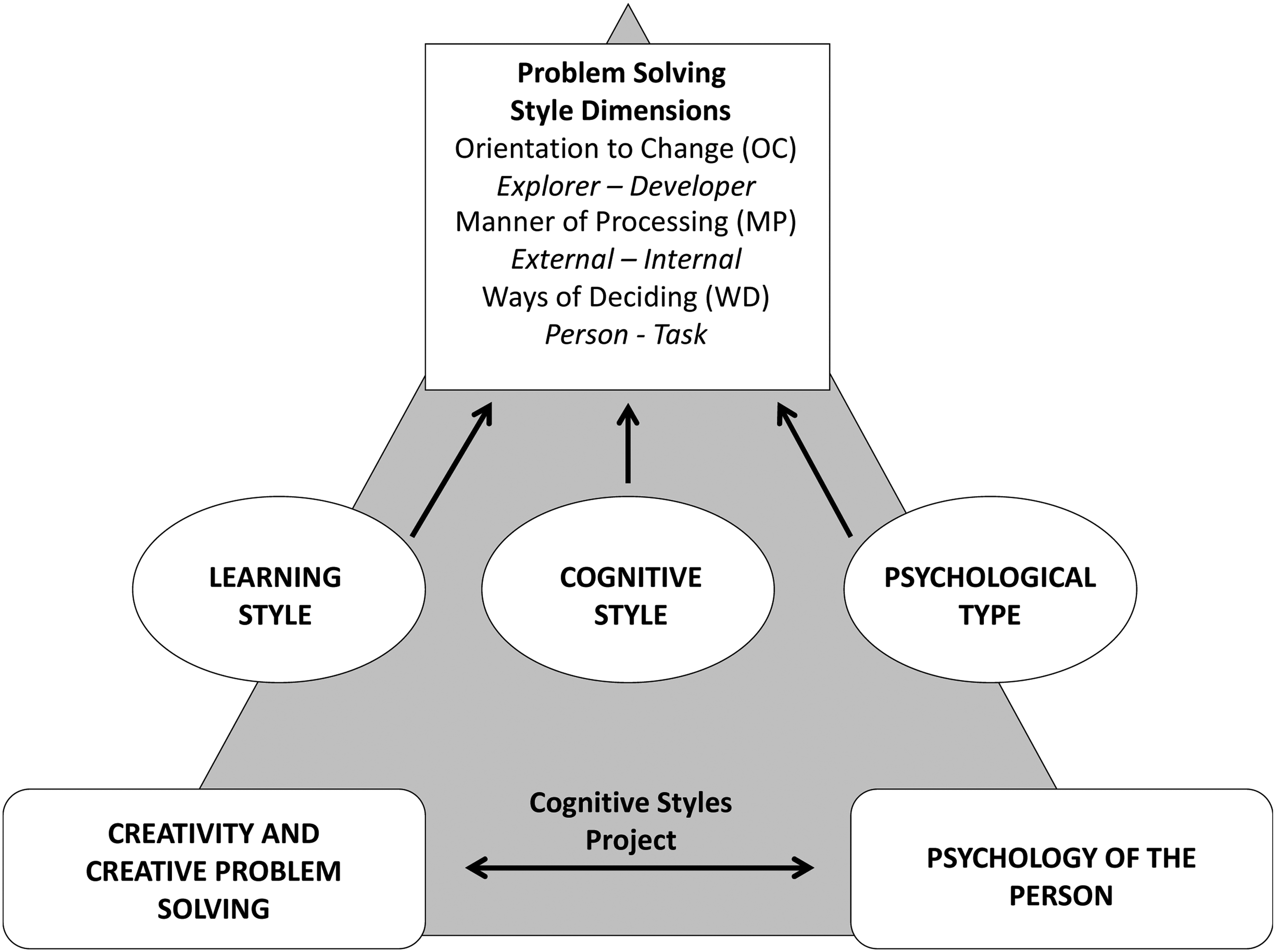
Foundations of VIEW: An assessment of problem-solving style.
The orientation to change dimension encompasses individual preferences for responding to and managing structure, authority, and novelty when dealing with change or solving problems and is anchored by explorer and developer styles. The manner of processing dimension focuses on preferences for how and when individuals use their inner energy and resources (and those of others or from the environment) when processing information when managing change or solving problems and is anchored by external and internal styles. The ways of deciding dimension refers to dispositions of individuals in balancing concerns for tasks and interpersonal needs when focusing, making decisions or taking action, and is anchored by Person and Task styles.
There is more than sufficient evidence regarding VIEW's reliability and validity (Isaksen et al., 2021a; Isaksen et al., 2021b). VIEW is clearly linked to individuals’ preferences for various aspects of CPS (e.g., Isaksen & Geuens, 2007). Yet, since it is not specifically linked to any particular model or method, it can be applied to guiding the use of a wide variety of creativity, innovation, and change methods. VIEW is value-neutral, as the evidence indicates it is unrelated to various level measures like intelligence (Isaksen et al., 2016), and creative-thinking abilities (Woodel-Johnson et al., 2012). Since VIEW is value-neutral, it readily provides individuals with valuable insights into their preferences. It also easily translates to the team level to encourage the understanding and appreciation of the preferences of others. As such, VIEW also readily improves teamwork and outcomes when addressing creative challenges (Main et al., 2019).
The Power of Place
Following the inclusion and integration of problem-solving style preferences into our approach to CPS, further impact studies led us to observe that participants often mentioned their workplace environment as a unique source of encouragement or resistance for applying what they learned. The atmosphere within which people applied CPS made a difference in their impact. Our learning was that we could have a great model and method, and help people understand and manage their problem-solving preferences, but if the conditions were not conducive, impact would be limited. We had made progress on ‘what works, for whom’—and now we needed to include “under what circumstances?” This concern led to the development of the creative climate project.
The creative climate project was heavily influenced by the ground-breaking work of Göran Ekvall (1987; 1996) who studied the work atmosphere that supported creativity and innovation. Ekvall defined and differentiated climate and culture. Climate is the perceived patterns of behavior that characterize the atmosphere in a particular place. Culture is about the deeper aspects of values and assumptions that exist, and influences the climate. He identified key dimensions of the climate supporting creativity and innovation, along with a clear conceptual model and an assessment of these dimensions. We collaborated with him beginning in the early 1980's to translate and further develop his assessment (e.g., Isaksen, 2022b; Isaksen & Ekvall, 2015; Treffinger et al., 1996; 2011) that has been applied in schools, classrooms, universities, businesses, and for teams and leadership development programs.
Creative Climate Dimensions
Some conceive of climate in a very general sense. Another trend is to link climates to more specific areas of focus like the climate for safety, service, etc. Ekvall was interested in the climate for creativity and innovation. There is still some debate about the number and kind of dimensions of climate that support creativity, innovation, and CPS (e.g., Hunter et al., 2007), but there is clear and substantial support for the following nine dimensions.
When challenge and involvement exists for students, they are interested, curious, motivated to learn, and eager to explore. When challenge and involvement are not present, students lack engagement in their learning.
When freedom is present for students, they are provided with opportunities to set their own goals independently and engage in self-directed learning. They have a variety of activities from which they can choose. When freedom is absent, students work within strict and confining rules and procedures, and there is little room for flexibility.
When trust and openness exists for students, open communication and respect results in a safe place for different ideas and opinions to be expressed. When these are missing, people become suspicious and guarded.
When idea-time exists for students possibilities exist to pursue meaningful learning projects and explore new topics. When idea-time is missing, every moment is filled with prescribed activities with heavy emphasis on “covering the material.”
“Laughter and learning are comfortable companions” (Treffinger et al., 2013; p. 93). When playfulness and humor exist for students, there is a good balance between working hard and allowing students to enjoy what they are doing. When these are missing, jokes and laughter are seen as improper and even intolerable.
When students experience high levels of conflict, they may express dislike and even hatred easily resulting in verbal and even physical aggression. Learning of any sort has a hard time taking root. When conflict is low, the level of threat and personal tension is reduced.
When idea-support is high for students, their ideas, input, and suggestions are actively listened to and considered. When idea-support is too low, no attention is paid to them and suggestions are quickly dismissed.
When debate is high for students, they readily engage in good arguments and disagreements are considered in a respectful manner. Many different points of view are tolerated and encouraged. When debate is low, only singular positions are considered and there is no tolerance for disagreement.
When risk-taking is high, students are willing to take on challenges and assignments for which the outcomes may be ambiguous and uncertain. When risk-taking is low, students take on assignments and tasks that are on the “safe side” or are easy and familiar.
These dimensions have been able to successfully distinguish innovative from stagnated organizations (Ekvall, 1996), and have been linked to a variety of important organizational outcomes related to creativity and innovation (e.g., Iqbal, 2019; Turnipseed & Turnipseed, 2013). The climate dimensions have also been applied to identify productive learning environments (e.g., Aliberti & Paolino, 2018) and creative classroom behaviors (e.g., McLellan & Nicholl, 2013; Peter-Szarka, 2012).
Situational Outlook Questionnaire
A key result of the creative climate project has been the development of the Situational Outlook Questionnaire (SOQ). The early versions of the SOQ assessed the nine dimensions of climate, and were applied at the individual level of analysis as psychological climate (Isaksen & Lauer, 1999), as well as the team (Isaksen & Lauer, 2002), and organization levels (Isaksen & Ekvall, 2010). The SOQ has more than adequate evidence regarding its reliability, validity, and psychometric qualities (e.g., Isaksen, 2020b; 2022b).
The climate for creativity was clearly an important part of the overall picture of the appropriate atmosphere or context, yet there were other important aspects that influenced the overall environment that was not originally included within the assessment such as culture or leadership. The next major phase of research and development was to include open-ended questions to the quantitative assessment of the dimensions. Adding the narratives to the SOQ allowed qualitative analysis to identify other salient factors within the environment affecting the climate within any specific context (e.g., Geurts, 2009; Sobieck, 1996). These data supplemented the quantitative results on the dimensions and promoted a deeper understanding of the context. A complete reporting of the developments can be found within Isaksen and Ekvall (2015).
This qualitative work created an opportunity to revise the earlier conceptual models for the SOQ (e.g., Isaksen, 2013; 2017) and resulted in a modified conceptual model that was also influenced by the work of Burke and Litwin (1992) to help guide future research and practice (see Figure 4).
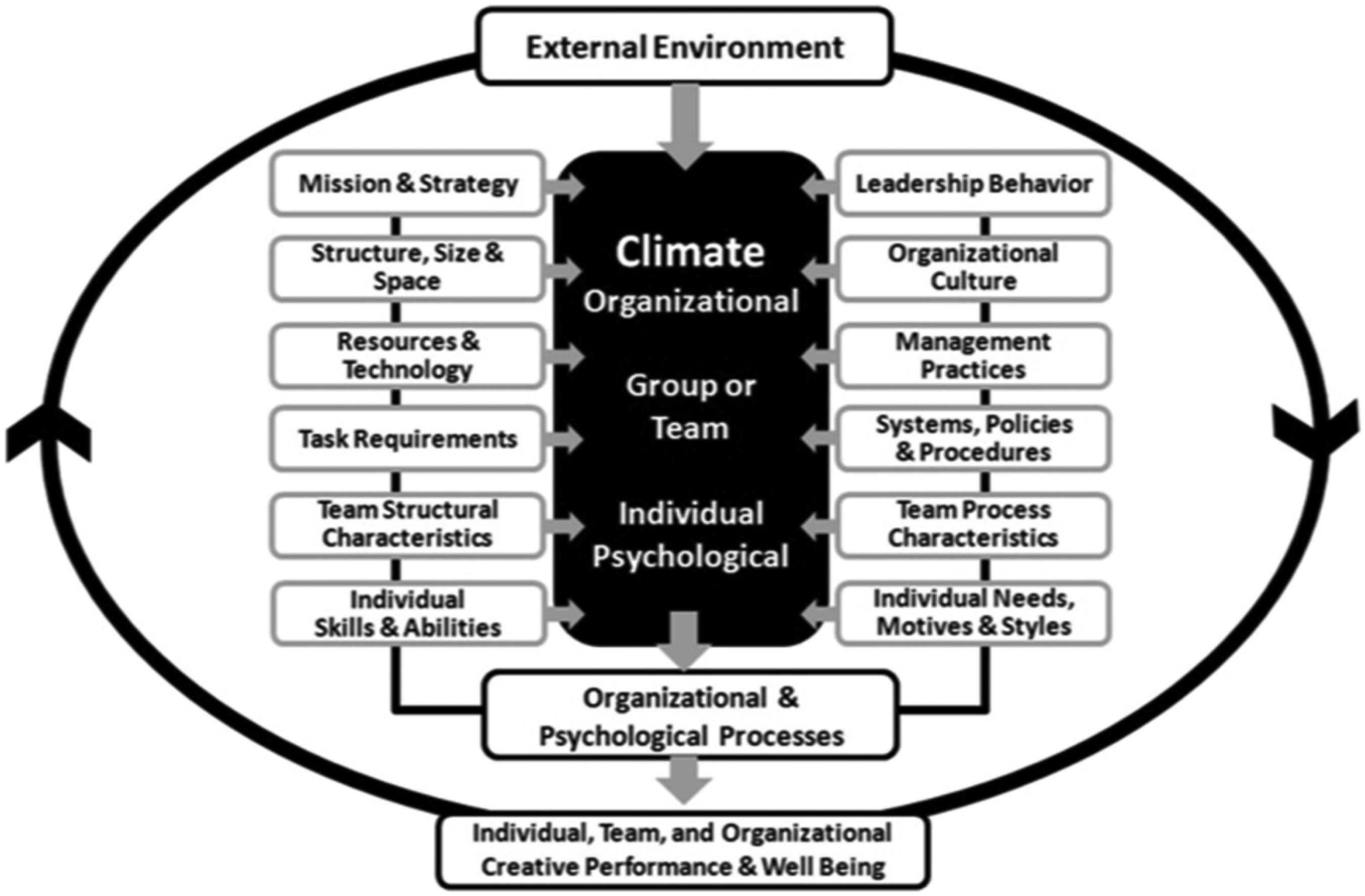
The work environment for creativity and innovation.
Potential Future Possibilities
The complete story of CPS has yet to be written. Contemporary CPS has achieved deep theoretical foundations, robust empirical research, and powerful practical applications. Many important challenges remain for creative, and disciplined, future research and development. Our thrust for CPS research and development has been: What works, for whom, under what circumstances? There are a number of current and future key questions and issues that I hope we might address. A few of these are outlined below.
Extending the Balance
In common parlance, creativity is all about generating ideas, and innovation is all about executing and implementing ideas. It seems more reasonable to consider innovation as a complex, dynamic, nonlinear, and unpredictable journey (e.g., Acar, Tarakci, & van Knippenberg, 2019; Van de Ven, 2017) with iterative cycles of divergence and convergence (Dooley & Van de Ven, 2016) that demand creativity throughout the entire process (Dul & Ceylan, 2014). This contemporary view should foster more nuanced definitions and allow for a deeper understanding and appreciation of the reciprocal relationship between creativity and innovation. Perry-Smith and Mannucci (2017, p.71) outlined the path through which an idea becomes a reality, and they asserted that: “Our investigation of the idea journey from generation to acceptance by the field helps illuminate how the creativity literature can inform the innovation literature, and vice versa.” This shifts us away from a simplistic dichotomy between ‘out of the box’ versus ‘in the box’ type of thinking, and opens up a more balanced conceptualization of the relationship among creativity, CPS, and innovation.
The preponderance of research on creativity has focused primarily on generating tools, particularly idea generation, brainstorming, and its derivatives. A promising trend is a move toward considering idea selection, convergence, and focusing tools (e.g., Berg, 2019; Fleury et al., 2020; Steele et al., 2018).
Our applications of CPS illustrate the value of considering the other components within the framework. The dynamic balance between generating and focusing has yielded important innovative outcomes by improving the clarity of ambiguous and novel problems, as well as building novel ideas to create actionable outcomes. It's not just about ideas. We should seek an improved balance of research and development beyond idea generation. Contemporary approaches to CPS include a balance of generating and focusing tools, techniques, and guidelines that can be applied within the entire framework. This is supplemented by using language that is appropriate for each stage. For example, there may be important differences between generating ideas and generating problem statements (e.g., how to…, in what ways might we…) that provide the focus for idea generation.
A few important questions to be pursued include:
Much more work should be done on focusing tools and guidelines such as seeking a better understanding of the relationships between the quantity and quality of generated options and the effects on screening, selecting, and supporting behaviors. We would also benefit greatly from moving beyond descriptive to experimental studies. CPS includes two important components beyond Generating Ideas. It is important to examine the independent and interactive effects of Constructing Opportunities, Exploring Data, and Framing Problems on Generating Ideas. Further research and development should also include a robust examination of the efficacy of different approaches to Developing Solutions and Building Acceptance.
Encouraging Mindful Cognition
One of the most significant transformations for contemporary approaches to CPS has been the movement away from seeing the creative process as a series of linear, step-by-step, prescribed stages and toward considering CPS as an open, dynamic system or framework. (No more mindless “run-throughs” of a predetermined process!)
This development led to the creation of the Planning your Approach component which plays a unique role within CPS. This component provides the opportunity to consciously and continuously plan, select, and monitor one's approach to CPS. This involves the engagement of the problem solver's executive function (e.g., Diamond, 2013; Doebel, 2020). The implication is that those engaged in CPS ‘think about their thinking,’ and make deliberate choices about the application of process tools, stages, and language while also considering the context and people. This allows monitoring progress toward the goal or outcome of the method and making ongoing adjustments along the way.
This metacognitive activity allows the individual problem solver to blend domain-relevant content knowledge with process knowledge (e.g., Norman, et al., 2019; Rhodes, 2019). For example, creative tasks can demand paradigm breaking, stretching, or enhancing outcomes. Some CPS tools are more likely to provide paradigm-breaking, and others more paradigm enhancing outcomes (e.g., Gryskiewicz, 1987). Beyond choosing tools, this metacognitive activity allows problem solvers to fit the overall process framework to the specific needs and purposes they require, and make ongoing adjustments to their process design.
Many creative challenges require collaboration and teamwork. The Planning your Approach component can be applied at the individual level, as well as for groups or teams. This allows the engagement of social metacognition (e.g., Briñol, & Demarree, 2012; Chiu & Kuo, 2009; Frith, & Frith, 2012). Social metacognition involves distributing metacognition across group members to monitor and control their engagement in CPS, and underscores the importance of facilitation.
Like the other CPS components, planning your approach can be applied independently from the others. For example, if the problem solver already has a clear statement of the problem, they can reach into the framework and detach and apply only the generating ideas component. Metacognition and social metacognition can be applied to a wide range of human behavior. The tools, assessment mechanisms, and approaches within this management component can support mindfulness (Langer, & Ngnoumen, 2017), and sensemaking (Weick, 2020) outside the application of CPS.
A few intriguing issues to be addressed include:
Since current approaches to CPS now include meta- and social meta-cognitive aspects, we need to learn much more about how facilitators can best help others navigate the process. Some early work has already been accomplished (e.g., McFadzean, 2002; Wallgren, 1998; Wrobel et al., 2021). An updated focus on identifying the competencies required to effectively engage in CPS is required. CPS includes a specialized language and vocabulary. For example, within this framework, there are some important distinctions among concepts like ideas, problem statements, criteria, opportunity statements, etc. We need to improve our understanding of the effects of applying these concepts within the domain of general semantics. Language and thinking are inextricably linked.
Considering People and Place
Systemic approaches to CPS should include consideration of people and place. It is likely that people who possess different preferred styles will make diverse contributions to, as well as need different beneficial aspects from, their engagement in the creative process. It is also likely that different styles may require distinctly diverse climates and work environments in order to manifest their creativity.
Some suggestions for needed insights include:
The level-style of creativity issue poses some important challenges for going forward. The value-neutral aspect of style opens the door for including a wide diversity of people, yet also points out that there may be some intriguing biases related to CPS (e.g., Glaveanu, 2014). For example, the concept of creative self-efficacy (CSE) seems rather pointed in the direction of a particular style of thinking. We may need to reconceptualize CSE, and other concepts, to allow improved inclusion of diverse styles, so that many are ready, willing, and able to apply CPS. The nature of the climate and work environment is likely to effect CPS performance (e.g., Hunter et al., 2020; Watts et al., 2017). Are there certain climate dimensions that matter more for certain aspects (tools, stages, or components) of CPS? We also do need to work toward an informed consensus on which dimensions relate to the creative and innovative climate, and which factors belong to the larger concept of work environment. Some initial progress has been made to better understand the potential linkages between style and climate (e.g., Isaksen, 2009; Isaksen & Aerts, 2011; Hoßbach, 2019). Yet, we need a much deeper understanding of their interrelationship and interaction, particularly as they relate to learning and applying CPS.
Conclusion
Modern-day CPS holds great promise and potential for deliberately developing creative potential. When I am asked to differentiate the current approaches to CPS from others, I would point out three major characteristics.
The first of these is that contemporary approaches include a dynamic balance and interplay between generating (divergence) and focusing (convergence). This implies having and appreciating a diverse set of tools, appropriate guidelines and language for both kinds of thinking and behaving.
The second characteristic is that the framework that links process to purpose is open, dynamic, and comprehensive. A descriptive approach allows for approaching CPS in a flexible manner—using tools, guidelines, language, stages, and components in ways that are fit for purpose. The framework needs to go beyond idea generation, and include a sufficient breadth to allow for application across a wide variety of tasks. Finally, the framework should go beyond limited consideration of just the CPS process and the task—to include attention to people and place.
The third feature of modern-day CPS is the focus on facilitation. At the individual level, a current approach provides sufficient information and guidance for effective personal use and helps people metacognitively make choices and design their way through the framework. For group-level application, contemporary CPS includes a social role for the facilitator who uses social metacognition with the client and resource-group to obtain an optimum design for their CPS journey.
This article has focused on process, people, and place. What about the fourth “P” called product? First, the main focus of all our efforts has been on people applying the process in their situations to produce outcomes that meet their innovation challenges, and their needs for new and useful results. Second, developing creative potential and talents is an outcome that is worthy in its own right. If we ignore or discount its importance and value at every level of society, we do so at our own peril.
Footnotes
Appendix 1: CPS Tools for Generating Options
Appendix 2: CPS Tools for Focusing Options
Declaration of Conflicting Interests
The author(s) declared no potential conflicts of interest with respect to the research, authorship, and/or publication of this article.
Funding
The author(s) received no financial support for the research, authorship, and/or publication of this article
