



Abstract
A camera technique known among sports broadcasters as a “hero shot” is used to capture the moment the athlete has successfully completed the task that seals or celebrates a victory. However, the “hero shot” and its components have not been examined in a scholarly setting. The current study aims to build a theoretical understanding of the “hero shot” as a visual frame that conveys hero mythology. The authors used the hero mythology literature and Brooklyn College's film department film glossary to determine which distance, angles, content, and means were most often used to capture heroic imagery of former American professional cyclist Lance Armstrong. This was done through a content analysis of 927 individual shots of Armstrong, aired between 1999 and 2010. Results suggest that low-angle and long shots were most commonly used for “hero shots.” However, the prominence of three-shots suggests the importance of other actors in contextualizing the hero.
Journalists frequently use myths to frame and to organize characters within familiar cultural narratives that their audiences already understand (Nossek & Berkowitz, 2006). The hero became a dominant myth in sports journalism during the Gilded Age, “the first period in American history when sports and games moved away from casual amateurism in the direction of organization and professionalism” (Isenberg, 1988, p. 206). In an examination of the 1998 home run race between Major League Baseball sluggers Sammy Sosa and Mark McGwire, Butterworth (2007) argued that sports journalists’ construction of McGwire as a hero was a way of embodying him with values prized by the wider society. Sports media used this hero myth to structure former American professional cyclist Lance Armstrong's narrative, most prominently from Armstrong's initial 1999 Tour de France victory. An example of this can be seen in Rick Reilly’s (2002), Sports Illustrated Sportsman of the Year article about Armstrong: What's the deal with that name, anyway? Lance Armstrong. Is that a comic-book hero or a bendable action figure? Once somebody gives you a name like that, how hard can life be? Lance Armstrong. Wasn’t he the star of those 1950s boys’ sports books? …
This is his third hour on the bike today, and the Tour de France isn’t for seven months. This is not natural. No other racer in the world is doing this. …
Though scholars have examined the use of hero mythology in text-based sports journalism, they largely have not studied its visual portrayal in televised sports journalism. The term “hero shot,” for example, is parlance in professional sports broadcast for a camera technique intended to capture the action or the player involved in an important play or happenstance. Professional sports journalists may colloquially understand a “hero shot” as the moment a basketball player sinks a game-winning three-pointer or a pitcher throws the final strikeout of a game, sealing their team's victory (e.g., USC Annenberg Media Center, 2017). It can also capture a notable shift in momentum in a team's comeback, such as a basketball player scoring a basket that ties the game and forces an overtime (Partnow, 2019). But sports journalism scholarship lacks an operational definition of a “hero shot.” In fact, when the authors began looking for scholarly literature explaining what “hero shots” are, they were surprised by how little they found, considering how frequently the term is used in professional broadcast journalism. This may partially be credited to the informal ways journalists learn how to shoot video—unwritten rules that are rarely documented (Berkowitz, 2000, p. 126). It may also be the result of an overall lack of framing theory in visual studies, which scholars have credited to numerous factors, such as a lingering belief in academia that words are more important than pictures and that coding and comparing images is too difficult (Coleman, 2010; Messaris & Abraham, 2001). This suggests a gap between professional and theoretical understanding of what “hero shots” are. Examining visual elements separate from their transcripts is important for teaching purposes because visual elements are not always congruent with text-based elements (Coleman, 2010; Zelizer, 2004, 2010). And when they are not congruent, audiences tend to recall the picture more than the words, a phenomenon known as picture superiority effect (Arpan et al., 2006; Gibson & Zillmann, 2000; Lichter & Noyes, 1995; Paletz & Guthrie, 1987; Zillmann et al., 2001).
The current exploratory study aims to build a theoretical understanding of what “hero shots” are. This study builds on past research by showing that “hero shots” convey a specific moment on the hero's journey. The authors used Brooklyn College's film department film glossary to examine 927 individual shots of Armstrong, aired on American television networks through their distance (i.e., extreme long, long, medium long, medium, close-up, extreme close up); angle (i.e., high, low, eye-level, reverse, canted); content (i.e., establishing shot, master shot, two-shot, three-shot); means (i.e., static or moving); and heroism, as adapted from Reed's (2019) study (e.g., pedals for finish line, arms raised in victory, standing on winner's podium, yellow jersey). Chi-squared tests of independence were conducted to determine whether certain distances, angles, content, and means were more significantly associated with “hero shots” than with non-hero frames.
Armstrong may initially not seem like a good candidate for this theoretical exploration. Besides the U.S. Anti-Doping Agency banning Armstrong for life and stripping him of his titles, Armstrong also confessed to Oprah in a January 2013 televised interview that, despite years of denials, he had doped. However, Armstrong is an appropriate athlete for examining “hero shots’” components and theoretical background because he won a record seven consecutive Tour de France titles from 1999 to 2005. His longevity, particularly the frequency with which sports journalists captured him crossing a finish line victoriously, make for a large enough sample for the authors to run meaningful statistical tests and to establish a theoretical understanding of what professionals refer to as “hero shots.” Also, sports journalists’ created this footage in a certain context. This visual storytelling influences how we view Armstrong, long after his narrative has changed, and how we teach videography. According to Zelizer (2010, p. 267), “As images move across digital platforms with increasing ease and accessibility, the meaning of an image that begins in one place with clear verbal texts about what it shows can rapidly change when it moves to other contexts that offer no information at all.” Images of a heroic Armstrong play a role in our collective sports memory, establishing and maintaining shared knowledge from an earlier time (Zelizer, 2004).
The following sections include a review of the hero myth and framing literature, research questions, methodology, findings, and discussion sections.
Literature Review
Professional norms and routines guide how sports journalists create content. The routines journalists learn for interviewing, gathering information, organizing content, and shooting film, for example, are often “learned informally on the job through socialization in the news media organization—‘by osmosis’—but are rarely documented or taught explicitly” (Berkowitz, 2000, p. 126). As members of an interpretive community (Zelizer, 1993), journalists develop meaning through their experience in this work culture, which reinforces practices through unspoken rewards and punishments (Soloski, 1989). A component of this training is learning how to interpret extraordinary occurrences and to report them in ways that will make sense to the news media audience (Berkowitz, 2000). Journalists need to construct narratives that are culturally relevant for their audience—and do it on deadline (Bird & Dardenne, 1997). This is crucial to news content creation because “the journalist who tells a story does so successfully only if and when he or she couches the story in the language, mythologies, norms, conventions, [and] ideologies of the culture within which he or she and their listeners are situated” (Cohen et al., 1995, p. 153). One way to do this is through myth.
Myths
A myth is a story told through a larger societal idea, value, and belief (Lule, 2001, 2005). Myths are neither untrue nor false. They are more like frameworks, “patterns, images, motifs and characters, taken from and shaped by the shared experiences of human life, that have helped structure and shape stories across cultures and eras” (Lule, 2001, p. 15). Myths have “identifiable narrative structures that become formulaic through repeated application, complete with common central actors and predictable outcomes” (Berkowitz, 2005, p. 608). When a society's values are under threat, journalists use myths to organize characters within familiar cultural narratives (Nossek & Berkowitz, 2006). In an analysis of the 2007 shootings at Virginia Tech, Berkowitz (2010, p. 656) found that journalists used myths to explain individuals’ roles in the tragedy and, thus, placing stories “deeper into historical meanings of tragedy while comforting society with the message that good can prevail over evil.” Initial coverage stuck to basic facts, describing engineering professor Liviu Librescu, who held the classroom door shut while students jumped out the second floor window to safety. However, journalists quickly began using a hero narrative to contextualize Librescu as “a frail, elderly professor who ironically survived the Holocaust only to die at Virginia Tech” (Berkowitz, 2010, p. 644). By pairing Librescu's actions at Virginia Tech with his history as a Holocaust survivor, journalists extended a larger message of good prevailing over evil. That “by highlighting heroes who make personal sacrifices for the public good, news texts can demonstrate that—in the big picture—the moral order remains largely intact despite the current aberration” (Berkowitz, 2010, p. 656).
Myths in general are so common in U.S. journalism, Lule (2001) found that journalists framed people and events in one of seven myths: the hero, the victim, the scapegoat, the good mother, the trickster, the other world, or the flood. Our understanding of “the hero,” though, has changed over time and in different cultures. For example, in Homer's ancient Greek poem Iliad, a hero is a “warrior who lives and dies in the pursuit of honor” and exhibits their heroism through “the brilliancy and efficiency with which they kill” (Schein, 1984, p. 58). They could be childish or arrogant, have close (albeit not always favorable) relationships with the gods, and instigate violence unnecessarily (Hamilton, 1942). In a work of comparative mythology, Campbell (1949) described a hero as someone who travels from the common world to a supernatural one, encounters fantastic forces and obstacles, and wins. This hero returns to the common world “with the power to bestow boons” upon their fellow human beings (Tudor, 2014, p. 4). Tudor argued that the endurance of the hero myth hails from a larger psychological need for a hero, someone who “can alter events and overcome threats to society and change history” (p. 4). This hope or wish derives from social and psychological needs, such as “hopelessness against the inevitability of disasters… [and] an escape from personal and political responsibility for shaping or participating in society” (Tudor, 2014, p. 4).
The hero myth, in particular, became prominent in American sports journalism because sports writing, as developed during the Gilded Age (1870–1900), articulated American cultural values (Trujillo & Ekdom, 1985), such as equality, freedom, ambition, success, and independence (see Rokeach, 1973). Sports journalists wrote about these athletes and coaches through the lens of these values (Roessner, 2014). In return, professional sports, such as baseball, attracted fans, money, and legitimacy (Riess, 1980; Roessner, 2014). Today, sports “stars” have become “increasingly dominant as a heroic class and are even more than twice as likely to be named as heroes than entertainers or heads of states” (Wenner, 2020, p. 225).
Armstrong's background story, often depicted as a rise from humble beginnings through adversity, is a formulaic hero myth (Lule, 2001; Reed, 2019). Lance Edward Gunderson was born September 18, 1971, in Richardson, Texas, to teenage parents Eddie and Linda Gunderson, who married earlier that year. The couple divorced about two years later, and Linda married Terry Armstrong in 1974 (Texas Department of State Health Services, Marriage Index, 1966–2002). Terry Armstrong adopted Lance, and was, according to Lance, abusive (Zenovich, 2020). Terry Armstrong said in a 2020 interview that, “Lance would not be the champion he is today without me, because I drove him. I drove him like an animal” (Zenovich, 2020). Lance joined the swim team when he was 12 years old, having to learn how to swim alongside 6-year-olds (Zenoviach, 2020). The following year, he competed in a junior triathlon, and by the time he was 16 years old, Lance Gunderson, now Lance Armstrong, was a rising triathlete, making $20,000 in competitions. Linda and Terry Armstrong had also divorced (Texas Department of State Health Services, Divorce Index, 1968–2014).
His success, however, was halted in 1996 when the then-25-year-old was diagnosed with Stage 4 testicular cancer that later spread to his brain and lungs. Doctors determined his chance of survival to be less than 50% (Gibney, 2013). Not only was he declared cancer free in February 1997, he went on to win a record seven consecutive Tour de France titles from 1999 to 2005. By surviving and thriving, he became the embodiment of a larger revered social value (Maquire, 2011; Parry, 2020). Or, according to Casper and Moore (2009), “the embodiment of glorious, red-blooded, American masculinity” (p. 176): In victory or defeat, with just one actual testicle but a collectively recognized set of symbolic cojones, Lance Armstrong is a mythical hero for our time … He is a “man's man,” a frequent subject in magazines catering to men's interests and the very picture of the valiant warrior from children's fairy tales. (p. 176)
But myths are neither fixed nor immutable. A subject can move from hero to villain (Parry, 2020). For example, footwear manufacturer Nike began collaborating with Armstrong in 1996 because Armstrong's hero myth appealed to the company (Fahrendorf, 2022). According to Hunt and Kint (2012, para. 2): Companies choose particular celebrities to endorse particular products because the celebrity projects an image, idea, or concept that the company wants consumers to associate with a product. In Armstrong's case, the idea was hard work, perseverance, and overcoming the odds.
Armstrong and his wife, Kristin, divorced in 2004, and he retired after the 2005 win. He then returned, finishing third and 23rd in the 2009 and 2010 Tour de France races, respectively. He retired again in 2011. After USADA stripped Armstrong of his titles, Nike, among other companies, ended its multi-million-dollar contract with Armstrong. By doping, and lying about it, Armstrong became “the polar opposite of” the heroic themes that made him an attractive athlete collaborator in the first place (Hunt & Kint, 2012, para. 2). In their reactionary columns, American text-based sports journalists blamed Armstrong as a rogue and a liar, bemoaned sports’ widespread dysfunction, acknowledged a collective love of mythmaking in sport and their disappointment in another fallen hero, and/or questioned whether the good that Armstrong did outweighed the bad (Reed, 2019). However, no sports journalists in Reed's (2019) study questioned whether perpetuating Armstrong's narrative could have been avoided or whether similar situations could be avoided in the future.
Framing
Journalists build frames when they organize information into a picture of reality (Chong & Druckman, 2007; Tuchman, 1978), promoting “particular definitions and interpretations of political issues” (Shah et al., 2002, p. 343). While agenda-setting theory examines issues’ salience, framing is a theoretical and methodological framework that allows for replicable examination of issue presentation and emphasizes the salience of a topic's different aspects (de Vreese, 2005). Frames are important because they have “subtle but powerful effects on the audience” (Tankard, 2001, p. 96). News framing research has been conceptualized in various ways, such as units, processes, and variables that interact with the audience's prior knowledge about a subject (Chong & Druckman, 2007; D’Angelo, 2002). News frames, more specifically, are themes within news stories that have identifiable concepts, can be commonly observed in journalistic practice, and can be reliably distinguished from other frames, such as the news story's basic facts (Cappella & Jamieson, 1997; de Vreese, 2005; Pan & Kosicki, 1993).
In text-based news research, two overarching frames have often been used: episodic and thematic. Episodic frames depict “issues in terms of individual instances or specific events” (Iyengar, 1991, p. 253). An example would be using an individual person's narrative to present an issue or problem, often couching the problem as belonging to that specific person (Gross, 2008; Iyengar, 1991; Springer & Harwood, 2015). Thematic frames, on the other hand, focus more on breadth and background information (Springer & Harwood, 2015). Thematic frames present an issue as a collective problem, often with government-based solutions (Springer & Harwood, 2015). For example, in their analysis of how Russian and American sports journalists cover Russian and American doping scandals, Reed and Harker (2022) found few differences between Russian and American sports journalists’ use of episodic or thematic frames. However, both Russian and American journalists framed the issue more thematically when reporting on Russian athletes or teams, and framed American athletes or teams more episodically. When sports journalists framed stories episodically, they were more likely to blame an individual for doping in sport (Reed & Harker, 2022). However, when sports journalists framed stories thematically, they were more likely to tie doping back to a large systemic problem (Reed & Harker, 2022).
Visual Framing
Framing theory has emerged in visual studies for its “ability to explain and predict visual content and its effects, but also for the opportunity to build on this valuable theory in ways that word-based studies cannot” (Coleman, 2010, p. 233). According to Coleman (2010, p. 236), “visual” means “content that is processed by the eye alone,” such as still photography, moving images, drawings, maps, cartoons, graphics, and color. Framing will refer to “the selection of one view, scene, or angle when making the image, cropping, editing or selecting it” (Coleman, 2010, p. 237).
As stated earlier, scholars have criticized the lack of framing theory in visual studies, citing lingering belief in academia that words are more important than pictures, and that coding and comparing images is too difficult (Coleman, 2010; Messaris & Abraham, 2001). Even when moving visuals such as television programs are studied, scholars often limit their analysis to the transcripts (Coleman, 2010). This, along with the informal ways in which journalists learn how to do their jobs, may explain why scholars have not developed a theoretical understanding of what sports journalists professionally refer to as “hero shots.” Though visual elements can work together with text-based elements to frame stories, they are not always congruent (Coleman, 2010; Zelizer, 2004, 2010). And when they are not congruent, audiences are more likely to recall the picture than the words (Arpan et al., 2006; Gibson & Zillmann, 2000; Lichter & Noyes, 1995; Paletz & Guthrie, 1987; Zillmann et al., 2001).
Television framing shapes audiences’ perception of an event (see Massaris & Abraham, 2001). Lang and Lang (1953) were among the first to analyze the differences between experiencing an event live, and consuming it on television by examining differences between experiences and impressions of people attending General MacArthur Day April 26, 1951, in Chicago, and those who watched it on television. Television audiences had the impression the crowd supported the event more strongly than the people who actually attended the event did. Numerous studies since then have examined news conventions’ influence on visual framing, like the use of action photos over passive photos, and the use of camera angles to denote power and weakness (see Arpan et al., 2006, Detenber et al., 2007; Gitlin, 1980; McLeod & Detenber, 1999; Messaris & Abraham, 2001).
One element of visual framing focuses on structural features, like camera angles and distances, and what these manipulations convey to the audience (Berger, 1981; Grabe, 1996; Moriarty & Popovich, 1991; Waldman & Devitt, 1998). These features are the result of where the journalist is in relation to where the subject is. For example, whether a photographer is shooting a subject at a low, high, or eye-level angle is not always a subjective choice, but also a result of where the photographer is physically positioned in relation to the event. Broadcasters have fewer opportunities during the competition to shoot cyclists than they do in other spectator sports. The Tour de France, for example, is a continuous course with cyclists moving at relatively high speeds. Armstrong's fastest Tour de France averaged 41.7 kph (25.9 mph) over 86 hours, 15 minutes, and 2 seconds (Arthurs-Brennan, 2019). There can also be precipitation. Riders wear helmets and often eyewear. In many parts of the race, it is difficult to see cyclists’ faces, and when their faces are clear, athletes’ contorted features reveal the grueling nature of the sport. It is possible “hero shots” overlap with the clearest angles of Armstrong's unobstructed and unstrained face. This may be different than other sports, were there may be more footage of an athlete doing a wider range of actions. Sports journalists and scholars need to consider these practical elements of the sport when determining hero shots’ components.
According to the Brooklyn College's film department film glossary, a “shot” is “a piece of film that has been exposed, without cuts or interruptions, in a single running of the camera. The shot is often regarded as the elemental division of a film. Shots may be categorized: (1) according to the apparent distance of the main subject from the camera (camera distance); (2) according to the angle of the camera in relation to the subject; (3) according to the content, nature or subject matter (e.g., a reaction shot or a two-shot); and (4) according the means accomplished physically (camera movement)” (para. 93).
Research Questions
In this content analysis, the authors explore “hero shots’” components. To understand how “hero shots” are constructed, the following research questions are proposed:
These research questions will be explored through descriptive statistics and Chi-squared tests.
Methodology
Units of Analysis, Sampling Units, and Coding Units
The sampling units for this content analysis were news stories about Lance Armstrong. More specifically, the analysis units were each shot of Armstrong that aired between January 1, 1999, and December 31, 2010, on American TV networks. These dates were chosen because they begin the year Armstrong won his first Tour de France and end the year he competed in his last Tour de France.
The sample was collected from the Vanderbilt Television News Archive. Search terms were “Lance Armstrong,” limited to January 1, 1999, through December 31, 2010, phrase search, most relevant, and news segments, specials, and evening news. Of the 247 videos, 97 were available to view free of charge (39%). The remaining 150 videos were purchased from the Vanderbilt Television News Archive in June 2019 for $1,900. Of the 247 videos, 19 were duplicates, five did not include news about Armstrong, and three were thrown out because they were commercials during Larry King Live. This left 220 eligible videos, aired on one of three American television networks: ABC, CBS, and FOX. Among these videos were 927 individual shots of Armstrong. The authors used Brooklyn College's film department film glossary to examine these shots of Armstrong through their distance (i.e., extreme long, a shot in which the scale of the object shown is very small; long shot, a shot that shows a character in his or her entirety, filling most of the frame; medium long shot, a shot in which an object that is 4-5 feet tall fills the screen vertically; medium shot, a shot that shows a character from the waist up; close-up, a shot in which the head of a person, or the entirety of a small object is shown; and extreme close up, a shot that shows only a small portion or detail of a character's body (e.g., eyes, ears, mouth) or a tiny object); angle (i.e., high-angle, a shot which looks down on a character or object from a height; low-angle, a shot which looks up at the subject; eye-level, a shot taken at the director's or the subject's eye level; reverse-angle, a shot taken by a camera positioned more or less opposite from where the previous shot was taken; and canted angle, which is a shot in which either the right or the left side is lower than the other, causing objects in the scene to appear slanted); content (i.e., establishing, which is often the opening shot of a film or sequence, showing the location of a scene or the arrangement of its characters; master, which is a single shot of one person; two-shot, which is a close-up or medium shot of two people; and three-shot, which is a close-up or medium shot of three people); means (i.e., static, which is a shot in which the camera is immobile; and moving, which is a shot in which the camera is panning or zooming in and/or out); and heroism, as adapted from Reed's (2019) study (e.g., pedals for finish line, arms raised in victory, standing on winner's podium, yellow jersey).
Coding
Each coder was given news stories (not pieces designated as opinion) aired about Armstrong between January 1, 1999, and December 31, 2010, on English-language, American television. Coding was done in a Microsoft Excel spreadsheet. Coders were to record the Vanderbilt Television News Archive number; the network name; airing date; the reporter(s) name (if available); and duration of the report. For each frame featuring Armstrong, coders coded the following: frame start time, end time, total duration; distance (i.e., extreme, long, medium long, medium, close-up, and extreme close up shot); angle (i.e., high, low, eye-level, reverse,-angle, and canted angle); content (i.e., establishing, master, two-, and three-shot); means (i.e., static and moving). Coders also coded for heroism, as established in Reed's 2019 study (e.g., pedals for finish line, arms raised in victory, standing on winner's podium, yellow jersey). For a more complete description of coding, including stick-figure depictions of distances, courtesy of Brooklyn College's film department film glossary, see Appendix A.
Intercoder Reliability
Krippendorff's (1980) alpha index was used to determine intercoder reliability. Krippendorff's alpha was used because of its versatility: it can be used for multiple coders, accounts for chance agreements, and is designed for variables from nominal to ratio (Lombard & Snyder-Duch, 2002). Though there is no established standard for what constitutes acceptable levels of reliability, Neuendorf (2002) examined methodologists’ recommendations (Banergee et al., 1999; Ellis, 1994; Frey et al., 2000; Krippendorff, 1980; Popping, 1988; Riffe et al., 1998) and concluded that coefficients of .90 or greater are universally acceptable, .80 or greater are acceptable in most situations, and .70 or greater is acceptable in exploratory research (though not all methodologists agreed). The lowest conceivable limit was .667 (Krippendorff, 2004).
Two coders performed intercoder reliability for this content analysis. The principal investigator gave the second coder a copy of the protocol and reviewed it in person. According to Kaid and Wadsworth (1989), between 5% and 7% of the sample should be tested for intercoder reliability. However, Wimmer and Dominick (2011) suggested 10% to 25% of the body should be tested. Based on the overall sample, 93 shots, or about 10% of the sample, were tested for intercoder reliability. Coders had acceptable reliability on distance (α = .870), angle (α = .800), content (α = .925), and means (α = .872), but not on heroism. This was because many of the elements Reed (2019) identified as a hero myth in text-based narratives about Armstrong overlapped in the current, visual-based study. For example, shots of Armstrong crossing the finish line or standing on the winner's podium often also included Armstrong raising his arms in victory, fist pumping, counting his victories on his fingers, or wearing the yellow jersey. To compensate for this, heroism was recoded to no longer discriminate between which kind of hero myth appeared, only that the hero myth was present (i.e., nominal coding “1” for hero myth being present, “0” for hero myth not being present).
Findings
Descriptive Statistics
The final sample consisted of 927 shots, aired between July 5, 1999, and July 25, 2010. About 80% of the shots aired in July, the month of the Tour de France. ABC aired about 51% of the sample, followed by CBS (30.2%), and FOX (18.8%). Shots ranged from 1 to 5 seconds in length. About 32% of shots were long and 27% were medium. For angle, most (72.8%) were eye-level and master (63.2%) shots. The sample was nearly split regarding static and moving shots—52% were static and 46.4% were moving.
Hero Myth
The hero myth frame, which captures the action or the player involved in an important play or happenstance of the event and tested in Reed (2019), appeared in 438 of the 927 total shots, or 47.24% of the sample. These included shots of Armstrong crossing the finish line, wearing the yellow jersey, standing on the winner's podium, raising his arms in victory, fist pumping, and/or counting his victories on fingers.
The first research question examined the relation between the presence of a hero myth and the five types of angles (i.e., high-angle, low-angle, eye-level, reverse-angle, and canted angle). The relation between these variables was significant, X2 (4, N = 925) = 38.669, p < .001. Though eye-level shots were the most frequent angles where hero myths emerged (327, or 74.6% of hero myth frames), this same angle was used for 348 frames that lacked hero myths, and there was no statistically significant difference between the two groups, X2 (1, N = 925) = 1.19, p = .274. Low-angle shots, however, accounted for 84 hero myth frames and 55 non-hero myth frames. A Chi-squared test of independence performed to examine the relation between the presence of a hero myth and low-angle shots was statistically significant, X2 (1, N = 925) = 11.227, p < .001. The relation between the presence of a hero myth and high-angle shots was also statistically significant, X2 (1, N = 925) = 20.72, p < .001, but for the opposite reason. There were 71 high-angle shots in non-hero myth frames and 24 in hero myth frames. There were also 11 instances of a reverse-angle shot, but none of them were used in hero frames. There were three instances of canted angle shots in hero myth frames, and two in a non-hero myth frame.
The second research question asked which elements of distance (i.e., extreme long shot, long shot, medium long shot, medium shot, close up, and extreme close up) were most often used in hero frames. A Chi-squared test of independence performed to examine the relation between the presence of a hero myth and distance was statistically significant, X2 (5, N = 923) = 19.534, p = .002. Out of the six distances, though, only two had a statistically significant relationship with the hero myth. The long shot was used to portray a hero myth in Armstrong coverage 153 times, or 52.4% of the times a long shot was used. The relationship between the presence of a hero myth and the long shot specifically was statistically significant, X2 (1, N = 923) = 4.372, p = .037. The relationship between the presence of a hero myth and the close up shot was also statistically significant, X2 (1, N = 923) = 13.853, p < .001, but again, for how rarely it was used to portray a hero myth. Out of the 178 times a close-up shot was used, 62 of those times (34.8%) were used for a hero myth. The relationship between the presence of a hero myth and the extreme long shot, medium long shot, medium shot, and extreme close up was not statistically significant.
The third research question asked which elements of content (i.e., establishing, master, two- and three-shot) were most often used in hero frames. The most common was a master shot (586), used in 64.6% of the sample. Establishing shots (119) followed at 13.1%, and two-shots (109) appeared in 12% of the sample. Three-shots were used the least (93, or 10.2%). A Chi-squared test of independence performed to examine the relation between the presence of a hero myth and content was statistically significant, X2 (3, N = 907) = 60.946, p < .001. The relationship between the presence of a hero myth and the three-shot specifically was statistically significant, X2 (1, N = 927) = 37.751, p < .001. Of the 93 times a three-shot was used, 72 of those times (77.4%) were used in a hero frame. For examples, see Figure 1.
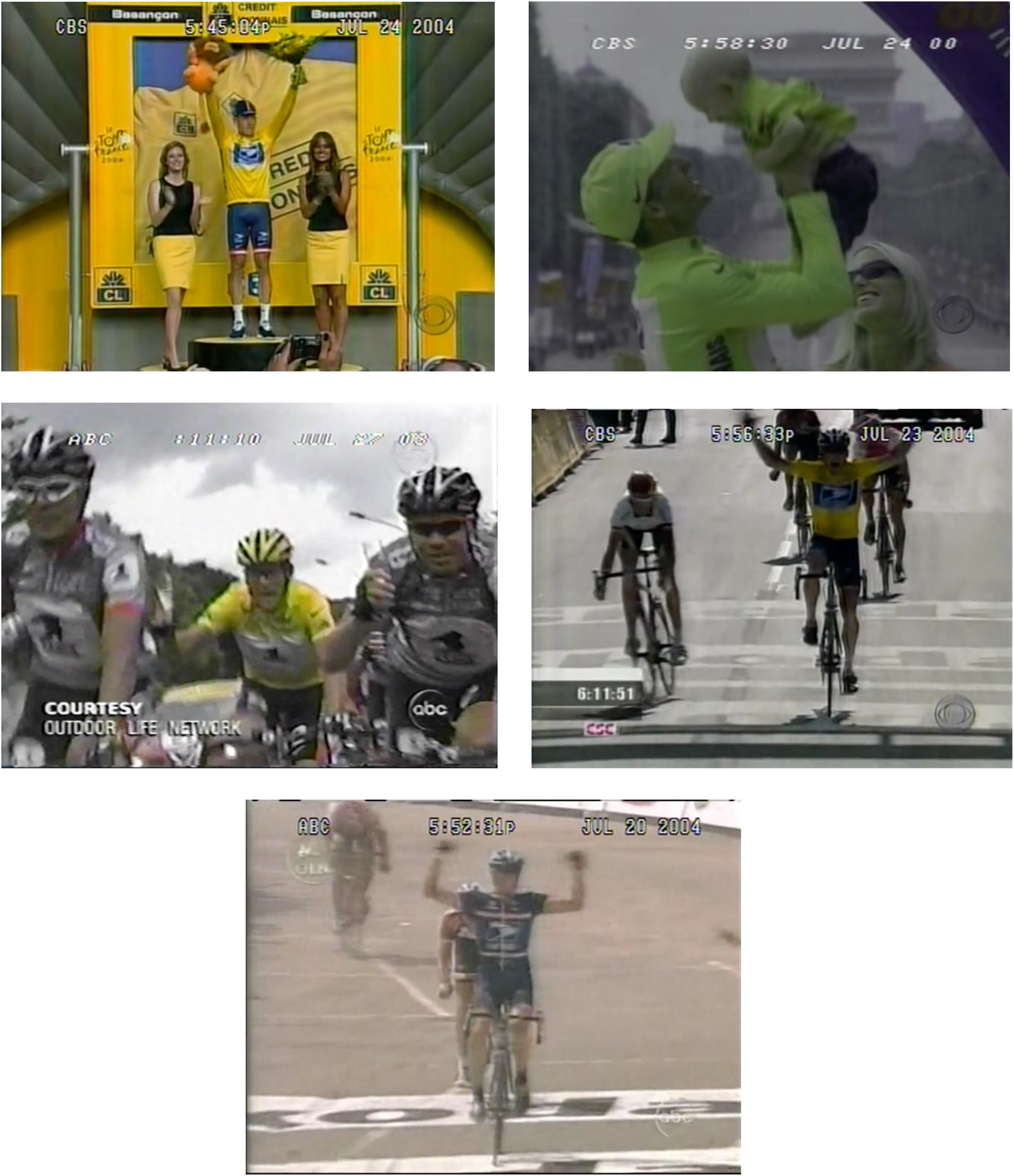
Examples of three-shot hero shots of Armstrong, including distance, angle, and means.
The relationship between the presence of a hero myth and the two-shot specifically was also statistically significant, X2 (1, N = 927) = 37.751 p < .001, because it was not popular for portraying a hero myth. It was done so 26 times, or about 6% of the 438 times a hero myth frame was present. The relationship between the presence of a hero myth and the establishing shot and the master shot were not statistically significant.
The fourth research question asked which elements of means (i.e., static, moving) were most often used in hero frames. Most of the time, a static shot was used (52%) in Armstrong coverage. However, the relationship between the presence of a hero myth and means was not statistically significant, X2 (1, N = 912) = .019, p = .890. There appeared to be no statistically significant difference between whether a hero frame used a static or a moving shot.
Discussion
Though the term “hero shot” has been used as a colloquial term sports broadcasters use in reference to a camera technique, this study identifies its components in scholarly literature. Out of the 927 total shots of Armstrong in this sample, 438, or 47.24%, were of a “hero shot.” The percentage is slightly higher than in Reed's (2019) study on sports journalists’ paradigm repair, which found a hero narrative present in about 40% of the sample's stories, but from nearly 70% of the sports journalists within the sample. The “hero shot” differs from Armstrong's text-based hero narrative, which painted a picture of Armstrong's humble beginnings, adversity, and ultimate victory in words, over the course of several paragraphs. The current study showed how “hero shots” in visual communication embody hero mythology by capturing Armstrong overcoming adversity.
The study also unearthed elements of the hero myth as a visual frame that distinguishes this camera technique from other visual techniques. Low-angle shots were predominantly used in “hero shots.” Low-angle shots looking slightly upward at Armstrong denoted his elevated status. High-angle shots, which dwarf the subject, were noticeably absent from Armstrong's “hero shots.” Long shots were also commonly used for “hero shots” in this sample, which gives the context in which Armstrong was victorious (e.g., Tour de France finish line). The emergence of a three-shot, which was a close-up or medium shot of three people, however, is more of a surprise. It brings attention to the role actors play in contextualizing the hero. Previous studies on hero mythology did not include this element. A reason for this is that text-based journalists, such as those in Reed (2019), included other actors only tangentially. For example, when journalists explained Armstrong's humble origins, they also mentioned his teenaged mother. But these actors comprise the humble beginnings stage of the hero myth—a stage, as stated earlier, the visual “hero shot” did not capture. The “hero shot” captures the moment on the hero's journey where the athlete has overcome adversity, and this included shots of Armstrong with opponents or teammates surrounding him, second- and third-place winners on the podium next to him, and Tour de France personnel standing next to and behind him.
Understanding what comprises a hero shot matters to professionals and instructors because when such file footage is shot, it is used repeatedly, potentially after a previous narrative has changed. Sports journalists’ created this footage in a certain context, and this imagery influences how viewers will perceive Armstrong long after his narrative has changed. As Zelizer (2010, p. 267) was quoted staying earlier, “As images move across digital platforms with increasing ease and accessibility, the meaning of an image that begins in one place with clear verbal texts about what it shows can rapidly change when it moves to other contexts that offer no information at all.” These hero shots of Armstrong play a role in our collective sports memory, establishing and maintaining shared knowledge from an earlier time (Zelizer, 2004). Armstrong was shot in the “hero shot” frame often. He won the Tour de France seven times. Those “hero shots” became file footage to be used in later pieces on Armstrong, regardless of the subject matter. And when the texts and visuals are not congruent, audiences tend to recall the picture more than the words (Arpan et al., 2006; Gibson & Zillmann, 2000; Lichter & Noyes, 1995; Paletz & Guthrie, 1987; Zillmann, Knobloch & Yu, 2001). Sports journalists should take this under consideration when shooting, capturing visuals that go beyond a contemporary mainstream narrative surrounding the subject (e.g., hero). If news stations’ file footage is limited to shots of Armstrong winning, this is the footage that would be used in stories about, for example, him doping. Having access to a wider range of shots would give stations visuals that better match Armstrong's fall from grace.
The positioning and use of other actors in relation to the hero is an important addition to our understanding of “hero shots’” theoretical components. This concept should be explored in further hero mythology research, particularly in other sports. As stated earlier, whether a photographer is shooting a subject at a low, high, or eye-level angle is not always a subjective choice, but a result of where the photographer is physically positioned in relation to the event. Broadcasters attempting to shoot cyclists have to contend with cyclists moving at relatively high speeds, often wearing helmets or eyewear that obstruct the face. These practical elements influence the footage sports journalists shoot.
There are limitations to this study. One is how Armstrong's cancer diagnosis influenced the way sports broadcasters captured his hero narrative. How this may have differed from other sports heroes was not examined in this study. But the role of cancer in Armstrong's hero narrative was apparent in the sample's earlier broadcasts. Also, not all reporters’ names were listed or mentioned within the segment. This meant coders could not consistently record who within networks was using hero narratives. Thirdly, the prominence of the color yellow and its symbolic meanings are limited to the Tour de France. Visual framing studies of other athletes in other sports wouldn’t necessarily see yellow used in “hero shots.” However, the strategic use of color overall is a key component of visual framing (Coleman, 2010) that should be explored further in sports journalism research.
Overall, this content analysis makes important contributions to sports journalism and hero mythology research in that it shows how the hero myth can be conveyed through a “hero shot”—a low-angle, long shot capturing the athlete in their moment of victory or celebration, often with two other athletes flanking them. This study also brings a common broadcast technique, known colloquially as the hero shot, into the academic body of literature. The practical and theoretical aspects of other actors being present in the hero shot, instead of just the isolated hero, is an area for further research.
Footnotes
Acknowledgments
This research was paid for with a 2019 Arizona State University Walter Cronkite School of Journalism and Mass Communication Dean’s Research Grant.
Declaration of Conflicting Interests
The author(s) declared no potential conflicts of interest with respect to the research, authorship, and/or publication of this article.
Funding
The author(s) disclosed receipt of the following financial support for the research, authorship, and/or publication of this article: This work was supported by the Arizona State University (grant number $6,000).

Author Biographies
Appendix A
Content Variables (CV)
Coders recorded the following information in the corresponding Microsoft Excel spreadsheet columns.
COLUMN
A.) Vanderbilt Television News Archive number (e.g., 706814.mpg) B.) NETWORK name (e.g., ABC, FOX). C.) MONTH, DAY, and YEAR of airing. D.) REPORTER(s)’ name, if available E.) DURATION of report F.) FRAME 1: Beginning time G.) FRAME 1: End time H.) FRAME 1: total frame duration I.) FRAME 1: Distances
a. Extreme long shots (XLS): A shot in which the scale of the object shown is very small; a landscaper a cityscape, or a crowd. Such an image is often used as an establishing shot. b. Long shot (LS): A shot that shows a character in his or her entirety, filling most of the frame. c. Medium long shot (MLS): A shot in which an object that is 4-5 feet tall fills the screen vertically. A shot that shows a character from the shins up (also referred as a Plain American). d. Medium shot (MS): A shot that shows a character from the waist up. e. Medium Close-up (MCU): A shot somewhere between a medium shot and a close up; generally one that shows a character from the chest up and with some background remaining. f. Close-up (CU): A shot in which the head of a person, or the entirety of a small object is shown. g. Extreme Close Up (XCU): A shot that shows only a small portion or detail of a character’s body (eyes, ears, mouth) or a tiny object.
Here are some examples:
J.) FRAME 1: Angles (described from the camera’s point-of-view):
a. High-angle shot: A shot which looks down on a character or object from a height. b. Low-angle shot: A shot which looks up at the subject. c. Eye-level shot: A shot taken at the director’s or the subject’s eye level. This is normally between 5 and 6 feet but it can change according to director and cultural context. d. Reverse-angle shot: A shot taken by a camera positioned more or less opposite from where the previous shot was taken. It often looks like this:
e. Dutch, canted, or oblique angle: A shot in which the frame is not level; either the right or the left side is lower than the other, causing objects in the scene to appear slanted out of an upright position. K.) Content
a. Establishing shot: Often the opening shot of a film or a sequence, showing the location of a scene or the arrangement of its characters. Usually an extreme long shot or a long shot. For example, classical westerns normally open with a long shot of a conventional setting, such as Monument valley. b. Master shot: A single shot of one person. c. Two-shot: Close-up or medium shot of two people. d. Three-shot: Close-up or medium shot of three persons. L.) Means
a. Static shot: A shot in which the camera is immobile. b. Moving shot: A shot in which the camera is panning or zooming in and/or out. M.)Heroism a. Pedaling for winning finish line and/or in yellow jersey b. Raising arms, fish bumping, thumbs up or counting victories on fingers c. Podium N.) Repeat Columns F-L for each frame until all frames of Armstrong have been coded.