



Abstract
Gender-based marginalization and discrimination in sports journalism is an ongoing concern of research addressing gender equality in journalism. The visibility of female reporters as authors in terms of sports coverage has been found to be under 10% in content analysis that spans several countries. Research into audiences’ perceptions of authorship in sports journalism further found female authors to be prone to byline biases—even though findings are mixed. In this article, we set out to examine if the under representation of female sport authors has changed over the time span of 15 years. This is explored by conducting a content analysis of news coverage from 2006 to 2020 (Study 1). Further, we study whether biases against female authors in sports coverage (still) exist among recipients and in how far this is different for male and female sports. To address audience perceptions of gender in sport reporting, we performed an online experiment investigating the effect of female and male authorship as well as men’s and women’s football (soccer) as one of the most popular topic of sport reporting (Study 2). We found that female authorship in sports journalism is still marginalized without any significant improvement observed from 2006 to 2020 (Study 1). This contrasts with our findings on audiences’ perceptions of male and female authors, which did not confirm a gender byline bias (Study 2). Our results therefore suggest that gender discrimination in newsrooms cannot be justified by audience perceptions.
Keywords
Introduction
It was not until the last decade of the 20th century that gender equality in sport has become a strategic concern for the International Olympic Committee and in many other sports organizations (Nunes, 2019: 675). In formal terms, equality was realized at the end of 2020, when female Nordic combined event athletes made their World Cup premiere in the only Olympic winter sport still reserved for men. After that competition, the media wrote: “It was one small step towards Olympic gender equality and one giant leap from American Tara Geraghty-Moats to win the first-ever women’s Nordic Combined World Cup gold” (Eurosport, 2020). Despite these developments, gender in sports is still a contested terrain—regarding both the representation of women’s sports (Boykoff and Yasuoka, 2015; Hull, 2017; Zbigniew et al., 2019) and women reporters involved in professional sports reporting (Schmidt, 2013, 2018; Mitchelstein et al., 2020). Besides the fact that female sports are less likely to be the subject of media sports coverage, two aspects are especially interesting when examining gender equality in sports reporting: (1) the visibility of female journalists, which suggests that women are underrepresented as authors in sports coverage and (2) audiences’ perceptions of female journalists, which imply a potential byline bias against sports coverage authored by women. Even though findings regarding gender byline biases are inconsistent, studies have pointed to perceptual disadvantages women face in sports journalism, particularly when it comes to credibility (Mudrick et al., 2017).
While the underrepresentation of female authors in sports reporting seems to be a consistent finding (despite varying in degree across countries), insights into whether this marginalization has changed over time has not been in the focus of studies so far. Further, findings on audiences’ perceptions of author gender in sports coverage are inconsistent and we wonder if biases against female authors in sports coverage reported in previous studies (still) exists and whether this is different for male and female sports. Focusing on the case of football (soccer) coverage as an example of a widely popular sport we therefore set out to investigate to what degree differences in authorship regarding articles on women’s versus men’s sports have changed over time by analyzing bylines of sports coverage from 2006–2020 (Study 1). Further, we examine if byline biases degrading female voices in sports coverage, which have been reported in earlier studies (e.g., Ordman and Zillmann, 1994), still exist. In order to test byline biases in sports coverage, a two (male vs. female author) by two (women’s vs. men’s sports) experimental design with reader gender as an additional quasi-experimental factor was conducted (Study 2).
Visibility of female and male sports journalists
Female sports journalists are a rarity in all countries of the world. According to a study by Nieland and Horky (2013), which analyzed 80 newspapers in 22 countries, only 8% of articles by named press sports journalists were written by women. This finding has been supported by studies in different countries. Franks and O’Neill (2016) studied the visibility of women in sports journalism in six national newspapers in the United Kingdom (UK). Their results show that in general the visibility of male sports journalists outnumbered that of female sports journalists at a ratio of just over 43:1 (only 2.3% were women). In a recent study, Schoch (2020) analyzed the Swiss francophone daily press and reported similar findings. Only 9% of the analyzed articles were exclusively written by women, and thus, female sports journalists remain almost invisible. Also, in Argentina, a content analysis of more than 3000 news articles from 8 national online news sites and their respective accounts on Facebook and Twitter found that, among all the topics analyzed, female writers were most underrepresented in sports reporting (Mitchelstein et al., 2020). Organista and Mazur (2020) conducted qualitative interviews with female sports journalists in Poland. It turns out that women in sports journalism are not only in the minority, but also that female role models in sports journalism simply do not exist. In the United States, Laucella et al. (2017) interviewed sports editors about their sports department staff. Only about two-thirds of their respondents stated that at least one woman worked in their sports departments. These international findings confirm that sports journalism is “one of the most masculine journalistic universes” (Schoch, 2013b: 96).
The question of who authors a news story has potential implications for the news content. Armstrong (2004), for instance, found that a female author is a significant predictor of women appearing in the news story. Regarding the case of sports coverage (basketball) in the US, Kian and Harding (2009) further outlined that authors’ gender is related to a framing of athletes, with male authors being more likely to reinforce gender stereotypes in their reporting.
Hegemonic masculinity in sports
Although much is being done nowadays in terms of gender equality, sport is still considered a male domain that contributes to the reinforcement of hegemonic masculinity. The concept of hegemonic masculinity emphasizes the gender-based differences between men and women. That is, the physical superiority of traditional manhood is stressed by attributes such as size, power, and athletic performance (Griffin, 1993). This concept has influenced many academic fields, but it has continued to be especially prominent in sports (Jansen and Sabo, 1994; Messner, 1992). Most sports are associated with physical strength, competitiveness, mental and physical power, speed, and muscularity—that is, with traditionally masculine values (Bernstein and Kian, 2013: 321). Consequently, masculinity is accepted as the norm in sports which has the effect that female values, female athletes, and “women’s sports in general [are] perceived as less important and thus [are] trivialized and marginalized” (Organista and Mazur, 2020: 1113). Also, sports journalism—as mentioned above—is also an exclusively male-dominated field in which the concept of hegemonic masculinity is apparent, and female journalists remain invisible (Organista et al., 2019: 2). To give an example, Hahn and Cummins (2014) found that sport reporters (regardless of their gender) are perceived as most credible when covering male athletes. Moreover, female sports journalists feel that they are not attributed the same level of trust regarding their work as their male colleagues. Trivialization, marginalization, and lower visibility are therefore simultaneously accompanied by a devaluation of women’s performance and a lack of legitimacy regarding women’s sports. This is evident on several levels: Women’s sports are less likely to be covered by the media compared to men’s sports, and female athletes are featured less often than male athletes. In addition, it was found that when women are reported on, it is often regarding their private lives and considered soft news, while men’s sports performance and abilities are the focus (Hartmann-Tews, 2019). This clearly shows that “the world of sports is a man’s world” (Hardin et al., 2008: 74) and that the underrepresentation of female sport journalists is a global phenomenon.
Gender bylines in sports journalism
Examining the potential impacts of male and female authorship in journalism is subject to research on gender byline biases. This line of research has explored the potential impact of content creators’ gender on audiences’ perceptions and attitudes. Previous research has, for instance, inquired into the impact of gendered bylines on the perception of news articles in general (Klaas and Boukes, 2020; Kian et al., 2011). In particular, audiences’ evaluations of the articles’ or authors’ trustworthiness or credibility (Searles et al., 2020), as well as the selection of articles (Armstrong, 2004), have been highlighted by previous studies. Studies focusing on this line of research further found that biases against female authors are topic sensitive. Previous research reported technology, politics, economics, and sports coverage to be subject to potential byline biases as these topics were considered areas of male expertise (Klaas and Boukes, 2020).
Regarding the area of sports coverage, Ordman and Zillmann (1994) examined the relationship between sports reporters’ gender, audience members’ gender, and athletes’ gender as factors impacting authors’ perceived competence. Their findings indicate that regardless of the sport covered (men’s basketball vs. women’s gymnastics), male authors were judged as being more competent, and this effect was stable for both male and female respondents. Recently, Luisi et al. (2020) examined the perceived credibility of a female play-by-play commentator in comparison to a male play-by-play commentator. The findings of their experiment showed that the male sports broadcaster was rated as more credible and more exciting than the female broadcaster. The gender of the participants did not significantly moderate the perceived credibility of the sportscasters. This finding is supported by a study by Cummins and colleagues (2019), who also found that female sports commentators on TV are perceived as less credible than their male counterparts by both male and female participants.
Adopting a similar study design, Mudrick et al. (2017) used a posttest-only, quasi-experimental design in which participants watched a video of a basketball debate between a male and female sportscaster. Their findings indicated that participants who endorsed gender-role stereotypes and sexist attitudes rated the female sportscaster as less credible compared to her male counterpart. These studies thus suggest that it is not the performance of women, but rather the outdated or sexist attitudes of some viewers, that lead to such devaluation.
Employing a similar design, Greer and Jones (2012) did not confirm a general gender bias against female sports journalists. Based on a two (masculine vs. feminine sport) x two (male vs. female sports analyst) factorial design, they found that female sports commentators were rated as most competent. Their findings further demonstrated an interaction between gender-appropriate sport and author bylines, in so far that women commenting on volleyball and men commenting on football were the most liked. Pratt et al. (2018) also found effects hinting at the importance of gender congruence. In their experiment, using women’s sport as stimulus respondents in general liked the female sportscasters more compared to the male. In addition, female respondents were found more likely to like sportscasters of their own gender but did not rate the credibility of women reporters higher than male respondents. Baiocchi-Wagner and Behm-Morawitz (2010) compared users’ perceptions of male versus female sports reporters. They did not detect differences in respondents’ perceptions of male and female reporters, even when controlling for respondent gender. Findings from an experimental study by Mudrick and Lin (2017) point in the same direction. The authors examined the influence of attractiveness and role congruency on the credibility of male and female print journalists using an experimental design. Their findings indicated that women who covered football were not seen as less credible but were perceived as being less congruent with the job in comparison to female volleyball writers.
Summarizing the current state of research on gender byline biases in sports reporting, studies have not come to a conclusion, if gender byline biases against female sports reporters exist or not. To provide further insights into this issue, we expand the current research by overcoming some of the methodological inconsistencies we see in some of the existing studies. One factor relates to the sports studied and the way gender-sports congruity is treated. In our study, we focus on football as the most popular team sports both for men and women in Germany and we also manipulate the gender of the team employed in our stimulus material. Additionally, methodological concerns relate to the obtrusiveness of byline manipulations. While some manipulations only rely on (gendered) names, our study employs a common, yet in terms of gender attribution more obtrusive presentation of authors by using both names and pictures.
Research questions and hypotheses
Sport is still considered a male domain (Burnett, 2001; Hardin et al., 2008) in which the overwhelming majority of sports journalists are men (Laucella et al., 2017; Mitchelstein et al., 2020; Organista and Mazur, 2020; Schoch, 2020). As a first step, and regarding women authors’ visibility in sport coverage, we take a content-analytical look at the visibility of female sports journalists in the German press (Study 1). Against the background of previous findings reporting between only 2,3% (in the case of the UK; Franks and O’Neill, 2016) and 8% (Nieland and Horky, 2013) of female authors, we examine to what degree this is the case for the German context. Thus, our first research question is as follows:
RQ1: How does the ratio of female sports journalists compare to that of male sports journalists in the German data set of sports news reporting?
Further, research has found that it is perceived as more congruent when women report on women’s sports and men report on men’s sports (Mudrick and Lin, 2017). To meet audiences’ expectations, we may thus assume that women’s sports are more likely to be covered by female journalists and men’s sports by male authors. Thus, we are interested in whether women report more on women’s football compared to their coverage of football in general.
RQ2: How does the ratio of females reporting on women’s football compare to that of football in general?
Studies have so far analyzed the ratio of female journalists at a fixed point in time. According to their findings across countries and in cross sections, ratios of female sports journalists seem to remain rather consistently low. However, the question arises as to whether the prevalence of female sports journalists within one country has increased over time despite their minority status.
RQ3: Has the ratio of female journalists reporting on sports, football, and women’s football changed over the last 15 years?
In Study 2, we address the effects of male and female authorship in sports reporting. As male sports journalists are still in the absolute majority compared to females, male journalists are considered the norm in sports (Organista and Mazur, 2020; Organista et al., 2019). Regarding previous research on gender byline biases, studies found that female journalists were often trivialized and marginalized, and their work was perceived as less important (Organista and Mazur, 2020). Consequently, we expect a main effect of author bylines in so far that the interest in reading an article differs in terms of whether it was written by a male or female author.
H1a: Readers are more likely to continue reading an article authored by a male journalist compared to the same article written by a female journalist.
Studies further found that male sports journalists were rated as more competent (Ordman and Zillmann, 1994) and credible (Luisi et al., 2020; Mudrick et al., 2017) compared to female journalists. We therefore make the following hypothesis:
H1b: Readers attribute more expertise to a male author commenting on the performance of a football team compared to a female author.
Expanding the research on gender byline biases in sports coverage, we further set out to inquire into to what extent men’s and women’s sports as objects of coverage are related to reader perceptions. Since most sports have been associated with traditionally masculine values reflecting physical superiority, such as physical power, speed, and muscularity (Bernstein and Kian, 2013; Griffin, 1993), we assume that people will prefer to continue reading articles where the sport conforms to this norm and is performed by male athletes (men’s football) instead of female athletes (women’s football).
H2: Readers are more likely to continue reading an article on male football compared to female football.
Regarding the impact of gender- and role-congruent sports coverage, findings have been mixed. A study by Mudrick and Lin (2017) showed that participants consider female sports reporters more appropriate for female sports than for male sports, but they did not find differences in respondents’ perceptions of male and female journalists. In contrast, the results of Greer and Jones (2012) indicated that sports commentators were perceived as most competent when they reported on a gender-appropriate sport. For instance, females were rated most competent when commenting on a “female” sport (e.g., volleyball) compared to a “male sport” (e.g., football). Following Greer and Jones (2012), we suppose the following assumption.
H3a: Authors are perceived as having a higher level of expertise when writing on gender-congruent sports compared to when they author articles on gender-incongruent sports.
Related to the expertise attributed by readers to gender-congruent reporting by male and female journalists, we further expect this evaluation to be related to readers’ interest in continuing reading the article. We therefore expect the following:
H3b: Readers are more likely to continue reading an article based on gender-congruent sports reporting compared to an article resulting from gender-incongruent sports reporting.
While, according to Luisi et al. (2020), the gender of the participants did not significantly moderate the perceived credibility of the sportscasters, Cummins et al. (2019) reported that the difference in the perceived credibility of male versus female reporters was greater among male participants. Due to the limited empirical evidence, we propose two research questions to explore the interaction with readers’ gender.
RQ4: Does readers’ gender moderate the perceived expertise of male and female authors commenting on female and male sports?
RQ5: Does readers’ gender moderate the reading intention regarding articles written by male and female authors commenting on female and male sports?
Study 1: Visibility of male and female journalists in sports reporting
Method
Data set
In the content analysis, we studied the news coverage from Süddeutsche Zeitung, a quality national media outlet with a wide reach in Germany. The newsroom is based in Munich, a city which has successful professional men’s and women’s football teams. The data set was bought directly from Süddeutsche Zeitung and contained all articles from the last 15 years (January 2006 until December 2020). For our analysis, we used all the articles published in four different sports sections (“Sports,” “Sports in Bavaria,” “Sport Supplement,” and “Munich Sports”). The sports data set contained 111,274 pieces of news. The meta data of the data set included a byline category, which was used for the analysis. Not all the articles had a byline. However, we did not expect this to influence the author gender ratios. Further, only articles with visible bylines including full names give visibility to the authors.
Within the study, we worked with three different data sets: (1) the main data set containing all the sports articles (data set S), (2) a subset of the main data set containing all the football articles (data set F), and (3) a subset containing all the women’s football articles (data set W). Data set F contained all the articles of data set S that included the pattern “football” (45,065 articles, 40% of the main data set). Data set W contained all the articles that included the pattern “football” and “player” in the German female form or the pattern “women’s football” (1888 articles, 4% of data set F and 1.7% of data set S). To generate the best pattern combination for data set W, we compared the size of and overlap between 13 different combinations, for example, “football” and “women’s team” or the German compound for female football player. We chose the combination with a small overlap, generating a large subset.
Analysis
The analysis was conducted using R (R Core Team, 2021) and the tosca text mining package (Koppers et al., 2021) to study the data sets and to generate subsets. To answer the research questions, we created a list of all the unique bylines of all the articles in the main data set S (n = 2622) and manually coded them according to 8 different categories: male author(s), female author(s), mixed team of female and male authors, unclear gender of an author (1 byline in 1 article), news agency, acronyms, abbreviated names, and no author definable (mainly flawed data entries, for example, with full texts or photo credits in the byline). The intercoder reliability between the two coders was calculated using a 15% random sample of bylines, resulting in a Krippendorff’s alpha of 1.0. The ratio of the categories (adjusted for “no definable author”) was then calculated by multiplying the frequency of the coding categories with the occurrence of each unique byline in the data sets. The coding results of the main data set could be reused for data sets F and W because they were subsets of the main data set S.
Results
Ratio of female to male authors in sports journalism (RQ1)
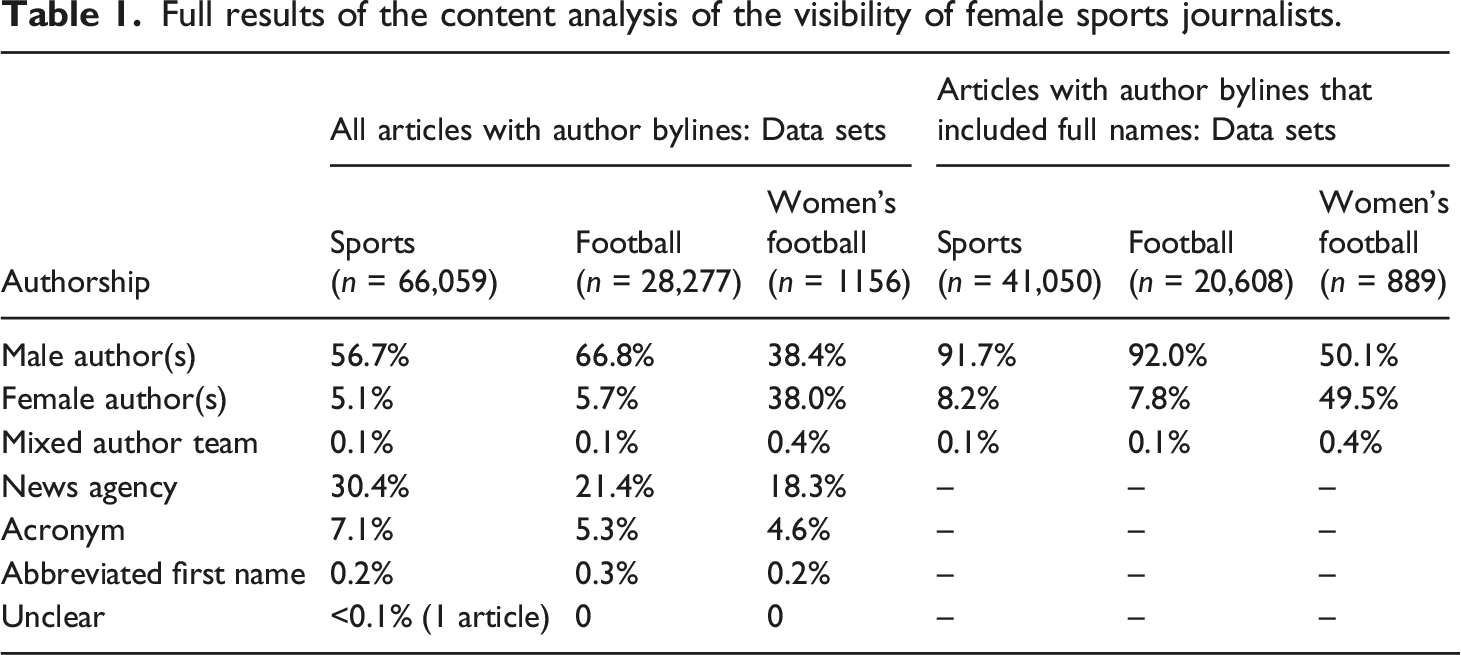
Full results of the content analysis of the visibility of female sports journalists.
Ratio of women reporting on women’s football versus football coverage in general (RQ2)
In terms of reporting on football in general (data set F), 7.8% of the articles were written by women (1614). This ratio is slightly smaller than for overall sports reporting. Mixed teams wrote 28 articles (0.1%), and men authored 92% of them (18,966). Regarding RQ2, the results on the reporting on women’s football show a stark contrast: 49.5% (440) of the articles were written by women, men wrote 50.1% (445), and mixed teams authored 0.4% (4).
Increase in female authorship from 2006–2020 (RQ3)
Regarding RQ3, we find no evidence for an increasing ratio of female authors in sports journalism over the last 15 years (Figure 1, solid line). The ratio of articles written by women per year fluctuates between 5 and 11% (2016 and 2019), with a mean of 8.1%, which, in absolute values, corresponds to a minimum of 138 and a maximum of 301 articles written by female journalists per year (a mean of 223) from a data set of 41,050 articles in total. The same is true for all football coverage, for which we do not see a positive trend either (dotted line). The ratio of articles written by women per year fluctuates between 4 and 10% (2020 and 2019), with a mean of 7.9%, which, in absolute values, corresponds to a minimum of 55 and a maximum of 134 articles written by female journalists per year (a mean of 107.6) from a data set of 20,608 articles in total. Ratio of female authorship in women’s football (dashed), all football coverage (dotted), and all sports’ coverage (solid).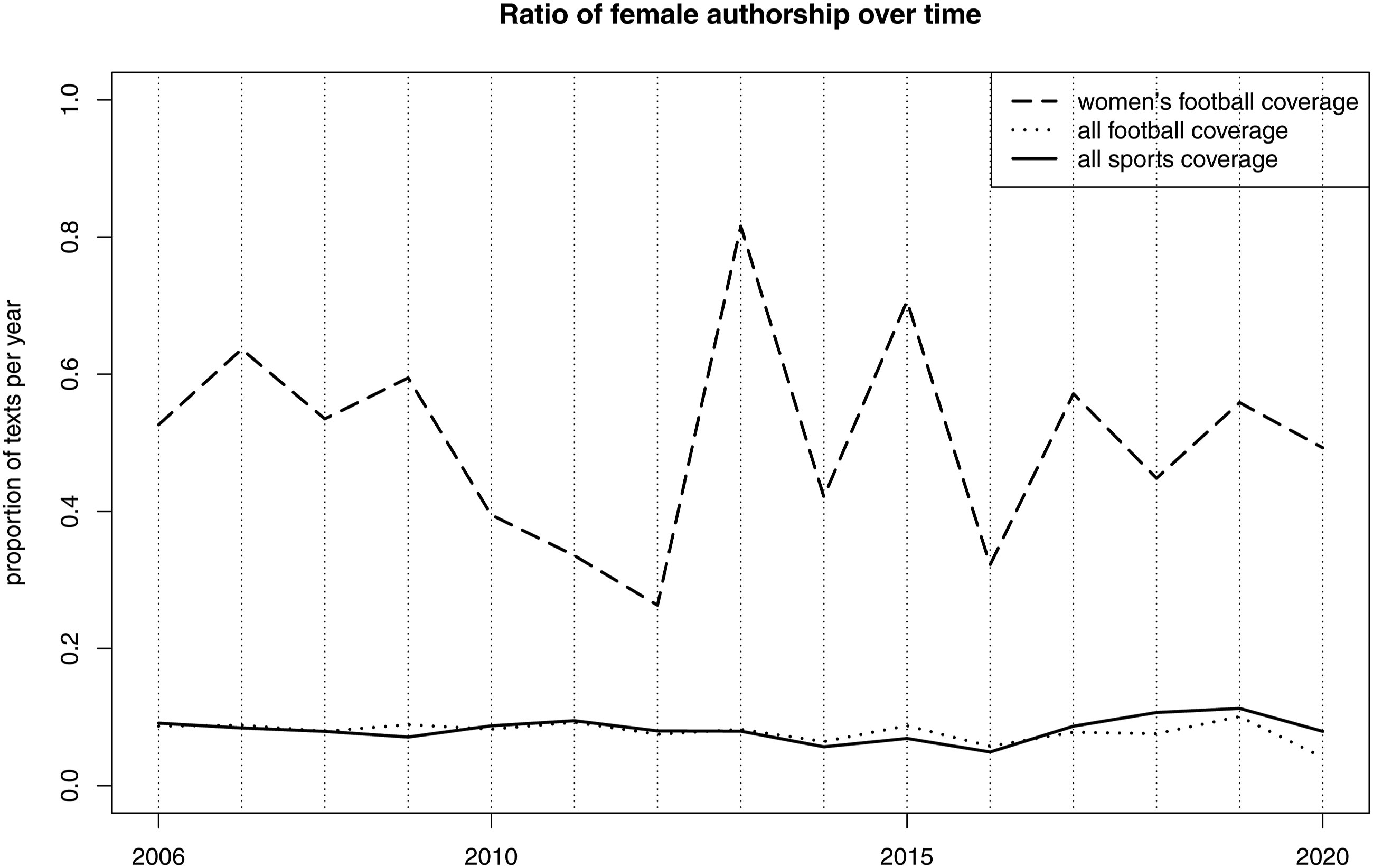
For women’s football, we see strong fluctuations due to the small number of data points (dashed line), but no increase in the ratio of female journalists is evident either. The ratio oscillates between 26 and 82%, with a mean of 50.8%. In absolute values, these ratios correspond to a minimum of 10 and a maximum of 62 articles written by female journalists per year (a mean of 29.3) from a data set of 889 articles over the course of 15 years.
Summary of Study 1
The results in terms of the ratio of women reporting on sports (RQ1) are in line with the underrepresentation described in previous studies (e.g., Franks and O’Neill, 2016), and we further found a tendency towards gender-congruent reporting; women authors report significantly more often on women’s than on men’s football. The ratio of female authors is 49% for women’s football articles versus 8% for all football articles (RQ2). Further, our data did not point to an increase in the ratio of women reporting on sports in general—or on football or women’s football in particular—over the period from 2006 to 2020 (RQ3).
Study 2: Audience perception of male and female journalists in sports reporting
Method
Participants.
Participants were recruited through a commercial online access panel in Germany to complete a questionnaire (n = 667). After eliminating the 5% of participants with the lowest completion times for the questionnaire, our final sample contained 635 respondents, with men being slightly overrepresented (56% men, 46.94 years, SD = 15.6 ranging from 19 to 91 years). Of the participants, 45% had the equivalent to a college degree, with 21% possessing a university entrance level qualification and 33% a university degree or Ph.D. Overall, the sample had a high structural comparability with the population of German internet users.
Procedure and stimulus material
Our study was based on a two (male vs. female byline) x two (women’s vs. men’s football) between-subjects design with readers’ gender as an additional quasi-experimental factor. We embedded our experimental stimuli in an online survey. After answering some questions on their general interest in news, participants were confronted with our stimuli. We employed a short teaser of an opinion piece, displaying a headline plus a lead of around 70 words comparable to a teaser text typically found on online websites. The presentation style represented such online teasers, inspired by those used by the well-known news brand also used in Study 1. Each stimulus was reviewed by an active sports journalist for adequate wording. Each text was accompanied by a picture, displaying either a male or female author based on the manipulated byline. The attractiveness of the profile pictures was controlled for in a pretest. We used the same last name for each author and a male/female version of a common German first name.
Our stimulus was a teaser for an opinion piece on the performance of either the male or female national football team, depending on our stimulus manipulation. To keep the information the same for both stimuli versions, we created an article that would fit both the performance of the women’s and men’s teams. The news comment stated that the team’s overall lackluster performance was attributed to the team’s deficient mindset. The only further adjustment for stimulus addressing the men’s versus women’s football team versions was the naming of the current national team coach (Joachim Löw for the men’s team and Martina Voss-Tecklenburg for the women’s team) to increase the realism of the stimulus. Appendix A depicts an example of the employed stimulus material translated into English.
Participants were randomly assigned to one of the four stimulus versions. After reading the teaser text, participants were asked questions on their interest in continuing reading and their perceptions of the author.
Measures
Dependent variables
Reading intention
We employed one item to inquire how likely participants were to continue reading the full article (from 1 = not at all to 5 = very likely).
Author’s perceived expertise
Using the subscale of Ohanian’s (1990) Source Credibility Scale, expertise was measured using five opposite pairs of adjectives, for example, expert – not an expert (α = .934, M = 4.02, SD = 1.04).
Independent variables
We noted the gender byline and the football team’s gender, as well as the reader’s gender based on self-reporting (male = 1; female = 2), for our experimental manipulation.
Control variables
Interest in topic
As interest in men’s and women’s football was likely to impact a respondent’s interest in the article, we controlled for its influence. We asked our participants to indicate to what extent they were interested in women’s and men’s football (1 = not at all to 5 = very much).
Right-wing authoritarianism (RWA)
Previous research reported an influence of gender-related attitudes of participants on byline biases (e.g., gender-role stereotyping and sexism) (Mudrick et al., 2017). In our study, we employed RWA as a more general measurement to assess respondents’ attitudes towards traditional values. While RWA addresses individuals’ disposition towards conservatism and negative attitudes towards individuals or groups that are perceived as deviant, it was also found to be a relevant predictor of traditional gender-role preference (Duncan et al., 1997; Christopher and Wojda, 2008). We employed a short form of the RWA scale (Manganelli Rattazzi et al., 2007) from a translated version (Beierlein et al., 2014). The scale captures three subdimensions of authoritarianism (authoritarian aggression, authoritarian submissiveness, and conventionalism), each measured with three items. Respondents were asked to indicate their responses on a 5-point response scale ranging from (1) strongly disagree to (5) strongly agree. Internal consistency was high for each of the dimensions (authoritarian aggression: α = .725; authoritarian submissiveness: α = .801; conventionalism: α = .773).
Sociodemographics
We accounted for respondents’ age in years, sex, and education.
Results
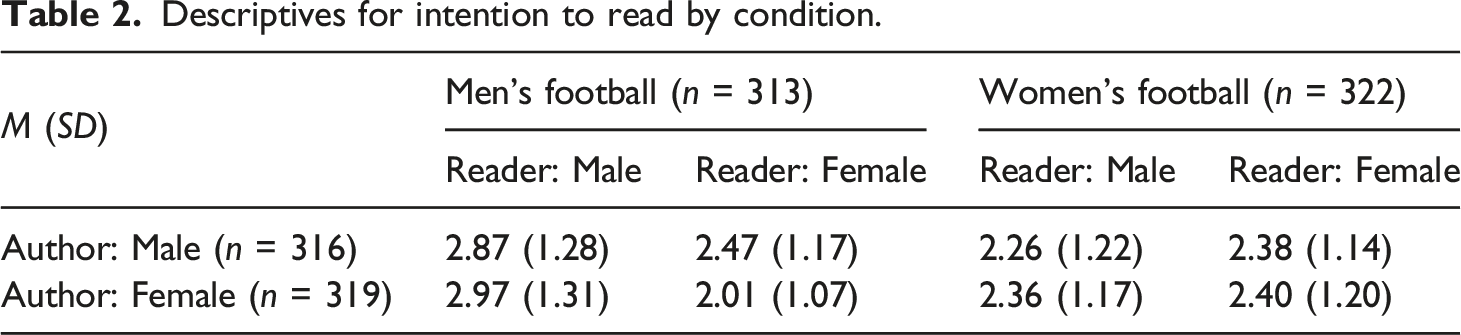
Descriptives for intention to read by condition.
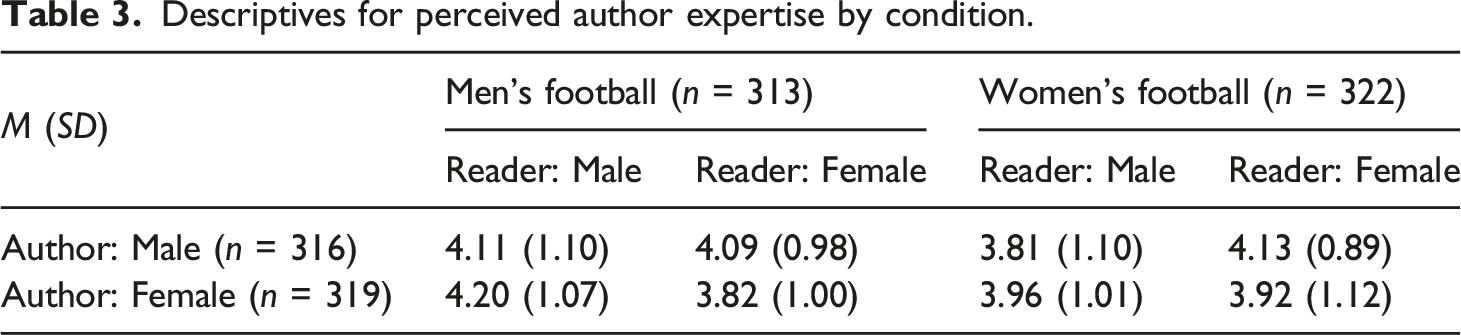
Descriptives for perceived author expertise by condition.
Effects of author gender on reading intention and perceived expertise (H1a and b)
ANCOVA results, DV = Reading intention.
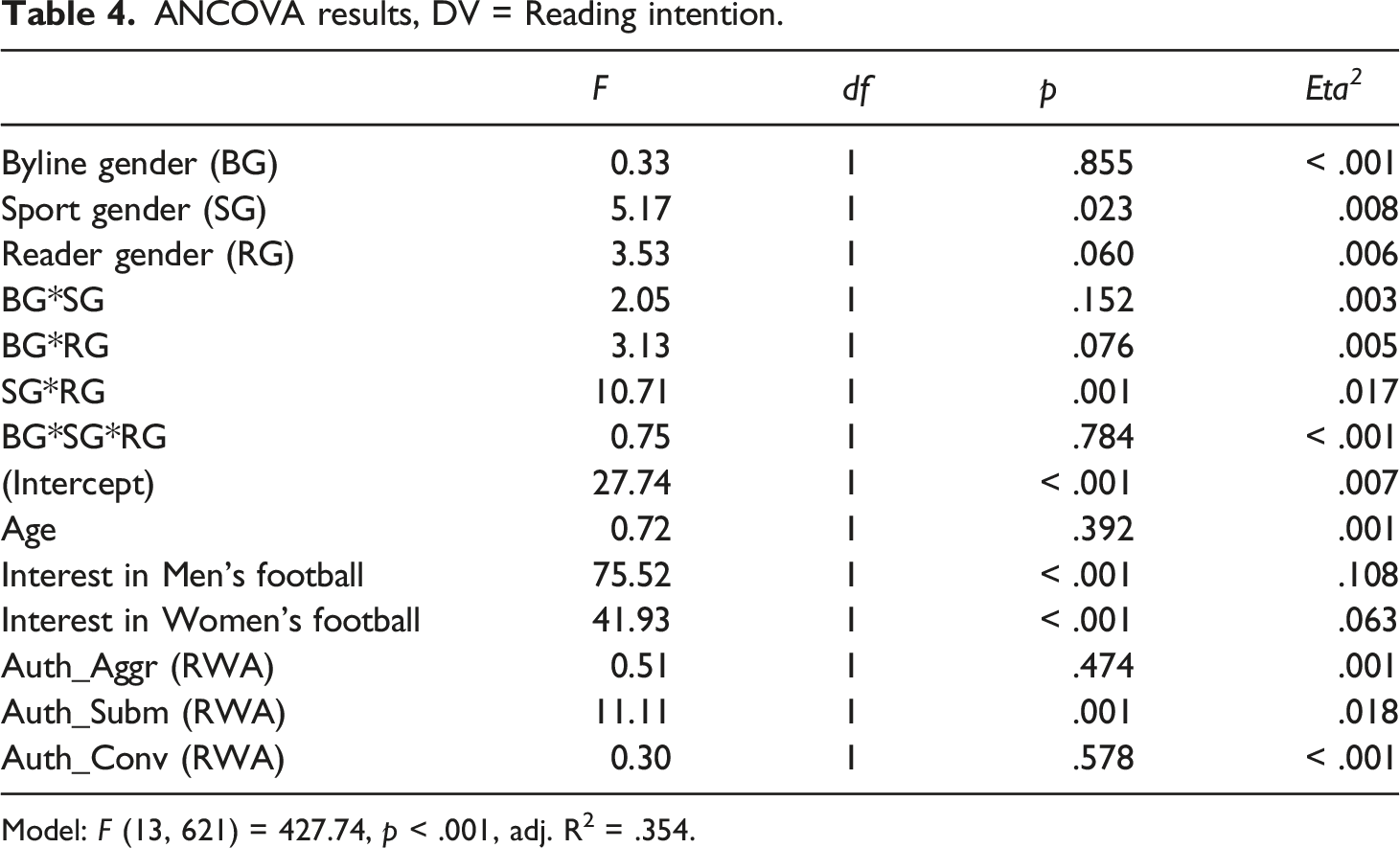
Model: F (13, 621) = 427.74, p < .001, adj. R2 = .354.
ANCOVA results, DV = Author expertise.
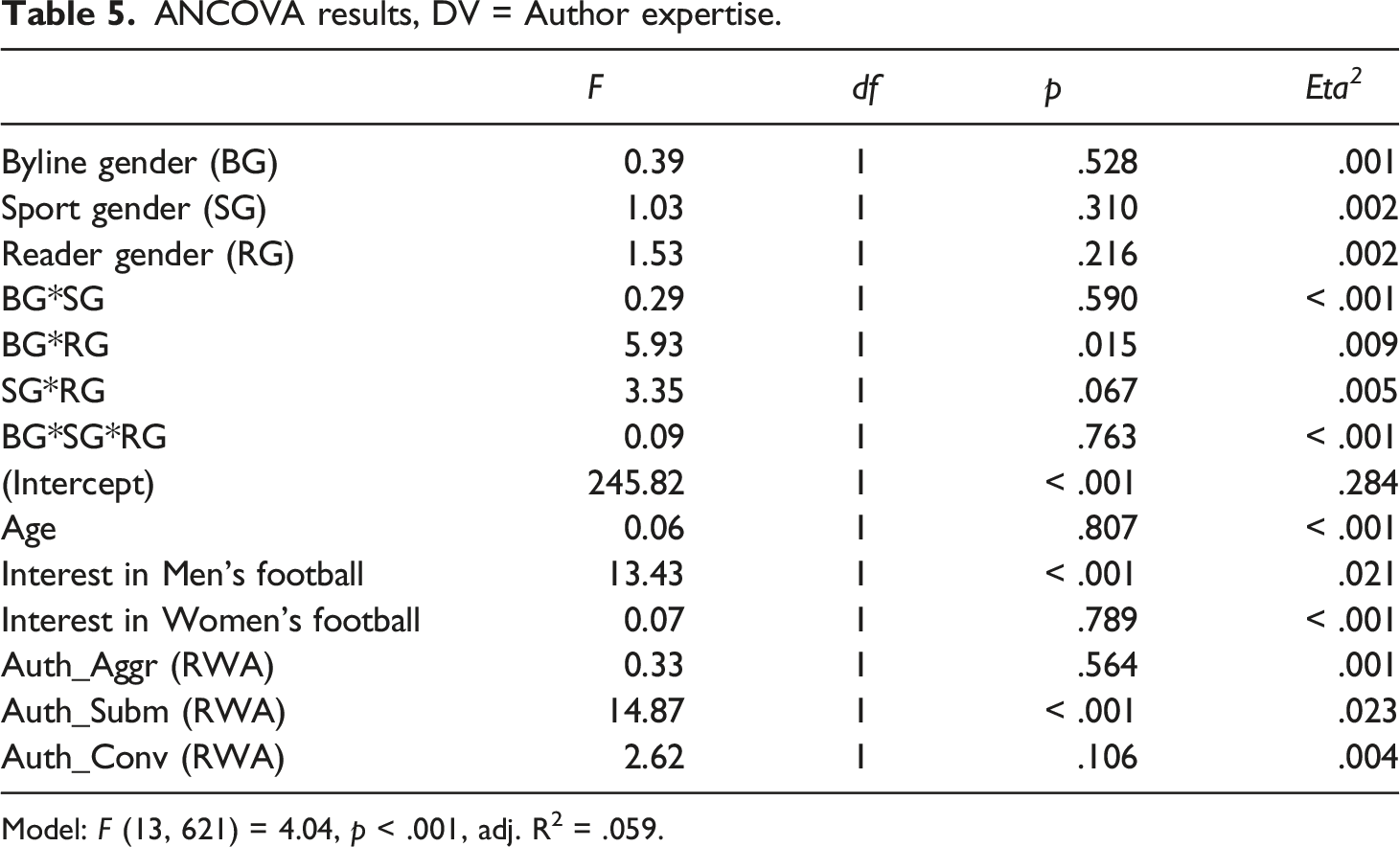
Model: F (13, 621) = 4.04, p < .001, adj. R2 = .059.
Effects of sport team gender (H2)
Regarding our second factor, findings point to a weak effect of team gender in the assumed direction; participants’ interest in continuing reading the article was higher for the article on men’s football (M = 2.65, SD = 1.28) compared to that on women’s football (M = 2.35, SD = 1.18). We therefore find support for H2.
Interaction effects (H3a and b, RQ4 and 5)
Inquiring on potential interactions between our two main factors byline gender and sports team gender and examining H3a, we did not find a significant effect. Participants’ interest in reading did not seem to favor articles with role-congruent authoring, for example, when women authors commented on women’s football (M = 2.38, SD = 1.18) or men authors on the men’s team (M = 2.72, SD = 1.25). We therefore reject H3a.
Regarding the interaction with our quasi-experimental factor (H3b), readers’ own gender, our findings only show a significant impact for our second main factor, the gender of the sport’s team. Female readers were significantly less likely to continue reading the article on men’s football (Mwomen = 2.24, SD = 1.14) compared to men (Mmen = 2.92, SD = 1.25). In contrast, no difference was found regarding female or male readers’ interest in reading the article on women’s football (Mwomen = 2.39, SD = 1.17; Mmen = 2.31, SD = 1.19). We did not find significant differences for interactions with author bylines (see Table 3). Investigating potential interaction effects between readers’ gender and author byline as well as sports team’s gender (RQ4), we found a significant interaction effect between the gender byline and the reader’s own gender in so far that women readers deemed female journalists writing about football as having the least expertise (M = 3.87, SD = 1.07) and male authors as having the most expertise (M = 4.14, SD = 0.89). Male readers, in contrast, did perceive men and women authors as having the same level of expertise (male authors: M = 3.98, SD = 1.11; female authors: M = 4.09, SD = 1.05).
For the case of reading intention and in answer to RQ5, we did not find significant differences for interactions with reader gender and author bylines (see Table 2).
Summary of Study 2
Our experimental study did not confirm a gender byline bias that devalues female sports journalists. Readers were equally interested in reading an article about football regardless of whether it was written by a man or a woman (H1a) and attributed the same level of expertise to male and female sports journalists (H1b). Since men’s football is more popular in Germany compared to women’s football, it is not surprising that participants were more interested in reading the article on men’s than women’s football (H2). Similar to the findings of Baiocchi-Wagner and Brehm-Morawitz (2010) and Greer and Jones (2012), but different from those of Luisi et al. (2020) and Mudrick et al. (2017), the audiences’ reading intentions and their perceptions of journalists’ competence were found to be the same regardless of their gender. Congruence between the gender of the author and the gender of the athletes influenced neither the perceived expertise of the author (H3a) nor the reading intention (H3b). Regarding the potential impact of readers’ own gender, the findings indicate that more men than women preferred to continue reading the article on men’s football, while there were no differences in the case of women’s football (RQ4). Regarding perceived expertise, however, we found that women attributed less competence to female than to male journalists (RQ5).
Discussion
A key question that arises from our Study 1 results is why the proportion of female journalists in sport stagnates at a low level over 15 years. It is likely that male sports journalists of higher professional ranking often decide which tasks are fulfilled by whom, with a preference for men (Organista and Mazur, 2020). The consequence could be that these leading sports journalists tend to give more important positions and jobs to men. Conversely, women report more often on women’s sport as such sports are generally considered less prestigious due to lower audience interest compared to men’s sports. Following this logic, reporting on women’s sports means reporting on less important sports (Organista et al., 2019). These observations show why male sports journalists cover all kinds of sports, whereas females are often restricted to reporting on women’s or less prestigious sports (Kian and Hardin, 2009; Schoch, 2020). Furthermore, current working conditions in sports journalism make it difficult for female sports journalists to compete with men and prevent women from working in sports newsrooms. That are, for example, hostile work environment, harassment in the workplace, and online hate speech which are often targeted at female sports journalists (Antunovic, 2019). Consequently, without the support and advancement of women, newsrooms will struggle to diversify their newsrooms, and nothing will change.
As demonstrated by Study 2, audiences’ perceptions, by contrast, do not seem to favor men authors in sports reporting. Our findings therefore do not point to a negative bias against female authors. However, we detected an interaction effect regarding readers’ gender: women were likely to attribute less expertise to female journalists writing about male football, while for men this was not the case. This finding is in line with the work of Etling and Young (2007), who found that women judged male sportscasters as more authoritative than men did. It might be a result of sexism unknowingly internalized by women, because they are used to seeing other women on television portrayed as less competent or in inferior job positions as men (for sports on TV see Harrison (2019)). In that way, women learn from an early age from the media—and thus, they more or less adopt unconsciously—that men are superior to women. Also, possibly a (mis)attribution of females’ own low expertise in the sports context to female sports journalists may taking place here. This makes it even more important that women receive higher visibility in sports journalism—especially in popular sports, such as men’s football—so that they become the norm and are not regarded as a less competent minority that has to face prejudices and objectivation (Cummins et al., 2019). Otherwise sport will remain a field of heteronormative masculinity (Jansen and Sabo, 1994; Messner, 1992; Organista et al., 2019).
However, a further key question is why the empirical findings of previous studies are still quite contradictory and why examples of discrimination against female sports journalists can be found again and again in reality (Antunovic, 2019). Several explanations are plausible here. First, we designed our stimulus in such a way that all the information—except for the names and pictures of the journalists—was identical. We deliberately decided to do so for the sake of minimizing confounding factors. However, male and female journalists might report on sports differently. For instance, empirical evidence suggests that men tend to focus on facts and technical analysis (Schoch, 2013a), reinforce gender stereotypes by praising the athleticism of male athletes (Kian and Hardin, 2009), and use more assertive language (Abisaid and Li, 2020) compared to women. In contrast, the writing of female sports reporters can be characterized by an interest in soft news and the psychological or human perspective (Schoch, 2013a). The latter may be because they are more likely to be allocated the soft stories (Schoch, 2020). In addition, it is likely that in audiovisual media, further evaluation dimensions are involved, such as the appearance (see Cummins et al., 2019) or the voice of the sports reporter.
This already points to limitations of our studies. First, both studies focused on the case of football, so future research is advised to systematically examine visibility and byline biases in other sports as well, such as in those where differences between male and female teams are not as pronounced. Regarding Study 1, the analysis of the ratio of male and female sports journalists was only based on one news brand. Here, too, additional studies would be beneficial to underpin our results. It is possible that the situation is different for the medium of television, for example—although not very likely, since the structures with “old, wise men” at the top of the editorial board are the same in many sports media. The same applies to the experimental study that was based on four versions of one stimulus only. While from a methodological point of view, message repetition is recommended to make findings more robust, it collides with external validity as it is difficult to come up with (equally) realistic stimulus material and to avoid potential negative effects (such as attention loss) in participants.
Taken together, our findings suggest that since audience perception does not justify the marginalization of female sports journalists, newsrooms should actively take measures to diversify their bylines. In practice, an equality initiative like the BBC’s 50:50 project (BBC, 2021) has been shown to be effective in terms of making inequalities visible within the newsroom. Until changes such as these are implemented across the board, it is likely that women will continue to be invisible and disadvantaged in sports journalism, even if they have as much expertise and competence as their male colleagues.
Footnotes
Declaration of conflicting interests
The author(s) declared no potential conflicts of interest with respect to the research, authorship, and/or publication of this article.
Funding
The author(s) received no financial support for the research, authorship, and/or publication of this article.

Author biographies
Appendix