




Abstract
Objective
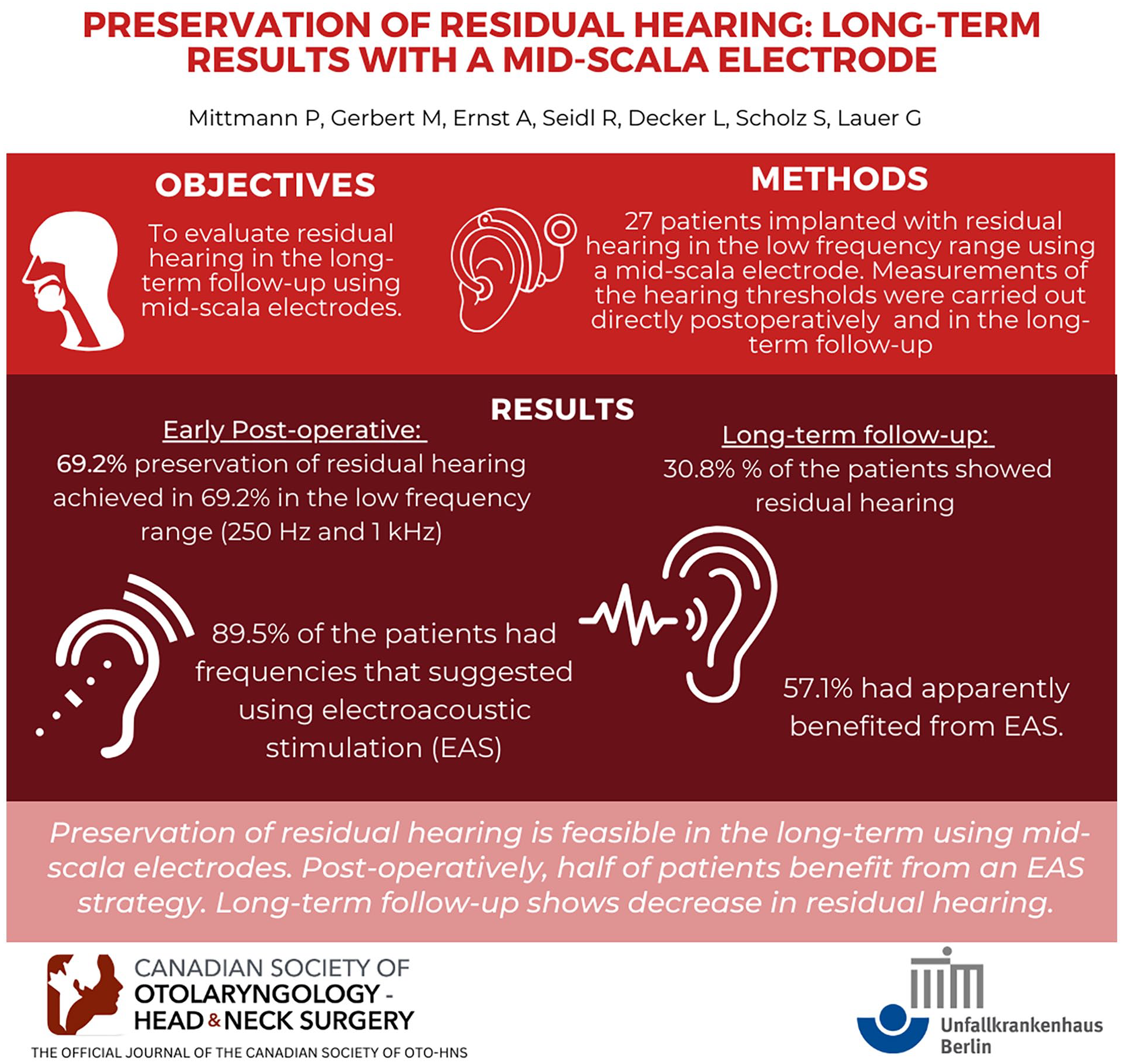
The long-term preservation of residual hearing after cochlear implantation has become a major goal over the past few years. The aim of the present study was to evaluate residual hearing in the long-term follow-up using mid-scala electrodes.
Methods
In this retrospective, single-center study, we collected data from 27 patients who were implanted between 2014 and 2015 with residual hearing in the low-frequency range using a mid-scala electrode. Measurements of the hearing thresholds were carried out directly postoperatively (day 1 after surgery) and in the long-term follow-up 43.7 ± 6.9 months. The calculation of the extent of audiological hearing preservation was determined using the HEARRING group formula by Skarsynski.
Results
Postoperative preservation of residual hearing was achieved in 69.2% of the cases in the low-frequency range between 250 Hz and 1 kHz, of which 89.5% of the patients had frequencies that suggested using electroacoustic stimulation (EAS). In the long-term follow-up, 30.8% of the patients showed residual hearing; however, 57.1% had apparently benefited from EAS.
Conclusion
Preservation of residual hearing is feasible in the long term using mid-scala electrodes. Postoperatively, there is over the half of patients who benefit from an EAS strategy. The long-term follow-up shows a certain decrease in residual hearing. However, these results are comparable to studies relating to other types of electrodes. Further research should be conducted in future to better evaluate hearing loss in long-term follow-up, compared to direct postoperative audiological results.
Introduction
Effective audiological rehabilitation in patients with severe to profound hearing loss has been enhanced by the development and constant improvement of cochlear implants and surgical techniques. Patients with severe sensorineural hearing loss, who no longer benefit from conventional hearing aids, can improve hearing with cochlear implants. 1 Besides patients with residual hearing, nowadays, the indication criteria for cochlear implantation include very young patients and even patients with ossifying otosclerosis.2-6 Along with the expansion of indication criteria, surgical techniques have improved. The approach of an atraumatic surgery with special focus on protection of the anatomical structures during the opening of the cochlea and during electrode insertion has been proven in several studies.7-13 Various authors have found that the variability of postoperative audiological outcome can, inter alia, be explained by the variability of scalar position and the insertion depth of the electrode array.14-16
One of the strategies to avoid intracochlear damage during cochlear implantation is the principle of reducing intracochlear pressure. Intracochlear pressure changes should be kept at a very low level before, during, and after the implantation and can be minimized by using a large and laser-guided opening of the round window membrane. Furthermore, a slow insertion speed of the cochlear implants electrode array and lubrication of the round window membrane reduce intracochlear pressure. 17 Lubricated insertion of the electrode array reduces intracochlear fluid pressure changes during the opening of the cochlea and insertion of the electrode array.18-20
It has been shown that residual hearing preserved after cochlear implantation has a major impact on speech perception, since electroacoustic stimulation (EAS) can be applied by means of sophisticated speech processors.21-23 Preservation of residual hearing is usually closely linked to lateral wall/straight electrode arrays, which was shown by the initial studies by Hodges et al 24 for the first time. Balkany et al 5 were able to demonstrate complete preservation of residual hearing in more than 30% of the cases and after 9 months, more than 50% still had residual hearing. In 2017, Moran et al 25 were able to demonstrate at least partial residual hearing preservation with straight electrodes in 139 patients up to 3 months after surgery. The follow-up showed no significant changes in residual hearing after 12 months. 25 Gantz et al 26 showed recently that individuals with shorter electrodes have a slightly better hearing preservation rate.
In 2019, Gautschi-Mills et al 27 demonstrated that complete and partial residual hearing preservation using perimodiolar electrodes was achieved in 92% of the participants after a follow-up of 24 months on average. 27 In contrast, preservation of residual hearing was only recorded in 9% to 25% of patients using the new slim modiolar electrode. 28
However, long-term data regarding residual hearing preservation of patients with mid-scala electrode arrays have not yet been published. Todt et al 29 emphasized that the use of a mid-scala electrode is comparable to lateral wall electrode arrays, with regard to preserving residual hearing.
Svrakic et al 30 were able to show in 2016 that the mid-scala electrode is superior to the lateral wall electrode, as part of a short-term follow-up in terms of residual hearing. Thresholds shifts at 4 audiometric frequencies ranging from 10 dB at 250 Hz to 7 dB at 500 Hz, 2 dB at 1 kHz, and 6 dB HL (hearing level) at 2 kHz are smaller for the mid-scala electrode than for the lateral wall electrode. 30 More recently, Battmer et al 31 demonstrated that patients with mid-scala electrode supply had better median performance for monosyllables in quiet than subjects with perimodiolar electrodes.
The aim of our study was therefore to monitor the preservation of residual hearing after cochlear implantation in a long-term follow-up of patients who received a mid-scala electrode array. Furthermore, it was investigated whether there were preoperative factors influencing postoperative preservation of hearing in mid-scala electrodes.
Material and Methods
Study Design
This study was approved and supported by the institutional review board (Charité Board CCM, EA1/168/20). All patients were included according to the German criteria for conventional cochlear implantation,32-35 with moderate to profound sensorineural hearing loss and speech perception below 60% at 65 dB SPL (sound pressure level). This retrospective single-center study included 27 adult patients implanted unilaterally with a cochlear implant at our hospital from 2014 to 2015. Patients with preoperative residual hearing with at least 1 frequency (250 or 500 Hz) of less than 80 dB HL (WHO grade 1-4) 36 in the pure-tone audiogram were included in the study. Speech understanding in all subjects was less than 60% with conventional hearing aids in the Freiburger monosyllabic test. Demographic data, audiologic measurements, and duration of the severe to profound hearing loss until implantation were collected preoperatively.
Electrode Design
In all cases, the implantations were performed using a HiFocus Mid-Scala Electrode (Advanced Bionics, Sonova Holding AG, Stäfa, Switzerland). The electrode targets a mid-scala electrode position to reduce the risk of trauma to the lateral wall and the modiolus. 37
Residual Hearing Approach: Perioperative Management, Surgical Procedure
Computed tomography (CT) scans of the temporal bone and magnetic resonance imaging of the neurocranium, including inner ear structures, were performed before surgery. All subjects showed regular temporal bone anatomy. A mastoidectomy was performed to get the approach to the posterior tympanotomy. After removing the promontory lip, a round window approach was used to access the cochlea. The round window was opened under fluid with a needle. 38 The electrode was then moistened with dexamethasone and inserted slowly and fully over a period of at least 2 minutes, using the provided insertion tool.17,18 The cochleostomy was then sealed with fascia and fibrin glue and the wire was carefully placed into the mastoid cavity after fixation in the posterior tympanotomy. All surgeries were performed by an experienced surgeon (P.M.). The intracochlear position of the electrode was determined postoperatively using a flat-panel tomography or high-resolution CT.
Audiological Data Acquisition and Statistical Analysis
Measurement of the pure-tone threshold in the absence of hearing aids was performed by audiometric standard procedures. The hearing thresholds were determined in the frequencies of 250, 500, 1000, 2000, 4000, 6000, and 8000 Hz on the ipsilateral ear, using sound-isolating earphones and masking of the contralateral ear. There was a follow-up 1 day postoperatively and a second follow-up 6 to 7 years after implantation.
The pure-tone averages (PTA) of the individual frequencies with residual hearing were calculated. Furthermore, to determine the change in the mean threshold shift, mean values of the residual hearing were generated within the low-frequency range (250, 500, and 1000 Hz) (PTAlow). Preoperative PTAlow was compared to postoperative as well as to long-term follow-up. Patients who showed complete hearing loss postoperatively were excluded from further calculation and evaluated separately. To make our data comparable with different international studies, preservation of residual hearing was also calculated with the HEARRING group formula. According to Skarzynski et al, 39 hearing preservation can be calculated by the formula S = ([1 − (PTApost − PTApre)/(PTAmax − PTApre)] × 100). PTApost describes the postoperative PTA of the respective patients and PTApre, the preoperative calculation. PTAmax represents the maximum possible threshold value determination of the audiometer in the respective frequency range. S describes the percentage of hearing preservation, which is then converted into a categorical scale, to determine the degree of residual hearing. A complete hearing preservation was considered when 75% of the preoperative calculation was reached, a partial hearing preservation between 25% and 75% and a minimal hearing preservation below 25%. A value of 0 indicated total loss of residual hearing.
Single frequencies with nonmeasurable hearing threshold preoperatively were excluded. The maximum measurable hearing threshold was determined on the basis of the maximum detectable level of the audiometer, according to the recommendations of Skarzynski et al, 39 fixed with PTAmax at 105 dB HL at 250 Hz, 110 dB HL at 500 Hz, 120 dB HL at 1 kHz, 120 dB HL at 2 kHz, 115 dB HL at 4 kHz, 110 dB HL at 6 kHz, and 95 dB HL at 8 kHz. 39
The data were statistically evaluated using Microsoft Office 2019 and SPSS Statistics (IBM SPSS Statistics 25). Demographic data were examined and described using descriptive statistics. All audiometric data were described as mean ± standard errors, except threshold changes, which were also shown as median and absolute frequencies (%). One-way ANOVA tests and Student’s t tests were performed to examine categorical and continuous variables. All P variables were 2-tailed with a significance level of P < .05.
Results
Twenty-seven patients were included in the study, 59% of them female (n = 16) and 41% male (n = 11). The average age at implantation was 60.9 (±3.1) years. The youngest patient on the date of implantation was 35 years old, and the oldest patient was 88 years old. In 75% (n = 21) of the patients, hearing loss had existed for more than 5 years. A total of 52% of the patients were implanted on the left side (n = 14). The postoperative long-term follow-up averaged 43.7 ± 6.9 months, with a minimum follow-up of 32 months and maximum of 54 months (Table 1).
Demographic Features of the 27 Patients.

A complete insertion of the implant including all electrode array contacts could be performed without intra- or postoperative complications. Postoperatively, the correct position within scala tympani was confirmed by either CT scan or flat-panel tomography in all the cases (n = 27). The mean insertion depth angle was 380 ± 25°.
Preoperative, residual hearing threshold were determined between 250 and 6 kHz. A mean value of 37.4 ± 13.9 dB HL (n = 19) was found at 250 Hz, 21 ± 8.7 dB HL at 500 Hz (n = 19), and 65.8 ± 8.8 dB HL at 1000 Hz (n = 20). In the high-frequency range, a mean of 65.7 ± 9.3 dB HL (n = 19) was recorded at 2 kHz, at 4 kHz a mean of 74.0 ± 10.7 dB HL (n = 7) and at 6 kHz a mean of 52.5 ± 3.5 dB HL (n = 2).
PTAlow for the low frequencies showed a mean value of 51 ± 15.8 dB HL with a maximum of 80 dB HL (Table 2). Postoperatively, an average hearing threshold of 72.2 ± 31.3 dB HL was found in the low-frequency range, at 250 Hz from 60.5 ± 31 dB HL, at 500 Hz a mean of 70.3 ± 31 dB HL and at 1 kHz a mean of 85.3 ± 26.7 dB HL (Figure 1).
Preoperative, Postoperative, and Thresholds at Long-Term Follow-Up, Pure-Tone Averages (± Standard Deviation) as Well as Mean and Median Threshold Shifts.


Hearing threshold in preoperative, postoperative, and long-term follow-up (dB HL).
In the low-frequency range from 250 Hz to 1 kHz, there was an average postoperative shift of 22.8 ± 4 dB HL. At 250 Hz, there was a loss of 23.1 ± 8.1 dB HL, at 500 Hz of 21.1 ± 7.1 dB HL and at 1000 Hz of 19.5 ± 5.9 dB HL. The long-term follow-up showed an average drop of 51.8 ± 2.6 dB HL in the low frequencies. At 250 Hz, a mean loss of 56.3 ± 5.7 dB HL, at 500 Hz a mean loss of 53.4 ± 4.2 dB HL and at 1000 Hz a mean loss of 46 ± 4.2 dB HL were found. Over the postoperative observation period of 4 to 5 years, this corresponds to a linear drop of 7.96 dB HL on average per year after initial surgery.
In summary, differences in postoperative hearing threshold shifts were divided into 3 groups: shifts less than 10 dB HL were found in 57.7% of the patients (n = 15). Shift of more than 10 dB HL were found in 11.5% of the patients (n = 4) and a total loss in 30.8% patients (n = 8). In the long-term follow-up, there was a loss of residual hearing in 69.2% of the patients compared to preoperative measurements, a drop of less than 10 dB HL was found in 7.7% of the patients (n = 2), and in 23.1% (n = 6) a drop of 10 dB HL occurred (Figure 2). These results indicate residual hearing preservation of 69.2% postoperatively and 30.8% in long-term follow-up.

Hearing threshold shifts postoperatively and in long-term follow-up.
Calculations of residual hearing in this study were carried out using the formula of Skarzynski et al 40 (Table 3). In the course of the calculation, there was complete residual hearing retention in all measured frequencies of 250 Hz to 8 kHz of 48.1% (n = 13) as well as a partial retention of 22.2% (n = 6) at the postoperative point in time. A total of 29.6% (n = 8) of the patients also suffered hearing loss postoperatively. In the long-term follow-up, a total of 25.9% of the patients (n = 7) showed residual hearing (7.4% completely, 11.1% partially, 7.4% minimally), but 74.1% of the patients showed no residual hearing after an average of 3.6 years.
Preservation of Residual Hearing Based on the Skarzynski Formula.

In the low-frequency range from 250 Hz to 1 kHz, postoperative PTAlow showed a complete hearing preservation of 57.7% (n = 15) and partial residual hearing preservation of 11.5% (n = 3). Total hearing loss was found in 30.8% of the cases (n = 8). The follow-up showed residual hearing preservation of 26.9% [complete preservation in 7.7% (n = 2), partially in 15.4% (n = 4), and minimally in 3.8% (n = 1)]. A total hearing loss occurred in 73.1%. A total of 89.5% of patients (17/19) with hearing preservation postoperatively showed a PTAlow of less than 80 dB HL, in follow-up in 57.1% (4/7) of the cases. One patient was excluded due to a lack of preoperative residual hearing in the low-frequency range in the PTAlow calculation. Using a 1-way ANOVA, a significant difference between postoperative shift and long-term follow-up was shown (P < .05). According to these data, there was a linear decrease in hearing preservation at an average of 11.6% per year, starting with the first postoperative shift after implantation.
The relationship between the postoperative PTA results and the degree of preoperative hearing loss was also examined. There were no significant differences between the preoperative hearing thresholds in the low frequencies and patients who had a total hearing loss or those who had postoperative residual hearing (P = .116). Furthermore, there were no significant differences in age, duration of deafness (more or less than 5 years), gender, and depth of insertion of the implant (P > .05).
Discussion
Hearing preservation in cochlear implant surgery continues to be a complex topic in current research. To our knowledge, this is the first study with a mid-scala electrode array, which evaluates long-term audiological data.
In our study, we implanted the HiFocus Mid-Scala Electrode. As any electrode diameter has a direct influence on intracochlear pressure changes, 19 this electrode results in minimal pressure gradients during insertion and thereby protects vulnerable structures of the cochlea. Due to its proximity to the modiolus compared to lateral wall electrodes, the pitch discrimination should be improved, compared to lateral wall electrodes for better postoperative speech perception. 41
We used the formula of Skarzynski et al to determine residual hearing postoperatively and in long-term follow-up. Other calculations like those of Nguyen et al 42 can lead to a questionable interpretation of the audiological results as a postoperative hearing loss can be classified as partial hearing preservation. In contrast to Skarzynski et al, the Nguyen classification divides into 3 categories. Complete hearing preservation was considered when a mean air conduction (AC) variation ≤10 dB was obtained. 42
A fair hearing preservation was considered when the mean postoperative AC threshold shift was between 10 and 30 dB. 42 A poor hearing preservation was considered when the mean postoperative AC threshold shift was above 30 dB. 42 According to Nguyen et al, 42 a patient with a pr-operative threshold of 40 dB HL and postoperative threshold of 60 dB HL would be classified in the group of patients with fair residual hearing. Assuming a preoperative hearing threshold of 90 dB HL for this patient, however, the patient would be classified with 110 dB HL postoperatively in the same group. This more detailed fact is considered in the formula of Skarzynski, based on the percentage loss, whereby a closer relationship to clinical practice is achieved. 39 Both, the Skarzynski and the Nguyen method focus on PTA thresholds. A weakness of both methods is that it is a relative hearing change and that it does not consider the ability of using acoustic stimulation in patients with preserved residual hearing.
In our data, which included 27 patients, 57.7% of the patients in the low-frequency range (PTAlow) had complete hearing preservation directly after the operation and 11.5% had partial hearing preservation. Long-term follow-up showed a general preservation of residual hearing of 30.8%, of which 7.7% were fully preserved, 15.4% partially, and 3.8% minimally. The rate of patients who lost their residual hearing increased from 27% to 73% postoperatively.
The data from Hunter et al using mid-scala electrodes showed similar results: 15% of the patients had full preservation of residual hearing 6 months postoperatively and 40% had partial preservation of residual hearing. A decline was noted 1 year postoperatively to even 0% of total preservation of residual hearing, while only 39% had partial residual hearing. 43
Using lateral wall electrodes, Helbig et al 44 determined total hearing preservation in 11.3% of the cases, partial preservation in 38.7% within a long-term follow-up after an average of 4.3 years, based on the classification according to Nguyen et al. 42 Santa Maria et al 45 found 37.5% complete and partial hearing preservation after 2 years.
Compared to lateral wall electrodes, Ramos et al used perimodiolar electrodes in 2017, which showed 30% loss of residual hearing postoperatively. Although they used perimodiolar electrodes, their data seem to show comparable results to our results with the mid-scala electrode array. 46
Several studies have shown a significant improved speech perception by using EAS in the low-frequency range, especially at thresholds <80 dB HL.42,44,47 In EAS the basal, high-frequency part of the cochlea is stimulated electrically and the apical low-frequency part is stimulated acoustically. 21 Beside improved speech perception, music perception 48 and sound localization 49 are superior in EAS users. Battmer et al 50 showed that 90% of patients who underwent cochlear implantation with preservation of residual hearing reported a subjective benefit using EAS, despite not improving in speech reception. With 89.5% postoperatively and 30.8% in long-term follow-up, our data show a mild proportion of residual hearing that should benefit from the use of EAS. Hunter et al 43 found that when activated, 43.8% of the cases and 30.8% after 1 year of implantation with a mid-scala electrode had residual frequencies for the use of EAS (defined as frequencies below 85 dB HL). Mamelle et al 51 rated the benefit of using EAS postoperatively at 56%. In comparison, we were able to identify more patients suitable for the use of EAS. The latter can be due to the better preoperative hearing and the use of pressure-controlled surgery19,29 as proposed by the Berlin group. The long-term follow-up shows an alignment of the results. 51
Studies with long-term data over 24 months using different electrodes showed a slight decrease in residual hearing, which according to Skarzynksi et al is between 3% and 7% per year.39,52,53 The linear drop in our data is 8% per year, which is slightly above this rank. Microtraumas caused by the inserted electrode are a cause of long-term loss of residual hearing. Surgical techniques regarding atraumatic electrode insertion have constantly improved over the years. One aim is to prevent the formation of fibrosis tissue and new bone growth within the cochlea. 54 Aschendorff et al 11 showed that preserving anatomical structures leads to improved electrical hearing, even if useful residual hearing cannot be preserved. Studies show a reduction of intraoperative trauma due to insertion through the round window and application of liquid before performing a slow insertion of the electrode to avoid pressure fluctuations.8,38,55 In addition, Todt et al 56 showed that the fixation of the electrode and its wire too can be modulated to reduce intracochlear pressure changes.
Furthermore, the correlations between preoperative hearing thresholds and the presence of postoperative residual hearing were made. There was no correlation between postoperative hearing shift with preoperative hearing. These findings are consistent with data from recent studies by Cosetti et al 6 and Gautschi-Mills et al, 27 but differ from earlier reports. 5 Balkany et al noted a correlation between postoperative loss of residual hearing and patients with poor preoperative residual hearing.
The limitation/weakness of our study is the retrospective design. Postoperative tympanograms were not performed. The postoperative data might by biased as intratympanal fluid could affect the threshold. Data on the patient-specific use of the EAS are not available in this study. Furthermore, we must admit the small size of the study population. Data with larger study population and meta-analyses should be studied in future.
Conclusion
Long-term hearing preservation can be achieved using mid-scala electrodes. Extensive hearing preservation is shown postoperatively, which decreases in the long-term follow-up, comparable to other electrode types. In the long-term follow-up, 30.8% of the patients with preserved residual hearing had remaining hearing thresholds to use EAS. Further research should be carried out to extend the possibility to preserve residual hearing, especially in long-term follow-up.
Footnotes
Author Contributions
M.G. analyzed and interpreted the patient data, drafted the manuscript, and personally accountable for the work. A.E. performed surgeries and final approval of the manuscript. R.S. revised the manuscript, final approval of the manuscript, and personally accountable for the work. L.D. analyzed data, final approval of the manuscript, and personally accountable for the work. S.S. performing audiological testing and final approval of the manuscript and personally accountable for the work. G.L. analyzed data statistical evaluation, revised the manuscript, final approval of the manuscript, and personally accountable for the work. P.M. performed surgeries, conception of the work, revision of the manuscript, final approval of the manuscript, and personally accountable for the work
Availability of Data and Materials
The datasets used and/or analyzed during the current study are available from the corresponding author on reasonable request.
Consent for Publication
Not applicable.
Declaration of Conflicting Interests
The author(s) declared no potential conflicts of interest with respect to the research, authorship, and/or publication of this article.
Funding
The author(s) received no financial support for the research, authorship, and/or publication of this article.
Ethics Approval and Consent to Participate
This study was approved and supported by the institutional review board (Charité Board CCM, EA1/168/20); informed consent was obtained.