




Abstract
Drawing on research on political culture and research on geopolitical orientations, this article analyses public opinion in the three Baltic states (2014 and 2021), focusing on political support, inter-ethnic relations and geopolitical attitudes. In the first section, the empirical analysis demonstrates widespread public support for the national communities in Estonia, Latvia and Lithuania. Most respondents feel a sense of attachment to or pride in their respective homeland, and a relative majority of all respondents feel that their contemporary political systems are preferable to other systems in the past. At the same time, the analysis alert us to distinct ethnic differences: the Russian-speakers in the three countries tend to be decidedly more nostalgic about the Soviet past and less satisfied with the present regimes. Confirming and updating findings familiar from previous studies, this article also notes that the population groups in the three Baltic states were growing more or less accustomed to the domestic situation, up until the escalation of the Russo-Ukrainian war in 2022. In the second part of the article, we turn to geopolitical belonging and security perceptions in Estonia, Latvia and Lithuania.
Introduction
Russia’s war against Ukraine—that began in February 2014 with the annexation of Crimea and escalated in 2022 with the full-scale invasion—sent shockwaves through the Baltic countries, who for years have been vocal proponents of the aggressive nature of Russia under Putin (Dapkus & Ritter, 2022; Hartwell et al., 2022). Moreover, the external threat has accented existing tensions relating to citizenship and language rights within the Baltic states, most notably in Estonia and Latvia (Auers, 2023; Duvold et al., 2020; Mierina, 2024). This article analyses public opinion in the three Baltic states, focusing on inter-ethnic relations and attitudes towards geopolitical issues in 2014 and 2021, that is, before the 2022 military campaign against Ukraine.
The heightened sense of a threat posed by Russia has resulted in detoriated inter-etnic relations. Long before 2014, this has been a sensitive issue because of the sizeable Russian-speaking minorities in the Baltic states (including some 20–25 per cent ethnic Russians in Estonia and Latvia, respectively, and some 4–5 ethnic Russians in Lithuania). These population groups, occasionally and inaccurately described as a Russian diaspora, also includes Belarusians and Ukrainians, as well as descendants from other parts of the former Soviet Union. In Lithuania, the ethnic minority includes Belarusians and some 5–6 per cent Poles (Coolican, 2021; Duvold et al., 2020; Viksnins 2023). The demographic composition of the three Baltic states have changed since the early 1990s, as many ethnic Russians have repatriated to Russia. Also, the number of non-citizens has diminished since independence, due to older non-citizens passing away and more people becoming naturalized citizens. Still, the Russian-speaking minority has remained a salient issue in the Baltic states.
After the 2022 Russian attack on Ukraine, the Baltic states have stood out in the EU as determined supporters of Ukraine, contributing with military and financial aid as well as welcoming a very large number of Ukrainian refugees, relative to their own populations. At the same time, the increasingly authoritarian developments in Russia and Belarus—and more specifically, the Russian mobilization—have entailed other types of migrants/refugees, which have not been welcomed in the same way in the Baltic states (cf. Reuters, 2022). Rather, security concerns have justified a border closure with Russia, to avoid a possible Russian migrant crisis (Mierina, 2024; Restelica, 2023).
The article draws primarily on studies on geopolitical orientations (cf. O’Loughlin et al., 2005; O’Loughlin & Toal, 2022), but also touch upon on what is conventionally labeled political culture research (Almond & Verba, 1965, 1980; Laitin, 1995; Voinea, 2020). While a general gap between “East” and “West” has received a lot of scholarly attention in terms of post-communist public attitudes towards democracy and European integration (Berglund, 2013; Duvold et al., 2020), there is less research about public opinion and geopolitical orientations in Central and Eastern Europe (attitudes towards the EU vs. Russia or, alternatively, a liberal-democratic Western civilization vs. an authoritarian, anti-liberal Russian world). Of course, the dissolution of the Soviet Union brought the geopolitical issue to the fore. After the Cold War, people’s cultural and religious identities were predicted to become the most important sources of conflict in the world (Huntington, 1996). Moreover, globalization has made geopolitical orientations an intrinsic component of national identity (Dijink, 1997; Dodds, 2007; cf. Balogh, 2022). Still, it was mainly the recent Russian military aggression in 2022 that made geo-cultural belonging re-emerge as a crucial question for contemporary European societies, including the countries of the Baltic region.
The article will unfold as follows. It starts with a section on existing research that includes both studies of political culture and research on geopolitical orientations. Here, we develop two research tasks that will structure the reminder of the article. The first task is about mapping and updating findings from previous studies. This will be done in an empirical section on inter-ethnic relations and system support in the Baltic context. The second task is explorative, focusing on geopolitical belonging and security perceptions in Estonia, Latvia and Lithuania. We draw on both original public opinion surveys and opinion polls existing in the public domain. In the final section, we bring out the principal implications of the empirical findings.
State of the art: Political culture and geopolitical orientations
A lot has been written on political developments in the Baltic states since the breakup of the Soviet Union (e.g., Auers 2013; Auers, 2015; Berglund & Duvold, 2003; Duvold & Jurkynas 2013; Lagerspetz & Vogt 2013; Lane et al., 2002; Lieven, 1993), including relations between the Baltic majority populations and the Russian-speaking minorities (Agarin, 2010; Budryte, 2005; Cheskin, 2016; Cianetti, 2019; Pettai 2011). Previous works have depicted the Baltic states as existing between East and West, between Russia and Europe, and between the Soviet past and the EU, but with an unfaltering orientation towards Europe and Western cooperation (Berg & Ehin, 2009; Duvold et al., 2020; Galbreath et al. 2008; Kasekamp, 2010; Mole, 2012; Purs, 2012).
Public opinion and political culture
When it comes to public opinion and political culture, several studies have focused on support for democracy and attitudinal differences between the ethnic groups in the region (Duvold, 2006; Duvold, 2014, 2017; Duvold & Berglund, 2014; Duvold et al., 2020; Lühiste, 2006, 2008, 2013; Ehin, 2007; Rose et al., 1998, 2004). Political culture is admittedly rather vague concept that is nevertheless used frequently in political science when comparing countries. Basically, it refers to what the population know, feel and expect of their political system as a whole. The concept is related to legitimacy, political support and political trust (Almond & Verba, 1965, 1980; Inglehart, 1997; Putnam, 1993). Although not exclusively based on surveys, the most common way of assessing the “political culture” of a country at a given point in time is to analyze nationwide representative public opinion polls (Norris, 1999; Duvold et al., 2020), looking at citizens’ values, attitudes and orientations related to the political system. How do ordinary people perceive the general development of their own country? How much trust is there in the government, in the parliament, and other political and societal institutions?
Lühiste (2006) analyzed New Baltic Barometer data (from 2001), demonstrating that in Estonia, Latvia and Lithuania, both interpersonal trust and support for the performance of democracy were associated with political trust. Drawing on New Baltic Barometer data from 1993–2004, Duvold (2006) analyzed political support, indicating that democracy as an ideal enjoyed increasing support over time, but that many Baltic citizens remained unconvinced about the performance of democracy. Also, Duvold’s analysis demonstrated that the Russsian-speakers in the region tended to be less satisfied with the current political system. These findings were confirmed by Ehin (2007): regime support in the Baltic states increased from the early 1990s to 2004, as a result of improving levels of economic and political performance; but that widespread dissatisfaction with parliaments and political parties remained a challenge. Also, Ehin noted a significant ethnic divide in popular regime evaluations (in Latvia and Estonia). Drawing on 2004 data from Estonia and Latvia, Lühiste (2008) showed that support for authoritarian rule were associated with the ethic cleavage in the two countries. Duvold et al. (2020) utilized public opinion data from the 1990s up until 2004 (New Baltic Barometer) as well as data from the 2014 Baltic Barometer (Ekman et al., 2023a) and the 2015 Post-Crimea Survey (Ekman et al., 2023b), demonstrating the continued relevance of ethnic identity and language for the political cultures of the Baltic states (cf. Duvold & Sedelius, 2022).
Attitudes to foreign policy is conventionally not covered in analyses of political culture; however, under certain conditions, public demands and expectations can actually shape foreign policy, as demonstrated by Ben-Porat and Mizrahi (2005). Public orientations towards foreign policy and security issues in the Baltic states have been covered in eg. Duvold and Ekman (2016) and Ekman and Duvold (2018). Next, we will turn to the literature on geopolitical orientations.
Geopolitical orientations and public opinion
Geopolitical orientations (sometimes geopolitical identities or cultures) may be analyzed at different levels, using different methods and different data sources. When analyzing geopolitical orientations among citizens by utilizing public opinion surveys, like in the present article, different strategies have been suggested. O’Loughlin and Toal (2022) point out three challenges in this context. To begin with, it remains far from certain that asking people about their attitudes towards certain (and perhaps specific and topical) foreign policy issues would necessarily reflect the underlying geopolitical culture of a given country (cf. O’Loughlin et al., 2005). One should rather ask respondents about their perceptions about their own country´s friends and enemies in the world or what countries function as model for their own state. Geopolitical orientations could, for example, be measured by asking people to locate their country on a spectrum between two competing poles of power, like Russia and the West (O’Loughlin & Toal, 2022: 46). The second challenge is related to the first; asking ordinary people about geopolitics (however you formulate the questions) is difficult, since it is often considered an elite activity, not really of their concern or interest. A third challenge is that people in general are not only uninterested in geopolitics; as a rule, they also tend to be poorly informed about geopolitical issues.
Looking at what has been written on geopolitical orientations and public opinion, different measurements and analytical strategies have been used. For example, when analyzing public opinion in unified Germany (Asmus, 1995), geopolitical attitudes include questions about foreign and security policy issues and concerns, and about Germany’s future role in the EU and NATO. The core questions relate to support for NATO membership and opinions about what NATO should do, as well as support for European integration. Respondents are also asked about Germany as a model for other countries when it comes to, for example, economic performance, cultural achievements and individual freedom; and the preferred foreign policy goals of Germany. O’Loughlin et al. (2004) examine “geopolitical storylines” among Russian political elites and the general public after September 11 attacks. The survey included questions about attitudes towards Putin’s foreign policy decisions, attitudes towards Russia-US cooperation in the struggle against international terrorism, and attitudes towards US military interests in Uzbekistan and Kyrgyzstan. Investigating post-Soviet geopolitical preferences among ordinary Russians, O’Loughlin and Talbot (2005) analyze questions about possible reunification preferences (with other post-Soviet states), attitudes towards the reunification the Soviet Union, economic reunification preferences, the perceived borders of Russia, the perceived cultural closeness of other post-Soviet states, and the readiness to approve of the statement that Russia should protect ethnic Russians living abroad (i.e., in other countries). Breuning and Ishiyama (2021) have investigated variations in geopolitical attitudes based on different countries’ historic relationship with Russia; and O’Loughlin et al. (2006) have analyzed geopolitical orientations among Russians, by asking a series of questions that together provide measures of Russia’s geopolitical identity. A final example could be O’Loughlin et al. (2016), who have looked at public beliefs that they live in a “Russian world” (Russkii mir), drawing on public opinion polls from southeastern Ukraine and three Russian-supported de facto states (Abkhazia, South Ossetia, and Transnistria). Here, geopolitical orientations equal respondents’ levels of trust in the Russian president and attitudes towards Russians in general.
Still, the suggestion by O’Loughlin and Toal (2022) to ask respondents to locate their country on a spectrum between two competing poles of power seem to be rather common. Comparing post-communist public opinion on geopolitical orientations, Dostál and Markusse (2001) use Eurobarometer data and questions about the future of own country; if it is tied to the EU or Russia. In a similar way, Vardomatsky (2020) analyses public opinion in Belarus, drawing on the question “Which union would be better for Belarusians: the European Union or a union with Russia?” Analyzing public geopolitical preferences in Georgia, Moldova and Ukraine, Torres-Adan (2021) constructs a four-fold classification where the central distinction is the one between supporters of the Eurasian Economic Union (“Easternizers”) and supporters of the European Union (“Westernizers”), plus two intermediate positions (“Balancers” and “Isolationists”). Onuch and Sasse (2022) have analyzed anti-regime protests in Belarus, drawing on online surveys. Here, different geopolitical orientations are understood as foreign policy preferences: support for joining the EU, support for joining the Russian Federation, and agreement/disagreement to the statement that the biggest threat to Belarus is Russia (cf. Anisimova, 2023; Leukavets, 2023). Finally, drawing on a representative opinion poll from late 2019 and early 2020, O’Loughlin and Toal (2022) measures geopolitical orientations among Belarusians by focusing on attitudes towards future foreign policy alternatives: preference for a neutral position between Russia and the West; support for joining the European Union; preference for staying in the Eurasian Economic Union; support for staying close to both the EU and the EAEU; and locating Belarus on a scale from 0 (the West) to 10 (Russia).
Recently, Russia’s war on Ukraine has created a need for analyses of geopolitical orientations not only in countries bordering on (or located close to) Russia, but within the EU. The Eurobarometer started to include questions about the war in Ukraine in the spring of 2022, and other public opinion surveys on geopolitical orientations have occasionally been conducted in individual countries (cf. Ekman et al., 2023b, 2023c; GLOBSEC Trends, 2022; Krastev & Leonard, 2023).
Two research tasks
Based on previous studies, we may formulate two general research tasks for the present article. Firstly, we can expect public attitudes to the political system in Estonia, Latvia and Lithuania to follow a distinct ethnic pattern, but also a cross-national pattern which puts Estonia ahead of Lithuania and Latvia in terms of public support and satisfaction with democracy and political institutions (cf. Duvold et al., 2020). We will test these patterns, drawing on available public opinion data. This first task is thus mainly about mapping and updating findings familiar from previous studies. The second task is more explorative, focusing on geopolitical belonging and security perceptions in the Baltic states. Drawing on both original public opinion surveys and opinion polls existing in the public domain, we will depict geopolitical orientations in the Baltic states in the shadow of war, that is, in 2014 and in 2021.
Data: Public opinion surveys
Three original public opinion surveys are used for the present analysis. The Baltic Barometer 2014; Ekman et al. 2023a) is based on representative samples of the adult population in Estonia, Latvia and Lithuania, including the Russian-speaking and Polish minorities, generated within the framework of the research project “European Values Under Attack? Democracy, Disaffection and Minority Rights in the Baltic States”, funded by the Foundation for Baltic and East European Studies (Stockholm). In each country, around 1,000 people from the majority populations were included, alongside about 500 people from the different ethnic minority groups (here referred to as “Russian-speakers” or “the minority groups”). The survey was coordinated by TNS Latvia (Riga), who also was responsible for collecting the Latvian sample, between 8 February and 8 March 2014 (n = 1507). The Estonian sample was collected by Saar Poll Ltd between 11 February and 5 March, 2014. As in Latvia, the Estonian survey was based on face-to-face interviews (n = 1500), in both in Estonian and Russian. The Lithuanian sample was collected by Vilmorus (Vilnius) between 21 February and 19 March, 2014 (face-to-face interviews, n = 1515).
The 2014 data collection coincided with the Russian annexation of Crimea, which justified a follow-up survey in Eastern Europe within the same research project (above). The Post-Crimea Barometer (Ekman et al., 2023b) is based on representative samples of the adult population in Hungary, Bulgaria and Latvia, including the Russian-speaking minority. The data collection was conducted from June through November 2015, coordinated by TSN Latvia and based on Computer Assisted Personal Interviews (CAPI) at the respondents’ place of residence. In Bulgaria and Hungary, the interviews were conducted in Bulgarian (n = 1010) or Hungarian (n = 1043), and in Latvia (n = 1501) in Latvian or Russian, according to the respondent’s choice. The 2014 and 2015 data have been used mainly in Duvold et al. (2020).
Baltic Barometer 2021 (Ekman et al., 2023c) is based on representative samples of the adult populations in Estonia, Latvia and Lithuania and was again coordinated by TSN Latvia within the framework of another research project—“Returning to Europe and Turning Away from ‘Europe?’”—funded by the Foundation for Baltic and East European Studies (Stockholm). This time, Computer Assisted Telephone Interviews (CATI) were used, due to the COVID-19 situation. The nationally representative samples covered Estonia (12 May through 28 June 2021, n = 1500), Latvia (13 May through 22 June 2015, n = 1502) and Lithuania (11 May through 4 August 2021, n = 1501). The 2021 data have only been partly used in previous studies (cf. Duvold & Sedelius, 2022), and hitherto not in analyses focusing on geopolitical orientations in the Baltic states.
In addition to these original data collections, various EU wide or cross-national public opinion surveys are used in the article (for secondary analyses), mainly the Eurobarometer (European Parliament, 2023) and GLOBSEC Trends (2022).
System support in the Baltic state: Differences across ethnical groups and countries
The theoretical approach in the first section draws on post-war research on political culture (Almond & Verba, 1980), which is based on the assumption that a stable political system requires citizens who support the fundamental values and institutions that form the core of the political system (Diamond, 1999; Easton, 1965; Linz & Stepan, 1996; Norris, 2025; Rose et al., 1998). The underlying assumption is that a political system that lacks public support will not work properly, or at worst, completely collapse. The collapse of the German Democratic Republic (GDR) in the autumn of 1989 is one example of such a system breakdown.
Support for the national community
Drawing on the framework suggested by Norris (1999), a fundamental feature of system support is related to the political (or national) community. This dimension is typically included among the standard items covered in assessments of political culture. In the Baltic context, the issue is closely associated with the ethnical composition of the three countries. We will start by looking at general feelings of belonging to the national community.
Presently, there are some 900,000 Russian-speakers in Estonia, Latvia and Lithuania, that is, people who consider themselves as ethnic Russians or descendants of people coming from other parts of the former Soviet Union, including Ukraine and Belarus (cf. Duvold et al., 2020; Krumm et al., 2023). The Russian-speakers share what has been described as an “alternative social identity around the Russian language and culture, as well as the shared Soviet past” (Mierina, 2024). This identification has been associated with a particular news consumption pattern that, up until recently, included Russian state media and its narratives of all Russian-speakers as being part of a “Russian world”. Previous studies have demonstrated a distinct attitudinal gap between the national core and minority populations (Duvold et al., 2020; Duvold, 2006; Lühiste, 2008, 2013; Rose, 2005); differences not without conflict potential. For example, the emphasis on the state language in public schools has repeatedly been accompanied by demonstrations under the banner of Russian minority rights. The 2004 language reform of the Latvian education system created a huge backlash from the Russian-speaking community, resulting in a compromise (bilingual education). In 2018, this bilingual education model was reformed again, this time aiming for Latvian as the sole language of instruction also in minority dominated schools. Presently, the idea to abandon Russian altogether, from 2026. Similar policies have been introduced in Estonia and Lithuania. Moreover, Soviet war memorials and May 9 celebrations (the victory of the Soviet Union over Nazi Germany) have been a constant issue of contention throughout the Baltics. Examples include the “Bronze Night” riots in Tallinn in April 2007 and the tension leading up to the demolishing of the Soviet Victory Monument in Uzvaras Park, Riga, in August 2022. The war in Ukraine has of course further reinforced potential ethnic tensions (Follorou, 2023; Viksnins 2023). Since 2022, all the Baltic states have associated the Orthodox church with a security risk (Kilp, 2024), and the war has entailed a ban of Russian media, to reduce the possibility of Russian disinformation campaigns. Also, a large number of websites have been blocked (Higgins, 2023; Luika 2024; Mierina, 2024; Rönngren, 2023; Vohra, 2023).
When asked in 2014, at the beginning of the Crimea crisis, most Baltic respondents had a strong sense of national pride: some 84 per cent of majority populations in Estonia, Latvia and Lithuania felt very or somewhat proud of “being an inhabitant of this country”. Among the ethnic minorities, the corresponding figures were admittedly lower: 58 per cent in Estonia, 74 per cent in Latvia and 69 per cent in Lithuania. Still, these were modest levels of support for the national community. When polled again in 2021, the question was phrased slightly different: “Are you proud of being a citizen of this country?” One average, 90 per cent of the respondents felt somewhat or very proud.
Thinking about the modern history of this country—in the 20th and 21st centuries—when would you say this country has been best off? (per cent).
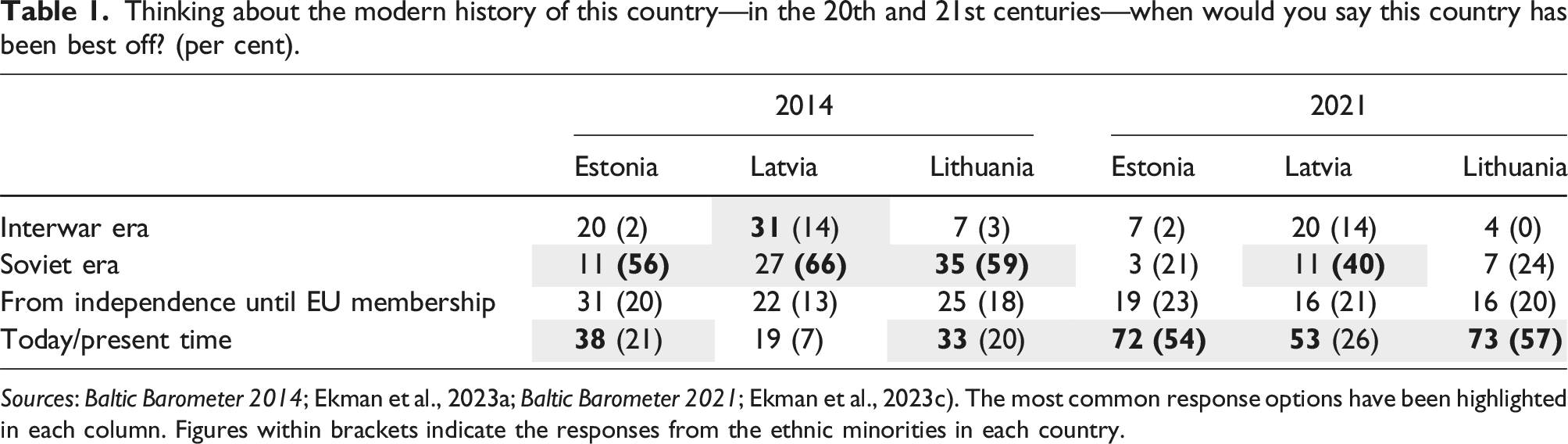
Sources: Baltic Barometer 2014; Ekman et al., 2023a; Baltic Barometer 2021; Ekman et al., 2023c). The most common response options have been highlighted in each column. Figures within brackets indicate the responses from the ethnic minorities in each country.
In the Baltic opinion polls, respondents were asked: “Thinking about the modern history of (this country) – in the 20th and 21st centuries – when would you say (this country) has been best off?” The response options were: in the interwar era; during the Soviet era (1940–1991); from the restoration of independence up until EU membership (1991–2004); and today/present time (i.e., since 2004 and onwards). When polled in 2014, it was above all the majority population in Estonia that expressed a preference for the contemporary system of political pluralism and market economies (38 per cent). The Lithuanians were divided between favoring the present era (33 per cent) and the Soviet era (35 per cent). In Latvia, only one in five agreed that the present time or the present system was the best period in the modern history of the country. Instead, the most common response was the interwar era (31 per cent), a period that tends to be glorified by nationalists in all the three countries (cf. Gerner & Hedlund, 1993, pp. 57–58). Finally, almost a third of the ethnic Latvians opted for the Soviet era as the best time (in 2014).
At a first glance, it would seem that responses in 2014 were quite diverse. But looking at the preferences for “today/present time” and “from independence to EU membership”, taken together, we actually find that, among the majority populations in Estonia (69 per cent) and Lithuania (58 per cent), that most respondents opted for the contemporary system (democracy), rather than past eras. Latvia was different: here any other period in the past was perceived as better than the present, both among the ethnic Latvians and the Russian-speakers (2014).
The attitudinal differences between the groups in Table 1 have all the trappings of an ethnic divide (again, judging from the figures in 2014 at least): in each country, the decidedly most popular response among the Russian-speaking or Polish minorities was the “Soviet era”. While about 60 per cent of the minorities in the region opted for the Soviet era as the best time for their country, only 11 per cent of ethnic Estonians agree, along with 27 per cent of ethnic Latvians and 35 per cent of ethnic Lithuanians. Thus, the minority groups seemed to be consistently more dissatisfied than the majority groups with the overall state of affairs in their own country.
The patterns documented in in Table 1 may partly be explained with reference to post-EU accession socioeconomic developments in the region. In 2008–2009, the global financial crisis that swept over Europe hit the Baltic states particularly hard. In Estonia, the economy shrunk by some 20 per cent from early 2008 to late 2009, and unemployment rose from 4.1 per cent (2007) to almost 20 per cent (2010). Estonia eventually recovered and was able to join the Euro-zone in 1 January 2011, successfully meeting all the criteria of the European Stability and Growth Pact. Lithuania and, in particular, Latvia found themselves in a more difficult position. In Latvia, GDP contracted by 4.2 per cent in 2008, and shrank by a further 18.0 per cent in 2009. Needless to say, the economic crisis hit society hard, and the country had to rely on the International Monetary Fund (IMF) to reduce the budget deficit (Klein et al., 2011: 34). The economic crisis was less severe in Lithuania, but it made an impact here as well: increasing emigration, swelling public debt and increasing energy prices remained high on the political agenda in Lithuania in the wake of the financial crisis (Jurkynas, 2011). The political elites accepted the social costs and chose to cut back sharply on government spending. In practice, the households thus paid the bill, in the form of significantly reduced wages, increased unemployment and deteriorating pensions. Health care was put on a diet. The idea was that the cuts would reduce production costs and that the countries would consequently attract foreign investment and increase exports, and thus bring about a recovery of the economy. The policy worked, in the sense that already in 2010 one could see a recovery and economic growth. Unemployment fell again, and the growth of GDP continued (cf. Duvold et al., 2020). Still, the opinion poll from 2014 quite possibly reflect lingering public dissatisfaction brought about by the financial crisis, in Latvia in particular.
The question about the past and present (Table 1) appeared in the 2021 poll as well. This time, a much clearer pattern appeared: in Latvia, some 14–20 per cent of those polled still agreed that the interwar era were the golden years, but in Estonia and Lithuania, not many respondents opted for this period. Rather (in both countries), most respondents among the majority populations as well the minority populations felt that “the present time” was preferable to the past. The same pattern was found among ethnic Latvians, but among the Latvian Russians-speakers, the most popular response was the Soviet period.
Support for democracy
Another central feature of system support is related to democratic support. In the public opinion data we utilize in this overview, we have one measure specifically designed to tap support for democracy as a principle or an ideal, that is, as the most appropriate form of government. Respondents were confronted with three statements and asked to pick the one they agreed with the most: “Democracy is preferable to any other kind of government”; “Under some circumstances, an authoritarian government can be preferable to a democratic one”; or “For people like me, it does not matter whether we have a democratic or a non-democratic regime”.
When polled in 2014, the strongest support for democracy was found in Estonia and Lithuania, where an average of 51 per cent agreed with the statement that democracy is always preferable. In Latvia, public support for democracy was lower, with around 43 per cent among the majority population. In all three countries, the pattern was basically the same: the minority groups were slightly less likely to express support for democracy, and slightly more likely than the majority groups to express support for a non-democratic regime alternative. In Latvia, such (conditional) support for authoritarian governance was particularly high: around 35 per cent among the majority population and the Russian-speaking minority alike (Ekman et al., 2023a).
Quite a few of the respondents in 2014 felt that it simply did not matter if you have a democratic or a non-democratic government. Again, it was the minority respondents who were the most likely to agree with such an assertion, in all three countries: 32 per in Estonia, 24 per cent in Latvia, and 25 per cent in Lithuania (Ekman et al., 2023a).
In 2021, the pattern was less ambiguous. A clear majority (70 per cent) of respondents in Estonia and Lithuania agreed that democracy was preferable to any other form of government. Not that many (14 per cent and below) supported authoritarian government or were indifferent. In Latvia, democracy was the relatively most popular response (52 per cent) as well, followed by authoritarian government (26 per cent) and indifference (19 per cent). Thus, the Baltic populations in general stood out strong (or in the case of Latvia, moderately strong) supporters of democracy (Ekman et al., 2023c; cf. Rose et al., 1998; Mattes & Bratton, 2007).
Patterns of attitudinal support for democracy were similar to public attitudes related to political efficacy and quality of government (data from 2021). In Estonia, 38 per cent agree that “people like yourself” can have a lot or some influence on government. The corresponding figures were 31 per cent and 39 per cent in Latvia and Lithuania. When asked about how many elected politicians that “care about what people think”, 40 per cent of Estonians, 25 per cent of Latvians and 34 per cent in Lithuania gave affirmative answers. Basically, the same pattern (i.e., Estonia as the more trusting society) is found when faced with the question “How widespread do you think bribe-taking and corruption are among public officials in this country?” In Estonia, 18 percent answered that most or all public officials are engaged in it. The corresponding figures in Latvia and Lithuania were 42 per cent and 39 per cent, respectively (Ekman et al., 2023c).
Familiar attitudinal patterns
In conclusion, when it comes to political support this section has documented a clear-cut cross-national pattern, where Estonia and Lithuania stand out as undoubtedly democratic and trusting societies. Latvia, on the other hand, seems to be characterized by comparatively higher levels of dissatisfaction. Moreover, we find quite strong support for the national communities in Estonia, Latvia and Lithuania. Most respondents feel a sense of attachment to or pride in their respective homeland, and a relative majority of all respondents feel that their contemporary political systems are preferable to other systems in the past. At the same time, the analysis alert us to distinct ethnic differences: the Russian-speakers in the three countries tend to be decidedly more nostalgic about the Soviet past and less satisfied with the present order of things (Table 1). These are, in fact, patterns familiar from previous studies (Duvold, 2006; Duvold et al., 2020; Lühiste, 2008, 2013; Rose, 2005).
It would seem that the population groups in the three Baltic states were growing more or less accustomed to the domestic situation, at least up until the escalation of the Russo-Ukrainian war in 2022. When asked explicitly about ethnic relations in 2021 (Ekman et al., 2023c), most Baltic respondents (74 per cent) evaluated the present situation as very or fairly good (“How would you evaluate the relationship between national groups in your country in general?“). After 2022, the situation has changed; and we will return to this in the concluding remarks. Before that, we turn to a section on geopolitical orientations.
Geopolitical orientations
The Russian war against Ukraine has had a profound effect on what is conventionally referred as the world order. Presently, the prospects for the arrangement of a global order based on the principles of liberal democracy, the rule of law, peaceful cooperation, and sustainable economic growth looks unrealistic. Instead, current assessments of future global trends tend to emphasize increased geopolitical competition and economic protectionism (cf. Garton Ash, 2023; Kasparov, 2016; Khodorkovsky, 2022; Rachman, 2022). While this does not mean that the world is falling apart, it certainly means that the capacity for dealing with global challenges (such as climate change and world poverty) has suffered in recent years. And, it also means that geopolitical orientations have re-emerged as a topical issue for ordinary citizens in Central and Eastern Europe. Should they be positioned to the East or to the West, or somewhere in between?
The Baltic Barometer 2021 (Ekman et al., 2023c) included a few questions designed to tap this dimension. Starting with support for the EU, Baltic respondents in general had a somewhat ambivalent relationship to Brussels. Some 82 of all respondents agreed that their country has benefited from membership (“Taking everything into consideration, would you say that your country has on balance benefited or not from being a member of the European Union?“). At the same time, some 58 per cent (strongly or somewhat) agreed to the statement that “the EU tends to interfere too much in our domestic affairs”. Still, the general verdict was that EU membership was indeed a good thing. When asked about Brexit—“Recently the United Kingdom left the European Union. Thinking about Brexit, would you like your country to follow suit?”—only some 15 per cent of Baltic respondents tended to agree.
Even if EU membership remains popular, it has sometimes been depicted as a threat to the identity and values of the own country. However, this seems to be a notion that has decreased recently, in all likelihood as a result of the war in Ukraine. According to the GLOBESEC Trends, 2022, support for this notion decreased from 22 to 17 per cent in Estonia, from 17 to 9 per cent in Latvia, and from 16 to 9 per cent in Lithuania (between 2021 and 2022).
As for orientations in the other direction, the 2021 survey included several questions: “How would you describe current relations between your country and Russia?“, “Does Russia pose a military threat to your country?“, “In your opinion, should the economic relations and general political orientation of our country be mainly towards Russia or towards the European Union?” and “There are different opinions about President Putin. How do you feel about his leadership?”
In Estonia (again, before the outbreak of the full-scale war in Ukraine), some 72 per cent described relations with Russia as “rather bad” or “very bad”. The corresponding figures were 78 per cent in Latvia and 83 per cent in Lithuania. But even if relations were thus generally perceived as bad, not that many respondents actually perceived Russia as a military threat, at the time. Threat perceptions ranged between 58 per cent in Lithuania, 46 per cent in Estonia, and 36 in Latvia (Ekman et al., 2023c). However, in another poll from March 2022, Russia was perceived as decidedly more distinct threat to 68 per cent of respondents in Estonia, 64 per cent in Latvia, and 83 per cent in Lithuania (GLOBESEC Trends, 2022).
When explicitly asked to compare a possible future orientation towards the EU or Russia (in 2021), only some 8 per cent of the respondents in Estonia, and 11 per cent in Lithuania opted for an orientation towards Russia. In Latvia, as many as 19 per cent made a similar choice. Positive attitudes towards Putin, as a strong leader, were more widespread, and some 24 per cent of the respondents in Estonia, 40 per cent in Latvia, and 16 per cent in Lithuania claimed to feel strong or some admiration for Putin (Ekman et al., 2023c). When asked about him in March, 2022, opinion polls displayed decreasing popularity ratings in all three countries, most notably in Latvia (GLOBSEC Trends, 2022).
Do you think any of these pose a real threat to peace and security in this society? (per cent).
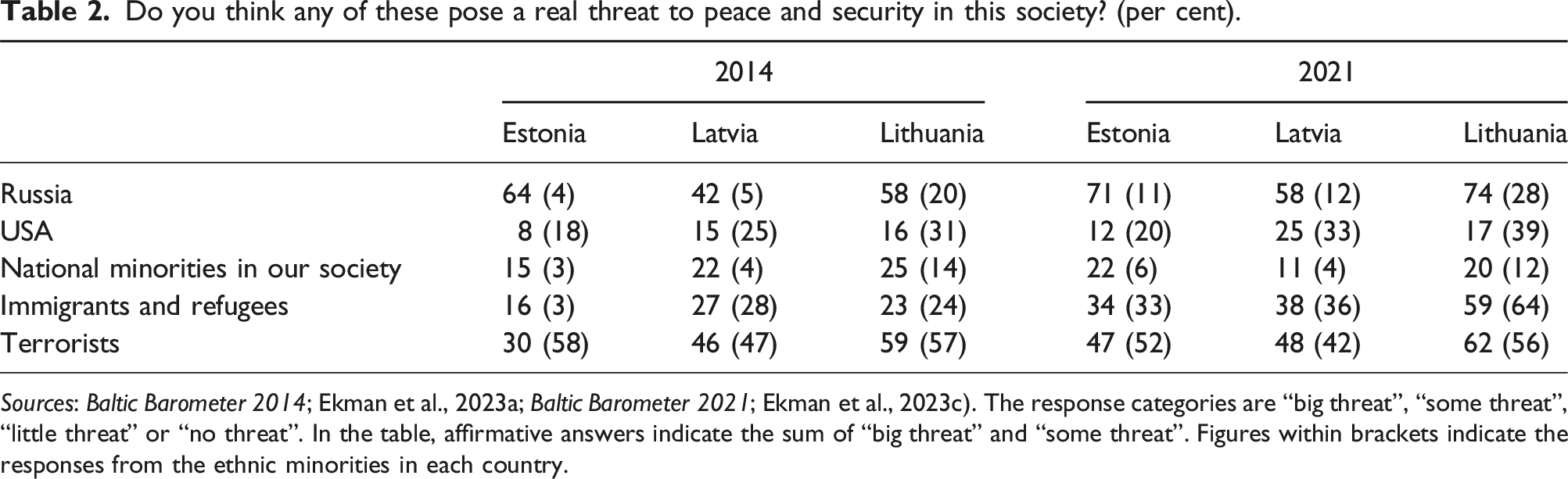
Sources: Baltic Barometer 2014; Ekman et al., 2023a; Baltic Barometer 2021; Ekman et al., 2023c). The response categories are “big threat”, “some threat”, “little threat” or “no threat”. In the table, affirmative answers indicate the sum of “big threat” and “some threat”. Figures within brackets indicate the responses from the ethnic minorities in each country.
As for the demographic composition in the three countries, Table 2 reports only rather modest levels of potential tension. Some 15 to 25 per cent of the majority populations in 2014 thought about “national minorities” as a threat.
The 2014 data collection was carried out at the same time as the “Crimea crisis” started, in February–March 2014. This was well before the European refugee crisis (2015–2016), which is arguably detectable in Table 2. Immigrants and refugees were not considered to be a major threat back then. In fact, people leaving the country were considered a more significant problem, especially to ethnic Lithuanians and Estonians (not displayed in Table 2). Terrorism was acknowledged as a severe threat in 2014; in Latvia and Lithuania this specific threat perception was very close to the perception of Russia as a threat.
A follow-up survey was conducted in September 2015 (Post-Crimea Barometer), in Latvia, Bulgaria and Hungary (Ekman et al., 2023b; cf. Ekman and Duvold 2018), asking the same question. Fear of immigrant waves and terrorism increased significantly between 2014 and 2015. Among ethnic Latvians, threat perceptions relating to Russia also increased dramatically, from 42 per cent to 75 per cent (Ekman et al., 2023b). Among the Latvian Russian-speakers, the share of respondents who felt that Russia was a threat (5 per cent) did not change at all, demonstrating possibly the fact that ethnic Latvians and Latvian Russian-speakers for a long time have lived in radically different media worlds (cf. Duvold et al., 2020).
In 2021, shortly before the Russian full-scale attack on Ukraine, threat perceptions relating to Russia had increased in Estonia, Latvia, and Lithuania, both among the titular populations and among the Russian-speakers/ethnic minorities. Threat perceptions relating to the USA increased as well, but less dramatically so. Different assessments of these threats followed the ethnic divide; the minority groups (in all three countries) perceived the USA as a significantly more serious threat Russia (Table 2).
Above, we noted a tendency of Baltic respondents growing more accustomed to the domestic situation, meaning here not exactly attitudinal convergence but still less tension/attitudinal differences between groups. Here, we find something similar. When asked in 2014, between 15 to 25 per cent of ethnic Estonians, Latvians and Lithuanians considered “national minorities in our society” to be threat to peace and security. In 2021, the share of respondents who felt the same way increased a bit among respondents in Estonia; but in Latvia and Lithuania, the figures actually decreased (Table 2).
When asked in 2021, experiences related to the European refugee crises were arguably detectable in public opinion. In all countries and ethnic group, the share of respondents identifying immigrants and refugees as a threat increased significantly (compared to 2014); and, so did threat perceptions related to terrorism, on average (Table 2). Of course, the immigrant/refugee situation has changed dramatically more recently, due to the 2020–2021 post-election protests in Belarus, the Russian full-scale attack on Ukraine, and the Russian mobilization campaigns. Some of the recent refugees are welcome (Ukrainians), others (Russians) are more associated with security threats (cf. Mierina, 2024).
Concluding remarks
This article has depicted key features of the political cultures of contemporary Estonia, Latvia and Lithuania, including attitudes towards the domestic ethnic minority groups, feelings of belonging to the national community, and attitudes towards democracy. Also, we have covered basic geopolitical orientations among the different ethnic groups in the Baltic states. We have focused on two points in time: 2014 (data collection coinciding with the invasion of Crimea) and 2021, shortly before the escalation of the war in Ukraine.
In the period under review, a few distinct patterns are present. Among the majority populations, most respondents stand out as strong or at least moderately strong supporters of democracy (and EU membership). In Latvia, the levels of support tend to be a bit lower, but certainly not absent. When it comes to the national political communities, strong support is also manifest. At the same time, there are attitudinal differences between the majority populations and the ethnic minorities, above all when it comes to retrospective evaluations of the Soviet past and attitudes towards contemporary Russia. Even if the “ethnic question” seems to have been quite manageable up until 2022, the most crucial question for the future is if the war will lead to a less harmonic situation, with more pronounced ethnic differences?
Contemporary developments seem to suggest precisely so (Mierina, 2024). For example, in the late fall of 2023, Latvia increased pressure on Russian citizens living in the country to pass a language test, if they wanted to stay. Although not designed to expel people, such rules have increased tensions between the majority society and the minorities. Of course, this has not gone unnoticed by the Putin regime, who has depicted Latvia (like Ukraine before) a fascist-led country (Higgins, 2023). According to a 2023 survey published by the Friedrich-Ebert-Stiftung, the Latvian population majority stands out as strong supporters of Ukraine, whereas the Russian-speaking minority are decidedly more ambivalent (Krumm et al., 2023). When explicitly asked about ethnic conflicts, both groups consider this to be quite possible, even if not likely. There is thus a risk that members of the Baltic Russophone community will only feel more alienated and isolated, due to recent demarcation policies against Russia, the banning of Russian media, educational reforms and memory politics. Also, among the Russian-speakers, feelings of being discriminated against has increased recently (Krumm et al., 2023). Similar developments have been noted in Estonia and Lithuania (Follorou, 2023; Veebel and Ploom, 2024). This is another way the Russian war on Ukraine has been destructive.
Footnotes
Declaration of conflicting interests
The author(s) declared no potential conflicts of interest with respect to the research, authorship, and/or publication of this article.
Funding
The author(s) disclosed receipt of the following financial support for the research, authorship, and/or publication of this article: The public opinion data used in this study was collected within two research projects (“European Values Under Attack? Democracy, Disaffection and Minority Rights in the Baltic States” and “Returning to Europe and Turning Away from ‘Europe?’”), both funded by the Foundation for Baltic and East European Studies (Stockholm).