




Abstract
The reaction of Ukrainian poets to the full-scale Russian aggression against Ukraine in February 2022 has been remarkable and was noticed all over the world. Understandably, interest towards Ukraine increased, and translation of Ukrainian poetry is one of the ways to learn and to share Ukrainian culture. Estonian is a small language, not at all related to Ukrainian, and until recently, the general public knew little about Ukrainian literature; nevertheless, the reaction of Estonian translators was immediate. Given the shared experience of the Russian/Soviet domination, this is not surprising. The study seeks to explore translators’ motives and their history of discovering Ukrainian poetry and language. The theoretical framework employed in the article is that of Translator Studies, that is, the focus is on the translator’s trajectories (why and how they turn to a particular literature/author, why and how they learn the necessary language, their beliefs, ethos, personal development, etc.). A connection between Translator Studies and sociolinguistic disciplines such as language biographies, multilingualism and (personal) language policy is discussed. The data comes from interviews with three translators of Ukrainian poetry into Estonian, Igor Kotjuh, Maarja Kangro and Irena Peterson-Pavljuk who are poets themselves. Their ethnolinguistic background, language biographies and paths of becoming translators from Ukrainian into Estonian differ, but all three emphasise their dedication to Ukrainian poets.
Introduction
The topic of the current article is the translators’ view on recent translation of Ukrainian poetry into Estonian, as expressed in interviews by three prominent translators: Maarja Kanrgo, Igor Kotjuh and Irena Peterson-Pavljuk. Recently, Translator Studies (Cronin, 2006; Chesterman, 2009; Simeoni, 1998; Venuti, 1995) have emerged as a separate subdiscipline within Translation Studies. It has become apparent that a traditional focus on the text or even the descriptive approach that puts recipient culture and translation culture centre stage cannot address the whole complexity of fiction and poetry translation, and that the translator is not an abstract mechanism for turning texts in language A into language B but has agency, a certain linguistic profile, experience and aesthetic preferences. In a similar vein, in the now classical work by Robert Le Page & André Tabouret-Keller (1985), (multilingual) language use is not only a matter of grammatical analysis but a speaker performs ‘an act of identity’ in every speech act. In a broader sense, this metaphor can be applied to the work of translators: a decision to translate a certain author from a certain language, the choice of texts to be translated may also be considered as acts of identity.
Estonia is a tiny country (population 1.3 mln), Estonian is a small language (1 mln speakers), and there are very few people who know both Estonian and Ukrainian. Yet Estonian population is highly multilingual; according to the census of 2021 (Statistics Estonia: Population Census), speakers of 243 languages reside in Estonia; 48 % of the population know at least one foreign language, 35 % know two and 13 % know three foreign languages. Being a small nation, colonised/occupied by various empires in the past, Estonia has developed a translation culture that is flexible and quickly reacts to political and cultural changes. Estonian translators have contributed to the increase of visibility of Ukrainian literature after the Maidan revolution of 2013 and the full-scale Russian invasion in 2022.
Translations from Ukrainian into Estonian as such are not new (see more in Lange, 2023). Still, the interest towards Ukraine and Ukrainian culture among Estonians has been modest until the Maidan events: despite a similar experience of subjugation by the Russian Empire and the USSR, the geographical and linguistic distance was a factor that prevented a closer mutual acquaintance. The situation has changed only after the Revolution of Dignity (Euromaidan or Maidan) of 2013–2014. After the beginning of the active phase of the war on 24 February 2022, several special issues of Estonian literary magazines Vikerkaar (June 2022) and Looming (March 2022 and March 2023) appeared, and readings of Ukrainian poetry in translations were organised in the Estonian Writers Union and during the literary festival Head Read in 2023.
Recently, three accounts on translations of Ukrainian literature into Estonian have appeared: an overview by Anne Lange (2023), a translation scholar, with the emphasis on activism and ethical imperative of translators from Ukrainian; an article in the cultural weekly Sirp intended for a general readership about recent works translated from Ukrainian into Estonian by Katja Novak (2023), and an article about the impact of the war on Ukrainian culture in the main Estonian literary periodical Looming by Igor Kotjuh (2023). This paper concentrates on translations of modern Ukrainian poetry in particular because poetry is the most immediate form of reaction to the historical events, while longer text types require a certain temporal distance, and what will count as a major prose work on Maidan and the war, is not yet clear.
Estonia as a country has been actively supporting Ukraine during the war both as a spokesperson on the international scale and with weapons and humanitarian aid. Not less important is moral support, including various activities, such as readings of Ukrainian poetry in original and translation, concerts, plays, special issues of literary magazines. Ukrainian language classes are being taught at the University of Tartu (since 2022) and at Tallinn University (since 2023), and a course for translators is available at the Estonian Writers Union. Despite a small number of translators who know both languages, poets, writers and translators have been active and visible. Importantly, they translate from the original and not through the medium of ‘big’ languages (Russian or English). This phenomenon of flourishing of translations from Ukrainian in Estonia lies (at least in part) in the personal trajectories of translators, their ethos and identity.
The article seeks to answer the following research questions:
RQ 1: What was the road that led to translations of Ukrainian poetry into Estonian?
RQ 2: What were the translators’ attitudes, beliefs and motivations?
RQ 3: Given that the translators are themselves poets/writers, whether and how, in their opinion, their translation activities have affected their own poetics and aesthetics? The article is structured as follows. First, the theoretical background for Translator Studies and several subdisciplines in linguistics helpful for the inquiry are provided, and the role of individual translator in a small culture is discussed. This is followed by methodology and data section. Then the analysis of the topics mentioned in the interviews is presented, followed by findings, conclusions and suggested perspectives for further research.
Translator studies
Defining the context
As described by Klaus Kaindl (2021, p. 3), the field of Translation Studies ‘was founded on a great misconception’ that ignores the translator and their agency. The emergence of descriptive Translation Studies and the ideas by James Holmes ([1972] 1988, p. 72–73) shed light to the human factor, postulating translation sociology and psycho-translation studies as disciplines within the descriptive Translation Studies; however, the personality of translator is still absent from this framework. Antoine Berman (1985) was the first who thought of the individual translator as the central issue in the field. He prefers a biographical approach and chooses to ignore psychological factors (see discussion and overview in Kaindl, 2021, pp. 7–8). Edwin Honig (1985) published a book of interviews with translators of poetry; it is not a scholarly work, yet remarkable in the sense that it presents the translators’ narratives about their development and creativity. Since the 1990s, a clear tendency of ‘humanisation’ and ‘individualisation’ of Translation Studies has appeared, leading to research that concentrates on the role of translator (for instance, often quoted work by Simeoni, 1998). A major collection of articles on Translator Studies has been published recently (Kaindl et al., 2021), where the contributors investigate individual biographies, translators’ archives, sociology of translators and the role of paratexts.
In a programmatic article, Andrew Chesterman (2009, pp. 13–14) defines Translator Studies as the study of translators and interpreters. He recalls the famous map by Holmes (1988) that has been reproduced in many studies, also as a diagram (Toury, 1995, p. 10). According to this map, Translation Studies are subdivided into ‘pure’ and ‘applied’, while ‘pure’ are in turn subdivided into ‘descriptive’ and ‘theoretical’. The map has been commented upon by numerous scholars (see overview in Chesterman, 2009, p. 15). Chesterman (2009, pp. 15–16) argues that the map (or diagram) does not include translators and that if the translator is placed centre stage, the whole picture changes, and rather different research questions are to be posed. He suggests that Translator Studies consists of three directions: cultural (ideology and ethics), cognitive (mental processes and attitudes) and sociological (networks, institutions, status and workplace processes) (Chesterman, 2009, p. 19). In these terms, the current article is concerned with the cultural aspect and not the remaining two, although it is extremely difficult to draw a clear border between them. For instance, personal networks may affect the choice of authors and texts to be translated. The cognitive aspect (the proficiency in the languages in question, that is, Estonian and Ukrainian, the attitudes towards the Ukrainian language and culture and its importance for the Estonian reader) is tightly linked to ideology and ethics. These interconnections will be discussed in Section 4.
Gisèl Sapiro (2013) introduces the topic of translator’s identity and concentrates on the biographical and sociological trajectories of translators on the example of translators from Hebrew into French. Using the concept of habitus by Bourdieux, she proposes that one should look into how the habitus of a translator emerges and develops. For this purpose, the researcher has to ask, how one becomes a translator and how a translator’s habitus is shaped; under which circumstances a translator has acquired various languages, started translating and so on. Questions concerning translator, translations and identity should also be considered (Sapiro, 2013, pp. 60–61). Taking the biographical approach, she identifies the main pathways of how one becomes a translator from Hebrew into French (studies of classical languages that may ultimately lead to studies of Hebrew, studies of Hebrew as a primary goal, immigration to Israel).
In connection with the biographical approach to translator’s identity and personal development, as chosen by Sapiro (2013), it would be instructive to look into what other fields, for instance, sociolinguistics and multilingualism, may suggest. This will be discussed in Section 2.2.
Interdisciplinary connections
It is not unusual in linguistics (and, probably, in humanities in general) that the same set of phenomena is being investigated from different perspectives that use their own metalanguage and seldom interact. An example which illustrates this state of affairs is the study by Meriläinen et al. (2016) on how loan translations are viewed in three fields: contact linguistics, language acquisition studies and Translation Studies.
The disciplines relevant to the cultural and biographical aspects within Translator Studies are language policy, investigation of (multilingual) language (or linguistic) biographies, and studies on multilingualism and language learning (from a sociocultural point of view).
Bringing in language policy may sound too general, yet since Bernard Spolsky’s (2004) seminal research on theory of language policy, it became clear that policy is not necessarily designed and implemented by state and its institutions (top-down) but also by communities, families and individuals (bottom-up). A three-component language policy model, rather influential in language policy research, was suggested by Spolsky (2004): language beliefs (ideology, attitudes), language management (what is being done in order to change/maintain something according to the beliefs and aspirations), and language practices (what language users really do). This model is applicable to states, polities, communities and individuals alike. Later on, Spolsky (2019) added the notion of self-management, defined as ‘the attempts of speakers to modify their own linguistic proficiency and repertoire’.
In other words, the questions asked by Sapiro (2013), that is, how one becomes a translator and how one decides to acquire yet another language, to familiarise oneself with a certain literature, and so on, may be interpreted in the terms of Spolsky’s model: for some reason, a translator becomes interested in another language/culture and decides that the works in this language in general or produced by a particular author deserve to be translated (beliefs), then decides to learn or to improve skills in the language (management, self-management) and, eventually, masters the language and starts translating (practices).
From another perspective, individual multilingualism is not (only) about the acquisition of lexical items, structures and patterns, as viewed in traditional language acquisition studies. Language learning and use is experience-driven, which is both cognitive and social. For example, David Block (2007) revised several classical studies in second language acquisition and re-interpreted their results, rejecting traditional structural explanations of language learning outcomes (‘speakers of language X have difficulties in acquisition of feature Y in language Z’) and suggesting the perspective of learner’s identity instead. Barbara Hennig (2010) describes language learning as a personal endeavour and a way of ‘self-formation’. In a similar way, Jan Blommaert and Backus (2011) explain that ‘to know a language’ may mean different things to different language users, and that people may encounter languages in different ways (in the classroom, in the environment, through reading, on the internet, via popular culture) and that origins of linguistic repertoires are biographical. Therefore, translators should also be considered as language learners and users, builders of their linguistic repertoire and their linguistic biographies.
Language (or linguistic) (auto)biographies research is a discipline that investigates narratives on one’s journey of encountering, acquiring, learning and using various languages. Rita Franceschini, one of the major contributors to the field, presents an account of its development since the 1990s and until now (Franceschini, 2022). A detailed overview of language biographies research lies outside the scope of the present study. What is relevant here, is the idea that linguistic biographies may be considered in a narrow sense as narratives on an individual’s linguistic experience, and, in a wider sense, a data collection instrument that allows to obtain information not available via ‘unidirectional questionnaires’ (respectively, ‘research ON linguistic biographies’ and ‘research WITH linguistic biographies’, emphasis in the original, Franceschini, 2022). The importance of bidirectional communication should be stressed because in order to be able to understand the narratives and not to miss details important for qualitative research, a scholar needs a possibility of dialogue. The biographical approach in Translators Studies relies, in fact, on linguistic biographies because translators are multilinguals, they have learned, formally or informally, another language or languages, and dealing with language is their profession.
Schematically, these relations are demonstrated in Graph 1. Interdisciplinary connections of Translator Studies.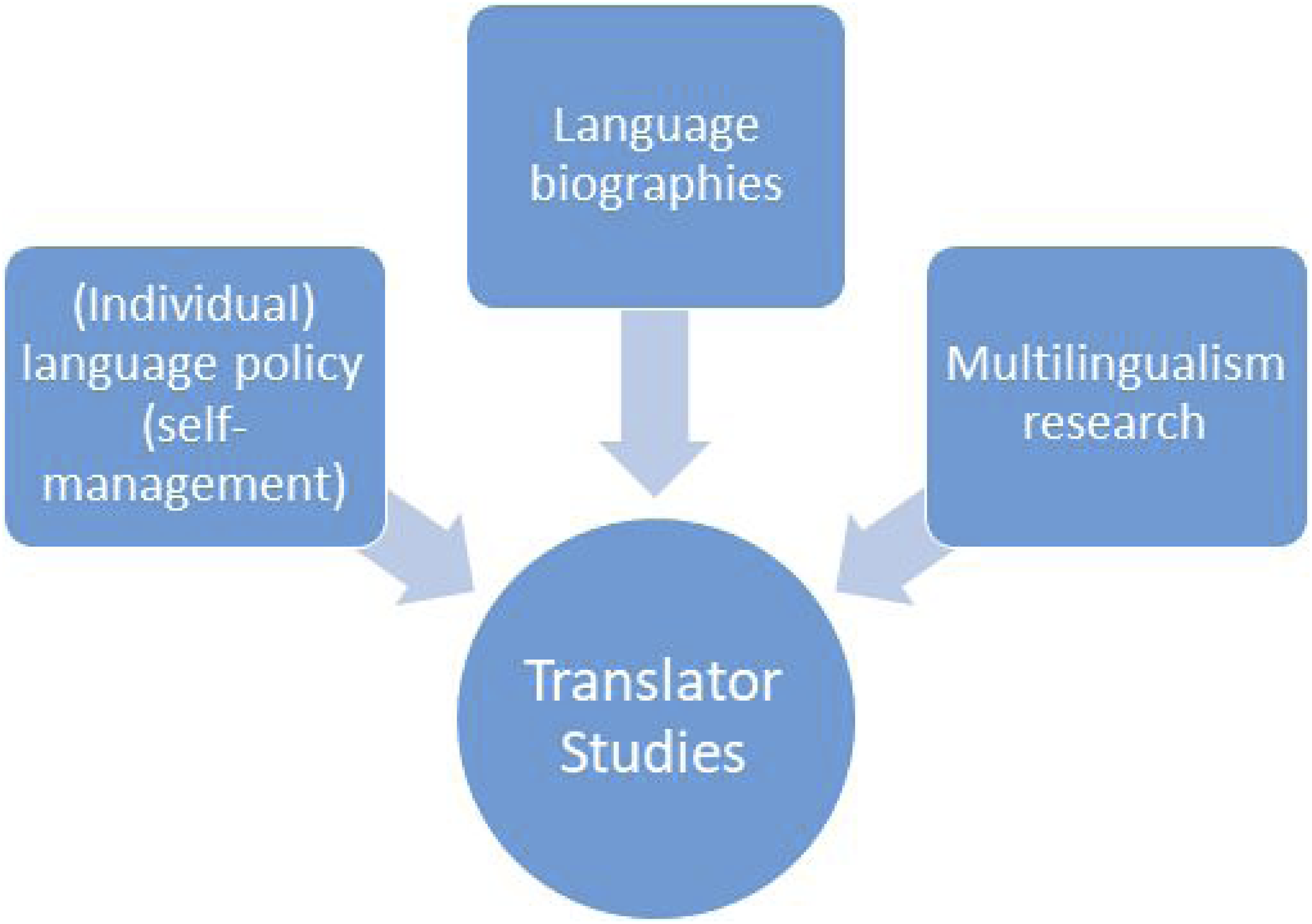
In sum, the ideas and concepts from sociolinguistics and multilingualism research, such as self-management, language learning as a tool of self-formation, language learner’s/user’s identity, and linguistic biographical point of view add to the understanding and development of Translator Studies. A study on individual translators and their cultural and linguistic journey may be considered as a special case of language policy (self-management), language learning and identity, and linguistic biographical research.
Participants, data and methodology
As there are few translators who constantly translate Ukrainian poetry into Estonian, the choice of the participants was obvious. All three translate from the original, yet their road towards translating from Ukrainian differs.
Maarja Kangro (born in 1973 in Tallinn, Estonia, hereafter MK) is a poet, writer and translator who had previously translated from English, German and Italian. She has translated poetry by Serhii Zhadan, Halyna Kruk, Ostap Slyvynski, Artem Polezhaka, Julia Musakovska and Jaroslav Dovgan.
Igor Kotjuh (born in 1978 in Võru, Estonia, hereafter IK) is a multilingual poet (Russian, Estonian, Ukrainian) whose first language is Russian and who translates between Russian and Estonian in both directions. Ukrainian is one of his heritage languages, recently added to his creative repertoire. He has translated poetry by Iya Kiva, Ostap Slyvynski, Kateryna Mikhalitsyna and Katja Novak.
Irena Peterson-Pavljuk (born in 1992 in Vinnytsia, Central Ukraine, hereafter IP) is a poet, song performer and translator who used to translate from German and French into Ukrainian, then as a student discovered and mastered Estonian and since recently has been translating in both directions between Estonian and Ukrainian. From Ukrainian into Estonian she has translated poems that are simultaneously song lyrics, most of them classical: Volodymyr Sosiura, Ivan Franko, Mykola Rudenko, Lesia Ukrainka, Mykola Palazhchenko, Pavlo Tychyna and Anatoli Drahomyretskyi.
The data collection method was semi-structured interview, one of the most frequent methods in language biographies research (Pavlenko, 2007). As mentioned in Section 2.1, interviews are widely used in Translator Studies. Saldanha & O’Brien (2013, p. 169) discuss advantages and risks of interviews as a method in Translation Studies in general and find that there are two ways to treat interviews: either, in line with the positivist approach, to address the potential bias created by the proximity between the researcher and the interviewee, risks of losing distance and neutrality (‘going native’) or to choose an interpretivist view and to treat the interactive aspect as ‘a valid part of research exercise’. This means that a researcher has to reflect on his/her position and be aware of the fact that it is not about a clear dichotomy between in- and outsider.
This leads us to the question of language choice in the interviews. Since the mentioned translators have different ethnolingustic backgrounds and linguistic repertoire, a researcher cannot depart from a reductionist and stereotypical position that translators into language A are speakers of A as L1 and language B from which they translate is their L2. Actually, the chronology of acquisition itself does not determine proficiency and says nothing about identity and attitudes.
In multilingualism research in general, the need to acknowledge the complex impact of language choice on the work with multilinguals is articulated (Rolland et al., 2023). Pavlenko (2007) discusses the importance of language choice in linguistic biographies research interviews; ideally, a researcher should know the languages of the interviewees, and interviews in different languages should be conducted on different days (or maybe even by different researchers). This study is not concerned with the narratives in different languages per se but, as mentioned above, it is a study with linguistic biographies, to use the classification by Franceschini (2022), so subsequent interviews in several languages does not seem necessary.
Since, in addition to being a linguist and a translation scholar, the current author is also a translator and has been contributing to the translation of Ukrainian poetry into Estonian, the involvement with the very tiny circle of translators from Ukrainian is inevitable. The author had been familiar with the potential participants prior to the current study, which means that the choice of language was predetermined, that is, the habitual language (or languages) of communication between the author and the interviewees.
MK is an ethnic Estonian, speaker of Estonian as L1, so choosing Estonian for the interview was the most logical option. IK has a mixed background, including Ukrainian, his L1 is Russian, and most active languages are Russian and Estonian, but the default language of communication between IK and the author is Estonian, so it would be unreasonable to change this. IP is a polyglot, her L1 is Ukrainian, and she is highly proficient in Estonian. We got acquainted under circumstances where the language of communication was Ukrainian and, rather logically, we have been speaking Ukrainian ever since and continued this during the interview.
Prior to the interviews, the participants received a small list of questions/topic blocks: When did you become interested in Ukrainian literature (i.e. before or after the Maidan revolution of 2013–2014, between 2014 and the beginning of the Russian invasion in 2022, after 2022)? What motivated you to start translating from Ukrainian? How would you assess your Ukrainian proficiency? Do you lean on your knowledge of Russian? Are you currently learning Ukrainian? What Ukrainian authors have you translated into Estonian? How did you choose them? Do you translate from other languages? Has Ukrainian poetry affected your own style and poetics?
As for IP, some questions were modified because Ukrainian is her first language, she grew up in Ukraine, and for sure she is well familiar with Ukrainian literature. In her case, I asked to comment on becoming a bidirectional translator because prior to 2022 she was mainly translating Estonian poetry and prose into Ukrainian.
The interviews were conducted via Zoom, about 30–35 minutes each (altogether 1 h 40 min). The conversation was loosely based on the suggested topics, and the participants were given freedom to raise other issues and comment on them. The interviews were recorded and analysed for the emerging themes. All translations from Estonian and Ukrainian into English are mine.
Analysis
The common topics discussed by the participants were as follows: how they became translators from Ukrainian; their language biography, multilingualism and mastering Ukrainian (in one case, Estonian); their esthetics, creativity and future plans; support of Ukraine and the position of Ukrainian literature. As the conversation was only loosely structured and the translators had an opportunity to discuss any aspect of their work, the amount of time given to each topic differed across the interviews.
Becoming a translator from Ukrainian
The ways of becoming a translator in general and a translator between Estonian and Ukrainian (in either direction) in particular had both similarities and differences for all three participants. MK stated that she had been thinking about some questions of the interview long before the interview took place. She has been translating from German, Italian and English and received several awards both for her original writing and translations. In general, she believes that translating poetry is inspiring and gives new ideas about one’s own work. Like other Estonians, she, of course, was aware of Ukraine because of the common past within the Russian Empire/USSR but knew nothing about Ukrainian literature in particular. She described it, somewhat exaggerating, as follows: ‘Before 2013, I was a usual Western fool’.
This is an overstatement because, as mentioned, the inhabitants of the former Soviet block are usually aware about other peoples with a similar history; however, this judgement provides a contrast between ‘then’ and ‘now’, when she became familiar with Ukrainian literature. In fact, she had been aware of the names of Taras Shevchenko and some other classics, and had read works by Oksana Zabuzhko and Yuri Andrukhovich in English translations. An impulse for further acquaintance with Ukraine and its culture came from a personal invitation in 2019 by the lecturer of Estonian at the University of Lviv, Riina Roasto, who herself translated later prose by Serhiy Zhadan. MK gave a lecture on Estonian poetry and got acquainted with young translators and poets with whose help she later developed her own network.
The story of IK is different because his mother was born in Ukraine, and he used to go there in summer as a child. The home language was Russian but during the summer visits he would learn to speak Ukrainian; unfortunately, after the death of the grandparents the trips to Ukraine stopped, and only a passive proficiency remained. This experience is nostalgically described in the Ukrainian-language poem ‘UA’ (Kotjuh 2022, p. 115). Later IK established himself as a bilingual poet and translator between Russian and Estonian. After a long pause he renewed contacts with Ukraine, visiting Crimea on the invitation of a local teacher of Estonian (there was a long-established Estonian minority, and Estonia provided a teacher of Estonian as a heritage language between 1991 and 2014). Then, participation in various literary festivals and translation workshops followed. A significant point was a personal acquaintance with the Ukrainian poet Ostap Slyvynski; they became each other’s translators (Slyvynski translated IK’s works through the medium of English, while IK translated from the original). Summarising, IK says: ‘I guess, it is everything together: my heritage and the events, possibly, everything’.
As he describes, somehow he tended to always choose activities connected with Ukraine, and has gradually broadened his Ukrainian network.
IP differs in a variety of ways, as she was born in Ukraine and her first language is Ukrainian. She started as a translator of French and German classical poetry into Ukrainian and her collection of poetry translations Cej svit je odnym tilom (This world is one body) was awarded with the prize Harnoslov in 2019. Her accidental encounter with Estonian and speakers of Estonian at a music festival in 2015 became a catalyst for her further development as a translator. She started learning Estonian and translating from Estonian into Ukrainian, both poetry and prose, and moved to Estonia in 2019 to study at Tallinn University. As she describes, changing the direction of translation and translating into Estonian became a completely different experience that she liked. She became a bidirectional translator in 2022 when suddenly a demand for Ukrainian culture emerged, and she was contacted by Arvo Pärt Centre, concert managers and choir conductors who wanted to play Ukrainian songs, and in order for the public to understand, the lyrics in Estonian were needed.
Multilingualism and language learning
As demonstrated above, the majority of Estonia’s population is highly multilingual. It is a different matter altogether whether people consider themselves as multilinguals because for non-specialists in this field of linguistics a multilingual may mean someone who has a perfect command in all languages in question and/or has mastered these languages in early childhood and identifies with all of them. The topic of proficiency in Ukrainian emerged many times in the interviews with MK and IK. Learning and using other languages was reflected upon by all three participants.
My question about the proficiency in Ukrainian and the ways of learning the language was rather natural for two reasons. First, Estonian translation culture, at least starting from the 20th century, favours translating from the original and not via other ‘big’ languages (Russian during the Soviet occupation and other major European languages before and after that; see Monticelli and Lange (2014) especially on the Soviet era). Second, during the Maidan events, many Estonians wanted to read Ukrainian news from Ukrainian sources, and started reading Ukrainian while leaning on their proficiency in Russian (this may not work for younger generations who do not have compulsory Russian at school). This phenomenon is called mediated receptive bilingualism, and it has been attested that Estonians with some proficiency in Russian are able to understand Ukrainian (however, the proximity between the Ukrainian and Russian is but one factor, see Branets et al., 2020; Branets & Verschik, 2021). MK belongs to the generation that had compulsory Russian at school, IK speaks Russian as his first language. This is the reason why I asked about leaning on Russian while reading Ukrainian.
As the ethnolinguistic profiles of the three translators differ, the answers differed, too. MK had had some experience with Polish (at first, using her command of Russian) and mentioned that she would rather lean on Polish than on Russian while reading Ukrainian: ‘It helped a lot to understand Ukrainian. Kochać [Polish ‘to love’], koštuje [Ukrainian ‘costs’], the names of the months. It was a discovery for me that many Slavic languages do not use the international names of the months’.
MK’s proficiency in Ukrainian is passive, she is able to read with a dictionary and to follow Ukrainian YouTube channels about history (she watches them especially before her trips to Ukraine). For her, it is easier to understand a written text than speech. When visiting Ukraine, she is reluctant to use Russian and speaks ‘some crazy pan-Slavic mixture’, as she renders it.
For IK, Ukrainian is one of his heritage languages (he refers to it as pärandkeel in Estonian, which is the exact equivalent of ‘heritage language’). His Ukrainian is mostly passive and it reminds of the early childhood visits to Ukraine when during the summer: he would feel the similarities between Russian and Ukrainian, yet being unable to say anything, then during the summer the fluency in Ukrainian would increase: ‘After a month you feel that you are in an opposite situation; you are unable to speak Russian, you have the so-called fricative h. Now my dream is to restore the state of that little boy who was able to speak Ukrainian’.
IP is fluent in several languages: the mentioned collection of her poetry translations contained authors in six different languages. However, during the interview she emphasised her special experience with Estonian, not so much because it is quite different from Germanic, Slavic and Romance languages but because she had gained access to Estonian literature that made a great impact on her. The next stage was becoming able to translate from Ukrainian into Estonian as well. In the narrative, IK almost did not mention language learning and the process of becoming multilingual, in contrast to MK and IK.
Creativity, identity and self-formation
All three participants talked about translation and its relations to creativity, identity and their plans. Still, the accents differed across narratives.
MK talked about discovering Ukrainian literature in general and poetry in particular (classics like Ivan Franko and Taras Shevchenko, and the contemporary authors she translated, like Ostap Slyvynski, Halyna Kruk, Artem Polezhaka, Julia Musakovska and Olena Stomina): ‘This world [of Ukrainian literature] is fascinating, I re-read classics: Ivan Franko, Lesya Ukrainka, they are complex and deep authors. A whole new world revealed itself to me…’
She did not elaborate on the impact of Ukrainian literature on her identity as translator or on her poetics, but, instead, talked about identity in a more abstract sense: the significance of Ukrainian literature, its place among European literatures and, more precisely, as a Central European literature. This realisation occurred to her only after the Maidan revolution. MK stated that it is not just about solidarity with the victims of aggression but, indeed, Ukrainian literature is manifold and diverse, and deserves more attention. In the Estonian context, she suggested that Ukrainian should be taught more, and an anthology of Ukrainian poetry is urgently needed.
For IK, individual identity as a person, poet and translator is linked to his heritage languages and the linguistic environment: he considers Russian, Estonian, Ukrainian, Belarusian and Võru (a South-Estonian variety, see more in https://en.wikipedia.org/wiki/V%C3%B5ro_language) as equally important for him. He has been active in the discussions on Russian-language literature of Estonia (eestivene kirjandus) and discussed multiple identities and the problems of delimitation of Ukrainian literature, that is, where Ukrainian authors who continue writing in Russian belong. This discussion has been going on in Ukraine for some time, and some authors have shifted to Ukrainian since 2014 or have become bilingual (Averbuch, 2023; Uffelman, 2022). He holds high opinion of several authors who write in Russian, such as Galina/Halyna Rymbu and Andrey Krasnyashchikh, yet believes that this is a complex question that is not for outsiders to solve: ‘It is clear for me but it is not my business to dictate to Ukrainians… If an author lives in Ukraine, it is not enough because they themselves may decide that they belong to a different culture’.
Interestingly, IK illustrates this point by drawing a parallel with the Estonian poets-refugees in Sweden after 1944: Marie Under (1883–1980) continued to write in Estonian only, it was enough for her to be an Estonian poet, while Ilmar Laaban (1921–2000) started writing in Swedish as well.
A lot of time in the interview was dedicated to personal development. IK spoke in favour of combining his own poetry and poetry translations in the same book, because he translates the works of poets whose esthetics and imagery are close to those of himself, suggesting thus a syncretic view on one’s creativity: ‘When my Estonian books appear, I include translations of Ukrainian and Belarusian poets whose works are close to my heart for some reason’.
He described in detail the discovery of such poets as Ostap Slyvinski and similarities between their poetics, their translations of each other’s works. IK strongly believes that an author needs challenges. As his formation as a Russian-language poet occurred under the significant influence of Estonian-language authors in the middle of the 2000s in Tartu, he decided to try writing in Estonian and translating in both directions, and eventually became a successful bilingual poet and translator. After that he turned to his childhood experience with Ukrainian. Now the next challenge is to become active in Ukrainian, Belarusian and Võro: ‘I grew up amidst five languages, it is a unique situation, and I have to pay tribute to them… I have to try to write in all five… I have plans. I want to immerse myself into Ukrainian, Belarusian and Võro poetry’.
IK acknowledges the significant impact of Estonian poetry on his poetic language; as for the influence of Ukrainian poetry, he believed that, eventually, this will happen as well. In his opinion, the importance of Ukrainian literature in general will definitely increase.
IP tells a different story because she is an active user of both languages, Ukrainian and Estonian, unlike the other two respondents. She acknowledges the fact that it is easier for her to translate into Ukrainian, her first language, yet she appreciates the opportunity to translate from Ukrainian into Estonian: ‘I like it a lot, although it is time consuming’.
Estonian poetry holds a special place in her esthetics. Estonian poetry, in her opinion, differs a lot from the classical romantic German and French poetry she has translated: it is not so ornate and rather minimalistic, which she has learned to appreciate: ‘I decided that my translations from Estonian should constitute a separate collection. The Estonian poetry I translated was different… My own poetry, starting from the move to Estonia, has taken a different direction: it is free verse, the intonation is calmer, there is more nature’.
She also mentioned that she discovered Estonian ancient animist (pagan) culture and is now looking for similar traits in Ukrainian culture. Being a musician as well, she wrote a chapter on Ukrainian music for an Estonian school textbook. Her story reveals a harmonic coexistence and mutual reinforcement between Estonian and Ukrainian culture in her personality.
Translation, activism and solidarity
In Estonia, the choice to support Ukraine and Ukrainian culture is quite apparent and unequivocal because of the common experience under the Russian imperial and Soviet dominance. As Anne Lange (2023, p. 94) renders it, ‘[t]ranalsations from Ukrainian at present are activist in the sense that they resist overtly to the political catastrophe in Ukraine like the authors they translate’. Still, the three translators in this study frame it differently.
MK explained that she started taking interest in Ukrainian literature out of solidarity (her first translations appeared in the special issue of the Vikerkaar magazine dedicated to Maidan, 2014, no. 9). But, after having learned more about Ukrainian literature, as described in the Section 4.3., she found that solidarity is not enough: ‘Sometimes they invite Ukrainians to festivals just as a formality but now many realise that it [Ukrainian literature] is serious’.
IK did not use the words ‘solidarity’ or ‘support’ in the interview, he talked more about his work, literature and creativity. Yet he made it clear that Ukrainian as well as Belarusian literature have been marginalised for a long time, and this should be changed.
IP was rather articulate about her position as a translator: ‘I feel like I have a mission. I understand how few we are… There are few Ukrainians who are fluent in Estonian and vice versa, and we convey a certain message’.
She emphasised the importance the similar history and experience: ‘It is so beautiful that we have started communicating with each other as equals. Both Estonia and Ukraine have gained their voice only recently. The common traumatic experience helps us to understand’.
This may imply, among other things, also the culture of translating between Ukrainian and Estonian from the original and not via Russian, as it happened sometimes in the Soviet era, or via English, as it happens now with many translations from lesser used languages.
Discussion and conclusions
Clearly, the current study has limitations because it is based on a rather small sample, as it often happens in qualitative research. Yet, hopefully, some preliminary conclusions can be drawn based on the data analysis.
As it becomes clear from Section 4, all three translators are dedicated to the cause and seek opportunities to promote Ukrainian literature among Estonian readers. However, their ways towards becoming translators from Ukrainian differ rather significantly due to the differences in their ethnolinguistic background, identity and language biographies. Thus, there is no uniform, typical road towards becoming a translator of Ukrainian poetry into Estonian.
RQ1 What was the road that led to translations of Ukrainian poetry into Estonian? There are significant differences between the three translators, mostly because of their different ethnolinguistic backgrounds. MK had had no contacts with or exposure to Ukrainian prior to Maidan; nevertheless, as an Estonian with an experience of the Soviet occupation, she was aware of Ukraine as a part of the same empire. As a seasoned translator of poetry from other languages, she made a conscious effort to start translating from yet another language, and acquired a passive command of Ukrainian, leaning on her proficiency in Russian and, to some extent, Polish. IK has Ukrainian heritage and was exposed to Ukrainian language as a child. He has a complex multiple identity, and his interest and gravitation towards Ukrainian literature dates back to the period before the Maidan. As a multilingual poet and translator, he quickly became able to translate from Ukrainian and even wrote some poetry in the language. IP presents a most complex story because of her fluency in both languages. For her, Estonian language and culture hold a special place. She had been translating in the opposite direction, that is, from Estonian into Ukrainian and became a bidirectional translator after the active phase of Russian invasion in 2022 upon receiving several requests for translations. In other words, it is her linguistic flexibility, to put it figuratively, that allowed her to quickly respond to those requests.
RQ2 What were the attitudes, beliefs and motivations? All three translators support Ukraine, believing that this is an ethical thing to do. For MK and IK, it was linked to the gradual discovery of and immersion into Ukrainian culture. All three find that the support should not be limited to lip service but that Ukrainian literature has been marginalised and neglected for too long. IP has become a bidirectional translator, and emphasises the similar situation of Estonia and Ukraine as nations who had to fight for their independence, albeit in different ways. Of all three translators, she was the one who talked mostly about mission and the need for a direct dialogue between the two cultures without intermediary languages.
RQ3 Given that the translators are themselves poets/writers, whether and how, in their opinion, their translation activities has affected their own poetics and aesthetics? Probably, this question cannot be answered in full. It may be hard for the authors to identify and articulate possible changes under the impact of poetry they have been transating. The temporal distance that is needed for such generalisations has not been sufficient either. MK and IK did not give a direct answer, yet IK acknowledged the earlier impact of Estonian poetry on him as a poet who started writing in Russian in the beginning; as for Ukrainian poetry, he believed it is too early to say. IP, too, mentioned a strong influence of Estonian poetry on her own writing. The trajectories of the translators may be summarised in the following way:
MK: from solidarity to learning and appreciation
IK: homage to heritage languages
IP: from classical romanticism to Estonian minimalism All participants talk about their plans on what authors to translate; MK and IK are determined to become more proficient in Ukrainian and to learn more about Ukrainian literature, IP describes the need to translate more in both directions. This may be summarised in the terms of telos that refers to the personal motivation of translators, as suggested by Andrew Chesterman (2009, p. 17). He states that ‘[v]oluntary translators in particular, such as activist translators, may have teloi that are especially interesting’. From a slightly different perspective, one may use the concept of imagined future identities (Kanno & Norton, 2004; Norton, 2013; Seals & Beliaieva, 2023). According to Seals and Beliaieva (2023), these identities are the identities people imagine as their ideal, a better future version of oneself. The quoted scholars apply the term in language learning and/or family language policy context where language learners, teachers and parents have an ideal future image and are trying to establish the ways in order for it to become real (such as seeking opportunities for a greater exposure and usage of a certain language, and so forth). In this respect, the interviews demonstrate that they have such an ideal future self-image and are constantly looking for ways to reach it (see also Venuti, [2000] 2013). The instances of IK and IP make one reconsider the topic of directionality. According to Allison Lonsdale (2011, p. 84), there is no agreement about terminology, and in English, the unmarked translation (or interpreting) is that from a foreign into mother tongue (or language of habitual use). Translation into a language that is not the translator’s mother tongue is often a common practice but is still viewed as problematic by many; yet is becoming more acceptable, especially in practical contexts (Mraček, 2024, pp. 437–438). As Lonsdale (2011) mentions, in the end of the 20th century many scholars in translation studies started problematizing the notion of mother tongue. The same is true about sociolinguists and scholars in multilingualism (Hewitt, 1992/2003, Rampton, 1990). Rampton talks about expertise (i.e. language proficiency), inheritance (origins) and affiliation (identity) as possible criteria for mother tongue definition. These three might but do not always necessarily coincide. The particular topic of multilingualism in literature has recently become a focus of scholarly research, and a whole new journal Literary Multilingualism was founded. Multilingualism in literature may refer either language shift (the case of Russian-language poets and writers who recently switched to Ukrainian, see Averbuch, 2023) or decision to add another language as a medium of creative expression (like Boris Khersonsky, a previously Russian-language poet who started writing in Ukrainian as well, see Uffelman, 2022) or combining several languages within one text (Linno, 2023; Lukas & Linno, 2022; on the case of the contemporary Estonian poetry). These cases provide additional arguments for questioning the established tradition of mother tongue definition as well as the notions of second or foreign language: some instances like that of MK are clear but IK and IP demonstrate complexity, multiple identity (especially IK), impact of literatures in the languages they translate from on their own poetics, and ability to change direction (see more in Ivancic, 2023 on directionality and decolonisation). It has been attested that small literatures are dependent on more dominant literatures (Even-Zohar, 1990, p. 55), so small literatures rely more on translations. As it is well known from the cultural history of small and/or subjugated peoples in the 19th century, translations are powerful vehicles for importing new images, concepts, and tropes and, therefore, modernisation. Estonian literature is ‘small’ (see the notion in Casanova, 2004; Moretti, 2000; Sapiro, 2013 for discussion concerning translation) both in the terms of its position and size (formerly subjugated people, small linguistic community, lesser used language), while Ukrainian literature is small in the discursive sense (as a peripheral, formerly subjugated nation that has been fighting for the right for a separate ethnocultural and political identity), although not in size. The example of the three translators demonstrates how two small literatures interact in translation without mediation of big languages. The personal trajectory of translators from a language relatively unknown in a small culture will determine the status, reception and further development of translations from that language, since it is unlikely that there will be a massive increase in the number of translators who would master that language. The formation of the tradition of translations from Ukrainian into Estonian is thus in the hands of these non-numerous translators.
Footnotes
Declaration of conflicting interests
The author(s) declared no potential conflicts of interest with respect to the research, authorship, and/or publication of this article.
Funding
The author(s) disclosed receipt of the following financial support for the research, authorship, and/or publication of this article: The research was supported by Estonian Science Agency grant PRG 126 ‘Translation in History, Estonia 1850-2010: Texts, Agents, Institutions and Practices’.