




Abstract
Since Perestroika, Russian journalism has gone through a liberalization. However, the short lived apex of journalistic freedom that took place in the late 1980s and early 1990s was followed by a setback in particular since Putin’s accession to power in 2000. The situation for the freedom of the daily press has stagnated. Despite this, the findings based on qualitative text analysis of news articles in some of the most important Russian news sites, strongly indicate that during 2008–2018 readers of news sites were being addressed as active and knowledgeable citizens. The methods focussing on perspectivation and the use of sources, exploring what voices that are used to get messages through and how they are represented, are applied to four case studies casting light on the period. The findings imply that a number of Russian Internet outlets had strengthened their role as advocates of the Fourth Estate. The results further indicate a sharp distinction between news sites that are utilizing traditional Western journalistic devices, and news sites employing a traditional Russian/Soviet journalistic approach. Thus, the roles of the audiences as active citizens were to a certain extent strengthened.
Introduction
In the West, the concept of free media currently seems to be in a process of transformation. The role of the Fourth Estate originally was to comprise a watch-dog and source of information for the citizens vis-à-vis insitutionalized power, above all the state. Today, western media are increasingly cooperating with organs of state, big business, and other entities that are outside the reach of democratic control. In many polities, in particular leading broadcast media, make up state television outlets in tandem with governing parties.
The situation in the Russian media system has been the focus of abundant research. At present, there is a considerable degree of interest in the propagandist role of Russian media outlets, such as RT and Sputnik, as well ‘trolls’ who are producing so called fake news both in Russia and abroad (Prier, 2017; Alsmadi & O'Brien, 2020). Today, the Russian invasion of Ukraine in February 2022 has radically changed the state of Russian media. The press and freedom of expression have been severely undercut (OECD Policy Responses 2022) and many papers and news sites have been temporarily restricted, and subject to other encroachments since. At the same time, the majority of Russians seem to be on board with the media’s interpretations (Kolesnikov & Volkov, 2022).
However, it is crucial to continue focussing attention on the everyday flow of news and opinion journalism. The recurring – but shifting – elements of news discourse have an important function for citizens’ perception of their places and roles in society. Through a close reading of Russian media discourse, we may ascertain what social roles and identities the news media assign to citizens as participants in politics and society at large. Citizens who gain information about the world are as an audience formed by participation and consumption of mediated communication – the specific uses of language construct certain social relations and identities (Dahlgren, 2018; Habermas, 1999).
A very limited number of studies have been carried out investigating the qualitative aspects of news output in Russia during the 2000s (Voltmer, 2000; von Seth, 2013). What happened in Russian media production during the ten year period, between 2008 and 2018, prior to the recent Ukraine war? Could the media be said to reflect the interests of the citizens? Analytical focus is Russian Internet news sites 2008-2018 that comprises the least controlled, and only growing, news medium during the period (Soldatov & Barayan, 2015). A qualitative reading of four case studies during the period comprises the empirical focus of the present study.
I start with presenting the historical perspectives on the Russian media versus state power. Then a discussion follows on the chosen theory and methods and the text samples. Thereafter a presentation of the findings, and then a discussion ensues. I will look at Internet news coverage of case studies that were widely covered, namely, the Georgian War of 2008; the parliamentary election of 2011; the Crimean Crisis of 2014, and the pension reform of 2018. The research question is: As to reported direct and indirect speech, what actors are allowed entrance to sites, and who are not? How is speech framed? The hypothesis of this study is that to a considerable extent, Russian news sites have fulfilled the role of the Fourth Estate. The four case studies are intended to produce implications to this statement.
Historical Perspectives
Perestroika and Glasnost: Loosening of Control and Rise of Media Freedom
In the Soviet Union mass communication was an instrument for the Communist Party to propagate policies (Siebert et al., 1963). Journalistic representations were to be in accordance with the Socialist perspective, with the implication that ‘truth’ in journalism had nothing to do with objectiveness (Hopkins, 1970). Instead, the press came to present an idealized view of society, showing how society ought to be (Oates, 2008).
Perestroika and Glasnost, the transformation of society that was introduced in 1985, changed the role of the media. Journalism started to address the needs and interests of the reading public (McNair, 1994). Journalists expressed personal opinions (Murray, 1994); timeliness of news items became more important as well as reporting on negative news (Schillinger & Porter, 1991); articles were audience-related and addressed the concerns of ordinary citizens (Voltmer, 2000, p. 494); and, articles critical of the authorities doubled (Roxburgh, 1987). Step by step, papers developed an independent relationship to major political actors, in particular the Communist Party. The positive developments for the Russian media culminated in the 1990 Media Law. The law stipulated the abolition of censorship; permission of private ownership of outlets and journalistic independence of editors/owners (Richter, 2001). All of this seemed to have ushered in a new era for Russian journalism.
The Russian Federation: Gradual Loss of Media Freedom
‘Shock therapy’ and the ensuing economic crisis that set in after the dissolution of the Soviet state in 1991 resulted in a deep crisis for the media, in particular for the press. One in five dailies disappeared from the market, and circulation fell sharply. In 1998, overall circulation was only about 20% of circulation in 1990 (I. Zassurskii, 2001, p. 13).
During the first five years of the new democratized Russia, the political arena was characterized by turmoil. In the 1996 presidential election, all important media had taken a stand for the incumbent, President Yeltsin. The first decade post 1991 made the public associate the concepts of democracy, market economy and free press with economic and social hardships, as well as political chaos. Non – state media’s (NTV) coverage of the Chechen war (1994) led to strong antipathy by the authorities. The free press was being attacked. Official references to ‘permissive journalism’ were used as a pretext for legal measures intended to increase control over the media system (Cuilenburg & Wulff, 2000).
Furthermore, many thought it was simply irresponsible of the mass media to present information in a neutral way. In 2002, a survey indicated that relatively few Russians thought it was the task of the media to be objective in their reporting (White & Oates, 2003, p. 33). In fact, they apparently believed that biased reporting is appropriate (Smyth & Oates, 2015, p. 3). However, western scholars may have been prone to state too quickly that Russians wanted Soviet style journalism back. Today’s Russian newsmaking is a product of the 1990s oligarch capture and economic crisis, followed by new forms of authoritarianism (Schimpfössl & Yablokov, 2021, p. 2901). Moreover, self-censorship, which is a characteristic of Russian journalism (Bodrunova et al., 2021), depends on both political pressure and threats – but also on Russian modern-day journalists being in the making (Schimpfössl & Yablokov, 2021, p. 2900). Russian journalism is fragmented and driven by countervailing forces. As for the public, Russians have no experience of a free market and that it can regulate free speech; this might be a reason why they seemed to rely on the state to ensure it; and hence their preferences for a more ‘biased’ reporting.
Further, after Putin’s accession to power in 2000 a number of laws were introduced aimed at controlling the freedom of expression. The Law on Extremism of 2002 stipulates the right of any federal organ to close outlets if they believe media are ‘involved in extremist activities’ (Federal Law on the Prevention of Extremist Activities, 2002). Under ‘extremism’ falls a very broad range of content, including terrorism, violence – and criticism of the state: any political opposition to the state government may be termed ‘extremist’. Subsequently, the use of law enforcement procedures to bring about changes in ownership or orientation has become legion.
The Russian Internet
The traditional media have been subjected to harsh state regulation, which has severely contained their freedom of expression. Audience figures have been affected. Between 2010 and 2020, the television audience has diminished from 87% to 71%, and trust in television has diminished while trust in internet news sites has increased (Balakhonskaya 2020, p. 28). The Internet, on the other hand, is a steadily growing part of the public sphere in terms of audiences, or users (74% in 2017, 79% (World Factbook 2020).
However, the RuNet is also subjected to state control. Control is enacted by above all indirect regulation of online speech (Dunn, 2014) and transferring of media ownership (Lehtisaari & Wijermans, 2020, p. 3). Most outlets are controlled directly or indirectly by the government, through government corporations, or by regime-friendly businessmen. Russian journalists have not reported any direct Soviet time type of control, but a number of economic and legal measures, and threats (Martynov, 2018; Slavtcheva-Petkova, 2019). In 2008, Roskomnadzor was established, the purpose of which is to block or blacklist media, that are, allegedly, spreading unlawful materials. Roskomnadzor can also issue warnings to mass media about their content and deprive them of their licences – without court decision. Since the setting up of Rozkomnadzor, state interference on the Net is more extensive. Also filtering is substantial and pervasive (Zittrain et al. 2017, p. 7). Blocked Internet sites have decidedly restricted the freedom of expression on the Net (Gainutdinov & Chikov, 2018). Since non-compliance with blocking notifications leads to liability, Roskomnadzor act as collateral censor. This problem is caused not only by vague legal definitions, for example, ‘extremism’, but also by the manoevre tactic applied by Roskomnadzor (Sivetc, 2020, p. 51, in Lehtisaari & Wijermans). A majority of content on the Net is regulated after publication and without court oversight, bringing the danger of politically motivated blocking. Since 2010, the RuNet is also controlled by ‘digital vigilantes’ ‘reporting’ on negative (unlawful) online content. The MSB (Youth Security Service) use ‘citizen investigators’ in cooperation with the police (Dancé et al., 2019). Persecution of citizens for sharing and liking content has also served to reinforce individuals’ restraint on speaking out online (Lehtisaari & Wijermans, 2020, p. 6). In Russia, oppositional outlets such as Lenta. ru (Lenta.ru ceased being an oppositional site in 2014, when its editorial staff, due to regime pressures, was exchanged by new personnel and became regime-friendly), Dozhd'. ru and Novaiagazeta. ru have been consistently blocked and attacked by the government on numerous occasions (Hutchings & Szostek, 2015, p. 184; Slavtcheva-Petkova, 2019, p. 1543). In sum, authorities can block access, prosecute and intimidate users and deflect attention from content on the Internet.
Russian Journalism: Differing Role Conceptions
According to a survey among contemporary Russian journalists, journalism often becomes a tool for propaganda in the hands of authorities and businesses (Kul’chitskaya, 2016, p. 125). Generally speaking, journalism students are not exposed to concepts of objective reporting (Obermayer, 2000) and journalism textbooks teach that news representations should not be ‘solely based on truth’ (Korkonosenko, 2004, p. 291). Moreover, Russian journalists believe that journalism ' should be assigned a 'higher cultural mission’, rather than 'simply inform’ (Kul’chitskaya, 2016, p. 126). In addition, today’s Russian journalism research, as well as education, is based on Russian indigenous writings. Contemporary western research is utilized only to a very limited extent (Vyrkovsky & Smirnov, 2018). It appears that the current Russian journalist is assigned an 'instrumental’ role, exclusive of 'free journalism'.
On the other hand, according to Azhgikhina (2007) journalism during Glasnost was primarily based on the traditions of Soviet journalism and was not concerned with western liberal journalism practices (Azhgikhina, 2007, p. 1250). Azhgikhina singles out the post-Soviet papers Kommersant and Novaia gazeta stating that these papers ' [have] inherited … the intellectual traditions of the best part of the Soviet press’ (Azhgikhina, 2007, p. 1252). Was the liberalization of media discourse during Perestroika exclusively based on Soviet practices?
What is of more interest, is that in Russia there are a limited number of regime critical outlets, for example, N. gazeta, whose freedom of expression is under incessant attack by the state. Yet their activities, according to Slavtcheva-Petkova (2019), bear witness that there are journalists who ‘practice the kind of ideal journalism western journalists today only pay lip service to – namely in the public interest with the aim of holding the powerful to account’ (Slavtcheva-Petkova, 2019, p. 1543). Furthermore, other scholars find that online journalists still ‘accumulate substantial popular discontent and foster cumulative formation towards authorities’ (e.g. Bodrunova et al., 2001) – attesting there are certain elements of vibrant post-Soviet public spheres
Research Overview
Comparatively little research has been dedicated to discourse analysis of Russian newspapers’ role in the democratization process. While there have been important works on the politics of the Russian media – apart from those already mentioned – (e.g. works by Mickiewicz, 2000; Beumers et al., 2009; also works by Nordenstreng et al., 2001; Christians et al., 2009) the qualitative focus on press and online media text discourses exploring how democratic values are related to media output is limited. In recent decades, however, a few projects have focused on discourse studies in Russia. For example, Voltmer (2000) finds that Izvestiia was more audience oriented in 1988, since articles addressed the problems of ordinary citizens; but on the other hand, the range of topics in 1996 was significantly broadened (Voltmer, 2000, p. 494). On the basis of analysis of semantic roles, speech act and modality analysis, and rhetorical argumentation analysis, von Seth (2011, 2012, 2013) argues that ‘a firm ground for citizen participation in Russia has been laid’ in post-Soviet Russia (AUTHOR). Furthermore, a recent examination by Pasti et al. (2022), reveals that in 2017 in Moskovskii komsomolets and Rossiiskaia gazeta half of the news in the papers used only one source. They emphasize that news had a ‘preference for official sources’ and were 'unbalanced and biased’ (Pasti et al., 2022, p. 235). Pasti et al. also state that the ‘watch-dog function’ – 'monitoring those who wield political power, has failed to take root as a norm in the practice of national level journalism’. They hold out that this function was carried out only by minor ‘niche media’ (Pasti et al. 2022, p. 235).
Theory and Methods
The Russian Media System and How It May be Analyzed
The mechanisms of media control in modern-day Russia are different from the mainstream theories developed during the Cold War (see, e.g. Siebert et al., 1963). In an attempt to solving the normative-teleological problem of analyzing the Russian media system, Altschull (1995) removes the western normative-determinist framework by criticizing the key premise that Soviet and ‘totalitarian media’ were ‘political’ – whereas the western counterpart was ‘above’ politics, merely performing a neutral, critical role against institutionalized power (Altschull, 1995). In other words, media are not neutral; and they are not using neutral language.
Media language on the other hand offers interpretational patterns for the understanding of reality (Fairclough, 1995) affecting the development of institutions, and citizen perceptions (von Seth, 2011 in Klyukanov & Sinekopova, 2014, p. 901). Media are never apolitical – they are always affected by societal interests. In fact, media discourse serves to deliver a number of empirical entry points of analysis.
Theoretical Framework
Discourse Analysis and Communicative Action. Media Use and Informed, Active Citizens
Discourse analysis sets out to reveal aspects of mediated language that are basically implicit with the aim of elucidating how reality is constructed and interpreted. Discourse is shaped by social structures, institutions and generally held norms and values. It is also constitutive, in that it helps to form all those dimensions of social structure which shape and constrain it (Wodak & Meyer, 2009). Further, discourse analysis stipulates that any text be simultaneously representing reality, setting up identities, and structuring social relations. ‘Representation’ deals with the construction of knowledge and belief. ‘Relations’ is to do with how social relations are constructed in text. ‘Identities’ refers to the ways in which social self-perceptions are mobilized in discourse (Wodak & Forchtner, 2017).
The media in the public sphere are central to democracy. Serving as arenas for political dialogue, their treatment of matters of the day are vitally important for how the public perceive and participate in social life.
Identity is crucial in understanding civic agency. In order to participate as an active citizen it is necessary to regard oneself – and to be regarded – as a citizen (Clarke, 1996; Dahlgren, 2006). In the public sphere, citizens communicate in pursuit of their interests, which is done by discussion, or deliberation. Such interaction shapes individuals’ identities and foster values suitable for democracy (Dahlgren, 2018).
The construction of social identities feasible to democracy is largely a function of communicative activity in the public sphere (Habermas, 1999). ‘Specific uses of language offer certain interpretational patterns for the understanding of reality, and also construct certain social relations and identities which are a precondition for the citizens’ participation’ (Habermas, 1988, p. 173). Language serves to implicitly position the participants, and linguistic elements appear as critical for the social formation of the citizen role (Dahlgren, 2006; Fairclough, 1992).
Journalistic texts are not ‘objective reflections of facts’. Formal choices are choices of meaning; one word rather than another, one grammatical construction rather than another. Where words are different, meaning will be different (Halliday, 1978). Journalistic texts constitute a specific meaning potential. Specific language causes audiences to make certain associations and inferential leaps, and not others. Thus, the aim is to describe which interpretations of social reality the sample texts are most likely to foster and what identities, that is citizen roles, they may give rise to.
Discourse Representation (Perspectivation), Framing, Style, Modality
Discourse Representation, Framing
‘Strategies of perspectivation and discourse representation use specific means of reporting of various events and utterances’ (Wodak & Meyer, 2010, p. 29). People that are allowed to express themselves in news texts will shape messages. Certain actors categories may be allowed space in the columns while others are not. When only certain layers of society express their opinions democratic quality can be questioned. Moreover, actors may be identified or not, and a news article have a press voice and actor voices. In indirect speech, actors are referred to using various reporting verbs. Their utterances may be represented in ways that are adapted to fit the policies of the news media, and can in addition serve to promote or discredit certain categories of actors (Wodak, 2015).
Style
Linguistic style also has effects on readers. If an elevated high style is utilized, it serves in general terms to lessen the active role of readers. On the other hand, when a colloquial style is used readers engagement and encouragement for various different topics is stimulated (Fairclough, 1992, p. 160).
Modality
Finally, explicitly stated positions in texts on views and politics will influence readers’ attitudes on matters. In this way, the 'freedom’ of readers’ interpretations of topics is directly affected by the explicit attitudes of a text, modality (Fairclough, 1992, p. 158). Claims can be objectively and subjectively asserted: ‘...It is a fact that…’, and ‘...I believe that…’. They can, in addition, be categorically or tentatively asserted: something ‘is’ so, and something ‘might be’ so. Modality is critical for the control of representations of opinion in article texts – are they challengeable or is the state of affairs decided once and for all? (Fairclough, 1992).
Thus, are only specific actor categories allowed entry into news articles, and are some excluded? When speech is reported, are report verbs neutral? Is there an identified press voice; and do press voices and actor voices agree on topics? Who is qualified to pass judgement, and who is not? The subject-matters will contribute to the audiences’ independent opinion formation if differing voices on topics are freely expressed.
Accordingly, the analysis of the sample texts strives to establish whether texts can be broadly classified as contributory to the development of informed and active citizens, even though we know that media texts are polysemic. Thus, we attempt to make interpretations about audiences, although we are not dealing with reception studies. Conclusions are made based on a linguistic classification of texts, not audiences.
Citizen Roles
The properties of the sample article texts have distinct implications for the audiences. I propose ideal typical identities, or, ‘citizen roles’, which are defined according to the communicative relationship that is implied through the specific modes of perspectivation, or discourse representation, that is performed and which serves to summarize the results of the text analyses. The specific citizen roles are classified accordingly: Critical reflection – low degree of manipulative rhetoric, that is, the communicative level that is striven for in a functioning public sphere. Functional reception – higher degree of manipulative rhetoric, but largely allowing relevant interpretation of issues. Instrumental repression – which denotes deceptive language that is directed at a passive and ignorant audience.
Text Samples: Article Text Classification
The sample has been selected from eight Russian language news sites: Vzgliad. ru; Rossiiskaia gazeta. ru; Zavtra. ru; Vesti. ru; Lenta. ru; Meduza. io; Kommersant. ru; and Novaiagazeta. ru. A new genre classification is proposed for analytical purposes. A study limiting itself to existing genre denominations would decrease the theoretical and methodological scope of the investigation. Thus, the analytical genre ‘information factual news article’ will encomprise a broad range of existing news genres such as zametka; korrespondentsia and otchet (broadly the news article; a more detailed news article, and a more specialized news report). These articles are categorized as informatsionnye zhanry (information genres) (Tertychnyi, 2017).
The pragmatic criteria of this category of text is to – report – inform – persuade
The linguistic criteria for this type article are narrating describing
From one point of view of a number of aspects on one, or several political, economic or social problems; and frequently going into great detail in the course of presentation. The examination covers 145 ‘information factual news articles'.
Text Samples: Purposes, Topics
The sample is aimed at, firstly, reflecting the broad pattern of political views existing in contemporary Russia. Secondly, the sources should exemplify some of the most often visited news sites. Thirdly, the goal has been to mix sources that only appear on the net with online sources that also are examples of national newspapers with high circulations.
The kind of approach that we are using has not been utilized by other research projects in the West. The period of study will also reflect ‘the latest’ developments in news sites before the Ukrainian war. Furthermore, the sample reflects a 10-year period which makes it possible to compare contents over a considerable time span. The sampled topics were chosen because of the high public salience and their potentially high political impact. The samples are also intended to mirror both domestic and foreign news.
The news sites under examination that exist on the Net are: Vesti. ru; Lenta. ru; Vzgliad. ru and Meduza. io. All aforementioned news sites are included on Statista’s (2021) listings of the ten most popular Russian news sites. Zavtra. ru; Novayagazeta. ru; Kommersant. ru and RG. ru are also newspapers. Lenta. ru is substituted by Meduza. io in the 2018 pension reform coverage as Lenta.ru completely changed its editorial team in 2014 and became more pro-regime. In sum, Vesti. ru, Vzgliad. ru, Zavtra. ru and RG. ru are considered broadly pro-government, whereas Lenta. ru, Meduza. ru, Kommersant. ru and Ng. ru are considered oppositional, or independent.
The sample articles reflect coverage of news reporting during 2008–2018. The article texts reflecting the Russo/Georgian/Ossetian conflict of 2008 have been chosen accordingly: one week prior to the war breaking out on the ninth of August; and two weeks directly afterwards. All week days were selected. The parliamentary election of 2011: articles were picked from election day; and two weeks afterwards. Selection days: Dec. 4, 5; 10, 12, 15 Dec. 2011. The referendum on the Crimea of 2014: articles were picked from the two weeks leading up to the referendum, on 16 March. Selection days: March 3, 4, 5, 6; 14, 15 16. The pension reform of 2018: the day of the announcement of the reform, and during the following week; then, one month after the announcement, during two weeks. All week days were selected. In ‘information factual articles’, analytical attention is put on framing, perspectivation devices and linguistic style.
Findings
Perspectivation. Information Factual News Articles
All materials can be broadly divided into either pro-regime or regime critical coverage. The assumption of the examination is therefore that a regime critical attitude is the basic criterion of manifoldness of opinion, and/or neutrality. The investigation shows proof of three ways of discursive representation, or three perspectives, in relation to regime policies. The first perspective is press voice that take up voices from society as a whole – experts, non-governmental organizations, private persons, and western sources; and at times representatives of the state organs and the governmental party, United Russia. On the basis of this, the press voice forms an independent opinion on the subject-matter, that is, the outlet’s own position regardless of the opinions of cited actors. The second perspective is press voice, taking up actors’ voices exclusively from federal organs, institutions and United Russia. In the 2008 Georgian case, it includes also Ossetians. The source then presents a message that is exclusively based on these voices. The third perspective comprises press voice, that includes voices from actors in society at large – experts, non-governmental organizations, other political parties than United Russia, private persons, and Western and Georgian sources; and at times also state organizations, institutions or United Russia. These voices form the message that is presented. The main divergence between these perspectives are the actors to whom they refer and on whom they base their messages (Figure 1). Different Perspectives in News Discourse.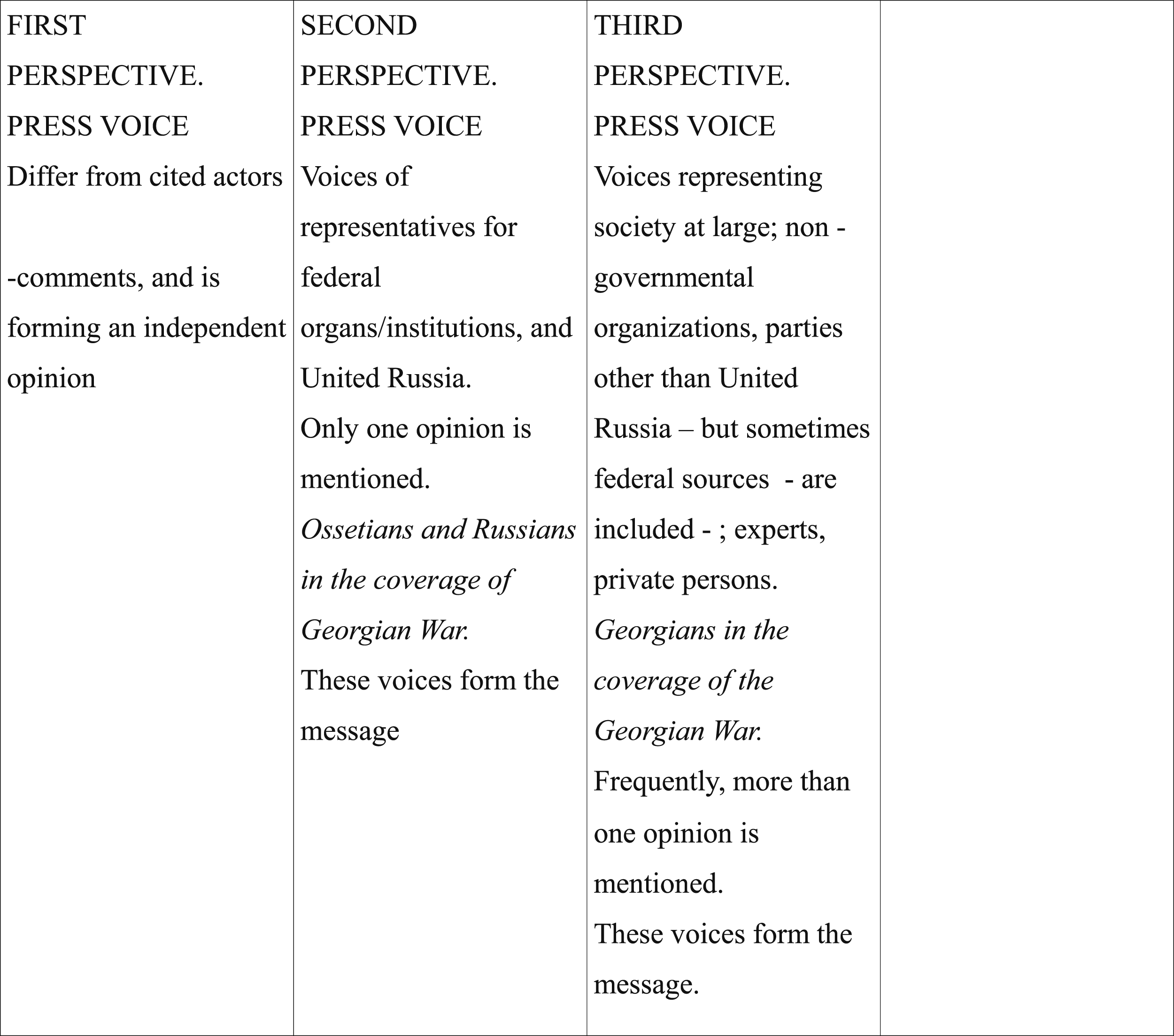
In total there were 145 articles distributed on four case studies.
44 articles on the 2008 Georgian war: Vesti 8; Vzgliad 7; Zavtra 6; Rossiiskaia gazeta 5; Novaia gazeta 5; Lenta 7; Kommersant 6.
35articles on the parliamentary election of 2011: Vesti 6; Vzgliad 5; Zavtra 3; Rossiiskaia gazeta 6; Novaia gazeta 6; Lenta 5; Kommersant 4.
31 articles on the 2014 Crimean crisis: Vesti 4; Vzgliad 3; Zavtra 4; Rossiiskaia gazeta 5; Novaia gazeta 1; Kommersant 3; Lenta 3; Meduza 8.
35 articles on the pension 2018 reform: Vesti 5; Vzgliad 5; Zavtra 4; Rossiiskaia gazeta 6; Novaia gazeta 4; Kommersant 5; Meduza 6.
2008 Article Text Examples
First Perspective
(1). ---‘Власти многих страны а также представители международных организаций в том числе ЕС и ООН выразили озабоченность происходящим и призвали всех участников конфликта прекратить огон.
Однако вопрос даже не в том, что они готовы (или что они могут) сделать, чтобы, по меньшей мере добиться перемирия. А в том, кто будет контролировать непризнанную республику, когда выстрелы стихнут. Если южносетинские и российские войска продолжат теснить грузинские подразделения с таким же успехом, то регион, очевидно, скоро окажется под полным военным контролем России'.---
---‘The authorities in many countries and also representatives of international organizations, among them the EU and UN, took alarm at the events and requested all participants to the conflict to cease fire. However, the question is not to do with what they are prepared to do (or what they can do), or; in order at least to achieve an armistice. The question has to do with who is going to control the non-recognized republic when the fighting has ceased. If the South Ossetian and Russian troops continue to successfully push back the Georgian formations, then the region will obviously end up under the full control by the Russians'.---
Various different voices and differing opinions precede the excerpt. Here, the press voice takes up an independent position on the issue.
(Lenta.ru, 08.08.2008. Headline: не удержались. The promise was broken).
Second Perspective
(2). ---‘Там же находился… генерал Марат Кулахметов. … Минувшей ночью, - сообщил Кулахметов, в зоне грузио осетинского конфликта с грузинской стороны применялось тяжелое вооружение.
… Однако наши источники в российском миноброны считают, что грузинский батальон - это уже не миротвортцы, а подразделение вооруженных сил Грузии, которые выполняют в зоне конфликта неизвестно какие функции. Не стоит забывать о том, что в самое трудное время именно российские миротворцы принесли относительный мир на землю Южной Осетии'.---
---‘And there was also… General Marat Kulakhmetov… . The night that passed, Kulakhmetov said, in the Georgian – Ossetian conflict zone, the Georgian side used heavy armament… . Still, our sources from the Russian Ministery of Defence believe that the Georgian battalion is not a peace-keeping force, but a formation of the Georgian armed forces and is serving an unknown purpose in the conflict zone. You should not forget that under the most difficult conditions it was the Russian peace keeping forces that brought about a relative peace on the South Ossetian territory'.---
A Russian military is indirectly quoted. Defence Ministry sources are represented indirectly.
(Rossiiskaia gazeta. ru, 08.08.2008. Headline: миротворцы в боевой готовности. Peace keeping forces ready for action).
Third Perspective
(3).--- Российские бомбардировщики полъностью разрушили несколько жилих домов, школу.
«Ты русская? Ну скажи, что там у вас говорят - будут нас еще бомбить?» (…).
Дорогу со стороны Цхинвали бомбили, объясняют мне (…).
Спустя немного времени с экстренным обращением выступил Mихаил Cаакашвили. Он заявил, что люди видели вовсе не русские танки, а грузинские отступающие из Гори. Он попросил не устраиватъ панику… (…).
Если психологическое воздействие на грузинское население было главной целъю российских бомбардировок, то можно сказатъ, что цель достигнута'.---
‘--- Russian bombers have completely wiped out some houses and a school’.
‘Are you Russian? Well tell me what they are saying there; are they still going to bomb us? (…).
The roads that reach out from Tschinvali have been bombed, they tell me. (…).
A while ago in an extraordinary appeal Michail Saakashvili spoke to the people. He said that people only had seen Georgian tanks – not Russian ones – withdrawing from Gori. He asked them not to panic… (…).
If the psychological effect on the Georgian population were the major aim of the Russian bombardments, then you can say that the mission has been completed'.---
A Georgian man is quoted. The Georgian President is indirectly quoted.
(Novaia gazeta. ru, 14.08.08. Headline: Колонна катафалков. Funeral processions.)
2011 Article Text Sample
First Perspective
(4).---‘Если им удалось вбросить свои бюллетени, то более 2310 бюллетеней поданных за Единую Россию в районе Хорошево-Мневники являются недействительными. Сколько человек участвует в подобных схемах по всей стране можно только догадываться'.
‘If they succeeded in stuffing the ballot box, then more than 2310 ballots cast for United Russia in the region Khoroshevo-Mnevniki become invalid. You can only make guesses as to how many people have participated in similar schemes around the country'.---
A number of voices precede the extract. Here, the press voice is taking an independent position on the matter.
(Lenta.ru, 04.12.2011. Headline: Карусель сломалась. The roundabout is broken).
Second Perspective
(5).
---‘Presidential aid Arkady Dvorkovitch announced: … -“ I do not consider manifestations the best way for citizens to express their position (…). Friends, anyone who attends a demonstration – please, take care.”
Russia’s representative at NATO, Dmitry Rogozin, expressed his view on the events after the election. -“From these controversies noone but Russia’s enemies will gain. I fear for the health of those who… attend the meeting of these provocateurs.”'---
Two high officials make statements that are directly quoted.
(Vzgliad.ru, 10.12.2011. Headline: Дворкович выразил свое мнение о митингах. Dvorkovitch spoke his mind about meetings (i.e. demonstrations).
Third Perspective
(6). ---‘В день выборов в Государственную Думу...интернет издании… предявлено обвинение о том что издания занимаются незаконной агитацией.
«Основная претензия к изданию… состоит в том, что Газета.ру публикует информацию о нарушениях Единой России»… (…).
(Эхо Москвы:) Главный редактор Алексей Венедиктов заявил, что сайт подвергся DDoS-атакам… .
Глава юридической службы ИД Коммерсант: «честно говоря, я вообще не слушал, чтобы чье -то заявление по поводу DDoS-атак было успешно расследовано». В ночь на 3 декабря почти на 12 часов була задержана исполнителный директор «Голоса» Лилия Шибанова, а ее ноутбук был изьят «для проведения экспертизы»'.---
---‘On election day for the State Duma, Internet sites… were accused of carrying out illegal electioneering. “The main accusation is that Gazeta. ru publishes information on violations related to United Russia…”
The chief editor (of Ekho Moskvy), Aleksey Venediktov, informed that the site had been subjected to DDos attacks… .
The head of the legal department of the Kommersant says “To be honest; I haven’t heard that anyone’s complaint about DDos attacks has been successfully investigated.”
In the early hours of the third of December, the Executive Director of Golos, Lilia Shibanova was detained for 12 hours, and her laptop was seized “for expert control.”’----
The represented voices in direct quotation belong to independent media organizations.
(Kommersant.ru, 05.12.2008. Headline: Интернет не пустили на выборы. Internet was not allowed on the election).
2014 Text Examples
First Perspective
No examples.
Second Perspective
(7). ---‘Совет Федерации дал согласие на использование Вооруженных сил России на территории Украины.
(…) Глава Комитета по конституционному законодательству Андрей Клишас сообщил… «Виктор Янукович лично обратился к верхней палате, и это является дла нас достаточным основанием чтобы поддержать обращение Владимира Путина…» (…).
Сенатор Вячеслав Штиров: ...События которые происходят на Украине это финал большой работы которая проводилась… с участием иностранных государств. «Немаловажную роль сыграли США»… . США… «вложило много денег,чтобы создать такую ситуацию. С другой стороны, Россия всегда занимала сдержанную и взвешенную позицию»… . В том, что сенаторы одобрят на внеочередном заседании обращение главы государства сомнении, практически не было'.---
---‘The Federation Council has approved the deployment of Russia’s armed forces on the territory of Ukraine.
…The head of the Committee for Constitutional Legislation Andrei Klishas said… “Viktor Yanukovitch personally turned to the Upper Chamber and that is enough ground to accept Vladimir Putin’s appeal…” (…).
Senator Viacheslav Shtirov (said) “...the events in Ukraine are the culmination of work involving… the participation of foreign states. The USA played an important role (he continues)… the USA… has invested heavily to create this situation. On the other hand, Russia has always adopted a restrained and carefully considered position.” There is practically no doubt that the senators will approve the appeal on the extraordinary session'.---
Through a long quotation, the head of an official committee is referred. Others follow. A web of voices appear. Press voice concludes on the basis these citations
(Rossiiskaia gazeta. ru, 03.03.2014. Спасти рядового гражданина. Saving the ordinary citizen).
Third perspective
(8). ---‘Cергей Лавров объяснил Джону Керри, что значит Крым для России, но тот не проникся.
По словам Сергея Лаврова, для России «Крым значит несоизмеримо больше,чем Фолкленды для Великобритании и Коморы для Франции».
Джон Керри заверил… что «США и мировое сообщество не признают результатов референдума в Крыму».
Ожидается, что сегодня США внесут на рассмотрение Совета бесопасности ООН резолюцию призивающую государства не признавать результатов референдума о судьбе Крыма. Россия же, как заверил «Ъ» источник в МИД РФ, эту резолюцию заблокирует'.---
---‘Sergei Lavrov explained to John Kerry what the Crimea means to Russia – but he failed to grasp the point. According to Sergei Lavrov, to Russia “the Crimea means incomparably more than the Falklands to Great Britain and to the Comores to France.” John Kerry declared that… “the U.S. and the world community will not acknowledge the results of the referendum in Crimea.” It is expected that the U.S. will propose to the UN Security Council a resolution calling for states not to approve the results of the referendum on the fate of the Crimea. Russia will, however, as a source in the Foreign Department told “Б (Kommersant)»,” veto this resolution'.---
Two high officials, of the U.S. and the Russian Federation, are directly quoted. An anonymous source is indirectly quoted.
(Kommersant.ru, 15.03.2014. Headline: И разошлись как в черном море корабли. And they disappeared like ships on the Black Sea)
2018 Text Examples
First Perspective
(9). ---‘Фактчек
Коротко. В 1990-е було не так страшно; в любом случае, сравнивать те демографические проблемы с Великой отечественной войной - просто неверно. Проблемы пенсионной системы связаны не только с демографическими проблемами'.---
---‘Fact check.
In short. In the 1990s it was not that bad; in any case, comparing the demographic problems of the 1990s to those of the second world war is plain wrong. The problems of the pension system are connected not only with demographic problems'.---
Different pro – and con voices on the issue precede the excerpt. Here, the press voice takes an independent position.
(Meduza.io, 29 August, 2018. Headline: Повышать пенсионный возраст приходится из-за потерь Великой Отечественной Войны и тяжелых 1990-х годов. It is necessary to raise the age limit for pension due to the losses of the Second World War and the difficult 1990s.)
Second Perspective
(10). ---‘Глава российского правительства Дмитрий Медведев заявил, что кабмин предлагает поднять возраст выхода на пенсию в России до 65 лет для мужчин и до 63 лет для женщин. Премьер подчеркнул, что нормальный уровень жизни пенсионеров на долгосрочный период можно обеспечить, только приняв дополнителные меры (…).
В правителъстве России давно ведется активное обсуждение пенсионной реформы. Президент Владимир Путин… напомнил, что «всегда относился к этому в высшей степены осторожно и адекватно». Вице премьер Татьяна Голикова говорила, что… контуры обновленной пенсионной системы будут отработаны в ближайший год, а пенсионное обеспечение в стране должно состоит из двух частей… ’.---
---‘The head of the Russian government Dmitryi Medvedev stated that the Cabinet proposes to increase the pension age by which you may go into pension in Russia to 65 for men, and to 63 for women. The PM underlined that in the long term a normal standard of living for pensioners could be guaranteed only by taking additional measures.
In Russia’s parliament one is working very actively on the pension reform (…).
President Vladimir Putin noted that “I have always approached this question with the utmost caution and consideration.” Deputy PM Tatiana Golikova said that… the outlines of the revised pension system will be drawn up during the next year, and the pension of the country should consist of two parts… '.--
Two high officials are indirectly quoted. The President is directly quoted. Other official voices appear – and the web of voices gives expression to a hierchiazation of voices
(Vzgliad.ru, 14.06.2018. Headline: Медведев предложил поднять возраст на пенсию. Medvedev has proposed an increase of the pension age).
Third Perspective
(11). ---Пенсионному реформу не одобряет 92% россиян. Несмотря на это, Госдума планирует принять правительственный законопроект о повышении пенсионного возраста.
«Мы должны очень скрупулезно подойти к обсуждению реформы. Мы должны подходить конструктивно, а не мгновенно…!» заявил на сессии спикер омского парламента Владимир Варнавский.
Сдержанно критиковал правительственный законопроект… губернатор региона Александр Бурков… «В той редакции,которая есть сейчас, я не давал согласия на эту реформу». Так поступил(и) врию главы Приморского края Андрей Тарасенко. Например Тарасенко высказался так «Сегодня не поддержать реформу - это убийство для дальнейшего развития этой идеи. Этой реформой мы даем уважение своим отцам и родителям»---.
---‘92% of Russians do not support pension reform. “In spite of this, the State Duma plans to approve the government’s proposed law project on raising the pension age.” We must adopt a very careful approach to the discussion of the pension reform. “We must be constructive, and not immediately… !” the speaker of the Omsk regional parliament Vladimir Varnavskii said at a session. “The governor of the region, Alexander Burkov, delivered a restrained criticism of the government project.” - In its present version, “I would not approve the reform” (…) the acting head of the Primorsk kraj, Andrei Tarasenko reacted in the same way. For example, “Tarasenko made the following statement”: If we don’t support this reform today, it will be like killing off the further development of the idea. With this reform, “we are honouring our fathers and our relatives”’.---
Regional power holders are referred in direct speech
(Meduza.io, 16.07.2018. Headline: Пять стратегии региональных властей. Five strategies of the regional official administrations).
Summary and Conclusions
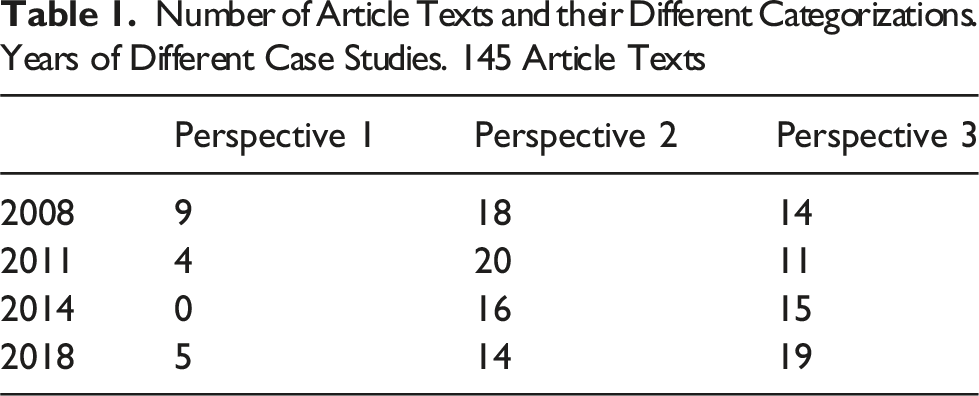
There is a sliding scale of journalistic representations from 1 to 3.
Number of Article Texts and their Different Categorizations. Years of Different Case Studies. 145 Article Texts
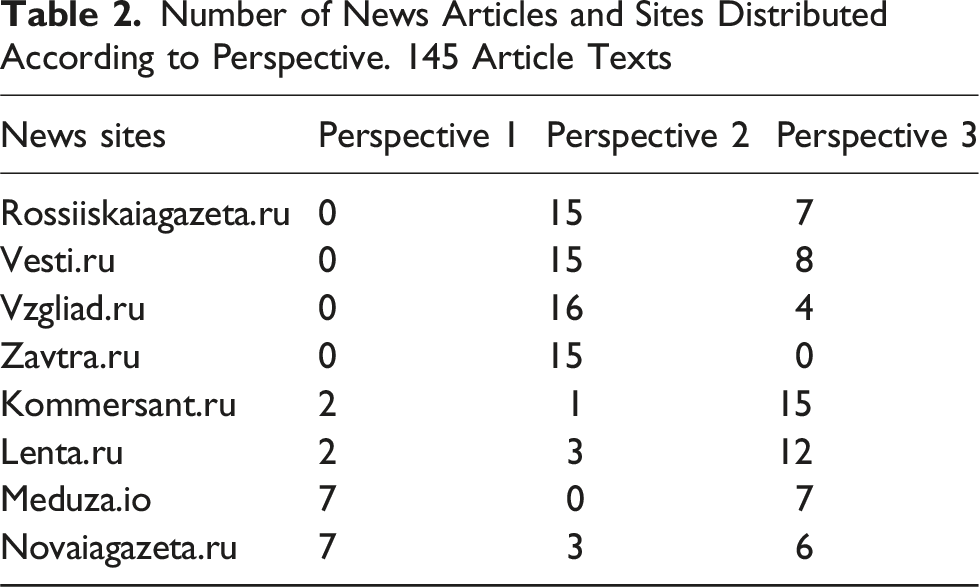
Number of News Articles and Sites Distributed According to Perspective. 145 Article Texts
Further, the article texts have on the whole similar features as regards reporting clauses. To pretty much the same extent, they use direct and indirect speech. Rossiiskaia gazeta, Zavtra, Vesti and Vzgliad have, however, a propensity to reserve direct speech for the highest officials – not least President Putin. Where there is talk about Putin he is always directly quoted. Reporting verbs are however practically without exception neutral. Press voice is generally identified.
In terms of style, the sample texts do not differ in any important respect. They vary between a fairly literary style and a colloquial style throughout. As pertains modality features, there is a certain dominance of objective modality and categorical assertions in especially Rossiiskaia gazeta. In this case claims about the world are not open to contestation, and have a tendency to take on the role of unquestioned assertions.
As to perspectivation, only Meduza. io, Novaiagazeta. ru, Kommersant. ru and Lenta. ru form their own opinions on subject-matters, and they also let a plethora of voices speak their views in articles. In contrast, Zavtra. ru, Rossiiskaiagazeta. ru, Vzgliad. ru and Vesti. ru practically only give voice to government officials, United Russia and supporters thereof. There is a clear demarcating line between these two categories of news sites in this respect. The results of the analysis of the pro-government materials – Zavtra, Rossiiskaiagazeta, Vesti and Vzgliad – indicates strongly that alternative political standpoints are not revealed by means of the use of references – more or less biased – to different political actors. Views are manifest by excluding alternative voices. To be sure, this does stifle reader interest and curiosity of other worldviews.
What implications does this have in terms of audience relationships to the political world?
As we saw, both a large part of journalistic notions and the general public have expectations that journalism should not be objective, nor that it should conform to any concept of western journalism. In addition, there are also attacks against media outlets and individual journalists.
The readers of Zavtra. ru, Rossiiskaiagazeta. ru, Vesti. ru and Vzgliad. ru can, as a rule, clearly demarcate between voices, direct and indirect speech is used, neutral reporting verbs and mostly a colloquial style is maintained. But most often, voices of state power dominate messages. In terms of the overall results, they show little variation. No criticism of state policies is to notice. In this respect, they are practically following a straight line from the Communist period. The implied citizen role for the readerships of these news sites, even if they are not equal on all points, is therefore to equal ‘functional reception'.
On the contrary, readers of Novaiagazeta. ru, Meduza. io, Kommersant. ru, and Lenta. ru can read pieces of news sites that form their own opinion, distinct from actors cited. Further, they may read about a multitude of actors having different, and critical, views on matters. In addition, they show several positive characteristics as regards modality, reporting clauses and style. As regards use of sources, we can conclude that the type of journalism, or journalistic role, that above was discussed in Slavtcheva-Petkova (2019) and Bodrunova et al. (2021), seem to be practiced in those news sites. Accordingly, these sites practice a journalism that has advanced beyond the democratized post-Soviet press. They make up sites that give expression to ‘critical reflection’. In their discourse representation, they make use of a
We can finally establish that Pasti et al.'s (2022) contention that the norm of monitoring political power holders has failed in national level journalism around 2017, is rather precipitated. On the contrary, as we have seen, we find that very function by Meduza, Novaia gazeta and Kommersant, and earlier in coverages by Lenta.
The above conclusions are relevant to the investigated news sites in the Russian public sphere until 2018-19. Subsequently, measures were taken against Kommersant. ru, and their staff was changed for a more pro-government one. Furthermore, Meduza. io and Novaiagazeta. ru have been blocked during the current Ukraine war.
It is, however, possible that the situation for the investigated sites gradually, sooner or later, returns to the former state, once the war is over.
At any rate, we saw that in spite of the fact that there are negative conditions for free journalism, a number of news sites contradicted the notion of partisan and biased media. They were using plurality of viewpoints in their representations of subject-matters. It falls outside the scope of the present investigation – but it would seem that these news sites were operating in a more open and democratic fashion than most of their western counterparts. Doubtlessly, a research project investigating this aspect of Western journalism could be worthwhile.
Footnotes
Acknowledgements
Dr. John Dunn for checking the Russian translations.
Declaration of Conflicting Interests
The author(s) declared no potential conflicts of interest with respect to the research, authorship, and/or publication of this article.
Funding
The author(s) disclosed receipt of the following financial support for the research, authorship, and/or publication of this article: This work was supported by the Funding for the present project was received by the Olle Engkvist Foundation. Post doc grant by the Wenner-Gren Foundation to Glasgow (CRCEES) 2010-2012. Substantial grants received by, for example, the Margaret Ax:son Johnson Foundation and the Olle Engkvist Foundation. Currently at European Studies, Lund University.
