




Abstract
Working (or volunteering) in a Lithuanian Saturday (or Sunday) school abroad is difficult. Teachers must balance work, family, and teaching in those schools, give up their free time to prepare for classes, and spend Saturdays working. Some of them need to find not only teaching materials, but also a place for teaching. Moreover, some parents often have very high expectations for the school—they do not speak enough Lithuanian at home, or not even at all, but they expect that the school will teach their child to speak it fluently in a half of a day. In addition, the Lithuanian language is a quite rare, non-international language for teaching and learning of which another motivation needs to be found rather than size, usefulness, and prestige. However, the number of schools abroad not only do not decrease in number, but every year more and more are established, and in more distant countries. The fact that this number of schools is growing tells us that teachers who want to take on the challenge can in fact be found. This article aims to find out why people choose to work or volunteer in these schools, what brings them there, and what keeps them there—what is their motivation. This article is based on the data of a quantitative survey about Lithuanian Saturday school teachers’ attitudes and motivation (2021–2022).
Keywords
Introduction
A large wave of emigration flooded from Lithuania following the restoration of its independence on 11 March 1990, and it was only 2018 when the numbers of emigration started to significantly decrease (Migration in numbers, 2024). In recent years, due to the changes in world politics, there has even been more immigration into Lithuania recorded, rather than emigration from it. Yet during the times of vast migration, when nearly 600,000 people emigrated from the country, the issues of sustaining the Lithuanian language and culture abroad in diasporas had become deeply important for these migrants. These issues also proved to be important to the Lithuanian community domestically, as native Lithuanians tend to expect the children of emigrants to be able to speak their heritage Lithuanian language to their grandparents, aunts, uncles, cousins, there is hope that the world will not see a decline in people who speak the language. These issues caught the attention of scientists as well, as research on language politics and management in Lithuanian emigrant families and communities has been conducted, along with research on why families choose to teach or not to teach their children their heritage language, how multilingualism is developed if it’s chosen to be developed, and what determines success or failure.
The history of Lithuanian Saturday schools (LSS) abroad has deep roots, the first one documented being built in 1888, in the United States of America. Many rises and falls in the number of these schools followed, but latest records show the impressive number of 285 LSS operating in 44 countries around the world, attended by over 11,000 children in the year 2023 (Lithuanian Ministry of Foreign Affairs, 2024; Universal Lithuanian Encyclopedia, 2024). The numbers keep growing. For comparison, in 2007 there were 177 schools recorded in 32 countries. It’s worth noting that this number was largely increased by the COVID-19 pandemic, during which a number of virtual schools were established. “There are currently over 1000 teachers teaching in Lithuanian Saturday schools worldwide” (Zykutė, 2023). Most LSS are established in places that see a larger concentration of immigrants from the older waves of Lithuanian emigration, as well as places that were popular destinations for the latest wave of migrants: Spain (12), Ireland (14), Norway (15), Russia (15), Germany (17), Sweden (17), the United States of America (40), and the United Kingdom (53). This is official data provided by the Lithuanian Ministry of Foreign Affairs (Official Registry of Lithuanian Education Institutions, 2024). Understandably, there are more schools that are simply unregistered, operating in small circles of like-minded individuals, for example, among a few acquainted families. However, it is believed that these numbers are close to the factual reality, because it’s beneficial for schools to register as they are then aided with methodical or other type of help. The large majority of these schools operate relying on volunteer work, with most of the heritage language teachers volunteering without pay, and the rest receiving pay that is merely symbolic.
The history of LSS (more on that in section “Context: A brief history of Lithuanian Saturday schools”) shows that there has always been a shortage of teachers, and that they would usually work for minimal pay if even that was available. So why would they still agree to work there? That is the aim of this research—to find out LSS heritage language teachers’ motivation to work or volunteer in these schools based on self-determination theory. To achieve this goal, the following research questions have been examined in detail: (1) Motivation to begin working or volunteering. (2) External motivation – while many LSS operate on a volunteer basis, it was decided to find out what was the effect of material rewards on the motivation. (3) Hardships and motivation to keep teaching or volunteering.
Methodology
This article analyses data from an online survey about LSS heritage language teachers’ attitudes and motivation (2021–2022) in Lithuanian diasporas. The method of quantitative survey data analysis has been applied along with qualitative analysis of open-ended answers. Self-determination theory was the theoretical basis while creating the survey and analyzing the respondents’ answers during the research.
Motivation in self-determination theory
In the field of applied linguistics, the majority of research on motivation relates to motivation while learning a second language, as it is recognized that motivation is a key factor in determining success in second language acquisition. As said by the author of one of the most prevalent theories on second language acquisition motivation Zoltan Dörnyei (1994, 1998), most researchers agree that “motivation is responsible for determining human behavior by energizing it and giving it direction,” while “motivation theories in general seek to explain no less than the fundamental question of why humans behave as they do” (Dörnyei, 1998, p. 117). While defining motivation, researchers usually note its dynamic nature. As Dörnyei expresses, motivation is a “process whereby a certain amount of instigation force arises, initiates action, and persists as long as no other force comes into play to weaken it and thereby terminate action, or until the planned outcome has been reached” (Dörnyei, 1998, p. 118). Motivation impacts all human behavior and decision-making. The author also notes that “one of the most general and well-known distinctions in motivation theories is that of intrinsic versus extrinsic motivation. <…> The first type of motivation deals with behavior performed for its own sake, in order to experience pleasure and satisfaction such as the joy of doing a particular activity or satisfying one’s curiosity. The second involves performing a behavior as a means to an end, that is, to receive some extrinsic reward (e.g., good grades) or to avoid punishment” (Dörnyei, 1998, p. 121).
Although Dörnyei’s theory is usually used in applied linguistics, this study was based on a different theory—self-determination theory. While Dörnyei’s theory analyses the learning of a foreign language, this study takes a different perspective—the voluntary choice to teach a heritage language. Self-determination theory has “become a highly influential theory of human motivation and well-being with a vast body of research evidence. It offers a blueprint for understanding the motivational basis of personality and social behavior, and of the relation of basic psychological needs to well-being, psychological flourishing, and high quality of life” (Maggino, 2022). Its developers are psychologists Richard M. Ryan and Edward L. Deci. The theory distinguishes between autonomous and controlled motivation: “To be autonomous involves acting with a full sense of volition, endorsement, and choice, whereas, to be controlled involves feeling externally pressured or compelled to behave whether by the promise of a contingent reward, fear of punishment, ego involvement, or other external factors. Hundreds of studies have shown that when people are autonomously motivated, either by intrinsic motivation or well-internalized (thus autonomous) forms of extrinsic motivation they display higher interest, excitement, vitality, and confidence, resulting in better performance, creativity, persistence, and overall well-being” (Ryan & Deci, 2017).
Self-determination theory also postulates that “there are basic psychological needs that universally must be satisfied for people to experience ongoing growth, integrity, and wellness, namely, needs for competence, autonomy, and relatedness” (Maggino, 2022). Ryan and Deci (2017, pp. 10–11) define these needs as follows:
These three basic needs were “initially identified functionally because they served well to integrate the results of behavioral experiments concerning the effects of environmental events and interpersonal contexts on intrinsic motivation and the internalization of extrinsic regulations” (Ryan & Deci, 2017, p. 11). This theory on the construct of motivation was the theoretical basis while creating the survey and analyzing the respondents’ answers during the research.
Principles of questionnaire design
Survey composition.
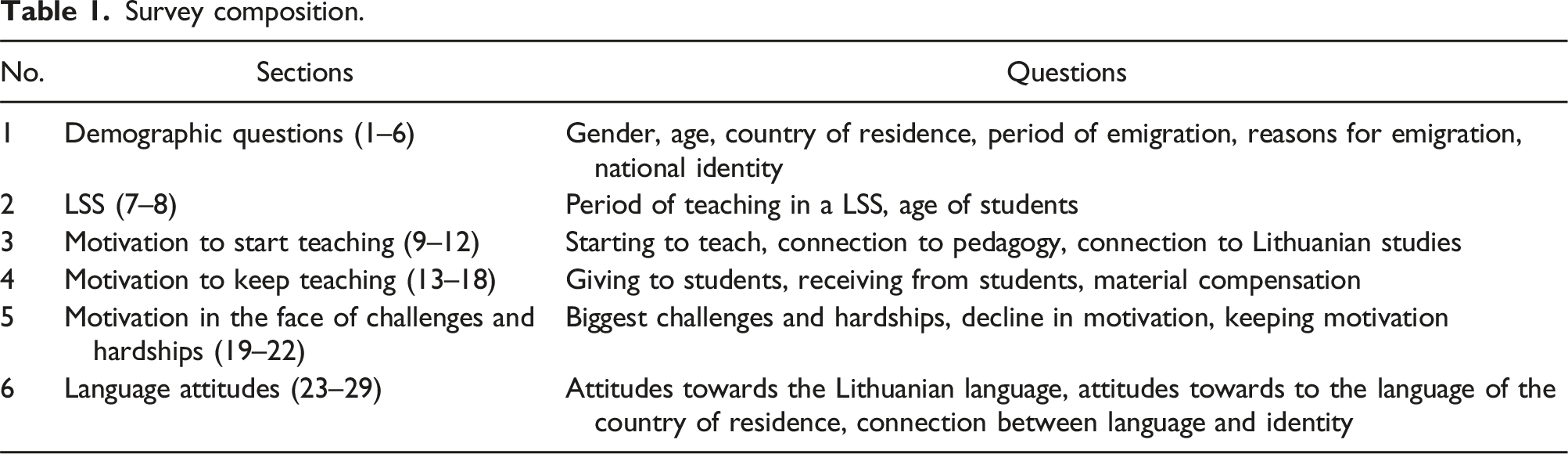
Though the number of open-ended questions was quite large, most of the respondents answered all of them. The end of the survey contained a section for additional comments if the respondents were to have any, which some of them did use. This article contains analysis of the respondents’ answers regarding their motivation to teach heritage language in LSS.
Participants
92 respondents participated in the study, all of them being women. The age of the respondents ranged between 24 and 76 years with the average being 42. Their period of emigration ranged between 3 and 26 years, with 2 of the respondents having lived outside of Lithuania all of their lives. The period of teaching in LSS ranged between 0,5 and 24 years. The respondents’ countries of residence reflected the trends seen in migration destinations for Lithuanians of the post-war and contemporary emigration waves, apart from some countries with long histories of ethnic Lithuanian population (Belarus, Poland). The respondents were residing in Lithuanian diaspora in 20 countries: the United Kingdom (13), the United States of America (12), Ireland (9), Australia (9), Norway (8), Germany (7), Denmark (7), Spain (5), Iceland (3), Italy (3), Sweden (3), Lithuania (2), France (2), Singapore (2), Turkey (2), Belarus (1), Greece (1), Poland (1), Luxembourg (1), Switzerland (1). The two respondents residing in Lithuania were teaching in online LSS at the time of the study.
Data collection procedure
Half of the material has been collected during the summer internship project funded by the Research Council of Lithuania (2021, grant agreement No. 09.3.3-LMT-K-712-24-0206), and the other part has been collected a year later to cover more countries and different age groups (2022). The quantitative survey was performed by distributing it to eligible respondents online. The respondents were gathered by employing convenience sampling and snowball sampling.
It must be admitted that there were difficulties in collecting the data. Although the questionnaire itself was not long, it was difficult to find respondents. In 2021, letters were sent to LLS in the diasporas, but in most cases, there was no response. In 2022, a training online was held for heritage teachers of LLS and after the training teachers were asked to fill in the questionnaire and to send a link to the questionnaire to teachers they knew. But the target of 100 questionnaires was not reached. However, the authors are also satisfied with the 92 responses collected, as both cover many countries, different age groups and different lengths of time spent in school. There are very few men working in schools, so it was not expected that there would be an equal number of men and women, but no questionnaires completed by men were received.
The authors of this article express great gratitude to every heritage language teacher who participated in the study, especially because they already spend a lot of time in LLS and preparing for lessons.
Context: A brief history of Lithuanian Saturday schools
The history of LSS (Universal Lithuanian Encyclopedia, 2024) begins at the end of the 19th century and the beginning of the 20th, when economic migrants of that wave built catholic churches with schools alongside them. These schools were places not only for children to learn Lithuanian, but for their parents to learn valuable skills as well—to read and write in Lithuanian, to count, to speak the language of their residence, they could even be taught accounting or knowledge crucial to obtain citizenship where they lived. The schools served as learning centers for children and adults, taking up huge importance in the lives of migrant families. The teachers of these schools were often priests, monks, and other educated people. A lot of these schools were established in countries in North and South America with their numbers peaking around the year 1935. It’s important to note that LSS in these times also experienced a shortage of teachers, as stated by Indrė Karčiauskaitė (2008, p. 120): “Unfortunately it was difficult to establish schools and find teachers to work in them. Lithuanian teachers were scarce, especially ones who would agree to work for such a small pay. Keeping laymen teachers was a huge financial burden for parishes, as many of them were already drowning in debt.” In 1907, a women’s convent was established specifically for this goal of working with children, teaching them the Lithuanian language, culture, and spiritual practices—the Sisters of Saint Casimir.
The second impulse to build new LSS or to revive old ones came from refugees of World War II, the post-war emigration wave after 1945. In the beginning most of the schools were built alongside displaced persons camps in Germany, as well as Austria, France, and the United Kingdom. These schools also suffered a difficulty to find teachers and to offer them payment: “Work without pay had a negative effect on organizing all education efforts. It was difficult to draw people into teaching, and to draw young women into helping out with kindergarteners” (Karčiauskaitė, 2008, p. 125). Later on, the problem saw some level of solution when Germany stepped in to solve the pay issue. These schools were particular in their idealistic goal to follow the Lithuanian education system in their practices. The schools employed educated people, often with pedagogic qualifications—similarly to schools in Lithuania at that time.
Later on, when Lithuanian migrants were granted permission to leave displaced persons camps and move to other countries, LSS were being established in every place that saw a significant volume of Lithuanian immigration: the United States of America, the United Kingdom, Australia, Canada and elsewhere. These schools were also usually built alongside Lithuanian parishes, with monks playing important roles in their activity. These were often Jesuits, Marians of the Immaculate Conception, as well as monks of other catholic orders. There were a lot of LSS at that time. They tended to rely on idealism and volunteer work. Teachers, as always, were sparce. In 1969 Antanas Masionis wrote (citation from Karčiauskaitė, 2008, p. 129): “There are still many places where teachers are not considered human beings, rather they’re perceived as some sort of ‘symbols’, it’s believed that a teacher can survive from a ‘symbol’. If the parents who hold such beliefs were given the same symbolic pay to work, especially on Saturdays, they would immediately quit that job and look for another one. Of course, teachers don’t just live from that symbolic pay they get at the school, but nevertheless they are still human beings…” Lithuanians living in the United States of America came to realize that Lithuania would not regain its independence soon and not enough teachers would come from there to work at LSS. To avoid the shortage, they even established the Institute of Lithuanian Studies which was later recognized by the state of Illinois. The number of LSS established by this wave of migrants peaked around the year 1960, after which the numbers started to decline, though some of those schools have kept their popularity and importance even to this day. Gradually the schools also moved away from the idealistic goal of following the Lithuanian education system in their practices.
Along with the current migrant wave after the restoration of Lithuania’s independence in 1990, many countries saw the establishment of new LSS as well as the revival of schools established by the post-war migration wave of the mid-20th century, and even some schools that were established by the earlier migrant wave in the early 20th century. Similarly to the schools established by the post-war migration wave, these schools were usually relying on volunteer work, and were developed by migrant parents and other proactive members of the Lithuanian migrant communities. However, there was a shift in the schools’ relationship to churches. Part of them were still connected to Lithuanian parishes, but a significant part of them were not connected to churches or parishes at all. Also, though the need for LSS stayed the same, migrants of the current wave often don’t establish official organizations. These schools are often unofficial, and their administrative communities are prone to change. The teachers in these schools are educated people, but often don’t have pedagogic qualifications. A large number of new schools were established in places that were not popular migration destinations for the previous Lithuanian migrant waves, such as Norway, Ireland, and Spain, even remote countries such as Japan, India, or Cyprus. Though all Lithuanian migrant waves faced the same challenge of keeping the Lithuanian language alive in emigration, this “new generation, affected by developments in technology and cosmopolitism, also requires a modern way of approaching ant teaching identity” (Bagdonavičienė, 2012, p. 26).
It is also important to note that from the middle of the 20th century general education schools, where the language of instruction was Lithuanian (either fully or partly), started being established, with the acknowledgment and support of the Lithuanian World Community and the Republic of Lithuania. These schools were established in countries with a long history of ethnic Lithuanian communities: Latvia, Poland, Belarus, Russia, and Germany. There are also schools in Europe which are built for children of officials in the institutions of the European Union, where part of the curriculum is teaching children their heritage language, in this case, Lithuanian.
Literature review
LSS of the late 19th to early 20th, and the mid-20th century have drawn the attention of many researchers. Particularly the schools established by the wave of refugees of World War II, the network of schools they created in displaced persons camps in post-World War II Europe, and in the United States of America once they were allowed to leave those camps (e.g., Tumėnas, 2008, p. 8). This was in large part due to the vast number of written sources left by the post-war migration wave, as they had published many books and magazines. Most of this research was conducted by employing the principle of historiographic analysis: describing who established what school, under what circumstances, what teachers worked there, who donated their time and money to the schools, what was the curriculum like, what textbooks they used, what was missing in the schools and what were the problems they faced. This resulted in detailed statistical data and a view of the schools’ context, along with fascinating quotes that described the experiences of those who established and worked in the schools, derived from publications of that time. In some cases, this historiographical approach has been used to analyze LSS built abroad by all three waves of Lithuanian migrants (Karčiauskaitė, 2008, pp. 117–141), and in some are also included schools that were established by World War I refugees in Russia (Bagdonavičienė, 2012, pp. 19–26). However, the question of why people agreed to teach in LSS has not been raised in previous research. It was taken as a given, relying on the unquestioned principle of the teachers’ supposed innate need to keep the Lithuanian language and culture traditions alive, without delving deeper into the topic of their motivation. Even though it is noted that finding and preparing teachers to work in LSS has always been a great issue.
For the post-war migration wave, maintaining the Lithuanian ethnic identity was inseparable from knowing the Lithuanian language. As one of the forementioned researchers of LSS history in the United States of America notes: “One of the key factors in keeping the Lithuanian ethnic identity alive in emigration was keeping the Lithuanian language alive. It was important that Lithuanian wouldn’t become a language used only for conversing with grandparents or chatting at the kitchen table, and for that reason LSS were needed” (Tumėnas, 2008). So, a Lithuanian person was regarded as inseparable from the Lithuanian language, and the language itself had to have several registers in order to be considered truly alive. Using it for domestic conversing at home was not enough. This idea of innate connection between language and ethnic identity, though widely discussed, persisted in Lithuanian migrant communities. For the children born in immigration, their native country was the country where they resided, unlike their parents. Even though that was the case, there were no signs of shifting to the idea that a Lithuanian person could fully keep their ethnic identity without speaking the Lithuanian language: “The spread of a suitable Lithuanian language program is our goal, from which we cannot and will not back down” (Kazys Mockus, 1956, citation from Karčiauskaitė, 2008, p. 127). It was not only the desire to keep the language alive in emigrant families that was important to the post-war migration wave. A great deal of importance was also felt to keep the Lithuanian language alive in general. Post-war emigrants feared that “Lithuanians back in Lithuania could become Russified under the occupation of the Soviet Union, and lose their language in its entirety”, also, keeping the Lithuanian language alive was “a matter of honor and dignity”, “a way to show their resistance to the soviet occupation and their desire to regain Lithuania’s independence” (Jakaitė-Bulbukienė, 2015, p. 109). The terms “language policy” or “language management” are not mentioned in this type of historiographical research; though, a recognition of the principles they describe can be seen. Language policy and management is generally described, but unquestioned—as if it is a given that it is supposed to be that way, and not another. The research provided in this article takes a different approach than previous efforts, by analyzing the point of view of the teachers themselves.
A large collective of authors in Lithuania—the authors of monographs “Emigrants: Language and Identity” in (Ramonienė, 2015) and “Emigrants: Language and Identity II: Four Sociolinguistic Portraits” (Ramonienė, 2019)—has provided detailed analysis regarding the matters of language and identity in current emigrant communities. Their research explored emigration history, growing up in emigration, raising multilingual children, and the challenges faced by multilingual families, analyzing the perspectives of parents and grown children. Though there were few LSS teachers’ perspectives analyzed in these monographs, with most of the information about them drawn from the stories of parents and children who encountered them. Research showed that the key factors in keeping the Lithuanian language alive in emigration were language management within families, community support with the help of LSS, as well as a strong connection to the country of origin, in this case, Lithuania. A LSS is the place where a child can not only expand their knowledge of the Lithuanian language and culture, but also where they can encounter situations in which a different register of communication is required, rather than what they encounter at home. They can use LSS to figure out how to speak Lithuanian to adults who are not related to them, how to express themselves with different levels of formality. They also meet children who are close to their age, which provides an environment where they can make friends with similar backgrounds and values—this can help with feelings of isolation, as the children come to understand that they are not the only ones who use Lithuanian at home (K. Jakaitė-Bulbukienė, 2015).
The majority of research aimed at analyzing Lithuanian emigration in the early 20th century and the post-war period tends to view a community as a whole, making general conclusions about what goals it did or did not achieve. However, authors of current research are more often interested with exploring the perspectives of singular people or families, taking macrolevel and microlevel language policy and management into regard. They are also less timid about discussing instances in which desired outcomes are not achieved in families, as well as instances in which outcomes are not what society might deem successful, for example, unharmonious bilingualism (Hilbig, 2020).
Data analysis results: Motivation to work or volunteer as a heritage language teacher in a diaspora Lithuanian Saturday school
Motivation to begin working or volunteering
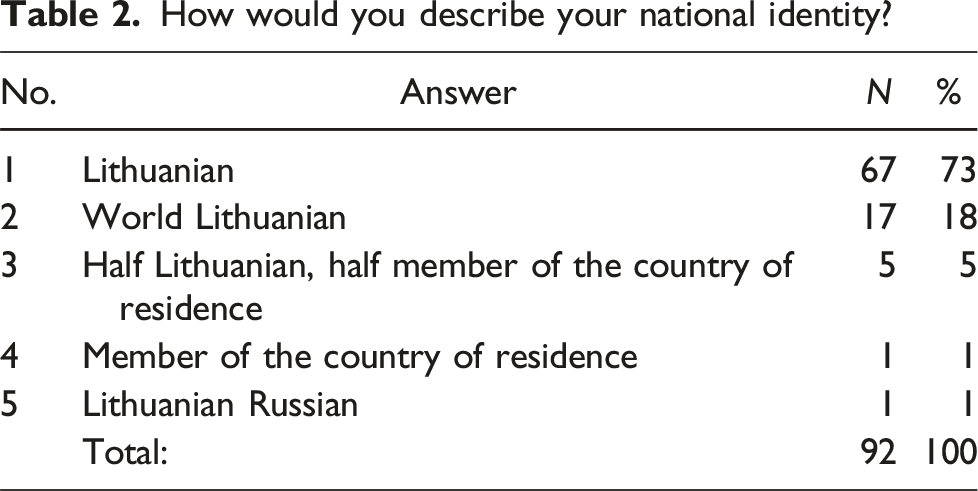
The first goal of the study was to find out what motivated the respondents to begin teaching in LSS. The aim was to find out what was the participants’ connection with Lithuania, their relationship with the Lithuanian language, whether they came to the LSS on their own initiative, or whether they were asked or even forced to come by someone else, also, whether they had previously studied pedagogy or worked as teachers.
How would you describe your national identity?
Does the Lithuanian language sound pleasant and beautiful to you personally?
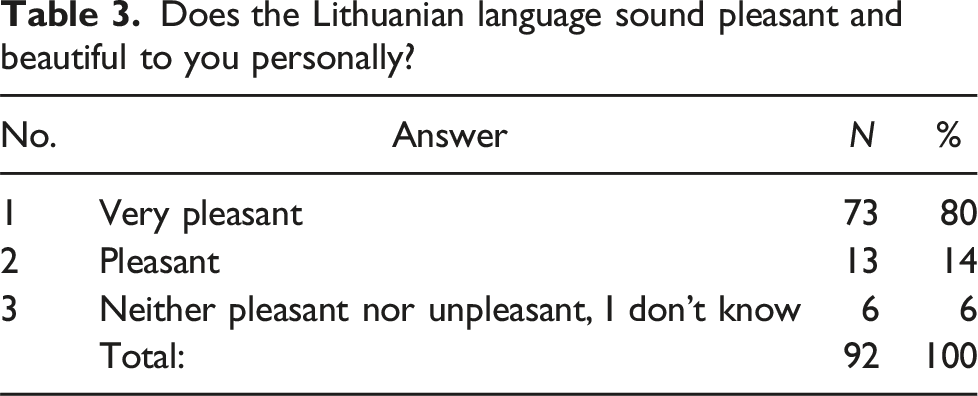
Finnish researchers have also found that teachers of various heritage languages working in Finland strongly identify with the language and country of their origin: “The teachers in our study gave a very high score when asked about their identification with the language, the culture and their students” (Ansó Ros et al., 2021, p. 11).
Was your decision to start working in a Lithuanian Saturday school completely voluntary, or were you influenced or encouraged by external factors?
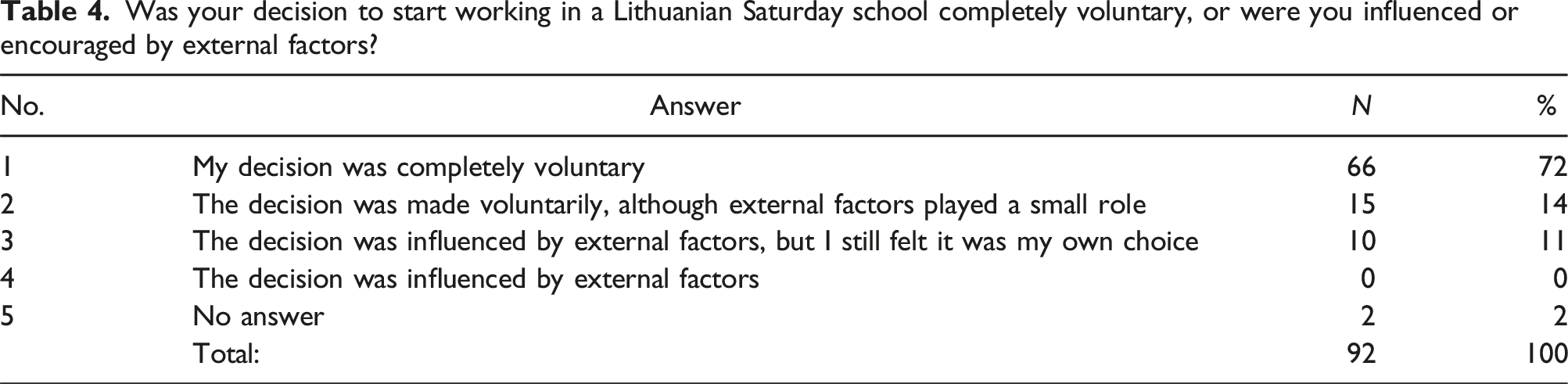
The open-ended answers showed different reasons for coming to work at the school. They revealed the attitude that identity is maintained through language (1), a partly pragmatic attitude that by teaching their own children, and creating a Lithuanian environment for them, the teachers can also help others to learn Lithuanian (2). The open-ended answers also showed the desire not to lose that which had already been created (3), and that those who want to start working in a LSS sometimes need encouragement from the outside (4). The post-war emigration wave was particularly characterized by a sense of duty to maintain the Lithuanian language, and this attitude connects the modern wave of emigration with the post-war wave, the word “duty” is also used, as you can see in example 3. 1. I wanted to maintain my identity and the identity of others through the Lithuanian language.
1
2. I wanted to teach my child at the same time. 3. I felt duty to maintain the school in our town. I have been a member and a president of the community board for 10 years. 4. I started because I was invited. After so many years, the motivation is different.
The survey was based on the assumption that people who had studied pedagogy or worked as teachers in Lithuania would not be able to do such a job in their new country of residence, at least at the beginning of their life in emigration. Therefore, they might want to transfer their knowledge and skills to LSS, as a way to satisfy their need of competence, and it would most likely be easier for them to start working in these schools. Of course, situations may vary—perhaps some respondents continue their teaching activities in emigration or have obtained teaching qualifications in their new country of residence, so the questions were asked in a multiple-choice format with the opportunity to select several answers.
Table 5 shows that a very high proportion of LSS teachers have a connection to the field of education: only one third of the respondents had no connection to it at all, while two thirds of them had some type of connection, either because they had worked or are working as a teacher, or because they had studied or are studying pedagogy. This suggests that teaching experience and subjects studied are also factors in coming to teach in LSS. Interestingly, among the 13 respondents who expressed a dream of becoming a teacher, only 2 had previously studied education and none had ever worked as a teacher. The open-ended answers also reveal that factors such as pedagogical knowledge (5), teaching experience (6), and even family tradition (7) are among the most important factors in the decision to start working in LSS. Although it can happen in reverse, for some, working in a LSS leads to working in a school in the country of residence (8). 5. I hold a diploma in theatre direction, certificates in separate pedagogy courses and lectures, and experience in working with pre-school children. 6. I have previously worked as a lecturer/teacher in Lithuania, and I am drawn to this field. 7. I studied pedagogy, I used to work as a teacher, and both of my parents were teachers. 8. When I started working in a LSS, I changed my profession and became a teacher. Apart from Lithuanian Saturday school, do you have any other professional connections to the field of education? (More than one answer is possible).
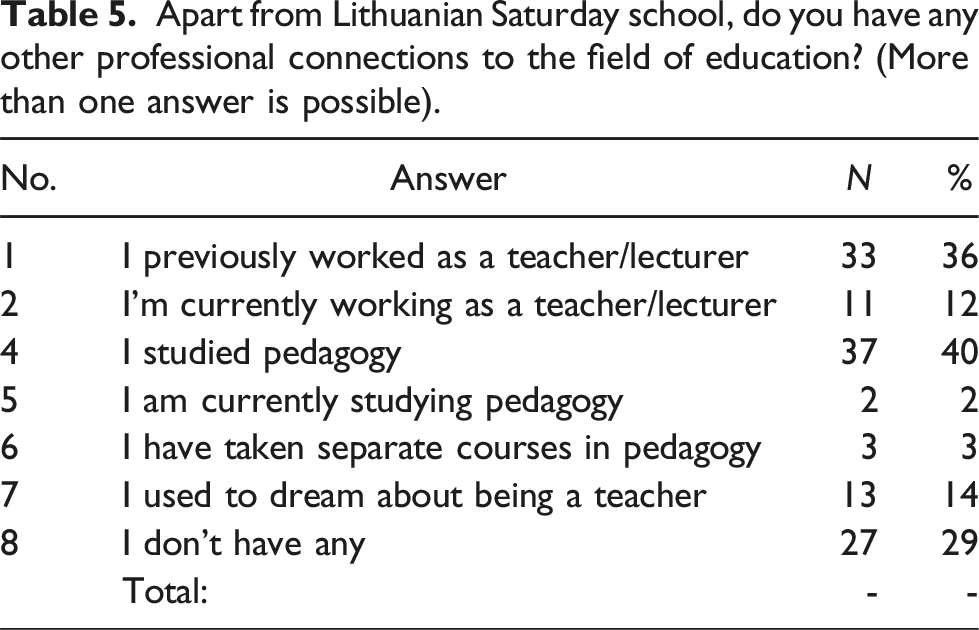
To summarize the section on starting to teach in LSS, most of the teachers come to the schools of their own free will and are often motivated by their strong connection to Lithuania and the Lithuanian language. Also, many have previous experience as teachers and have acquired knowledge during their studies. While this is not the norm, and teachers often do start their work in LSS without this kind of experience and knowledge, some of them are motivated by an old desire to be teachers. Thus, in line with self-determination theory, by choosing to work in a LSS, teachers are satisfying their need for autonomy, because this choice reflects their interests and values. For some of them, it also fulfills their need for competence, because they know that they will be able to use the knowledge they have acquired, and that this knowledge will be valued in LSS. By coming to the school, teachers also assume that they will be able to fulfill their need for relatedness by being part of the LSS community, and contributing to the Lithuanian migrant community where they live.
External motivation
Do you receive any monetary payment for your work at the Saturday school?
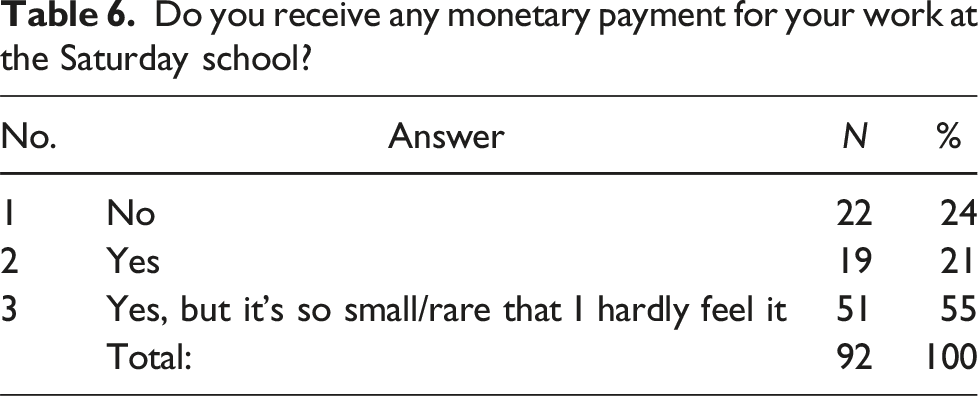
Respondents gave various answers when asked about how payment affects their decision to work in LSS. They pointed to the desire to help, and that this desire can be more important than money (9), some noted that the opportunity for their children to go to a LSS can be more important than money (9, 10), but monetary compensation is important as well (10, 11). 9. Money helps my motivation in part. But even when I wasn’t receiving any money I kept working because I needed it for myself and my daughter, and it felt good to be able to help, even though I wasn’t being paid at the time. 10. If there were no children of my own at the school, I think monetary payment would be a strong motivator. 11. A teacher’s work, like any other, must be paid. Nobody lays tiles for free on the terrace either.
How does the aspect of monetary payment (the fact that you get it or don’t get it) affect your motivation to work in a Saturday school?
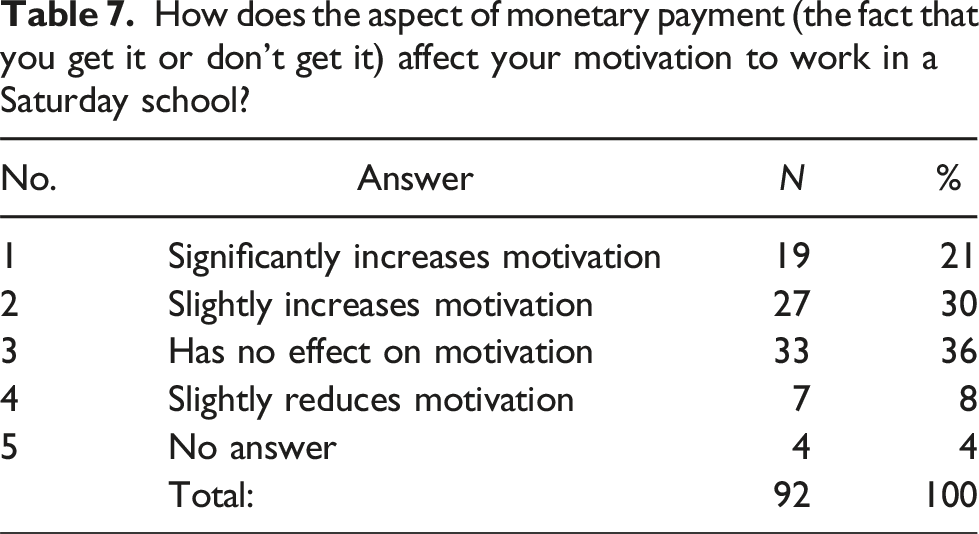
Although some respondents do not see monetary payment as a priority (12), the majority see teaching as a job rather than a voluntary activity and expect to be paid for their efforts (13). 12. I get a symbolic payment, which I put either back into the school or into events in the community. 13. I agreed to volunteer. But the amount of time it takes to prepare for a lesson – finding, selecting, and preparing materials, teaching, and later disseminating activities – makes you realize that doing this in a school in Lithuania would both earn you a salary and count as years of professional experience. So, a salary would be a great encouragement.
Thus, although one goes to teach in a LSS with the understanding that there will most likely be either no or only symbolic payment for this activity, only one third of the respondents feel that this factor does not affect their motivation at all. It seems that the question of adequate payment arises when hardships are faced, and when the time needed for this work is understood (the hardships will be discussed in the next section). How to interpret these results in terms of self-determination theory? Of course, financial reward is an extrinsic motivator, but it is also a matter of survival in today’s society, especially for emigrants, so it is a very important motive that can also reduce intrinsic motivation. Although teaching in a LSS satisfies the need for autonomy and is self-validating, the time spent preparing for lessons and other work can become a source of inner conflict. However, despite the lack of monetary compensation, teachers continue to work, which means that other aspects must compensate them in a satisfactory way.
Hardships and motivation to keep teaching
When asked what hardships they face in LSS, the teachers named many and talked about them widely. Only 5 teachers said that they don’t face any hardships at all, while most named at least one, with the average being between 3 and 4 hardships named, and there were even some who named 12. Teachers mentioned the difficulty of balancing teaching and other aspects of their lives, such as work, family, hobbies, etc. (14). There were also mentions of struggling to find common ground with the parents of their students, due to the parents’ dismissive attitudes towards LSS (15). 14. Since the lessons are held either online in the evenings and on weekends, or in person on weekends, I see that it takes a toll on my time with my family. When we all finish our work and get to see each other, I still have to work in the school. 15. It’s hard to motivate parents to be more involved in the schooling. Even with things like regularly bringing their kids to classes. The instability of the classes have to face makes the teachers’ job much more difficult.
Do you face any hardships while teaching in a Lithuanian Saturday school? If so, what are they? (More than one answer is possible).
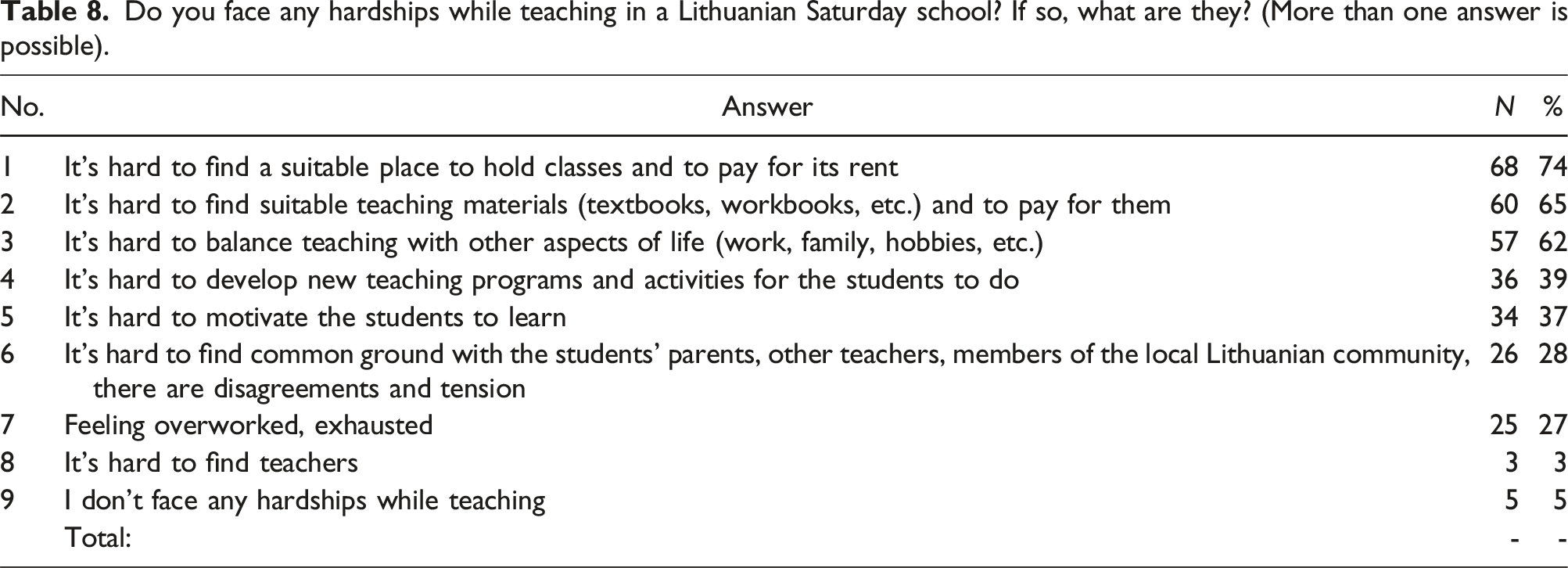
The question arises, why were so many hardships named? One of the possible answers may lie in the nature of the research itself—perhaps by participating, the respondents wanted to be heard, wanted their problems to be seen in Lithuania or their country of residence, maybe they wanted to draw the attention of Lithuanian institutions, as they were informed that this research would result in an article. The second possible answer has to do with the scope of their duties. The answers of the teachers show that they are often expected to do everything to make their classes happen: find a place to hold the classes, develop teaching programs, lesson plans, and other activities. Meaning, they often take on the responsibilities of school administrators, along with their responsibilities as teachers. Of course, this significantly depends on the specifics of their country of residence, the local Lithuanian community’s organization, involvement and their efforts to help the teachers. It is also possible that part of these hardships stem from a lack of experience—those who don’t have previous experience in teaching and knowledge in pedagogy have to not only teach but learn at a very fast pace themselves.
It’s important to note that current LSS teachers face the same hardships that were experienced by teachers of the earlier migration waves. It has always been difficult to find spaces suitable for teaching, as we can tell from earlier records: “Our schools have been struggling for 20 years. Some of them are still held in basements and nooks. The students’ lack of desire to attend classes in these conditions is fully understandable, as they spend their whole week learning in modern environments, and then have to spend their Saturdays cooped up in some basement. It takes a certain sacrifice” (Masionis, 1969, on the state of LSS in the United States of America, citation from Karčiauskaitė, 2008, p. 129). These hardships are experienced by teachers of other heritage languages as well. In the forementioned research on heritage language schools in Finland, it is stated that, among other hardships, the teachers in them find it difficult to obtain suitable teaching materials, just like teachers in LSS: “there seemed to be a lack of materials not only in the less taught migrant languages (e.g., Spanish, Polish and Italian) but also in some of the bigger heritage languages worldwide (e.g., Arabic, Kurdish, and Russian). Also, the teachers identified challenges in the scheduling of classes and even in aspects related to the language itself” (Ansó Ros et al., 2021, p. 11). There are many hardships and challenges that LSS teachers face, so how do they affect the teachers’ motivation to stay and come back the following school year?
When asked whether the hardships they faced had an effect on their motivation to keep teaching in LSS, the teachers answered very differently. Some saw the hardships as a problem that had to be tackled (16), some saw them as a normal part of their work, regarding the situation (17), some reported feeling annoyed (18) or desperate (19), some reported that they caused temporary dips in motivation (20), and others said that the hardships had made them want to give up and stop teaching, but once they would take some rest and let their emotions calm down, the desire to teach would come back (21). 16. I take it as a challenge. 17. I take it as a given. 18. The hardships somewhat affected my motivation, because the preparation for classes took up more time than I had expected. 19. Sometimes I feel powerless. When it’s hard to find a solution, you still have to find it in some way. 20. There were times when I wanted to quit, but then I changed the age category of the children I taught, and it was interesting again. 21. Of course, the hardships affect my motivation negatively. Every May I tell myself that I won’t go back, but then I rest, and by September, I find myself rolling up my sleeves again.
Were there ever times when you wanted to quit teaching at a Lithuanian Saturday school?
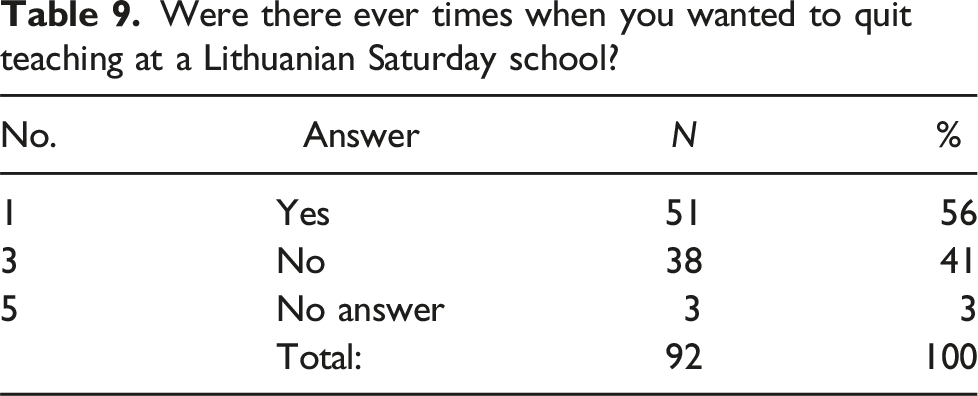
Some respondents saw their thoughts of quitting as temporary, thoughts that would come and go (22, 23), while others expressed having plans to put those thoughts into action and quit (24). 22. I just think about it sometimes, but when I get a new idea, I keep going again. 23. These thoughts come, but they’re temporary, based on emotions. 24. Not yet, but I plan not to teach anymore, starting next year.
When presented with an open-ended question on why they didn’t quit teaching in LSS, the teachers gave various responses. A total of 59 (64%) answers were collected, that is, more than the number of teachers who reported having ideas of quitting. It could be that some of the respondents wanted to explain their reasons to keep teaching in LSS, even though ideas of quitting didn’t present themselves to them. After grouping the answers, four main motives to keep teaching were found. These motives are presented here regarding the times they were mentioned, with the most common motive presented first in the list, and the least common presented last: (1) Responsibility, duty, “who else if it’s not me.” (2) The good of the children – their own, and others’. (3) The joy of being a teacher, self-realization. (4) Belonging in a community.
Those who stated that they are encouraged to keep teaching by feelings of responsibility explained it in various ways. Some felt a responsibility to accomplish what they had already promised (25), others felt that this particular work is something they can do, so they do it (26), which can possibly be attributed to attitudes that everyone must contribute to their communities in some way. Some see that there is a shortage of teachers and fear that, if they would quit, the situation in the school would be even worse (27, 28). A large number of teachers mentioned the children that they teach, along with the Lithuanian language and identity—feeling responsibility to preserve the language by teaching it, to introduce children to the Lithuanian identity, and to preserve their own connection to the Lithuanian identity in the process of teaching it to others (29, 30). However, some of the answers showed that feelings of responsibility are not always enough to keep ideas of quitting away from the teachers’ minds (25). 25. I didn’t quit because I have already made a commitment. When I accomplish what I had promised, I will probably quit. 26. Who else is going to do it if I don’t? 27. I know that there is a shortage of teachers. 28. I don’t have anybody that I could pass my responsibilities to. It’s a shame to let go of all the work I’ve done. 29. Responsibility and the feeling that sometime in the future these children will need the Lithuanian language. 30. Because I am a Lithuanian and I can’t forget my roots, nor can I let others forget them.
It’s important to note that the current emigration wave is fundamentally different from the post-war emigration wave in their reasons for emigration, as well as historical and political circumstances. However, the feelings of responsibility persist, which is one of the key similarities between these waves.
Those who wrote that it was children who motivated them to stay, focused on different aspects. Some said that it was good to see their own children be able to attend a LSS (31), some felt joy in the connection they had with their students, and joy in watching them grow (32, 33), some felt joy in working with children and teaching itself (31), and others noted that LSS help to strengthen Lithuanian communities abroad (32). 31. My own daughters motivate me, and I love my job. 32. I have a very strong connection with my students. I feel that, even though it takes a lot of effort, these past years I have seen our community grow and strengthen because of the school. 33. Because I know that when I come to the classroom and see the children, grown after the summer, my heart will melt.
These answers also gave some insight into the teachers’ relationship to teaching itself, the joy they get from teaching. Part of the responses focused specifically on this aspect. Some mentioned that teaching is precisely the kind of work that they enjoy doing the most (34), while some saw teaching as the thing they can do which holds the most value (35). They mentioned feeling joy (36) and meaningfulness (37) when they teach. 34. Because, even with all of the hardships, I am crazy about my job. 35. Teaching is the best thing I know how to do… 36. The satisfaction I gain. 37. I see meaning in this work.
Support from the local Lithuanian community was also mentioned as an important factor that determined the teachers’ decision to stay, along with receiving encouragement, and other people asking them to stay (38, 39). Some see teaching in LSS as an opportunity to find other like-minded people and make friends (40), while others are motivated by feelings of appreciation for their colleagues and administration in the schools, their efforts to solve difficulties when they arise (41, 42, 43). 38. I strongly believe that what I do is beneficial to me, to the children, and to the school. Also, I feel huge support coming from the rest of the team at the school. 39. I had quit before but came back because they asked me to. There is a shortage of professionals. 40. I found great friends among the parents. I don’t want to betray them. 41. It was a challenge to make schedules work. But then we found a solution. 42. We have generally been able to work through any issues or disagreements diplomatically through committee meetings and discussions. 43. The difficulties were solved, and we could successfully keep working.
After analyzing all of the respondents’ answers, we can see that the most common motivator to keep teaching is the feeling of duty, which is not always a good feeling. Sometimes duty becomes too heavy to bear, and brings on guilt when not completing certain tasks, as well as the feeling of helplessness. It can also chip away at the genuine desire to do something. It’s worth noting the word “betray” (40), mentioned in one of the answers. It’s not perceived as a simple job that one can quit whenever their life circumstances change. Quitting is seen as the betrayal of friends. It is also important to note that the aspects of community, received encouragement and support were not mentioned often. It could be that Lithuanians are relatively restrained, and don’t tend to verbally express their support or gratitude, even if they feel these things. But those words are important to hear for the teachers volunteering in LSS. Though many other, more positive motivators are common, the joy of working with their students, satisfaction felt in the process of teaching, the feeling of value in their work, a sense of community, seeing that solutions and compromises could be found. There are many things that can help to keep up a teacher’s motivation, and to strengthen it in times of exhaustion.
From the perspective of self-determination theory, sometimes the motivation to work or volunteer in a LSS may decrease because not all of the basic needs are met. The need of competence may waver in its fulfillment if it turns out that there is a shortage of knowledge and time to teach a heritage language in the specific way it’s best to be taught. Sometimes teachers don’t feel significant or valued enough in the school community, which may make their need of relatedness waver. The need of autonomy may also waver, in cases when teachers can’t act in the way they wish, when they have to abide by the demands of the administration or the parents. However, if one or two of these needs are fully fulfilled, then the teachers tend to keep working, even with some needs not met.
Discussion
After comparing the results of this study with the results of another similar one, the thing that sticks out the most is the fact that the teachers’ motivation to work in LSS is very dependent on cultural circumstances. Teaching a heritage language is in some ways similar to keeping the heritage language alive in the family. They both have a lot to do with the reason of emigration, historical and political circumstances, relationship to the country of origin, and language policy in the country of residence (Jakaitė-Bulbukienė, 2015). Ching Ting Tany Kwee (2023, p. 333), who researched the motivation of teachers that were teaching Chinese as a heritage language in Australia, found “that traditional Confucian beliefs, a favorable learning environment and the attainment of teaching goals are the factors motivating the teachers to continue teaching heritage language.” After learning more about the concept of “Confucian beliefs,” it was found that it generally means a goal of the teachers to make their own parents proud: “When Chinese immigrant teachers are able to get a permanent teaching position, they can fulfill their parents’ expectations, thereby more likely entering or continuing teaching heritage language.” It also means helping the community: “This study showed that Chinese immigrant teachers feel obliged to prepare students for further academic pursuit so as to attain their personal goals, whereby it is also a pathway to social equity.” While a “favorable learning environment” pertains to the fact that “Better classroom discipline allows Chinese immigrant teachers to apply what they have learnt in their previous teaching training, including theories and teaching techniques, in their lessons, thereby boosting their self-efficacy, self-confidence and effectiveness in teaching.” Discipline, learning and feedback are characteristic of China’s education culture, yet teachers happily implement other elements of teaching that are characteristic of Australia’s education culture. Comparing the forementioned study to ours is difficult, but not impossible. Heritage Chinese language teachers are strongly affected by external motivation—the desire to get approval from their own parents, they are proud when their students can get good grades, and, therefore, elevate their status in society. But the thing that is similar between the findings of that study and this one, is the teachers’ desire to help the community, their efforts to help the students learn their heritage language, and the joy experienced while watching the results of their work.
Conclusions
Self-determination theory was chosen as the theoretical basis for this study, regarding the idea of the theory’s authors Ryan and Deci (2017) that there are three basic psychological needs: competence, autonomy, and relatedness. By choosing to volunteer or work at a LSS, Lithuanian heritage language teachers fulfill their need of autonomy, as this choice reflects their interests and values. It can fulfill their need of competence, because teachers know that they can apply their knowledge in a meaningful way. The need of relatedness can also be met, as teachers become part of the LSS community and have more opportunities to build relationships in the Lithuanian diaspora community where they live.
Teachers in LSS have the chance to meet all three of their basic psychological needs by contributing and showing their benevolence, acting autonomously and creatively, feeling their efficacy and mastery, connection and belonging. Sometimes the need of competence may waver in its fulfillment if it turns out that there is a shortage of knowledge and time to teach a heritage language in the specific way it’s best to be taught. Sometimes teachers don’t feel significant or valued enough in the school community, which may make their need of relatedness waver. The need of autonomy may also waver, in cases when teachers can’t act in the way they wish, when they have to abide by the demands of the administration or the parents. The thing that troubles teachers the most is the time they spend preparing for classes and doing other tasks that are important to teaching, as the time spent makes this volunteer activity become more of a second job, which doesn’t fit their initial idea of volunteering. The study shows that, if not all of the basic psychological needs are met, that imbalance in motivation could be compensated by the extrinsic motivator of monetary compensation. However, LSS teachers continue their work even if they are not monetarily compensated for it. Therefore, we see that if one or two of the basic psychological needs are fully fulfilled, then the teachers tend to keep working, even with some needs not met.
The authors of this article believe that, due to the large number of respondents and the variety of their countries of residence, it was possible to grasp the main aspects concerning the motivation of Lithuanian Saturday heritage language school teachers. However, it would be beneficial to further analyze these results while taking the specifics of different countries of residence into consideration, as LSS are impacted by their countries’ language policy and Lithuanian community in diaspora. This study could also be expanded with qualitative data.
Footnotes
Declaration of conflicting interests
The author(s) declared no potential conflicts of interest with respect to the research, authorship, and/or publication of this article.
Funding
The author(s) disclosed receipt of the following financial support for the research, authorship, and/or publication of this article: Half of the material has been collected during the summer internship project funded by the Research Council of Lithuania (2021, grant agreement No. 09.3.3-LMT-K-712-24-0206), and the other part has been collected independently a year later to cover more countries and different age groups (2022).