



Abstract
This cross-cultural, interdisciplinary study aims to investigate how the linguistic picture of the world differs in various age groups from kindergarten years to adulthood. In this paper, linguistic picture of the world is referred to as a technical term introduced into linguistics by Leo Weisgerber (Weltbild der Sprache). In order to trace the differences in Russian and Hungarian language users’ linguistic picture of the world in different age groups, thus obtaining a more precise picture of the linguistic development of the individual from a cross-cultural perspective, a research was conducted and data were collected with the aid of the association experiment, a foundational research method of Russian psycholinguistics. Respondents from three age groups (4–5 years, 10–12 years, and 18–26 years) were investigated via the collection of word associations to 10 stimulus words. As the research results suggest, culturally bound traits of linguistic development were identified, including the Russian linguistic consciousness changing its orientation from being self- and family-oriented in early childhood to being people-oriented (man-oriented) as an adult. The study also revealed common characteristics of the age-related development of the Russian and Hungarian linguistic pictures of the world, for instance, toys and games moving from the center of the linguistic image of the world to the periphery to be replaced by love. Results can be utilized not only for theoretical psycholinguistic purposes including a better description of the presumed age-related changes in the mental lexicon but also in the practical realm of education for curriculum development or the fine-tuning of pedagogical methods, as well as in intercultural studies for gaining a more precise picture of the linguistic consciousness of representatives of different cultures.
Keywords
Introduction
This paper investigates how the linguistic picture of the world differs in three age groups in the Russian–Hungarian intercultural context. The first dimension of the study is age: comparing linguistic units, lexemes, and their connections in the human mind in three different age groups (4–5 year olds, 10–12 year olds, and 18–16 year olds) allows the researcher to trace age-specific differences; thus, presumable changes can be identified on the level of the development of the individual’s linguistic picture of the world. The second dimension of the study is the intercultural one: specificities and differences of a Russian and a Hungarian language user’s linguistic picture of the world can be identified by contrasting the country-level results.
Various concepts have been developed in psycholinguistics aiming at explaining the fundamental processes of language production, comprehension, and language acquisition. As a result of more than 20 years of research since the early 2000s, the pivotal role of mirror neurons in understanding action and intention in speech production and comprehension was discovered (Fabbri-Destro & Rizzolatti, 2008). While mirror neurons are crucial in language acquisition, there is no consensus on the extent to which they influence the comprehension of word meaning. According to Fabbri-Destro and Rizzolatti, the mirror mechanism helps to transform heard phonemes into phoneme production motor acts, as well as understand not only speech but also human intention (Fabbri-Destro & Rizzolatti, 2008, pp. 171–173). It is a core element of the human brain which implies that even very young children have the ability to understand words.
Linking language acquisition to action by the investigation of mirror neurons and the foundation of the neural exploitation hypothesis as a means to explain the interdependence of action and language (Gallese, 2008) are well summarized by Gallese: “My main claim is that key aspects of human social cognition are underpinned by neural exploitation, that is, by the adaptation of neural mechanisms originally evolved for sensorimotor integration, later on also employed to contribute to the neurofunctional architecture of thought and language, while retaining their original functions as well” (Gallese, 2008, p. 327). In parallel with the dynamic development of brain imaging technologies, word associations and the functioning of the mental lexicon can be more effectively investigated. This paper’s focus is limited to the analysis of the word associations after conducting the word association test; however, the application of brain imaging technologies based on the findings may offer fresh insights for the ongoing study.
Extensive research has been conducted from another psycholinguistic perspective whereby phenomena connected to language use and language acquisition are conceptualized by the introduction of the notion of a mental lexicon (Aitchison, 1987; Jarema et al., 2007; Quillian, 1968). The mental lexicon is described as a “dictionary of the mind – [that] stores information in lexical units” (Kovacs, 2021a, p. 181). The mental lexicon is similar to a network with lexical units as nodes that are connected to each other by different types of connections including semantic, phonetic, syntactic, and grammatical ones (Kovacs, 2021a, 2021b, 2022).
The technical term, linguistic picture of the world (Weltbild der Sprache) applied in this study was introduced into linguistics by Leo Weisgerber in the late 1920s (Weisgerber, 1929, 1934) and then concisely discussed in further works of the author (Weisgerber, 1962). The term is used synonymously with worldview and was extensively incorporated into Russian scholars’ conceptualization of language. Based on the Humboldtian tradition, Weisgerber claims that different languages register reality in different ways; thus, he agrees with the strong formulation of the Sapir–Whorf theory of linguistic relativity (Kay & Kempton, 1984). Weisgerber states that language users apply their own linguistic pictures of the world (Weltbild der Sprache) when conceptualizing reality. As the author states in his early monograph (Weisgerber, 1929), language “allows a person to combine all experiences into a single picture of the world and makes him forget about how he learned the language before and how he perceived the world around him” (translated from Russian by Lenart: Weisgerber, 2004, p. 51).
In Russian psycholinguistics, linguistic picture of the world (or language picture of the world or worldview) has been for several decades a central explanatory element. The inception of the Russian School of Psycholinguistics—also known as the Vygotsky-Luria-Leontiev School of Psycholinguistics—that started to systematically apply this term can be traced back to Alexey Leontiev’s first lectures on psycholinguistics in Moscow in 1966 (Akhutina, 2007; Endrody et al., 2020; Lenart & Markovina, 2021). As stated by Ufimtseva and Balyasnikova (2019: 6) “the language picture of the world is defined as the representation of the real world in the system of concepts and categories of the language. Language processes (e.g., nomination) are inextricably related to the processes of identifying objects from the outside world and their understanding.” The term linguistic picture of the world thus enables us to analyze and cross-culturally compare language users of different nationalities and cultural backgrounds.
The relevance and popularity of cross-cultural and inter-ethnic (linguistic) studies have increased in recent decades. The Russian explanatory model that heavily relies on the notion of linguistic picture of the world is substantiated in several scientific research areas including Ethnolinguistics (Alexeyevna, 2016; Zinken, 2004), Ethnopsycholinguistics (Endrody et al., 2020; Leontiev, 1999; Shusharina, 2016; Ufimtseva, 2014b), Cultural Linguistics (Frantceva, 2018), or Linguoculturology (Kireeva, 2017). A key methodological approach applied by the Russian School of Psycholinguistics is the association method or association experiment which incorporates the collection of reaction words to certain stimulus words in the form of free word associations. As Ufimtseva claims: “The specific systemic character of the world image can be revealed through a mass associative experiment and associative dictionaries compiled on the basis of the latter” (Ufimtseva, 2014a, p. 5).
The technical term linguistic picture of the world that has been extensively used in Russian academia since the 1960s can be effectively linked to the mental lexicon (Jarema et al., 2007), another key concept in international psycholinguistic research. As Libben et al. states: “The mental lexicon, therefore, enables us to examine the roles of storage and computation in the mind; to correlate psychological and neural activities; and to examine how the properties of languages, populations, and tasks interact” (Libben & Jarema, 2002: 2). Both approaches apply the word association method extensively and consider word associations as a mental network with words being nodes of it. While researchers following the Russian psycholinguistic tradition apply the triad of language, consciousness, and culture underlying the term linguistic picture of the world, Libben et al. (2002) refer to the following three prime fields of research of the mental lexicon: language, task, and population. The two terms, linguistic picture of the world and mental lexicon, thus describe a very similar conceptual framework.
In this study, a Russian–Hungarian team of linguists and education researchers joined forces and expertise to compare different age groups’ linguistic pictures of the world in a cross-cultural setting, applying the above-mentioned concept of the linguistic picture of the world, as well as the association experiment as their key research method.
The research thus aims to fill two main research gaps in parallel. Firstly, by investigating the development of the individual’s linguistic picture of the world across different age groups, namely, from early childhood (4–5), through young teenage years (10–12) to early adulthood (18–26), it attempts to observe and describe the age-related changes in the individuals’ linguistic picture of the world. Secondly, as to the cross-cultural aspect of the research, the authors seek to find similarities and discrepancies in Russian and Hungarian language users’ perceptions of the world around them.
This study attempts to shed light on the processes of the linguistic development of the individual including the dynamic changes in the language user’s mental lexicon from early childhood to adulthood. A wide array of psychological, linguistic, and pedagogical approaches have been used to search for a concise explanation of linguistic development from childhood including behaviorist theories (Pavlov, 1926; Skinner, 1957) to sociocultural theories (Vigotsky, 1934, 1978), cognitive development theory (Piaget, 1936, 1952), nativist language acquisition theory (Chomsky, 1957, 1965, 1967), and cognitive linguistics (Geeraerts, 1995; Lakoff & Johnson, 1980; Lakoff & Johnson 1987; Langacker, 1987). In this research, the theoretical background of Russian psycholinguistics (Karaulov et al., 2002; Lenart, 2016, 2017; Lenart et al., 2019; Lenart & Markovina, 2021; Leontiev, 1969, 1977, 1999, Markovina, 1982, 2011; Markovina et al., 2006; Panasiuk & Schröder, 2006) as well as its most widely used research method, the association experiment (Ufimtseva, 2014a, 2014b), is applied in order to gain an insight into the development of the linguistic pictures of the world of individuals from early childhood to adult years.
The research is furthermore of an interdisciplinary kind through the collaboration of two scientific fields: Psycholinguistics and Early Childhood Studies. The underlying purpose of merging the tools and theories of various disciplines is based on the firm conviction that interdisciplinary research generates a more robust understanding of the social world than does knowledge emerging from a single traditional discipline (Frickel et al., 2017, p. 5).
In the current study, the authors aimed at investigating linguistic changes in language users’ linguistic picture of the world with the help of the speakers’ association fields. These are viewed in Russian psycholinguistics as representations of the content of consciousness images that occur in children as they grow up and acquire the culture-based language consciousness or cultural mindset shared by the members of the culture (Endrody et al., 2020; Leonard et al., 2019).
As mentioned above, the psycholinguistic aspect of the research relies on the traditions of Russian psycholinguistics. Based on the foundations of Vigotsky’s Cultural-historical Psychology (Vigotsky, 1934), Leontiev developed a consistent school of thought of psycholinguistics, often referred to as the Moscow School of Psycholinguistics (Leontiev, 1977). This school of thought contributed to the advancement of the field with various theories and research methods including the theory of speech activity (Leontiev, 1969); the theory of linguistic consciousness sometimes referred to as verbal consciousness (Tarasov, 1996; Ufimtseva, 2006); the lacuna theory; and the psycholinguistic interpretation of the association experiment (Leonard et al., 2019; Ufimtseva, 2014a). For the purposes of this article, the technical terms linguistic picture of the world and linguistic consciousness are used as synonyms and are defined as “a complex of verbally externalized mental images that contain concepts of man (i.e., a human being), and his activities as well as of objects and phenomena of the world developed by the members of a certain culture” (Tarasov, 1996, p. 7).
The primary research problem of the systematic observation of the development of the individual’s linguistic picture of the world can be interlinked with the triad “language-consciousness-culture” that has become the principal research field of the Moscow School of Psycholinguistics (Ufimtseva, 2014b). The Russian Psycholinguistics views culture as a means to externalize the consciousness of members of a certain culture. Language is another semiotic form of consciousness existence. Both cultures and languages unite people into one cultural group and at the same time differentiate one cultural group from another. Language objectifies consciousness images and arranges them into the linguistic image of the world of a group of people and members of a culture. Via language, it is possible to tap into the consciousness of a cultural group and reconstruct its somewhat incomplete equivalent which has been coined as linguistic (verbal) consciousness. With the above in mind, this research aims at better describing the Russian and Hungarian linguistic consciousness and systematically comparing them as well as their changes over time. This way, a clearer picture can be drawn about the common traits of the psycholinguistic development of the individual across cultures, along with identifying cross-cultural differences during language acquisition.
From an international perspective, as Leonard et al. (2019) note, it is easy to identify that there is a link to the Neo-Humboldtian approach to the problem of how language consolidates the cognitive and cultural experience of a community, first developed by Vygotsky and then further elaborated by the Moscow School of Psycholinguistics. One of the core ideas of Russian Psycholinguistics is the role of culture “as a source of conceptualizing experience through cognitive structures such as word associations. It uses natural language semantics as a cognitive approach to meaning and shows how cognition is structured” (Leonard et al., 2019: 111).
An underlying term of interpreting language acquisition and language processing is linguistic consciousness (yazikovoye soznaniye/языковое сознание), a synonymous term to linguistic picture of the world that can be explained as “Images of language consciousness comprise mental knowledge developed by a person primarily in speech communication, and sensory knowledge which appears in the mind as a result of the processing of perceptual data received from sense organs during object-oriented activity” (Tarasov, 2000:3).
From an educational perspective, understanding early childhood learners’ childhood narratives and linguistic picture of the world might help researchers of education and connected fields to examine possible changes in the linguistic consciousness of the individual. Furthermore, through the application of this psycholinguistic approach, important developmental phases can be revealed about when and how the mentioned narratives change over age.
In this paper, social construction of childhood is interpreted following James and Prout (1997), two sociologists who published their theory about childhood as a social construction. This new paradigm has great potential in interdisciplinary research too. The authors claim that childhood is a variable of social analysis; further to that, James and Prout state that children live in social circles including their primary circle of family and, secondly, their institutional circle (kindergarten or school). This paradigm implies the application of different narratives of childhood. Different views of the notion of childhood rely on various ethnic, class-based, or gender perspectives. There are varieties of childhood, and childhood as such has to be considered as a universal phenomenon (Jenks, 2015).
In the course of the investigation, the three different age groups were scrutinized taking into account their specific educational characteristics. The cut-off points for the youngest group (4–5 years) were determined relying on Early Childhood researchers’ belief that 4- to 5-year-old children are already able to express their feelings, can create simple sentences, and are able to explain the world surrounding them (Cole & Cole, 2001). Furthermore, they typically understand the structure of social circles and can comprehend that certain objects can be located in a different, faraway place, not in the vicinity of the speaker (although they sometimes mix up their own viewpoint with that of others). Children from this age group also begin to understand causality, a capability which will be fully functioning at the age of around six. Taking the above phenomena into consideration, this age group can be considered as the first Early Childhood developmental phase when children are ready and capable of being interviewed.
Regarding 10- to 12-year-old speakers, these teenagers are able to fully express themselves in terms of emotions and feelings. Members of this age group are able to explain the meaning of any word, and they are familiar with abstract concepts such as family or foreigner. Possible difficulties of this group include these young teenagers’ uncertainties connected to their self-concept. In the last age group of respondents (18–26), young adults are expected to be able to fully elaborate their answers and explain all investigated stimulus words without refusing to answer; thus, their answers can be effectively compared to that of members of the other two selected age groups.
Methods
Settings
Data collection in the three age groups.
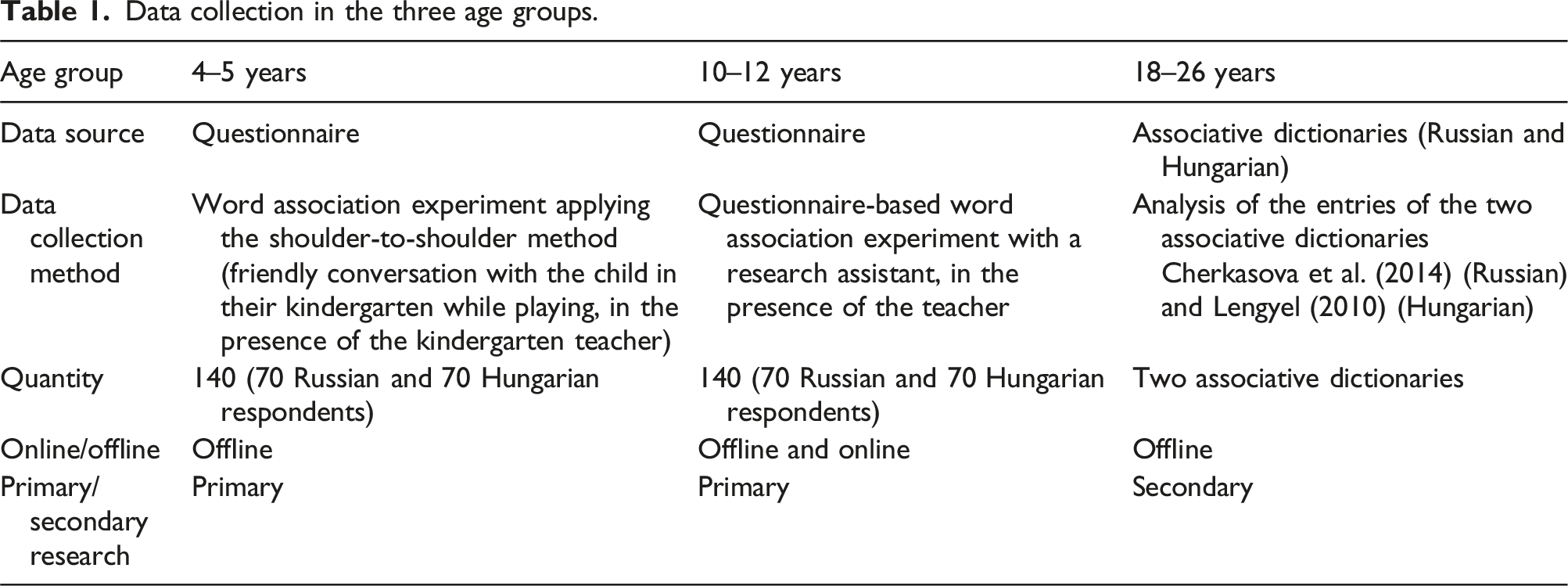
The 4–5 and 10–12-year-old individuals were examined in both countries using the association experiment based on 10 stimulus words to which 70–70 respondents provided their free associations. In the adult age group (18–26), existing Russian and Hungarian associative dictionaries were applied and their entries were analyzed (associative dictionaries utilize the same type of association experiment as was used in this current research).
Hungarian data were collected in Budapest schools (on the Pest side of the town), while Russian data collection took place in Moscow schools. In the case of both the 4- to 5-year-old kindergarteners and the 10- to 12-year-old schoolchildren, native speakers were selected from parents speaking Hungarian and Russian languages, respectively, as their mother tongue. Children in each group were allowed to participate in the research, even if they were about to turn either 4 or 10 at the time of the study and if they had not yet reached 6 or 13 in their respective groups. Informed consent was obtained from at least one parent of each child as well as from the heads of the kindergartens and elementary schools.
The association method or association experiment is a widely applied linguistic research method that aims to obtain linguistic material to construct the model of the linguistic picture of the world of a native speaker of a certain language by collecting reaction words to certain stimulus words. These stimulus words were selected prior to conducting the word association test (Ufimtseva, 2014b).
The association experiment as research method was chosen purposefully, due to its perfect adaptability in constructing both the Russian and the Hungarian linguistic pictures of the world. Besides being an excellent tool of mapping the linguistic consciousness of one specific age group, another underlying motive was the fact that the authors’ own research of word association with the two younger age groups (4–5 and 10–12 year olds) could be efficaciously compared to existing associative dictionaries of young adults (18–26 year olds).
List of stimulus words.
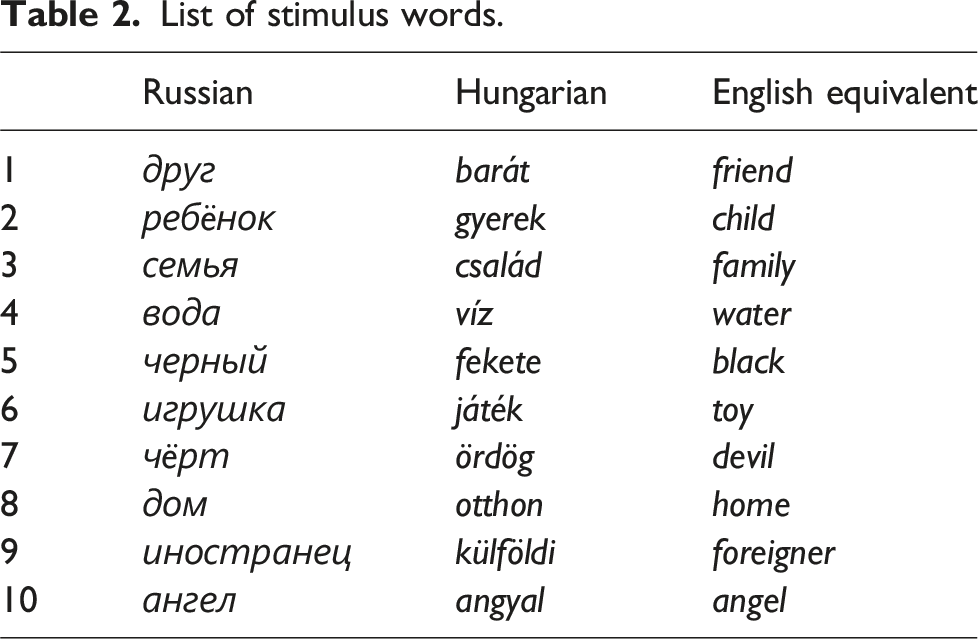
In the course of this research, the Hungarian and Russian linguistic pictures of the world were investigated in 3–3 different age groups (4–5 years, 10–12 years, and 18–26 years) applying the word association method. In the two younger age groups (4–5 years and 10–12 years), 70–70 association tests were conducted, making the total number of respondents 280 (two age groups, two nationalities). In the 18- to 26-year age group, the data of existing associative dictionaries (Russian language associative dictionary: Cherkasova et al., 2014; Hungarian language associative dictionary: Lengyel, 2010) were utilized (no additional research was conducted).
In the Hungarian context, associative dictionaries and thesauri have been applied and are available for linguistic analysis as well (Bóta & Kovacs, 2015; Kovacs, 2019; Kovács et al., 2020; Lengyel, 2010, 2012); thus, the dictionary–thesaurus of the Hungarian language with respondents from similar age group (18–26 years) was selected and compared to the Russian Regional Associative Dictionary-Thesaurus EVRAS (Cherkasova & Ufimtseva, 2014).
Questionnaire
The two groups of kindergarten children (4–5 year) were surveyed applying the shoulder-to-shoulder method (Griffin et al., 2014) that allows the respondent to freely play and move around during the conversation, thus creating a friendly atmosphere in which children are more willing to answer the questions. Members of the 10- to 12-year-old age groups filled in printed questionnaires either face to face with a research assistant or online. Online questionnaires were needed after the outbreak of the COVID pandemic, because schools were closed in Hungary.
The Hungarian respondent groups were addressed with the same written associative questionnaire as the Russian children in the 4- to 5-year-old and 10- to 12-year-old age groups. Questionnaires of the two younger age groups were validated in the course of a pilot survey with four persons from each age group and each nationality: minor text adjustments were made based on the pilot survey. The questionnaires were anonymized; respondents’ names were substituted by identification codes in each case. In the adult (18–26) group, no validation was needed as the associative dictionaries were already compiled successfully; therefore, only secondary data analysis was conducted.
Results were analyzed and contrasted with Sketch Engine (Kilgarriff, 2014), relying on the results of corpus linguistics, a field that is gaining increasing relevance in both applied and theoretical linguistics (Fajri et al., 2020; Lavrova, 2015). This online Corpus Linguistic tool enables the researcher to create corpora out of survey results and analyze the linguistic data by creating frequency lists and individual analyses of selected lexical items of the corpora including word sketch investigations, keyword in context analysis, and thesaurus checkup. Responses to the questionnaires were transcribed in full length and inserted into the Sketch Engine online tool, where separate online corpora were created for each age group and each nationality (six corpora in total). Following the insertion of the data, the corpora were investigated by the built-in tools of Sketch Engine as mentioned above, including frequency lists, keyword analysis, and word sketch.
Result
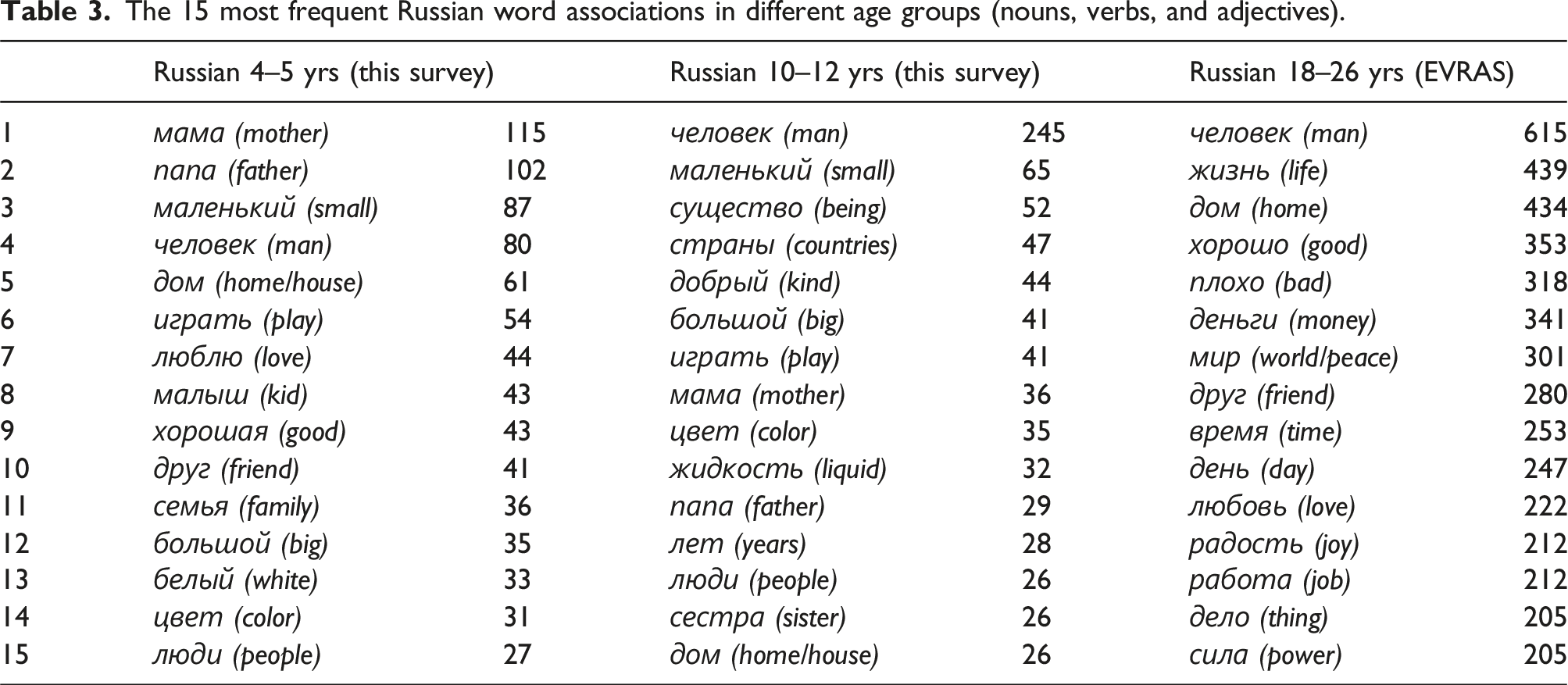
The 15 most frequent Russian word associations in different age groups (nouns, verbs, and adjectives).
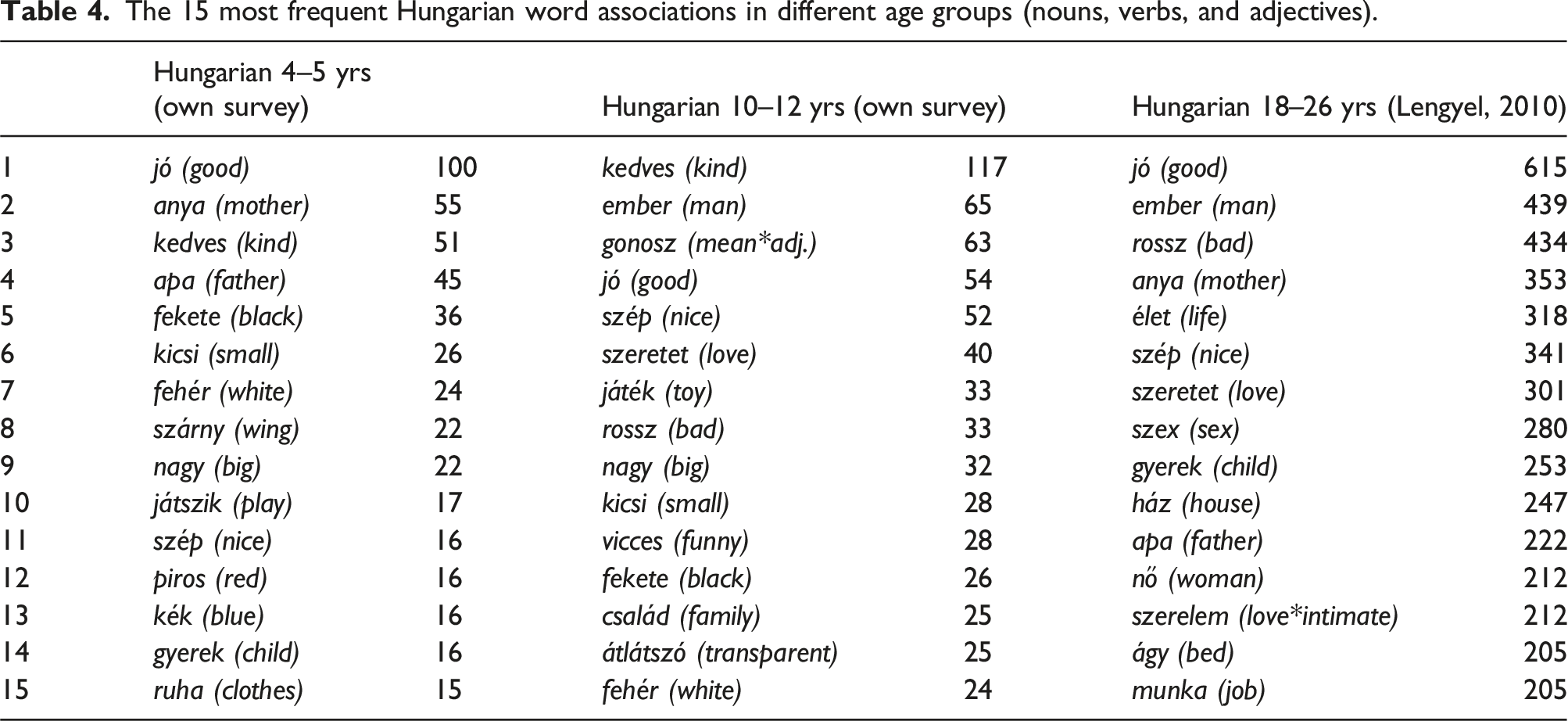
The 15 most frequent Hungarian word associations in different age groups (nouns, verbs, and adjectives).
Russian results in the three age groups
Table 3 confirms that the noun человек (man) is a lexeme of utmost importance in the Russian linguistic consciousness in all age groups, occupying the first position in two groups (10–12 years and 18–26 years) and taking the fourth place in one group (4–5 years). Interestingly, although the Hungarian 10- to 12-year-old and 18- to 26-year-old respondents associated to ember (man) in an outstandingly high proportion (this is the second most frequent lexeme in these two Hungarian datasets), the kindergarten-age (4–5 years) children’s top 15 results do not contain the word ember (man) at all.
Based on the results of the four word association experiments, it can be observed that in both the Russian and the Hungarian 4- to 5-year-old and 10- to 12-year-old respondent groups, the adjective маленький (small) and its Hungarian equivalent kicsi (small) occupy an essential position, while in the adult (18–26 years) group’s results, this word does not appear in the top 15 most frequent items.
The Russian results reflect a neutral (neither positive nor negative) image of the world in the adult age group and a neutral, slightly positive image in the two younger (4–5 years; 10–12 years) age groups. Adults associate to хорошо (good/well) and плохо (bad) in nearly identical number, and these adjectives (nota bene: хорошо is in an adverbial form here) take the 4th and 5th place of the frequency list, respectively. Meanwhile, in the two younger groups only adjectives with positive denotation appear хорошая (good) and добрый (kind).
Hungarian results in the three age groups
The Hungarian results seem to reflect a more positive image of the world compared to the Russian dataset. Although the Hungarian adult group’s top result jó (good) is somewhat balanced by the 3rd most frequent association rossz (bad) and a handful of other negative denotations such as gonosz (mean), all three groups’ results are generally more positive, containing such key lexemes as jó (good); kedves (kind); szép (nice); szeretet (love); vicces (funny).
Family members (anya [mother]; apa [father]) are ranked lower in older Hungarian respondents’ perception, and more abstract notions appear in the second and third age group (szeretet (love); átlátszó (transparent); szerelem (intimate love).
A comparison of Russian and Hungarian results in general
In the case of the pair of stimulus words otthon (home) and дом (house/home), a semantic asymmetry needs to be mentioned. In the Hungarian language, there are two etymologically independent lexemes for home (otthon) and house (ház); meanwhile, in the Russian language дом means house and home at the same time, with home often being translated as global дома (which also means at home). Keeping this in mind, it can be stated that дом (house/home) belongs to the group of most essential Russian lexemes, present in the top 15 words of all three groups. At the same time, neither ház (house) nor otthon (home) got into the top 15 in the Hungarian language; thus, it was concluded that in the Russian linguistic consciousness дом (house/home) plays a more pivotal role than it does in the Hungarian one.
Among the Russian results, Table 3 displays the presence of играть (to play) as a key element of children’s linguistic consciousness; however, the lexeme does not appear in the top 15 list of adult language users. Similarly, for Hungarian children in the 4- to 5- and the 10- to 12-year-old groups, játszik (play) and játék (toy/game) appear, respectively, but neither the noun nor the verb appears in the adult language users’ associative dictionary’s top 15 associations.
A comparison of the Russian and the Hungarian concepts of family
A critical aspect of children’s and young adults’ linguistic worldview appeared to be the concept of “family.” As a result, the authors conducted a more in-depth investigation to gain a comprehensive understanding of how the perception of “family” varies across all three age groups in both countries.
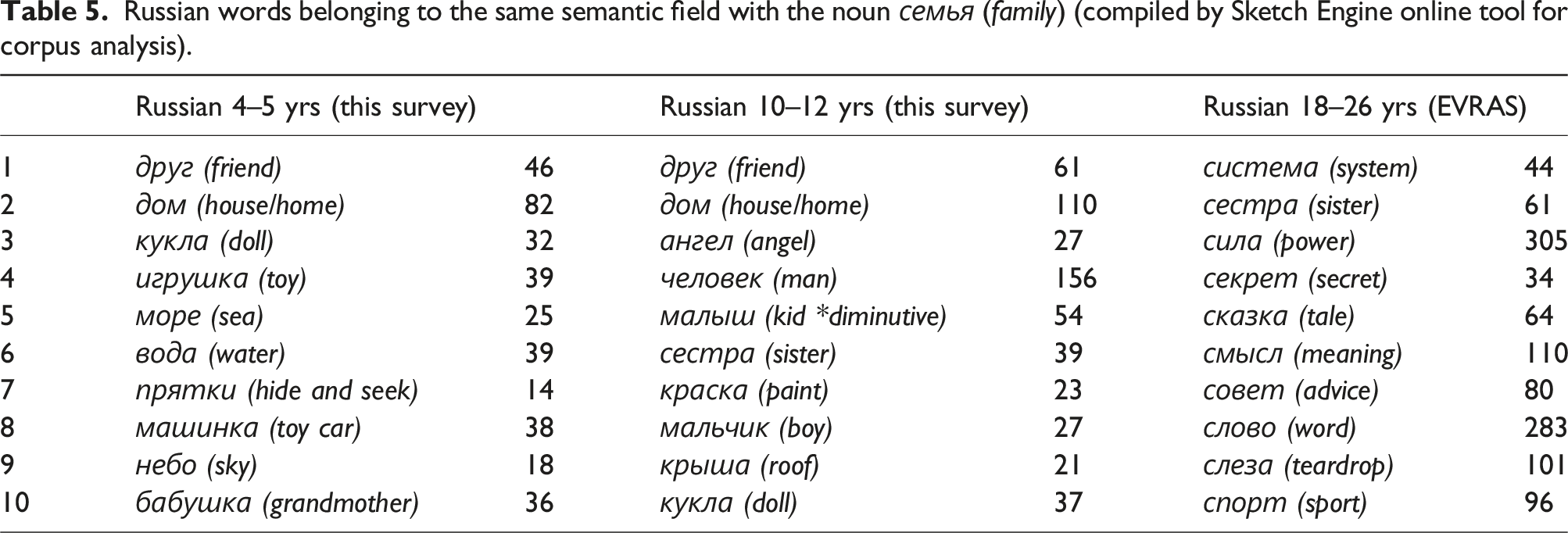
Russian words belonging to the same semantic field with the noun семья (family) (compiled by Sketch Engine online tool for corpus analysis).
Hungarian words belonging to the same semantic field with the noun család (family) (compiled by Sketch Engine online tool for corpus analysis).
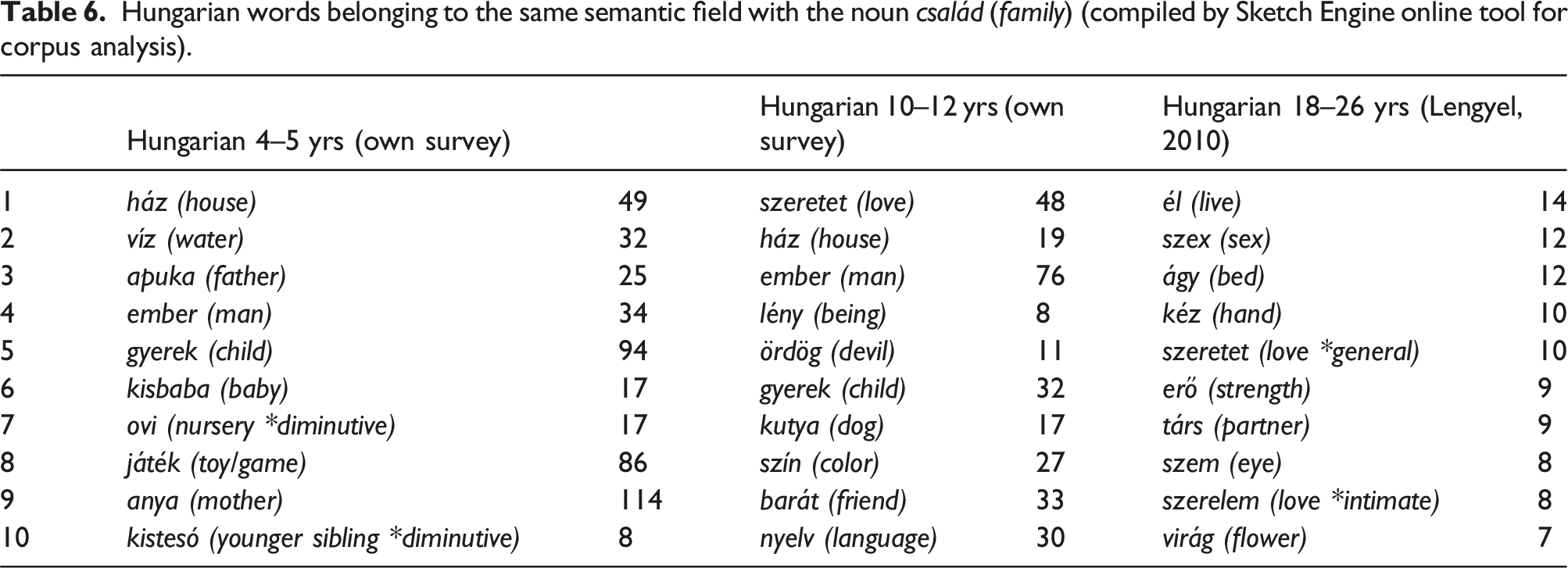
Table 5 and Table 6 display the 10 closest semantic connections of the word family in the 4- to 5-year-old, 10- to 12-year-old, and 18- to 26-year-old respondents’ linguistic consciousness in both the Russian and the Hungarian contexts. Based on the Russian results, it is evident that in the groups of kindergarteners and early teenagers, the top two most significant semantic associations with “family” are друг (friend) and дом (house/home). On one hand, these associations reinforce the strong connection between family, home (or house), and friends. On the other hand, the inclusion of these two lexemes among the 10 stimulus words in the association experiment may suggest that they are somewhat over-represented in the results.
The results show that the semantic field of the word family incorporates concrete family members in the two younger age groups (grandmother and sister in the Russian, and father, mother, and younger sibling in the Hungarian context).
The Russian adults’ results also include the noun sister (сестра) as a concrete member of the family and teardrop (слеза) that might refer to the presence of a romantic or an emotionally intensive relationship. It should be noted that the Russian semantic field of family (семья) contains numerous items that sound very similar to the word семья (family) including сестра (sister), сила (power), and слеза (teardrop). All of the top 10 key semantic connections of семья (family) start with the letter “с” (sound: /s/) in the Russian adult group. As the reaction word сила (power) appears by far the most frequently in this semantic field (frequency value is 305, see Table 5), it can also be interpreted as demonstrating that power is the key idea relating to family in the Russian linguistic picture of the world.
Discussion
The noun человек (man) is a central lexeme of the Russian linguistic consciousness in all age groups, occupying the first position in two groups (10–12 years; 18–26 years) and fourth place in one group (4–5 years). Interestingly, the Hungarian participants aged 10–12 and 18–26 showed a notably high association with the word ember (man), ranking it as the second most frequently mentioned lexeme. However, in contrast, among the results from the kindergarten age, this finding aligns with prior research conducted in Russia and Hungary (Lengyel, 2010, 2012; Ufimtseva, 2014a; Ufimtseva & Balyasnikova, 2019), which emphasizes the significant role of the term человек/ember (man) in the linguistic perceptions of individuals in both countries. This research, however, sheds light upon age-related differences in the presence of the aforementioned words, as noted above.
It was concluded that for the members of the Russian and the Hungarian 4- to 5-year-old and 10- to 12-year-old groups, the adjective маленький (small) and its Hungarian equivalent kicsi (small) play a central role. This can be interpreted as a key element of the linguistic picture of the world (linguistic consciousness) of kindergarten-age children and young teenagers; meanwhile, in the adult (18–26 years) groups, the top 15 results did not contain that word. From an educational perspective, a possible explanation of this phenomenon is that representatives of these age groups typically compare themselves to adults.
The younger respondents described themselves as a smaller version of adults. Alternatively, children might also typically have more encounters with smaller objects (toys, clothes, shoes etc.) and thus might have a stronger and more constant presence of small–big dichotomy in their everyday lives. From an educational perspective, it is important to note that this is in contrast with the previously widespread belief that the child was a smaller and less perfect version of an adult, “Child-centred education does not view the child as a small or ‘defective’ adult. Rather it sees children as needing to be active, both physically and mentally, through their learning experiences” (James, 2007, p. 67).
The results also indicated that in 4- to 5-year-old children, the Russian picture of the world only begins to develop, the center of the world being the child’s closest social circle, that is, their mother and father. The 10- to 12-year-old group demonstrated a relatively developed Russian linguistic consciousness as the reaction man ranks first, similarly to the adult Russian speakers’ picture of the world.
Based on the investigated associations, the Russian groups seem to have a generally neutral or slightly positive image of the world reflected by such lexemes as хорошая (good) and добрый (kind). The Hungarian results suggest a more positive image of the world of the respondents, described by such adjectives as jó (good), kedves (kind), szép (nice), and vices (funny).
A fundamental concept the research aimed at investigating in childhood is toy, an object of crucial importance in a kindergartener’s life. However, while the Russian word игрушка translates to only toy, in the Hungarian language, játék denotes toy and game (in Russian: игра) at the same time. It can be concluded that play and toy/game is a central element of the linguistic consciousness of both the 4- to 5-year-old and 10- to 12-year-old Russian and Hungarian groups. However, it’s worth noting that these associations do not appear among the top associations of adult language users.
When responses of the 4- to 5-year and 10- to 12-year age groups are contrasted, it can be observed that ház (house) is present in the top 10 strongest associations in these two younger age groups; meanwhile, this disappears from both Hungarian and Russian adults’ results. Friend typically appears in the younger age groups (4- to 5-year-old Russian and 10- to 12-year-old Russian and Hungarian respondents). While otthon (home) and дом (house/home) can be considered as quasi-equivalents in the Hungarian and Russian languages, it is claimed that there are considerable semantic differences due to the presence of lacunarity: in the Hungarian language, there are two etymologically independent lexemes for home (otthon) and house (ház), and meanwhile, in the Russian language, дом means house and home at the same time, while home is often translated as дом.
The Hungarian results in the adult age group suggested that by the age of 18–26 instead of parents and siblings, romantic relationships gain increased importance. This is mirrored in lexemes such as szex (sex), ágy (bed), szeretet (love, in general), társ (partner), szem (eye), and szerelem (love, toward an intimate partner). The above result can also reflect the structure of a family: in Hungary, nuclear families are common, as only two generations live together according to the statistical data collected by the National Bureau for Statistics. Altogether 65% of households include a couple and child or children (53%) or a single parent and child or children (12%). In 2016, only 9.2% of the families included grandparents in their households (Monostori and Murinko, 2018, p. 184).
This cross-cultural research was not exempt from the Lacuna Paradox which refers to the fact that a piece of research can be affected and distorted by semantic differences of the vocabulary used, including the usage of those lexemes that have no equivalent or asymmetric semantic structure in the two investigated languages. The Lacuna Paradox is defined as being “present in all cases of intercultural comparisons when we use at least two languages in our research. Results of the survey will necessarily be distorted due to the lacunas within the survey itself (i.e., in the questionnaires, in the utterances of respondents, etc.)” (Author 1, 2016: 131). In this paper, three such pairs of words were set forth such as дом (house/home) translated to otthon (home), игрушка (toy) translated to játék (toy/game), and любовь (love) translated to szeretet/szerelem. It was stated that the results were presumably influenced by the fact that there is a phenomenon of lacunarity (linguistic gaps) in the above cases. Another example of lacunarity is the word that appears in the associations (not among the stimulus words) is любовь (love) that can be translated into Hungarian both as szeretet (love, in general) and szerelem (love, to have strong romantic feelings toward another person). Quasi-equivalents of love (noun or verb) appear in the top 15 associations in four out of the investigated 6 groups: in the 4- to 5-year-old Russian, the 10- to 12-year-old Hungarian, and both adult groups. In the Hungarian adult group (18–26), both szeretet (love, to have strong romantic feelings toward another person) and szerelem (love, between intimate partners), as well as szex (sex), appeared among the top 15 associations.
The comparison of the 10 strongest connections of the word family in all six examined groups highlights a strong semantic connection of family and house/home in the kindergarten and the early teenager groups in both cultures; meanwhile, this connection is much weaker in the adult group (house or home is not among the top 10 semantic connections of family).
In the Russian language, toy is translated as игрушка, whereas in the Hungarian language játék denotes toy and game (in Russian: игра) at the same time. In the case of both Russian and Hungarian children of 4–5 and 10–12 years, играть (to play) or játszik (play) or játék (toy/game) appear on the list of top 15 associations. Thus, for all children (4–5 and 10–12 year olds) playing and toy/game can be considered as central elements of the linguistic consciousness of the two age groups, respectively. Meanwhile, this lexeme is lacking from both the Hungarian and the Russian adult language users’ top associations.
When investigating the semantic field of the word family, it was stated that family typically contains concrete family members in the 4- to 5-year-old and 10- to 12-year-old groups (grandmother and sister in the Russian and father, mother, and younger sibling in the Hungarian context). The Hungarian adults’ results indicate that the 18–26 year olds attach greater importance to an intimate relationship of a romantic nature mirrored in lexemes such as szex (sex), ágy (bed), szeretet (love, in general), társ (partner), szem (eye), and szerelem (love, toward an intimate partner).
While sister (сестра) similarly appears in Russian adults’ semantic field of family, it was observed that several items of the top 10 main semantic connections sound very similar to семья (family), including сестра (sister), сила (power), and слеза (teardrop). The strong appearance of the reaction word сила (power) suggests a noteworthy presence of power in the Russian linguistic picture of the world fragment connected to family. Interestingly, the Russian associations of the stimulus word семья (family) display a strong phonetic resemblance with top associations all starting with the same sound. While the majority of the associations that emerged as a result of this research proved to be based on semantic connections, the above is a less frequent type of the four main types of relations within the mental lexicon: 1. semantic, 2. phonetic, 3. syntactic, and 4. grammatical connections (Kovacs, 2021a).
Among the research results, любовь (love, noun) that can be translated into Hungarian both as szeretet (love, in general) and szerelem (love, between intimate partners) or любить (love, verb) appeared as a top 15 association. This lexeme was evoked as a top 15 association in four out of the investigated 6 groups: in the 4- to 5-year-old Russian, the 10- to 12-year-old Hungarian, and both adult groups. Hungarian adults (18–26) associated with both szeretet (love, in general) and szerelem (love, between intimate partners). The word szex (sex) also appeared within the top 15 association in the Hungarian adult group, while in the Russian it did not.
Conclusion
In conclusion, by using word association experiments to investigate the evolution of the image of the world of a language speaker, the authors were able to demonstrate the change in the hierarchy of notions in the linguistic consciousness that occurs with age. As the results suggest, both the Russian and the Hungarian linguistic pictures of the world change their orientation from being self- and family-oriented in early childhood, that is, in children aged 4–5 years (reactions such as mother/mom, dad, small rank highest) to being people-oriented (man-oriented) as adults. The above is a clear outcome of the survey as well as an answer to the research attempt of identifying age-related changes in the continuum of the individual’s social, educational, and linguistic development. Furthermore, this seems to be another experimental proof of the presumption that by the age of 10, native language users acquire the image of the world with its typical cultural characteristics.
On a more detailed level, it can be observed how and when, in the process of socialization, toys and games move from the center of the linguistic image of the world to the periphery of linguistic consciousness; they are replaced with love in the case of both the Russian and the Hungarian language users (and with the reaction word sex appearing in the Hungarian sample). Furthermore, both Russians and Hungarians tend to shift from the more concrete (home/house, father, child) to the more abstract notions (love, joy, time). This phenomenon is more strongly present in the Russian associations of the 10- to 12-year-old group indicated by such nouns as существо (being) and жидкость (liquid).
In both cultures, kindergarteners seem to have a generally more positive picture of the world when compared to adults, portrayed by such lexical items as good or love; meanwhile, adults’ results are more balanced (neutral) containing such antonyms as good and bad in parallel. The associations also suggest that Hungarian children, both kindergarteners and in the early adolescents, see the world in a more positive manner when compared with their Russian counterparts.
During the implementation of the research, in the case of several salient stimulus words and associations that emerged as results of the survey, the phenomenon of Lacuna Paradox (Author 1, 2016) can be observed. This refers to the fact that whenever applying research materials (i.e., questionnaires, word association tests, and case studies) in more than one language, the translation of the survey (thus its results as well) will be influenced (distorted) by the presence of lacunas. In this paper, a similar phenomenon was witnessed in several cases—three of those were discussed in this paper including home/house, game/toy, and love.
As an outlook for future opportunities, it can be added that subsequent studies with the involvement of other countries, cultures, or additional age groups could substantially contribute to a better understanding of the development of the linguistic picture of the world of language users from a longitudinal, cross-cultural perspective.
Footnotes
Declaration of conflicting interests
The author(s) declared no potential conflicts of interest with respect to the research, authorship, and/or publication of this article.
Funding
The author(s) disclosed receipt of the following financial support for the research, authorship, and/or publication of this article: This work was supported by the Russian Foundation for Basic Research: 21-512-92001∖22.
