



Abstract
This paper outlines an apparent ‘cognitive convergence’ occurring between the economic kaupapa (principles) of Māori (the Indigenous people of Aotearoa New Zealand) and wellbeing economy strategies (WES). Based on a broader project aimed at helping Māori develop economies of wellbeing, it details te ao Māori (the Māori worldview) and the economic kaupapa that emerge from this, and compares them to neoclassical capitalist principles. It then uses these kaupapa to examine the ontological alignment between the kaupapa and six WES: community wealth building, regenerative, common good, solidarity, doughnut, and wellbeing economics. There is significant alignment detected. The reason for this, the paper argues, is that these WES are tapping into a primordial view of the world, one that predates the current Western orientation: the relational worldview. This worldview is common across most Indigenous peoples including Māori and, it is proposed, also common for many who live and operate in the capitalist system. The paper concludes by noting that identifying the reason for this cognitive convergence might provide a coherence and unity to the various WES seeking to depose or alter the current capitalist system.
Introduction
In Aotearoa New Zealand, there are a number of initiatives to develop wellbeing economies. Central government is attempting to incorporate te ao Māori (the Māori – Indigenous people of Aotearoa New Zealand – worldview) into their wellbeing policies. While this is welcomed, Māori also want to develop their own economies of wellbeing, largely because of historical and contemporary grievances caused by colonisation and resulting current socio-economic marginalisation. Furthermore, ensuring ‘cultural match’ is also vital for successful economic outcomes. The Harvard Project has shown over decades of research that successful Native American economic development is underpinned by a cultural match between traditional and contemporary settings (Cornell and Kalt, 1998, 2000). Research suggests this is equally important for Māori (Lindsay Barr and Reid, 2014). Thus, ensuring that future Māori economies of wellbeing align with traditional economic kaupapa (principles) is critical. It also needs to function in the current context – that is, within the contemporary capitalist economy. This means that it needs to be able to operate in ways that do not conflict with the existing institutional framework. Thus, it will need to find a balance between the economic kaupapa and contemporary capitalist principles, effectively ensuring it is able to meet Māori wellbeing whilst not running afoul of the law.
This paper is part of a broader project that has a mandate from Aotearoa New Zealand’s only Māori Centre of Research Excellence to help build Māori economies of wellbeing – that is, locally embedded and controlled economies that prioritise collective human and nonhuman wellbeing and are built on the economic kaupapa. The project is focused on identifying practical pathways Māori can take towards building economies of wellbeing within the settler state institutional framework. During the initial scoping of this project it was decided that adapting wellbeing solutions that have already been successfully implemented was more efficacious than attempting to develop them independently as this is likely to deliver better results faster and most of these have been implemented within similar institutional settings to Aotearoa New Zealand.
Wellbeing economics has gained traction in recent years, as have an increasing array of what the Wellbeing Economy Alliance ([WEAll], 2021) calls ‘wellbeing economy strategies’ (WES) such as community wealth building, and regenerative, common good, solidarity, doughnut, and wellbeing economics. The project hopes to borrow from these WES. However, this poses a potential ontological threat to Māori, as they all largely emerge from a Western worldview. Therefore, there is a risk that they retain some capitalist principles, which could ‘colonise’ the economic kaupapa. As Indigenous people who have already lived through colonisation, itself in many ways a manifestation of capitalism’s hegemonising character, Māori are naturally concerned about this possibility. Certainly, many of the WES acknowledge similarities with indigenous orientations, but there is no research that shows alignment between all the WES and te ao Māori so it was felt that scrutinising them collectively was important for the project. Fortunately, as the paper argues, not only do all of the WES have an ‘ontological alignment’ with the Māori economic kaupapa, but it appears there is a ‘cognitive convergence’ occurring – that in the process of finding an alternative to capitalism, the WES all reverted to the relational worldview shared by most Indigenous peoples and many non-Indigenous people.
While the primary aim of the paper is to both outline the misalignment between the kaupapa and capitalist principles and examine the ontological alignment between the kaupapa and the WES, it also seeks to explore this apparent cognitive convergence. To achieve these aims requires several steps. The first is to outline the concept of worldviews and the key components of te ao Māori, providing some context for the kaupapa. After this, the kaupapa that shape Māori economies will be detailed. Briefly, these are: embedded, collective, empathetic, reciprocal, balanced, and local. This provides an analytical framework with which the WES can be evaluated. After that, the Western worldview will be briefly outlined and the origins of the neoclassical economic paradigm described, after which the principles of the current capitalist economy – abstract, individual, rationalistic, competitive, growth, and universal – are examined. This is followed by an analysis of why these principles are a threat to Māori economies of wellbeing. Then the key components of the different WES are detailed and their alignment with the kaupapa discussed. This is followed by a discussion that briefly discusses the alignment between the WES and the kaupapa before to exploring why there is a convergence, where it is argued that it is because they are all tapping into a foundational cognitive orientation, the relational worldview. Finally, a conclusion provides an overview of the findings and their implications. It should be noted that the order the paper takes – Māori kaupapa, capitalist principles, then WES – is chronological, at least from a Māori perspective, and is intended to situate the reader in this perspective.
Worldviews
A worldview is the foundational lens through which humans understand their existence, it is the fundamental cognitive orientation of a society or culture (Palmer, 1996). At their most basic, worldviews can be understood to deliver a base model of reality that provides guidance into a vast array of parameters from sensory inputs through to emotional issues and value judgements. In more nuanced classifications, worldviews have been divided in several ways. They can encompass ontology (the nature of reality), epistemology (how reality can be understood), axiology (what is of value), and anthropology (humanity’s role in reality) (De Witt, 2015). Alternatively, worldviews can be described as including: an explanation of the world; a purpose or destination for it; answers to ethical questions; a praxeology, or theory of action; epistemology, or theory of knowledge; and an etiology, or origin story (Aerts et al., 2007). A useful metaphor for these complex aspects is that worldviews serve as lenses that shape perception, filters that support interpretation, and compasses that guide action (Naugle, 2002). This paper is mostly interested in the lens component, ontology. Critically, worldviews are a key determinant of economic praxis. As noted Māori economic historian Manuka Hēnare (cited in Dell et al., 2018: p. 55) believes, the Māori economy ’emanates from a Māori worldview’. ‘In Māori economies’, Scobie and Sturman (2024, p. 31) more specifically identify, ‘kinship was woven through economic groupings so that it exerted comprehensive economic functions’.
Te ao Māori and the Māori economy
Before detailing the economic kaupapa, it is useful to provide an overview of the key components of te ao Māori as these inform the kaupapa. Te ao Māori is the primary shaper of how Māori understand and engage with reality. For Mikaere (2011, pp. 357-358), te ao Māori: Provides the lens through which we view our world. It determines the way in which we relate to one another and to all other facets of creation. It enables us to explain how we came to be here and where we are going. It forms the very core of our identity.
Te ao Māori is founded on kinship relationships both within humanity and between humans and the natural world, binding all into an interdependent network (Reweti et al., 2023). It is a relational view of the world, which generates a deep commitment to reciprocal bonds of respect because all aspects of creation have intrinsic worth (Spiller et al., 2011). This view of reality as a web of relationships is vitally important to Māori and is best understood through the concept of whakapapa, which is the ‘cosmic taxonomy’ that views all of creation as related, with this shared ancestry traced back to the atua, or supernatural primordial ancestors and symbolic personifications of all natural phenomena (Roberts et al., 2004). The cosmos as a whole is understood as an enormous network of kinship that links everything from people to plants, from animals to the atua (Dell et al., 2018). Whakapapa not only binds everyone and everything in the present but also looks both back to the atua and forward to future generations (Kawharu, 2000). Whakapapa also unites the spiritual and material realms, with the material emerging from the spiritual (Hēnare, 2016). Whakapapa is the ‘most fundamental way Māori think about and come to know the world’ (Graham, 2009: p. 2).
Critically, te ao Māori is a cosmos infused with life forces – tapu, mana, mauri, and hau (Spiller and Stockdale, 2013). Ruwhiu and Elkin (2016, p. 313) provide a useful summary of these powers: ‘Tapu’, which recognises the essential potency of those things held to be sacred; ‘mana’, a religious power, authority and ancestral efficacy emerging in the social world; ‘mauri’, the energy that animates all living organisms…; and ‘hau’ described as a complex totalising system of exchange beginning with the gods, creation and social relationships.
They are all interactive forces, both in that they can varying depending on the quality and outcome of interactions within the web of whakapapa (aside from tapu) and also that they interact with each other. The life forces play a critical role in any Māori economy, shaping and constraining economic exchanges, both amongst humans and between humans and the environment. While there is not room to provide full explanations, in brief: tapu prevents or restricts depleting or harmful exchanges, particularly with nature, by enforcing the sanctity inherent in existence and demanding deliberation and due process when extracting resources; mana drives escalation in exchange as giving increases the giver’s prestige, while failure to return a good or service, or providing one of insufficient value, resulted in a loss of mana; mauri pressures exchanges to be balanced as it is understood that depleting the life force of those in critical proximate relationships has negative impacts on both parties to an exchange; and hau creates an obligation for a return exchange, both through the threat of supernatural repercussions and the same mutual-benefit imperative that drives mauri (Hēnare, 2001; Rout et al., 2021).
As noted, Māori economies – traditional, colonial-era, and current – emanate from te ao Māori. In recent decades, these economies have been examined from a number of perspectives. Hēnare (2014a, 2014b), along with others like Spiller et al. (2011), Dell et al. (2018), and Scobie and Sturman (2020), have used an economy of mana framing, which builds on Hyden’s economy of affection and Mauss’s notion of gift economies, Amoamo et al. (2018) and Bargh (2011), who have utilised Gibson-Graham’s diverse economies theory, and Rout and Reid, 2019 and Rout et al. (2021) have applied institutional economics as a key analytical framework. The aim here is to use these works amongst others to outline the kaupapa of a te ao Māori-based economy, which are that it is embedded, collective, empathetic, reciprocal, balanced, and local. There is some overlap between them, but the reason for these particular divisions will become clear when the capitalist principles are examined.
Embedded
Māori economies are socially and environmentally embedded. Embeddedness, to paraphrase its originator Karl Polanyi (2001), is when an economy is constrained by social relationships and the economic system is run on noneconomic motives. As Dell et al. (2018, p. 53) explain: The market existed within the social realm whereby the community kinship structures both drove trade and were the purpose for its existence… Māori did not consider the exchange of goods and services as an isolated transaction; instead, layers of relational interactions and exchanges emerged from economic agreements and commercial contracts.
A Māori economy serves the people, instead of people serving the economy (Amoamo et al., 2018). Economic exchange not only facilitates supply and demand in Māori economies but has a social bonding function, strengthening webs of whakapapa (Hēnare, 2014a; Rout et al., 2021; Rout and Reid, 2019). For Māori, economics – that is the production, distribution, and consumption of goods and services – is one aspect of a broader spiritual-social-environmental relational web (Rout et al., 2021). All economic relationships are simultaneously social, spiritual, and ecological such that any economy founded on te ao Māori is, inherently, an environmental economy in conception and practice (Dell et al., 2018; Hēnare, 2014a). In effect, the Māori economy is embedded by numerous tikanga (customary laws) that restrict and constrain exchanges in order to protected social and environmental parameters. For example, a rāhui or prohibition of use can be called on certain environmental resources when their mauri is depleted, making them tapu until the mauri is restored (Rout et al., 2021). Likewise, the collective focus restrains individual avarice in service to the community.
Collective
A Māori economy is focused on providing for the collective rather than favouring individual profit, with this including nonhuman kin as well as human kin (Hēnare, 2014a). Māori ‘concepts of value centre on collective wellbeing as opposed to self-interest’ (Dell et al., 2021: p. 16). This collective focus is a key element of the embedded economy. There is a nuance to this collective focus, with greater individual freedom of action in times of plenty but with the safety net of collective support structures in place when crisis strikes (Petrie, 2013). The supporting ecosystems are also included in this emphasis on collective good, with tapu and mauri in particular restraining the exploitation of the natural world. The ethic of kaitiakitanga best encapsulates this, generally translated as ‘the act of guardianship’, it requires Māori care for their supporting ecosystems both because of their intrinsic worth as kin and because they facilitate collective wellbeing (Kawharu, 2000; Rout et al., 2021)
Empathetic
Decision-making in a Māori economy is guided by empathy as well as grounded rationality, it encourages a mode of production based on affection that takes the needs of both ancestors and descendants, as well as nonhuman kin, into consideration (Scobie and Sturman, 2020; Spiller et al., 2011). This empathy is apparent in the way individuals will contribute to the collective wellbeing in times of need (Petrie, 2013). Likewise, it is clear in the way labour is prioritised over capital. Scobie and Sturman (2020, p. 81) detail how: Māori modes of production embody a labour relationship that involves gift-making and exchange. Human labour and culture are given for continued employment and wages and this incorporates the notions of tapu (sacred), mauri (life force) and mana (authority/prestige). Māori philosophy gives dignity (tapu and mana) to people (labour) over capital. In this framework, workers are not instruments or objects in the production process with the value of their labour measured by the wage-relation, but are imbricated in value creation and exchange in diverse ways.
This empathy comes from the kincentric view of reality that whakapapa delineates, where all exchanges occur within the ‘cosmic family’. It is also empowered by both tapu and mauri, which encourage measured and balanced exchanges, respectively.
Reciprocal
Economic exchange in Māori economies is reciprocal, they are mutually-beneficial exchanges. Dell et al. (2018, p. 53) identify a ‘distinctive economic ethic of reciprocity’ as a critical component of a Māori economy. Reciprocal exchange can be seen as naturally emerging from a worldview that sees relationships as foundational (Rout et al., 2021). Driven by mana and hau in particular, this ethic involves an escalating see-saw of obligated exchanges that drive productivity in a way that mitigates zero-sum outcomes. Following an initial exchange, the giver has increased their mana, with hau meaning that the receiver is now obligated to return a good or service at the same or greater value, thus increasing their mana, with failure to return or return at a lower value eroding their mana. Mana is obtained through giving rather than gathering (Dell et al., 2018). ‘In contrast to the capitalist tendency towards accumulation’, Scobie and Sturman (2020, p. 81) explain, a Māori economy is ‘instead focused on wealth distribution’. At a more applied level, reciprocal exchange incorporates non-market transactions (Amoamo et al., 2018). Mauri also helps regulate exchanges with the natural world as it encourages judicious use of resources without depleting their vitality (Reid and Rout, 2018).
Balanced
Another core kaupapa in a Māori economy is balance, though it is more complex than this might suggest. While achieving balance, or collective outcomes, is the aim of economic exchanges, it is also recognised to be fleeting in nature. In fact, the drive for escalation and the obligation to reciprocate create a dynamic situation where there is actually an ongoing temporary imbalance that operates in a back-and-forth, see-sawing manner such that there is a dynamic equilibrium at play (Metge, 2002). While exchanges are focused on achieving balance, this is understood to be fleeting and contingent because of the complex network of ongoing exchanges and temporary imbalances (Salmond, 2012: p. 121). There is room for growth in a Māori economy, with the escalated return mana requires driving this, but even this growth must be balanced by broader social and ecological considerations.
Localised
A Māori economy is also rooted in a particular place, it is localised, with a specific focus on close kin who operate in a shared ecosystem. Bargh (2011, p. 57) notes that while the diverse economies approach focuses on the wellbeing of the entire community, for ‘Māori one of the points of difference from a diverse economies approach may be that the highest priority is the wellbeing of particular peoples that are genealogically connected’. This makes it an inherently diverse set of economies, as each one is locally contextualised, geared towards meeting the wellbeing of the specific actors within the geographically defined kin-sphere in which it takes place. The Māori economy, Amoamo et al. (2018, p. 69) explain, is characterised by ‘the multifarious ways in which Māori are engaged in economic activity, particularly the richness and diversity of those small enterprises operating at a regional level’. This localisation also refers to the level at which authority sits, mana as a force of prestige is partly derived from relationships to land, and an economy of mana is one where the power to decide is closely tied to specific locations (Dell et al., 2018). ‘Maori economic development’, O’Sullivan and Dana (2008, p. 374) explain, ‘is about achieving tino rangatiratanga [self-determination], a goal that can be achieved through a community being economically independent’.
These kaupapa shaped and guided the pre-contact Māori economy, before they collided with the expanding sphere of capitalism. While they endure in certain forms today, they do so in face of an extremely antagonistic economic modality.
Western worldview and the current capitalist economy
Just as the economic kaupapa emerge out of te ao Māori, capitalism emanates from the Western worldview. This orientation, often referred to as modernist, mechanist, reductionist, positivist, universalist, individualist, post-industrialist, or Newtonian-Cartesian variously, can be traced back to the ancient Greeks, the early Christians, and the Enlightenment philosophers and scientists, amongst many others (Best and Kelner, 1991; Rout and Reid, 2020). In the interest of space, rather than outline what is a complex, diverse worldview, the focus turns to its economic expression, capitalism, specifically here neoclassical ‘Western capitalism’ (Abercrombie et al., 2015; Dolderer et al., 2021). Neoclassical economics, and much of the Western worldview, can be partly traced back to Isaac Newton. Adam Smith, the founder of classical economics, viewed Newtonian mechanics as the ideal framework for economic theorising (Hosseini, 1990). Similarly, John Stuart Mill believed Newtonian methods were the only valid approach for economics (Fullbrook, 2008). This aspiration to model economics on Newtonian mechanics shaped the capitalist principles, with economists from Smith onward striving to emulate the precision of physics (Hosseini, 1990). However, this ‘hard science’ approach saw classical economics shift from its initial focus, which included happiness, toward marginal utility in the neoclassical era (Reyes, 2018; Rojas, 2019). The architects of the neoclassical shift were also enthralled by Newtonian physics. Jevons (cited in Fullbrook, 2008: p. 3) wrote that ‘as all the physical sciences have their basis more or less obviously in the general principles of mechanics, so all branches and divisions of economic science must be pervaded by certain general principles’, while Walras claimed neoclassical economic theory mirrored the physico-mathematical sciences in every way (Fullbrook, 2008). Yet, this mechanistic approach often resulted in oversimplified models and unrealistic conclusions – a critique Schumpeter termed the ‘Ricardian vice’ (Kurtz, 2017). Coase similarly lamented that economics had become an abstract mathematical system disconnected from real-world phenomena (cited in Fullbrook, 2008). The capitalist principles that have been largely determined by Smith and his successors are diametrically opposed to those of te ao Māori: it is an economic system premised on abstraction instead of embeddedness, the centrality of the individual over the collective, rationality without empathy, competition rather than reciprocity, growth over balance, and universality in lieu of localism.
Abstract
Capitalist economies are largely abstracted from social and environmental constraints. Modernisation saw economic transactions disembedded from broader societal and environmental considerations (Granovetter, 1985; Polanyi, 2001). Individuals were encouraged to pursue their self-interest, leading to economic activity becoming disconnected from social relationships and connections with nature (Spiller et al., 2011). This abstraction reduced nature to a resource with purely instrumental value, framing environmental damage as a ‘negative externality’, where those causing harm do not bear its costs (Movahed, 2016). More contentiously, it could be argued that neoclassical economics is abstracted from reality itself, which is partly a product of the disembedding.
Individual
A key principle of capitalism is that the individual is sovereign (Abercrombie et al., 2015). Capitalism privileges individual autonomy, agency, and freedom in economic activities (Abercrombie et al., 2015). Individual profit maximisation is the core driver of capitalism (Movahed, 2016). At the heart of neoclassical economic theory lies the concept of homo economicus, an individualistic and instrumentalist figure who acts based solely on personal benefit, and is assumed to make decisions that maximise personal profit, disregarding the choices or freedoms of others (Foti et al., 2017).
Rational
Neoclassical economics is built on rational choice theory, which assumes that individuals make logical, sensible, reflective, and consistent consumption choices that maximise their utility and profit (Hosseini, 1990). Rationality is the primary capitalist decision-making framework, it views individuals as ‘lightning calculators’ of their own utility, unmoved by emotion or empathy, abstracted from society and the environment (Semov, 2009). It is a one-dimensional model of human decision-making more influenced by particles than people.
Competitive
Capitalism is an inherently competitive economic mode. Competition is seen as a mechanism that drives producers to innovate, reduce costs, and optimise production, ultimately lowering prices and increasing consumer welfare (Wigger and Buch-Hansen, 2013). It is celebrated as the most efficient way to organise markets, rewarding success, and penalising failure (Wigger and Buch-Hansen, 2013). In free markets, competition allows individuals to act in their own self-interest (Foster et al., 2011). This competitive impetus means that many exchanges result in winners and losers. Also, this competitive system often leads to monopolies, as market dominance becomes the ultimate goal for competitors (Foster et al., 2011).
Growth
Capitalism is premised on continuous growth, driven largely by its competitive nature. Spiller et al. (2011, p. 154) identify capitalism’s ‘reified, profit-dominated market-place governed by modern business transactions in which the emphasis is typically on economic growth’. This demands endless growth in order to remain stable (Movahed, 2016). This growth is not only restricted to increased production, ‘the imperative of capitalist competition has become a totalizing and all-pervasive logic expanding to ever more social domains and geographical areas around the world’ (Wigger and Buch-Hansen, 2013: p. 604). Capitalism is hegemonising, seeking to dominate not only the entire planet but also all domains of life.
Universal
Capitalism can also be understood as universal, in that its underpinning principles are viewed as universally applicable and that it seeks to become the sole, universal economic mode. Imperialism, colonialism, and globalisation can be seen as manifestations of this impetus for universalism, seeking to replace local variation with the ever-expanding market. This ‘capitalist universal’ is also psychosocially isolating, as it creates an atomised market of competing individuals with no localised authority or centralised cohesion (McGowan, 2017).
Why capitalist principles are a threat to Māori economies of wellbeing
The capitalist principles are almost diametrically opposed to the economic kaupapa. Of course, the way they have been laid out highlights this opposition, but still the contrasts are stark. While the threats capitalism poses to Māori economies of wellbeing should be relatively clear from the above, it is useful to make them obvious and to bring all of the kaupapa and principles together.
The principles of capitalism, like the kaupapa, all work together to shape and inform the economic system – they bolster, support, and reinforce each other. The belief in the rational individual, partly founded on abstraction, drives competitive growth, while this competitive growth and abstraction sees capitalism push for universality without constraint. As an economic system, then, capitalism poses an existential threat to Māori economies of being because of the way the various principles operate in isolation and in conjunction, acting in direct opposition to the kaupapa theoretically but also actively seeking to subsume or replace any alternative economic system (Scobie and Sturman, 2024). The abstracted, disembedded nature of capitalism conflicts with the emphasis on the social bonding and sustainable resource management at the core of Māori economic modalities. Individualism directly contradicts the primacy of the collective and the emphasis on common good as delineated by the economic kaupapa. The reification of rationality as the sole decision-making criteria denies the importance of empathy and care for others that sits at the heart of the Māori economic system. Capitalism’s competitive dynamic is in direct contradiction to the collectivism and wealth distribution that is foundational to Māori economic practices. The growth impetus of capitalism runs counter to the drive to maintain equilibrium in Māori exchanges. However, it is when all of these principles work together to help manifest the universal imperative of capitalism that the threats to Māori economies of wellbeing go from theoretical to actual. As Scobie and Sturman (2024, p. 18) explain, ‘the requirement for growth that is hard-wired into capitalism means that it is inherently expansionary’. Likewise, Amoamo et al. (2018, p. 69) explain, the ‘representation of the economy as a singular, hegemonic and all-encompassing yet abstract entity reduces the economy to mere monetary values, stifling possible alternative, diverging or parallel economies’. All of the principles fuel the expansionistic, hegemonising nature of capitalism, and they all seek to discredit Māori kaupapa individually, whilst also collectively seeking to subsume Māori economies within the capitalist market.
This is, of course, not theoretical either. Capitalism was one of the driving forces of colonialism, and over the past several centuries Māori have seen their economic kaupapa denigrated, degraded, and denied through legislation, market forces, and more insidious yet equally destructive factors such as the colonial narrative (Pool, 2015; Reid et al., 2019; Reid and Rout, 2016; Rout and Reid, 2019). Collectively-held land was forced into individual title, purchased by the monopsistic government and sold at a profit, destroying the Māori economic foundation, severing their capacity to manage their relationship with the environment, and pushing them economic dependency as poorly paid wage labour (Pool, 2015). Most forms of reciprocal exchange are illegal or subject to taxation (McCormack, 2017). Māori tribal organisations must adhere to the corporate-beneficiary model, distancing tribal members from their remaining resources and dividing the profit-oriented corporation from tribal governance and its social, cultural, and environmental functions (Reid and Rout, 2018). And through the colonial narrative – essentially the story the coloniser tells themselves and the colonised to justify colonisation – Māori economic kaupapa have been framed as ‘primitive communism’ and even ‘uneconomic’ (Reid and Rout, 2016).
That said, it is important to note that Māori have in many cases successfully navigated the capitalist system. From their very first contact with Europeans, Māori were trading, and by the 1840s – only 60 years since contact – Māori accounted for roughly 95% of the gross national product of the colony (Reid et al., 2019). Admittedly these were ‘proto-capitalist systems’, with Māori overlaying their own kaupapa where possible, creating hybrid economic modalities. Yet still, many Māori individuals and collectives have proven to be adept at operating within the capitalist system in recent decades, though often there is an enduring element of hybridity with, for example, many balancing the profit motive with social and environmental considerations (Reid et al., 2019). And there is a growing desire amongst Māori to restore, revive, and rejuvenate the kaupapa, growing these hybrid networks of Māori economies of wellbeing across Aotearoa New Zealand. This is where the wellbeing economy strategies come into play, as they provide tested solutions that operate within broad capitalist institutions whilst, as will be shown, aligning with the kaupapa.
Wellbeing economy strategies
The Wellbeing Economy Alliance ([WEAll], 2021) lists a number of what it calls ‘wellbeing economy strategies’ (WES): • Circular economy; • Community wealth building; • Regenerative economy; • Economic democracy; • Common good economy; • Solidarity economy; • Doughnut economics; • Core economy; and • Foundational economy.
It should be noted that many of these WES represent substantial fields of inquiry and domains of practice with diverse positions and approaches, meaning that what follows is a surface level review of alignments based on what are viewed as the dominant perspectives and key voices in each WES. That said, the following represents a small portion of the work done exploring the WES for the broader project, meaning that the representations of the WES here are felt to be fairly accurate. Due to both space considerations and the applied nature of the project, it was decided to focus on those WES that met two criteria: a substantial literature; and, a substantial set of implemented solutions. For this reason economic democracy, which lacks substantial implemented solutions, the core economy, which has a limited literature and lacks substantial implemented solutions, and the foundational economy, which lacks substantial implemented solutions, are not covered. The circular and regenerative economies share many similarities, with the former seen as less holistic in scope than regenerative economy, so only the regenerative economy is examined. Finally, wellbeing economy has been included.
Community wealth building (CWB)
CWB was first articulated in 2005 and has been implemented by many cities around the world (Dubb, 2016). The idea behind CWB is that ‘people join together through some type of public-, community-, or employee-owned business to meet local needs and thereby regain a measure of local economic democracy and control’ (Dubb, 2016: p. 141). Rooted in ‘place-based economics’, CWB ‘is an economic development model that transforms local economies based on democratic community ownership and control of assets in place. It addresses wealth inequality at its core in order to produce broadly shared economic prosperity, racial equity, and ecological sustainability’ (McKinley and McInroy, 2023: p. 7). McKinley and McInroy ( 2023) identify five key benefits: resilient local economies; community control and power; green and just transition; local wellbeing; social investment; and tackling inequalities. Adding to this, WEAll Aotearoa and The Urban Advisory (2024) note the benefits of CWB are regenerative, prioritising social and environmental health and wellbeing, viewing wealth holistically, including but not limited to financial wealth, emphasising circular economic activity, empowering local communities, and equitably distributing wealth.
A number of alignments are obvious from this description: CWB is embedded, though it is more socially oriented; it has collective outcomes as a priority, aiming to equitably distribute wealth and empowering communities; it suggests empathetic decision-making in its intent to deliver wellbeing and equality; it has elements of reciprocity but also appears to retain a market focus; it favours balanced outcomes through its emphasis on addressing wealth inequality; and it is clearly localised, both spatially and in terms of authority.
Regenerative economy (RE)
RE is based on ecological principles, drawing inspiration from how ecosystems function to enhance the vitality of systems and entities they interact with, aiming for an economy that nurtures life and regenerates communities and environments rather than just sustaining them (Fullerton, 2015). The Capital Institute, an RE thinktank, and its associated Regenerative Communities Network, have 26 bioregions across eight countries, working with almost 80 partners. The Capital Institute (N.D.) outlines a number of relevant principles of RE: • Relational: Humanity is part of an interconnected web of life. The scale of the human economy matters in relation to the biosphere in which it is embedded; • Holistic: Wealth understood in terms of holistic wellbeing, beyond financial, material and technological capital to include social/relational capital, cultural, experiential, and spiritual capital; • Participatory: All parts must be ‘in relationship’ with the larger whole through empowered participation; • Place-based: Nurtures healthy and resilient communities and regions, each uniquely informed by the essence of their individual history and place; • Circular: Circularity of resources, capital, information, and empathy; • Dynamic balance: Achieving harmony requires balancing paradoxes. Healthy systems harmonise multiple variables in a unified whole rather than optimising single ones at the expense of others.
There are a number of alignments between RE and a Māori economy: an RE is embedded, particularly environmentally; collective outcomes are not an overt element, though the emphasis on holistic wellbeing implies they are included; the role of empathy is made clear; likewise reciprocal exchange is not explicitly detailed; the description of dynamic balance resonates with te ao Māori; and the emphasis on resilient, unique communities aligns with the localised element.
Common good economy (CGE)
Common Good Matrix. Source: Ejarque and Campos (2020, p. 5).
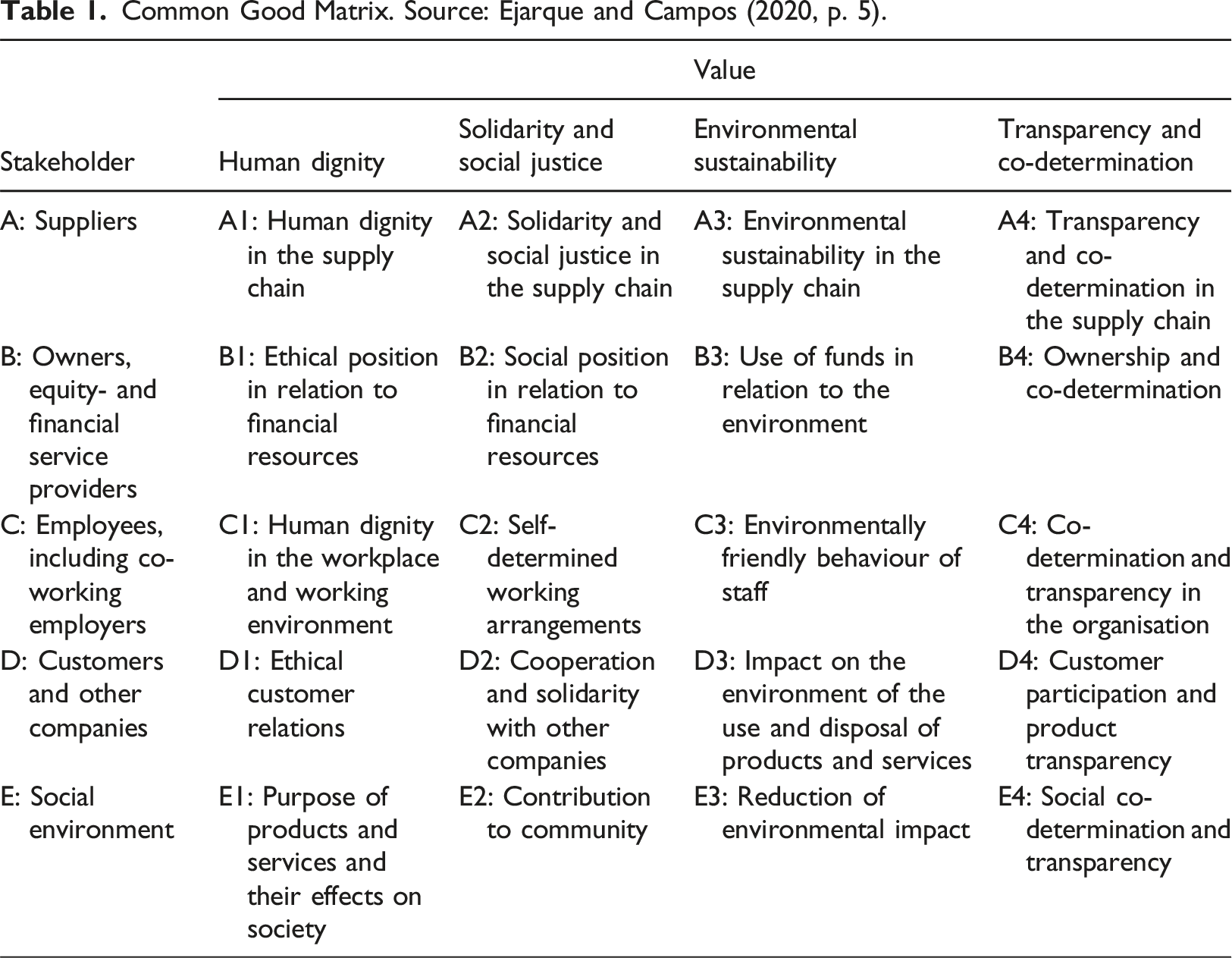
The CGE has several core alignments: it is embedded both social and environmentally, with democratic measures, environmental protections, and values-based economics at its heart; its emphasis on the common good makes it collectively-oriented; its focus on closing the gaps between feeling and thinking and economics and ethics provides an empathetic alignment; the emphasis on moving beyond markets to satisfy needs, and common good and cooperation over competition aligns with reciprocity; there is a degree of balance indicated in the limitations placed on natural resource use though the dynamism is possibly better located in the cooperative approach; and, the local element is also somewhat apparent as CGE encourages bottom-up approaches.
Solidarity economy (SE)
The SE was used as an economic organising concept as early as 1937, when Felipe Alaiz advocated for the construction of an economìa solidária between worker collectives during the Spanish Civil War (Miller, 2010). A SE incorporates ‘cooperation, collective sharing and action, while putting the human being at the centre of economic and social development’ (Dacheux and Goujon, 2011: p. 206). Miller (2010) outlines six key values underpinning a social and solidarity economy: cooperation and mutuality above unfettered competition; individual and collective wellbeing, as defined by communities, over profit; economic and social justice; ecological health through developing respectful and sustainable relationships with ecosystems; robust democracy with communities as the active agents of their own lives; and diversity and pluralism, with people working together to forge their own unique paths toward freedom. These are common across much of the SE literature (Salustri, 2021). The SE takes a bottom-up approach that aims to builds network between already existing cooperative, democratic, localised economic actors (Miller, 2010). It also acknowledges that alongside the market other mechanisms of exchange including redistribution and reciprocity need to be utilised, promoting a range of community and complementary currencies as well as barter networks intended to facilitate these forms of exchange (Bindewald et al., 2019; Dacheux and Goujon, 2011; Miller, 2010). Miller (2010) identifies ecological and cultural creation as the original points of production that sustain all life and culture and should be shared and held in common trust.
There are a number of alignments between SE and Māori economies: SE is embedded both socially and environmentally; it is focused on collective outcomes through its self-determined community wellbeing; while not explicit about empathetic decision making the inclusion of economic and social justice has some connection; it references reciprocity as an important form of exchange; SE advocates for balanced relationships, particularly with nature; and it is localised in its view of self-determination as well as its approach to fostering and connecting localised developments.
Doughnut economics (DE)
DE was first outlined in 2017, but has seen quick uptake with the creation of the Doughnut Economics Action Lab. (DEAL), which has almost 200 partners, and a number of projects at various scales. The metaphoric doughnut of DE represents the ‘safe zone’ in between maintaining social foundations – essentially the Sustainability Development Goals – and avoiding ecological ceilings – a set of planetary boundaries developed by Earth-system scientists. It aims to ‘create local to global economies that ensure that no one falls short on life’s essentials… While safeguarding Earth’s life-giving systems’ (Raworth, 2017: p. 220). DE is built on a set of seven insights about how the field of economics needs to change: shifting from GDP to more holistic bottom line; re-embedding the economy in society; changing from the belief in ‘rational’ calculating humans to a more emotional and reciprocal view of human nature; understanding economics is not like a physical science; putting distribution at the core of an economy; ensuring an economy is regenerative by design; and becoming agnostic about growth (Raworth, 2017). The DE has been identified as a globalised concept, largely as the environmental thresholds are hard to scale down, though (Turner and Wills, 2022). That said, it has been applied at city-scale (DEAL, 2020).
DE has clear alignments with te ao Māori: The doughnut is the embedded economy; DE is collectively-oriented, with its focus on both the holistic bottom line and distribution; the move from rational calculation to emotional view of human nature shows empathy has a key role; it also promotes a reciprocal rather than competitive view of human nature; it has a degree of balance as agnostic about growth; however, there are some possible issues with localism.
Wellbeing economy (WE)
WE has seen significant implementation globally, with several governments including Aotearoa New Zealand implementing WE principles. The most generally agreed upon definition is that a WE shifts the central economic goal from growth to human and planetary wellbeing (Hayden and Dasilva, 2022; WEAll, 2021). WEAll (2021) list five core principles of a WE: dignity, everyone has enough to live in comfort, safety, and happiness; nature, a restored and safe natural world for all life; connection: a sense of belonging and institutions that serve the common good; fairness, justice in all its dimension is at the heart of economic systems, and the gap between the richest and poorest is greatly reduced; and participation, citizens are actively engaged in their communities and locally rooted economies. Costanza et al. (2018) list five goals: stay within planetary biophysical boundaries; meet all fundamental human needs; create and maintain a fair distribution of resources, income, and wealth; have an efficient allocation of resources to allow inclusive prosperity, human development and flourishing; and create governance systems that are fair, responsive, just, and accountable.
WE aligns well with te ao Māori: It is embedded through its emphasis on human and planetary wellbeing and aim to stay within biophysical boundaries; the principles of dignity and fairness as well as aim to efficiently allocate resources delineate a focus on collective outcomes; there is some degree of empathetic decision-making present, not just in the focus on dignity, but also on connection; there is no overt reference to reciprocal exchange; balance is a key aim of WE as outlined by the principles of dignity and fairness and the goal of creating and maintaining a fair distribution of resources, income, and wealth; and the principle of participation outlines the need for locally rooted economies.
Ontological alignment and cognitive convergence
Alignment between wellbeing economy strategies and te ao Māori economic kaupapa.
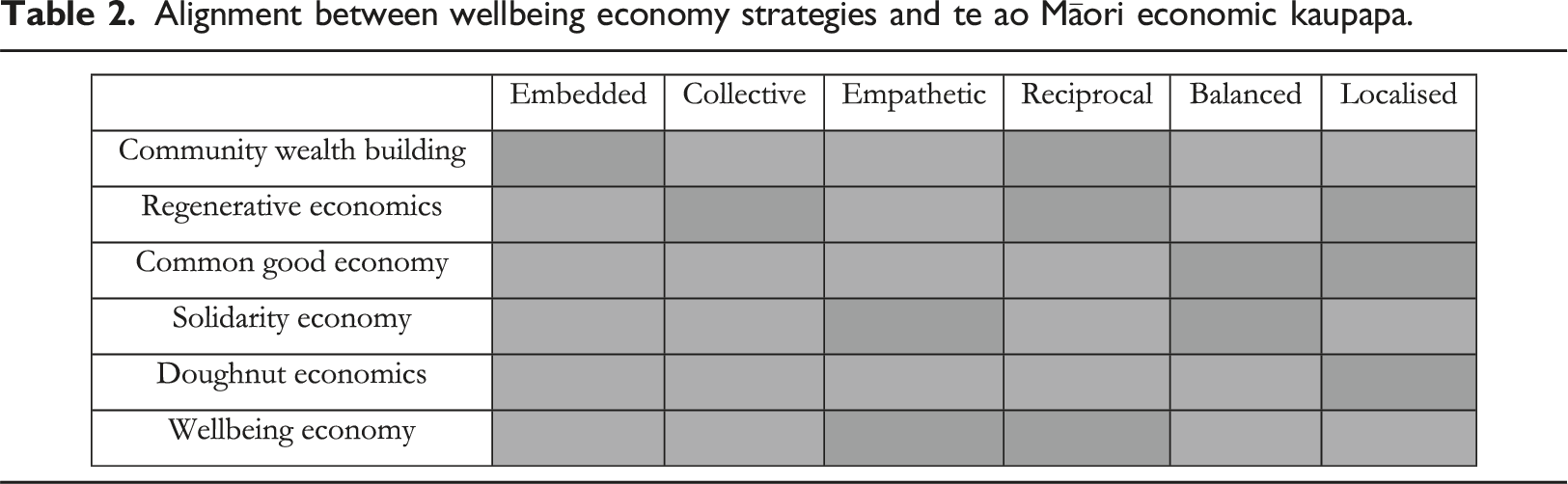
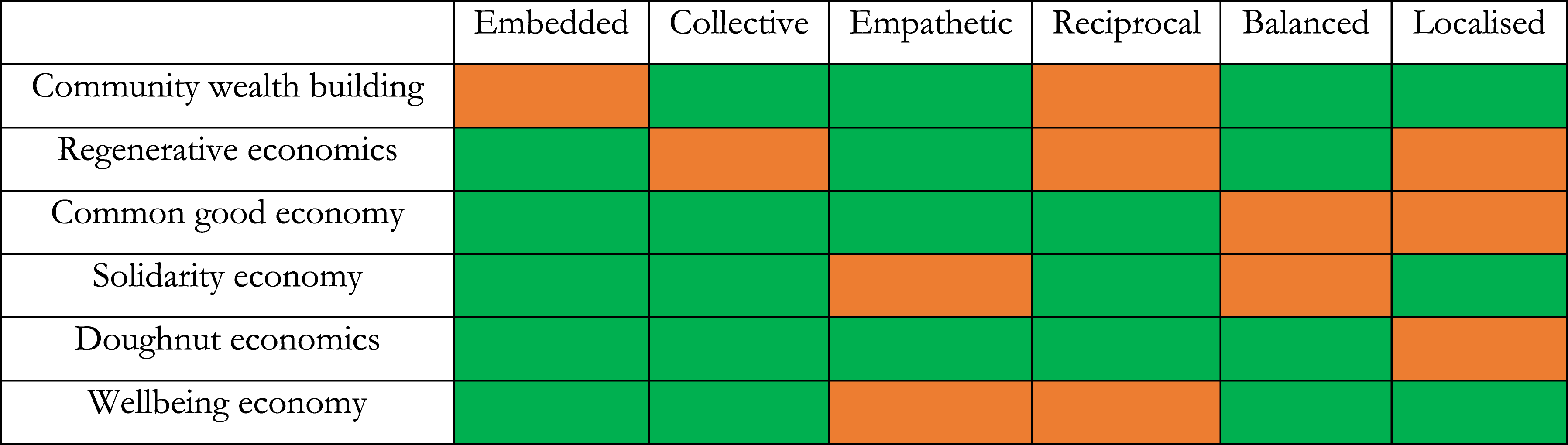
For the project, this suggests that solutions from these six WES can be incorporated into Māori economies of wellbeing with minimal risk of being colonised by capitalist principles. The similarities between the six WES and the kaupapa, and between the WES themselves asks an even more profound question, however: Why are they all so similar?
The answer, it is believed, is that the WES are tapping into the primordial view of the world. There are many different names for this worldview: animism, ancestrality, holism, vitalism, biocentrism, and relationalism. From an Indigenous perspective, there are issues with many of these, particularly animism, which emerged from anthropological taxonomies and as such is cast in binary opposition to ‘modern’ (Bird-David, 1999; Franke, 2012). The term ‘relational’ is not only less problematic but has resonance with Māori and other Indigenous peoples; hence, all quotes will replace ‘animism’ and its lexemes with ‘relationalism’ (Wildcat and Voth, 2023).
The claim that the relational worldview is primordial is admittedly impossible to verify empirically but its near ubiquity amongst Indigenous peoples suggests that the claim has some veracity (Hart, 2010; Niezen, 2012; Peoples et al., 2016; Sullivan, 2010; Wildcat and Voth, 2023; Willerslev, 2007). The relational worldview seems to be the common orientation of hunter-gatherers, an economic modality that everyone’s ancestors have in common at some point (Peoples et al., 2016; Willerslev, 2007). Current thinking in fields like biological anthropology and evolutionary psychology posits that relational thinking predates language and provided humanity with a critical evolutionary advantage (Coward, 2016; Dunbar, 2003). It has also been referred to as the world’s oldest religion (Peoples et al., 2016; Victoria, 2018). Further suggesting the primordiality, and syncretic influence, of this worldview, many major religions have relational aspects as well such as Shintoism, Hinduism, and Buddhism (Longkumer, 2017; Sprenger, 2015; Victoria, 2018).
Many anthropologists believe even those with a Western worldview also have relational tendencies. As Hornborg (2014, pp. 23-24 – emphasis in original) argues: All of us are actually born ‘pre-modern’, have an ontogenetic familiarity with ‘relatedness’, and will generally tend to struggle to maintain some measure of community in our lives. Our training in the skills of modernist detachment and objectification is contextual, as illustrated by the professional logger who privately cares for his garden, or the industrial butcher who privately cares for his dog.
Latour (1993) also argues that the modern self is essentially a fictitious, even pernicious, overlay, titling his impactful book We have never been modern. Harvey (2014, p. 11) in response to Latour’s title, replies: ‘but perhaps we have always been [relationalists]’. Likewise, Ingold (2006, p. 11) argues that humanity has a predisposition to assume everything is alive, such that ‘we have all evolved to be closet [relationalists] without of course realising it’.
While the primordial nature of the relational worldview is unprovable, there is an increasing amount of empirical work examining the ubiquity and influence of relational worldview in contemporary societies and economics. The importance of social capital, effectively an emergent property of embeddedness, in economic growth across different countries and cultures is well documented (Neira et al., 2009; Westlund & Adam, 2010; Whitely, 2000; Woolcock, 1998). Much research has been done into relational values – which focus on the human-nature relationship– showing, amongst other aspects, that they resonate with diverse population groups (Himes et al., 2024; Klain et al., 2017; Kleespies and Dierkes, 2020; Pratson et al., 2023; Schulz and Martin-Ortega, 2018). This is backed up by the World Values Survey (2000, cited in Leiserowitz et al., 2006: p. 421), which found that ‘76% of respondents across 27 countries said that human beings should “coexist with nature,” whereas only 19% said they should “master nature.”’ There is also ‘a large body of evidence gathered by experimental economists and psychologists during the last two decades… [that] indicates that a substantial percentage of the people are strongly motivated by… concerns for the wellbeing of others, for fairness and for reciprocity’ as well as self-interest (Fehr and Schmidt, 2006: p. 617). A number of studies also show that empathy is an important component in economic decision-making (Botelho, 2019; Kirman & Teschl, 2010; Martingano and Konrath, 2022; Singer and Fehr, 2005). While none of this research is a ‘smoking gun’ on its own, there does appear to be strong support for the ubiquity of the relational worldview even in the dominant capitalist system, suggesting that despite the strictures of the neoclassical paradigm humanity remains intrinsically relational.
The Western worldview, it is argued, is a recent superimposition that is imprinted and replicated socio-culturally yet is unable to fully erase the foundational relational orientation over which it is stamped. It is, as Loh and Shear (2022, p. 1210) describe it, ‘an imposed fiction’. This is why Māori kaupapa and capitalist principles are in such a juxtaposition: ‘modernity’ as a political, economic, scientific, social, and cultural concatenation triumphed precisely because it freed itself from relational restraints (Franke, 2012). Yet in this fiction also lies the source of its own failings. These failings are manifold; they can be seen in the rampant environmental destruction, the pillage of imperialism and colonisation, the injustice of inequality, and the atomisation of society, amongst many other ills. Berman (1988, p. 15) captures this paradoxical nature eloquently: To be modern is to find ourselves in an environment that promises us adventure, power, joy, growth, transformation of ourselves and the world – and, at the same time, that threatens to destroy everything we have, everything we know, everything we are. Modern environments and experiences cut across all boundaries of geography and ethnicity, of class and nationality, of religion and ideology: in this sense, modernity can be said to unite all mankind. But it is a paradoxical unity, a unity of disunity: it pours us all into a maelstrom of perpetual disintegration and renewal, of struggle and contradiction, of ambiguity and anguish.
To state the obvious, the WES have all largely developed as a reaction to modernism and capitalism in general, neoclassical economics in particular, and the significant failings they have brought about (Brand-Correa et al., 2022; Dash, 2016; Dolderer et al., 2021; Raworth, 2017). As Dolderer et al. (2021, p. (2) note, ‘neoclassical economics have been under massive criticism… [which] has generated a wide field of alternative, heterodox economic theories, and the call for a transformative, pluralistic economic science’. But while the WES may constitute a ‘wide field of alternative, heterodox economic theories’ they are also built on a shared view of reality: relationalism. They have come full circle, back to the view of reality that was developed and refined over many thousands of years by numerous groups around the world because it provides collective, sustainable wellbeing.
The embedded interconnectedness that relationships generate is what makes the relational worldview eminently suited to ensuring human and nonhuman wellbeing is maintained. There are two components to this conjecture. Firstly, the understanding that everything one interacts with is an active subject requires these subjects to be related to in a respectful manner because they have intrinsic worth; the cognizance of human and nonhuman agency demands ‘careful and constructive engagement’ (Harvey, 2014: p. 208). As Harvey (2005, p. xi) writes, relationalism ‘is more accurately understood as being concerned with learning how to be a good person in respectful relationships with other persons’, human and nonhuman. Secondly, relationists view their place in reality as one of mutual interdependence with everyone else they relate with; put simply, they realise that how they interact with the wider ecosystem affects them and this serves to limit short-term self-interest and promote long-term collective interest (Rout and Reid, 2020). Collective wellbeing is an emergent property of living in a web of relationships.
Conclusion
For the project, this ‘ontological alignment’ is reassuring as it not only because these various solutions can be harnessed to improve Māori wellbeing but it also means that relationships with the various communities implementing them can be forged so that the insights flow both ways, enabling the kind of andragogical – peer-to-peer – learning necessary for delivering mutually-beneficial outcomes. Developing these relationships is critical for the success of the project, and it is critical for success of ‘human project’ as well, which brings us to a final insight:
If neoclassical economics is to be countered effectively, then there needs to be coherence to this opposition. The wellspring of different WES is a positive sign of this opposition but its fractious diversity is also a weakness. The opposition to neoclassical economics needs to reach an ‘economy of scale’ to compete with the status quo, and the shared underpinning of the relational worldview might play that role, uniting the multiple models and approaches at a core ontological level. This would not favour any one particular Indigenous worldview as they are each a product of their own specific location and application, that is one of the inherent benefits of seeing the world in this way: it is an intrinsically bottom-up, diverse, and participatory approach to economics.
Conceptually, the relational worldview could provide the different schools of economic thought with a common intellectual foundation from which points of intersection can be identified and emphasised, which might in turn help them build towards constructing a shared, if locally variable, replacement to capitalism. At a practical level, this might see settler states working more closely with their Indigenous populations, harnessing their economic insights to grow locally responsive solutions.
Footnotes
Declaration of conflicting interests
The author(s) declared no potential conflicts of interest with respect to the research, authorship, and/or publication of this article.
Funding
The author(s) disclosed receipt of the following financial support for the research, authorship, and/or publication of this article: This work was supported by Ngā Pae o te Māramatanga
