




Abstract
This paper is an initial attempt to evaluate the challenges of promoting a new national language as a medium of instruction (MOI) in a post-socialist higher education (HE) context. In the case of Kazakhstan, the choice of MOI is perceived as a key tool to strengthen national identity and resist domination of Russian; in higher education sector language policies are constructed to foster cultural independence which translates into establishing Kazakh as a full-fledged medium of academia. Drawing on the historical-structural approach (Tollefson, 1991, 2013), we analyze the ideologies and practices of university students studying in Kazakh. Findings from audio-recorded interviews suggest that implementing Kazakh-medium instruction policies face numerous pragmatic and ideological challenges, such as a dearth of teaching and learning resources in Kazakh and lack of Kazakh-speaking faculty. This study contributes to scholarship on language revitalization in the context of tertiary education.
Introduction
When it comes to choosing the medium of instruction, the field of higher education has oscillated between two orientations—the international and the national (Vila, 2014, p. 182). The international orientation supports adopting an international language, often a former colonial language, to teach at the tertiary level. This post-national university model is often backed by the idea that only mediums of broader communication, such as global English or Russian in post-Soviet countries, can be languages of science and knowledge; many languages are deemed unfit to be used in academia. It is also sustained by the intellectual capital accumulated in the dominant language, an association of the dominant language with powerful institutions, and the elite’s desire to protect its social boundaries.
The national orientation presupposes the elaboration of local languages to make them fully fledged means of instruction in HE. Analysis of international practices suggests that predicting whether a language will become or remain a viable means of instruction in HE is difficult. Vila (2014), suggests that some conditions make the choice more likely to succeed. The language in question should have previously occupied the rest of the cultural and economic domains it should be established as a language of secondary education, with strong political support by a significant portion of the population and a sufficient number of speakers in that language.
Penetrating the domain of academia, which provides one of the highest levels of linguistic elaboration, is crucial for language revitalization and maintenance. It is viewed as “the arrival of the pursuit of cultural autonomy for those who have pursued the vision of Xmen-via-Xish” (Fishman, 1991, p. 107). However, only few languages are used as a language of science and academia around the world (Laponce, 2006), and many medium-sized languages are at risk of losing the domain of higher education to English. Drawing on data from Kazakhstan universities, this paper attempts to identify challenges associated with establishing a sociolinguistically weaker, historically marginalized language as a medium of instruction at the university level.
Given the Soviet legacy when the medium of instruction (MOI) policy was used for the interests of a dominant group of Russian speakers by providing them with privileged access to higher education and employment opportunities, new MOI policies of independent Kazakhstan are constructed as a means to counter this social and economic inequality and to promote cultural independence. Kazakhstani language policy and educational policies are strategically targeted at reinstituting the Kazakh language in all domains, particularly at establishing and increasing the share of students studying in Kazakh as a medium of instruction at both school and university levels. Establishing Kazakh as a medium of instruction in secondary schools has been successful: a majority of children in the country now study in Kazakh, all school materials are available in Kazakh, and there is no shortage of Kazakh-speaking teachers. While instituting Kazakh as a language of the HE and science domains is often presented as a way to strengthen national identity and contribute to long-term language survival, the implementation of the policy has been challenging. Drawing on the historical-structural approach (Tollefson, 1991, 2013), we try to understand the dynamics of promoting a new national language as the medium of academia and identify structural factors hindering attempts to reinstate former minority languages in the high-power domain of academia. The study adds to the scarce literature on language revitalization in HE in the context of internationalization and the association of tertiary education with the information society (Heller & Duchêne, 2012).
Theoretical underpinning: Historical-structural approach
Earlier studies on medium of instruction have been traditionally conducted in the field of bilingual education. Researchers paid particular attention to the choices of the medium of instruction, the effectiveness of programs in L1 and L2 language acquisition, and students’ academic achievements in content subjects. Since the 1990s, scholars have adopted a critical linguistics approach to study medium of instruction, focusing on the role of language in power, language rights, language dominance, and language inequality. In these regards, Tsui and Tollefson (2003, p. 9) state that “medium-of-instruction policies are never politically neutral […] They can be instruments of cultural and linguistic imperialism, but they can also be means for promoting linguistic diversity and cultural pluralism.” As history shows, when there is no threat to the existing power structure (e.g., New Zealand, Wales, Canada, etc.), language policy is drawn toward linguistic diversity in the community; it is tolerated and supported. Once there is a perceived threat to national unity, language policy is drawn toward linguistic homogenization; it further deepens the disadvantageous position of speakers who lack linguistic capital (Tsui & Tollefson, 2003).
Current research in language policy and planning draws predominantly on neoclassical and historical-structural approaches. While the former focuses on individual linguistic decisions (e.g., learners’ attitudes, values, motivation, openness to innovation, etc.), the latter focuses on constraints that guide individual decision-making. Tollefson (1991) states that language behaviors and language problems individuals face are better explained through the historical-structural approach that falls within the theory of critical language studies. For example, patterns of language use, language status, and the emergence of a particular language policy can be explained concerning the country’s history (e.g., the country’s colonial past in post-colonial settings). Structural factors, although they could be conceptualized in different ways (e.g., “race, ethnicity, and gender (Tollefson, 2011), institutional forms and practices (Althusser, 1971), the international division of labor (Phillipson, 1992), the political organization of decision-making, the role of language in social policy (Forester, 1985)” (Tollefson, 2015, p. 142), depending on the researcher’s ideological framework, can contribute to the examination of language policies that “sustain social, economic and political inequalities” (ibid.) and “benefit wealthy and powerful individuals, groups, institutions, and nation-states” (Tollefson, 2013, p. 27).
This approach views language and MOI policies as situated sociocultural processes; thus, historical and structural issues of dominance, hegemony, inequality, power, ideology, etc., are considered in seeking explanations for language use, language planning, and language policy decisions (e.g., Al Zumor, 2019; Hossain, 2008). For instance, within the historical-structural model, motivation for learning a language is not treated as a “learner” variable but placed in the context of historical and structural factors, such as economic interests in learning a language variety, ideological support, and access to quality education (cf., Lee, 2021).
Tollefson argues that “within the historical-structural approach, language policy is viewed as one mechanism by which interests of dominant sociopolitical groups are maintained, and the seeds of transformation are developed” (ibid.). In other words, the approach allows examining the role of language planning and how it creates and sustains systems of inequality (Tollefson, 2015, p. 140). This paper explores how structural pressure leads to particular language practices in universities, which sustain structural and material inequalities and limit access to quality education.
Language revitalization and maintenance in HE
In many contexts, the choice of MOI is a key tool to strengthen national identity; therefore, language education policies in such cases are driven not only by educational and/or language maintenance agendas but also by the ideology of resisting linguistic domination of a national or former colonial language. However, shifting a language hierarchy and changing language practices in education is challenging. Even the incorporation of minority languages at the secondary school level faces numerous difficulties. While schools “can become strategic platforms for more broad-based language planning, from orthographic standardization to preparing Indigenous teachers, to elevating the status of oppressed and marginalized languages” (McCarty, 2008, p. 16), across studies, it is commonly reported that in the implementation of indigenous and minority language programs in schools, there are enormous challenges, such as a shortage of qualified teaching staff, lack of teacher training opportunities, limited language teaching and learning resources, underdeveloped strategies, and methodologies to integrate indigenous language in classrooms and schools, etc.
Beyond secondary school, universities rarely provide programs with minority languages as a medium of instruction. Where available, these programs tend to offer teacher training modules to prepare teachers to support secondary schools. The evidence from post-colonial Africa, where former colonial languages have been retained as MOI at tertiary and upper secondary school levels, demonstrates that deep-running structural inequality makes the task of shifting language hierarchies and reinstating minority languages in HE problematic for pragmatic and ideological reasons (Alidou, 2003; Meeuwis, 1999). Another impediment to using African languages for teaching is of a practical nature: a need for linguistic, material, and financial resources (Ferguson, 2022, p. 185).
The literature on language revival and revitalization efforts tends to concentrate on the medium of instruction (MOI) in secondary school settings, which are seen as the ultimate sites for the production of new speakers (e.g., Chevalier, 2017; Heidemann, 2014; Malone, 2003; McCarty, 2008; Todal, 2018). The research on MOI in higher education (HE) predominantly focuses on the implementation of English as a Medium of Instruction (EMI) programs (e.g., Baker & Hüttner, 2017; Breeze & Guinda, 2021; Curle et al., 2022; Dearden, 2014; Doiz et al., 2012; Hu & Lei, 2014; Kirkgöz & Karaka, 2022; Rose & McKinley, 2018; Wilkinson & Gabriëls, 2021) and pressure of EMI on medium-sized and minority languages and local cultures (Coleman, 2006; Parera, 2018; Ram, 2018; Rose & Galloway, 2019; Tsui & Tollefson, 2003; Vila & Bretxa, 2014).
However, research examining MOI issues in academia in the context of language revitalization is scarce and has not received enough attention. Very few studies (e.g., Hossain, 2008) report the effects of the implementation results of introducing a mother tongue as the language of instruction in HEIs. This is a very unsatisfactory state of affairs, considering that in today’s globalized world, HE is of unprecedented importance in educating people to develop a country’s economy and knowledge production (Altbach, 1998, 2007).
Kazakhstan HE as a research context
Formerly a member of the Soviet Union, the Republic of Kazakhstan is currently an independent country with a population of about 19 million. The majority of the population (70.4%) are Kazakhs; Russians represent 15.5% of the population, and the rest are ethnic minorities: Uzbeks (3.2%), Ukrainians (2%), Uighurs (1.5%), Germans (1.2%), Tatars (1.1%), and others. In terms of language skills, according to the 2021 Census, 80% of Kazakhstani people report Kazakh-language proficiency, and 49.3% of them use Kazakh daily (Bureau of National Statistics of the Agency for strategic planning and reforms Republic of Kazakhstan, 2022). Both Kazakh and Russian are widely spoken and used in various domains. Kazakh is the sole official language, and Russian is a co-official language that can be used on a par with the Kazakh language when necessary (Constitution of the Republic of Kazakhstan, art. 7, 1995). Except for a few English-medium universities that emerged after 1991 independence (e.g., KIMEP University, Nazarbayev University, or branches of international schools), all other HEI traditionally offer instruction in Kazakh MOI and Russian MOI: students are placed in two separate language streams. While one’s main language of instruction in university is typically defined by the language of instruction in secondary schools, students may choose to change it.
During the Soviet period, most programs in HEIs were taught in the Russian language. The exceptions were teacher training, humanities, and agriculture programs. This obviously created problems for school graduates educated in other local languages of instruction, like Kazakh (Fierman, 1989; Liddicoat, 2019). Russian-medium higher education and research, especially in the fields of science and technology, became more “suitable for advancement within the Soviet system” (Liddicoat, 2019, p. 7). Eventually, education-oriented parents opted to enroll their children in Russian-medium secondary schools, which contributed to languages shift in urban areas (Smagulova, 2008).
Since independence, the goal of language policy has been the reinstatement of the Kazakh language, manifested in the increase in the status and social prestige of the new state language, language spread and homogenization of the population, and corpus planning (for instance, the creation of new terminology). The status of Kazakh language has been upgraded to the sole national language, and there is political and ideological support to spread the use of the Kazakh language across a number of domains, especially in the education system. A dramatic change in student demographics has helped the nationalizing policy. In 1992, the share of students studying in Kazakh-medium schools was around 38% of the total number of secondary school students (Kunantayeva, 1997); in 2022, their share increased to 67% of the total student population (Bureau of National Statistics of the Agency for strategic planning and reforms of the Republic of Kazakhstan, 2022a). Accordingly, the share of students studying in Kazakh in local universities has also increased from 85,300 (32%) in 2000 to 371,123 (64.4%) in 2022 (ibid.).
Implementation of the cultural project “Trinity of Languages” in 2016 aimed to transition all levels of education to trilingual instruction in Kazakh, Russian, and English. In HE, this policy calls for adopting a “50:20:30” model, which recommends that 50% of subjects should be taught in Kazakh or Russian as L1, 20% in Russian or Kazakh as L2, and 30% in English as L3 (Irsaliyev et al., 2017). Some scholars argue that improving English-language proficiency has topped the educational agenda under the implementation of the trilingual policy in Kazakhstan (Karabassova, 2020). Kazakhstani education policymakers see EMI as a means of internationalization, improving the quality of education, and offsetting the lack of current research and teaching resources, especially in Kazakh.
In this paper, we critically evaluate the implementation of Kazakh-medium instruction at the tertiary level. In the next section, we specifically focus on exploring the views of students studying in Kazakh MOI regarding the challenges they encounter.
The data
The study was conducted in Astana, the capital of Kazakhstan since 1997. The official articulated reason for moving the capital from southern Almaty to northern Astana was its central location and safer area, which is not earthquake-prone like Almaty. The underlying agenda was to balance the ethnic distribution of the country by creating a new center for immigration, particularly for people from the predominantly Kazakh-speaking south, and making the north less exclusively Russian speaking. Currently, the population of Astana is around 1.3 million (Bureau of National Statistics of the Agency for strategic planning and reforms of the Republic of Kazakhstan, 2022b). The share of ethnic Kazakhs has increased from 18% in 1989 to 79% in 2022 due to natural growth, emigration of Slavic and German ethnic groups from Kazakhstan, repatriation of ethnic Kazakhs from neighboring countries (e.g., China, Mongolia, Uzbekistan, Turkmenistan, etc.), resettlement of ethnic Kazakhs in regions with a higher proportion of the non-Kazakhs population. Despite the dramatic demographic shift, Russian remains Astana’s dominant language of everyday communication.
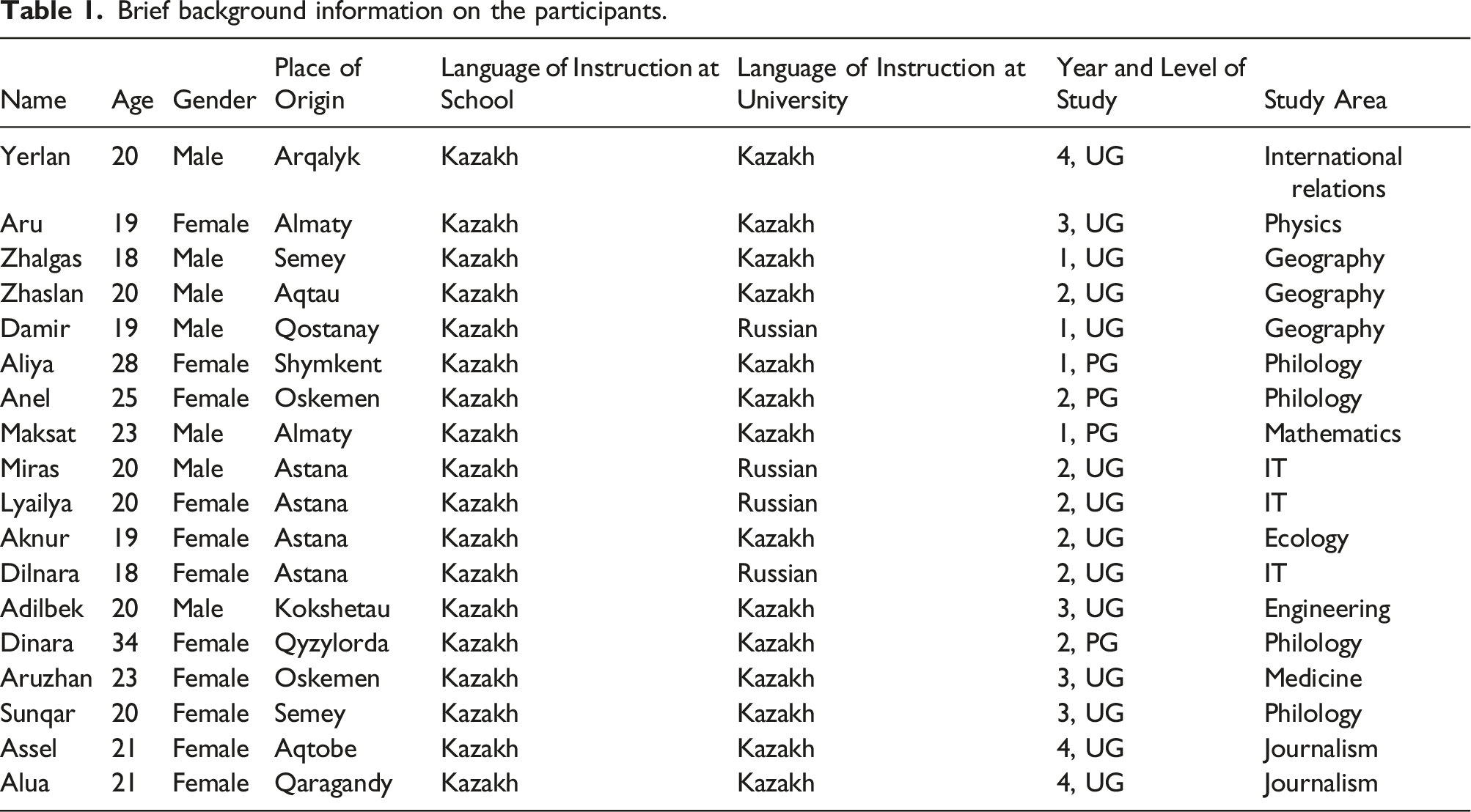
The study draws on the data collected through interviews with university students studying in Kazakh as a medium of instruction. To recruit participants for the study, the researchers used their network and reached participants through “a friend-of-a-friend method.” Before the data collection stage, we obtained verbal and written consent from the participants. The names of participants were changed, and other personal information was anonymized.
All respondents were proficient speakers of spoken Kazakh and Russian, although their language proficiency in written Kazakh and Russian languages varied. At the beginning of the interviews, the participants were asked about their preferred language (Kazakh or Russian) to answer the interview questions. The interviews were, thus, conducted either in Kazakh or Russian. Some respondents answered in a Kazakh-Russian mixed code since code-switching and code-mixing are typical for bilingual speakers in Kazakhstan.
In the interview, the respondents were asked about their current language practices at university. The interview data was later transcribed. For managing and organizing the data by the most common themes, the core themes through coding of interview data in NVivo software were established following Allsop et al. (2022). The interview data comprised around twenty-one hours of audio recordings collected in September 2022 and May 2023.
Brief background information on the participants.
Results and analysis
The data reveal several practical and ideological difficulties concerning Kazakh-medium instruction in universities. The results are organized by themes that most frequently emerged in our data.
Access to learning resources in Kazakh
One of the most frequent themes in the interviews is the lack of teaching and reading resources in Kazakh. The respondents report that instructors use and refer to learning materials in Russian, and respondents themselves rely on materials in Russian because the information and library resources in the Kazakh language are limited. Below are some of the typical comments we received: Жеке өз басым күнделікті өмірде қазақ тілін қолданамын, және сабақта да. Бірақ та бізге сабаққа байланысты материалдар немесе информация табу кезінде ағылшын тілін немесе орыс тілін қолданамын, себебі орыс тілінде материалдар көбірек кездеседі, қазақ тіліне қарағанда. Соларды аудару арқылы...қазақшаға аударып содан кейін пайдаланамын. [Personally, I use the Kazakh language in my daily life and class. But I use English or Russian when finding materials or information related to the lesson because there are more Russian materials than Kazakh. By translating them… I translate them into Kazakh and then use them]. (Sunqar, 20) Обычно использую русский язык для подготовки к сессии, так как на казахском информации практически нет. [I usually use the Russian language to prepare for exams because there is almost no information in Kazakh]. (Lyailya, 20) На казахском языке библиотека очень скудная, потому что вся информация идет либо на русском, либо на английском языках. Насчет качества – тоже не особо... [The library in the Kazakh language is very poor because all the information is either in Russian or English. About the quality – is not good either…]. (Aknur, 19)
The lack of learning resources becomes more pronounced in more advanced classes. Aruzhan (23), who studies Medicine, reports that the more she progresses with her studies, the more limited access to learning resources in Kazakh she has experienced. The respondents would frequently report that instructors shoulder the responsibility of finding learning resources on students as they often were not able to provide an assigned reading in Kazakh. Мысалы, бірінші-екінші курстарда бізде сабақтар, материалдар, қазақша кітаптар болды, оларды библиотекадан алғанбыз, ол кезінде қиыншылық болмайтын. Ал үшінші курста қазақша материалдар аз болады да, сосын мұғалімдер рекомендация береді, орысша кітаптар іздеп көріңдер деп. Струтынский, Ройтберг деген “Пропедевтика” мысалында, тағы басқа кітаптарды айтады, бірақ қай жерден сол кітаптарды алу екенін — айтпайды. Сосын өзіміз іздеп табамыз интернеттен, Telegramнан [...] [For example, in the first and second years, we had lessons, materials, and books in Kazakh, which we got from the library, and there were no problems then. And in the third year, there were few materials in Kazakh, and then our teachers gave recommendations that we look for books in Russian - Strutynsky, for example, Roitberg’s “Propaedeutics” and other books. But they do not say where to get these books. Then we search for them on the Internet, on Telegram […]. (Aruzhan, 23)
Four informants in our sample have decided to change the university’s instruction language. The main reason they all cite is a lack of resources which impedes quality of education. The interview respondents note that studying in Kazakh is challenging due to the practical difficulties in finding information. Lyailya (20), for instance, adds that it is especially problematic in her “Systems of Information Security” major. She believes switching from Kazakh MOI to Russian MOI is the better option for studying “Computer programming.” И вообще по программированию Java, по C++ — очень мало информации на казахском, поэтому приходилось искать информацию больше на русском. И благодарая тому, что искала на русском, конечно, я делала эти все задания. Но я понимала, что лучшим вариантом будет перевестись лучше в русскую группу — раз уж на то пошло... [And in general, there is very little information about programming in Java and C++ in Kazakh, so I had to search for more information in Russian. And I completed all these tasks because I was looking for the info in Russian. But I understood that the best option would be to transfer to a Russian group – if it came to that…]. (Lyailya, 20)
Proficiency in Kazakh
Another serious concern expressed by informants is that many instructors are L1 Russian speakers; they received their education in Russian and thus their primary professional language is Russian. The data suggests that ethnic Kazakh faculty are assigned to teach in Kazakh even when their language proficiency is limited by fluency in everyday conversational Kazakh. Because the faculty lack academic and professional language skills in Kazakh, it is common for classes to be conducted in bilingual mode or in Russian. It is common that teaching materials are designed in Russian and then translated into Kazakh. The quality of translation is not necessarily good: Бывают такие моменты, что по некоторым предметам, “Масс коммуникация” и тому подобное, учителя готовят лекцию на казахском, и там непонятно очень, как-будто перевели с гугл-переводчика, если честно, вот… [There are times when (lectures) in some subjects, “Mass Communication” and something like that, teachers prepare a lecture in Kazakh, and it’s not very clear, as if they (lecturers) translated (a lecture into Kazakh)with a Google translator, to be honest, yeah […]. (Alua, 21) В некоторых предметах, в лекциях, учителя переводят сами, поэтому перевод хромает. [In some courses, and lectures, teachers translate (materials from Russian into Kazakh) themselves, so the translation is poor]. (Adilbek, 20) Даже лекции иногда пишут с грамматическими ошибками, либо же они переведены либо в Yandex, или каком-то еще браузере, где перевод немножко кривой, и смысл меняется. [Even lectures are sometimes written with grammatical mistakes or translated in Yandex or any other browser, where the translation is a little awkward, and the meaning has changed]. (Aknur, 19)
Expectations of multilingual and translation skills
Interviews show that multilingual proficiency is expected and often taken for granted. All students report that they were routinely assigned materials in Russian and expected to translate materials from Russian to Kazakh on their own. Бірінші переводқа салдым, жалпы мағынасын түсініп алу мақсатында, содан кейін өз сөздік қорымды, тіл байлығымды қосып, қазақ тілінде жаздым. [First, I translated it (through online translation) to understand the general meaning, then I added my (Kazakh) vocabulary and linguistic skills and wrote (the paper) in Kazakh]. (Dinara, 34) Орыс тілін қазақшаға аударған кезінде, көбінесе переводчикпен аударамыз, сол Google переводчикпен. [When translating Russian into Kazakh, we often translate with translation (software), with Google translator]. (Aruzhan, 23)
While translation is a common practice, students also often use the materials in the original Russian language without converting them into the Kazakh language. Moreover, some coursework is written and submitted in Russian. Хотел добавить, что некоторые материалы мы не переводим на казахский язык, а изучаем именно на русском языке (...) Курсовые мы писали на русском языке. [I would like to add that we do not translate some materials into the Kazakh language (from Russian) but study them in the Russian language (…)We wrote our coursework in Russian]. (Adilbek, 20)
The instructors assume proficiency in Russian, and they need to be reminded that not all students are able to comprehend advanced technical texts in Russian. The example below illustrates the situation. Only when students complained that the course instructor “promised” to prepare the lecture materials and assignments in Kazakh: Осы екінші курсқа өткеннен кейін алғашқы екі сабағымыз материалдары орысша жіберілген, заданияларын, үй жұмыстарын. Біз ағайға ескерттік, бізге орыс тілі, біз түсінбейміз, қазақ тілде берсеңіздер деп. Ағай келісті келесі сабақтан бастап қазақша материал дайындаймын деп уәде берді. Біз сұрағанда “несі түсініксіз? Нені аударып берейін? - деп сұрады. “Если түсінбесеңдер - сұраңдар” - деп. [In my second year, when we had just started our classes, the materials of our first two classes were sent in Russian, assignments, and homework. We reminded the teacher that we did not understand Russian, so please give the materials in Kazakh. The teacher agreed and promised to prepare materials in Kazakh for the next class. When we asked him to do so, he wondered, “What was unclear? Let me translate. If you do not understand, just ask me”]. (Zhaslan, 20)
Also, the informants observe that students with limited proficiency in Russian are disadvantaged because they have limited access to learning resources. Возьмем ту же группу казахскую, у них получается меньше информации. То есть, когда они готовятся по домашнему заданию, у них меньше информации […] если какой-нибудь мальчишка, который знает чисто казахский, хочет заниматься по какому-то учебнику, а его просто-напросто нету. [Let’s say a Kazakh-medium stream gets less information. In other words, when they are doing homework, they have less information (available) […] if, for example, any boy who knows Kazakh only wants to study reading a particular textbook, there is just no such a textbook there]. (Damir, 19)
Difficult Kazakh
While the resources in Kazakh are limited, the students also complain about the quality of the existing translated texts. Respondents report that the texts in Kazakh are often incomprehensible because they are either a word-by-word translation from Russian/English into Kazakh or Google-translated texts. Недавно девочка с казахской группы подошла и сказала: “Можешь объяснить?”. И там просто перевод, я прочитал и не понял ничего. Просто взяли и перевели русский текст на казахский с гугл переводчика. [Recently, a girl from the Kazakh-language section came up to me and asked: “Could you explain (the learning material)?”. And there is just a translation; I read it and understood nothing. They just took and translated the Russian text into Kazakh using Google Translate]. (Damir, 19) Қазақша контент, қазақша информация – бұл өте шектеулі. Тіпті шектеулі болмаған өзінен тырысу керек, дұрыс аударма алу үшін. [Kazakh content, Kazakh information is minimal. Even if it is not limited, it is challenging to get the correct translation]. (Maksat, 23)
Because of the poor-quality translation, which lacks clarity, many have to rely on Russian-language texts to learn the required material: У нас же ядерная физика, на казахском ничего такого нет, только на русском физика. На казахском – это очень сложно. На русском — это более нормально. Просто біздің адамдар прямой переводпен нетеді, істейді, и это не очень понятно. Ты не понимаешь, где должна быть запятая, какие знаки. Да вот так вот просто читаешь и все […] иногда бывают такие моменты, когда нам предоставляют такой учебник – там переведено с английского на казахский прямой перевод. Ананы осындай жерлерді, не знаю, маған қиын болды. Cөйтіп, мен орысша оқитын едім көп нәрсені. [We have nuclear physics in Kazakh; there is nothing of this kind, only physics in Russian. In Kazakh, it is challenging. In Russian, it is more normal. It’s just our people translating it, well, directly, and this is not clear. You do not understand where the comma should be or what signs. Yes, just like that, you just read, and that’s all [...] sometimes there are moments when we are provided with a textbook - directly translated from English into Kazakh. At such moments, I don’t know; it has become complicated for me, so I mostly read in the Russian language]. (Aru, 19) Менде бірінші курста “Эстетика” деген сабақ болды. Мысалға, сол “Эстетикада” Борев деген бір орыс ғалымның кітабын біз оқып шықтық, целый семестр. Бірақ оның қазақша нұсқасын оқыдық, қазақшаға аударған. Мен өз басым оның қазақша нұсқасын мүлдем ше түсінбейтінмін, өйткені ол дұрыс аударылмаған. Дұрыс аударылған да шығар, бірақ маған қиынға соқты. Сондықтан, оригинал нұсқасын орыс тілі нұсқасын екеуін салыстыра отырып, оқып, сабақ айтатынмын солай. [I had an “Aesthetics” course in my first year. For example, we read a book by a Russian scientist, Borev, for a whole semester. But we read its Kazakh version, translated into Kazakh. I did not understand its Kazakh version, which was not translated correctly. Maybe it was translated well, but I experienced difficulties (in understanding it). I used to read it by comparing its Kazakh translation with the original version in Russian]. (Dinara, 34) Книжки, которые читал, все медиа легче воспринимать на русском. Они, по крайней мере, качественнее, чем на казахском. [The books I read, and all the media, were easier to perceive in Russian. At least, they were of better quality than in Kazakh]. (Yerlan, 20)
The students also highlight that understanding terminology in Kazakh is especially not difficult: Для преподавателей несложно было объяснить (на казахском), но именно термины мы многие не понимали, многие в моей группе [...] И нам приходилось спрашивать друг у друга, что это такое, как это на русском. Допустим, мы сидим на уроке и просто начинаем друг у друга спрашивать, что это... [It was not difficult for the teachers to explain (in Kazakh), but we did not understand the terminology, many of us in my group [...] And we had to ask each other what it was, how it was in Russian. For example, we are in class and ask each other what it (a terminology) means...]. (Lyailya, 20)
The same idea is expressed in the interview with Miras (20), who states that although the majority of students majoring in “Information Technologies” are graduates of Kazakh-language secondary schools (Grades 1–11), they had to opt for Russian-medium education due to the difficulties in learning their subjects in the Kazakh language. Половина студентов, обучающихся на моей специальности, и вообще на факультете информационных технологий, половина из них, которые обучаются на русском языке, они оканчивали казахскую школу. Я с ними общался на эту тему, и они большинство со мной согласны то, что, и вправду, на казахском языке очень трудно учиться. На русском языке намного проще. [Half of the students studying in my major, and in general at the Faculty of Information Technologies, half of them studying in Russian, graduated from Kazakh schools. I talked to them about it, and most agreed that learning in the Kazakh language is very difficult. It's much easier in Russian]. (Miras, 20)
Value of Kazakh
Above, we described practical difficulties typically reported by students, but the data also hint at ideological challenges regarding Kazakh-medium instruction. Our informants question the value and prestige of Kazakh and reflect on its link to national identity. The respondents report that they are more inclined to speak and use the Russian language. The data seems to indicate that proficiency in Russian is believed to be linked to upward social mobility and improved job opportunities. One common observation made by informants is that Kazakh is less likely to be associated with high-power positions. They state that many state officials, members of the Parliament, embassy personnel, and many more speak Russian better than Kazakh. The respondents wonder whether one should be bothered to learn and use the Kazakh language when political advancement does not require fluency in Kazakh. (To be fair, there is a Kazakh-language test that all state officials must pass to hold a position in the government.) Therefore, it is believed that the absence of role models—Kazakh-speaking politicians, top government figures, and university professors—is one of the reasons for the lack of motivation to learn Kazakh among young people. Многие молодежи, мои сверcтники думают так да, типа у нас же есть такие министры, депутаты, которые не знают казахского языка. Дәптерге қарап оқып тұрады, оның өзінде де соған карайды. Олар по-любому влиять етеді […] Министрлерді билік басында отырғандарды көргенде, өздерің біріншіден қазақ тілінде сойлесіп бастаңдар, сендерге қарап бүкіл ел қазақша сойлейді. [Many young people and my peers think, for example, our ministers and Parliament Members do not know the Kazakh language. They look at their notes when they speak to the public in the Kazakh language. They influence in any case […] When you see the ministers, let them start talking in Kazakh first, then the whole country will talk in Kazakh, too]. (Aru, 20) В госучреждениях, в принципе, русский знать — гораздо выгоднее, потому что все знают русский, а на казахском мало кто общается. И вот у меня в университете то же самое говорят, что по специальности, те, кто работает по специальности “Международные отношения,” даже на должностях высоких, возможно даже какие-то послы, они знают казахский гораздо хуже, чем русский. [In state institutions, well, knowing Russian is much more helpful because everyone knows Russian, and few people speak Kazakh. And now at my university, people say the same thing, that in our major, those who work related to the major “International relations,” even in high positions, even some ambassadors, know Kazakh much worse than Russian]. (Yerlan, 20)
Russian is still associated with urban identity and sociocultural prestige. Kazakh seems to be continually interpreted as rural, lower social class, and backward. Mои сверстники [...] они все в основном на русском разговаривают между cобой, хотя при том то, что они учатся в казахской группе […] типа это (разговаривать на русском) для них — это понты, пафос […] сейчас студенты такие пафосные, олар өздері […] Типа они прикидываются, как тупики, ничего не знают на казахском, вот так. И мне это жутко не нравится. Почему я вот так думаю да, типа, иногда, что они стесняются своего языка или қалай? Сонда қазақша сөйлейтіндер бәрі сондай пафосный емес па? Неге ондай? [My peers, [...] they all mostly speak Russian among themselves, although they study in the Kazakh language [...] it’s like (speaking in Russian) for them is show-off, pathos […] now the students are so pretentious, they [...] Like, they pretend to be stupid like they don’t know anything in Kazakh, like that. And I don’t like it. Why do I think like that, yes, like, sometimes, that they are ashamed of their language or something? So, if you speak Kazakh, are you not cool or what? Why?] (Aru, 20)
This account surprised us because Aru’s response suggests that in her social circle it is prestigious to be seen as an L2 Kazakh speaker who is more dominant in Russian. However, elsewhere, many Russian-dominant L2 Kazakh speakers report being shamed and denigrated as inauthentic Kazakhs for anything less than flawless Kazakh.
At this point, however, it is worth noting that speaking pure standard Kazakh, without code-switching and code-mixing, is viewed as more prestigious than speaking Russian to some respondents. Compartmentalization of the normal talking mode and the high standard is a shared language ideology. Ironically Zhalgas code switches and code mixes while praising speaking pure Kazakh. The identity of a “pure Kazakh speaker” is not easily attainable for these new speakers. Больше казахский элитный считается у нас. Если сен таза қазақша сойлеватсаң, ешқандай орыс сөз айтпай –“Блин, братан, красавчиксың ғой!” [The Kazakh language is considered to be more elite among us. If you speak pure Kazakh without saying a word of Russian -“Wow, bro, you are great+[2nd person intensifying particle]!”] (Zhalgas, 18)
We also see in our data a disassociation of citizenship and language. Students observe that speaking Kazakh does not make a person a “genuine patriot.” Yerlan (male, 20), for example, argues that patriotism is not only about knowing a mother tongue. In his reflection, he questions the nationalist claims that true ethnic identity is impossible without proficiency in the mother tongue. Патриотизм — это же любовь к родине. Я не вижу в этом проблемы: ты знаешь, не знаешь язык, но знаешь свою культуру, свою историю, ты к этому относишься с уважением, то почему бы нет. Например, для некоторых может быть просто затруднительно изучение языков, особенно чем старше становишься, тем сложнее […] Mожно, не зная казахского языка, быть большим патриотом, чем те, кто знает язык. [Patriotism is love for one’s country. I don’t see a problem with this: if you know the language, but you know your culture and history, you treat this with respect, then why not. For example, for some people, it may simply be difficult to learn languages, especially the older you get, the more difficult it is […] you can be a greater patriot without knowing the Kazakh language than those who know the language]. (Yerlan, 20)
To sum up, the interview data reveals the complexities of the process of establishing Kazakh as a full-fledged language of academia:
Firstly, there is an obvious lack of quality teaching and learning materials in Kazakh, which seriously impacts the quality of education. However, we also see how both faculty and students manage to overcome this difficulty by translating materials, doing post-translational editing, uptaking new terminology, and co-constructing texts. In other words, students and faculty are jointly engaged in the continuous process of linguistic elaboration of academic Kazakh. Moreover, these activities are taken for granted; there is little, if any, public discussion about the current practice, which hints at strong ideological support for the policy of major stakeholders in the local academia.
Secondly, while old ideologies of Russian as high value and high prestige and Kazakh as rural and low prestige are reproduced, we see signs of ideological shift—speaking Standard Kazakh is becoming a marker of highly valued identity. In the new language hierarchy, Standard Kazakh is the highest valued resource and an ultimate acquisition target. What is equally interesting is that this new Kazakh speaker’s identity is not linked to the national or ethnic identity—one can be a good citizen without proficiency in Kazakh. This is very different from the official nationalizing discourse associating land with ethnic group and their language “Kazakhstan is a land of Kazakhs who speak Kazakh.”
Thirdly, the data show that ideologies of Kazakh as a natural property of ethnic Kazakhs are dominant. There is a presumption that if you are Kazakh or have some Kazakh ability, you can do anything in Kazakh. Thus, adding Kazakh as a co-medium of university instruction is shouldered on ethnic Kazakh faculty, not all of whom are L1 Kazakh speakers, and many of whom received their entire education in Russian. The interview data hints that few faculty members seem to possess sufficient knowledge of Standard Kazakh to teach in Kazakh. The data also seems to suggest that the role of academic and professional literacy is a greatly underestimated factor in local language education policy and planning. To our knowledge, no teaching training programs are available to in-service faculty members to increase their Kazakh proficiency to a professional level.
Finally, the interviews show that Russian remains a valuable educational and social resource without which it would be challenging to study at the tertiary level and advance socially. Our data demonstrates that proficiency and literacy in Russian and, to some degree, proficiency in English among Kazakh students are often assumed, and multilingual skills are vital for students. Overall, the findings show that Kazakhstan academia is a multilingual space and that linguistic resources are used creatively to overcome the lack of learning resources in Kazakh, lack of linguistic elaboration, and lack of Kazakh speakers fluent in academic Kazakh.
Concluding Discussion
This paper was an initial attempt to explore challenges associated with promoting Kazakh as a language of academia. Despite the rather sobering account of language and teaching practices in universities presented above, we would like to argue that interview data hints at ongoing sociolinguistic shift. Kazakh has a strong presence in academia. Medium of instruction policies in Kazakhstan receive robust grassroots backing; parents demonstrate their support for expanding Kazakh-language instruction by sending their children to Kazakh-medium schools and choosing Kazakh-medium instruction at universities. The question of whether Kazakh is a viable language of university never emerged in our data; no one questions the status of Kazakh as a MOI in HE.
However, challenges identified by the informants are rarely discussed publicly and need to be appropriately addressed by policymakers and researchers. Clearly, there is a need to invest in the production of teaching materials in Kazakh. “No medium can be effective without textbooks” (Ferguson, 2022, p. 195), yet large-scale production of textbooks and other additional educational resources in the Kazakh language (e.g., recent research publications, cases, etc.) across a range of subjects is not available. While Kazakh has a history of being used as a language of pedagogical, humanities, and agricultural studies, it needs linguistic elaboration, especially in coining new terminology and codifying discipline-specific academic discourses. The lack of such linguistic elaboration became apparent when the state launched a massive translation project. In 2017, the state announced the “New Humanitarian Knowledge. 100 New Textbooks in the Kazakh Language” project to provide university students studying in Kazakh with Kazakh versions of international textbooks in humanities and social sciences majors. Teachers, scientists, writers, and publishers have been invited to translate the selected textbooks into Kazakh. The campaign has sparked public criticism, especially after the first translated textbooks emerged—they were condemned for being of poor quality and often incomprehensible. A similar project focusing on translating engineering or science textbooks has yet to follow. The lack of teaching materials in Kazakh in HE remains pervasive which has negative impact on quality of education for Kazakh-speaking population.
Because of the unavailability of Kazakh-language resources, Kazakh-speaking students and faculty are forced to use Russian-language and English-language textbooks and other reading materials—a practice that seems to be taken for granted. Language is central to learning but rarely given sufficient prominence in discussions of language-in-education policy in HE. Numerous research demonstrates that low proficiency in the medium of instruction is a barrier to engagement with the curriculum. Yet, there is little research on the impact of proficiency in the societally dominant language, not the MOI (lingua franca, former colonial language, or language of wider communication), on learning. How do speakers of local languages like Kazakh engage with texts in dominant languages like Russian, and how do students’ level of proficiency in Kazakh influence their academic achievement? How does the language gap impact students’ learning and quality of education? This is one of the research areas that require our immediate attention.
We also need to take a closer look at the role of MOI in a broader social struggle for cultural independence. Our case hints at sustained social stratification in the education system of Kazakhstan. Providing quality education in Kazakh depends on the academic cadre’s quality and supporting infrastructure—research and teaching faculty, publishing and translation industry—for knowledge production, distribution, and dissemination. During the colonial Russian and Soviet periods, formal education was mainly available in the Russian language. The predominance of Russian in academia and science has contributed to the processes of undervaluing and underdevelopment of the Kazakh language, expressed in the shortage of Kazakh-speaking specialists and a skills gap between Kazakh and Russian academics. Therefore, we could argue that it is not only a language proficiency issue; it is a structural pressure that sustains inequalities and limits access to quality education in Kazakh. The sustainability of Kazakh-language education at the university level necessitates building a critical mass of experts capable and committed to promoting Kazakh as a language of academia. However, it seems that the lack of critical appraisal of current education and language reforms, treating formal implementation as success along with “dominant populist nationalism” (Smagulova, 2021), limit the HE system’s capacity to transform.
Furthermore, the complexity of implementing Kazakh MOI at present raises questions whether attempting to provide predominantly monolingual Kazakh higher education is a feasible or necessary goal at this stage. As argued in Heller (2006), the creation of monolingual space as a linguistic norm in secondary school settings is challenging, while in HE settings, it can be even less feasible or may be undesirable. Instead, perhaps it is possible to envision a form of higher education that takes steps to increase the prominence of Kazakh in academic domains while not shutting out (or pretending to shut out) other languages which provide students with greater access to academic resources. It also seems that a single multilingual model based on the compartmentalization of languages by disciplines (50% of disciplines in L1, 20% in L2, and 30% in English) does not reflect the intricate reality of multilingual academia. Perhaps a less prescriptive multilingual approach would better prepare a generation of professionals who are able to help address the lack of resources and qualified faculty able to teach in Kazakh. To mitigate teaching difficulties in the Kazakh language and improve classroom teaching pedagogy, for example, in-service teacher training programs could be offered based on the principles of bilingual education. Kazakh to Russian code-switching has already been unofficially used as a valuable resource, so acknowledging and using code-switching and translanguaging can help to devise teaching strategies for better learning.
This brief summary of issues associated with promoting a previously marginalized language as the medium of higher education makes it apparent that more research is needed to examine linguistic complexity in Kazakhstani HE and other similar contexts of language revitalization in academia. We call for more studies that critically analyze language ideologies and practices of faculty and students working in local, regional, and minority languages within economic, sociopolitical, and cultural conditions, especially at the backdrop of globalization when local governments increasingly see universities as crucial for economic growth and expect international competitiveness of graduates and faculty. The special focus should be on the processes and mechanisms of decolonizing knowledge production institutions and challenging current relations of power.
Footnotes
Declaration of conflicting interests
The author(s) declared no potential conflicts of interest with respect to the research, authorship, and/or publication of this article.
Funding
The author(s) received no financial support for the research, authorship, and/or publication of this article.