




Abstract
Value chain management actively studies sources and types of interfirm power because increasing power symmetry between partners fosters innovativeness and adaptability to a market context. This study focuses on global value chains (GVCs) as a special type of value chains that experiences substantial influence of collective power. In the analysis I attempt to demonstrate higher power symmetry between partners inside a GVC than in other value chains. This hypothesis is based on a combination of resource dependence, mutual dependence, and social exchange/social embeddedness approaches with the analysis of structure in a GVC. The paper uses data from four waves of a survey conducted in Russia between 2010–2019 that include more than 2.700 managers of both buyers and suppliers. (OLS) and logit regression models were built for the analysis. The results demonstrate that partners inside GVCs share trade margins more symmetrically, have more equal negotiation power, and are more intensively involved in social exchanges through informal support.
Keywords
Introduction
Studies in value chain management intensively discuss sources and configuration of power in value chains. Previous results show that increasing power symmetry between partners increases the degree of innovativeness and the ability to adjust operational practices to market changes (Belyavskiy, 2019; Brown et al., 1995; Huo et al., 2017; Mesquita et al., 2008). Three main approaches attempt to explain the sources of power in value chains: resource dependence theory (Carter & Rogers, 2008; Pfeffer & Salancik, 1978), mutual dependency theory (Reimann & Ketchen, 2017; Terpend & Krause, 2015), and social exchange theory (Granovetter, 1985; Huo et al., 2017; Pullman et al., 2018). However, these approaches provide contradictory views on interfirm power (Nyaga et al., 2013).
This study focuses on power redistribution inside global value chains (GVCs) as a special configuration of value chains. Previous studies of features in GVCs (Gereffi & Lee, 2016; Gibbon & Ponte, 2008) allow me to propose a hypothesis about higher power symmetry between partners inside a GVC than in non-global value chains. In this paper I combine three approaches to study power in a value chain with the analysis of power relations in studies of GVCs. By examining the role of the collective power of governments (Levy, 2008), local players (Husted et al., 2016), and influence of standards of corporate social responsibility (CSR) (Attig et al., 2016; Coe & Yeung, 2015), I test the hypothesis about higher power symmetry between strong and weak players at a GVC.
For this purpose, I created three groups of indicators to measure the degree of power symmetry: redistribution of shares in the production of value; equality in negotiations through mutual concessions; and involvement in social exchanges through informal assistance. Empirical analysis is made on the data of a single-respondent survey of buyers and suppliers working in Russia. The survey was conducted in four waves in 2010, 2013, 2016, and 2019; containing more than 2700 replies from managers. Key theoretical assumptions are verified by OLS and logit regressions. The work is structured as follows. First, I describe the main approaches to power estimation in value chain management and specifically in GVC studies. Second, I explain research hypotheses about higher power symmetry inside GVCs than in other value chains. After that, the relevant processes of data gathering and research methods are explicated. At the end, I discuss the results, managerial implications, and perspectives on future research offered by this study.
Theoretical background and hypotheses
Power in value chains: Sources and types
Studies of power in interfirm relations primarily discuss sources and types of power. The sources of power are described by three approaches resource dependence, mutual dependence, and social exchange. While the types of power are classified as mediated and nonmediated ones (Reimann & Ketchen, 2017).
Resource dependence theory assumes that foundations of power arise when one firm controls resources that another firm demands (Pfeffer & Salancik, 1978). From this perspective, the potential of power depends on the demand for particular resources, and the demand can increase as time passes (Elking et al., 2017; Reimann & Ketchen, 2017). By contrast, the proponents of mutual dependency suggest that power asymmetry cannot be limitless because both stronger and weaker actors make firm-specific investments. This means that each side suffers losses when the partnership breaks (Chu et al., 2019; Terpend & Krause, 2015). Therefore, the stronger side cannot use power considering only resource allocation. Both approaches see economic capital as the key source of power. The second approach, along with economic capital, relies on the theory of transaction costs developed by Williamson (1986) and considers means of uncertainty reduction as a source of power.
Unlike the first two approaches, social exchange theory utilizes sociological concepts and regards social network as the key source of power. The approach was developed by Mark Granovetter (1985; 2005) and based on Karl Polanyi’s (2001) view on social embeddedness of economic relations. The approach explains that any economic relation embedded in social networks. These networks form stable norms on legitimate methods of power exercise. The social exchange theory of embeddedness proposes an even stronger interdependence among partners, as interfirm relations depend on social norms like fairness and degree of trust (Pulles et al., 2014). Firms initiate mutually beneficial interactions and try to ward off uncertainty through informal reciprocal support of each other (Huo et al., 2017; Radaev, 2013; Uzzi, 1996). The usage of power ruins partnerships as it decreases trust and creates the risk of terminating the partnership, which leads to the loss of firm-specific investments (Arain et al., 2020). Informal reciprocal ties are called relational exchanges and are opposed to transactional ones (Macneil, 1978).
Empirical studies of interfirm relations suppose, that power sources can be used through the two types of power: mediated and nonmediated ones (Johnson et al., 1993). Mediated power is an ability to have the direct influence on a weaker partner by an encouragement (reward power) or a punishment (coercive power) (Nyaga et al., 2013; Zhang & Qian, 2017). Nonmediated power manifests through shaping the desired views of the counterpart, but indirectly. Nonmediated power exists in three forms: referent power as a desire to correspond with socially accepted models of organization, expert power as a trust in the knowledge and professionalism of the stronger counterpart, and legitimate power as a respect for the counterpart’s authority, which arises from its structural position in a value chain (Chae et al., 2017; Reimann & Ketchen, 2017). The classification of power types on mediated and non-mediated ones overlaps with, but does not match, views of Steven Lukes and Michael Foucault on power. Mediated power in the current classification corresponds to decision-making power of Steven Lukes (2004). Non-mediated power partially coincides with Lukes’ non-decision-making power when implemented through the development of expertise benchmarks (Lukes, 2004). At the same time, non-mediated power utilizes institutional foundations of power, as stated by (Foucault, 2011) in “The Courage of Truth”: when the institutional position of an actor determines the possibilities of subordination of a counterpart. Particularly through audit and professional associations.
Power in global value chains: Collective pressure
Global value chains are of interest for the study of power symmetry, since they represent a combination of all analyzed forms of power interaction across several regions and countries at once. In this paper, I attempt to show that the multidirectional effect of power will increase the power symmetry in GVC. Global value chains is formed by firms redistributed worldwide and involved in the production of one end value (Gereffi & Lee, 2012). At the core of GVCs are multinational enterprises (MNEs) or large transnational corporations, which perform an ambivalent role in a GVC. From the one side, an MNE participates in the production process as an ordinary partner in a GVC (Gong et al., 2018). From the other side, an MNE realizes explicit power control over a GVC, coordinates GVC participants, and overcomes the transactional costs of interaction between partners in multiple sociopolitical contexts (Gereffi et al., 2005; Gibbon & Ponte, 2008).
Despite the coordinator’s role in a GVC, an MNE suffers from both mediated and nonmediated power pressure posed by multiple actors. In the GVC perspective, both mediated and nonmediated forms of power can be used not only in buyer-supplier dyads, but collectively by state structures, market institutions, non-government organizations (NOGs), and other participants in a GVC (Gibbon & Ponte, 2008). The mediated form of the collective power is constituted by laws and market standards, while the nonmediated form originates in expert opinions relating to best practices for a firm’s performance (Dallas et al., 2019; Levy, 2008) and informal expectations of local partners (Wan et al., 2020).
Both governments and local partners force an MNE to decrease the usage of mediated power and share sources of power with weaker players. Governments are interested in an upgrading of their economy through increasing country’s share in the production of an end value (Gereffi, 2014). This interest forms expectations to an MNE called corporate social responsibility (CSR). Corporate social responsibility includes obligations to help weaker partners increase their share of the produced value and establish new ethical standards of doing business (Li et al., 2019). Governments translate CSR expectations into the market standards that are obligatory for MNEs, if the last ones want to continue their business in local markets (Jamali & Karam, 2018; Kolk & van Tulder, 2010). The market standards form the collective mediated power, and according to Attig et al. (2016) and Yawar & Seuring (2017), MNEs with headquarters in countries with developed market institutions tend to have higher rates of CSR.
Local partners have an ability to influence an MNE due to the specific knowledge of a local market. If an MNE ignores local business practices and demands of local partners, then the MNE gets liability of foreignness (LOF). Liability of foreignness prevents the creation of new firm-specific advantages (FSAs) that local firms already have; because local players have the knowledge of local customers and know the best practices for interaction under local institutional conditions (Husted et al., 2016; Wan et al., 2020). LOF appears as nonmediated collective power and corresponds with direct governmental restrictions that limit the ability of an MNE to use mediated power. In such conditions an MNE seeks to build trust with local partners through social exchanges. Otherwise, local partners can refuse to build joint competitive advantages despite their weaker resource position (Oh, 2018).
Research hypotheses
This paper proposes to determine whether the power structure in GVCs leads to a higher power symmetry between partners in GVCs than outside GVCs. Three hypotheses were formulated on the basis of each of three power perspectives: resource dependence, mutual dependence, and social exchange. Figure 1 represents the theoretical model of the paper. In the resource dependence perspective, GVC would have more equal resource distribution due to the pressure of collective power. An MNE forced to share sources and production processes with local partners to comply with CSR standards, imposed by governments and the UN (Crilly et al., 2016; Radaev, 2018). Following the standards of CSR, an MNE helps local partners to upgrade economically (Gereffi & Lee, 2012, 2016). These actions of an MNE lead to a more symmetrical input of partners in the end value and, consequently, more equal shares of trade margin. Interfirm relations inside a GVC.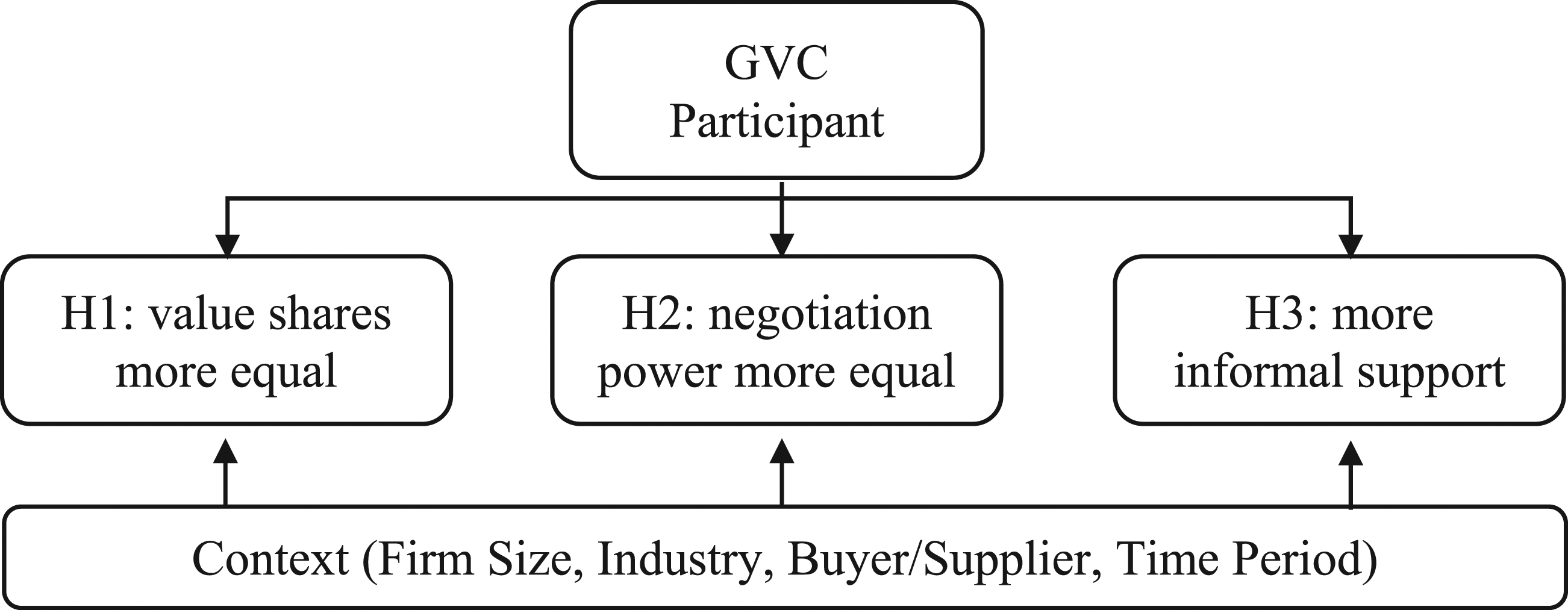
At the same time, the sharing of sources and past dependency, increase mutual dependency inside a GVC. Firstly, as an MNE shares more production processes with local partners (Belyavskiy, 2020), they become key co-producers in a GVC which are difficult to replace (Chu et al., 2019). Secondly, MNEs are large companies with long cycles of decision-making processes. Extended duration of interactions with partners leads to a higher amount of firm-specific investments. Specific investments increase the cost of conflicts by raising risks of monetary losses, when an interfirm partnership breaks down (Radaev, 2016; Uzzi, 1996). To cut these risks, partners will seek compromises during negotiations.
As mutual dependency between MNEs and local partners increases, GVC participants have more motivation to develop non-power relations based on trust and informal help. Such social exchanges decrease uncertainty and support the protection of firm-specific investments. Additionally, MNEs face LOF, which could be overcome by social exchanges with local partners (Wan et al., 2020). One of the core forms of social exchange is informal support between partners that is performed reciprocally. This support increases levels of trust and decreases market uncertainty (Granovetter, 1985; Radaev, 2016) and should be intensively used in GVCs.
Sample design and data collection
In this study I paid special attention to theoretical calibration (Ketchen et al., 2018) and methodological reflection of survey design, sampling, and data analysis. Dyadic relations of power and informal support between buyers and suppliers became the main unit of analysis. Such relations are measured by polyadic and subjective constructs, which raises the threat of several biases (Flynn et al., 2018). To prevent potential biases, I use one of the best-designed surveys of managers working in Russian companies. The survey was financed by HSE University 1 and realized by Levada-Center. 2 The data was collected in four waves in 2010, 2013, 2016, and 2019 years. The survey was constructed as a single-respondent questionnaire of key informants, while the sampling design was calibrated by conducting deep interviews and making fictional buyer-supplier dyads to measure polyadic constructs.
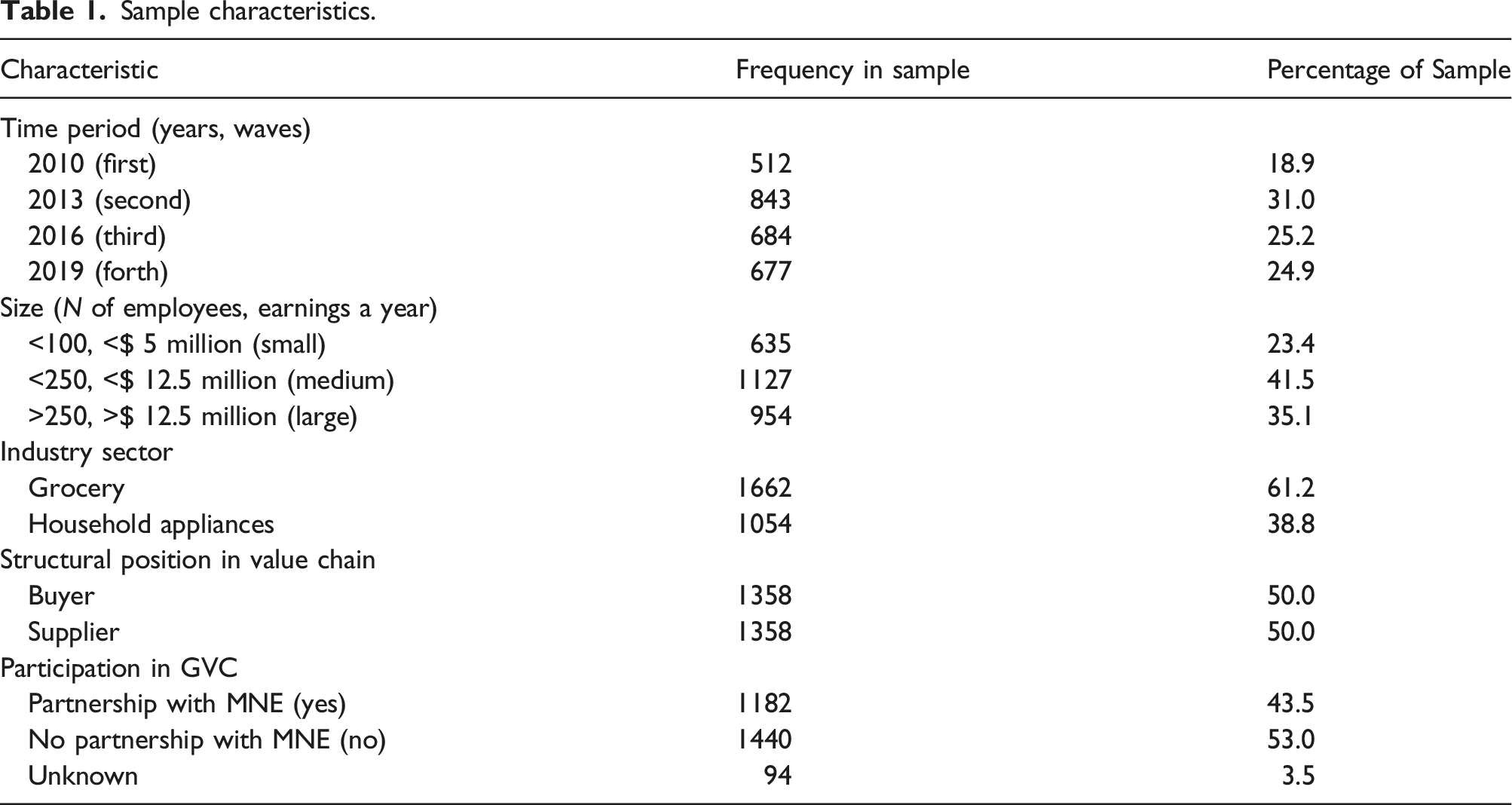
Before making the questionnaire, 30 deep interviews with buyers and suppliers were conducted. The sample of interviews was designed to reach maximum heterogeneity of firms and managers’ positions. Interviewers spoke with executives of large Russian companies and MNEs, owners of small and medium enterprises (SMEs), and with medium-level managers within the firm, responsible for a particular category of goods. The results of the conducted interviews were used to select characteristics of key respondents, calibrate survey design, and establish sampling criteria. The final sample of the survey represents Russian retail firms by five criteria: industry (grocery/household appliances), firm size (small/medium/large), type of ownership (Russian/foreign), structural position in a value chain (buyer/supplier), and location (Central Europe/Northern Europe/Ural/Western Siberia/Eastern Siberia).
Special attention was dedicated to selection of the key informants, as the characteristics of informants determine the validity of a single respondent survey (Krause et al., 2018; Montabon et al., 2018). Buyer-supplier relations in the same product category were selected as a unit of data collection. All managers directly work with counterparts (buyers or suppliers) in similar product categories in corresponding locations. One manager per product category per firm was surveyed. Such an approach helped to avoid confusion of contradicting viewpoints on a single interfirm tie, described by (Krause et al., 2018).
Survey design has the plausibility of polyadic bias that was compensated by advantages of time duration and absence of socially acceptable answers. The survey has no real buyer-supplier dyads, as firms were randomly selected to fulfill quotas from five sources: National Register of State and Legal Entities 3 (buyers and suppliers), RUSLANA database 4 (suppliers), and three business catalogs (buyers): RosFirm, 5 InfoRos, 6 and TorgRos. 7 To measure polyadic constructs survey contain fictional buyer-supplier dyads. The survey sample includes an equal number of both buyer’s and supplier’s managers in each product category with the same quota characteristics: firm size, location, and type of ownership. The fictional character of dyads creates bias of interpreting polyadic constructs (Flynn et al., 2018).
However, the influence of bias was reduced by reaching randomness of selection and running four waves of the data collection. Both buyers and suppliers answered similar questionnaire to make the results stable (Bloom et al., 2000). Also, random, non-dyadic selection helps to avoid socially acceptable answers. As the deep interviews showed, managers tend to hide details of their relationships with partners, if their partners participate in the same survey. Additionally, similar managers were surveyed in following waves to make an additional validation of answers (Montabon et al., 2018). Some managers dropped out in the next waves, and additional managers were selected by the same procedure to maintain comparability of the results.
Measures and validation
Sample characteristics.
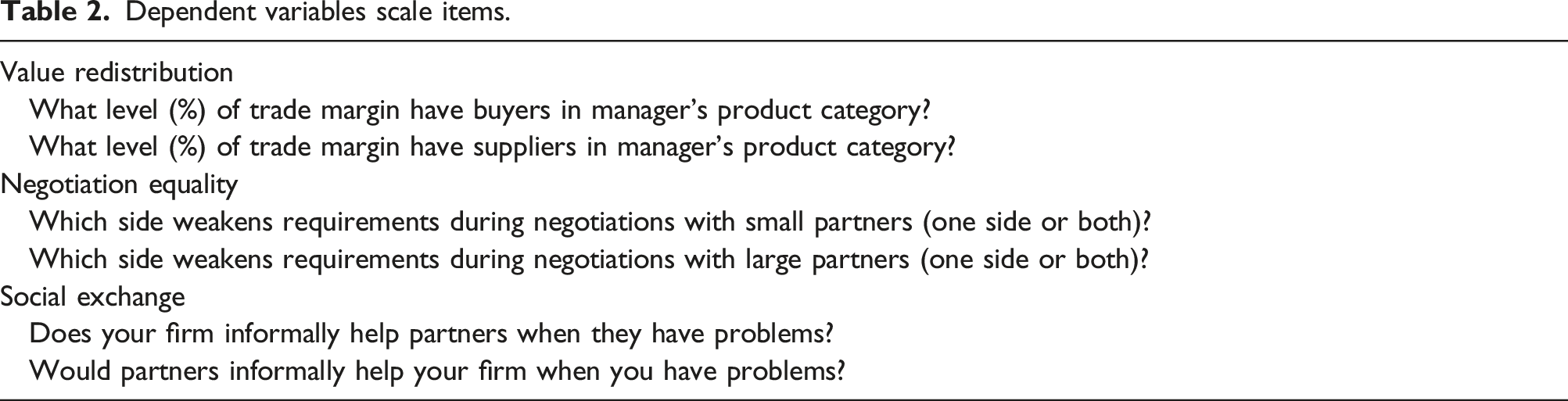
Dependent variables scale items.
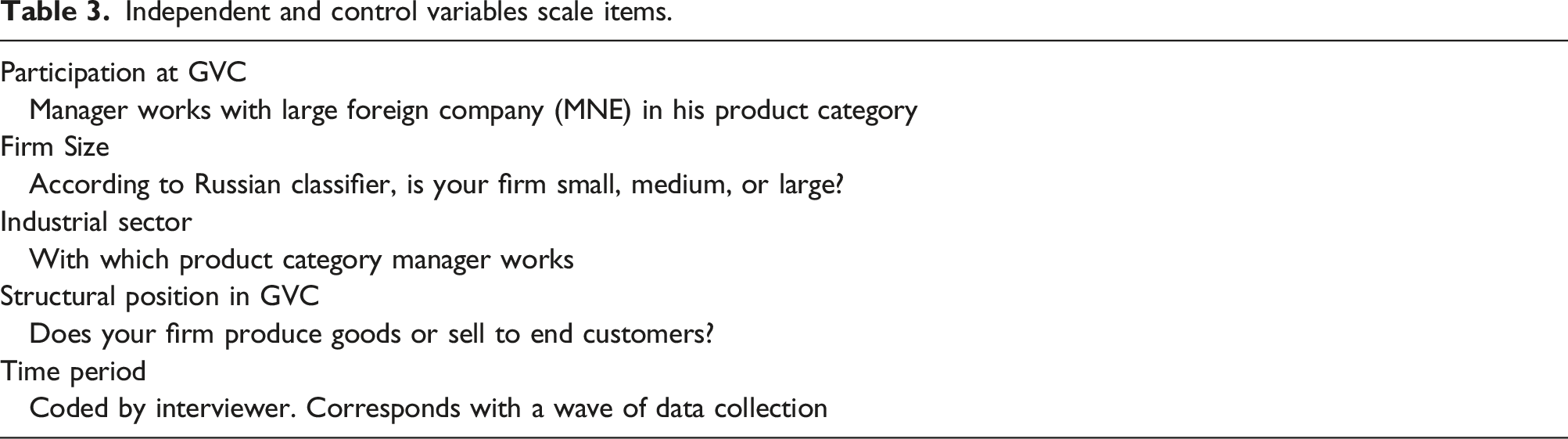
Independent and control variables scale items.
Correlation matrix and descriptive statistics.
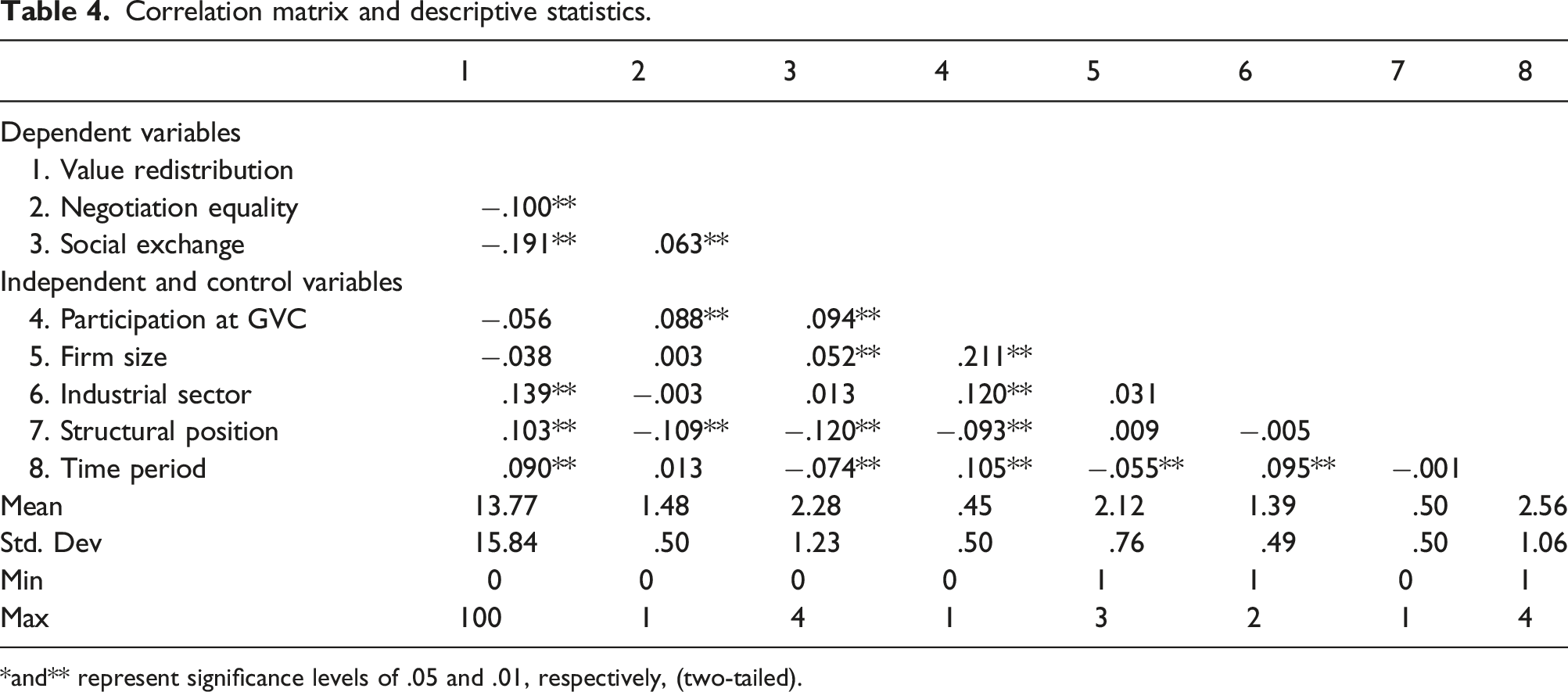
*and** represent significance levels of .05 and .01, respectively, (two-tailed).
Dependent variables
To test each hypothesis I constructed a specific dependent variable. Value redistribution (H1) was measured by a multi-item construct which consists of two single-item questions provided to respondents. Both single-item questions measure subjective estimation of trade margins. The first single-item construct represents the trade margin (%) of a respondent’s firm. The second one represents the trade margin (%) of a respondent’s partner. Both constructs have a scale from “0” to “100” and are designed on the basis of (Gereffi et al., 2005). The multi-item construct of value redistribution represents a non-negative difference between trade margins in a buyer-supplier dyad with values from “0” to “100”.
(In)equality in negotiations (H2) was measured by a multi-item construct, designed on the basis of (Radaev, 2013, 2016). This construct consists of two single-item questions provided to respondents. Both single-item questions represent a willingness to reach a compromise during interfirm negotiations. The first single-item construct represents negotiations between the respondent’s firm and its large partners. The second one represents negotiations between the respondent’s firm and its small partners. Both constructs were coded dichotomously: “0” was coded if one side dominated during negotiations, “1” was coded if both sides made mutual concessions during negotiations. Multi-item construct was also coded dichotomously: “1” was pointed when in both single-item variables a respondent gets “1”, while “0” was pointed in all other cases.
The intensiveness of social exchanges (H3) was measured by a multi-item construct, designed on the basis of (Radaev, 2016). This construct consists of two single-item scales that represent informal support in buyer-supplier dyads. Single-item constructs designed by (Cannon & Perreault, 1999; Rajamma et al., 2011). The first single-item question represents informal assistance provided by a respondent to their partner. This question has two values: “0” when a respondent does not provide informal assistance to their partner; “1” when a respondent gives informal assistance to their partners. The second single-item question represents expectation of informal assistance from a respondent’s partner. This construct has three values: “1” when no assistance is expected; “2” when assistance is expected conditionally; “3” when assistance is expected unconditionally. The final multi-item construct was computed as a sum of single-constructs’ values and varies from “0” to “4”, where “0” represents no informal assistance; “4” represents intensive informal assistance in buyer-supplier dyad.
Independent and control variables
To measure participation in a GVC the study uses a single-item scale with two values. The value “0” represents situation when a respondent’s firm has no foreign MNE as a partner, while “1” was coded when a respondent works with a foreign MNE in their product category. Besides a participation in a GVC, the study includes four control variables: firm size, structural position in a value chain, industry, and time period.
According to studies of GVCs (Lee & Gereffi, 2015; Levy, 2008), a firm size influences on a distribution of resources and negotiation power. The firm size was measured as a single-item scale with three values taken from the Russian classifier. Small firms have less than 100 employees and less than 5 million USD of annual revenue. Medium firms have 101–250 employees and between 5 and 12,5 million USD of annual revenue. Large firms have more than 250 employees and more than 12,5 million USD of annual revenue. 8
A structural position in a GVC and an industry both influence on a redistribution of mediated power. New GVCs appear as buyer-driven: multinational buyers accumulate control over resources and brand-developing, which makes them more powerful participants in value chains than suppliers (Gereffi, 2014). Studies show that buyers gain power despite institutional restrictions designed to protect suppliers in local markets (Radaev, 2018). The structural position was controlled by a single-item construct with two values. The value “1” represents buyers, while “2” represents suppliers.
Control variables for Russian context
The Russian context is defined by authoritarian political and economic governance. This governance ambivalently affects the distribution of power symmetry in GVCs. The variables of time period and industry are used to control the context.
On the one hand, the Russian government promotes power symmetry for the sake of extracting political rent. The regime puts its political preservation as the first priority. (Dabrowski, 2022), while the fulfillment of economic obligations is one of the key levers to gain citizens’ political credence (Berdysheva, 2022) Therefore, governments introduce protectionist measures, including the requirement for MNEs to invest in, and support local players, as manifested in the strengthening of trade laws in 2013 (Radaev, 2013) 2013 trade legislation further restricted the use of mediated power by MNEs, including through the use of fines (Radaev, 2013, 2018). At the same time, the authorities set a course for food import substitution, which was framed as a political achievement for the “food security” of the country. (Caldwell, 2002; Kusimova, 2022). To achieve import substitution, the regime enhanced regulation of grocery retail, further limiting MNEs in application of non-mediated power, also punishing informal reciprocal agreements in value chains (Radaev, 2013, 2022)
On the other hand, Russian governments contribute to asymmetry by refusing to authorize mandatory CSR standards, as well as limiting economic freedom for enterprises. Recent research shows that authoritarian post-communist regimes prioritize rent extraction for political elites (Tysiachniouk et al., 2022). Governments enter joint ventures with MNEs to generate profits and, if possible, exempt from costs like CSR. The weakening of control over international CSR increases the ability of MNEs to use mediated power over the local enterprises. At the same time, in an attempt to strengthen authoritarian control, the regime limits the opportunities for free economic exchanges (Dabrowski, 2022) and, in particular, informal social exchanges (Radaev, 2013, 2018). Informal exchanges are good at managing uncertainty (Huo et al., 2017), but are difficult to control by the state. According to the hypotheses of the current study, the restriction of informal practices promotes power asymmetry in favor of global MNEs.
To track the tightening of control over mediated power and social exchanges, a control variable of time period is used. The time period is controlled by a single-item construct with four values, where one value represents one wave of survey. “1” = 2010; “2” = 2013; “3” = 2016; “4” = 2019. A control variable of industry was also used, which made it possible to track a special attitude towards “food security”. To control industry, I use a single-item construct with two values. The value “1” represents managers working in grocery, while “2” represents managers working with household appliances.
Measurement validation
The measurement validation is performed in several steps of examining all multi-item scales on unidimensionality, reliability, and validity. Appendix 1 describes all details of the examination, model estimates, and construct reliabilities. The final analysis includes all validated multi-item constructs.
The survey data could contain the common method bias, because same respondents reported on both dependent and independent variables (Flynn et al., 2018). To triangulate the data and consider potential biases of responses, described by Montabon et al. (2018), I had made year-long participant observation before started to work on this study. The participant observation included a work as a sales manager in an MNE-supplier of household appliances and 33 deep semi-structured interviews with colleagues and counterparts. The results of the observation showed that buyers tend to hide their involvement in social exchanges and sources of power superiority. On the contrary, suppliers confidently speak about their practices of social exchange and describe their power position in a value chain.
Analysis and results
To test the hypotheses, I conducted regression analyses of two types: with ordinary least squares (OLS), and binary logistic regression. The OLS analyses were used to measure the influence on value redistribution and social exchange. Each variable was mean-centered before producing the interaction terms in order to minimize potential multicollinearity. I also calculated variance inflation factors (VIF) for each regression coefficient. All scores are lower than 2.0 and thus within the acceptable levels. Finally, the OLS models were examined for autocorrelations using Durbin-Watson test. Both OLS models got scores around 1.86 which is within the acceptable levels.
Regression results.
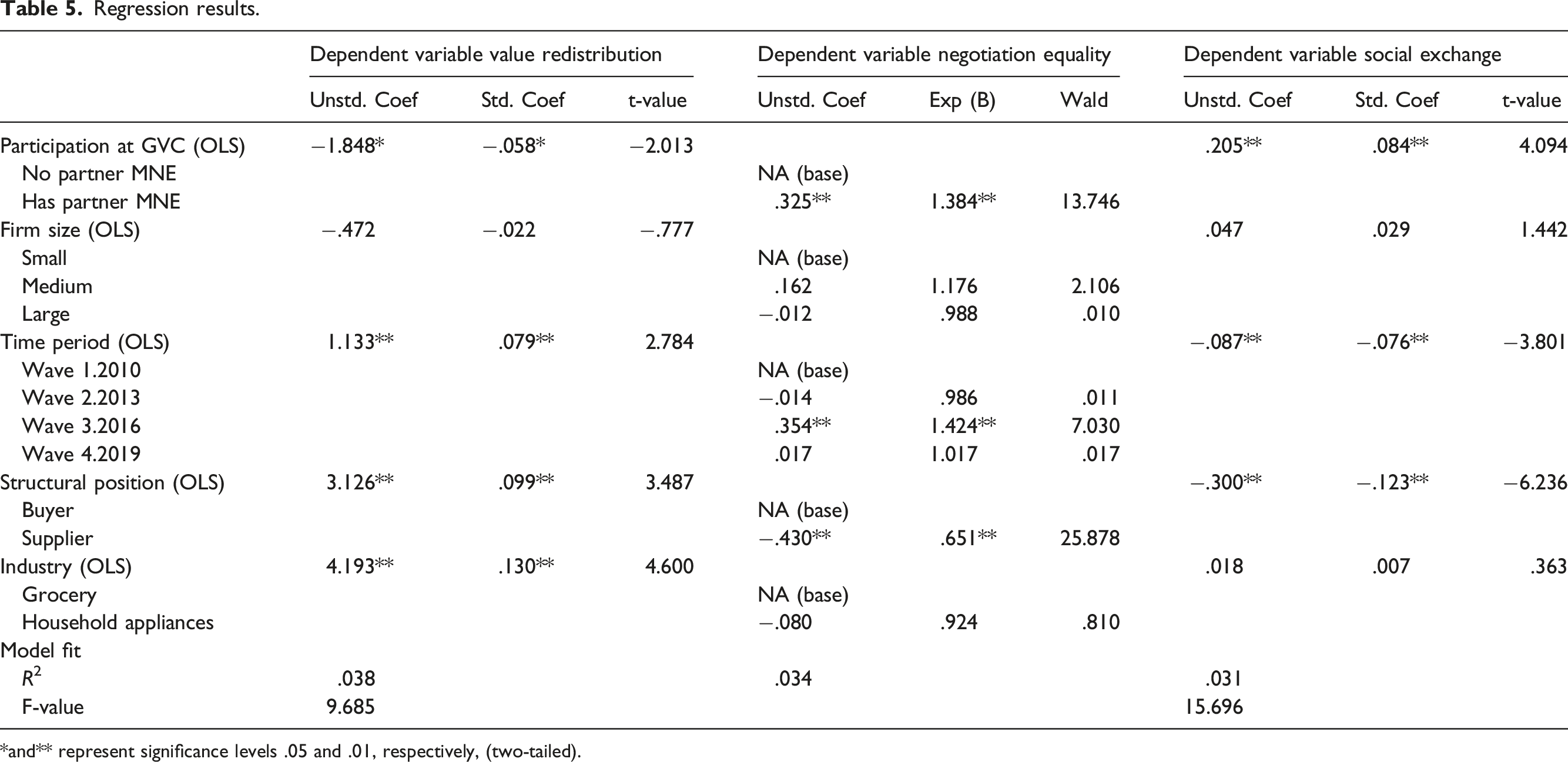
*and** represent significance levels .05 and .01, respectively, (two-tailed).
Generally, the results demonstrate support for all three hypotheses. The model 1 presents an evidence for the H1 that participation in a GVC decreases inequality of a redistribution of a produced value between partners (β = −.58; p < .05). Significant impact is also caused by time period (β = .08; p < .01), structural position (β = .1; p < .01), and industry (β = .13; p < .01). The inequality in a value redistribution increases as time passes. Suppliers and managers working with household appliances claim higher inequality in a value redistribution.
The model 2 provides support to the H2, that participation in a GVC increases probability of reaching equality during negotiations (exp.(B) = 1.38; p < .01). The supplier’s structural position is related to a lower probability of making mutual concessions (exp.(B) = .65; p < .01). The redistribution of probabilities related to a time period demonstrates the significance only in 2016 (exp.(B) = 1.42; p < .01) which may be caused by a non-linear relation. The differences between industries appeared insignificant (p > .10).
The model 3 provides evidence for the H3, that participation in a GVC is related with more intensive social exchange via informal interfirm assistance (β = .08; p < .01). Time period (β = −.08; p < .01) and structural position (β = −.12; p < .01) appeared significant too. The intensiveness of social exchanges was decreasing as time passed which corresponds with tightening of the trade law in Russia (Radaev, 2018). The supplier’s structural position in a value chain related with lower intensity of interfirm assistance, while industrial differences remained insignificant. The firm size appeared insignificant in all models.
Discussion and conclusions
This research develops and tests a model of power redistribution between partners in GVCs. Using a data set of chronologically linked buyers’ and suppliers’ responses, the study provides novel evidence on the higher power symmetry inside GVCs compared to other value chains and makes both academic and managerial relevant contributions.
Implications for theory and research
By investigating power redistribution, this study contributes to the understanding of the influence, caused by GVCs, on power symmetry and abilities to upgrade economically. I found that participation of a local firm in a GVC leads to a more symmetrical redistribution of shares in a produced value, measured by a comparison of firms’ trade margins. The results demonstrate that partners have higher equality in interfirm negotiations inside a GVC regardless of firm size and their scope of resources. Social exchanges also appear more intensive inside a GVC than between partners in other value chains.
Contextual variables also show a significant impact. Buyers and suppliers demonstrate different patterns of power redistribution. A buyer’s position related to higher asymmetry in a redistribution of produced value, and with a lower intensity of social exchanges. While suppliers report a lower equality in negotiations. Industrial differentiation shows that grocery firms face higher symmetry in a redistribution of produced value. The comparison of time periods demonstrates growing asymmetry in a redistribution of value combined with a shrinking of social exchanges, while firm size remains insignificant to differentiate power redistribution in value chains.
Taken together, this research adds to extant studies of power in value chains and theory of power in general by, (1) providing concrete evidence of upgrading in developing markets, (2) showing the influence of collective power on the structure of coordination in GVCs, and (3) demonstrating crucial role of interfirm social ties as a source of power.
First, studies of GVCs put power redistribution at the center of analysis, because power relationships determine conditions of economic upgrading (Dallas et al., 2019; Li et al., 2019). Researchers of GVCs write that local partners experience power pressure from MNEs. This power pressure prevents the upgrading of local firms in developing markets (Gereffi, 2011, 2014; Levy, 2008). At the same time, another research branch focuses on studying CSR as an ability to shape the mediated power of large firms. These studies investigate how governmental control in developed markets enforces compliance of large MNEs with CSR (Attig et al., 2016; Kolk & van Tulder, 2010; Yawar & Seuring, 2017). Until the present moment, no study attempted to integrate both perspectives. This study is the first of which I am aware to theorize how CSR standards, established in a developed market, influence the work of an MNE in developing markets. The broader implication is to study how the collective power of multiple actors at different markets can unify the work of a GVC worldwide and assist in reaching power symmetry between partners in a GVC.
Second, collective power enforces an end to the usage of mediated power as a tool of coordination in a GVC. Value chain studies include a theoretical debate of two perspectives about ways of coordination in a GVC. From the perspective of dependence theory (Pfeffer & Salancik, 1978; Reimann & Ketchen, 2017), the reduction of mediated power threatens the ability of an MNE to coordinate a GVC. From the other perspective of social exchange (Huo et al., 2017), the asymmetry of a mediated power complicates coordination of a GVC by constraining innovativeness and reducing the ability to adjust operational strategies in changing markets. The results of this study support the second perspective. Collective power forces an MNE to decrease sources of mediated power and use the practices of social exchange for coordination. The revealed empirical evidence corresponds with (Belyavskiy, 2020; Japutra & Molinillo, 2019) and contributes to the further investigation of coordination abilities in GVCs.
Third, social ties have a powerful effect on economic actors regardless of size and geography. Previous studies of social embeddedness have shown that informal reciprocal interactions produce social norms that act as a source of power and shape the scope of possible actions of business counterparts. (Uzzi, 1996). However, studies known to me considered embeddedness exclusively within local communities, ethnic diasporas. (Uzzi, 1996, 2018), either considered cross-border embeddedness qualitatively (Belyavskiy, 2020; Geifman-Broder & Zaidman, 2021). The current research proves the prevalence of social embeddedness and social networks as a source of power, including with the participation of large MNEs. Moreover, social embeddedness inside GVC allows local players to benefit from economic upgrading and scaling, while (Uzzi, 1996) considered embeddedness as a growth constraint at the growth stage of a medium-sized enterprise.
Managerial implications
This study has important practical implications as well. Relatively small power asymmetry in a GVC can be utilized both by public and business managers. Business managers can use the information about collective pressure on MNEs during their negotiations with counterparts. As MNEs are forced to comply with the CSR standards, local firms can appeal to that CSR standards to reach more beneficial and symmetrical terms of agreement with an MNE. Furthermore, managers of local firms should develop reciprocal relationships with MNEs, as this format of social exchanges helps firms to overcome market uncertainty, simplify the process of creating joint innovations (Mesquita et al., 2008), and remain safe from power pressure. Public managers can foster economic upgrading of their local economies by implementing best standards of CSR. Policymakers can implement best working standards used by MNEs as the obligatory rules for all players in national markets. Studies show (Amaeshi et al., 2008), that advanced standards help to increase power symmetry in a local economy and make national brands more competitive in international markets.
Limitations and future research
While this study has several restrictions, each of them provides opportunities for a future research. The restrictions can be grouped in three types: contextual, conceptual, and construct ones. The contextual restrictions are related to the market and industrial specificities. The analysis was performed on the data of the developing market that has more vague requirements of an interaction with state regulators and lower standards of CSR; which would be different for the US and European markets (Darby et al., 2020; Davis-Smarek et al., 2017), while closer to Eurasian post-communist countries. This fact establishes sociopolitical frames of external validity and highlights the value of conducting a similar analysis on a West-European data.
The specifics of industries are determined by the focus on grocery and household appliances. The currently studied industries have easier entry conditions and contain more new players than other industries that were not studied. The industrial sector and automotive industries contain limited numbers of firms with longer production cycles and long-lasting histories of business practices that are weakly affected by changes in time (Dyer, 1997; Lazzarini et al., 2008). It is important to carry out a deeper investigation of the influence that industrial differences have on power redistribution.
The conceptual limitations are related to the absence of MNEs with headquarters in Russia and third parties in the survey. The lack of Russian-based MNEs creates the bias in the achieved results, as the collective power over such Russian-based MNEs may be lower, because the political regime has more opportunities to extract profits from locally based companies and will not allow third-party control over its cash flows (Tysiachniouk et al., 2022). To expand and validate the achieved results, a future research needs to study MNEs, whose headquarters are located in developing countries with a relatively weak regulation of CSR, also as countries with authoritarian political regimes. The lack of third parties like governments appears as the additional conceptual limitation. For the further investigation of the collective power it is important to study the direct influence of governments on the work of MNEs. It is also important to consider a difference between local and international pressure in a modeling.
Finally, the research contains the bias of using subjective constructs to measure value redistribution, negotiation power, and supportive behavior. Subjective interpretations help to increase a response rate and get data on a commercial information, but make constructs insufficient for the more precise and, especially, multi-dimensional analysis. The subjective answers have a smaller range of variation and are less precise than answers on objective measurements. A fruitful avenue for a future research would be to collect non-subjective data and test multi-level relations between practices of social exchange and redistributing of value.
All in all, this research sheds light on the difference of power redistribution between global and local value chains. It provides the first step in explaining the role of the collective power on the shaping of the coordination inside a global value chain. I hope it will guide future research on value chains in new and interesting directions.
Supplemental Material
Supplemental Material - Power Symmetry in Global Value Chains: Evidence from the Russian Retail Market
Supplemental Material for Power Symmetry in Global Value Chains: Evidence from the Russian Retail Market by Boris Belyavskiy in Journal of Eurasian Studies
Footnotes
Author’s note
The work is realized within the project of “Non-economic sources of the dynamic in Russian markets” organized by the Laboratory for Studies in Economic Sociology, HSE University.
Acknowledgments
Author thanks the participants of International workshop “The Varieties of Power in the Economy”, especially Vadim Radaev and Zoya Kotelnikova, for their comments and questions. Special thanks to Elena Belyavskaya for support and suggestions.
Declaration of conflicting interests
The author(s) declared no potential conflicts of interest with respect to the research, authorship, and/or publication of this article.
Funding
The author(s) disclosed receipt of the following financial support for the research, authorship, and/or publication of this article: This work was supported by the research has received support from the Center of Fundamental Studies, HSE University.

Supplemental Material
Supplemental material for this article is available online.
Notes
Author biography
References
Supplementary Material
Please find the following supplemental material available below.
For Open Access articles published under a Creative Commons License, all supplemental material carries the same license as the article it is associated with.
For non-Open Access articles published, all supplemental material carries a non-exclusive license, and permission requests for re-use of supplemental material or any part of supplemental material shall be sent directly to the copyright owner as specified in the copyright notice associated with the article.
