




Abstract
In this article, a modest attempt is undertaken to connect the rational choice theory mechanism with the sociological theory of voting, as efforts to juxtapose both theories are still rare, although some cited accomplishments offer interesting insights. Our dependent variable is participation in a local election in Poland. The local government elections in Poland seem to offer a setting particularly well-suited for a test of the rational choice hypothesis and its relation to sociological explanations of voting behavior. The essential contribution of the article derives from our conviction that social embeddedness and rooting into the social milieu and local community matter for both the cost of participating in a local election and the cost of deciding whether to participate. In the world of post-cleavage politics, individualization of political behavior and involvement in (new) social networks play an increasingly important role. The general finding can be summarized as follows: the social embeddedness of citizens does enhance the probability of participation in an election; however, it does not substitute for the impact of rational motivation factors, nor does it significantly decrease the latter’s net impact on our dependent variable.
Introduction
The question of why people trouble themselves to vote has not been resolved since it was raised in the seminal work of Anthony Downs. 1 In this article, we return to this question in the Polish case, testing the relative importance of the individual-level rationality of voters and their social embeddedness for predicting their readiness to participate in local elections. The context of local government in Poland is particularly well-suited for testing both the contradictory logic of and the synergistic mechanisms between individual-rational and socially determined factors. For almost a quarter of a century since the collapse of Communism, local government was one of Poland’s few real successes in the sphere of the design and operation of institutions. Manifestations of this success are to be found in the quality of local government’s relationships with state institutions, social organizations, and nongovernmental organizations (NGOs), as well as in the legitimacy bestowed upon it through the widespread popular support it enjoys. 2 Yet Polish society is characterized by an idiosyncratic feature of long standing: the importance placed on the immediate social milieu of family and close friends on one hand, and affinity with the nation as a whole on the other, but only limited appreciation for intermediary institutions, including institutions of state. 3
According to the paradox of voting, if all voters were wholly rational, then none would vote. The reality, however, is different. The rational choice paradigm presumes voters are rational creatures aiming to maximize their individual benefits and reduce their personal costs. The costs of voting include the investment of the time required to gather information on candidates and party programs and to participate in the election itself, the cognitive effort required to make sense of programmatic alternatives, and the emotional cost of enduring disputes and conflicts with family, friends, and acquaintances. These costs must be weighed against the potential benefits of one’s own side winning the election, and in particular against the possibility that an individual vote may make a material difference in the determination of that outcome.
Yet the ontological character of elections may differ considerably because of their varying importance and technicalities. Sub-national institutions provide services and goods directly related to citizens’ daily needs, creating a clearer connection between the act of voting and the enactment—or not—of local policies. The smaller size of constituencies increases the potential for personal relationships with candidates to decrease the cost of voting. The explanatory power of the rational choice mechanism should thus be more dominant at the local level.
Compared with national elections, the pool of candidates from which citizens elect their representatives in local elections is less numerous, which matters significantly for the rational calculus of the power of an individual’s vote. At the same time, local elections are usually more clearly nested in micro- and meso-structural issues that are closer to the individual. Accordingly, we explore whether the social embeddedness of citizens—the extent to which they are rooted in the local community—influences their participation in elections, and to what extent it interacts with the processes of rational decision-making.
The aim of this article is to bridge the rational choice mechanism and sociological threads in the theory of voting. Efforts to combine both theories are still rare, although the more accomplished attempts offer interesting insights. 4 We do not aim to provide a comprehensive test of rational choice theories or of sociological impacts on electoral participation. Rather, we make selective reference to their core propositions, in particular those relevant to the essence of Polish local politics.
Theory
Rational choice theory consists of a complex, multifaceted set of propositions, but where voting is concerned it relies on a simple underlying premise, which pertains to the conceptualization and operationalization of the concept of the cost of voting (C). Since Anthony Downs’ 5 groundbreaking work, C, being one of the terms in the classical instrumental voter model, is accompanied by at least two other important concepts: the party differential (B) and the assessment of the probability of one’s vote affecting election outcomes (P). The above three concepts form the basis of the calculus of the voting equation. A more expanded version assumes that axiological-cultural factors matter, such as that voting signifies a moral and/or civic obligation, a subjectively experienced duty (D), which covers the non-instrumental part of the story. 6
In other words, the orthodox version of the rational choice model of electoral participation assumes that citizens are rational actors who wish to maximize their personal benefits and simultaneously minimize their individual costs. One aspect of political representation also matters greatly: the proximity of citizens’ policy preferences to those offered by political parties. Moreover, citizens are more likely to participate in elections if their involvement is expected to make a difference to the results. Numerous studies show that close races boost turnout. Geographical context counts a lot, and local circumstances, particularly the closeness of local competition, also matter. 7 The cost of voting (C) has been given much detailed attention. In-depth analyses of this factor call for distinguishing at least two elements. The first of these may be termed “substantive”: the cost of acquiring information about programs and policies and then linking them to one’s own preferences. The second may be termed “technical,” and it concerns factors such as the clarity of electoral rules and the cost of going to the polls. 8 More complex models 9 include additional non-instrumental (societal/altruistic) factors, such as the sheer expressive value of participation or the understanding that participation in elections sustains democracy. This model may be defined as V = pB − C + D (where V is the net private benefit of voting).
Rational choice theory and its advocates are tightly linked to at least two threads of the electoral participation literature. These threads are crucial for understanding the broader context in which the calculus of the utility arises and are essential for the approach presented in this article. The first is linked to mobilization models of participation and the vote, and the second to group-based models of voting, which presuppose ethical pressure in the small groups that matter most for electoral mobilization. In mobilization theory, the role of the leader(s) is crucial; they create and transform purely social pressure into the desired type of political behavior. This is a classical sociological, interactive mechanism by which group members influence each other in a social network context and where intermediary elites play a crucial role in mobilizing like-minded people. Mobilization models do not elaborate on the nature of the pressure exerted by elites. This type of social pressure is presumed to derive from mutual, rewarding (or punishing) behavior on the part of participants in the community in question. 10
The second thread originates less from the micro- and meso-structures to which mobilization theories refer but rather from a macro-perspective of sociotropic concerns. 11 In this case, voters are assumed to be motivated by ethical and/or altruistic matters focused on the public good of the population at large, rather than by narrow individualistic concerns. Group-based models derived from this perspective focus mainly on the universal issue of electoral turnout and not just on the specific matter of who wins an election. Numerous empirical investigations substantiate the merits of group-based models, pointing to correlations between the margin of victory, obligation (civic duty), cost of the vote, and turnout. 12
Moreover, under the logic of collective action theory, 13 people are more likely to initiate and participate in an action when the group is less numerous, which boosts members’ subjective feeling that one person’s voice matters. In a macro setting of very large groups, such as those potentially participating in a national election, the feeling that a single vote will make a difference is negligible. In local elections, as in the ones under scrutiny, the electoral success of a given party is decided by a much narrower margin of votes. Each vote subjectively matters more, and the logic of collective action is more plausible. 14 The above mechanisms pertain almost exclusively to majoritarian/plurality electoral systems.
Mark Franklin 15 adds an essential point to this discussion by noting that turnout, and its decline in particular, depends more on the type of election than on the character of society. It is also shown that turnout is strongly related to levels of socioeconomic development 16 in a curvilinear fashion, increasing when societies change from traditional to fully fledged modern ones but then declining in more individualistic, post-industrial societies.
The dependent variable in our analysis is the decision to participate in a local election. Our key independent variables include the main elements of the rational choice model (excluding the D element of subjectively experienced duty) and an index derived from various measures of social embeddedness (the extent to which people are entrenched in their local community). To this, we add a number of sociodemographic factors. Including a measure of religious participation is important, as in Poland, the Catholic Church plays a direct and influential role as a force for political socialization, and also as a political actor in its own right. Education is conducive both to participation and to facilitating the estimation of the costs of voting. 17 Higher education equips voters cognitively to better understand political issues and policies and link them to their preferences. The sheer accumulation of experience that age brings generally enhances people’s ability to make sense of their political environment, and it may substitute for education in this respect. 18 Belonging or attachment to a political organization reduces the cost of gathering information about public and political issues. 19 This relationship has been well tested for political parties, especially voters’ identification with them. However, membership in any type of organization provides people with heuristic shortcuts and simplified cues that help people understand the complexity of the world around them. Numerous studies point to the positive relationship between the duration of living in a given area on one hand and participation and detailed knowledge of policies and public issues on the other. This relationship is even more evident in local elections. 20
One of the most significant factors in electoral research is a general feeling and opinion among citizens on whether elections matter at all, and on whether whom we vote for and who ultimately gets elected matters. If not, the motivation to participate in a given (type of) election declines, as it simply becomes irrelevant (vide the theory of second-order elections). 21
The Polish Context
Before we discuss the idiosyncrasies of the Polish case, they should be placed in a broader context. As official electoral data from European democracies show, countries of the central and eastern Europe (CEE) region exhibit specific electoral patterns. First, citizens of post-Communist countries are less likely to participate in elections than their Western counterparts. 22 The negative effect of high levels of electoral abstention on the quality of democracy is well documented in the literature. 23 This phenomenon is attributed above all to different forms of political socialization under Communist rule. 24
Second, despite the already low turnout in the CEE region, there is a significant electoral gap between parliamentary elections on one hand and European and local elections on the other, with turnout being noticeably lower in the latter. 25 This phenomenon is typically explained with reference to the second-order election theory, which suggests that political participation is mobilized mainly by national party competition, which is less meaningful at the local level. 26
The competing approach states that local elections are different from (and thus incomparable with) national elections. Such small-scale democracy occurs in communities that differ from those at the national level in terms of their size, scope, and/or redistributive bias. 27 Advocates of this approach emphasize the effect of factors such as personal contact with candidates, the lower costs of campaigning, and issues or policies specific to a particular place, which makes electoral competition place-bounded and varying across polities.
Local government elections in Poland offer a setting particularly well-suited for a test of the rational choice hypothesis. According to official electoral data, slightly less than half of Poles take part in local elections. 28 Turnout is an average of six percentage points lower than in parliamentary elections. Nevertheless, research indicates that Poles attach significant importance to local governments and to the process of their election. 29 Local governments are the institutions closest to citizens, responsible for providing them with crucial public services such as public education, health care, and social care. Local government activities translate into the satisfaction of citizens’ daily needs (which people recognize), and can, therefore, be linked to the benefits derived from voting for a party. This is the key element of the rational choice model. At the same time, the smaller size of local constituencies increases the significance of each single vote for the electoral result, meaning that the perceived probability that a single vote matters is higher than it is on the national level.
Electoral rules are another factor of great significance for the perception of the relevance of the vote. In single-member districts with only one winner, the conviction that a single vote matters is higher than under a proportional system. 30 In this context, it is worth emphasizing that reforms in 2011 to the laws on local elections led to a situation in which similar localities elected their representatives according to different rules. Towns with county status used proportional representation, while towns without county status used a majoritarian system. These distinctions ended with the introduction of further changes to the electoral law in 2018, but their introduction provided a window of opportunity to observe whether the implementation of a first-past-the-post (hereafter FPTP) system influenced the sense of political agency experienced by Poles in those particular constituencies.
Other factors include personal familiarity with candidates, which lowers the cost of voting, as local representatives in smaller localities are usually elected from among people voters know (their relatives, friends, neighbors) or have met (during campaigns or municipality festivities). Polish local government differs as far as the degree to which parliamentary parties dominate electoral competition. Local political agendas are organized either according to entirely local lines of division or around issues present in the national debate. The latter is true especially, but not exclusively, of larger municipalities. Yet we also observe the growing importance of party cues in smaller constituencies. The process of bringing national-level competition to the local context (and the increasing importance of national political parties at the local level) can be dated back to 2006. 31 Since then, the fierce rivalry between the two main parties, Law and Justice (PiS) and Civic Platform (PO), has extended to the local political scene, transforming local elections into a test of a party’s power in advance of more important ballots. This was clearly evidenced in 2018, when local elections were the first in a close sequence of elections that included European and national parliamentary elections in 2019 and presidential elections in 2020. National-level political parties treated these local elections as something of a primary for the larger elections to follow, projecting likely national election prospects on the basis of local election performance.
PiS’s victory in 2015 had other important consequences for local government, arising from a change in the nature of the relationship between national and sub-national governments. The distrust of the central government toward local government institutions, its lack of will for cooperation and dialogue with them, and specific actions (such as selective application of constitutional standards and discretionary awarding of subsidies) led to the gradual decentralization of the latter. 32 Our study, focusing on the 2014 local elections, captures the point in time just prior to the beginning of this process.
Certain idiosyncrasies of the Polish case also require further elucidation. First, the cost of acquiring information depends on many factors, among them participation in organizations that are social, public, or utterly political (parties). The available empirical record clearly shows this to be a positive relationship. Compared with more secular European countries, the role of religious institutions in Poland is much more profound and consequential for political behavior. 33 Consequently, we treat Poles attending church once per week or more as being exposed to intense and persuasive political indoctrination in favor of (radical) right parties.
Second, social embeddedness matters for both the cost of participating in a local election and the cost of deciding whether to participate. In a world of post-cleavage politics, the visible individualization of political behavior and alternative social networks—be they professional, private, or local network structures—play an increasingly important role. 34 In an era of individualization, a rise in cognitive sophistication, coupled with a substantial increase in social and spatial mobility, sees strong organizational-party links decline. So too does the impact of such links on participation itself. Nevertheless, political behavior remains inherently social. 35
Our considerations here are influenced by Achen and Bartels’ 36 injunction that greater emphasis should be placed on the nature of citizens’ social identities and in particular their newly created bonds in informal networks. This work has attracted substantial attention and has been subjected to empirical testing, primarily in the European context. 37 Our aim is to test the relative impact of such social identities and bonds as theorized by Achen and Bartels, compared with that of cleavage-related sociodemographic variables and other traditional explanatory factors in the determination of voting.
In our case, in the study of local elections, regional social embeddedness matters. 38 We thus introduce several indicators of social-local embeddedness: (1) length of domicile, (2) plans to move from the town of residence to another locality, (3) membership in a local organization, and (4) subjective affective closeness to the town of residence. Their impact on participation (after controlling for other factors) is analyzed separately.
Third, Polish elections, particularly local ones, are characterized in absolute terms by low participation. National parliamentary elections since 1991 have attracted typically around half of the eligible voting population, while local ones have usually attracted just over 40 percent. 39 Consequently, this means that barely half of the voters decide on the electoral outcome, which makes the decision to vote generally more rational for those who do decide to participate.
Fourth, the typical indicator of the cost of participation (C) pertains to countries where registration procedures apply, population density is low, and where the location of polling places is not constant. This does not apply to Poland, where all voters are administratively registered and the location of polling stations—typically school buildings—remains constant from election to election. We therefore do not include these variables as costs in our equation.
Finally, and perhaps most importantly, at the most general level, the public and political behavior of Poles is determined by what Nowak dubbed the institutional void in the social consciousness of Poles. Nowak contended that because of historical legacies, contemporary Poles are attached to their family, kin and close friends, and the nation at large, but they are alienated from the world of public institutions, including the state. 40 This phenomenon contributes to their low bridging social capital, enhanced by the dominant axiological narrative of the Polish Catholic church. 41 Consequently, we expect that these idiosyncrasies should boost the impact of micro- and meso-structural factors aligned with our concept of the level of social embeddedness.
Research Questions and Expectations
Our key research question concerns whether the social embeddedness of individuals plays a significant role in mitigating the effects of rational choice mechanisms on the decision whether or not to participate in local elections. We explore this question using data pertaining to participation in the 2014 local elections in Poland, examining separately the role of the rational choice mechanism on participation in these elections, the role of social embeddedness on participation, and the interactive impact of these two distinct influences.
Our first hypothesis concerns the influence of rational choice variables on the propensity to vote. An endorsement of the benefits of voting and a conviction as to the decisiveness of a single vote on the election result should increase the propensity to participate in the 2014 election, while an awareness of the costs of the act of voting should have the opposite effect (Hypothesis 1).
The merits of the rational choice theory concerning electoral participation have been brought into question primarily because the probability that a single vote will influence the election result is close to zero, which means that a rational voter should not vote. However, more recent studies 42 suggest that what really matters is not the objective probability that a single vote will be decisive for the election result but rather a voter’s subjective conviction that one vote might be decisive. This subjective assessment is determined by several factors. First, the size of the electorate is essential: the smaller the electorate in a given district, the greater the probability that a single vote will decide the election result. Therefore, the perceived probability that a single vote matters should be higher in local elections where the constituencies are smaller. Our sample selection criteria do not permit us to verify this, as the size of constituencies are similar by design (see Appendix B).
Second, in line with the logic of collective action, people are more inclined to take action if the group is small enough for their contribution to be meaningful. 43 In larger groups, such as the electorate in parliamentary elections under a proportional representation (PR) system, the probability that an individual’s decision whether to vote or not will be significant is close to zero. In local elections, the victory of a particular candidate or political entity is often decided on the basis of significantly smaller differences. We thus assume that the logic of collective action is more relevant to this level than the national. According to the literature, 44 the very definition of what constitutes success is crucial here. In majoritarian systems, the issue of electoral victory is unambiguous: there is no doubt who the winner is. In proportional systems, electoral victory can be defined in various ways (obtaining a higher proportion of votes, being successfully elected, gaining the status of incumbent of an elected office). Consequently, we assume that in a majoritarian system, the perceived chances of the impact of a single vote on the election result should be greater than in a PR system (Hypothesis 2).
The second set of factors influencing the propensity to vote in local elections is the social embeddedness of individuals. This is measured using a set of social indicators: (1) the length of their domicile, (2) their plans to move from the town of residence to another locality, (3) their membership in a local organization, and (4) their subjective affective closeness to the town of residence. We use these indicators to create an additive index of social embeddedness. We expect that the extent to which citizens are rooted in the local community affects their propensity to participate in elections as it reduces the cost of deciding whether to participate (Hypothesis 3).
Finally, we hypothesize that the social embeddedness of individuals plays a significant role in mitigating the effects of the rational choice factors on the decision of whether to participate, as embeddedness reduces the cost of participating in a local election (Hypothesis 4).
In addition, we investigate the extent to which sociodemographic variables play a role in explaining participation, both in terms of their direct effect and as moderating factors for the impact of social embeddedness and rational choice mechanisms.
Data and Operationalization
We use survey data collected within the project “Electoral Rules’ Influence on the Quality of Local Democracy in Poland.” The key objective of this project was to determine the effect of the natural experiment that came about as a result of the aforementioned local electoral law reform in 2011. As a consequence of this reform, similar localities elected their representatives according to different electoral rules. The experiment ended in 2017 with the introduction of further changes in electoral law, abolishing the previously introduced differentiation between localities.
The experimental design affected the selection sample. First, researchers used the propensity score matching method to select sixteen cities for treatment (with majoritarian representation) and a control group (with proportional representation; for details of the experimental sample selection, see Appendix B). Second, in each locality, a two-stage random quota sample of the adult population of Poles was selected. The process consisted of (1) the selection of a random sample of addresses from a representative TERYT database and (2) the allocation of gender and age quotas separately for each individual city.
The experimental design required a panel study of two waves (which were realized in summer 2014 and 2017). We use only the first wave of the study (N = 1,562, approximately 100 interviews per city), as it captures the last moment before the commencement of the process of undermining sub-government institutions. PiS’s victory in 2015 was the beginning of the process of changing the relationship between national and sub-national governments. The central government’s distrust toward local government institutions, its lack of will for cooperation and dialogue, and specific actions (such as selective application of constitutional standards and discretionary awarding of subsidies) led to gradual decentralization of the latter.
Our dependent variable is the declared participation of citizens in the 2014 elections in their own locality. In our analyses, we use the following explanatory variables for the rational choice model: B (whether who wins matters), P (a single vote matters), and the cost of voting, C1 (difficulty in deciding whom to vote for). The measures of P and C are self-explanatory. In the case of B, we follow Blais’ 45 operationalization on the basis that “people are more likely to vote when an election is perceived to matter a lot, that is, when they believe that who wins will make a big difference to them.” 46 We omit the D (civic duty) element of the model, as we are interested in the effect of a pure rationality mechanism on vote choice and its relationship with social embeddedness. We assume it is the instrumental benefit of voting that motivates citizens to cast their ballots. Moreover, as the D factor is strongly related to social norms and social influence, 47 there is a risk of high collinearity with our embeddedness variable.
For the social embeddedness model, we use an additive index, combining respondents’ affective ties with the town they live in; their plans to move from the town to another locality; their duration of residence in the town, and their formal membership and activity in a local organization. These four aspects cover the affective, behavioral, formal, and organizational dimensions of their local social roots. The models also include a set of control variables: gender, age, level of education, full-time employment, and religiosity—the usual suspects explaining voter turnout (for operationalization and coding, see Appendix A). To test our hypotheses, we use logistic regression models with standard errors clustered by municipality.
Results
The presentation of the results follows a simple pattern: we show the main empirical results of regression analysis models with participation in the local election as the dependent variable. In our sample, 57 percent of respondents declared they have voted in their own locality (with the remaining respondents declaring they did not vote), which indicates that voting is overreported in our sample by approximately ten percentage points (the official turnout was 47%). Although this imperfect picture of voting behavior has consequences for empirical results, it is nothing unusual in survey studies. 48
Because of many suspected collinearities and apparent tautological relationships between the set of our independent variables in our regressions, we will also refer to other computations (not shown here) to ensure we have clarity concerning the gross and net impact of particular variables.
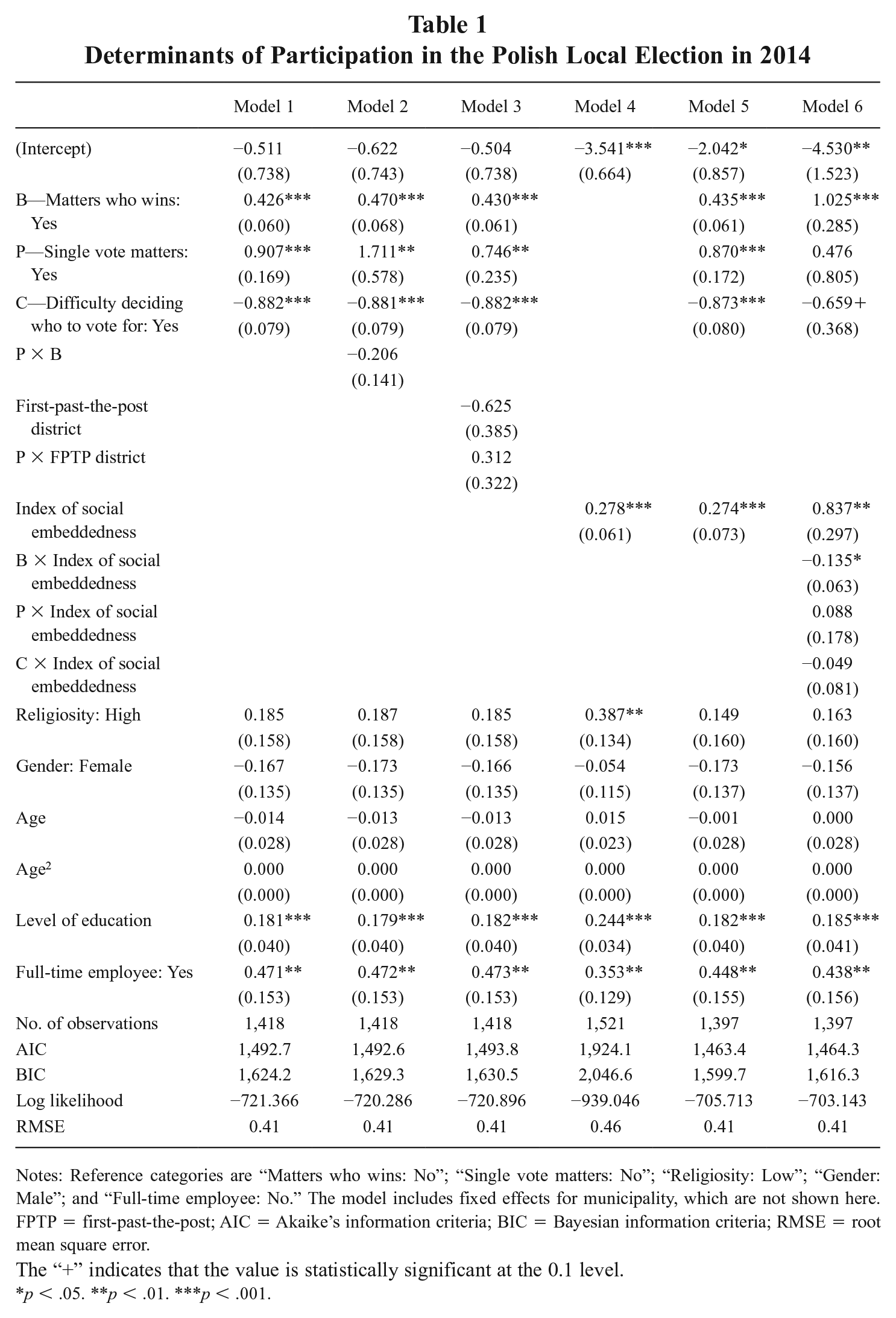
The first important research question tested pertains to the key issue of rational choice theory: whether the decision to vote is rational. To answer this question in model 1 of Table 1, the impact of three variables is tested: B (whether who wins matters), P (a single vote matters), and indicative of the cost of voting, C1 (difficulty in deciding whom to vote for). This is our basic model, controlled by socio-demographics.
Determinants of Participation in the Polish Local Election in 2014
Notes: Reference categories are “Matters who wins: No”; “Single vote matters: No”; “Religiosity: Low”; “Gender: Male”; and “Full-time employee: No.” The model includes fixed effects for municipality, which are not shown here. FPTP = first-past-the-post; AIC = Akaike’s information criteria; BIC = Bayesian information criteria; RMSE = root mean square error.
The “+” indicates that the value is statistically significant at the 0.1 level.
p < .05. **p < .01. ***p < .001.
Model 1 shows that all three of the main rational factors, when controlling for sociodemographic variables, indeed matter significantly for deciding whether to participate in local elections. Broadly speaking, a conviction that a single vote matters and that it matters who ultimately wins plays a decisive role. The more demanding and laborious the decision about whom exactly to vote for, the less likely is participation. In model 2, we tested the interactive effect of P and B as anticipated by rational choice theory, but this did not have any significant additional effect on the probability of voting. Further analyses thus employed a simpler model without interactions. All three elements of the basic rational choice model have the expected relationship with voting, after controlling for sociodemographic variables. Among sociodemographic variables, higher education and full-time employment predict voting, while age and gender have no effect.
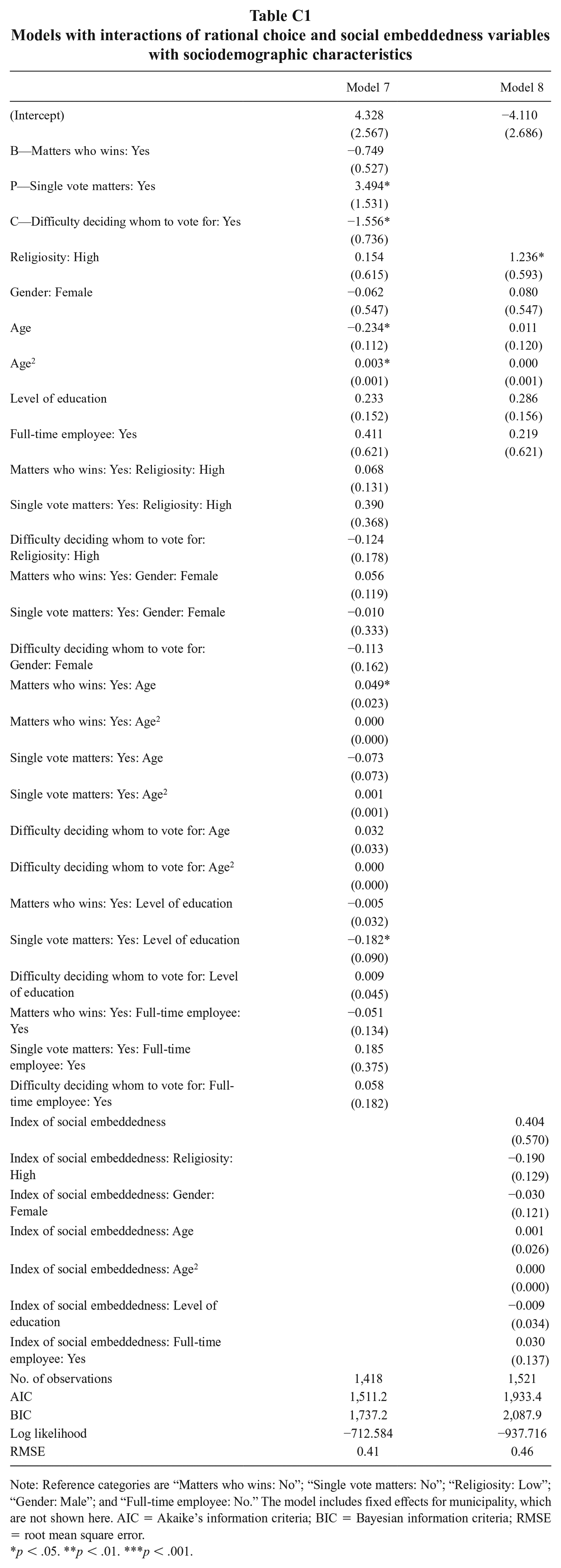
As we are interested in understanding to what extent sociodemographic variables play a role as moderating factors for the impact of rational choice mechanisms, we tested for interactions between these variables. Out of fifteen interactions tested, only two were significant (for detailed analyses, see model 7 in Table C1 in Appendix C).
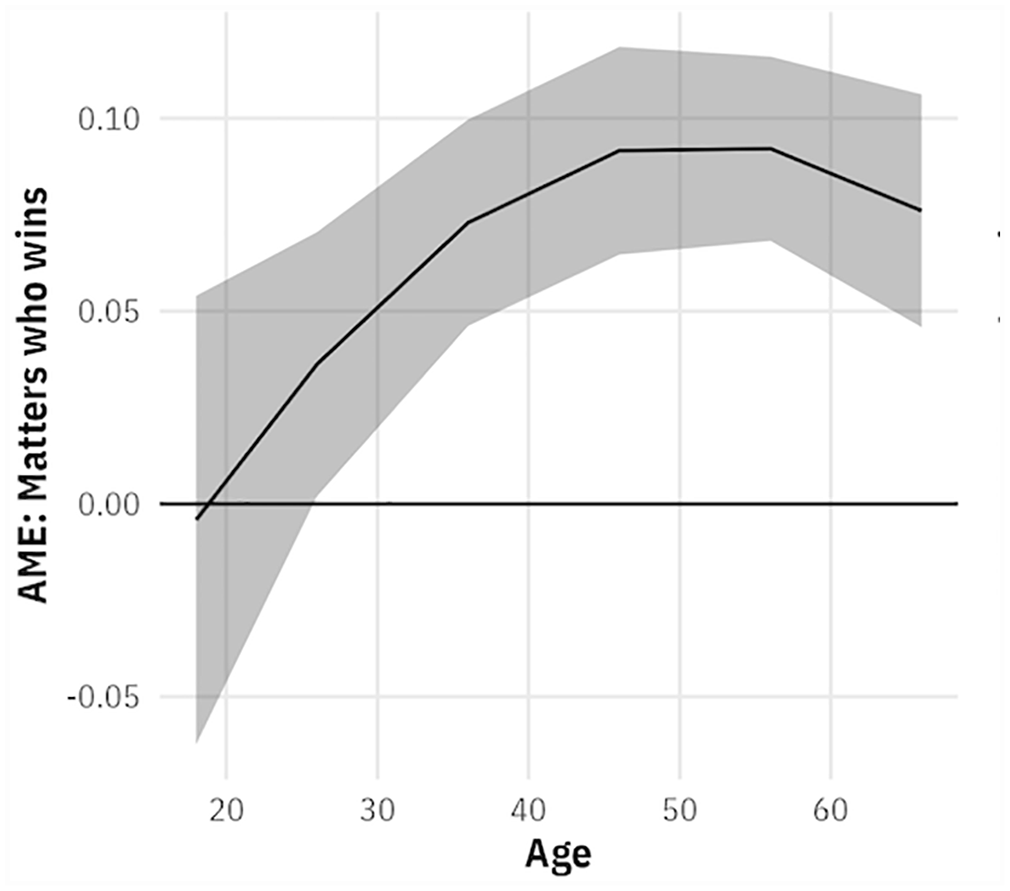
The influence of the instrumental benefits of voting (B—whether who wins matters) on the propensity to vote changes with age: it is insignificant among the youngest voters, then increases with age until age fifty-five, and from then on, it gradually decreases. The curvilinearity can be attributed to changes in the importance of elections (and their stakes) once people get the primary resources necessary to vote. In later stages, changes in the life cycle (setting up families and entering or exiting the labor market 49 ) play an essential role (Figure 1).
Interaction between B and age
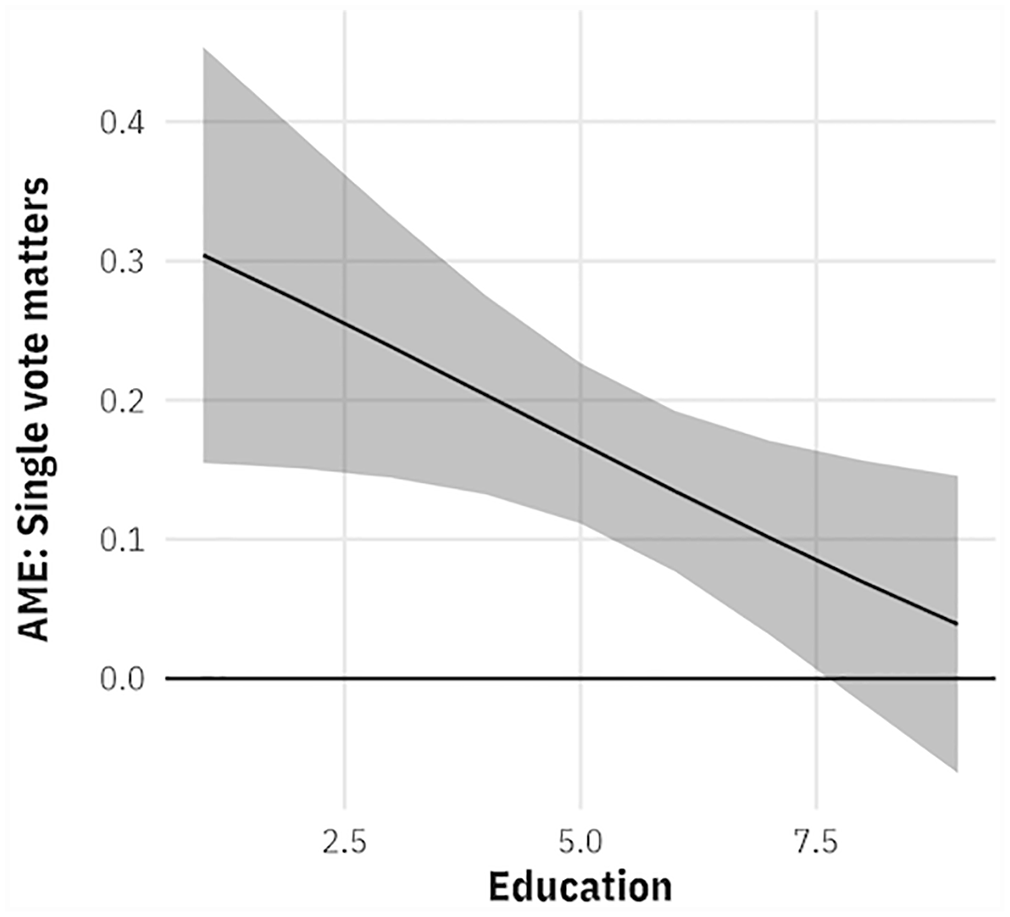
The impact of the belief that a single vote matters on the decision to participate in elections decreases with a respondent’s level of education. This is most likely related to the electoral probability calculation (the conviction that a single vote changes the outcome of the elections is close to zero) and the importance of other factors, such as the aforementioned sense that much is at stake in these elections or the sense of civic duty (Figure 2).
Interaction between P and level of education
In model 3, we added an interaction between the probability of casting a decisive ballot and the crucial macro-structural factor of voting in a majoritarian system. The interaction results are insignificant. A plausible explanation for this is that it is not only the electoral system that matters but also the extent to which voters are aware of it. Our data show that around 70 percent of respondents were not aware of which electoral system their constituency uses.
Model 4 shows the effect of the social embeddedness of local inhabitants when controlling for sociodemographic variables. The independent impact of the index of social embeddedness is statistically significant and shows the expected relationship, with higher levels of embeddedness predicting a greater probability of participation in elections. None of the interactions of the social embeddedness index and socioeconomic variables were statistically significant (for details, see model 8 in Table C1 in Appendix C).
The crucial part of our analysis concerns not only the extent to which the social embeddedness of local inhabitants matters for participation but also whether it has an impact on the extent to which rational choice matters. We expect deep social embeddedness to enhance participation to the extent that it moderates the direct impact of rational choice factors—in particular, the costs of voting. Models 5 and 6 thus test the combined effect of the rational choice and social embeddedness variables.
In model 5, the effect of the three rational choice variables B (whether who wins matters), P (a single vote matters), and C1 (difficulty in deciding whom to vote for) remains unchanged. At the same time, the index of social embeddedness has a direct net effect on participation in local elections.
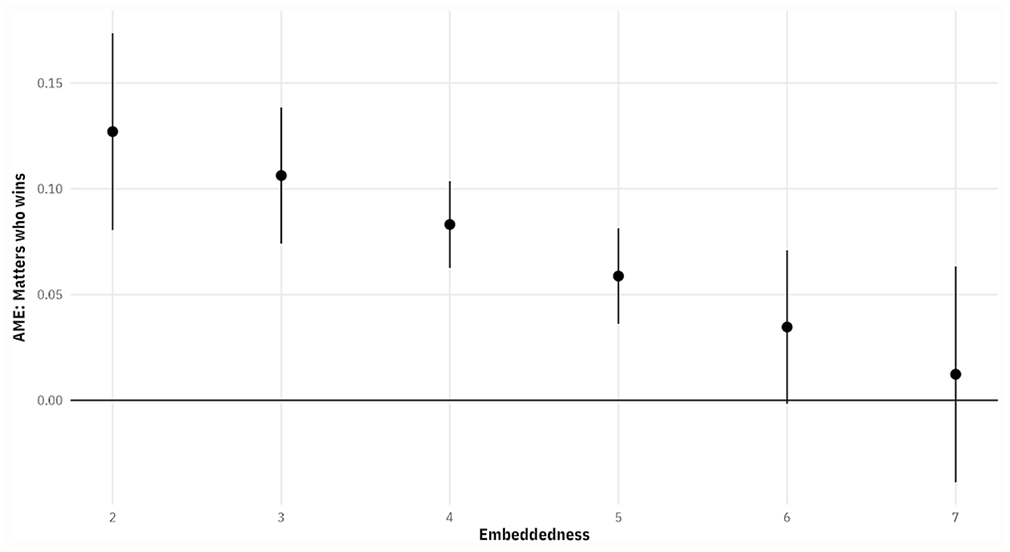
When social embeddedness and rational choice variables are interacted (model 6), we find that higher levels of embeddedness reduce the impact of B on the probability of voting in local elections. As Figure 3 reveals, at low levels of embeddedness, the effect of B is positive and statistically significant, while at high levels of embeddedness, it cannot be distinguished from zero. Social embeddedness possibly activates different motivations to vote than pure instrumental benefit, such as civic duty to vote or willingness to comply with social norms.
Interaction between B and index of social embeddedness
However, in the case of P and C, the interaction is not significant at any value of embeddedness. We conclude therefore the effect of P and C as well as the index of social embeddedness affect propensity to vote independently. The perceived probability of casting a decisive ballot and difficulties with deciding whom to vote for are unaffected by the level of social embeddedness (and hence depend on other, probably more individual factors).
Conclusion
This analysis has tested the impact of ontologically different sets of factors on participation in local elections in Poland. The main research question concerned the impact of the local social embeddedness of citizens on their propensity to vote in local elections. This analysis was compared with rational choice mechanism factors. Our expectations proved mostly correct, although some were not entirely correct, and still others outright incorrect.
First, the rational choice part of the story confirmed the key assumptions of the orthodox version of rational choice theory: P, B, and C factors had the predicted effect. In other words, citizens’ general conviction that who wins an election matters, as well as their belief that a single vote matters, are conducive to participation. Moreover, the two cost factors—high familiarity with candidates and subjective assessment of the difficulty in choosing whom to vote for—also have the predicted effect.
Second, the social embeddedness of citizens enhances the probability of participation in an election. However, it does not substitute for the impact of the rational motivation factors, nor does it significantly decrease the latter’s net impact on participation.
Third, while sociodemographic variables are typically treated as controls, in our analysis, factors such as education, professional status, and age ought to be treated as substantive elements of the model, with education and age serving as proxies for political experience. These factors are positively associated with participation and with moderating the impact of rational choice mechanisms.
Fourth, given the important role played by the Catholic Church in Polish political life, we expected religiosity to play a role in enhancing participation, yet its relationship with participation and with the set of independent variables tested in this study turned out to be a more complicated issue. Church attendance is associated with a greater propensity to vote, even in the presence of numerous other sociodemographic controls. However, rational choice factors mitigate its impact to the extent that it becomes insignificant. We know from several studies of the electoral behavior of Poles 50 that religious belonging to a parish affects the direction of the vote, that is, voters’ party preference. However, when controlled for by the set of factors presented in our study, church attendance is irrelevant for enhancing participation in local elections.
Finally, and in accordance with expectations, the presence of a FPTP electoral system enhances participation. However, this factor is not particularly influential, nor does it mitigate the impact of other factors.
We claimed that the specificity of the Polish local election context provides a well-suited setting for a test of the rational choice hypothesis in the context of the social embeddedness approach. The results confirm the assumption. Electoral decision-making is facilitated by smaller constituencies, a direct (and perceptible) impact of electoral choices (and their consequences) on people’s lives, familiarity with candidates, as well as specific candidates or policy preferences. The model performs better than in more distant national elections, where the variables are more sensitive to political context. 51 Whether this fact results from the specific character of local elections or can be attributed to Polish idiosyncrasies is an empirical question for further investigation.
Footnotes
Appendix A
Appendix B
Appendix C
Models with interactions of rational choice and social embeddedness variables with sociodemographic characteristics
| Model 7 | Model 8 | |
|---|---|---|
| (Intercept) | 4.328 | −4.110 |
| (2.567) | (2.686) | |
| B—Matters who wins: Yes | −0.749 | |
| (0.527) | ||
| P—Single vote matters: Yes | 3.494* | |
| (1.531) | ||
| C—Difficulty deciding whom to vote for: Yes | −1.556* | |
| (0.736) | ||
| Religiosity: High | 0.154 | 1.236* |
| (0.615) | (0.593) | |
| Gender: Female | −0.062 | 0.080 |
| (0.547) | (0.547) | |
| Age | −0.234* | 0.011 |
| (0.112) | (0.120) | |
| Age2 | 0.003* | 0.000 |
| (0.001) | (0.001) | |
| Level of education | 0.233 | 0.286 |
| (0.152) | (0.156) | |
| Full-time employee: Yes | 0.411 | 0.219 |
| (0.621) | (0.621) | |
| Matters who wins: Yes: Religiosity: High | 0.068 | |
| (0.131) | ||
| Single vote matters: Yes: Religiosity: High | 0.390 | |
| (0.368) | ||
| Difficulty deciding whom to vote for: Religiosity: High | −0.124 | |
| (0.178) | ||
| Matters who wins: Yes: Gender: Female | 0.056 | |
| (0.119) | ||
| Single vote matters: Yes: Gender: Female | −0.010 | |
| (0.333) | ||
| Difficulty deciding whom to vote for: Gender: Female | −0.113 | |
| (0.162) | ||
| Matters who wins: Yes: Age | 0.049* | |
| (0.023) | ||
| Matters who wins: Yes: Age2 | 0.000 | |
| (0.000) | ||
| Single vote matters: Yes: Age | −0.073 | |
| (0.073) | ||
| Single vote matters: Yes: Age2 | 0.001 | |
| (0.001) | ||
| Difficulty deciding whom to vote for: Age | 0.032 | |
| (0.033) | ||
| Difficulty deciding whom to vote for: Age2 | 0.000 | |
| (0.000) | ||
| Matters who wins: Yes: Level of education | −0.005 | |
| (0.032) | ||
| Single vote matters: Yes: Level of education | −0.182* | |
| (0.090) | ||
| Difficulty deciding whom to vote for: Level of education | 0.009 | |
| (0.045) | ||
| Matters who wins: Yes: Full-time employee: Yes | −0.051 | |
| (0.134) | ||
| Single vote matters: Yes: Full-time employee: Yes | 0.185 | |
| (0.375) | ||
| Difficulty deciding whom to vote for: Full-time employee: Yes | 0.058 | |
| (0.182) | ||
| Index of social embeddedness | 0.404 | |
| (0.570) | ||
| Index of social embeddedness: Religiosity: High | −0.190 | |
| (0.129) | ||
| Index of social embeddedness: Gender: Female | −0.030 | |
| (0.121) | ||
| Index of social embeddedness: Age | 0.001 | |
| (0.026) | ||
| Index of social embeddedness: Age2 | 0.000 | |
| (0.000) | ||
| Index of social embeddedness: Level of education | −0.009 | |
| (0.034) | ||
| Index of social embeddedness: Full-time employee: Yes | 0.030 | |
| (0.137) | ||
| No. of observations | 1,418 | 1,521 |
| AIC | 1,511.2 | 1,933.4 |
| BIC | 1,737.2 | 2,087.9 |
| Log likelihood | −712.584 | −937.716 |
| RMSE | 0.41 | 0.46 |
Note: Reference categories are “Matters who wins: No”; “Single vote matters: No”; “Religiosity: Low”; “Gender: Male”; and “Full-time employee: No.” The model includes fixed effects for municipality, which are not shown here. AIC = Akaike’s information criteria; BIC = Bayesian information criteria; RMSE = root mean square error.
p < .05. **p < .01. ***p < .001.
