




Abstract
The article discusses the problems of the effectiveness of a comparative analysis method used for diaspora studies. Depending on their nature, diasporas can be either comparable or non-comparable. The article provides a methodology for studying diasporas as well as its paradigm and implementation algorithm. It relies on the approach that one of the key factors of comparative analysis is whether the cases compared are comparable or not. Thus, it becomes necessary to reveal the nature of diasporas and their communities. To ensure the effectiveness of the analysis of comparable diasporas, the article proposes to classify the variables defining diasporas into two groups: identity variables and institutional variables. Identity variables can be used when there is a need for more detailed assessment of the nature of diasporas. The comparative analysis of diasporas or communities with the same nature should be based on institutional variables. The article examines the cases of the Armenian community in Russia and Lebanon to test the proposed methodology. It argues that these communities have different nature and thus their comparative analysis for the purpose of disclosing the prerequisites for the preservation of identity and effective functioning of institutions is senseless.
Introduction
In the 21st century, not only the number of people living outside their homeland is rapidly growing (International Migration Report, 2015), but also the number of countries that are striving to develop a clear and long-term strategic plan for the establishment, management and activation of relations with their diasporas (Boyle et al., 2013, 80–97). To this end, until 2014, 60% of the UN member states have already established respective institutions (Gamlen et al., 2017). The specific goals of these countries are often different: one wants to defend the right of state existence (Israel), the other wants to overcome the geographical cutoff from the global economy (New Zealand), the third wants to overcome the challenges of extremely low birthrate (Scotland), the fourth regards diaspora as a resource for building post-Soviet national identity and trajectory (Armenia), the fifth considers it as an important mechanism for effective integration into global economy under the conditions of a new world order (India and China), the sixth views the remittances from diasporas as an important mechanism to withstand the consequences of so many people leaving the country (Mexico) and so on (Boyle et al, 2013, 80–97). Due to national peculiarities and the growing diversity of strategies, institutions, motives and strategic goals of cooperation with the diaspora, the forms and institutional capacities of “Homeland-Diaspora-Hostland” relations are rapidly developing, and become more complicated. The number of theoretical and empirical researches on diaspora studies is continuously increasing for revealing the existing problems and providing effective solutions to them. The researches on this topic cover both general theoretical issues, i.e. definition and classification of diasporas, etc. (Brazil & Mannur, 2003; Cohen, 2008; Dufoix, 2008; Esman, 2009; Kokot & Tölölyan, 2004; Laguerre, 2006; Sheffer, 2003a) and such specific dimensions as Homeland-Diaspora-Hostland relations, the dilemma of identity and integration, institutions of diaspora, the impact of diaspora on international relations and foreign policies of homeland and hostland, etc. (Burla, 2015, 602–619; Shain & Barth, 2003, 449–479; Shain, 2007; Sheffer, 2013, 13–30; Ter-Matevosyan et al., 2017, 64–80). Nevertheless, it is still early to state that the methods, their peculiarities and mechanisms used for this research are in a complete form. This, in particular, refers to the comparative analysis method used for diaspora studies. While it is one of the most frequently used methods in diaspora studies, there is still a need to substantiate the criteria for selecting comparable diasporas (or communities), a set of variables to ensure the credibility of the solution of research problem, etc. As a contribution to scientific research on diasporas, the article proposes a methodology for conceptualizing a comparative analysis method. This will allow to avoid the challenges and wrong conclusions arising from the comparative analysis of heterogeneous diasporas. Due to the deepening of globalization, the collapse of the USSR, exacerbation of conflicts aimed at the formation of new world order, migration movements have dramatically increased thereby leading to transformations of diasporas not only in a quantitative but also in a qualitative sense. In a number of cases (Armenian, Ukrainian, Georgian, Lithuanian and other diasporas) even the nature of the diaspora has started to change: transforming diasporas have appeared (Torosyan & Vardanyan, 2020, 59–71). If, for instance, the Armenian diaspora has traditionally been considered a victim diaspora (Cohen, 2008, 16–18), after the collapse of the USSR, a significant number of Armenians who left their homeland formed new communities or new sections of communities, radically different from the communities formed prior to that. As a result of this, the nature of diasporas is also changing. They turn into a unit consisting of heterogeneous communities, thereby causes serious difficulties, firstly in the matter of forming relations between the heterogeneous communities and ensuring the unity of the diaspora, secondly in the matter of the diaspora’s relations with the motherland, and thirdly, in the matter of the relations with the hostland. Moreover, it requires from the relevant structures diversified relations with different communities and different mechanisms for their organization. Obviously, such radical shifts require new approaches to their study. Moreover, the application of old approaches in new conditions can lead to serious flaws, to avoid which it is required to revise the extant approaches. One of the main problems that appears during comparative studies of diasporas is that the cases compared are not distinguished according to the parameters characterizing them. Cases are often compared, which are incomparable and can lead to wrong conclusions, and based on them, to wrong approaches and goals for the establishment and development of homeland-diaspora, diaspora-hostland relations. In particular, the article proposes to take into account the aforementioned circumstances while conducting comparative analysis in diaspora studies, and to apply an algorithm for the classification of comparable and non-comparable diasporas. The article suggests classifying the variables used in such studies into two groups: identity and institutional variables, and accordingly conduct the research in two stages. The case of the Armenian Diaspora is being examined to prove the effectiveness of the proposed methodology.
The Methodology and Research Structure
Various developments of political systems, institutions and processes, in particular, the “Homeland-Diaspora-Hostland” interactions and their institutions cannot be explained by the existing theoretical models and schemes. Therefore, comparative analysis is important both for the prediction, promotion or prevention of these developments and for the increase of their effectiveness. It also allows identifying and justifying the similarities and peculiarities of the social units involved in these processes, i.e. peoples, societies, communities and cultures (Smelser, 2002). According to D. Apter (Apter, 1996, 372), comparison is a unique way of discovering the links between ideas based on events and phenomena, and it stems from the philosophy or theory of politics. The main objective of the comparative method is to show the differences and similarities of two or more cases or processes as well as to make generalizations based on the analysis of empirical data in forms of patterns, models, classifications (Torosyan & Petrosyan, 2015, 121–138). In diaspora studies, the method of comparative analysis serves to address the following issue: Why in some cases the “Homeland-Diaspora-Hostland” interactions, institutionalization of diaspora or policy making and implementation structures on diaspora issues in homeland are more effective than in other cases alike?
The effectiveness of the comparative method is conditioned by two factors: selection of comparable cases and selection of variables (Lijphart, 1971, 682–693). Accordingly, it is necessary to solve two problems: choosing the comparable cases that accurately correspond to the purpose of the study, and choosing the respective set of variables to solve the problem. Thus, the comparative analysis of diasporas should be carried out in two phases: selection of comparable cases and comparison of institutional variables to identify the differences between the institutions of diasporas, their activities and the reasons behind these differences.
The most distinctive feature of diaspora as compared to the rest population of hostland is its collective identity. Levin attaches great importance to the inner organization of diaspora and the socio-cultural context. He considers Diaspora to be the ethnic segment of people living outside its homeland which will exist in parallel with maintaining its ethno-cultural identity (Levin, 2001, 5). In other words, identity is the essence of diaspora and the latter will cease to exist in case identity is lost. In addition, it is necessary to take into account that identity is not carved in stone and it is subject to continuous changes under the influence of various factors (Torosyan, 2006, 3–21). Therefore, the variables used in diaspora studies can be classified into two major groups: identity and institutional variables. The variables of identity directly affect the formation, maintenance, or changes of identity. Institutional variables also affect the identity, but their impact is indirect and depends on the effectiveness of institutions. These two groups play different roles in diaspora studies. To ensure the effectiveness of researches on this topic, the variables of the first group should be generally used at the first stage of survey when selecting the comparable cases, while the second group—in the evaluation of the functioning of institutions.
Figure 1 presents the algorithm for implementing the comparative analysis methodology described above. The algorithm of comparative analysis of diasporas. Formulation of research problem.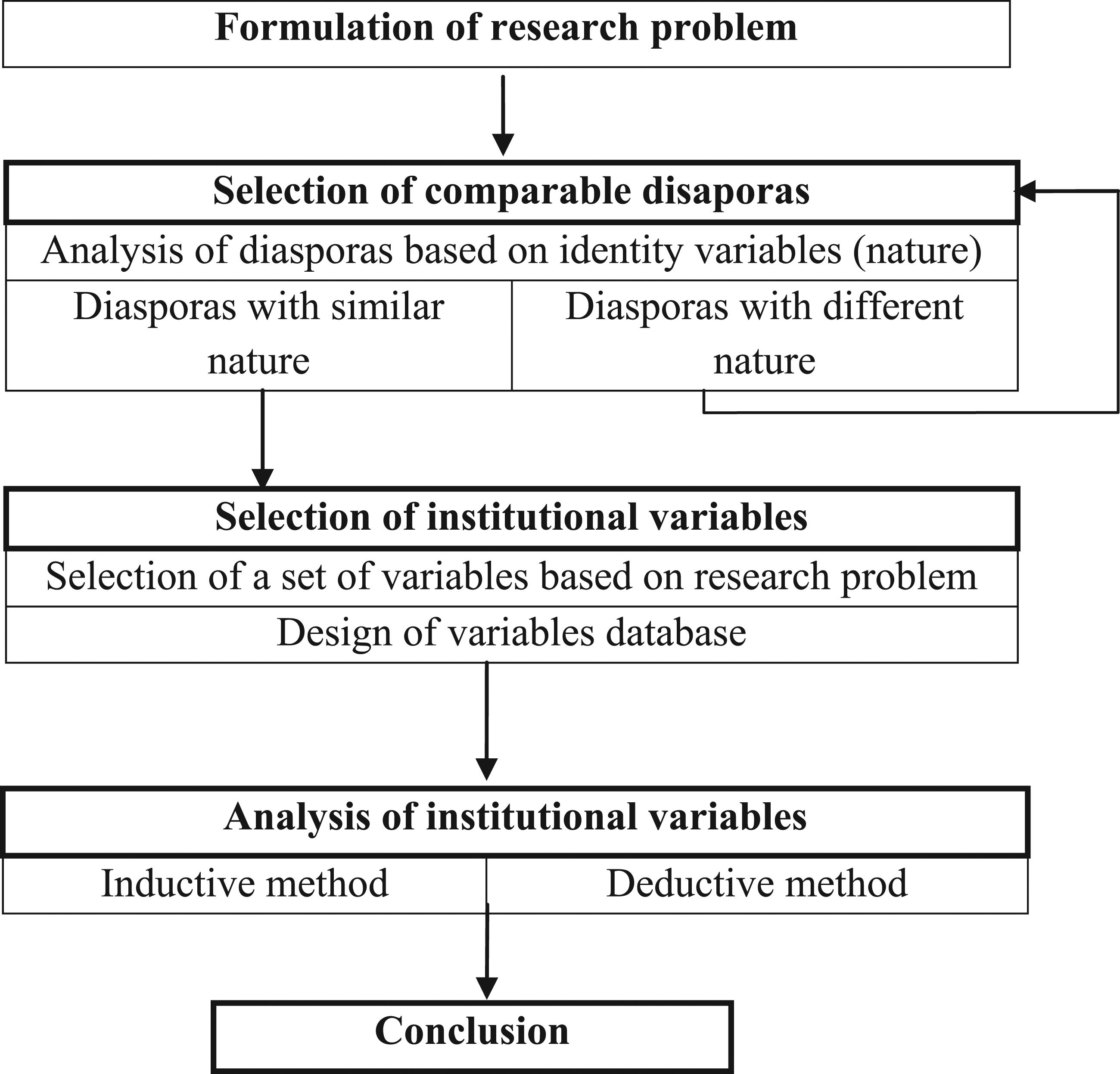
The conducted research and this article have the following structure. First, the variables of the studies cases of diasporas are classified into two groups: identity and institutional variables. Then, according to identity variables, the cases under study are divided into comparable and non-comparable groups. Based on this, it is decided which cases of diasporas or which communities of the same diaspora can be compared with each other in order to obtain reliable results. The database of institutional variables forms the basis of the data by which the comparative analysis of diasporas can be carried out. Guided by this structure, the article verifies the reliability of findings by analyzing the empirical data regarding the case of Armenia.
Thus, in order to obtain reliable results in diaspora studies, first one needs to classify variables into two groups: identity and institutional variables, then select comparable cases based on these two groups, and further formulate conclusions based on the results obtained.
Identity and Institutional Variables Used in Diaspora Studies
In academic literature on diaspora studies, different variables are used for research purposes. The first problem they address is the definition of diaspora to clarify the characteristics of a particular community and to distinguish it from similar groups, the second is the classification of diasporas. One of the first works on this issue was the article of Armstrong published nearly four decades ago. It suggested a two-dimensional model of diaspora classification (mobilized and proletarian classes), as well as a set of variables (criteria) used for its definition (Armstrong, 1976, 394–408): 1. People are scattered all over the world and there is a “Homeland-Ethnic group-Hostland” triangular relationship; 2. The constant feeling of belonging to homeland as well as the collective consciousness of ethnic group’s history and identity is among the most important elements of diaspora; 3. An ongoing desire to return to homeland and attempts of its idealization; 4. A process of transnationalism and network collaboration within the communities of the given ethnic unit; 5. Intensifying cooperation in the context of Homeland-Diaspora relations.
Armstrong’s two-dimensional model has been revised over the past decades, which will be discussed in the next section of the article. What refers to the variables characterizing diaspora, they will be viewed from the point of view of their belonging to the two groups of variables mentioned above. One can notice that the first, fourth and fifth variables belong to the institutional class, while the second and the third to identity class.
In the early 90s, along with the growing interest of the academic circles to diasporas, the importance of the variables characterizing the identity of diasporas has been emphasized. In particular, Safran has identified six characteristics (variables) of diasporas: 1. The people or their ancestors have been dispersed from a specific original “center” to two or more “peripheral” or foreign regions; 2. They retain a collective memory, vision or myth about their original homeland—its geopgraphical location, history and achievements; 3. They believe that they are not and perhaps cannot be fully accepted by their host society and therefore feel partly alienated and insulated from it; 4. They regard their ancestral homeland as their true, ideal home and as the place to which they or their descendants would (or should) eventually return when conditions are appropriate; 5. They believe that they should, collectively, be committed to the maintenance or restoration of their original homeland and to its safety and prosperity; 6. They continue to relate, personally or vicariously, to that homeland in one way or another, and their ethnocommunal consciousness and solidarity are defined by the existence of such a relationship (Safran, 1991).
These six variables belong to the class of identity. This is indirectly proved by the fact that the three variables of Safran’s model (3, 4, 5) stated the return to homeland as one of the important missions of diaspora. That is why the model proposed by Safran is often called four-dimensional model.
In the second half of the 1990s, a group of experts returned to the agenda Armstrong’s thesis of self-organizing capabilities of diaspora as a second important manifestation of its consolidation. In particular, Toshchenko and Chaptykova note that Diaspora is a stable group of people belonging to the same ethnic background and living beyond its historical borders, in other ethnic environment, and it has some public institutions needed for the development and functioning of that particular ethnic group (Toshchenko & Chaptykova, 1996, 33–42). It means that the institutional variables have been again highlighted along with the variables of identity. Cohen considered it necessary to expand the four-variable-model proposed by Safran to four additional variables. Accordingly, the definition of diaspora should also 1. include ethnic groups scattered on a voluntarist reasons and as a result of aggression, persecution or extreme repression. 2. take into account the necessary time-shifting, during which the given ethnic community turns into a diaspora. According to Cohen, the transnational community needs to be strongly tied with the past, which will protect it from the danger of assimilation. 3. include the peculiarities of diaspora and the identity formed within its framework. In particular, the disclosure of differences between national, ethnic and transnational identities and their synthesis can lead to more constructive and creative developments. The ethnic community, established abroad, can register great achievements in hostland in scientific, cultural, economic and other spheres. 4. recognize that the diaspora does not only form a collective identity in a given place of residence but also shares a common identity with the same ethnic groups of other countries (Cohen, 2008, 7–8).
It essentially expanded the original and classical perception of diaspora and increased communities created for commercial and business purposes. During the first decade of the 2000s, a group of researchers again referred to the idea of the return to homeland as one of the key features of diaspora. In particular, Brubaker has proposed three other diaspora-specific criteria (Brubaker, 2005, 1–19) that sum up the semantic and conceptual aspects introduced by a number of authors (Clifford, 1994; Cohen, 1996; Safran, 1991; Sheffer, 2003a; Tölölyan, 1991). 1. Dispersal: this criterion is widely acknowledged and is often perceived as a situation resulting from forced displacement; 2. Devotion to homeland: means that any diaspora resident has an internal motivation for repatriation, aims at improving his or her own homeland and maintaining an effective homeland-diaspora relationship, 3. Identity preservation: implies the importance of preserving identity in hostland.
Butler highlights the importance of Armstrong’s three criteria above, meanwhile suggesting to complete the list with the historical-chronological factor. According to him, the ethno-national group meeting these criteria can be considered diaspora only when at least two generations passed, the group still aims at returning to homeland (Butler, 2001, 189–219).
Clifford criticizes the models proposed by Safran and those researchers, who emphasize the idea of the return to homeland, considering them as “centered” templates on the idea. According to him, the decentralized connections are as important as the links centered on the goal of returning. He justifies this opinion by the claim that the goal of diaspora can be not only the return to its roots, but also the re-creation of culture in different geographical areas. Such an attempt can be seen in case of the African Diaspora where the primary goal is not at all a repatriation. Clifford acknowledges that the classical cases of diaspora are the Jewish, Greek and Armenian diasporas in which a repatriation took place in one or another region. However, he believes that under the new, global conditions of survival and hybridation, the Jewish, Greek and Armenian cases can be considered as non-standard starting points (Clifford, 1994).
Sheffer as well does not consider the idea of the return to homeland as a must and distinguishes three general variables (characteristics) within the definition of diaspora (Sheffer, 2003b). These are: 1. Preservation and development of the collective identity of diaspora, 2. Internal organization apart from institutional units of homeland and hostland, 3. Real and meaningful relationship with homeland.
Two of these three features (second and third) refer to the institutional class and only one to identity, which shows that the first was not less important than the second.
Sheffer proposed another, more detailed model, according to which diaspora is a socio-political unit created as a result of voluntary or forced emigration the members of which recognize that they have the same ethnic background and are considered minorities in one or more host countries. Members of such an ethnic unit keep in touch with their homeland and with their compatriots living in other countries. At the same time, there is a desire not to leave the hostland, but to maintain a common identity. Thereby, diaspora displays a unity inside and with the whole nation. It operates in an active and organized way, in cultural, social, economic and political spheres. In different fields, it creates a supranational network of activities focused on multilateral relationships with homeland, hostland, and compatriots from other countries (Sheffer, 2003a). This approach presents a harmonious combination of identity and institutional lessons. Although Sheffer’s model presents a rather comprehensive description of diaspora, however, it bypasses the studies which consider the return to homeland a necessary precondition for calling a particular community a diaspora. According to Sheffer, diaspora has the goal of permanently residing in hostland. Although the author attaches great importance to homeland-diaspora relations, he rejects the idea of unconditional return to homeland. However, it is not a principled debate since Sheffer does not deny the possibility of the return to homeland. Moreover, his “real and meaningful relationship with homeland” approach may, in some cases, lead to individual or collective repatriation. Repatriation as a possibility of solving the problems in homeland is a subject of separate study. This refers to both involuntary repatriation (due to changes of situation in homeland or hostland) and to that organized by homeland itself.
Thus, the study of diasporas has been conducted in four main directions: 1. Definition of diaspora, 2. Classification of diasporas, 3. Comparative study of diasporas, 4. Identification of a set of variables describing the origin and development of diasporas for the solution of the above mentioned problems.
A number of authors have suggested different sets of variables the elements of which have been repeated to this or that extent. According to the classification suggested in this article, all variables belong to either institutional or identity class. Moreover, in different periods of time attention has been focused on one of these classes without making clear distinction between them. The analysis shows that identity variables are typically used for diaspora classification, while institutional variables for comparative analysis. In the last decade, a quest for optimal formulation of the diaspora and the debate on the issue “Which are more important: identity or institutional variables?” has given way to comparative analysis of diaspora institutions, the effectiveness of their activities, the integration factor on the development of diaspora, as well as effectiveness of diaspora-homeland, diaspora-hostland relations (Sheffer, 2010, 379–399; Sheffer, 2013, 13–30; Koinova, 2009, 41–64; Burla, 2015, 602–619; Boyle et al., 2013, 80–97; Gamlen et al., 2017).
Still, the question remains as to which diasporas or communities are “comparable” from the point of view of the results of the analysis and the high reliability of conclusions.
The effectiveness of diaspora studies will be greatly increased if a mechanism is proposed that would allow to find out whether the selected diasporas are comparable or not. It is recommended to carry out such an assessment using the parameters that are usually used in diaspora studies. It will also allow to replace the not so important from the point of view of research, but frequently used question: “Which parameters are more important: the identity or institutional parameters?” with the following question “For which research problems are identity parameters more important, and for which—institutional parameters? " One of such problems is the determination of comparable cases.
Selection of Comparable Cases
Half a century ago, during the formation of the concept of comparative analysis, it was widely acknowledged that comparisons between two or more societies or political processes are more effective, in case they share a greater number of common features rather than universal or nationwide comparisons (Linz & de Miguel, 1966, 268).
In comparative analysis, the selection of “comparable” cases is crucial in ensuring the accuracy of the results of research (Torosyan & Petrosyan, 2015). In this case, comparative analysis should focus on such countries or diasporas that are most similar to each other and do not cause problems of incompatibility and inadequacy. “Comparable” means that the features or variables of identity defining the nature of diaspora do not vary. The prerequisite for the formation of diaspora, national identity, people’s life experience, value system and other factors shaping individual and collective features are among such variables. The conduction of similar researches creates more favorable conditions for the effective use of the comparative method as it allows revealing the links and patterns between several (institutional) variables, while some other (identity) variables are regarded as constants (Smelser, 2002). Institutions dealing with diaspora in homeland and diaspora, types of regime in hostland and homeland, educational institutions, etc. can be considered among the first group of variables. Many researchers agree that the index of diaspora is the formation of institutions and organizations the activities of which are aimed at maintaining and developing ethnic and religious identity, as well as ensuring effective socialization. Nevertheless, the existence of institutions without non-diasporan communicative functions and their implementation infrastructure limits the self-sufficiency of diaspora and condemns it to isolation (Myl'nikov, 2007).
Below, different models of characterization of diasporas that use identity and institutional parameters will be considered. These models and parameters will be discussed from the point of view of determining the comparability of diasporas and their communities.
Among the identity variables used in academic literature on diaspora studies, one can mention the motivation of diaspora’s formation, people’s life experience, the value system, and other factors shaping individual and collective attributes.
At the initial stage of diaspora studies, an attempt has been made to classify them on the basis of institutional variables rather than identity variables. Particularly, Medam identifies two types of diasporas -“crystallized” and “fluid”—based on the degree of unity and dynamism of diasporas (Medam, 1993).
It is no coincidence that one of the main criteria for the classification of diasporas is the motivation or prerequisite for their formation. At the beginning of the 1990s, Bruneau suggested classifying diasporas into three groups according to dominating sphere of their activities (Bruneau, 1995). These are 1. Entrepreneurial (China, Lebanon), 2. Religious (Israel, Greece), 3. Political (Palestine, Tibet).
This approach served for the main purpose of the study, i.e. the study of the spheres diasporas are involved in. However, for providing general characteristics of diasporas aimed at assessing their nature, it can work only in case of diasporas formed voluntarily. Meanwhile, it is not applicable to the ethnic groups (for instance, Jewish and Armenian diasporas) who have been forced to leave their homeland. Cohen’s classification of diasporas into five groups, which he calls the ideal options of diaspora, is free from such a shortcoming. He distinguishes the following types of diasporas (Cohen, 2008, 16–18): 1. Victim diasporas (Jewish, Armenian, Palestinian, African-American Diasporas), 2. Labor diasporas (Indian Diaspora), 3. Trade diasporas (Chinese Diaspora), 4. Imperial diasporas (British, French, Spanish, Portuguese Diasporas), 5. Cultural diasporas (Caribbean Diaspora).
One cannot argue that this is the revised version of Bruneau’s classification, which it shares some common features with. Cohen’s classification has other content; it reflects the nature of diasporas, including those of ethnic groups that have been forcibly evicted from their homeland, and subsequently complied with the demands of diasporas. The recent study on this issue proposes to add the transforming type of diasporas (Torosyan & Vardanyan, 2020, 59–71) to Cohen’s model, aimed at more accurate description of diasporas or their communities formed as a result of post-Soviet processes.
Thus, in comparative studies of diasporas and their communities, the use of Cohen’s model of classification is the most appropriate one for choosing “comparable” cases, if necessary completing it with identity variables to ensure a more detailed assessment.
The implementation of the proposed methodology for comparative studies of diasporas and their communities will allow evaluating its practical significance.
Verifying the Effectiveness of the Proposed Methodology on the Basis of Case Study
For the purpose of verifying the effectiveness of the proposed methodology, one of the recent works of the comparative analysis of the Armenian Diaspora conducted by Matevosyan and others is being examined (Ter-Matevosyan et al., 2017). The work analyzes and compares the institutions and identity policies of the Armenian communities of Russia and Lebanon to identify the factors that explain the differences in the institutional structure and the results of preservation of identity in these communities. The authors consider the reputation and activity of the Catholicosate of the Great House of Cilicia as the main factor determining the success of the Armenian community of Lebanon—active cooperation between schools, political parties and non-governmental organizations. The Armenian community of Russia is offered to learn lessons from the Lebanese experience in terms of the development of diaspora institutions. The article stands out among the other works on the comparative studies of the Armenian Diaspora due to the fact that it seeks to disclose the differences between the two communities of the Armenian Diaspora rather than regards it as a homogeneous community or focus on a particular country or case (Ter-Matevosyan et al., 2017).
From the point of view of description and comparison of the Armenian communities of Russia and Lebanon, the statements presented in the article are quite convincing. However, it is important to find out the extent to which the findings are justified, whether the reasons for the differences are correctly disclosed; whether it is possible to realize that suggestion in the Armenian community of Russia or of any other country. And if so, will it produce the results comparable to the results of the Armenian community in Lebanon? Below you will find answers to these questions based on the methodology suggested in this article.
Variables for diasporas of Lebanon and Russia.
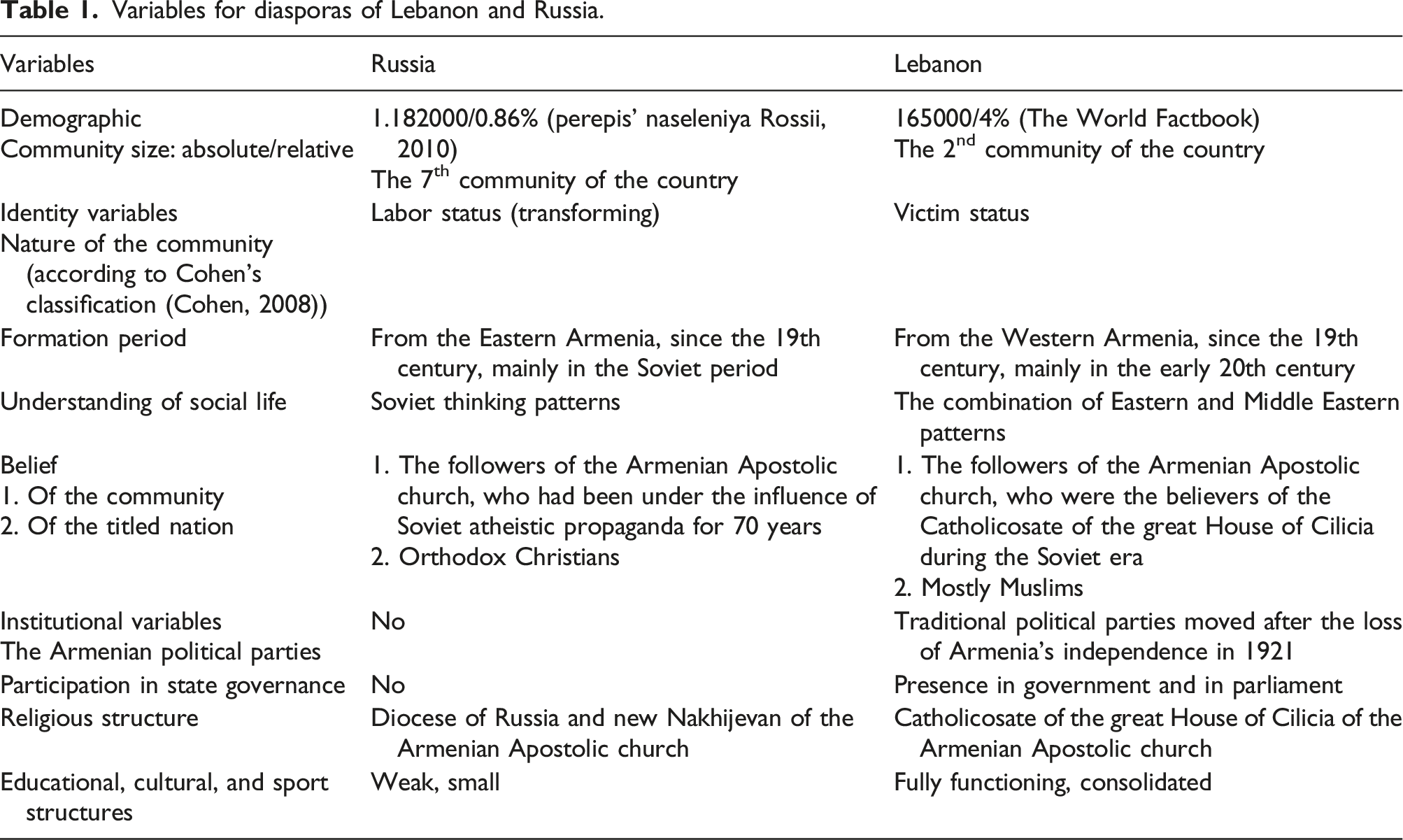
The fact that Russia and Lebanon, as host countries, are completely different in terms of size, number and structure of the population, political cultures, and even the dimension of civilization, implies that the diaspora communities formed in them must have noticeable features. Another important feature is the fact that the Armenian community of Russia was formed mainly from Armenians who migrated from Eastern Armenia (for a long time it was part of the Russian Empire, then the USSR), and the community of Lebanon was mainly from those who migrated from Western Armenia (for a long time it was part of the Ottoman Empire, then part of Turkey). In order to ensure the accuracy of the assessment, these two communities will be considered below based on the approaches presented in the article.
As suggested by the above mentioned methodology, the nature of the two communities has been determined based on Cohen’s classification. These communities are diverse: the Armenian community of Russia is a working diaspora, and the Armenian community in Lebanon is a victim diaspora. According to Cohen, the prehistory of leaving homeland forcibly due to unbearable conditions (in particular mass killings, torture, etc.) constitutes the basis of victim diaspora. The examples of the latter are the Armenian, Jewish and African diasporas. The formation of the working diaspora is based on the principle of volunteerism of the ethnic group that seeks to work in other countries with the intention of creating more favorable living conditions, thereby gradually forming working diaspora. One of the examples is the Indian Diaspora in the UK, formed in the 1830s (Cohen, 2008, 61).
The data provided in Table 1 shows that the initial prerequisites for the formation of the Armenian community in Russia were labor-based (not excluding the fact that a non-influential segment of people could have a victim’s status). It started in the 19th century during the era of the Russian Empire and gained momentum in the years of the Soviet Union. A large segment of this community moved to Russia after the collapse of the USSR. Although this segment should be considered as transforming diaspora (Torosyan & Vardanyan, 2020, 59–71) to give a more accurate description of it, this is not of key importance in terms of the issues considered in this article.
The main precondition for the formation of the Armenian community in Lebanon is the deportation of the Armenians from the Western Armenia through mass extermination, torture and massacres and the relocation of a part of it to Lebanon.
The community of Lebanon grew in 1921 after the loss of independence of Armenia, when a significant number of Armenians, as well as the central governing bodies of the Armenian political parties moved to Beirut. The nature of this segment of the Armenian community in Lebanon can also be considered as a victim diaspora, since it has been dispersed from homeland by the Soviet authorities.
The identities of the Armenian communities of Russia and Lebanon, in addition to the common national features, have also significant differences, since they have been formed and functioned under the influence of various prerequisites, in quite different environments and conditions. According to the methodology suggested in this article, this is enough to claim that these communities are not comparable. Nevertheless, the principal differences of institutional variables will be briefly presented below, not only to prove that they are not comparable but also that the case of the Armenian community of Lebanon is so unique that it cannot serve as a role model for any community.
At first glance, it may seem that the Armenian communities of Russia and Lebanon have problems of religion only related to the titled nation of their country, since the Russians are Christians like Armenians while the natives of Lebanon are Muslims. At the same time, both the Armenians of Russia and those of Lebanon are followers of the Armenian Apostolic Church, and it seems there is no problem of identity. However, there are some nuances that provoke significant differences, particularly in perceiving the role and influence of church on the community. While the Armenian community of Russia carries a heavy legacy of the Soviet era in a religious sense (the church was persecuted in the USSR and it was under the strict control of government; the relationship of believers with the church was not encouraged, etc.), the spiritual center of Lebanon, i.e. the Catholicosate of the Great House of Cilicia, enjoyed all the freedoms, and it has been free from the actual influence of the Mother See of Holy Etchmiadzin since the Soviet years. The created situation is a result of historical developments and cannot be simply copied out.
There is also a fundamental difference in terms of political institutions. There are no Armenian national political parties in the Armenian community of Russia, and the Armenians, like the representatives of other nations, are involved in the state system of that country as merely the citizens of Russia. Several non-governmental organizations (the Union of Armenians of Russia, the World Congress of Armenians, etc.) have been established after the collapse of the USSR that proclaimed national consolidation and preservation of identity among the other statutory goals. However, from that point of view, their effectiveness is not high not only due to the large territory of Russia and the number of the Armenians living there, but also due to the fact that in the Soviet years there were no organizations engaged in the protection of national identity or, in general, those functioning independently. According to A. Brown, until the mid-1980s, the establishment of any organization was inadmissible in the Soviet Union without state permission and control, even in case it was not a political organization (Brown, 1996, 16–17). Moreover, there could be no organization dealing with the issues of national identity as the state ideology in the USSR was directed to eliminate the differences between nations (thus, national identity) and to form a community of the Soviet people. Accordingly, there was no experience of building national identity preservation and development structures. In general, transformation of social consciousness is the most complex component of social transformations, i.e. in this case, post-Soviet transformation (Torosyan, 2006, 179–185). Meanwhile, as mentioned above, the central bodies of the three main parties, the Armenian Revolutionary Federation, the Armenian Democratic Liberal Party and the Social Democrat Party, have moved to Lebanon after being persecuted and subjected to violence under the Soviet rule. Moreover, these structures have not only been involved in the political system of Lebanon and have representatives both in the parliament and the government, but also had a great impact on the formation and development of educational, cultural, charity and other organizations, in cooperation with the Catholicosate of the Great House of Cilicia. If we add to this the radical difference between the perceptions of the Armenian community of Russia and that of Lebanon on the organization of public life, it will become clear that the comparative analysis of these communities is senseless in terms of the preservation of national identity and effective functioning of its institutions.
Thus, the use of the proposed methodology for the comparative study of the Armenian communities of Russia and Lebanon shows that those communities, though sharing few common elements of national identity, are not comparable due to different nature and key historical facts. Consequently, these communities cannot be the subject of comparative analysis and the conclusions arising from the differences in the results of their activities, which are presented in this article (Ter-Matevosyan et al., 2017), cannot be justified. To select the cases for the comparative analysis of the Armenian communities, the classification of these communities according to their nature can be used (Torosyan & Vardanyan, 2020), comparing only the communities in each group with each other.
Meanwhile, the use of the proposed methodology for the comparative analysis of diasporas shows that this methodology allows not only to quickly identify the comparability/incomparability of the various cases, but also to avoid wrong conclusions and suggestions. The application of this methodology will also ensure the reliability of the conclusions of comparative study to guarantee the effectiveness of the selection of strategies for the development of diasporas.
Conclusion
The analysis of diaspora classification models, the set of variables used for that purpose, the approaches used in comparative studies as well as the case studies discussed in the article, in particular, the case of the Armenian diaspora and its communities, demonstrates that 1. The approaches and principles serving as the basis for the comparative analysis of diasporas and their communities need an elaboration and conceptualization for the effective application of research methodologies and insurance of reliable results. 2. The article provides a methodology for the comparative analysis of diasporas and their communities as well as their implementation algorithm. It is based on a well-known approach in the theory of comparative studies, which views “comparability” of the cases observed as an important factor ensuring reliable results. At the same time, the article identifies two groups of variables used in diaspora studies, i.e. identity and institutional variables, since they are used at different stages of the implementation of the proposed methodology. 3. The algorithm of the methodology of comparative analysis is composed of four main phases: the selection of diasporas (communities) according to their nature (both diasporas and different communities of the same diaspora may vary), the selection of a set of institutional variables and the design of their baseline data, the comparison of cases using this data analysis, and the conclusions derived. 4. The appropriate selection of comparable cases is an important prerequisite for the purpose outlined above, for which it is necessary to formalize the selection process and to define the criteria on which the selection process should be based, thereby ensuring reliable results and conclusions of the comparative analysis. To this end, it is suggested to identify the nature of comparable cases through identity variables. Often, to achieve this, it is enough to determine the nature of diasporas or their communities based on Cohen’s classification. 5. In the comparative studies on diasporas, the analysis of the baseline data of institutional variables provides reliable conclusions only for the comparable cases. 6. The study of the Armenian communities of Russia and Lebanon by the proposed methodology demonstrates that even the nature of the communities belonging to the same ethnic group may vary which makes the comparative analysis of such communities, for the purpose of their assessment and comparison, ineffective and may lead to wrong conclusions.
Footnotes
Declaration of Conflicting Interests
The author(s) declared no potential conflicts of interest with respect to the research, authorship, and/or publication of this article.
Funding
The author(s) received no financial support for the research, authorship, and/or publication of this article.
