




Abstract
Grappling with the contemporary topos of a Sino-Russian Entente, Kazakhstan is caught between a delicate long-term peer-competition and potentially a structural rivalry involving the two Eurasian Leviathans, China and Russia. Acknowledging this perspective, Nur-Sultan is inducing hedging dynamics, fishing for a better range of net benefits, while playing a significant fulcrum role central to the regional geopolitical and geo-economic matrix. Although Russia is retaining the prevailing role in the security domain, China is catching up with Russia in various economic indices, notably generated by the Belt and Road Initiative. Utilizing the conceptualization of hierarchy in international relations adapted from the work of David A. Lake, this paper outlines how Nur-Sultan’s interests and preferences are acknowledged by the respective dominants, as a basis for social contracting processes to generate a dual hierarchical order in Central Asia.
Introduction
As the formative successor of the Soviet Union, Russia has re-engaged in the Russo-centric paradigm of constructing a peripheral zone to insulate its developing hegemonic order with significant attention directed upon the former Soviet peripheral regions in Central Asia, comprising several subordinates, in other words, a Russia-plus zone or Kremlin-centric hegemony (Trenin, 2001, p. 110). Faced with the task of achieving great power status as the precondition for orchestrating the Kremlin-centric political and economic order, Russia perceives the need to renegotiate its bargains with the Central Asian republics (Gvosdev, 2004; Lake, 1997). Simultaneously, China’s relative increase of military and economic capabilities has been portending a geopolitical shift to the potential detriment of the Kremlin. This raises the question whether and, if so, to what extent China is able to challenge Russia by offering more tangible net benefits for the former Soviet republics in the security and economic domains (Blank, 2010). Despite its ambitious quest for great power status and contemporary resurgence, the Kremlin is still struggling to offset its deficient power capabilities (Trenin, 2012, 2013). Therefore, China has emerged as Russia’s prime geopolitical competitor in Central Asia, considering its increasing engagement with the Central Asian republics, which have been striving to overcome the politically volatile instabilities after the post-Soviet smuta (time of troubles), while incurring the outcomes of regional power hedging between Moscow and Beijing (Korolev, 2016).
Considering this constellation, China and Russia, recognized as the leading or dominant states, are facing the predicament as to whether primacy over the other is more appropriate than parity in the shaping of their geopolitical periphery in Central Asia. In particular, they have been engaged in establishing a dual hierarchical order checked and balanced by the subordinates in various institutional projects. In the international arena, however, a Sino-Russian entente, as the result of the expansion of Western influence, is conceived as a geopolitical counterweight, providing alternative political and economic order(s) since the United States gained the unipolar moment (Larson & Shevchenko, 2010).
Kazakhstan as a case study offers a sufficient scope of applicability surrounding these geopolitical dynamics. Due to its position in the heart of Eurasia, it is able to link countries by functioning as a transit actor for future economic and security prospects. In addition, since Nazarbayev’s resignation in March 2019, Kazakhstan has had to redefine its role in the regional dimension, facing the conundrum as to whether the balancing act between Moscow and Beijing is still the prime foreign policy narrative in the near future. In recognition of these patterns, the following questions will be addressed: how do both dominants engage with Kazakhstan, specifically in terms of the potential economic and security benefits? Why and to what extent is Kazakhstan incurring regional hedging, considering the background of China’s potential “intrusion” into Russia’s conventional sphere of influence? And, finally, to what extent do the regional dominants’ interests and preferences overlap within the dual hierarchical order, specifically regarding the specific hierarchical designs?
In the forthcoming analysis, the understanding of hierarchy elaborated by David A. Lake is applied to illustrate these dynamics in such relational authority frameworks as the basis for the dual hierarchical order conception. Thereafter, Kazakhstan’s bargaining position is outlined by taking into consideration the incentives that various institutional frameworks generate, as well as convergences of interests and preferences between Nur-Sultan and the two dominants. In particular, the Collective Security Treaty Organization (CSTO) and the Shanghai Cooperation Organisation (SCO) (security domain) as well as the Eurasian Economic Union (EAEU) and the Belt and Road Initiative (BRI), more specifically the land-based Silk Road Economic Belt (SREB) (economic domain), function as examples to illustrate how the two dominants are orchestrating their respective political order. This provides the empirical scope of application to validate the conception of the dual hierarchical order in Central Asia. Such regional power contestations reveal a distinct hedging pattern, which the Central Asian states intend to incur to obtain the best set of net benefits. By demonstrating the dual hierarchical order hypothesis, this paper seeks to fill a gap in existing discourses, which is occurring as the geopolitical tectonic plates are beginning to shift decisively.
Kazakhstan and the Sino-Russian Entente: redefining the bargaining position
Since it gained independence in 1991, Kazakhstan has maintained a balancing position between two regional powers, thus having adopted a multi-vectoral political agenda as an engagement stratagem. However, the multi-vector foreign policy is largely dependent on how Russia, China and also the United States design their respective relationships—a constellation referred to as the “Second Great Game” (Krapohl & Vasileva-Dienes, 2019). Therefore, a constant recalibration of the Kazakh government to the fluctuant changes is required to maintain the balance amid the geopolitical competition, to control the pivot area of power projection in the Eurasian rim-lands (Harper, 2017; Sullivan, 2019, p. 36). As such, Kazakhstan has to respond to the different structures of the respective international order that each dominant power has been seeking to materialize.
Stemming from the adherence to derzhavnost, the “natural right to claim great power status,” Russia has been traditionally seeking to legitimize its power projection by providing sufficient military deployability to protect the periphery of the imperial structures in the Eurasian rim-lands (Zabortseva, 2016, p. 106). This Kremlin-centric political order is, according to the revisionist perspective, “doomed to be an empire,” which has reinforced the claims to great power status after the collapse of the Soviet Union (Trenin, 2001, p. 313, 2009). However, this constitutional moment has contributed to a redefinition of the previously subordinated properties with varying degrees of approval to Moscow’s historical and political role (Trenin, 2012). Also, the Kremlin’s claims to derzhavnost have been challenged by numerous other subordinates, inter alia by Uzbekistan having opted to finally suspend its CSTO membership in 2012 (Romashov, 2016, pp. 170–171). This points to Moscow’s inability to maintain its influence over centrifugal subordinates—a constellation which is exacerbated by political instabilities and fears of regime change, as in the cases of Georgia (2003) and Ukraine (2004, 2014) (Berryman, 2015; Trenin, 2009). Kazakhstan, by contrast, has maintained close relations with Russia, which dominate the official diplomatic rhetoric of both countries concerning both the economic and security domain (McDermott, 2012; Zabortseva, 2014). According to most scholarly literature, Nur-Sultan’s multi-vector foreign policy, nevertheless, insinuates a more nuanced approach to the regional environment beyond the traditional bond with Moscow. While proposing Eurasian integration in 1994 and, thus, signaling a re-bargaining interaction with the Kremlin, it has also sought to enhance engagement with the West and China to preserve its newly gained national sovereignty (Alexandrov, 1999; Cooley, 2012; Satpayev, 2015).
China was historically more focused on organizing hierarchical tributary systems (chaogong tixi) to generate a political order by establishing a ring of allied states that protected the inner core of the empire and central decision-making, conforming to tianxia (all under heaven) (Womack, 2012; Zhang & Buzan, 2012, p. 24). Specifically, under the Ming and Qing dynasties, the integral aspect of the Eurasian rim-lands became a prime foreign policy imperative to secure the trade routes westwards—a narrative which has been revitalized since President Xi Jinping announced the BRI in Kazakhstan in 2013 (Harper, 2017, p. 16). Following its formidable rise China has been seeking to invigorate its construction of an economically based hierarchical architecture in Central Asia, signaling its commitment to economic development as a vital incentive for potential subordinates in its periphery (Lake, 2017). This is reinforced by the perception of encirclement along the southern and western frontier, where most actors have expanded bilateral security commitments with the United States, compelling China to seek engagement with states to its west in Central Asia to construct an international order and, thus, providing incentives to induce alignment (Cooley, 2012). Kazakhstan has been recognized as one of the key components in China’s vision due to, as various literature suggests, a convergence of interests in both the security and the economic domain. This pertains to cross-border cooperation to combat the spill overs of the separatist movements (specifically in Xinjiang); the deepening of economic interdependence based on the exchange of natural resources from Kazakhstan for consumer goods from China, culminating in the former’s commitment to the SREB; and the preservation of regime legitimacy in Central Asia (Blank, 2011; Burkharov & Chen, 2016; Kembayev, 2018; Rousseau, 2013).
To personify the new power dynamics of China’s rise and ambitions, Yan Xuetong contextualizes China’s posture as a wangdao (humane authority), which “represents the view that China can and wishes to be an enlightened, benevolent hegemon whose power and legitimacy derive from its ability to fulfill other countries’ security and economic needs—in exchange for their acquiescence to Chinese leadership” (Yan, 2019, p. 44). This is also reinforced by Beijing’s attempted charm offensive to illustrate China’s role as a responsible great power—although idealistic in tone—with proclamations, such as renlei mingyun gongtongti (community with a shared future for mankind) and hezuo gongying (win-win cooperation), to dissuade actors that are skeptical of Beijing’s intent (Schmidt & Hellmann, 2011, pp. 20–21).
As for Sino-Russian relations, a substantial power shift is visible, as Russia’s relative capabilities (both militarily and economically) have been decreasing as compared to China, which may shape the cornerstone for its own potential hegemony. 1 This provides the basis for the hedging dynamics of most Central Asian republics in the Eurasian rim-lands engaged in geopolitical and geo-economic projects. Given these conditions, the geopolitical competition may generate certain frictions between Moscow and Beijing, leading either to conflictual or peaceful change in the respective bids for hegemony (Lo, 2008; Sutter, 2018). As implied above, in spite of being labeled as geopolitical contenders in the regional dimension, China and Russia do have a convergence of interests framed by a Sino-Russian entente, which is based upon a shared rivalry with the United States. To challenge Western interventionism, Beijing and Moscow have made significant contributions to regime legitimacy in Central Asia (Trenin, 2015). The CSTO and the SCO are, thus, to be seen as an establishment of hierarchical security relationships under Russian and Sino-Russian leadership respectively (Allison, 2018). In addition, two development projects are discernible in the economic domain: (1) the EAEU, which notably contributes to the economic consolidation of Russia and (2) the launch of the BRI as a Chinese attempt to enhance the economic development in Central Asia. Kazakhstan is, thereby, of specific geo-strategic importance due to its location in the Eurasian heartland and being the geographically largest and most economically developed of the Central Asian republics. Seeking to become a land-linking actor, Kazakhstan has expanded its bilateral relations with China and Russia, resulting in its commitment to the BRI, while simultaneously maintaining its alignment with Russia in both military (CSTO) and economic institutional projects (EAEU). Nur-Sultan is, thereby, manifesting its balancing act between the two Eurasian powers (Morozov, 2015). This instance is yet another case amid the developing “dual-order thesis” in IR ontology and discourse—a pattern in Sino-Russian relations, which has not yet been sufficiently covered in academic literature (Ikenberry, 2016; Liu & Liu, 2019; Q. Zhao, 2014).
“Anarchy” and “hierarchy” as sui generis hegemonic order categories
The “anarchy-hierarchy” dichotomy as a concept has long existed under the rubric of international relations, yet it has recently gained prominence as a significant alternative to the dominance of formal legal sovereignty approaches centering on a “culture of anarchy” (Kang, 2004; Lake, 2009; Mearsheimer, 2001; Morgenthau, 1948; Waltz, 1979). Alternatively, through the lens of various hierarchical literature, anarchy and hierarchy operate as opposite poles, with varying gradients of authority: anarchy <–> loose hierarchy <–> tight hierarchy (Parent & Erikson, 2009, pp. 136–137). Hierarchical relations are synthesized to generate a political order by having conferred authority upon the dominant state, which is recognized by the approving subordinate(s) and enshrined in a social contract (Lake, 2009).
As seen in Figure 1 which delineates a form of rational bargaining interactions, a subordinate views hierarchical conditions with a dominant as a valuable alternative to the conditions of self-help or anarchical relations, as it has identified potential for aligned interests. These hierarchical (H) bargains are conducted as dominant (D) to subordinate(s) (S1/Sn), that is, H1 = D1(S1 + Sn) (Cook et al., 2019, p. 6). Under these conditions, actors per se are not ordered as equal entities, but via an asymmetric lens, as actors’ relative properties are unequal (Renshon, 2017, p. 1; Womack, 2016). The dominant, as a major power seeking to synthesize hierarchical relations to construct or expand a political order, then offers incentives via either an attractive output of net benefits for the subordinate or by means of persuasion (Womack, 2016, pp. 136–139). A dominant may also specialize in providing a range of incentives, befitting the characteristics of its order, based upon the arsenal of its capabilities and its interests, that is, security, economic, diplomatic among more or all factors. If there is more than one available dominant in a geopolitical theater, subordinates may be afforded the ability to engage in order shopping, that is, seeking the best range of net benefits from the political orders provided without offsetting them entirely, while the dominant will attempt to use their carrots and sticks to push and pull subordinates in the direction they wish (Ikenberry, 2016).
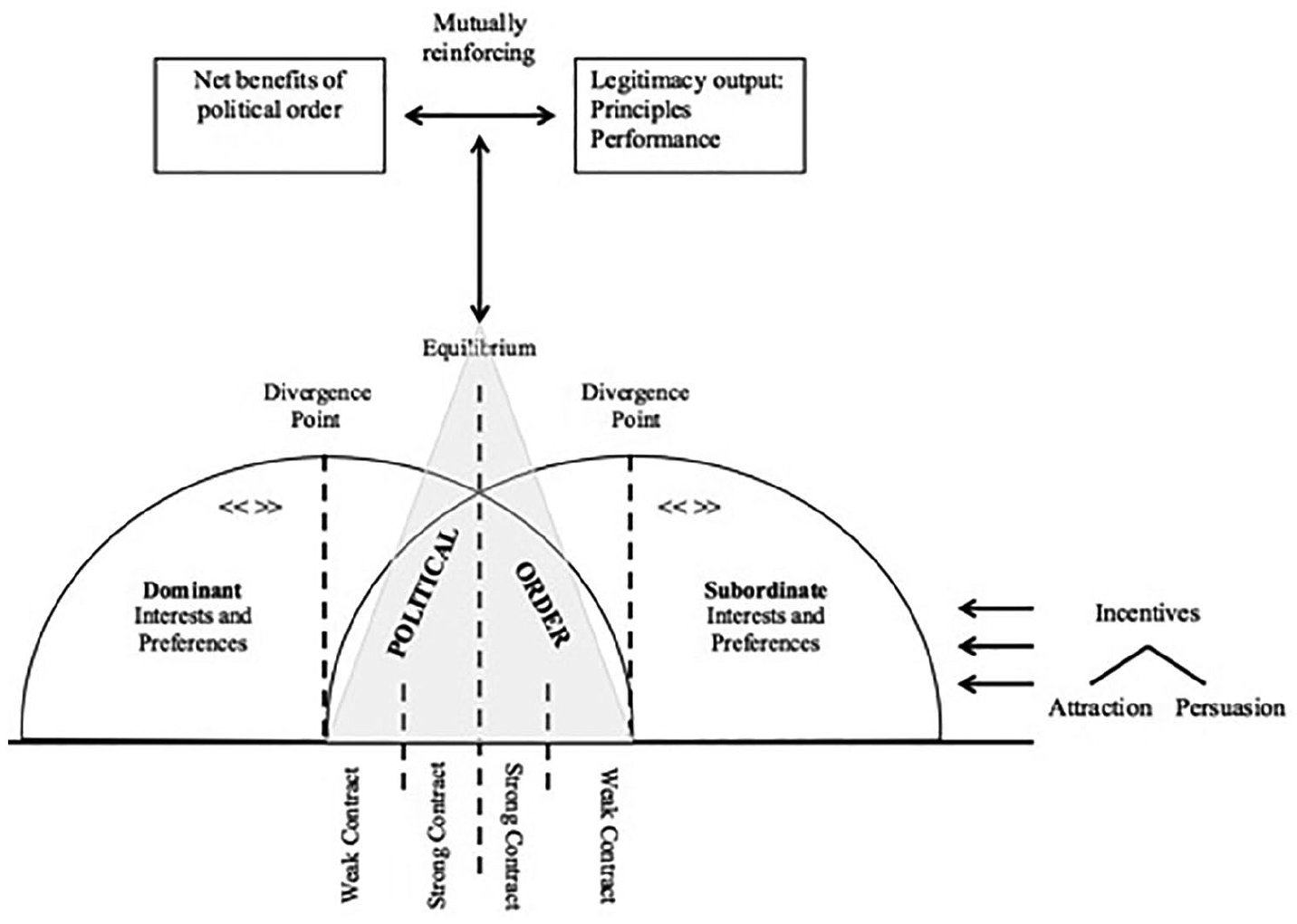
Dynamics of relational authority bargaining.
Based upon converging interests, the incentives signaled by the dominant offer additional policy preferences pertaining to closer alignment (Frieden, 1999; Lake, 2017, pp. 370–371). The dominant and subordinate align by crossing a point of equilibrium and then synthesize a political order based upon a social contract, conforming to the subordinate, conferring a gradient of authority to the dominant. Following Dahl’s definition of power as “the ability of A [the dominant] to get B [the subordinate] to do something he would otherwise not do,” the subordinate subjects itself to the rules set out by the dominant, thereby legitimizing the political order (Dahl, 1957, p. 202; Lake, 2007, p. 50). Recognizing the authority conferment upon the dominant as the manifestation of the inequality among states in the international system, subordinates thus display bandwagoning patterns by signaling their commitment as a bargain to obtain the most optimal set of net benefits (Fearon, 1997; Jervis, 2002; Kang, 2004; Lake, 2009, pp. 8–16; Weeks, 2008). Doing so, subordinates will consistently seek to obtain the best sets of net benefits, while not offsetting the political order provided that the order conforms to interests, incentives and preferences (Clapton, 2009; Kang, 2003; Lake, 2009, p. 26). Strong alignment of interests and preferences produces a strong social contract with tighter alignment, whereas lesser alignment of interests and preferences produce a weaker social contract with a looser order (Parent & Erikson, 2009, pp. 136–137).
The net benefits generated by the political order further provide attraction and legitimize the dominant’s relational authority, mutually reinforcing the legitimacy outputs, conforming to the principles of the political order and its performance. According to Lake, “principles of legitimation are typically embodied in ideologies or precepts that are ‘moral’ or ‘normative’ precisely because they are understood and accepted by all (or nearly all) members of society” (Lake, 2017, p. 379). Referring to the performance aspects, the reinforcement of the dominant’s legitimacy of the political order necessitates that certain constraints are acknowledged, as the dominant and the subordinate maintain a mediation medium between them (Nexon & Wright, 2007, p. 264). This entails that the dominant must not overstep its authority and engage in abusive behavior as this would evaporate principle and performance factors eroding legitimacy and reducing, or even removing the benefits of the subordinate to remain in the political order. If such an occurrence were to take place, the effects would not be restricted, but would trigger an audience cost with other subordinates throughout the dominants hierarchical network filtering down to other nodes of the political order, disrupting its image as a rational and attractive provider of net benefits (Cooley & Spruyt, 2009, p. 44; Lake, 2009, p. 14).
As interests, preferences and incentives are subjected to the flux of political change in the international arena, the social contract must be continuously re-negotiated, to maintain a condition of hierarchy, and as such the political order (Lake, 2009, p. 44). If interests diverge and social contract value and activity decreases, net benefits as the output of the political order begin to shrink, effecting the performance, principle and, as such, the legitimacy of the political order. Two outcomes of hierarchical failure can be identified here: the first would be the subordinate moving back to anarchical relations seeking self-help and/or even defection to another political order. This, however, opens the door for the dominant to potentially signal its ability to punish the subordinate and coercively persuade it via a disciplinary measure. The second views the dominant ejecting the subordinate from the political order via contractual severance, as the subordinate has become detrimental to its foreign policy plans.
As such, utilizing a hierarchical lens provides sufficient applicability to the dynamics in Sino-Russian, Sino-Kazakh, and Russian-Kazakh relations, as it offers an alternative way of how a subordinate (Kazakhstan) maintains its relations with more than one dominant. This conceptualization insinuates a dual hierarchical order with overlapping branches of engagement, which requires an issue-specific analysis to investigate the respective bargaining stratagems built upon converging interests, incentives, and preferences.
How does Russia engage with Kazakhstan geopolitically and geo-economically?
Already by December 1991, Russia had set the cornerstones for a post-Soviet hierarchy by establishing the CIS to create multiple interdependent channels of military and economic power projection (Loftus & Kanet, 2015, p. 25). Pertaining to the military and security domain, the Collective Security Treaty was signed in 1992 as a basis for the establishment of a military alliance in 2002, the CSTO, which currently consists of Russia, Belarus, Armenia, Kazakhstan, Kyrgyzstan and Tajikistan (CSTO, 1992, 2002). Since the inception of the CSTO, Russia has been seeking to canalize its power projection into the near abroad, specifically the aforesaid countries, by offering sufficient security incentives and, despite initial setbacks, posing itself as a security guarantor. The latter is ensured by Russia’s prevailing military capabilities and deployability rates, manifesting its authority over the members of the CSTO. These aspects conform to the contemporary components of a Russian or Kremlin-centric hierarchical architecture in the security domain (Klevakina, 2013; Zakharov, 2012).
On a bilateral basis, Moscow and Nur-Sultan have further deepened their security commitments enshrined in the “Treaty on Military Cooperation between the Russian Federation and the Republic of Kazakhstan,” which was signed in 1994 (Administration of the President of the Russian Federation, 1995). Thus, the Kremlin has maintained its military and security leverage over Kazakhstan, having deployed military personnel at the Baikonur space launch center, the Sary-Shagan anti-missile testing range as well as the space-surveillance radars at Balkhash according to specific bilateral agreements (Berryman, 2007, p. 155). 2 This arrangement has enabled the Kremlin to supply sufficient security provision along the “southern strategic frontier” against spill overs deriving from subversive forces in Afghanistan, Tajikistan and Kyrgyzstan—factors that have raised concerns about increasing instabilities in a highly volatile and politically charged environment, which may entail, if not properly contained, regime change (Gorecki, 2014, p. 66; Trenin, 2012, p. 180). The “Color Revolutions” have further reinforced these fears, as their implications—particularly the “Tulip Revolution” in Kyrgyzstan (2005) due to its immediate proximity—would have threatened the self-proclaimed legitimacy of the regime in Nur-Sultan, thus revealing a sufficient congruence of interests and preferences with Russia (Gorecki, 2014, p. 86; Trenin, 2012, p. 177).
As such, Russia’s bilateral hierarchical orchestration in the security domain is based upon shared interests and preferences, stemming from a similar threat perception, military heritage, geographic proximity and administrative structure of the military forces (Weitz, 2012). Supplementary to this security commitment is the complementarity to the CSTO, as the interoperability is amplified through the regular conduction of military exercises and the CSTO defense mechanisms, inter alia the Collective Rapid Reaction Force, to counter military aggressions, terrorism and transnational drug trafficking (McDermott, 2012, pp. 49–50). Since the CSTO functions as a prime foreign policy tool to maintain a post-Soviet political order, it has generated sufficient incentives to attract subordinates to acknowledge Russia’s post-Soviet security order (Lukin, 2014, p. 91).
Russia is also committed to designing the post-Soviet economic order following the inception of the CIS and various economic appendages. Recognizing Russia’s comprehensive capabilities, Nursultan Nazarbayev, former President of Kazakhstan, proposed in 1994 to promote the multilateral cooperation based on a robust institutional structure and regulatory powers in the principal branches of the economy (Alexandrov, 1999, p. 229). Such a posture was interpreted as a subordinate bargaining for better net benefits and requesting dominant-subordinate interaction. As Russia supported this vision, it signed bilateral agreements on the customs union with both Belarus and Kazakhstan in 1995, marking the commencement of post-Soviet Eurasian economic integration through means of multilateral institutionalization and regionalism within the framework of the CIS. Russian ambitions have gradually become more tangible, considering the establishment of the Eurasian Economic Community (EurAsEC) and the subsequent finalization of the Customs Union between Russia, Belarus and Kazakhstan in January 2010. Underlining the necessity to further expand the multilateral cooperation, the presidents of these states signed the Declaration on Eurasian Economic Integration to initiate the Common Economic Space (CES) as the next step for the necessary diversification of trade and the transition from a resource-based economy to an economy built on innovations (January 2012). This expressis verbis involves unified legislation, free movement of goods, services, capital and labor, subsidies for industry and agriculture, transport, power engineering, tariffs of the natural monopolies as well as several privileges for entrepreneurs (such as free access to the common market, free and independent choice of registration within the CES and the sale of their products in any CES member state). To regulate the economic relations within the CES, the Eurasian Economic Commission (EEC) has been set up as a supranational organ. It further emphasizes the inclusive character, revealed when the accessions of Armenia in 2014 and Kyrgyzstan in 2015 were acknowledged to expand the Eurasian integration projects, which culminated in the transformation of the hitherto existing EurAsEC into the EAEU in January 2015 (Sargsyan, 2016; Yarashevich, 2014).
While drafting the EAEU Treaty, Kazakhstan accentuated the principle of non-interference into matters of political sovereignty as an essential precondition for economic cooperation. According to Nazarbayev, the EAEU should be based upon economic pragmatism and voluntary integration without changing the political system, thus insinuating a multi-vectoral approach between the regional powers. As such, the Kazakh leadership has been seeking to strengthen its bargaining position and the potential benefits that the EAEU, as a geo-economic project, may generate—in particular: (1) the market access to EAEU member states and government contracts for Kazakh corporations, which increases cross-border trade activities; (2) the transformation of Kazakhstan into an international transport and logistics hub that attracts further investments, even beyond the EAEU framework; and (3) the access to energy infrastructure (Satpayev, 2015).
Notwithstanding these significant incentives, Russia maintains its prevailing position since the inception of the EAEU. Despite the formal equality among the member states, the bilateral trade figures indicate such a disparity, as all branches considered are dominated by Russia (Targsyan, 2016, p. 14). By providing more financial contributions, Moscow is able to insinuate itself into the decision-making process. It is amplified by the fact that the EEC, the key institution of the EAEU, is located in Moscow, so that in case of negotiations with the member states or even with other international actors and third countries, Russia principally determines the political settings of the contractual arrangements (Dragneva & Wolczuk, 2017, pp. 13–17). The Kremlin’s proposal to link the EAEU with China’s SREB in spring 2015 without having sought coordination with the other EAEU member states can serve as an example in this context (Sangar, 2017).
As Moscow is seeking to shape its subordinates’ interests, it has established various institutions and appendages as a contemporary architecture of its political order based on a “loyalty for stability” exchange system. It is maintained by a broad range of sanction mechanisms and coercive diplomacy as deterrent measures, to demonstrate Russia’s “enforcement of integration,” which prevents subordinates from defection. The Kremlin has been so far unable to readapt the strategies to constitute a social contract with relational authority properties. Should the interests and preferences diverge on a remarkable scale, the hierarchical framework of the Kremlin—as in the cases of Ukraine and Georgia—might collapse, as in this sense defection would be considered the only option available to obtain a better set of net benefits beyond the “loyalty for stability” pattern (Makarkin & Oppenheimer, 2011; Sergunin, 2016).
Does the alignment with China generate better net benefits for Kazakhstan?
While maintaining alignment with the Kremlin, Kazakhstan has reiterated its signals to recognize China as a valuable option to obtain additional net benefits. As Nur-Sultan seeks to diversify its developmental strategies and various forms of bilateral and multilateral cooperation, Beijing has enhanced its incentives within the framework of the BRI. Furthermore, under the security umbrella of the SCO, the commitments have been intensified in the domain of security collaboration. Regarding the latter, as Russia has been a long-standing member since the inception, an institutional hedging dynamic based upon a checks-and-balances pattern has commenced, amplified by subordinates signaling to seek the most optimal benefits in a political order provided by both dominants.
SCO: regional power hedging—common security interests and preferences
Founded in 2001, the SCO—currently consisting of Russia, China, Kazakhstan, Kyrgyzstan, Uzbekistan, Tajikistan, India and Pakistan—has emerged as an institutional framework to resolve regional security issues, which have been threatening the regional stability and the regimes of Central Asia in particular since the collapse of the Soviet Union. The commitment encompasses the combat against secessionism, terrorism and extremism (the so-called “three evils”) as well as divisive clan politics, border disputes and transnational organized crime. The SCO, thereby, functions as an institutional instrument to coordinate the means of conflict resolution, recognizing the national interests of the other member states. Since the Regional Anti-Terrorist Structure (RATS) was adopted in 2002, the member states have also been considering military measures, if applicable, to stabilize the politically charged and highly vulnerable environment—namely: the encouragement of information sharing; provisions of advice and proposals on combatting terrorist forces; training of personnel; and the maintenance of contacts with other international organizations related to containing terrorism (Lanteigne, 2006; H. Zhao, 2013, p. 440). Since the SCO is specifically designed to take on internal security challenges, it is functioning as an institution of regional cooperation with a permanent negotiation mechanism. Its decision-making essentially involves the regime legitimacy and geopolitical sustainability of strong and centralized regimes, the dominant political form of government in Central and East Asia. Thus, the SCO provides sufficient incentives for the subordinates to contribute to this political order generated under the informal Sino-Russian leadership (Aris, 2009).
With the increasing role of China in the security sphere, questions are beginning to arise as to China’s ability to develop security leverage over Nur-Sultan. This is tied to Beijing’s developing arms industries and superior military spending in comparison to Moscow. However, Russia maintains significant leverage over the arms export industry to Kazakhstan.
As indicated in Table 1 and Graphs 1 and 2, China has constantly increased its military expenditure, which signals the capability to supply sufficient security provision, whereas Russia has to afford proportionately more to maintain its military might. Despite this, Kazakhstan significantly relies upon Russian arms sales, as displayed in Table 1, suggesting that Russia, despite China’s developing interests in entering the international arms trades, still maintains sufficient security linkages. China’s commitments are, nevertheless, interpreted as a supplementary means of security provision, stemming from the correlation of security interests and preferences between Beijing and Nur-Sultan. In particular, China is concerned about domestic tensions and separatist threats in Tibet and Xinjiang. Regarding the latter, since the political instabilities have been threatening its gateway to Central Asia, China has been compelled to increase its engagement with neighboring states, to offset its demarcation vulnerabilities (Abilov, 2012; Zheng, 2014). These fears are reinforced by a potential American patronage over the Uighurs, echoing Washington’s assistance of the Taliban to restrain the Soviet Union (Christoffersen, 2006, p. 44). As a significant number of Uighur insurgents currently reside in Kazakhstan to shirk Chinese law enforcement, such a constellation necessitates comprehensive cross-border security cooperation to combat secessionism more effectively (H. Zhao, 2013, p. 437).
Transfers of Major Weapons: Chinese and Russian Deals with Deliveries or Orders made for 2000 to 2018.
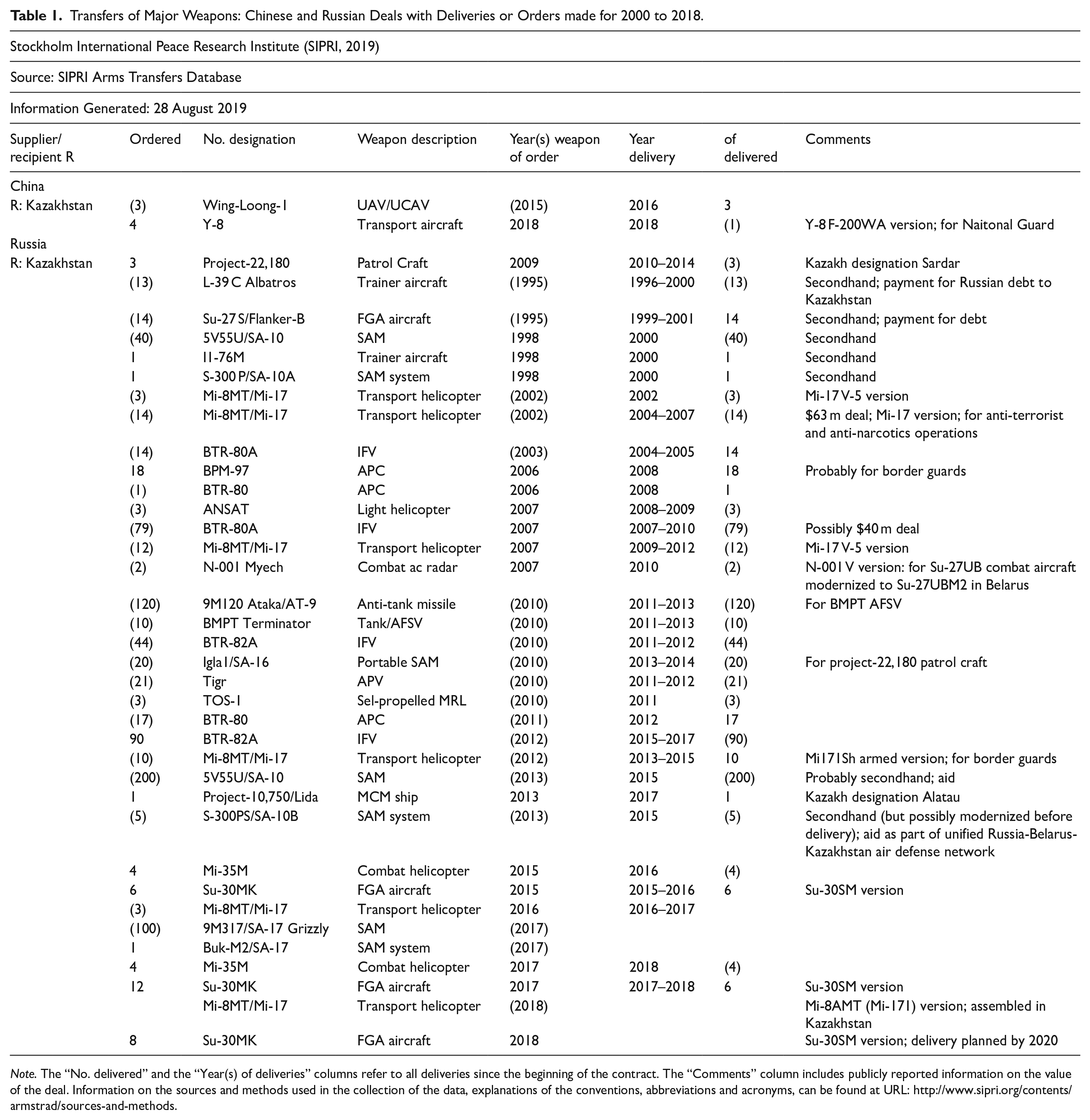
Note. The “No. delivered” and the “Year(s) of deliveries” columns refer to all deliveries since the beginning of the contract. The “Comments” column includes publicly reported information on the value of the deal. Information on the sources and methods used in the collection of the data, explanations of the conventions, abbreviations and acronyms, can be found at URL: http://www.sipri.org/contents/armstrad/sources-and-methods.
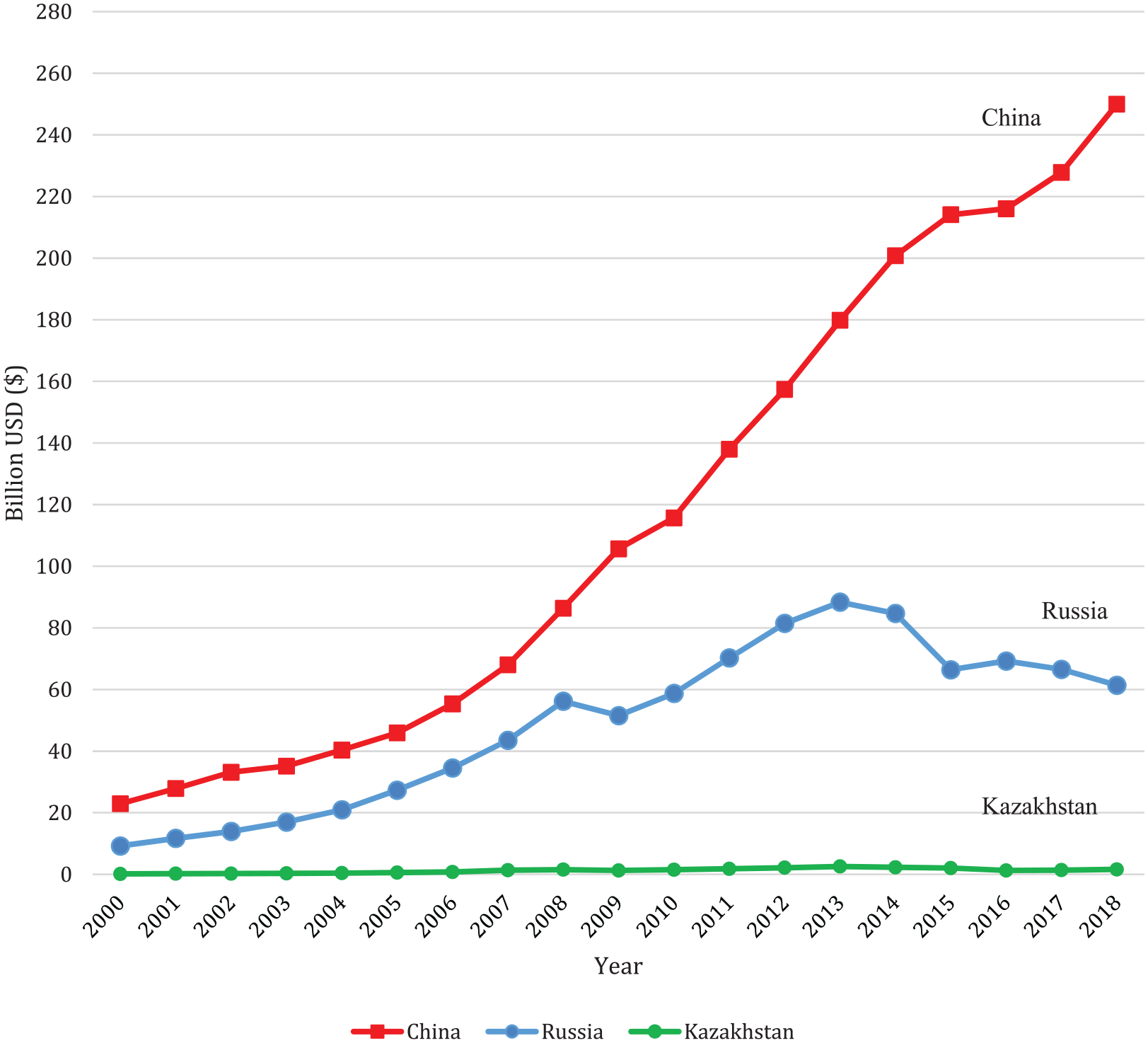
Military expenditure—China, Russia and Kazakhstan (Current USD $).a
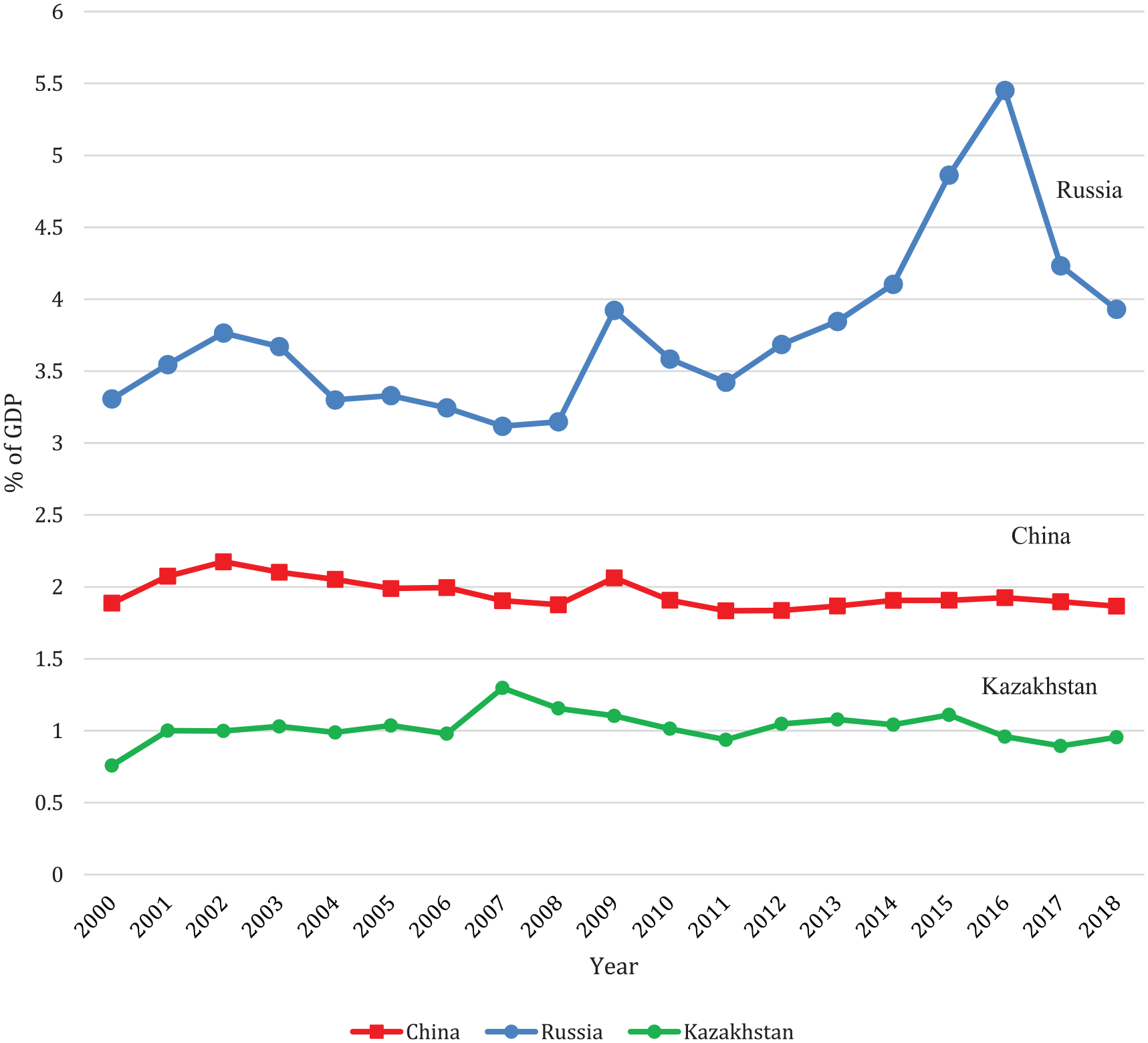
Military Expenditure—China, Russia and Kazakhstan 2000–2018 (% of GDP).
In parallel, Kazakhstan is well aware of the threats posed by ethnic and religious separatism having emerged from the war in Afghanistan, the instabilities in Tajikistan and the aftermath of the Color Revolutions. Considering the potential spillover effects deriving from the aforementioned, the SCO declarations since 2005 have reiterated the joint commitment of all member states to countering such developments, seeking to ease concerns about regime change. This forms the basis for Kazakhstan’s harmonization of interests and preferences with both Russia and China, thus revealing a convergence between the subordinate and the two dominants and sufficient potential for alignment (Lanteigne, 2006, pp. 616–618; Sullivan, 2019, pp. 35–36). Recognizing Nur-Sultan’s proposal to launch the Code of Conduct in International Anti-Terrorist Operations in the UN format, Kazakhstan’s commitment was widely praised in the SCO, as it was reiterated in the Qingdao Declaration of the SCO (2018). The Code of Conduct presents a more nuanced implementation approach of previous international security commitments, seeking to establish a global coalition against international terrorism in accordance with the principles of the UN. Kazakhstan’s vision of the Code of Conduct also reflects its own political agenda in the SCO, reaffirming its commitment to ensuring regional stability in Central Asia under the RATS of the SCO. In particular, it has approved the increasing regional cooperation, inter alia involving the following: (1) the more effective implementation of joint measures against the threats posed by the three evils; (2) a more harmonious legislation directive among the member states, while upholding the non-interference principle, such as the refusal to grant asylum or the immediate extradition if requested by another SCO member states; (3) training of relevant specialists; and (4) the securitization of trade routes as an essential means to promote economic growth, and the provision of infrastructure for temporary deployment of military troops if requested (SCO, 2005, 2018).
Considering these implications, Nur-Sultan has enhanced its security commitments not only with Russia, but also with China that may function as a reassurance to Kazakhstan that certain security challenges stemming from the volatile and politically charged environment of Central Asia do not spill over. Such signals do not necessarily indicate an authority transfer, but do legitimize China’s role as a consolidator of the political order within the SCO and the bilateral engagement between Nur-Sultan and Beijing (Jia, 2007; Syroyezhkin, 2010). Hence, China is able to challenge the Russian leverage over the Central Asian republics. Although Russia can counter-balance by promoting Eurasian integration in other institutional frameworks, it has forfeited its domination in the SCO (Facon, 2013). This reveals regional power hedging patterns within the SCO checked and balanced by the subordinates as well as Sino-Russian convergence of security interests and preferences in the international dimension (Harper, 2017; Korolev, 2016).
SREB—economic strategies for central Asia to overcome developmental shortcomings
In addition to its security commitment with Kazakhstan, China has underlined its ambitions to promote economic development as a vital incentive to legitimize its hierarchical orchestration. Considering China’s increasing demands for energy resources to facilitate further economic growth, President Xi Jinping has put forth a comprehensive strategy to (1) strive toward energy self-sufficiency by developing clean coal technologies, reducing coal consumption, and increasing oil, natural gas, shale gas and alternative energy sources; (2) reduce energy consumption by promoting energy efficiency; (3) increase international cooperation, energy technology, focus on “going out,” especially for Russia and Central Asia, Middle East, Africa, the Americas, and Asian Pacific and develop land and sea transport; and (4) promote energy research and development (Cole, 2016, p. 123; Petersen & Barysch, 2011, p. 11). As approximately 80% of China’s oil imports are transferred via the Strait of Malacca, a vulnerable geopolitical chokepoint in southeast Asia (i.e., the so-called Malacca Dilemma), Beijing is de facto compelled to diversify its trade routes to ensure a long-term and alternative energy supply (Andrews-Speed & Dannreuther, 2011; Chen, 2011; Cole, 2016, pp. 135–137).
Designed to discover new trade routes west- and southwards through bi- and multilateral trade expansions, the BRI is, thus, not only a vital incentive for the Central Asian republics to promote economic development, but also China’s principal political instrument to seek long-term leverage over the periphery of its sphere of influence (Pirro, 2015; Witte, 2013). In that light, the generation of net benefits is substantially based on the extraction of natural resources in exchange for investments in the oil and gas sector and infrastructural projects (Cooley, 2012, p. 9; Qoraboyev & Moldashev, 2018, p. 123).
Due to its location in the heartland of Eurasia, Kazakhstan has played a crucial role in China’s geopolitical visions. Already in 1997, Beijing and Nur-Sultan agreed on the construction of an oil pipeline across Kazakhstan (from Atyrau at the Caspian Sea to Alashankou in Xinjiang at the Chinese-Kazakh border), which had been completed in 2005 and already exceeded the annual amount of 14 million tons of crude oil by the end of 2014 (Fedorenko, 2013, p. 13; Pepe, 2016, p. 424). Since then, the pipeline has been jointly operated by KazMunayGaz and the Chinese National Petroleum Corporation (CNPC). In addition, China has already acquired a share of the oilfield in the Caspian Sea, worth USD 30 billion, and purchased Petro Kazakh for USD 4.2 billion to expand the energy relations in the oil sector. Acknowledging such a tremendous commitment, Kazakhstan exports 4.3% of its annual trade volume in the oil sector to China (Hu et al., 2017, p. 423; Ipek, 2007, p. 1190; Pirro, 2015, p. 123). The Chinese-Kazakh economic cooperation is similarly discernible in the transport of gas resources from Turkmenistan via the Central Asia-China pipeline to Khorgos (Xinjiang) at the Chinese-Kazakh border, emphasizing Kazakhstan’s role as a transit actor. Since 2014, three (out of four) sections of this pipeline have been in full operation to transfer a total amount of 85 billion cubic meters per annum of natural gas resources extracted in Turkmenistan and Uzbekistan. The fourth section is estimated to be completed by 2020, enabling China to import an additional amount of 30 billion cubic meters per annum. Regarding Nur-Sultan’s membership in the EAEU, the Chinese-Kazakh energy commitment is principally negotiated within the framework of the regulations set by the EEC, prompting Russia to provide the settings under which such cooperative frameworks are cultivated (Hu et al., 2017, pp. 422–423; Roberts, 2016, p. 8).
Identifying Kazakhstan’s position as a transit and resource-exporting actor, President Xi Jinping has signaled this value, as he announced the BRI during his state visit at the Nazarbayev University in Nur-Sultan 2013. By providing comprehensive economic development, China seeks to legitimize the construction of its political order, recognizing that these republics do not have other substantial alternatives, except for Russia. Beijing considers Central Asia as compatible with the BRI because its components are solely based on economic aspects, neglecting political criteria (Mardell, 2018).
This bilateral engagement has been enhanced since the SREB was synergized with Nurly Zhol (bright path), an economic initiative launched by the previous Nazarbayev administration, to receive a more considerable amount of Chinese investments (Silin et al., 2018, p. 307). The process of linking, or otherwise translatable as “pairing” (sopryazhenie in Russian or duijie in Chinese), was enshrined in a joint declaration signed by President Xi and former President Nazarbayev in 2015 (Chubarov, 2018). Nurly Zhol is an economic stimulus plan to develop the national infrastructure after the global financial crisis of 2008/2009 and the following depreciation of the Tenge, the national currency of Kazakhstan (Lukin & Yakunin, 2018, p. 104). In particular, it has supplemented numerous national strategies, inter alia the initiative “The 100 Concrete Steps Set Out by President Nursultan Nazarbayev to Implement the Five Institutional Reforms,” “The Strategy for Development of the Republic of Kazakhstan until the Year 2030” and the “Strategy ‘Kazakhstan-2,050’,” aiming to provide sufficient means for modernization and incentives for foreign investors (Ministry of Justice of the Republic of Kazakhstan, 2016; President of the Republic of Kazakhstan, 2014). Via the aforementioned synergies, Kazakhstan has been aiding China’s construction of economic corridors in Central Asia, thus contributing to an increase of Beijing’s economic power projection and a canalization of Chinese investments into Kazakhstan to achieve modernization (Fallon, 2015).
Although both President Xi and former President Nazarbayev have officially claimed the aspects of “mutual benefits,” it has to be emphasized that such a geopolitical symbiosis is not necessarily constituted. As the trade figures in Graphs 3 and 4 indicate, although Kazakhstan has gradually increased its exports rates to China, which have proportionately exceeded the volume to Russia, the import rates specify contrasting dynamics with a higher volume from the latter as compared to the former. Although Kazakhstan’s overall trade with Russia has been declining relatively since the 1990s, while China has caught up significantly, Nur-Sultan is still dependent on how the Kremlin implements its economic policies, as most of the natural resources are exported to the European Union, thus utilizing Russian pipelines as a transporting means (nearly 85%). Considering Beijing’s increasing demand for oil and gas to satiate the domestic market, the China–Kazakhstan pipeline currently accounts for approximately 15% of the entire volume of oil exports, which is likely to grow in the future and, thus, indicates increasing Chinese leverage. Therefore, Nur-Sultan maintains its multi-vector foreign policy, which involves a hedging position between China, Russia and—to a lesser extent—the West (Kembayev, 2018; Krapohl & Vasileva-Dienes, 2019; Orazgaliyev, 2017).
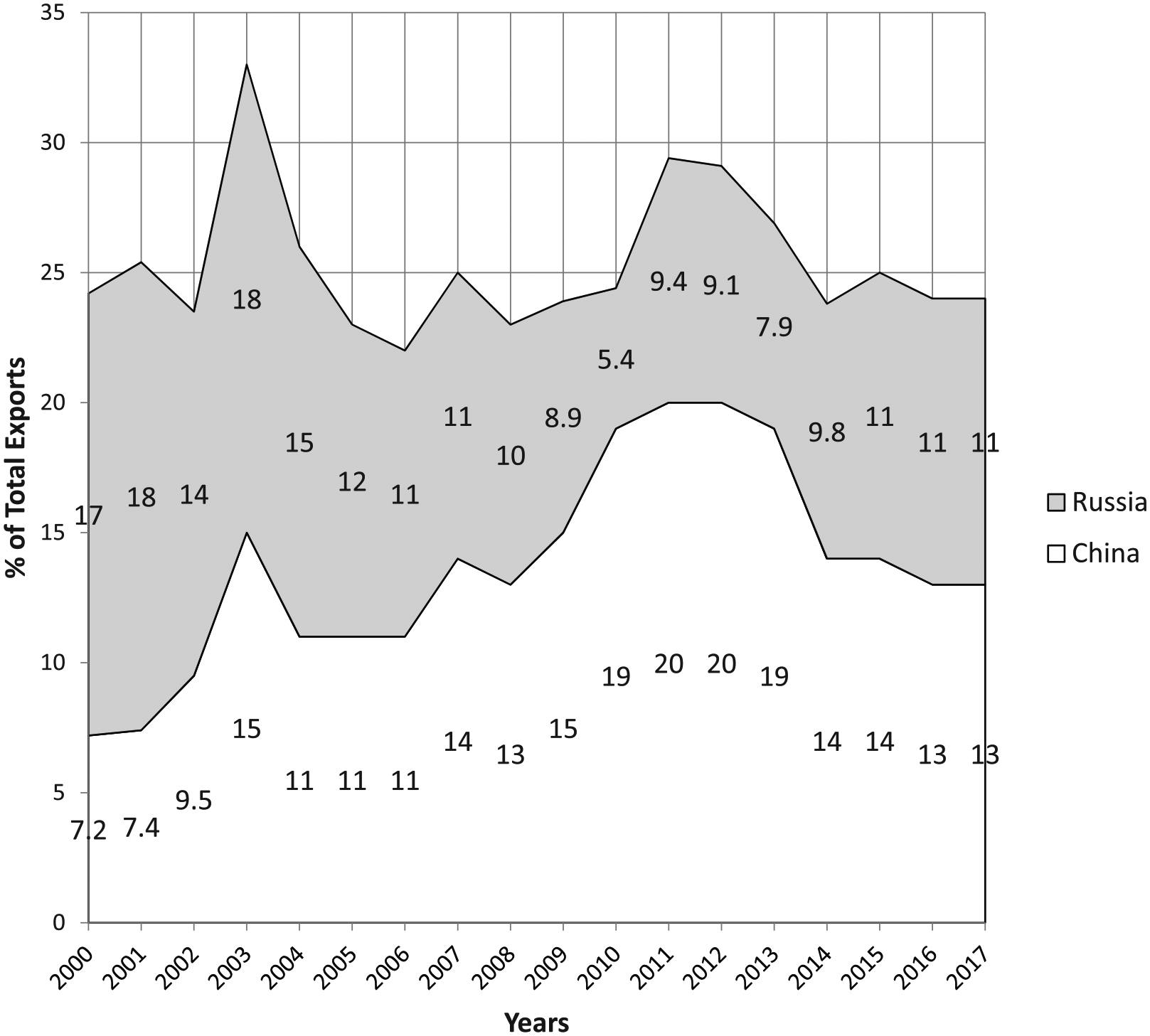
Kazakhstan’s Exports to China and Russia 2000–2017.
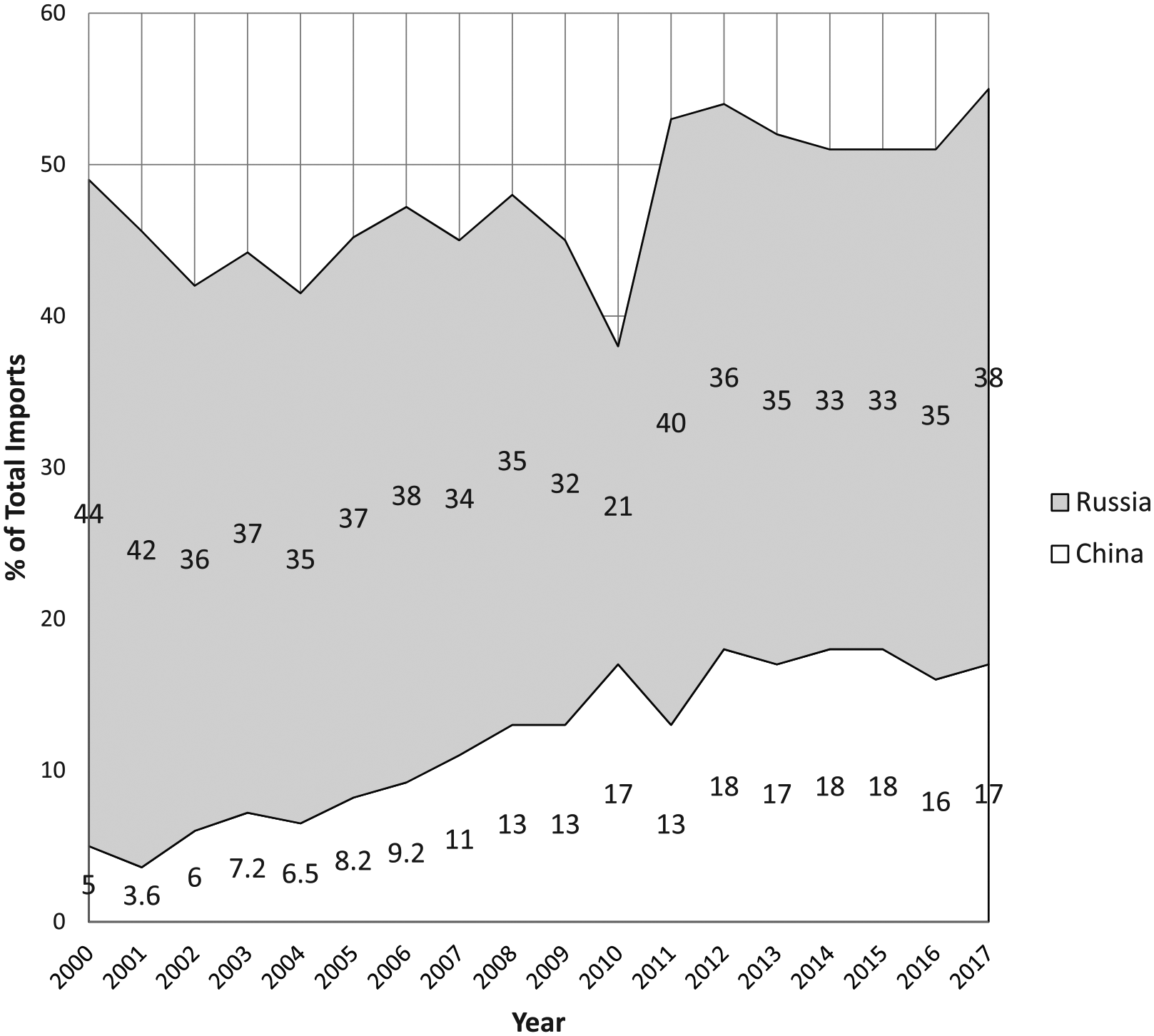
Kazakhstan Imports from China and Russia 2000–2017.
Moscow and Beijing are aware of the value that Kazakhstan’s geostrategic position provides, so that any sharp shift vis-à-vis one side may disturb Nur-Sultan’s relations with the other, although it does recognize the benefits generated by the BRI, potentially exceeding those that it would receive from the EAEU. Acknowledging that it is compelled to engage in regional power cooperation with China, Russia declared its commitment in March 2015 to a link-up between the EAEU and the BRI, despite concerns about potential collisions with its own economic institutionalization process (Pieper, 2019). While officially endorsing Beijing’s economic projects encompassing the BRI, the Kremlin has been, nonetheless, attempting at the same time to prevent Beijing from constructing a hegemonic order in Central Asia (Lukin, 2003, 2018). In that light, the Kremlin seeks to accommodate a rising China, responding to the latter’s position as one of Kazakhstan’s biggest trading partners (Harper, 2017, p. 5).
Conclusion: pursuing the benefits from China in the “Russian World”?
The empirical domain has illustrated Kazakhstan’s carefully calibrated hedging position amid the two regional Leviathans engaged in leverage seeking. The current paradigm insinuates that to respond to China’s rise, Russia is compelled to increase its engagement with Kazakhstan by maintaining its hierarchical grip over Nur-Sultan, while offering sufficient security provision (CSTO and, partly, SCO) and means for economic development (EAEU) to ensure that it remains in the Kremlin-centric political order. Nevertheless, Russia has not yet entirely released itself from the zugzwang situation, as it has to further resort to reactionary acts to restrain a rising China, despite the fact that any move possible would further constrain Russia geopolitically stemming from Beijing’s increasing power projection, chiefly in the economic domain (SREB).
While Kazakhstan can opt to seek additional benefits from outside the region, namely the West, it is still geopolitically inclined to carefully assess policy options to avoid friction with Beijing and Moscow, which could undermine its stability through the presidential transition period. Particularly the United States, retaining interest following Kazakhstan’s assistance during the War in Afghanistan and combating Islamic extremism as well as significant US private sector interest on the energy front, is keen to deepen its involvement to bolster competition, essentially aiding investment opportunities as US trade activity totaled more than USD 2.2b in 2018, while investments exceeded USD 5b (Coffey, 2019). A prime motive for the United States is to “seek Central Asian states resilient to domination by rival powers” which could presuppose Russia and China (President of the United States of America, 2017, p. 50). This constellation is likely to be continued even after Nazarbayev’s resignation, announced on 19 March 2019. As Kassym-Jomart Tokaev, Nazarbayev’s successor, has acquired sufficient expertise on China-related issues in the 1980s while serving at the embassy of the Soviet Union in Beijing, he is also recognized to conform Nur-Sultan’s role to the regional environment in Central Asia. As the head of the Security Council, Nazarbayev himself will nevertheless continue to determine Kazakhstan’s foreign policies, to supervise the bargaining interactions vis-à-vis Russia and China as to whether Nur-Sultan’s preferential outcomes can be achieved within a hierarchical framework (Putz, 2019).
Considering the balancing act between the two Leviathans, Nur-Sultan’s multi-vector foreign policy builds upon the maintenance of the dual architecture or “co-ruling dynamic” embedded in a dominant-dominant engagement. Often referred to as the third type of “great power relationship,” as opposed to hegemonic war or cold war, “the ‘co-ruling dynamic’ whereby two major powers jointly lead all or most of the small and medium-size states in the system, rather than demarcate their ‘spheres of influence’ geographically,” reinforces a dual hierarchical hypothesis (Yang, 2018, p. 195). This presents the conception of a hierarchical overlap, as previously proposed, a phenomenon in the epistemology of international relations and worthy of further investigation and medium-term observation as the possible outcomes remain hard to predict in terms of their pace and inter-state dynamics. In other words, “China would be the bank, and Russia would be the big gun,” as Beijing is recognized as an economic leader, whereas Moscow remains the diplomatic and military broker, at least for now (Lukin, 2018; Standish, 2015).
Footnotes
Funding
The author(s) received no financial support for the research, authorship, and/or publication of this article.
