



Abstract
The growing threat to environmental human rights underscores the urgency of enhancing criminal law mechanisms for the protection of the natural environment, prompting scholars and legislators to seek more effective legal responses. The examination of foreign legislative experience and best practices emerges as a critical strategy for adapting national legal frameworks to contemporary environmental challenges. Recent developments within the European Union position its regulatory model as one of the most progressive globally, offering a benchmark for jurisdictions seeking to reform their environmental legislation. This study conducts a comparative legal analysis of current criminal law provisions on environmental offences in the EU, Kazakhstan, and the Russian Federation. The objective is to identify differences, strengths, and limitations across these jurisdictions. EU legislation has undergone significant advancement in recent years, notably through the expansion and clarification of environmental crime categories, the specification of penalties, and the broadening of the scope of liability. These reforms have been codified in newly adopted supranational legal instruments, such as Directive (EU) 2024/1203. In contrast, Kazakhstan and Russia, despite possessing foundational legal frameworks, require substantial modernization. This analysis may be of interest to policymakers, environmental NGOs, and legal practitioners working at the intersection of criminal and environmental law.
Keywords
Introduction
In the context of rapidly intensifying global and local crises in the field of environmental protection, the issue of effective legal safeguards for the natural environment is acquiring ever-increasing significance. Contemporary challenges—such as climate change, transboundary pollution, industrial expansion, and weak environmental oversight in developing economies—underscore the need to reassess approaches to the qualification and prosecution of environmental offences. There is a growing insistence in calls to recognize so-called ecocide as an international crime, as well as to harmonize and strengthen national criminal legislation in this domain. 1 To be fair, it must be acknowledged that the issue has not gone unnoticed: the development of environmental legislation in advanced economies is among the most dynamically evolving areas of law. For instance, within just the past two years (2024–2025), the European Union has adopted two major legal instruments concerning liability for environmental protection: the Directive on Environmental Crimes 2 and the Council of Europe Convention on the Criminal Protection of the Environment. 3 With these developments, the EU once again sets a global precedent, delineating a model framework for sector-specific regulation that other jurisdictions may emulate. Other legal systems may adopt selected provisions of both the Directive and the Convention to enhance their national legislation. Notably, the Convention is open for accession by any state and can become part of its domestic legal framework.
Among the key innovations is the possibility for participating states to prosecute intentional acts that lead to environmental disasters comparable to ecocide. In this context, the Secretary General of the Council of Europe, Alain Berset, stated that the 2025 Convention “changes the rules of the game” in the field of environmental protection. 4 As emphasized in the document, protecting the environment from the adverse effects of human activity has become one of the central concerns of the international community, reflecting the growing awareness of the intrinsic connection between the state of the planet and the well-being of humanity.
With regard to the practical implementation of environmental legislation—particularly in the domains of liability and law enforcement—although some progress is evident, it remains insufficient in scale and scope relative to the urgency of the issue. This observation applies not only to developing states but also to advanced economies with high economic and social indicators and relative political and social stability. To date, environmental protection has not been elevated to the status of a national priority or integrated into socio-economic paradigms from a strategic and long-term policy perspective. Nonetheless, the experience of certain countries—such as Switzerland and Norway—demonstrates a consistent trajectory toward such prioritization. A similar tendency is observed in other countries where criminal law is gradually turning into an effective instrument of environmental policy. In recent years, Germany has implemented a multi-tiered system of corporate liability for pollution, based on a combination of criminal and administrative measures. 5 The Netherlands demonstrates a high level of transparency in environmental investigations and prosecutorial involvement in transboundary pollution cases. 6 Canada and Japan are developing models in which criminal prosecution is complemented by mandatory environmental remediation and compensation programs. 7
In contrast, the situation in many developing countries is markedly worse and, in some instances, even catastrophic. This is evidenced by the environmental degradation observed in urban areas of Indonesia, Afghanistan, and several African nations. The dominant attitude in the majority of countries toward environmental protection and the exploitation of natural resources (including subsoil, water, flora, and fauna) remains shaped by the maxim “what is common belongs to no one,” a principle that continues to influence both legislative development and enforcement practices.
These challenges are to varying degrees characteristic of both Kazakhstan (RK) and the Russian Federation (RF). Kazakhstan represents a median case within the Central Asian region in terms of legal enforcement in the environmental sector. Nevertheless, the country has demonstrated a proactive approach to revising its environmental strategies and integrating best practices, primarily those developed within European jurisdictions. This extends to efforts aimed at improving legislative regulation more broadly. In the case of the Russian Federation, the patterns of legal regulation and enforcement largely mirror those of Kazakhstan, owing to their shared legal heritage within the Romano-Germanic legal tradition, specifically its Soviet-influenced variant. However, the longstanding industrial and resource-dependent orientation of Russia's economy has constrained the implementation of ecological reforms, with economic interests frequently prevailing over environmental considerations. Overall, the question of how to strengthen environmental preservation efforts through legal mechanisms and instruments is gaining increasing global relevance, as evidenced by contemporary scholarly research.
Against this backdrop, increasing attention is being directed toward the criminal law dimension of environmental protection—namely, the use of criminal legal mechanisms as instruments of both preventive and punitive influence on individuals who engage in environmentally hazardous conduct. Criminal liability is not only capable of delivering proportionate punishment for the most severe forms of environmental degradation, but also of fostering a sustained motivation among potential offenders to comply with environmental standards. Nevertheless, the effectiveness of such mechanisms remains a subject of ongoing academic and practical debate. Key issues include the proportionality of sanctions, the evidentiary challenges associated with establishing the elements of environmental crimes, and the role of corporate liability in addressing eco-criminality. Contemporary Kazakhstani, Russian, and international research on liability—both criminal and more broadly legal—for environmental offences has focused on a range of interrelated topics. These include: challenges in the classification of environmental crimes in Kazakhstan, 8 comparative legal analysis of Kazakhstan's criminal law governing environmental protection violations, 9 problems related to the prevention of environmental crimes involving water resource usage in Kazakhstan, 10 the fight against environmental offences through the lens of criminal and environmental law in the Republic of Kazakhstan, 11 comparative legal approaches to regulating liability for ecocide, 12 the convergence of environmental crimes with serious criminal offences, 13 and corporate environmental crimes and the liability of legal entities for environmental violations. 14
The relevance of the present study is driven by several key factors:
the global nature of environmental protection issues and the pressing need for legal responses; the scholarly interest from the perspective of legal comparative studies, as well as the necessity of a comprehensive legal assessment of the existing criminal law provisions in the Republic of Kazakhstan aimed at counteracting harmful anthropogenic impacts on the natural environment, including an evaluation of their effectiveness in a comparative context; the importance of conceptualizing the prospects for the development of criminal liability in light of prevailing political and legal conditions. The objectives of this study are to conduct a comparative legal analysis of current criminal legislation in the European Union, Kazakhstan, and the Russian Federation concerning liability for environmental offences. The study aims to identify key differences, strengths, and limitations of the respective legal systems, and to explore potential avenues for reform or the adoption of best practices.
Scope of the Legal Analysis
The documentary and analytical foundation of this study is based on the current regulatory instruments of the European Union, the Republic of Kazakhstan, and the Russian Federation in the field of criminal law regulation of liability for offences related to environmental protection. These include:
Council of Europe Convention on the Protection of the Environment through Criminal Law (2025), Directive (EU) 2024/1203 of the European Parliament and of the Council of 11 April 2024 on the protection of the environment through criminal law and replacing Directives 2008/99/EC and 2009/123/EC, and Directive 2008/99/EC of the European Parliament and of the Council of 19 November 2008 on the protection of the environment through criminal law (European Union); the Criminal Code of the Republic of Kazakhstan (adopted on 3 July 2014), and the Environmental Code of the Republic of Kazakhstan (adopted on 2 January 2021) (Kazakhstan); the Criminal Code of the Russian Federation of 13 June 1996, No. 63-FZ, and the Federal Law “On Environmental Protection” of 10 January 2002, No. 7-FZ (Russian Federation).
The methodological basis of the study combines comparative legal and formal legal approaches, through which the regulatory framework of criminal liability in the area under investigation is analyzed. Structurally, the work consists of three substantive sections, each dedicated to the legal regulation of the EU in the relevant domain and the corresponding regulations of Kazakhstan and the Russian Federation, examined in comparative perspective with the European experience.
Given that several EU regulatory acts discussed in this study were adopted recently, the availability of practical application data is limited, presenting a constraint for empirical assessment. Nevertheless, the study primarily focuses not on enforcement practice, but on the formal legal articulation of regulatory mechanisms within the two national jurisdictions.
Results
Environmental Harm and Criminal Liability
(A) European Union
In recent years, the environmental policy and legislative framework of the European Union have undergone substantial advancement, both in depth and in scope. A strategic breakthrough was marked by the adoption of the European Green Deal, which sets the ambitious objective of achieving carbon neutrality by 2050. 15 This comprehensive plan encompasses not only the energy sector but also agriculture, transport, industry, the judiciary, and the economy at large. It also introduces stringent environmental standards and integrated sanctioning mechanisms across multiple policy areas. Another key policy milestone was the adoption of the EU's “Fit for 55” package—a suite of legislative proposals aimed at revising and updating existing EU laws and introducing new initiatives to align the Union's policies with its climate goals. 16 These and other initiatives have been accompanied by institutional strengthening, including the enhanced role of prosecutorial bodies, courts, and governmental agencies in environmental governance. The measures implemented in this regard have been actively supported by the European Commission, increasingly endorsed by Member States, and backed by the binding legal nature of EU directives for participating countries. The aforementioned political decisions have been complemented by equally significant regulatory developments that establish new legal standards for criminal liability in environmental matters within the EU. Most notably, on 14 May 2025, the Council of Europe Convention on the Criminal Protection of the Environment was adopted during the meeting of the Committee of Ministers in Luxembourg. 17 The new Convention represents the first legally binding international instrument dedicated to combating environmental crime, encompassing a broad spectrum of criminal acts that exacerbate the triple planetary crisis of climate change, pollution, and biodiversity loss. The primary objectives of the Convention are to prevent and combat environmental crime, promote both national and international cooperation, and establish minimum legal standards to guide states in the development and implementation of their national legal frameworks. 18 The Convention was drafted over a two-year period with the involvement of experts and stakeholders from 46 member states of the Council of Europe, as well as representatives from the European Union, the United Nations, Interpol, and civil society organizations. In its current version, the Convention defines and criminalizes a wide range of environmental offences. 19 A year earlier, on 26 March 2024, the Council of the European Union officially adopted the Directive on the Protection of the Environment through Criminal Law. This legal instrument is expected to enhance the investigation and prosecution of environmental crimes across the Union. The Directive sets out minimum EU-wide rules for defining criminal offences and associated penalties, replacing the earlier directive adopted in 2008. While its provisions apply to offences committed within the territory of the European Union, Member States may choose to extend their jurisdiction to offences committed outside their national borders.
The number of acts classified as criminal offences under the Directive has increased from 9 to 20. Among the newly included offences are illegal timber trade, unlawful disposal of polluting components from ships, and serious violations of chemical regulations.
The tightening of criminal liability for environmental offences within the European Union may be interpreted as a reflection of a broader transformation in public perception—namely, the shift from viewing environmental elements and natural resources merely as utilitarian “assets” toward a recognition of the interdependence between humans and the natural world. This paradigm shift has found political expression in the form of a tacit societal consensus that supports the EU's evolving environmental protection agenda. In this context, criminal liability for environmental pollution gains particular significance amid growing climate instability, soil degradation, and declining air quality in industrialized and urban areas. Among the various categories of environmental offences, air and soil pollution are among the most hazardous and prevalent forms of ecological harm. These infractions often result in long-term and largely irreversible damage to both ecosystems and human health.
20
National criminal legislation across jurisdictions varies considerably in terms of the specificity, stringency, and effectiveness with which such offences are regulated. The adoption of Directive (EU) 2024/1203 has contributed to the refinement of offence definitions related to air and soil pollution, including those involving legal entities. A legislative innovation introduced by the Directive is the explicit criminalization of air pollution, which is now formally listed among punishable offences. For the first time, air pollution is singled out as an independent basis for criminal liability (Art. 3(1)(a–c)). Criminal offences now include emissions that:
occur without the necessary permit; exceed established legal thresholds; cause or are likely to cause serious harm to human health or the environment.
The Directive also expands the scope of liability to include legal persons and addresses situations in which corporate officials are complicit in environmentally harmful emissions. Sanctions for natural persons may reach up to eight years of imprisonment in cases of serious harm, while legal entities may face fines of up to 5% of their annual turnover or a fixed amount of up to €40 million. With the adoption of the Directive, soil pollution has also been criminalized as an autonomous offence. It is now explicitly included as a criminally punishable act (Art. 3(1)(a), (e), (f)).
Criminal liability applies to the burial or discharge of hazardous substances or waste into soil, as well as to actions that violate national or European environmental regulations. The law penalizes not only actual contamination but also the creation of a serious risk of substantial soil damage. Furthermore, the Directive provides for liability not only for intentional misconduct but also for gross negligence—an especially important provision in the context of waste management and the use of agrochemicals.
The new Directive also introduces the concept of a “qualified offence,” which applies when an offence listed in the Directive is committed intentionally and results in destruction, irreversible damage, or long-term harm to the environment. In parallel with the adoption of the Convention, the Council of Europe has also endorsed a new long-term environmental strategy, which sets forth five core objectives:
To integrate human rights considerations into environmental policy, and conversely, to embed environmental concerns into human rights frameworks. To strengthen democratic governance in matters concerning environmental protection. To support and safeguard human rights defenders working in environmental protection, including environmental activists and whistleblowers. To prevent and suppress crimes related to environmental protection. To safeguard wildlife, ecosystems, habitats, and landscapes.
21
Nevertheless, environmental law experts argue that the Council of Europe missed a critical opportunity to initiate the formal legal recognition of the right to a clean, healthy, and sustainable environment for all inhabitants of Europe. A number of scholars have expressed concern and frustration over the fact that, as of 2025, Europe has yet to legally recognize this right as one of the fundamental human rights. 22
The foundations of legal regulation within the European Union in the field of environmental protection were established through two key instruments: the Charter of Fundamental Rights of the European Union (Charter of Fundamental Rights of the European Union 23 and the Council of Europe Convention on the Protection of the Environment through Criminal Law. 24 According to Article 37 of the Charter of Fundamental Rights of the European Union, a high level of environmental protection and the improvement of environmental quality must be integrated into EU policies and ensured in accordance with the principle of sustainable development. The Council of Europe Convention on the Protection of the Environment through Criminal Law, adopted on 4 November 1998, emphasizes the need to establish criminal liability for offences against the environment. The 1998 Convention was a pioneering, legally binding international instrument that mandated the criminalization of conduct harmful to the natural environment. However, it must also be noted that this instrument never entered into force, as the minimum threshold of three ratifications required for its enactment was never met. 25
Thus, the 2025 Convention has become the first international legal instrument specifically aimed at the criminal prosecution of environmental offences. The Secretary General of the Council of Europe, Alain Berset, described this document as a “turning point” in the protection of the environment.26,27 The Convention defines a broad range of environmental crimes—including illegal waste disposal, timber trafficking, pollution, and unlawful resource extraction—and introduces the category of particularly serious offences, referring to acts with consequences comparable to ecocide. Moreover, the Convention establishes a set of qualifying elements for such offences by introducing categories such as irreversible, widespread, and severe—as reflected in Article 31: “[…] when such an offence causes destruction or causes irreversible, widespread and substantial damage.” It also provides for the criminal liability of legal persons. Notably, the Convention incorporates specific provisions aimed at strengthening intergovernmental cooperation and at protecting environmental defenders and witnesses. For instance, Article 5(2) obliges the Parties to “take the necessary legislative or other measures to establish appropriate mechanisms for coordination and cooperation at both strategic and operational levels among all their competent authorities involved in the prevention and combating of the offences established in accordance with this Convention.” This wording represents a substantive revision of the corresponding provision in the 1998 Convention. 28 Article 26(2) of the Convention further stipulates that its provisions apply not only in times of peace but also in situations of armed conflict, war, or occupation. In this regard, the Convention's norms may operate in conjunction with the principles of international humanitarian law and international criminal law, thereby extending the scope of human rights protections. 29
Among the current legislative instruments comprising the acquis communautaire in the domain of environmental criminal law, a central role is played by the Directive (EU) 2024/1203 on the Protection of the Environment through Criminal Law. 30 This newly adopted directive, enacted on 11 April 2024, establishes criminal liability for offences against the environment. It repeals and replaces the earlier Directive 2008/99/EC, 31 substantially expanding and refining the scope of criminalized conduct, applicable sanctions, and the categories of liable persons.
Several provisions of Directive (EU) 2024/1203 merit particular attention. These include:
− the broadened list of environmental offences (Article 3); − aggravating circumstances (Article 4); − corporate liability (Article 6); − sanctions and penalties (Articles 5 and 7); and − protections for witnesses, whistleblowers, and environmental defenders (Article 10).
The Directive establishes a comprehensive system of criminal offenses aimed at protecting key components of the natural environment (air, water, and soil) as well as biodiversity. The document establishes twenty offenses covering a wide range of environmentally harmful activities, from illegal emissions and discharges of pollutants to the unlawful handling of waste and toxic and radioactive materials. Particular attention is paid to illegal deforestation, water pollution, violations of regulations for the handling of chemical and ozone-depleting substances, and crimes related to greenhouse gas emissions trading. A separate category is also allocated to acts affecting wildlife conservation, in particular, the illegal trade in rare species of flora and fauna. The Directive therefore does not simply update the list of environmental crimes, but creates a comprehensive model of criminal law protection of the environment, linking liability for pollution with modern challenges such as climate change, ecosystem degradation and transboundary pollution.
The criterion for criminal liability under the Directive is that the offence must cause significant harm to the environment or human health, or create a substantial risk thereof. Compared to its predecessor, the current Directive introduces more stringent penalties, particularly in cases where the offence has resulted in death or serious injury, was committed by an organized criminal group, or involved abuse of an official position. Sanctions for natural persons may include imprisonment for up to ten years for particularly serious crimes—such as those resulting in fatalities or severe environmental damage.
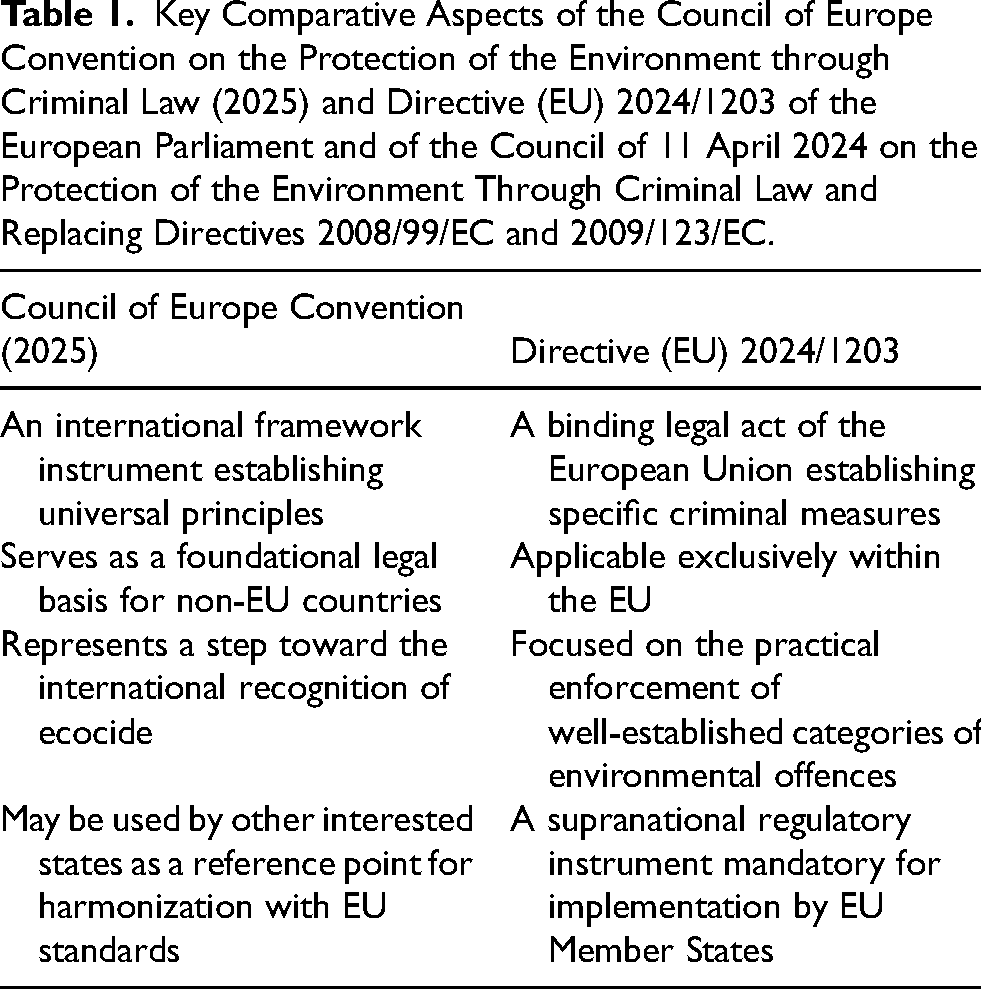
With respect to corporate liability, EU Member States are required to ensure that legal persons can be held criminally or equivalently liable for offences committed for their benefit or due to their negligence. Sanctions applicable to legal entities may include fines of up to 5% of annual turnover or €40 million, temporary bans on operations, or even dissolution. The Directive also introduces provisions for the protection of witnesses—namely, individuals who report environmental crimes. However, it does not mandate specific protective mechanisms (e.g., anonymity, asylum, or witness protection programs), leaving their implementation to the discretion of national legal systems. In comparing the scope and regulatory reach of the aforementioned Convention and Directive, it is evident that the two instruments are closely aligned, yet complementary rather than duplicative. The Convention constitutes a framework-level international treaty applicable beyond the borders of the EU, whereas the Directive is a binding internal legal act of the European Union, with concrete obligations regarding timelines, implementation, and the formulation of offences. EU Member States that are party to the Convention will be required to harmonize their provisions with those already established under Directive (EU) 2024/1203, ensuring legal coherence and avoiding conflict.
At the same time, the Convention serves as a tool to engage non-EU countries in a shared system of legal standards, thus contributing to the alignment of legal regimes in the global effort to combat environmental crime (For key comparative aspects of the Convention and the Directive, see Table 1).
Key Comparative Aspects of the Council of Europe Convention on the Protection of the Environment through Criminal Law (2025) and Directive (EU) 2024/1203 of the European Parliament and of the Council of 11 April 2024 on the Protection of the Environment Through Criminal Law and Replacing Directives 2008/99/EC and 2009/123/EC.
(B) Kazakhstan
In Kazakhstan, criminal liability in the field of environmental protection is governed by specialized legal provisions aimed at safeguarding natural resources and preventing ecological violations. The Criminal Code of the Republic of Kazakhstan (hereinafter referred to as the CC RK) establishes a number of principles that apply, inter alia, to matters of environmental protection. Most notably, the criminality of an act, its punishability, and other legal consequences under criminal law may be determined exclusively by the CC RK. This means that no other legislative act, including those pertaining to environmental protection, may independently establish criminal liability outside the framework of the CC RK.
Environmental offences in Kazakhstan are classified into offences with general and special legal elements. These encompass violations of ecological safety regulations and damage to natural territories, objects, or the atmosphere. In total, Kazakhstani legislation identifies approximately 20 core environmental offences (the exact number may vary slightly depending on theoretical classification criteria) codified in Chapter 13 of the CC RK, entitled Environmental Criminal Offences. 32 Additionally, the offence of ecocide is recognized as a distinct crime and is included in Chapter 4 of the CC RK, Crimes Against Peace and Security of Humanity—a placement that emphasizes its gravity in the context of international criminal law». Chapter 13 of the CC RK systematizes environmental offenses, covering a wide range of actions capable of causing damage to the environment. As an example of the normative formalization there can be highlighted the: pollution, contamination or depletion of waters; air pollution; pollution of the marine environment. The regulations distinguish between general violations of environmental requirements during economic or other activities, as well as specialized crimes related to the handling of hazardous chemicals, biological substances, microbiological agents, and toxins. Special attention is given to violations of veterinary and phytosanitary regulations ensuring the protection of animal and plant health, as well as the regulation of water resources, the atmosphere, and the marine environment.
A special category is made up of crimes related to the use of natural resources: illegal extraction of mineral resources, fisheries resources, hunting, violation of wildlife protection regulations, and rare plant and animal species. The law also covers crimes against forest resources – illegal logging, destruction, or damage to trees and forests, as well as the violations of the protection regime of specially protected natural areas. An important part of the regulation is the requirement to eliminate environmental damage, which enshrines the principle of liability for the consequences of activities. Thus, Chapter 13 of the CC RK reflects a comprehensive approach to environmental protection, combining preventive measures with criminal liability for actions that threaten ecosystems, biodiversity, and the sustainable use of natural resources. Together, these provisions form the legal basis for environmental protection at all levels: from individual actions to industrial and economic activities. 33
From a comparative perspective and within the framework of a formal legal assessment of the provisions mentioned above and the Criminal Code of the Republic of Kazakhstan (CC RK) as a whole, one of the most salient observations is the absence of any reference to the institution of criminal liability for legal entities, including in relation to environmental offences. This constitutes a significant divergence from the regulatory approach adopted within the European Union. 34
A second critical issue pertains to the vague and evaluative language found in a number of provisions. Many environmental offence definitions in the CC RK rely on indeterminate legal terms such as “significant damage,” “mass illness,” or “violation of protection rules” (as in Article 338 of the CC RK concerning wildlife protection). As a result, this imprecision creates difficulties in law enforcement and legal qualification, grants broad discretionary power to investigative and judicial authorities, and opens the possibility for evasion of liability due to evidentiary ambiguities. For example, in the context of Article 338, the use of the term “rules” (pravila) is arguably less precise from the standpoint of legislative drafting techniques than the term “legislation” (zakonodatel'stvo), which would provide greater normative clarity. In particular, it comes about the fact that Kazakhstan's legal framework does not contain specific rules for the protection of wildlife (as an independent regulatory act), that violates the principle of legal certainty. In this context, the proposed amendment stipulates the replacing the vague term “rules” with a reference-based/blanket norm. In contrast, EU legislation—specifically Directive (EU) 2024/1203 (Article 3)—offers a more clearly articulated framework for defining environmental offences. The Directive explicitly enumerates 20 offence types, establishes criteria for severity, and delineates thresholds for environmental harm, thereby enhancing legal certainty and enforcement effectiveness.
Particular attention should be given to environmental offences that may be classified as crimes against humanity—in contemporary legal discourse, this refers primarily to the crime of ecocide. In the Criminal Code of the Republic of Kazakhstan (CC RK), ecocide (Article 161) is not placed under Chapter 11, Environmental Criminal Offences, but rather under Chapter 4, Crimes Against Peace and Security of Humanity, thereby emphasizing its international legal character. This is the only environmental offence that is regarded as a potential threat to international peace and security, subject to prospective international investigation (e.g., by the International Criminal Court), and legally recognized as a particularly serious crime, punishable by 10 to 15 years of imprisonment.
Thus, ecocide may be viewed as an “environmental” analogue to genocide or other crimes against humanity, distinct from “localized” offences such as air pollution or illegal waste disposal. According to the Criminal Code, ecocide is defined as the mass destruction of flora or fauna, contamination of the atmosphere, land, or water resources, or other acts that have caused or may cause an environmental disaster or emergency ecological situation. Offences meeting the qualifying criteria for ecocide are punishable by imprisonment for a term of ten to fifteen years, with or without deprivation of citizenship of the Republic of Kazakhstan.
In contrast, EU legislation does not yet contain a specific legal norm defining ecocide. However, the formulation “widespread and substantial damage” appears in the text of Directive (EU) 2024/1203, with corresponding penalties of up to ten years’ imprisonment. Although discussions on the legal recognition of ecocide have been underway within the European Parliament and Council since 2021, no unified definition has been codified in binding legal texts to date. Nonetheless, the EU continues to closely monitor international developments and has acknowledged the possibility that the term “ecocide” may be formally adopted in the future, particularly in the event of its recognition at the level of the United Nations or within the framework of the Rome Statute. 35
As previously noted, one of the key legislative innovations incorporated into Directive (EU) 2024/1203 is the provision for the protection of witnesses, whistleblowers, and environmental defenders. These measures are intended to ensure the safety of individuals who report environmental crimes. At present, the relevant legislation of the Republic of Kazakhstan does not include comparable provisions; that is, there is no institutionalized framework for the protection of witnesses or environmental human rights defenders. It is important to acknowledge, however, that the European Directive does not prescribe specific protective mechanisms (such as anonymity, asylum, or security programs), instead delegating their implementation to the discretion of national legal systems. With regard to the practical enforcement of environmental legislation in Kazakhstan, weak prosecutorial and judicial practice remains a notable concern. A review of consolidated judicial statistics indicates that the number of criminal cases involving serious environmental offences remains low, and harsh penalties are seldom imposed. 36 In 2024, according to judicial registry data, approximately 150 criminal cases were heard nationwide—over half of which concerned the illegal handling of rare, endangered, or prohibited species of flora and fauna. By contrast, nearly 15,000 cases 37 were processed through administrative proceedings during the same period.
Additional challenges include limited engagement with civil society and environmental NGOs in the context of criminal proceedings, which further hinders effective implementation and oversight in the field of environmental protection. 38
With regard to soil, water, and air pollution, the criminal legislation of the Republic of Kazakhstan also reveals several shortcomings. Unlike the current provisions of the Criminal Code of the Republic of Kazakhstan (CC RK), Directive (EU) 2024/1203 clearly differentiates between offences related to air, water, and soil pollution. Furthermore, the Directive explicitly outlines mechanisms for holding legal persons accountable, and establishes liability not only for actual harm but also for the threat of harm, employing the concept of “attempt” in its legal framework.
While the relevant provisions of Kazakhstani criminal law addressing pollution of soil, water, and air are fairly well formalized and codified under Articles 329, 330, and 332 of the CC RK, the practical application of these norms remains limited, as evidenced by judicial practice reviews. Moreover, as previously noted, Kazakhstani criminal legislation does not provide for the criminal liability of legal entities. Legal persons may be held accountable solely through administrative proceedings, which significantly weakens the preventive impact of the law—particularly in relation to major industrial polluters and corporate actors. In addition, the legal framework often lacks a clear distinction between forms of culpability and the severity of consequences, which is crucial for accurate legal qualification of offences. At the same time, several legislative developments in Kazakhstan deserve recognition. Most notably, the explicit recognition and definition of ecocide (Article 161 of the CC RK) positions Kazakhstan among a limited number of states with such a provision in their criminal codes. The country has also consolidated environmental offences under a single chapter, thereby ensuring a structured classification, and has established a high maximum penalty threshold—up to 15 years of imprisonment—compared to a 10-year maximum under EU law. In summary, while Kazakhstan's criminal legislation contains certain progressive elements—such as the formal inclusion of ecocide and a comparatively high sanction threshold—it falls short of EU law in terms of institutional maturity, breadth of legal coverage, and the availability of enforcement mechanisms. The EU legal model places greater emphasis on corporate accountability, effective witness protection, enforcement infrastructure, and the flexibility of national adaptation in the implementation of supranational standards.
(C) Russian Federation
The legal regulation of criminal liability for environmental offences in the Russian Federation is, in general, comparable to that of the Republic of Kazakhstan. As in Kazakhstan, the principal sources of legislative regulation in this domain are the relevant provisions of the Criminal Code of the Russian Federation (primarily Chapter 26, Environmental Crimes) and the Federal Law “On Environmental Protection” (2002), which corresponds in function to Kazakhstan's Environmental Code.
The criminal law of the Russian Federation establishes liability for a range of environmental offences, including: pollution of water bodies, the atmosphere, and the marine environment; land degradation; illegal extraction or capture of aquatic biological resources and violations of the rules governing their conservation; illegal hunting; unlawful extraction and trade of especially valuable wild animals or destruction of their habitats; and illegal logging, destruction, or damage of forest plantations, among others. Sanctions for such offences may include fines, compulsory labour, correctional labour, community service, disqualification from holding certain positions or engaging in certain activities, restriction of liberty, or imprisonment.
Given that the majority of articles in Chapter 26 of the Criminal Code of the Russian Federation are blanket provisions—i.e., they do not independently define the substantive elements of environmental violations—courts are required to identify and specify in their judgments which the defendant has breached exact environmental regulations. Scholarly commentary in the relevant legal literature has repeatedly emphasized that courts may encounter practical difficulties in determining quantitative or evaluative parameters of offences, such as assessing the extent of environmental harm or verifying the exceedance of maximum permissible pollutant concentrations. 39
In Russian legislation, ecocide is defined as the mass destruction of flora or fauna, contamination of the atmosphere or water resources, as well as the commission of other acts capable of causing an environmental disaster. As in the Criminal Code of the Republic of Kazakhstan, the crime of ecocide is not classified under environmental crimes in the Russian Criminal Code, but is instead included in Section XII, which addresses crimes against peace and the security of humanity.
From a formal-legal standpoint, Russian environmental criminal law may be considered relatively comprehensive, covering the majority of widely recognized and codified types of environmental offences. Its strengths include the presence of a dedicated chapter on environmental crimes within the Criminal Code, formal recognition of key environmental threats, and the possibility of aggravating liability through qualifying elements.
However, contemporary global challenges point to the need for legislative adaptation in line with the current international environmental agenda. Systemic issues include the absence of criminal liability for legal entities, despite the fact that large-scale environmental harm is often caused by corporate actors; persistent difficulties in legal qualification—particularly the omission of explicit references to forms of guilt (e.g., intent vs. negligence) in several provisions; vague definitions of “significant harm” to the environment; and the lack of protection for environmental activists and whistleblowers. In the latter case, there are no statutory provisions on witness protection, and additional restrictions are imposed on the activities of non-governmental organizations (NGOs).
With regard to soil, water, and air pollution, the environmental criminal legislation of the Russian Federation faces challenges similar to those observed in the legal framework of the Republic of Kazakhstan. The legislation does not comprehensively address a broad range of environmental threats, such as climate change, diffuse pollution, or ecological negligence. As in Kazakhstan, criminal liability for legal entities is absent. Companies may only be subjected to administrative liability, which significantly limits the effectiveness of enforcement actions against major polluters. Russian environmental criminal law also exhibits systemic issues in differentiating between forms of culpability and the gravity of offences. The mens rea (mental element) is often unspecified or vaguely articulated in the statutory text. For example, Article 254 of the Criminal Code of the Russian Federation (Land Degradation) employs the term “negligence,” yet fails to establish a distinct, privileged category of offence, instead using negligence as a qualifying criterion without clear legal consequences. In general, compared to the newly adopted EU legislation, Russian environmental sanctions are more lenient and rarely enforced to their full extent. The basic legal framework typically prescribes penalties such as fines, corrective labour, or restrictions on liberty. In contrast, EU sanctions are considerably more severe, with maximum prison sentences of up to ten years, substantial financial penalties, and enforceable liability provisions targeting legal entities.
As in Kazakhstan's legal framework, the Russian criminal law does not contain dedicated provisions for the protection of whistleblowers or environmental activists, highlighting a significant gap in the institutional safeguarding of those reporting environmental offences.
In discussing other characteristic shortcomings of Russia's environmental legal framework within the scope of this study, particular attention should be given to the insufficient formalization of interagency coordination among environmental, law enforcement, and public health authorities. The distinction between administrative and criminal liability remains unstable, giving rise to procedural ambiguities and challenges in enforcement practice.
In Russian practice, the low effectiveness of environmental sanctions is largely due to a combination of institutional and economic factors. First, there is no fully-fledged institution of corporate criminal liability. Particularly companies that are the main sources of pollution are subject to administrative penalties only, making sanctions disproportionate to the actual environmental damage. 40 Second, the fines stipulated by Articles 246–262 of the Russian Criminal Code (Chapter 26 “Environmental Crimes”) remain relatively low and are often replaced by warnings or suspended sentences, especially in cases involving economically significant activities. According to the Prosecutor General's Office of the Russian Federation, in 2023, only approximately 15% of environmental crime cases resulted in actual penalties, reflecting weak law enforcement. 41 Furthermore, the existing criminal prosecution model focuses on individuals (managers and specialists), while actual decisions regarding environmental violations are made by the corporate body.
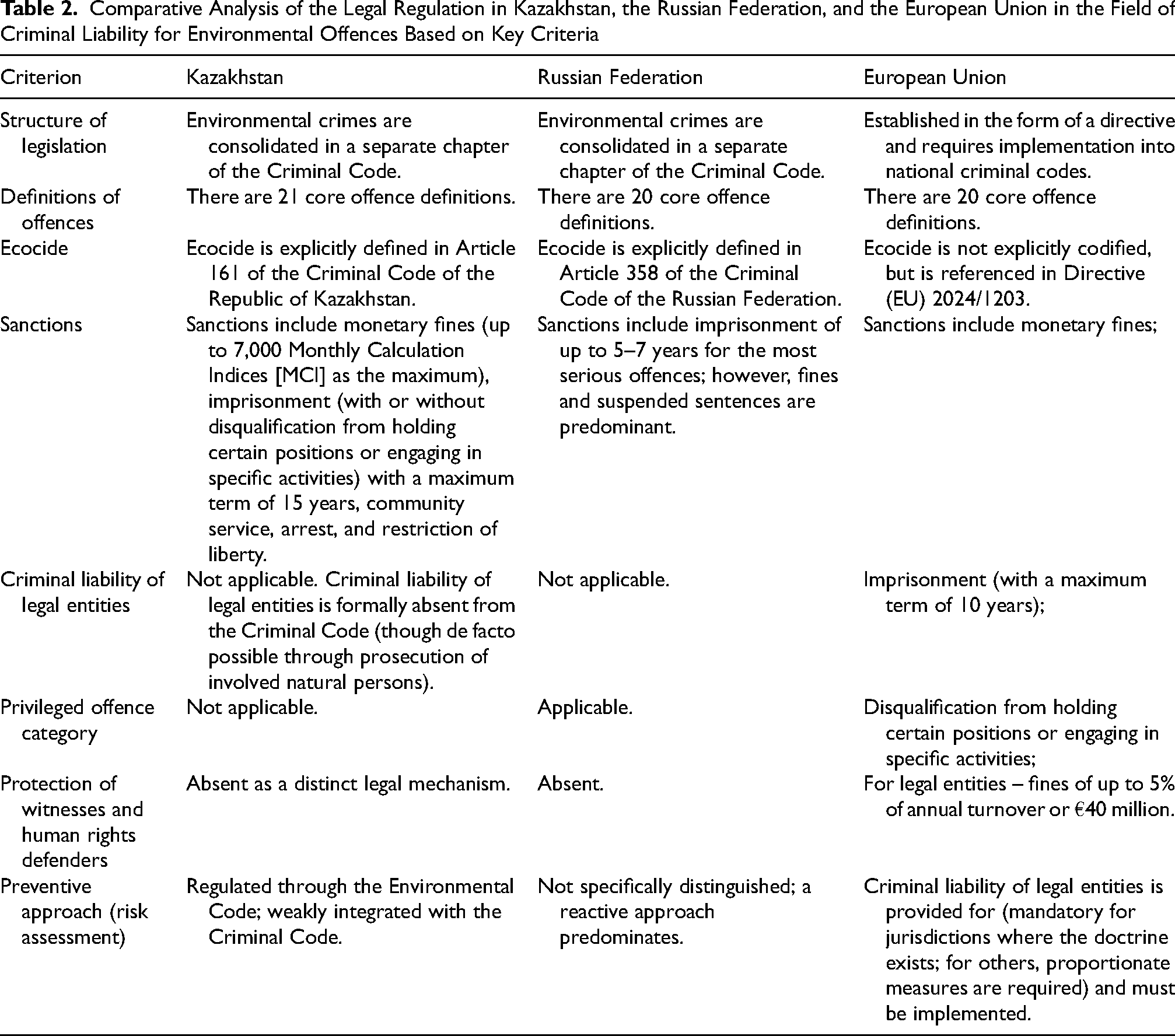
As a general conclusion, the effective implementation of criminal environmental law in the Russian Federation requires several key reforms. The latter should include the introduction of criminal liability for legal entities, the refinement of offence qualification criteria through the clear articulation of mens rea (forms of guilt) and legally defined harm thresholds, as well as the integration of national legislation with preventive and international mechanisms for environmental protection (For a comparative overview of the legal frameworks of Kazakhstan, the Russian Federation, and the European Union concerning criminal liability for environmental offences across several key criteria, see Table 2).
Comparative Analysis of the Legal Regulation in Kazakhstan, the Russian Federation, and the European Union in the Field of Criminal Liability for Environmental Offences Based on Key Criteria
Comparative Legal Analysis: EU, Kazakhstan & Russia
A comparison of the legal regulation of environmental crimes in Kazakhstan, Russia, and the European Union reveals that the countries employ different approaches to formalization, structure, and penalties. Kazakhstan and Russia formally define environmental crimes in separate chapters of their Criminal Codes, while the EU implements them through a directive requiring implementation into national legislation. This provides flexibility but requires active legislation at the member state level. The countries are similar in the number of crimes they define, with 20–21 main elements. The issue of ecocide highlights the differences: a direct definition is enshrined in the Criminal Codes of Kazakhstan and Russia, while the EU limits its reference to it to a directive. Sanctions in Kazakhstan and Russia primarily focus on imprisonment and fines, but Kazakhstan additionally provides for community service, arrest, and restriction of liberty; the EU imposes high fines for legal entities (up to 5% of turnover or €40 million). A significant difference is observed in the regulation of criminal liability of legal entities: it is formally absent in Kazakhstan and Russia, but is provided for in the EU. Witness and human rights protection mechanisms are explicitly established only at the EU level. The EU also embraces a preventive approach through mandatory risk assessments and an investigative system, while Kazakhstan and Russia act primarily reactively. Overall, the EU demonstrates a more comprehensive, preventative, and institutionalized approach to criminal liability for environmental offenses, while Kazakhstan and Russia focus on formalizing the elements of crimes and reactive measures, with limited protection for whistleblowers and a lack of direct liability for legal entities. At the present stage, comparative studies on criminal liability for environmental offences that include the practice of the European Union remain relatively limited. Notably, no relevant research has been identified in the context of Central Asian countries within this field. Similar studies are also scarce across Asian states more broadly, as well as in the Middle Eastern region. This absence, however, is not surprising and can be attributed to two principal factors: (a) EU legal and policy frameworks are not consistently regarded as reference models in many countries of these regions (with Kazakhstan representing a notable exception, demonstrating a clear commitment to broad-based analysis and an objective evaluation of the applicability and adoption of best practices); and (b) the relevant EU regulations in this domain have been adopted only recently and have yet to be fully implemented. Nevertheless, given that the primary focus of this research lies in the normative (legislative) dimension rather than in enforcement practice, arguments regarding divergent legal and policy trajectories across these regions appear to be of limited relevance. Furthermore, an analysis of comparative legal scholarship produced in the Republic of Kazakhstan over the past five years reveals a sustained commitment to the study of EU experience in the field. 42 Directive (EU) 2024/1203, adopted in April 2024, represents a new generation of regulatory instruments aimed at fundamentally strengthening the legal response to environmental crime. EU Member States have not yet completed the process of implementing this directive, and practical case law is either lacking or still in the early stages of formation. A second factor that complicates comparative research in this area is the differing levels of legal detail and institutional integration. Kazakhstan's legal framework is characterized by a relatively stable structure: provisions on environmental crimes have been embedded in the Criminal Code since 1997, with the most recent reforms undertaken between 2014 and 2021. In contrast, the European Union operates a multilayered system that includes framework directives, regional protocols, country-level implementation acts, and various other normative instruments. Contemporary legal scholarship in Kazakhstan is primarily focused on addressing internal challenges. Key issues include difficulties in the legal qualification of environmental offences, limited effectiveness of preventive mechanisms, and deficiencies in accountability frameworks, all of which indicate a need for further legislative improvement and enhanced enforcement practice. 43 Particular attention has been given to the unlawful use of water resources and subsoil exploitation, where an increase in violations has been observed, alongside a growing recognition of the need for stricter regulatory oversight and enhanced liability. 44 Kazakhstan aligns itself with international standards and UN recommendations; however, it faces ongoing challenges in operationalizing the principles of sustainable development and in achieving a balanced relationship between economic growth and environmental protection. 45 A critical task remains the improvement of preventive strategies for environmental crime, the development and implementation of new policy instruments and programs, and the strengthening of environmental monitoring and enforcement systems. 46
Recent legal scholarship highlights that the Criminal Code of the Republic of Kazakhstan (CC RK), in its provisions concerning liability for violations of environmental protection legislation, employs the term “offence” (pravonarushenie) rather than “crime” (prestuplyenie). This terminological choice implies a lower degree of social danger and typically entails less severe punitive measures. This feature is widely viewed as a legislative shortcoming: the relative leniency of sanctions often enables perpetrators to evade criminal liability altogetherю 47 There is also a prevailing consensus that the current criminal law does not provide for the criminal liability of legal entities for the commission of environmental offences. This legal gap is frequently exploited by unscrupulous business leaders. Given that corporate decisions are usually made collectively, and in accordance with the principle of individual (personal) responsibility, legal entities cannot be held criminally liable for unlawful decisions made in a collegial manner. 48 According to the Criminal Code of the Republic of Kazakhstan (CC RK), criminal liability may be imposed solely on natural persons. Even when an employee of a company commits an environmental crime, the legal entity itself cannot be held criminally liable. 49 This means that, in cases of environmental violations—regardless of their severity—only individual perpetrators may be subjected to criminal prosecution. Legal entities may be held accountable through the Code of Administrative Offences, yet such liability implies a lower degree of social danger and does not entail criminal penalties such as imprisonment or criminal fines. 50 This creates a significant gap in the system of accountability, as large enterprises can, in practice, evade criminal prosecution even when their actions cause substantial environmental harm.
In general, the issue of criminal liability of legal entities remains a subject of doctrinal debate in many legal systems, as it appears to conflict with fundamental principles of criminal law—namely, personal culpability and the requirement of conscious, intentional conduct. Moreover, the imposition of such liability poses challenges in terms of evidentiary standards and the application of sanctions. Classical criminal law theory—particularly within civil law jurisdictions—rests on the notion of personal fault, whereby the perpetrator of a crime must possess consciousness and volition, attributes that legal persons, by definition, do not possess. A third layer of complexity arises in the practical implementation of corporate criminal liability. Even if such liability is formally introduced, numerous technical issues must be addressed, including the identification of the guilty party (e.g., the director, the board of directors, or the beneficial owner), the measurement of fault (whether through the actions of a specific employee or the aggregate conduct of the organization), and the determination of appropriate sanctions (as imprisonment is not applicable to corporate entities, leaving primarily fines or operational prohibitions as viable penalties). Nevertheless, the prevailing international trend points toward the search for a doctrinal and practical compromise—gradually moving in the direction of recognizing corporate criminal liability as a legitimate and necessary component of modern criminal law systems.
Despite existing divergences on this matter, the present study affirms the necessity of introducing corporate criminal liability into the current criminal legislation of both the Republic of Kazakhstan and the Russian Federation. This should be implemented through the inclusion of new chapters in the Criminal Code of the Republic of Kazakhstan and the Criminal Code of the Russian Federation, respectively, which would provide for coercive criminal-law measures applicable to legal entities. 51 Given the similar structure of the codes of both countries (divided into Special and Specific Parts), from a formal standpoint, in this case, it comes about the amendments the General Part of the Codes. The above measure implies expanding the list of subjects of the crime (Section 2 in both Codes) and the Specific Part in terms of the relevant articles covering environmental crimes. This legislative development is necessitated by several objective considerations. First, the ongoing socio-economic transformations within the Eurasian Economic Union (EAEU) member states have led to the emergence of a new category of offences, commonly referred to as corporate crime. The organizational complexity and specific modes of corporate governance frequently render it difficult to identify culpable individuals, particularly in cases involving collective ownership structures or distributed management. This presents significant evidentiary challenges when attempting to establish the direct involvement of executive leadership in the commission of environmental harm.
Second, the potential for corruption benefiting legal entities and the existence of shadow governance structures—in which official powers are delegated through civil contracts or powers of attorney—further complicate accountability mechanisms. Third, the issue of corporate leadership succession must be considered. In many instances, the environmental damage—such as air pollution due to improper disposal of radioactive waste or long-term soil degradation—may become apparent only after a significant period has elapsed and after the original corporate leadership has been replaced. The current regulatory landscape in the area of environmental protection calls for effective remedial measures addressing harm caused by corporate actors. This includes situations where the emission of hazardous substances into the atmosphere results in a cascade of adverse consequences, such as public health risks, soil and water contamination, and broader ecological degradation. Accordingly, the establishment of corporate criminal liability is essential to ensure the full accountability of legal entities whose activities lead to environmental damage. In this context, it is necessary to implement the following measures: (a) the creation and enforcement of a legal framework that guarantees environmental protection by imposing property-based sanctions on legal entities to compensate for the harm they have caused; and (b) the establishment of corporate criminal liability by lawmakers, limited to a specific category of environmental offenses, where a direct causal link can be demonstrated between the environmental damage and the activities of the legal entity Against this background, it is increasingly evident that the current civil law provisions, which allow for monetary penalties against legal entities for environmental breaches, are insufficiently effective. Relying on administrative law measures, primarily through increasing fines, fails to adequately address the issue, especially considering the potential public danger posed by corporate actors to national environmental and security interests. Therefore, the most appropriate and legally robust solution is to introduce criminal sanctions for legal entities, thereby strengthening environmental protection and ensuring institutional accountability for environmentally harmful actions.
In addition to the challenges and issues previously outlined, the question of revising the current provisions of the criminal legislation of the Republic of Kazakhstan and the Russian Federation concerning environmental protection remains highly relevant—particularly with respect to the expansion of these provisions through the introduction of privileged offence categories. One of the persistent difficulties in the legal qualification of environmental crimes is the absence of a clearly defined mens rea element—namely, whether the offence was committed intentionally or through negligence. 52 This issue has been noted earlier and is reiterated in the present study. The lack of such a component within the structure of the offence significantly complicates the process of criminal qualification for this category of violations and, as a result, hinders the selection of an appropriate and proportionate sanction. By contrast, European Union legislation explicitly incorporates such differentiation. Moreover, in the absence of a clearly articulated mens rea requirement in national legal provisions, the prosecution of legal entities becomes particularly challenging. In such cases, the mental element—whether intent or gross negligence, as expressed through the actions or omissions of responsible corporate officers—serves as the foundational basis for attributing culpability to the organization as a legal subject. Accordingly, the lack of clarity concerning the element of fault undermines not only the pursuit of individual accountability but also obstructs the systematic prosecution of environmental offences committed within the framework of corporate activity.
Conclusion
Against the backdrop of growing global concern over environmental challenges, new forms of response are emerging—demonstrating that solutions lie not only in technological innovation but also within the realms of political will and legal regulation. The search for effective strategies to prevent and counteract environmental offences remains ongoing. Comparative analysis of regulatory mechanisms across jurisdictions in the field of environmental protection (EP) enables the identification of best practices that may help shape a common trajectory for the development of both national (as well as supranational and international) environmental regulation and policy.
The European Union's sustained economic growth and socio-political development in recent decades have allowed it to shift focus toward environmental protection and global ecological issues. This shift has significantly influenced the evolution of environmental law, positioning the EU as a supranational entity that sets normative trends subsequently adopted—directly or indirectly—by other countries, including Kazakhstan and the Russian Federation.
Kazakhstan, under current conditions, actively seeks to align its environmental policy with the global environmental agenda, aiming to critically assess the state of national regulation, identify strengths and weaknesses, and enhance its institutional framework. In contrast, Russia's environmental policy may be characterized as regressive. Although institutionally developed, the current state of environmental legislation and policy in the Russian Federation is implemented in a fragmented manner. The country possesses a comprehensive legal framework for environmental protection; however, its enforcement suffers from weak judicial practice, the absence of corporate criminal liability, and limited preventive capacity.
The question of strengthening criminal liability for environmental offences is, in essence, a reflection of the increasing anthropogenic pressure on natural systems. In recent years, the EU has made considerable progress: moving from declarative norms to enforceable sanction-based mechanisms, from administrative regulation to a system of multi-level criminal liability, and from soft coordination to binding directives.
While the legal frameworks of both Kazakhstan and the Russian Federation appear coherent at the structural level, the global and transboundary nature of many environmental challenges necessitates a rethinking of regulatory approaches. Several key deficiencies become evident when comparing the regulatory practices of Kazakhstan and Russia with those of the EU. Among these are: the absence of criminal liability for legal entities, which weakens deterrence and reduces legal exposure for major polluters; the insufficient specificity of offence definitions and the lack of clear articulation of mens rea in numerous statutory provisions; and, in the case of Kazakhstan, the legal isolation of Criminal Code norms from related legislative domains—particularly the lack of cross-references to specialized regulatory acts—thereby hindering a comprehensive legal approach to environmental offences.
Moreover, from a formal-legal standpoint, both Kazakhstan and Russia demonstrate inadequate protection for environmental activists and whistleblowers, as well as weak institutional support for public environmental monitoring. In contrast, EU legislation presents a more progressive, preventive, and integrated model of environmental criminal law, one focused not only on sanctioning harm but on preventing it proactively and systematically.
Despite possessing a foundational normative structure, the environmental criminal legislation of Kazakhstan and Russia requires modernization. The latter implies the introduction of corporate criminal liability (with appropriate legislative formalization, to the extent consistent with prevailing doctrinal positions), the refinement of offence definitions and fault elements, the expansion of judicial practice and interpretive guidance, and the provision of effective guarantees for whistleblowers and environmental human rights defenders. Considering that the codes of both countries share a similar structure, divided into a General Part and a Specific Part, the amendments in this case primarily concern the General Part of the Codes. This measure involves expanding the list of subjects of the crime (Section 2 in both Codes). Along with the above the specific articles (containing in Specific Part in both Codes) that cover environmental offenses should accordingly expand the list of the subjects of the crime.
At the same time, it must be acknowledged that the concept of corporate criminal liability remains controversial in the legal doctrines of many countries, as it challenges fundamental principles of criminal law, particularly those related to individual culpability and intentionality. This issue is by no means unique to Kazakhstan or Russia; rather, it reflects the broader doctrinal stance of civil law systems, especially within the post-Soviet legal tradition, where such an approach has historically been deemed incompatible with the core tenets of criminal jurisprudence. Accordingly, future research within the scope of this study may be devoted specifically to the question of corporate criminal liability in environmental law.
Footnotes
Funding
The authors received no financial support for the research, authorship, and/or publication of this article.
Declaration of Conflicting Interests
The authors declared no potential conflicts of interest with respect to the research, authorship, and/or publication of this article.
Data Availability
All data generated or analysed during this study are included in this published article.