



Abstract
This article seeks to answer the question of how legal education can contribute to the creation and strengthening of environmental citizenship. In this context, it first examines the concept of environmental citizenship. It then focuses on establishing a system of environmental rights and duties that not only enables citizens to play important roles in environmental issues but also, as a further step, requires the reevaluation of non-human entities within a community of all inhabitants of the Earth. Finally, it investigates street law programs to understand their possible effects (including their potential benefits and challenges) on the creation and promotion of environmental citizenship, considering that legal education through street law programs can play an important role in this foundation.
Keywords
Introduction
As is known, the sixth principle of the Framework Principles on Human Rights and the Environment, which sets out the basic human rights obligations relating to the environment, states: “States should provide for education and public awareness on environmental matters.” 1 The UNEP Strategy for Environmental Education and Training also emphasizes the importance of involving all citizens in the assessment and solution of environmental and development problems, and in particular, increasing their participation in decision-making processes, recognizing that working towards sustainable development is the responsibility of every citizen. 2 Furthermore, in line with the Sustainable Development Goals (SDG), all members of the international community are expected to acquire the knowledge and skills needed to promote sustainable development by 2030, including “global citizenship,” which is embedded in one of the Sustainable Development Goals, namely SDG 4: Ensuring Inclusive and Equitable Quality Education for All and Promoting Lifelong Learning. 3
On this basis, it can be argued that educational institutions, such as universities and law schools, have the responsibility to promote environmental citizenship by teaching students and the public at large, using various methods of public education. This education should emphasize that individuals are members of an environmental community that includes all human and non-human entities in the ecosystem, and that they should use their knowledge, training, and skills to contribute to this community.Importantly, this responsibility extends beyond fostering individual awareness to empowering citizens to address and overcome structural and political barriers to environmental justice. To effectively fulfill this responsibility and create better educated and more environmentally conscious citizens of the future, this article proposes the street law model (which can be implemented as separate law clinics or as sub-programs within law clinics). These are clearly public-oriented initiatives based on an experiential and interactive teaching methodology that greatly contributes to the goals of clinical legal education (CLE).
Today, street law programs have expanded worldwide. However, there is a lack of research on the specific role of the street law clinic model in the development of environmental citizenship. Therefore, this study conducts a comprehensive review, starting from the concept of environmental citizenship and the establishment of a system of environmental rights and responsibilities, to clinical law education on the subject, law clinics, and specifically the street law clinic model. It begins by clarifying the concept of environmental citizenship based on various discussions of citizenship; and then examines the current system of environmental rights and duties to address the rights and duties associated with environmental citizenship. It also discusses the potential benefits and challenges of street law programs in clinical legal education in creating and promoting environmental citizenship. Finally, in an overall assessment, it highlights the need to add several other elements to the environmental law curriculum to focus on broader philosophical and practical issues that can promote and support environmental citizenship.
Defining Environmental Citizenship
From Citizenship to Environmental Citizenship
While there are many different definitions and discussions about the concept of citizenship, reflecting its contested and dynamic nature (see also the concept of “citizenization”),
4
most of them share three main components:
Membership in a community, involving a social bond and/or a common identity; Possession of a set of rights; and The obligation to perform specific duties with respect to that community.
When these three components—membership/belonging, rights, and participation—converge, citizenship is typically defined with an emphasis on political citizenship. 5 However, today, the concept of citizenship is considered in a broader sense, encompassing not only rights to individual freedom but also the right to political participation and the right to social and economic welfare. 6
The roots of today's definitions of citizenship date back to ancient Greece and Rome. In ancient Greece, citizenship was granted to a privileged minority (excluding youth, women, slaves, metics, and barbarians). In the Roman Empire, conversely, it was used as a tool for integration and expansion. The definition and inclusion of citizenship through law and human rights (political, economic rights) was a pioneering development for contemporary definitions and discussions stemming from the French Revolution (1789). Indeed, from the 18th to the twenty-first century, with evolving citizenship rights influenced by social inequalities, citizenship has rapidly evolved from civil to political and social forms.
Many concepts related to environmental citizenship trace back to the conservation movements of the late nineteenth century, exemplified by figures like George Perkins Marsh and John Muir and organizations like the Sierra Club. It found political expression in the environmentalism of the 1960s onwards, and from the early 1980s onwards, it was associated with the goal of sustainable development. 7 Challenging both philosophy-centered and politics-centered approaches, Smith and Pangsapa argue that citizenship is “better understood as an ethico-political space where the right, the good, and the virtuous are acknowledged as provisional, open to contestation, and subject to deliberation.” 8 This definition assumes not only social relations but also a state that regulates them.
With the twenty-first century, discussions have expanded to include different levels of citizenship: national, regional, and global. For example, EU citizenship, which complements the national citizenships of member states, effectively illustrates the regional level of citizenship (Article 9, TEU; Article 20, TFEU). 9 On the other hand, the roots of global citizenship can be traced to Kant's cosmopolitan institutions and laws, which highlight the interconnectedness and interdependence in global networks that transcend nation-states. 10 The re-evaluation of these views, particularly in addressing contemporary environmental problems like pollution, global warming, and climate change, raises the possibility of a global civil society comprising global environmental citizens and grounded in forms and institutions of global environmental governance. 11
While the ideal of global environmental citizenship offers an impressive vision, its full implementation faces significant practical challenges. These include varying levels of government commitment, often conflicting national priorities, and the inherently limited enforcement mechanisms of international environmental law. Consequently, while evident in certain progressive legal frameworks and grassroots movements, progress remains uneven across regions and socioeconomic contexts. Given that environmental problems often generate cross-border issues and that environmental responsibilities are intergenerational and interspecies, 12 there is a need to reconsider new areas of civic participation and decision-making that can rival the traditional jurisdictions of nation-states and regional organizations. These situations also encourage innovative and unconventional thinking.
In addition to cosmopolitanism, other approaches to environmental citizenship include neoliberalism, 13 multiculturalism (pluralism), 14 and feminism. 15 Definitions and understandings of environmental citizenship also vary across contexts such as economics, policy, philosophy, and education. For instance, the literature uses various concepts to explain and conceptualize citizenship in relation to environmental issues, such as green citizenship, sustainability citizenship, environmental citizenship, 16 and ecological citizenship. 17
Green citizenship is defined as being a socially responsible citizen living sustainably and acting justly, considering intergenerational and interspecies rights. 18
Sustainability citizenship extends beyond environmental citizenship to encompass economic, social, political, and cultural areas while maintaining a focus on environmental issues. 19
Environmental citizenship is categorized into two main approaches: the lifestyle approach and the participatory rights approach, derived from liberal (individual responsibility, rights to environmental goods) and republican (participatory rights, rights to the common good) political theories. 20 Addressing over-consumption and excessive waste through citizens’ lifestyles and consumption preferences requires citizens to assume self-governance responsibilities. As governmentality theory, based on Foucault's ideas on “the art of government,” suggests, this can be achieved through public deliberative processes that involve the public in decision-making on policy options. 21 However, relying solely on consumption preferences within a market-based logic, such as compelling businesses/industries to act responsibly through consumer choices, limits environmental citizens’ responsibility to consumption-related activities, excluding other forms of engagement like protests or building low-consumption communities around housing, energy, or food cooperatives. 22
Environmental citizenship, as an evolving concept, is also identified as the extension of citizenship rights (civil, political, and social rights) to include access to environmental goods or the prevention of environmental harms. For example, Dobson's proposed “post-cosmopolitan citizenship” (in addition to liberal and civic republican citizenship) is “non-contractual, non-territorial, non-discriminatory.” 23 It operates in both public and private spheres, emphasizing duties, responsibilities, and virtues. Ecological citizenship is similarly viewed as the extension of citizenship rights, with a new set of rights and duties belonging to an earth citizen, enhanced by various social movements: the animal rights movement, responsibility for nature, and the global movement with the notion of a global ecological citizen. 24 Here, the emphasis is on the necessity of just distribution based on intergenerational equity, along with responsibilities and virtues, challenging both the liberal state and market logics, whereas environmental citizenship is closely associated with market-based mechanisms for pro-environmental behavior change.
From an educational standpoint, environmental citizenship is defined by the European Network for Environmental Citizenship as an umbrella term encompassing all these diverse interpretations and perspectives on the relationship between environment and citizenship. 25 While concepts such as green citizenship, sustainable citizenship, and ecological citizenship offer distinct theoretical frameworks, often differing in their primary focus of responsibility (individual vs. collective) or their anthropocentric vs. ecocentric focus, their ultimate goal is to foster a more effective “environmental democracy” 26 that establishes a system of environmental rights and duties (informally, “entitlements and obligations”). 27 This shared goal encompasses empowering citizens to actively participate in decision-making processes, ensuring transparency and accountability in environmental governance, and ultimately leading to a more equitable and sustainable relationship with the environment. Thus, despite their differences, these diverse approaches converge on the broader ideal of an effective environmental democracy, albeit with variations in scope, action, and emphasis, as a more participatory, transparent, and accountable form of environmental governance.
From Human Beings to Nonhumans
Further assessment of environmental citizenship necessitates a reconsideration of nonhumans within a community of all Earth's inhabitants, 28 while positioning human beings as “plain citizens of the land-community.” 29 This is particularly crucial given the understanding that nonhumans cannot defend their rights, thereby requiring humans to advocate on their behalf. 30 There is already an ongoing discourse in the literature regarding the philosophical and legal underpinnings of granting moral consideration or even legal personhood to non-human environmental elements. 31 This includes the conceptualization of environmental autonomy (EA) in legal terms. 32
Such recognition acknowledges the intrinsic value of nature beyond its utility to humans, fostering ecosystem integrity and extending ethical responsibility beyond anthropocentric views. 33 Globally, this has translated into groundbreaking legal developments. For instance, the IUCN World Declaration on the Environmental Rule of Law serves as a positive step.Notably, numerous global court rulings and regulations concerning the rights of have emerged worldwide. These include cases inAustralia (Birrarung/Yarra rivers of Victoria State) 34 ; Chocó, Colombia (Atrato river); 35 Uttarakhand, India (Ganga-Yamuna rivers/their glaciers) 36 ; Bangladesh (Turag and all other rivers); 37 and Canada (Mutehekau Shipu/Magpie River); 38 U.S. Denver (Colorado river); 39 the Northern California, Yurok Tribe (Klamath River) 40 among others. 41 Among these, the landmark recognition of legal personhood for rivers, such as the Whanganui River in New Zealand 42 ; and the Vilcabamba River in Ecuador (Vilcabamba river) 43 , 44 granting them rights akin to human entities, stands out. Such advancements exemplify a crucial shift towards integrating non-human interests into legal frameworks and adopting an ecocentric jurisprudence, further challenging traditional human-centered approaches to environmental governance.
This evolving legal context regarding nonhuman entities has profound implications for legal education. Law curricula must adapt to encompass not only traditional anthropocentric legal frameworks but also emerging concepts such as ecocentric legal philosophy and the rights of nature. This requires training future legal professionals to critically analyze anthropocentric biases in existing legal systems, defend the legal status of natural entities, and engage with interdisciplinary perspectives that transcend traditional legal boundaries. Law clinics, in particular, can provide invaluable platforms for students to explore these concepts through real-world cases and develop innovative legal strategies to protect ecosystems.
The System of Environmental Rights and Duties
Since the concept of citizenship is fundamentally based on the possession of rights and duties, an examination of the environmental rights and duties system is naturally essential to discuss environmental citizenship and address related issues. The aim here is to consider these rights and duties from both human and non-human perspectives. 45 As previously mentioned, while it is generally accepted that non-human beings do not possess rights like humans in current systems, the notion that these beings should be considered morally significant and that this attributed ‘moral significance’ imposes duties on humans is not new. 46
Such emphasis on environmental duties, including protecting natural resources, avoiding pollution, reducing environmental harm, and taking all reasonable and practicable measures to prevent or minimize harm, are analogous to the duties of citizenship in states, such as paying taxes, being a good citizen, contributing to the community, serving in the military, and maintaining good neighborly relations. These duties are regulated and implemented under various levels of legal frameworks, including international, regional, and national/local laws. Their effectiveness depends on the strength of the legal system and its mechanisms, which vary with levels of democracy and development. Consequently, uniform effects and results cannot be guaranteed universally or consistently.
In relevant discussions, while environmental duties imposed on humans are highlighted, the issue of granting specific rights to non-humans remains ambiguous. Therefore, rather than legal rights, the idea of extending legal interests to non-humans is more frequently proposed. In other words, the question of granting rights to non-humans is often replaced by imposing duties on humans or advocating for ecological virtues applied through flexible strategies tailored to each situation, considering the complexity, uncertainty, and interdependence between society and nature, without prioritizing any single ecological virtue. 47 Although these discussions have evolved over time to a point where granting rights may be acceptable, 48 and while preferring a ‘nature-focused’ rights approach over a human-centered ‘duties’ approach, 49 the practicality of today's conditions raises questions about their acceptance and implementation. The primary reason for this objection is that current legal, administrative, and judicial systems are established and developed in a human-centered manner. 50
Overall, both environmental duties and rights require further development to facilitate the adoption of environmental citizenship. Indeed, to address environmental citizenship more concretely as a concept with defined frameworks and boundaries, discussions on rights and duties need to be grounded in more robust conceptual, theoretical, and practical dimensions, thereby eliminating ambiguities. Given that education, especially legal education and awareness, can play a pivotal role in this process, it is crucial to examine environmental citizenship through legal education and law clinics. The ongoing debate over the priority of environmental rights versus duties, particularly concerning the legal status of non-human entities, stands asa prominent manifestation of the contested landscape of environmental citizenship. This section addresses this particular dimension, recognizing it as an important but not exhaustive element of the broader discourse.
The role of law clinics
As “not an optional extra, but an integral part” of citizenship, 51 both formal and non-formal education can play a role in promoting environmental citizenship by contributing to behavioral changes in citizens. 52 Therefore, it is possible to cultivate better educated and more environmentally conscious citizens. Among other fields, legal education can play a significant role in this regard. In fact, if implemented correctly, legal education can be a valuable tool for integrating relevant research findings and fragmented knowledge on environmental citizenship into a coherent framework. Moreover, through professional education, particularly clinical tools, it can ensure their effective incorporation into best practices and policy frameworks. 53 Clinical programs are generally designed to combine pedagogical and professional goals with public-interest benefits and justice-based values. 54 While some programs may involve student representation of clients under clinician supervision, others include public/community law education (also known as street law (SL) or citizenship law clinics), providing legal information, advice, and potentially some legal services to the public within their clinical scope.
How can SL add value to environmental citizenship?
In the context of empowering environmental citizenship, environmental law clinics (ELCs) and street law clinics (SLCs) can be considered as part of this analysis. ELCs can play a crucial role in preparing law students to become environmental lawyers by providing client representation in complex litigation and facilitating access to the legal system for those facing environmental issues. Thus, they can be effective instruments for positively shaping environmental law and policy, and consequently, environmental justice in the long term. 55 Notably, ELCs often address cross-border, interdisciplinary, and multidisciplinary issues that involve numerous stakeholders due to the multidimensional nature of environmental law. In these clinics, law students may engage in a wide range of community projects in addition to client representation in litigation. 56 Therefore, it can be suggested that ELCs should be categorized into three groups based on their practical focal points: litigation-oriented (Type A), public education-focused (Type B), and mixed model (Type C). 57 Consequently, diverse ELC models emerge in practice. For instance, unlike US ELC models, which primarily focus on litigation under the supervision of licensed lawyers, Australian ELCs operate through project-based, external internship opportunities, emphasizing law reform, social communication, or consultancy, with limited student participation in courtroom proceedings. 58 ELCs can potentially expand their services to include public education under appropriate conditions, integrating street law as sub-programs or courses.
On the other hand, SLCs (or street law programs conducted by law clinics) are explicitly public-oriented, non-live, non-litigation initiatives. As a component of CLE, like many other CLE activities, they employ experiential and interactive teaching methodologies. In fact, SLCs, similar to ELCs and other law clinics, are designed to contribute to the objectives of CLE, including pedagogical and professional goals, public-interest benefits, and justice-based values. Thus, they have the potential to provide various benefits to all stakeholders involved in the process, i.e., “everyone's a winner,”
59
primarily enhancing students’ legal knowledge and skills while raising public awareness of their rights and responsibilities (see Table 1):
60
Student aspect: Enhancing students’ legal knowledge (both substantive and procedural law) and lawyering values (ethics of law), their capacity to think and act like a lawyer, and their soft skills (such as teamwork, organization, communication, management, public speaking, time-management, research, and advocacy skills).
61
Public aspect: Raising public awareness of their rights and responsibilities and stimulating public-oriented legal education initiatives, such as legal literacy projects. This public-based (or community-based) legal education aspect is a foundational element of SLCs. It is precisely this aspect that differentiates them from other law clinics, enabling the public to learn and understand practical legal information and develop the necessary skills and attitudes to effectively engage in related democratic processes.
62
Street Law Benefits for Environmental Citizenship.
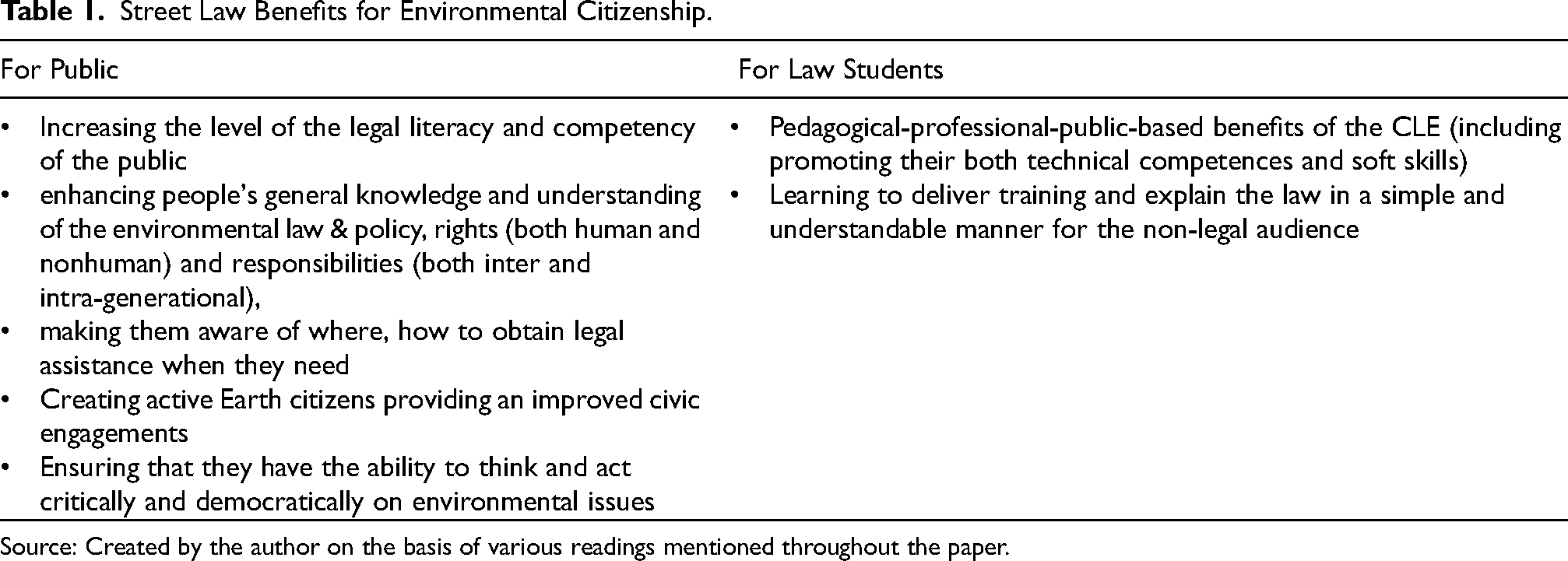
Source: Created by the author on the basis of various readings mentioned throughout the paper.
Law clinics can serve as significant sites for enacting prefigurative envşronmental law and policy strategies through legal education, legal assistance and advocacy/social mobilisation. 63 They can assist local communities facing environmental problems to learn, cooperate, and seek a legal recourse. To illustrate, a law clinic might cooperate with residents of an underserved community affected by industrial pollution, offering workshops on the right to a healthy environment and effective ways to make their voices to be heard.Beyond simply disseminating information, supervised students could assist these residents with petition preparation, navigating administrative processes, and even organizing peaceful protests or public hearings, thus strengthening their collective voice and self-advocacy. This approach moves beyond merely encouraging individual behavioral change; street law programs can serve as critical tools for creating and expanding democratic space, particularly for marginalized communities disproportionately affected by environmental degradation. By equipping individuals with legal literacy and practical advocacy skills, these clinics empower them to challenge existing power structures, take action for environmental justice, and effectively convey their concerns to authorities without fear of reprisal. Ultimately, this approach addresses the systemic inequities that often hinder effective environmental citizenship, rather than focusing solely on individual responsibility.
The origins of street law programs trace back to the 1970s, specifically to the development of practical law lessons at Georgetown University, 64 where law students taught law to high school students. This development was not coincidental for that era, as the 1970s marked the post-civil rights period, during which people recognized the necessity of legal knowledge to assert their rights. 65 Street law, which emerged and was embraced as an anti-neoliberal initiative due to its community-based approach, has achieved significant success within the neoliberal higher education system from the 1970s to the present day, yielding results that do not contradict the neoliberal value system. 66 Consequently, various versions of street law are now recognized as an important aspect of legal education in diverse countries worldwide. 67
SL in action: challenges, limits and beyond
Street law can be implemented in various ways, such as through courses, programs, or clinics. There is no single, universally accepted method of management. Like other clinical methods, there are ongoing debates among practitioners regarding best practices, methodologies, and even the fundamental goals. 68 While law students are often preferred as teachers/trainers, sessions can also be conducted by clinicians (academics or lawyers). In either case, the primary objective is to assist diverse segments of society in gaining a better understanding of practical law, legal rights, and duties through interactive and hands-on teaching methods.
Therefore, if students are to lead these sessions, preparatory seminars based on existing street law lesson plans and practices are essential. These seminars should focus on:
Explaining complex legal concepts in simple, accessible language for those outside the legal field. Utilizing interactive, collaborative, and participatory teaching methods such as group work, structured class discussions/brainstorming, film screenings, constructive feedback, creative drama (role-playing), storytelling, case studies, simulated negotiations, moot court, and mock trials.
Furthermore, given the diverse nature of the target groups, which may include individuals with varying languages, religions, races, and cultures, students must be prepared to understand and respect these differences and foster a harmonious environment. Applying interactive teaching methods, even within formal legal education, is challenging. Therefore, adapting these methods for non-student populations (or high school and middle school students) and ensuring active participation can be particularly difficult. Implementing alternative, engaging techniques tailored to the specific group and subject matter can expedite progress. 69
Establishing an effective coordination and sustainable system for supervising and monitoring law students, while considering the specific context (target group, subject, location, expectations), can also pose significant challenges. 70 This framework highlights the substantial workload for both staff and law students. To alleviate this burden, collaborative efforts across all training levels and the removal of individualized assessments based on teaching performance are recommended. 71 However, integrating these programs into the credit curriculum, rather than maintaining them as voluntary/non-credit initiatives, can enhance management, academic supervision, and monitoring, thus balancing workload and addressing potential challenges. 72
Essentially, for a well-developed and effective street law program, the following best practices are highly recommended
73
:
Effective use of lesson plans with clear objectives and outcomes, along with guides and handbooks to ensure predictability. Manageable supervision and continuous monitoring. Creating a supportive and constructive environment (both physically and psychologically) for interaction. Establishing effective communication with the target groups from the outset. Promoting interactive participation during training. If law students are the lecturers (the preferred option), ensuring proper implementation of the reflective aspects of clinical (experiential) training by providing opportunities for students to analyze their experiences.
Other challenges common to law clinics, such as financial constraints, inadequate faculty resources (classrooms, infrastructure, effective curriculum systems, qualified staff), academic calendar conflicts with target group schedules, and program sustainability, are also relevant to street law clinics. Regarding sustainability, environmental rights and protection initiatives may encounter unique obstacles. A political or social climate hostile to environmental work can lead to objections and even attacks, as these initiatives may threaten economic interests and their political supporters. To ensure sustainability in such cases, securing support from the school administration and academic community and developing collaborative partnerships with high schools, non-governmental organizations, and various business sectors can facilitate successful progress. 74
Conclusion
Today, the existence of global environmental problems, potential environmental threats and disasters, and the urgency of addressing these issues, increasingly highlight humanity's responsibility towards both current and future generations, as well as past generations and other species. Faced with these problems, humans must recognize their limitations and adopt a holistic perspective, acknowledging that other beings and their rights exist. Cultivating environmental citizens who view and value the entire ecosystem as a whole, who are aware of their rights and responsibilities, and who are committed to taking action, can make a significant contribution in this regard. Street law clinics, as a public education tool, can help foster this awareness among citizens. Therefore, this historical period presents a crucial opportunity to reassess the role of law clinics in promoting environmental citizenship.
As discussed throughout this paper, recent research on environmental citizenship has been evolving and expanding, with many studies emphasizing ecocentrism (holism) over anthropocentrism through the “greening of citizenship,”
75
which introduces more complex approaches to justice. Consequently, achieving environmental citizenship today requires at least the following elements:
Environmentally conscious citizens, Adopting pro-environmental attitudes, behaviors, and practices, Being able to respond and engage in thoughtful discussions on environmental issues, as well as related economic, social, political, and cultural spheres, Exercising environmental rights and duties in a participatory manner, considering not only intra-generational but also intergenerational and interspecies justice.
Since it is thought that the concept of environmental citizenship should include these elements as an umbrella concept in today's understanding, it has been preferred to be used throughout this article instead of other concepts, like green citizenship, sustainability citizenship, or ecological citizenship.
This article suggests that law school-based street law programs, which aim to improve public legal education, may provide meaningful pathways in this direction. While encouraging individual pro-environmental attitudes and behaviors is crucial, this article argues that genuine environmental citizenship requires equipping individuals and communities with the capacity to overcome and challenge the structural barriers and power imbalances that hinder environmental justice. It is often argued that long-term environmental behavior change, and thus pro-environmental behavior, can be achieved by fostering pro-environmental attitudes. 76 However, increasing awareness of environmental rights and responsibilities does not always linearly translate into attitude change and, consequently, more responsible environmental behavior, 77 as it is acknowledged that numerous other factors influence environmental attitudes and behaviors. 78 In this context, in addition to the voluntary, non-coercive approach suggested by Dobson (2003), 79 a more substantive and practical account of liberal citizens’ environmental rights and duties is recommended to bridge the gaps between environmental attitudes and behaviors. 80
If law school curricula are carefully designed to integrate strategies for addressing environmental citizenship through law clinics, enabling students to apply their classroom knowledge and skills to educate the public on their environmental rights and responsibilities, these clinics can become valuable instruments for promoting self-regulation and environmentally friendly behaviors, thereby achieving long-term societal change and transformation-a process that is unattainable without civic engagement. This specifically includes incorporating modules on environmental advocacy, community organizing, and strategic litigation management into clinical curricula alongside traditional legal education. Clinics should actively engage in identifying systemic environmental injustices, supporting communities in litigation against polluting industries or discriminatory policies, and building collective action platforms. Indeed, when considering that post-training legal assistance can extend to other specific services, such as aiding individual clients in documenting their concerns, completing necessary official forms, and submitting them to the appropriate responsible person or institution (Streetlaw “Plus”), and may even catalyze activities leading to “bigger projects” like positive changes, revisions, and innovations in environmental laws and policies, the importance and potential of these clinics in cultivating environmentally conscious citizens become even more evident. 81 For these reasons, it is imperative to recognize and act on the notion that universities and law faculties, rather than being exempt from addressing environmental problems and concerns, should pioneer efforts to educate the public using street law tools, lead actions against environmental damage and threats, promote environmental justice, and enhance the inclusive and consultative participation of local communities in environmental law and policy formulation.
Furthermore, educating citizens about environmental laws and policies, rights and responsibilities, and respecting non-human, intergenerational, and interspecies rights can serve as an effective strategy to foster a society that understands and values the principles of “environmental democracy.” 82 It can also play a crucial role in establishing and promoting a culture of environmental citizenship globally. In other words, if street law, which focuses on developing an understanding of the law, the legal system, and the legal-administrative-judicial processes essential for effective environmental citizenship, gains momentum in law school curricula, it can empower individuals through citizenship education to become the active ecological citizens and leaders the world urgently needs. Given the pressing nature of today's environmental challenges, strengthening environmental citizenship tools can critically enable resolving existing problems and preventing future ones, thereby yielding long-term positive outcomes for environmental protection.
In conclusion, if street law clinics are implemented correctly and effectively, they are likely to achieve the desired outcomes in strengthening environmental citizenship. Although practical difficulties and limitations exist, it is plausible to argue that the association of street law and environmental citizenship encompasses numerous features that bolster environmental citizenship. Therefore, it would be advantageous to conduct further research and studies to determine the most beneficial model on a case-by-case basis for establishing street law clinics that can enhance environmental citizenship.
Footnotes
Acknowledgements
This article was produced as a result of my sabbatical visit to Berkeley ELC (University of California, Berkeley). I would like to thank Berkeley ELC for giving me the chance to conduct my research with better facilities and extensive consultancy, and especially Claudia Polsky for her academic guidance, insights, criticisms and interest throughout the research, and for her invaluable collegial support.
Ethical Considerations
Not applicable for that specific section.
Consent to Participate
Not applicable for that specific section.
Consent for Publication
Not applicable for that specific section.
Author Contributions
The only contribution for the article has been provided by the mentioned author. No other author contributed to the study.
Funding
The author received no financial support for the research, authorship, and/or publication of this article.
Declaration of Conflicting Interests
The author declared no potential conflicts of interest with respect to the research, authorship, and/or publication of this article.
Data Availability
Datasets generated or analysed during the study can be available on request.