



Abstract
At the Stockholm + 50 (June 2–3, 2022) event, the UN Secretary-General (UNSG) Antonio Guterres warned the assembled world leaders that we have not kept our promises on the environment since our consumption is “at the rate of 1.7 planets a year” and the “global well-being is in jeopardy.” It set the global alarm bells ringing for the global decision-makers. The gathering storms indicate smoldering of a planetary-level environmental crisis. It appears, the humankind has literally sleepwalked into an existential planetary crisis. Does this planetary crisis cast shadows of the coming events before as we enter the second quarter of the twenty-first century? Can we reverse the planetary crisis? What lies in store for the planetary future with rapidly “depleting time”? This ‘moment of truth’ posits some existential questions for the humankind. It is in this context that this paper modestly engages in preliminary prognosis as well as search for prospects for our planetary future. It calls for ideating on the nature and content of the planetary crisis and moots some initial workable proposals to augment ‘low-hanging’ instrumentalities for securing future of the humankind and the planet Earth. The Pact for the Future, outcome document of the UN Summit of the Future (New York; September 22–23, 2024), reflected in the UNGA (resolution 79/1 of September 22, 2024) is indicative of the limits of multilateralism at work as it is neither inspiring nor adequate for a decisive course correction and attaining the intended objectives for a robust planetary future. With some 59 conflicts raging in the world that jeopardize the lives of one-fourth (2 billion) of the global population (8 billion) and 700 million people (2024) facing undernourishment (hunger), we need many more concrete ideas along with an effective blueprint of international environmental governance to enable walking-the-talk for salvaging our planetary future.
Keywords
Introduction
The UN News reported (July 08, 2024) that the month of June was the “hottest”
1
on record. It also became the 13th month in a row to set a temperature record. In an address to the assembled gathering of world leaders at Stockholm + 50 conference (June 2–3, 2022), the UN Secretary-General (UNSG) Antonio Guterres described the current “world problematique”
2
as the “triple planetary crisis”
3
that includes climate change, nature loss and plastic pollution. The use of the phrase “world problematique” is reminiscent of the futuristic prognosis done in the 1972 report of the Club of Rome wherein it was seen to comprise three commonalities since “they occur to some degree in all societies; they contain technical, social, economic, and political elements; and, most important of all, they interact”. Elaborating on the problematique, the Limits to Growth spelled it out as: “It is the predicament of mankind that man can perceive the problematique, yet, despite his considerable knowledge and skills, he does not understand the origins, significance, and interrelationships of its many components and thus is unable to devise effective responses. This failure occurs in large part because we continue to examine single items in the problematique without understanding that the whole is more than the sum of its parts, that change in one element means change in the others”.
4
Two of the UN ‘specialized agencies’ have expressed grave concerns for the global undernourishment (hunger)
5
faced by 700 million people (Food and Agriculture Organization) and the global climate crisis as the “defining challenge that humanity faces” (World Meteorological Organization).
6
The findings from the Copernicus Climate Change Service also highlighted that the earth will be “exceeding the 1.5 degrees Celsius level on a temporary basis with increasing frequency, on a monthly basis.” It referred to the efforts to limit the long-term global average surface temperature to 1.5 degrees Celsius by the end of this century. This target, based on scientific studies as a prerequisite for the planetary survival, was earmarked under the 2015 Paris Agreement.
7
Moreover, in an address to the Fifth Committee (October 10, 2023) of the UN General Assembly (UNGA), the UNSG Guterres observed: “Inequalities are growing wider and the prospects of achieving the Sustainable Development Goals (SDGs) are growing more distant. And climate disasters are becoming more frequent, deadlier, and costlier. One in three countries is at high risk of a fiscal crisis, and almost half of those in extreme poverty live in countries with severe fiscal problems. The role of the United Nations has never been more vital – and we are stepping up our efforts”.
8
Ironically, COP29 ended on a dismal note notwithstanding the dire predictions as regards staggering estimated cost for nationally determined contributions of developing country Parties at “USD 5.1–6.8 trillion for up until 2030 or USD 455–584 billion per year” and adaptation finance needs estimated at “USD 215–387 billion annually for up until 2030.” 11 The Baku COP29 ended with a call to “triple finance to developing countries, from the previous goal of USD 100 billion annually, to USD 300 billion annually by 2035.” 12 However, in view of previous experience of non-compliance with the 2009 goal of US$ 100 billion annual funding, the new goal is most likely to remain on paper. Cumulatively, there is a huge chasm between reality and expectations. In turn, it has led to the entire climate change juggernaut floundering since most of the key parties to the UNFCCC do not seem to be taking seriously the decisions and outcome of the yearly COP meetings. To add to the woes, an executive order issued by the Trump 2.0 Administration on the first day of assumption of office (January 20, 2025) has made the situation grimmer since it mandates: “The United States Ambassador to the United Nations shall immediately submit formal written notification of the United States' withdrawal from the Paris Agreement ... to the Secretary-General of the United Nations”. Though the US withdrawal “shall take effect upon expiry of one year” (Article 28), if emulated by other major GHG emitter countries, it could upset the Paris Agreement applecart.
Genesis of the Planetary Crisis
The Secretary-General Guterres, as the UN's conscience-keeper, issued another stern warning to all the 193-member states on the World Day to Combat Desertification and Drought (June 17, 2024) 13 – that almost 40% of planet's land is degraded land. 14 The UNSG observed, “The security, prosperity and health of billions of people rely on thriving lands supporting lives, livelihoods and ecosystems, but we’re vandalizing the Earth that sustains us.” These concerns of the UNSG's appear to be emanating from the humankind's profound insensitivity as regards the signals (World Environment Day; June 05, 2024) 15 that “Our planet is trying to tell us something. But we don't seem to be listening”.
The UNSG's words were echoed by CEO and Chairperson of the Global Environmental Facility (GEF) Carlos Manuel Rodríguez at the 67th Council meeting (Washington DC; June 17–20, 2024) 16 that “We are at a moment of truth for the planet. We need to rise to the challenge by assessing what we have, where we need to go, and how we will get there.” Several global confabulations were lined up during the year 2024. They comprised Bonn climate talks (June 3–13, 2024), 17 the G7 industrialized countries 50th periodic Apulia (Italy) 18 parleys (June 13–15, 2024), 19 G20 Summit in Rio de Janeiro (November 18–19, 2024), the 79th session of the UNGA (September 10, 2024) 20 and the UNFCCC Baku COP29 (November 11–22, 2024). 21 Notwithstanding all efforts to reduce greenhouse gas (GHG) emissions, a recent study (Potsdam Institute, April 17, 2024: https://www.pik-potdam.de) has found that by 2050 climate chaos would still cost yearly at least $38 trillion. This staggering cost only underscores the gravity and implications of climate change as one of the drivers of the triple planetary crises.
The humankind appears to have sleepwalked into the current crisis impinging upon the planet Earth's essential ecological processes in the third decade of the twenty-first century. As observed in preface to the futuristic ideational works, Envisioning Our Environmental Future (2022) 22 and Our Earth Matters (2021), 23 we need to “ponder on the rapidly depleting time we have left for remedial action to safeguard our future amid warnings of impending environmental catastrophe”. In his opening remarks (June 02, 2022) 24 to the 2022 Stockholm + 50 Conference, 25 the UNSG described the triple planetary crisis as “our number one existential threat” that needs “an urgent, all-out effort to turn things around.” Ironically, in the words of the UNSG, 26 the human consumption is “at the rate of 1.7 planets a year” and the “global well-being is in jeopardy”. Similarly, UNEP executive director (Inger Andersen) and the Secretary-General of Stockholm + 50, 27 underscored that “If we do not change, the triple planetary crisis of climate change, nature and biodiversity loss, and pollution and waste will only accelerate.” The President of the 76th General Assembly, also reminded that the policies we implement today “will shape the world we live in tomorrow. 28
In a way, the UNSG's warnings graphically vindicated the 1992 scholarly prognosis, 29 at the time of the 1992 Rio Earth Summit 30 that: “much of the developmental process in the world today does not appear to be sustainable…the human quest to conquer nature through science and technology has brought us on to the present brink. The threats to our eco-system essentially emanate from human activities in almost every sector.” At this stage, the drivers of the triple planetary crisis include: climate emergency; ecosystem degradation leading to biodiversity loss and pollution and waste.
The UNSG's warnings were based upon the findings of several scientific reports released during 2022–2023 including IPCC6; UNEP and WMO. The Global Annual Decadal Update (2024–2028) 31 released by the WMO underscored that: “there is an 80 percent likelihood that the annual average global temperature will temporarily exceed 1.5°C above pre-industrial levels for at least one of the next five years”. The 2023 WMO report predicted that during the period 2013–2022 sea level rise has been 4.5 mm/yr, wherein the human influence is construed as the main driver of such ominous sea level rise. Similarly, the IPCC Sixth Assessment Report (April 2022) 32 drew a grim scenario that the “Net anthropogenic GHG emissions have increased since 2010 across all major sectors globally…as have cumulative net CO2 emissions since 1850”. Even UNEP's Emissions Gap Report 2023 33 had warned that “Global GHG emissions increased by 1.2 per cent from 2021 to 2022 to reach a new record of 57.4 gigatons of CO2 equivalent (GtCO2e)”. In the previous year, the UNEP's Emissions Gap Report 2022 34 had reinforced the global concerns that “the international community is falling far short of the Paris goals, with no credible pathway to 1.5°C in place. Only an urgent system-wide transformation can avoid climate disaster”. Thus, there is consistent prognosis based on scientific reports as regards the state of the deteriorating global environment.
We now live in the Anthropocene as the new geological epoch (recognized on May 21, 2019), with an unmistakable imprint of human activities. This has been affirmed in the formal 2023 proposal of the Anthropocene Working Group to the Sub-commission on Quaternary Stratigraphy. 35 It calls for a new human prism for the care, maintenance and trusteeship of the planet. Therefore, it is high time to reflect upon the course traversed in the past more than 50 years to earnestly look ahead to seek answers for our better common environmental future. It raises some pertinent questions: What lies in store for us in the next three quarters of the twenty-first century? How do we manage our profligate life styles, heavy resource extraction-based production processes and wasteful patterns of consumption so as not to endanger the very survival of life on planet earth in general and the future of humankind in particular? It would require serious prognosis to make sense of the concerted international environmental law-making 36 and institution-building processes 37 comprising the normative approach at work, global conferencing processes (1972, 1992, 2002, 2012, 2022 and 2024) wherein the UN General Assembly remained as anchor, 38 application and efficacy of the basic legal underpinnings of international law to the environmental challenges, actual working of the giant treaty-making enterprise, and quest for a robust architecture for international environmental governance. 39
It is yet another defining moment for a futuristic gaze to make sense of the perennial “predicament of mankind” to “devise effective responses” for the “world problematique”. 40 That would necessitate an honest introspection as regards what have we attained in the last six decades of giant regulatory process, use of innovative tools and techniques, art and craft of international law-making. Did it brought about changes in human mindsets, jettisoning of greed and defining our needs? What could be the new ideas, approaches, processes, regulatory tools and institutional structures to address the world problematique? These questions continue to haunt the humankind.
Overcoming the Human Predicament
The current warning bells concerning planetary level crisis and quest of conscientious thought leaders and decision-makers to find solutions underscores proverbial dilemma of the humankind on living in harmony with nature. 41 It vividly reminds us about the alarm bells rung in the decades of sixties and seventies through scholarly works such as Silent Spring (Rachel Carson, 1962), 42 The Limits to Growth 43 (Club of Rome, 1972), This Endangered Planet (Richard Falk, 1972) and Only One Earth 44 (Barbara Ward & Rene Dubos, 1972). They, in fact, set the stage for the epochal first UN Conference on Human Environment 44 (Stockholm, 1972). An early publicationof this author, as a doctoral scholar, on “Destroying the Global Environment” (International Perspectives, Ottawa, Nov./Dec. 1986) sought to underscore the “human quest for development seriously threatens our fragile ecosystem”. The resultant global environmental regulatory process has come a long way. Full 50 years later, two curated scholarly works in 2022 (Envisioning Our Environmental Future) 45 and 2021 (Our Earth Matters) 46 reflected the spirit of those early works by reminding the decision-makers as regards rapidly “depleting time” 47 for a decisive course correction.
The existential crisis has emanated from human frailty and inability to know the Limits to Growth
48
(1972 Club of Rome report) and the finitude of resources on our only abode, the planet Earth. There appears to be human civilizational inability to overcome the greed (against need). It constitutes the root cause of the global problematique and the proverbial “predicament of humankind” as prophesized in the Club of Rome report: “It is the predicament of mankind that man can perceive the problematique, yet, despite his considerable knowledge and skills, he does not understand the origins, significance, and interrelationships of its many components and thus is unable to devise effective responses. This failure occurs in large part because we continue to examine single items in the problematique without understanding that the whole is more than the sum of its parts, that change in one element means change in the others.”.
49
Thus, it is ironical that notwithstanding all the intellect, resources as well as scientific and technological prowess, the humankind is unable to make a decisive course correction for our own planetary existence.
As underscored in an article in Green Diplomacy (September 05, 2023) 50 as well as three of recent talks of the author: (i) Prof. R. P. Anand Memorial Lecture; September 14, 2023; 51 (ii) India's G20 Presidency Lectures at School of International Studies, September 05, 2023; and (iii) Indian Society of International Law, Valedictory Address at International Conference, March 04, 2023, 52 it is the “world we live in” that mainly presents a serious challenge comprising human induced problems (along with nature driven processes). The October 07, 2023 strikes by Hamas 53 in the civilian areas of Israel, and retaliatory ferocious Israeli air pounding and ground operation 54 since then in the civilian areas of Gaza have been grave violations of the 1949 Fourth Geneva Convention. 55 Some 2 billion people (out of total 8 billion) live in conflict zones including the Gaza standoff (since October 2023), Russia-Ukraine conflict (since February 2022). Cumulatively, these conflicts along with other global crises and deep rooted issues (such as poverty, debt crisis, health pandemics, governance crisis, gender based violence against women, worsening climate crisis, failing states) have vindicated the grave concerns of the scholars, decision-makers and the UN system lead by the Secretary-General, as reflected in 2024 SDG Report, the 2030 Sustainable Development Goals (SDGs) are in peril and prospects for their realization practically seem to be bleak. 56 This author's concern for the “world we live in” found an explicit echo in the G20 New Delhi Leaders’ Declaration (September 9–10, 2023) 57 as it noted with “deep concern immense human suffering and the adverse impact of wars and conflicts around the world” (para 7) as well as “adverse impact that conflicts have on the security of civilians thereby exacerbating existing socio-economic fragilities and vulnerabilities and hindering an effective humanitarian response” (para 12). The “scourge of war” (Preamble to the UN Charter) 58 even 79 years after the advent of the UN, still presents an ideational challenge to operationalize the talks of “dialogue and diplomacy” as well as “today's era must not be of war”. 59
UNGA in the Vanguard Role
Built on the ashes of the League of Nations (first meeting January 16, 1920; dissolved April 18, 1946) 60 in the aftermath of the World War – I, the UN has stood the test of time for 79 long years. Notwithstanding its organizational limits and “constitutional problems” 61 since inception, the UN matters most as a members-driven international organization in a State-centric global order. The UNGA has played a crucial role in institutionalizing law-making as well as institution-building processes. At each of the momentous occasions, through the instrumentality of its resolutions (though described as “recommendations” in Chapter IV of the UN Charter), the UNGA took crucial decisions across a wide canvass of its functions and powers 62 that include the convening of major global conferences (1972, 1992, 2002, 2012, 2022 and 2024), 63 establishment of international environmental governance 64 structures (such as UNEP, CSD, HLPF, UNFF), took initiatives for launching inter-governmental negotiations (such as the three Rio Conventions 65 : 1992 climate change, 1992 biodiversity, 1994 desertification) and provided mandates on several occasions for high-level informal consultations 66 (such as the Global Pact for the Environment; UNGA resolution 73/733 of August 30, 2019). 67 As the plenary organ comprising all the UN member states, the Assembly has played its unique vanguard role in addressing the world's environmental problematique with varied levels of successes.
The UNGA provides a springboard to the UN member States for institutionalized cooperation, expression of grievances, records the needs, aspirations and concerns of the time and comes out with consensual outcomes by way of ‘resolutions’ that are largely recommendatory. Over the years, some scholars shave sought to decipher norm-setting legal significance (Asamoah, 1966) 68 in some of the landmark resolutions adopted (mostly consensual and/or without taking a vote) by the UNGA. The resultant churning process itself needs to be considered a blessing for the humankind. There is no other global forum at present that commands such a universal reach, trust, competence and legitimacy to resolve a variety of global problematique. In the wake of a staggering number of annual resolutions (covering practically ‘everything’ under the Sun), 69 it has resorted to a remarkable engineering skill to engage a host of actors in contentious issues from the past (colonialism, racial discrimination, slavery, apartheid), existing global problems (climate change, biological diversity, desertification, SDGs, conflicts, sexual and gender-based violence against women) and future challenges (artificial intelligence, harmony with nature, planetary crisis, future generations). The Assembly has perfected the art of ‘conferencing technique’ that sets the global agenda reviewed at different periodicity. Since 1972, it can be palpably seen in addressing the global environmental challenges (Figure 1). Interestingly, notwithstanding the legal quibbling primarily arising from ostensible limits placed by Article 11 of the UN Charter on the UNGA's principal instrumentality of resolutions as “recommendations”, 70 it has never per se come in the way of their legitimacy or making most of these resolutions work (taken seriously by the UN member states).
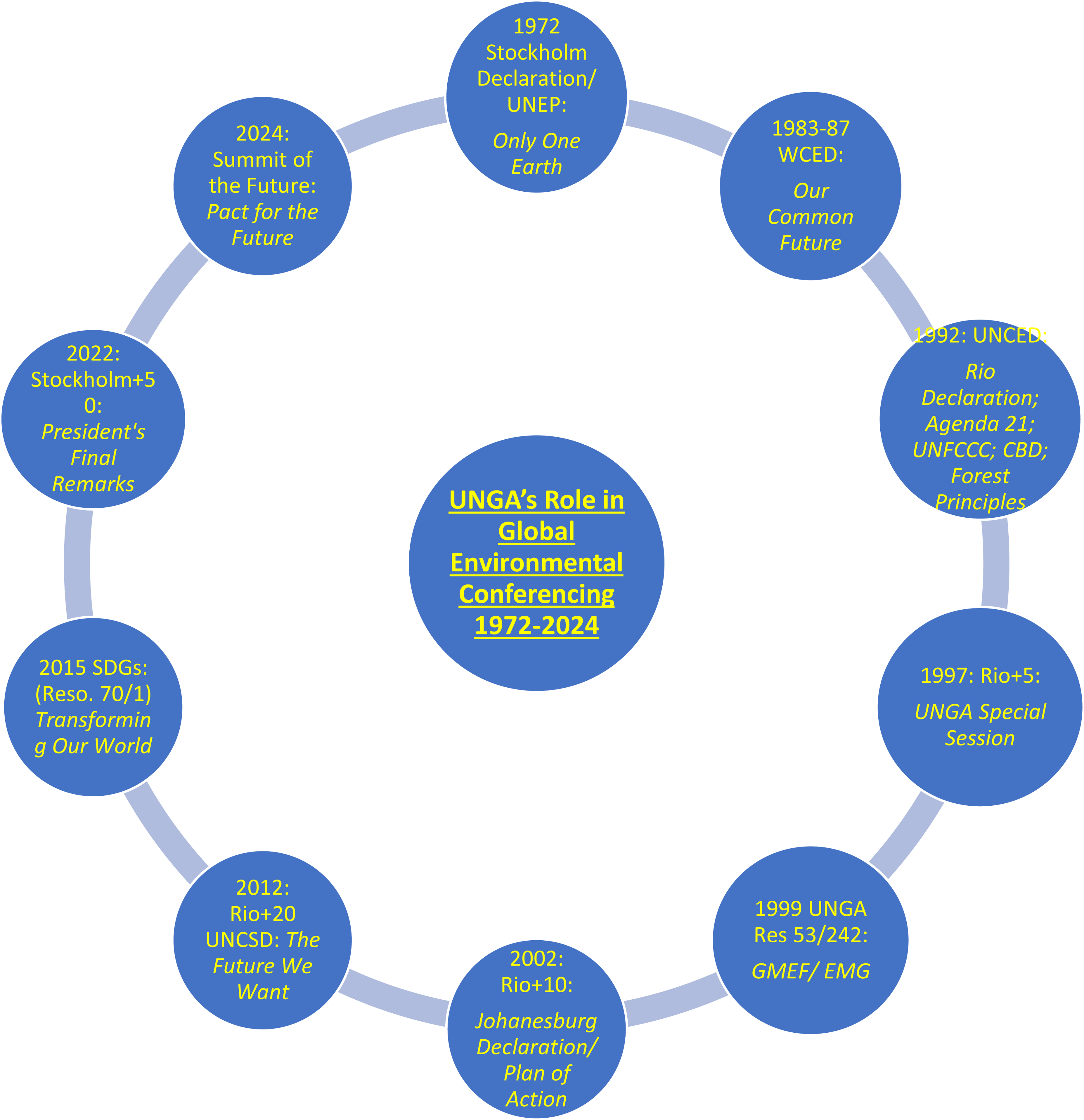
UNGA Organized Global Environmental Conferences Organized and their Outcomes (1972–2024).
In view of the UNGA's consistent engagements in addressing some of the global challenges as the “conductor of a grand orchestra” 71 the President of the UNGA, Csaba Kőrösi, invited 72 the Heads of State and Government (HoS&G) for the 2023 High-level political forum on sustainable development 73 under the auspices of the UNGA's 2023 SDG Summit (September 18–19, 2023). 74 It became significant mid-point (2015–2030) event. They were adopted (vide UNGA resolution 70/1 of September 25, 2015) with a mission for Transforming Our World. The 2023 SDG Summit could be considered as a last-ditch effort to address the “impact of multiple and interlocking crises facing the world” in the remaining seven years (2023–2030) of the current SDG cycle. The 2024 SDG Report 75 provides graphic account of the utopian goals in our troubled world (see Part III).
Audacity of Hope for the Planetary Future
The 1972 Stockholm Moment was an outcome of the “Swedish initiative” 76 that took the form of the UNGA resolution [2398 (XXIII), December 03, 1968] 77 and the resultant outcome, though under the UN auspices, had a strong Stockholm imprint. 78 In contrast, as underscored by this author [“The Stockholm Moment”; EPL 52 (3–4) 2022], 79 the Stockholm + 50 Conference was enabled by the first UNGA resolution (75/280 of May 24, 2021) 80 that explicitly gave mandate to “Sweden to host and assume the cost…with the support of Kenya” and a subsequent resolution (75/326 of September 10, 2021) 81 that called for “Sweden to host and assume the cost…with the support of Kenya…two Presidents, one from Sweden and one from Kenya”. These resolutions explicitly made the Swedish Government share the credits with the Kenyan Government.
The said UNGA mandate required that the “international meeting should be mutually reinforcing with UNEP@50, avoiding overlap and duplication”. Therefore, the UNGA required “the United Nations Environment Program to serve as the focal point for providing support to the organization of the international meeting” and suggested to the Secretary-General “to appoint the Executive Director of the United Nations Environment Program as the Secretary-General of the international meeting”. It was also curious that the commemoration of the 2022 Stockholm + 50 Moment 82 was parceled into two parts for a mere two-day event across two far-away continents: (i) UNEP@50 83 in Nairobi, March 3–4, 2022 and (ii) Stockholm + 50 84 in Stockholm, June 2–3, 2022. The changed times brought about this ‘parceling’ both due to pulls from Kenya (as host of UNEP) and UNEP itself as a ‘grown-up’ entity to share the laurels alongside the original host – Sweden – of the 1972 UNCHE.
In 2022, the world witnessed 50 years of the global environmental regulatory processes in two back-to-back events at the Stockholm + 50 Conference (June 2–3) and UNEP@50 (March 3–4) as well as 30 years of the 1992 UN Framework Convention on Climate Change 85 (June 04) and 40 years of the 1982 UN Convention on the Law of the Sea 86 (December 10). Two mega Conference of Parties meetings of the universal conventions on climate change (COP27: November 6–20, 2022) 87 and on biodiversity (COP15: December 7–19, 2022) 88 were also held without any major splash. Both the conventions, adopted at the 1992 Rio Earth Summit, 89 are yet to make a critical difference with respect to attaining their primary objectives. These events and largely ‘framework convention’ 90 processes with their in-built law-making mechanisms have shown the limits of the global conferencing techniques. Moreover, it has showed vulnerabilities of the post-Stockholm regulatory model since global environment has continued to deteriorate. Now the gathering storms indicate a planetary-level environmental crisis and possibly recalibration of the regulatory approach followed hitherto. It appears, the humankind has almost ‘sleepwalking’ into an existential “triple planetary crisis” 91 akin to the events of 1914 that led to the catastrophic World War – I. 92
The UNSG Guterres, in an address at opening (September 10, 2024) of the 79th UNGA, called for “solutions across the board” including “climate catastrophe that is killing our one and only home”. 93 In an address to the Fifth Committee (October 10, 2023), the UNSG had underscored the global perplexity wherein “we face challenges on every front” (climate change, conflicts, nuclear threat, human rights, inequalities and the SDGs in peril). 94 Similarly, in his address at the Stockholm + 50 Conference (June 2–3, 2022), the UNSG had warned that we have not kept our promises on the environment since our consumption is “at the rate of 1.7 planets a year” and the “global well-being is in jeopardy”. 95 Taking a cue from the UNSG's anguish, Inger Andersen, executive director of the UNGA's environmental subsidiary organ (UNEP), minced no words to remind the audience about our inability to find answers to “what went wrong”. Recalling the presence of only two heads of government – India and Sweden – at the 1972 Stockholm Conference, she herself chose to pose a lingering question: “If Indira Gandhi or Olof Palme were here today, what excuses would we offer up for our inadequate action?” In turn, she gave the obvious answer: “They would tell us that further inaction is inexcusable”. 96
Cumulatively, in essence, the stage set at the “2022 Stockhom + 50 Moment” 97 was inherently robbed of the luster as regards the historical significance of the occasion. Possibly, keeping in mind the ground reality of the much-divided world, it showed that the effort was to be ‘politically correct’ rather than seize the Stockholm + 50 Moment to ordain a rigorous revitalization of the existing international environmental legal instruments as well as the architecture for international environmental governance 98 (IEG) including structure, performance and location of UNEP. The organizing of the three leadership dialogues 99 as well as the Stockholm + 50 Report (August 01, 2022) 100 spelt out the five interconnected pathways (Figure 2) to provided altruist goals to weave together various global and regional processes for a healthy planet. 101
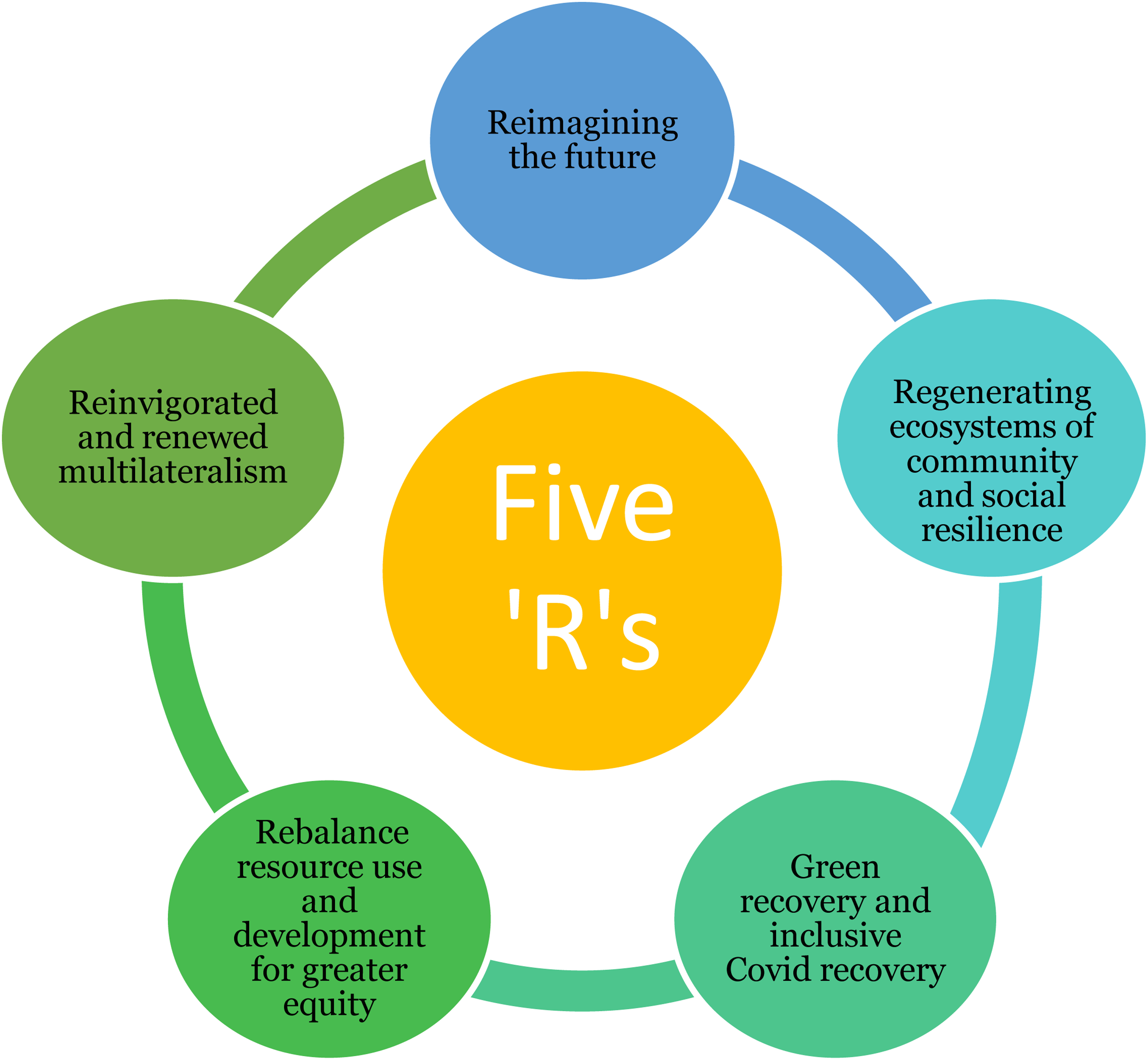
Showing the five pathways for a healthy planet.
The UNSG's repeated laments at the UNGA sessions and the recent three successive summits (2024 Summit of the Future; 2023 SDG Summit; and 2022 Stockholm + 50) underscore the gravity of the planetary crisis at work and the risks emanating therefrom. Ironically, the calls of the UNSG have been akin to the plight of the lonely House Sparrow who ran from the pillar to the post by sprinkling little drops of water when her own forest was on fire!
2024: Year of the Planetary Future
The year 2024 was all set to become a landmark in succession to 2023 and 2022 that witnessed summits on the Sustainable Development Goals 102 (New York; September 18–19, 2023) and the Stockholm + 50 Conference 103 (Stockholm; June 2–3, 2022). The outcome of these global conferences of 2023 104 and 2022 105 showed the gravity of the smoldering planetary level crisis. 106 During 2024, as mandated by the United Nations General Assembly (UNGA) resolution 76/307 of September 8, 2022 107 (Modalities Resolution), the momentous Summit of the Future 108 was held in New York on September 22–23, 2024. Thus, the year 2024 109 will be cast in stone as the year of the Planetary Future.
The Summit of the Future outcome document - Pact for the Future – is a negotiated text (56 actions point arranged in 84 paragraphs). 110 It was agreed upon through intensive intergovernmental negotiations and comprises two annexes containing two other instruments: (i) Global Digital Compact and (ii) Declaration on Future Generations. The Pact's reaffirmation of multilateralism has been assured through “unwavering commitment to act in accordance with international law, including the Charter of the United Nations and its purposes and principles” (paragraph 8). It is corollary to the earlier pledge of “recommitment to international cooperation based on respect for international law” (paragraph 5) as well as subsequent reiterations that “we must abide by international law, including the Charter (paragraph 12) as well as every “commitment in this Pact is fully consistent and aligned with international law, including human rights law” (paragraph 13). Thus, it appears, the drafters of the Pact have left no doubt whatsoever by positioning prima facie non-legally binding instrument (Pact for the Future) on the bedrock of International Law in general and the UN Charter in particular. It appears unprecedented that the final outcome declaration (designated as the ‘Pact’) of a summit comprises such explicit pledges and commitment for adherence to the architecture of International Law of which the UN Charter itself is a product. Like a treaty-based process for a review and compliance with commitments, the Pact has laid down an in-built timeframe for such a review by Heads of State and Government after 4-year hiatus at the 83rd session (2028) of the UNGA. 111
As seen in detail in previous sections, the gravity of the planetary crisis came out vividly in the three back-to-back global summits of 2024 (Summit of the Future), 2023 (SDG Summit) and 2022 (Stockholm + 50). The grim scenario was succinctly underscored by the UNSG Guterres in reminding the UN member states that we have not kept our promises on the global environment. 112 The gathering storms and the growing scientific evidence underscore the planetary-level crisis underway and humankind seems to have sleepwalked into planetary crisis. 113 Some Heads of Government have showed realization that “the decisions we make today are going to determine our future for decades to come” 114 as well as in securing “a better future to the world, and a better world to the future”. 115 Can we reverse this planetary crisis? What lies in store for the planetary future with rapidly depleting time?
Quest for Futuristic Ideas
The above-mentioned global efforts, outcomes of various multilateral global conferences and other confabulations, provide enough indications of a planetary-level environmental crisis. Do they cast shadows of the coming events before in the twenty-first century? It is almost akin to some of the catastrophic events including the two world wars that devastated the world in the twentieth century. Hence, it was logical that one of the panelists of the June 5, 2023 EPL global webinar, 116 Patricia Mbote (Director, UNEP Law Division), endorsed ideational quest for “exploring the future pathways” 117 to address the planetary level crisis. The global environmental crisis has worsened notwithstanding the mega regulatory enterprise at work since 1972 UNCHE. The crucial questions that haunt the humankind are: What went wrong? What decisive course correction is required? Thus, it makes great sense to strive for innovative and iconoclastic solutions that could form a basis for a decisive course correction. This author sought to walk-the-talk by bringing together cutting-edge ideas of global thought leaders by curating four marathon scholarly processes: (i) Perspectives of Women Scholars on International Environmental Law (IOS Press: Amsterdam, 2024); (ii) Regulating Global Climate Change (2023); 118 (iii) Envisioning Our Environmental Future (2022); 119 and (iv) Our Earth Matters (2021). 120
As a sequel to the 2024 Summit of the Future, 121 it would be appropriate for the UNGA to hold an emergency special session to set in motion a concrete normative process for a decisive course correction 122 to nudge the 193 member states to gear up for placing the crisis as a “planetary concern”. 123 It posits a challenge for the global scholarly community for pursuing an ideational groundwork, including contours of the UNGA's normative process, to be affirmed by a concrete plan of action as a follow-up to the outcome of the 2024 Summit of the Future. 124 It is in this wider context that the EPL Special Issue 54 (2024) has a theme of The Planetary Future 125 wherein some of the global thought leaders from the five continents have contributed their ideational and solution-oriented papers to look ahead into the future. The Part – I of the EPL Special Issue [54 (2–3) 2024] 126 comprises ten cutting-edge contributions by the eminent scholars: The second batch of scholarly ideas will be curated and published after the 2024 Summit of the Future 127 in the EPL Special Issue: Part – II 54 (4–5-6) 2024 on The Planetary Future. 128
A lot of scholarly ideas will be required to strengthen and amplify push to the global regulatory juggernaut, to make international law instruments work as well as ensure that various global actors including sovereign states, international institutions and other decision-makers take the task of securing our planetary future seriously. It calls for engaging in and striving for audacious scholarly quest to produce a reasonable body of solution-oriented outstanding scholarly works in the field of International Law.
Making International Law at Work
In the aftermath of the three global summits (2024, 2023, 2022) hosted by the UN and in view of the gravity of the planetary crisis, 129 the instrumentalities of International Law need to be reinvigorated so as to make them work effectively. As the plenary organ of the UN, the General Assembly has unique standing to goad the member states to comply with their treaty obligations. As noted earlier, the UNGA has employed varied tools, techniques and conferencing at different periodicity to make things happen. In the wake of this massive churning, often with heads of state and government in attendance, the line gets blurred between soft normativity and treaty-based obligations. Alongside the soft obligations in a treaty form – “hard shell with a soft belly” 130 – contained in UNFCCC (1992), CBD (1992) and UNCCD (1994), the explicit soft normativity enshrined in the Agenda 21 (1992), the SDGs (2015) and Pact for the Future (2024) are exemplars in this respect. Therefore, a concerted process mandated by the UNGA matters most.
In view of the above, it is high time that the UNGA rises to the occasion to take charge of the planetary crisis so as to secure the future before it is too late. Therefore, the UNGA needs to chart the future roadmap to institutionalize the review, establish synergy and inter-linkages as well as determine the trajectory of some of the principal MEAs (with universal membership, such as UNFCCC, UNCCD and CBD) as well as determine the designs of the futuristic IEG architecture 131 that is warranted to address the planetary level environmental challenges of the twenty-first century. A robust governance architecture as a backbone of the UN system led effort would have required resources, strength and legitimacy to attain desired results in the interests of the future generations and the planet earth. In order to set in motion a concerted global response to the planetary crisis, the UNGA could at the minimum, invoke three ideas, processes and instrumentalities of International Law as ‘low-hanging fruits’ to be set into motion at the least cost. To begin with, these would be most pragmatic steps, not requiring any de novo international legal and institutional structures as follows:
Climate Change as a Planetary Concern
Since 1988, the UNGA has been the principal conductor of the grand climate-change orchestra. Originally, it invoked the normativity of ‘common concern’ (UNGA resolution 43/53 of December 8, 1988) 132 which brought into being the UNEP-WMO joint mechanism of IPCC (resolution 43/53, paragraph 5) and triggered the process for negotiations (1990–1992) leading to the adoption of the UNFCCC 133 at the 1992 Rio Earth Summit. Therefore, it is high time for the UNGA to rise to the occasion and elevate that common concern to the higher pedestal of a planetary concern. The IPCC AR6 Synthesis Report (Interlaken; March 13–19, 2023), 134 has unequivocally confirmed widespread and rapid “human-caused climate change” occurred in the “atmosphere, ocean, cryosphere and biosphere…in every region across the globe”. Hence, the UNGA needs to take charge by adopting an appropriate normative resolution possibly during the 80th session and beyond to provide future directions to the 1992 UNFCCC 135 and 2015 Paris Agreement 136 processes.
There are indications of floundering of the UNFCCC process as seen in the outcomes of last three successive COP meetings at Baku (2024), 137 Dubai (2023) 138 and Sharm-al-Sheikh (2022). 139 The previous three decades of experiences do not augur well for transfer of technology to usher into transition away from fossil fuel economy as well as climate funding commitments desperately sought by the vulnerable countries. As we look ahead, the future trajectory of the climate change regulatory process remains uncertain. The climatic crisis presents an ideational challenge for international law scholars, the UN General Assembly and the UNFCCC regulatory process. After 30 years, as argued in the pages of this journal (Environmental Policy and Law 52 (5–6) 2022), 140 it earnestly calls for elevating the normative ambit of climate change regulation from a common concern to a planetary concern (2023; 141 2022 142 ).
To begin with, the UNGA needs to take the generational initiative by ushering the regulatory approach into a higher gear by elevating climate change from common concern of humankind to planetary concern of humankind. Moreover, the climate change regulatory process needs make International Law work by earnestly requiring the states Parties primarily responsible for causing the climate change problem in the first place to take the lead by complying with all legal obligations, consequences and requirements. In the era of a planetary crisis, as we look ahead, it is high time for the States Parties to the three climate change instruments (1992 UNFCCC, 1997 Kyoto Protocol and 2015 Paris Agreement) to engage in a major course correction in their respective current regulatory approaches – as preliminarily spelled out above, within the limits of time and space – for securing our planetary future.
Significantly, the advisory opinion sought by the UNGA resolution 77/276 (March 29, 2023) 143 from the International Court of Justice (ICJ) 144 is indicative of the crisis at work. The ICJ has been requested to clarify as regards: “obligations of States under international law to ensure the protection of the climate system and other parts of the environment from anthropogenic emissions of greenhouse gases for States and for present and future generations” as well as “legal consequences under these obligations”. As set out by the Court, the processes of filing of 91 written statements and oral presentations (December 02–13, 2024) has been completed. Notwithstanding, three legal instruments regulating global climate change and the annual COP meetings taking place, it seems most of the states and international organizations are looking for an authoritative exposition of the illusive ‘obligations’ from the world court. Having prepared the written statement filed by India (March 21, 2024), this author is cognizant of the general view and desire of the sovereign states to stay with the chosen course that “obligations of States with respect to climate change are under the 1992 UNFCCC, and its instruments- the 1997 Kyoto Protocol, and the 2015 Paris Agreement.” As a corollary, it is legitimate for the state parties to expect the ICJ to “avoid devising new or additional obligations beyond what is already agreed under the existing climate change regime.” 145 After completion of the marathon and unprecedented process, the Court is expected to pronounce its advisory opinion in the first half of 2025.
After the ICJ renders an opinion, the ball would revert back to the UNGA. Therefore, the onus would lie upon the UNGA and possibly the ICJ advisory opinion could illuminate the future pathway by suggesting the “decisive course correction.” Still, any such remedy and the framework for salvation from climate crisis, undertaken in the collective wisdom of the UNGA, would need to be made to work upon the bedrock of International Law.
Specialized Agency for the Environment: UNEPO
A product of the 1972 Stockholm Moment, UNEP has been working as an environmental subsidiary organ of the UNGA. There has been much discussion among scholars and decision-makers to enhance the current programmatic format of UNEP. Since the 1998 Klaus Toepfer Task Report on Environment and Human Settlements, 146 several exercises were undertaken to boost its institutional status within the UN system. In an invited talk of January 15, 1999, at the Legal Department of the World Bank, this author had called for upgradation of UNEP as the United Nations Environment Protection Organization (2014; 147 2012; 148 2006; 149 2000 150 ). Notwithstanding the change in nomenclature as UNEA 151 in place of the Governing Council and the universal membership, UNEP remains trapped in the quagmire of a program and its location in Nairobi (Kenya) that has often posed many practical challenges. Since UNEP is still not a full-fledged international organization, it is high time to finally confer it with the status of a UN ‘specialized agency’ (vide Articles 57 and 63 of the UN Charter). 152 Instead of the current ‘program’, such a treaty-based international environmental organization (UNEPO), 153 would be an effective instrumentality to address the planetary-level environmental challenges of the twenty-first century, contribute to new forms of regulatory approaches, processes and institutionalized forms of international environmental cooperation, avail membership-based UN scale of funding assessment as well as bring other institutional actors and stakeholders on board. After full 53 years, the UN system needs to have a full-fledged ‘specialized agency’ (UNEPO) for the global environment through adoption of a special treaty by the UNGA. It would resolve the issues pertaining the ‘status anxiety’ in the hierarchical UN system as well as taken seriously by the UN member states and other global institutional actors.
Repurposed UN Trusteeship Council
Along with the UNEP, there is a need to revive and repurpose the UNTC to look after the need and actions of the present and future generations for the conservation and protection of the global environment and the global commons. In the 2021 Our Common Agenda report, 154 the UNSG Antonio Guterres acknowledged that the UNTC needs to be repurposed as a deliberative forum on behalf of succeeding generations. The UNSG report has provided a fresh impetus to this author's 155 long-pending 1999 proposal (2023; 156 2022; 157 2022; 158 2021; 159 2018; 160 2014; 161 2000 162 ) for revival and repurpose of the UNTC (Articles 86–88, Chapter XIII of the UN Charter). 163 It came at a time when the world was getting ready for the 2022 Stockholm + 50 Conference. As explained at length in this author's above-mentioned proposal, the UNTC could be entrusted with the task of supervising the scattered legal regimes for some of the universal environmental conventions as well as the global commons. In fact, it could share the tasks of the other two overburdened principal UN organs — the UNGA and the ECOSOC. As a corollary, the repurposed UNTC would serve as the UN system's in-house global supervisory organ for the environment, global commons and sustainable development. It will also obviate the need for new funding demands and the creation of any de novo institutional structure.
Notwithstanding all the pious declarations, international instruments and institutional maze, global environmental conditions have reached a perilous state. On June 02, 2022, UN Secretary-General António Guterres 164 described the triple planetary crisis as “our number one existential threat” that needs “an urgent, all-out effort to turn things around.” Similarly, Inger Andersen, UNEP executive director and the Secretary-General of Stockholm + 50, 165 underscored that “If we do not change, the triple planetary crisis of climate change, nature and biodiversity loss, and pollution and waste will only accelerate.” The President of the 76th General Assembly, Abdulla Shahid, 166 also reminded at the 2022 Stockholm + 50 Moment that the policies we implement today “will shape the world we live in tomorrow”. Thus, the collective wisdom reflected in the UNGA mandated global summits and multilateral processes underscore the dire need for a strong inhouse institutional mechanism of the UN. Therefore, it is the need of the hour to revive and repurpose the dormant UN organ that can marshal all its concerted and full efforts to squarely address the challenge of the planetary crisis. The repurposed UNTC would be in a best position to bring together entire UN system wide energy and resources to put into practice the decisions of the UN member states on a war footing even as the calls are made to reposition and equip the UN with twenty-first century instruments to address the twenty-first century challenges.
Pact for the Future of the Planet
On the road to the 2024 Summit of the Future
167
there was a room for terrain mapping as regards the agenda and issues to be addressed so as to engage in greater scholarly churning for invoking instrumentalities of international law. However, the onus remained on the decision-makers of the sovereign States, the UN system, multilateral treaty frameworks and other international institutions to translate some of these cutting-edge scholarly ideas into action to save the humankind from a planetary crisis.
168
It was expected that “an action-oriented Pact for the Future will be endorsed by Heads of State/Government at the Summit, showcasing global solidarity for current and future generations.”
169
The Summit's aim was to reinforce the UN and global governance structures to address the old in a better way and handle the new challenges for the advancement of the SDGs by 2030 and “a booster shot for the SDGs”.
170
The UNSG Guterres justified convening of the 2024 Summit since “twenty-first century challenges require twenty-first century solutions” and observed: “We are here to bring multilateralism back from the brink. I called for this Summit to consider deep reforms to make global institutions more legitimate, fair and effective, based on the values of the UN Charter. I called for this Summit because twenty-first century challenges require twenty-first century solutions: frameworks that are networked and inclusive; and that draw on the expertise of all of humanity. I called for this summit because our world is heading off the rails – and we need tough decisions to get back on track.”
171
The Summit of the Future ended on September 23, 2024 after two days of routine speeches by the Heads of State or Government as well as intensive and interactive four dialogues. The Summit adopted an ambitious outcome document – Pact of the Future– along with its two annexes on Global Digital Compact and Declaration on Future Generations. 178 It was presented by the President of the 79th UNGA and formally adopted as resolution 79/1 on September 22, 2024. Philémon Yang, President of the 79th UNGA (elected on June 06, 2024) observed that “As we close the Summit of the Future, I urge all Member States to continue to push for decisive action and to create meaningful progress.” 179
There have been areas that needed to be addressed as futuristic challenges at the 2024 Summit of the Future. According to different studies, the world economy may face huge economic losses due to climate change. According to the S&P Ratings (April 28, 2022) “climate risks could expose 3.3%, 4%, and 4.5% of world GDP to losses by 2050 under climate pathways RCP2.6 (Paris Agreement), RCP4.5 (current policies), and RCP8.5, assuming no adaptation and all risks materialize simultaneously”. 180 In conditions driven by events such as pandemics, epidemics and climatic conditions, there is heightened risk of violence against women. According to the UN Women, the cost of violence against women could amount to around 2 percent of the global gross domestic product. Thus, it seems clear that SGBV due to climate change imposes double economic burden on States. Climate change and SGBV cause economic loss for States, societies and families both individually and jointly resulting in phenomenal economic losses. 181
In view of these current and futuristic global planetary level challenges, all the sovereign States would need to earnestly adhere to the UNGA mandated multilateral deliberations and follow-up the outcome (Pact for the Future) of the 2024 Summit of the Future so as to work out concrete solutions to save the planet Earth. The resolute mantra would need to be walking-the-talk even as the Pact for the Future (September 22, 2024) fell short of being a game changer amidst dire warnings of the planetary crisis.
Conclusion
The outcomes of three global summits (2024, 2023, 2022) provided vital lessons for the scholars of International Law and International Relations to think aloud and ahead for our better common environmental future. In order to save the humankind and the planet from a smoldering planetary crisis, we need cutting-edge ideational solutions. In the realm of such possibilities, it was a humbling experience for this author to reach out during 2020–2024 to the outstanding thought leaders from around the world. The harvesting of the creative ideas yielded rich corpus of ideational research papers, curated by this author and published by the IOS Press (Amsterdam, Berlin, Washington DC) in four books: 2024, 182 2023; 183 2022 184 and 2021. 185 It shows that at a time of such a planetary crisis when our future is stake, it is possible for the conscientious and forward-looking scholars to seed ideational solutions to save the humankind from the brink. There are ‘limits to growth’ but no limits to human ingenuity in times of existential planetary crisis. It is this audacity of hope 186 that engenders role for a world leader beyond 2024 Summit of the Future to invoke instrumentalities of International Law by translating into action some of the ideas enumerated in this paper comprising prognosis and prospects for the planetary future. It would decide what lies in store for the humankind and the planet Earth in the coming years. Time will need to be kind to us in salvaging our planetary future.
Footnotes
Funding
The authors received no financial support for the research, authorship, and/or publication of this article.
Declaration of conflicting interests
The authors declared no potential conflicts of interest with respect to the research, authorship, and/or publication of this article.