



Abstract
Purpose
This retrospective cohort study sought to examine participant skill and functional progression in an adaptive snow sports program for children and young adults with disabilities.
Methods
One hundred twelve individuals, majority male, who participated in at least 2 adapted ski or snowboard sessions were evaluated by trained adaptive instructors. The primary outcome measure was standardized skill level ranging from 1-novice to 9-expert. Secondary outcome measures of cognitive, emotional, social, physical, and independence scores, were rated on a scale from 1–5, with 5 being the highest.
Results
The median number of sessions per participant was 4 (range 2–65 sessions) and median participation duration was 2 years (range 2–10 years). A Wilcoxon-rank sum test demonstrated an improvement in final skill level compared to baseline (p < 0.0001), with an average increase of 1.2 skill levels per participant and an average increase of 0.48 skill levels per year of involvement. There were also improvements from initial session to final session in all secondary outcomes: social (p = 0.002), emotional (p = 0.018), physical (p < 0.0001), and independence (p < 0.0001) scores.
Conclusion
Overall, there were improvements in all measured domains. This uses objective and functional measures to validate ongoing engagement with this adaptive skiing program at the athlete, volunteer, and organizational levels.
Background
Adaptive downhill skiing has been described as a fun, safe, engaging recreational activity for those with disabilities. 1 Over the past few decades, advancements in adaptive sports have made safe participation an option for those with disabilities. There are numerous ways alpine skiing can be modified to meet these athletes’ needs. For instance, amateur athletes can use tethered skis, horizontal poles held by their instructors, or modified walkers. For those that have poor standing balance, or are non-ambulatory, sit-skis are an option. Furthermore, these can have outriggers to add additional support and balance for athletes with poor trunk stability or core strength. These options provide equal and accessible alternatives for those with disabilities to get out and enjoy the winter slopes but there is increasing pressure, in a finite resource environment, to show objective benefits of participation.
Adaptive skiing is well-established as a therapeutic activity, yet the literature of its benefits remains incomplete with a focus on a relatively short duration of clinical intervention. Repeat themes include improvements of strength, endurance, cardiovascular health, autonomy, self-esteem, social and conversation skills, attention, health perception and quality of life. No studies have examined the objective sport specific skill progression during participation in an adaptive ski program. Additionally, there are limited studies exploring the outcomes of participation over a long duration. A systematic review examined 10 studies with most interventions lasting less than 10 days and having a follow-up of 10 weeks or less. 2 Only one study looked at long-term follow up, with multi-year trends of self and parent reported quality of life for those that participated from 1–5 years, 3 but it did not evaluate skill level. Our study aims to determine longitudinal skill and functional progression of participants in a community-based adaptive snow sports program for children and young adults with disabilities.
Methods
With approval from the institutional review board, a retrospective cohort study was conducted of records collected by a local adaptive ski/snowboard program. The analysis included all de-identified participants over a 10 year period, from 2012–2022.
Unlike some adaptive sports programs, that have more structured, consistent requirements, the program described in this study allows for various degrees of athlete involvement. Children can come test out the slopes a minimum of one time, via a single day pass, or longer throughout the entire winter. These snow sports options include a four-week, weekday series and three-week, weekend series. Often parents and children choose two four-week weekday series, for a total of 8 sessions. No matter the duration of the winter season, each snow sports session is 3 h long. Athletes are encouraged and welcome to come out additional days with their friends and family.
Like other adaptive ski programs, athletes were typically instructed on a 1 to 1 basis. 4 Professional Ski Instructors of America and American Association of Snowboard Instructors (PSAI-AASI) certified instructors trained volunteers on ski instruction, adaptive equipment use, skill levels, and scoring. The primary outcome was the PSIA-AASI skill level assessment. 5 Skill levels range from 1-novice to 9-expert (Table 1). Daily scores were assigned by the instructor at the completion of the session.
Professional Ski Instructors of America (PSIA) skill classification.
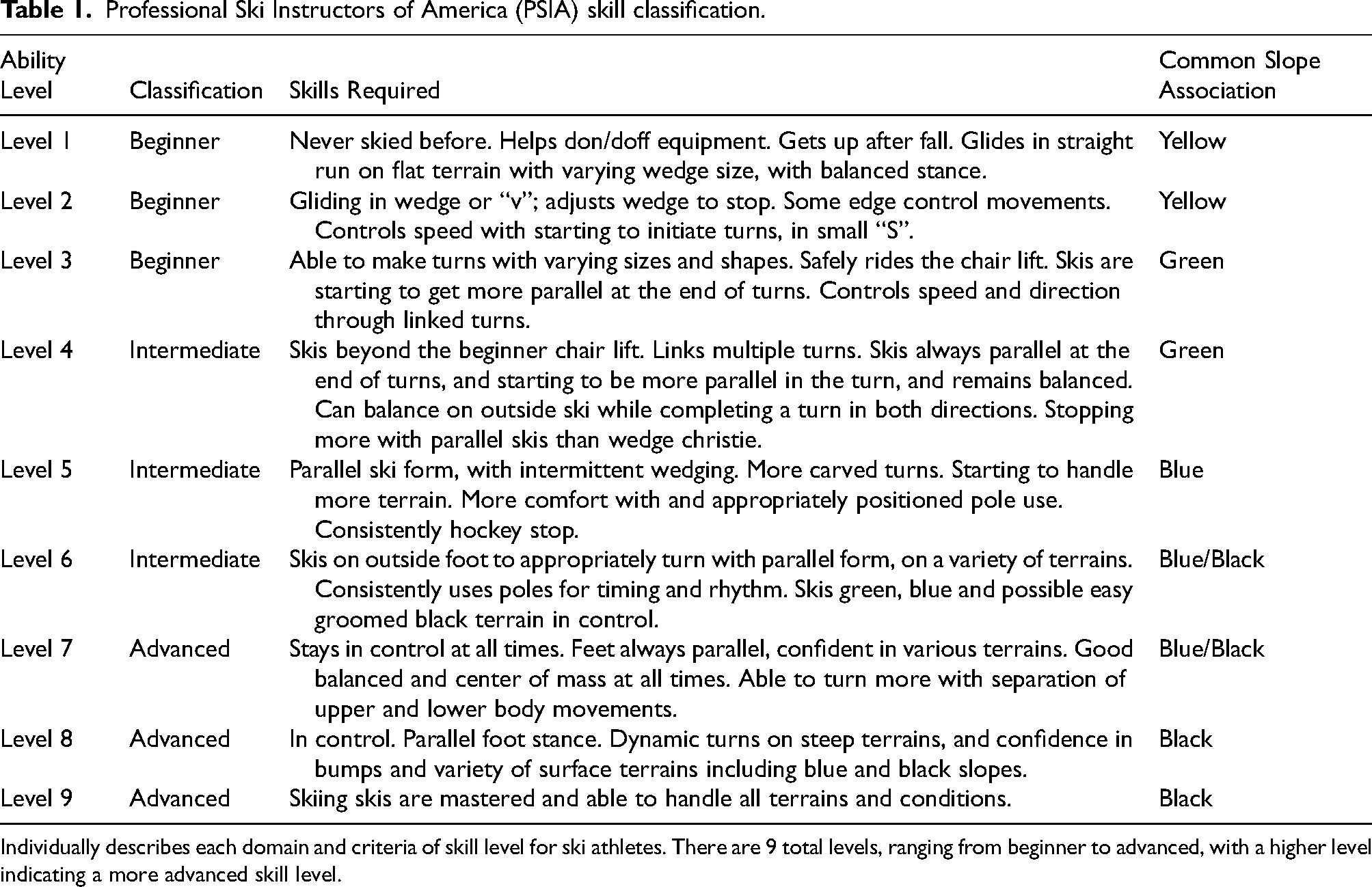
Individually describes each domain and criteria of skill level for ski athletes. There are 9 total levels, ranging from beginner to advanced, with a higher level indicating a more advanced skill level.
The secondary outcomes include instructor-based scores of the participants’ cognitive abilities, emotional stability, social engagement, physical abilities, and perception of independence that day. These were scored on a scale from 1–5. Higher scores were associated with more engagement, improved emotional regulation, appropriate social interaction, improved physical skills, and independence. These secondary outcomes scores were not based on a published scale, rather these scores were pulled directly from the organizations’ previously created scoring sheet, and were used to document subjective progress in these realms. (Figure 2)
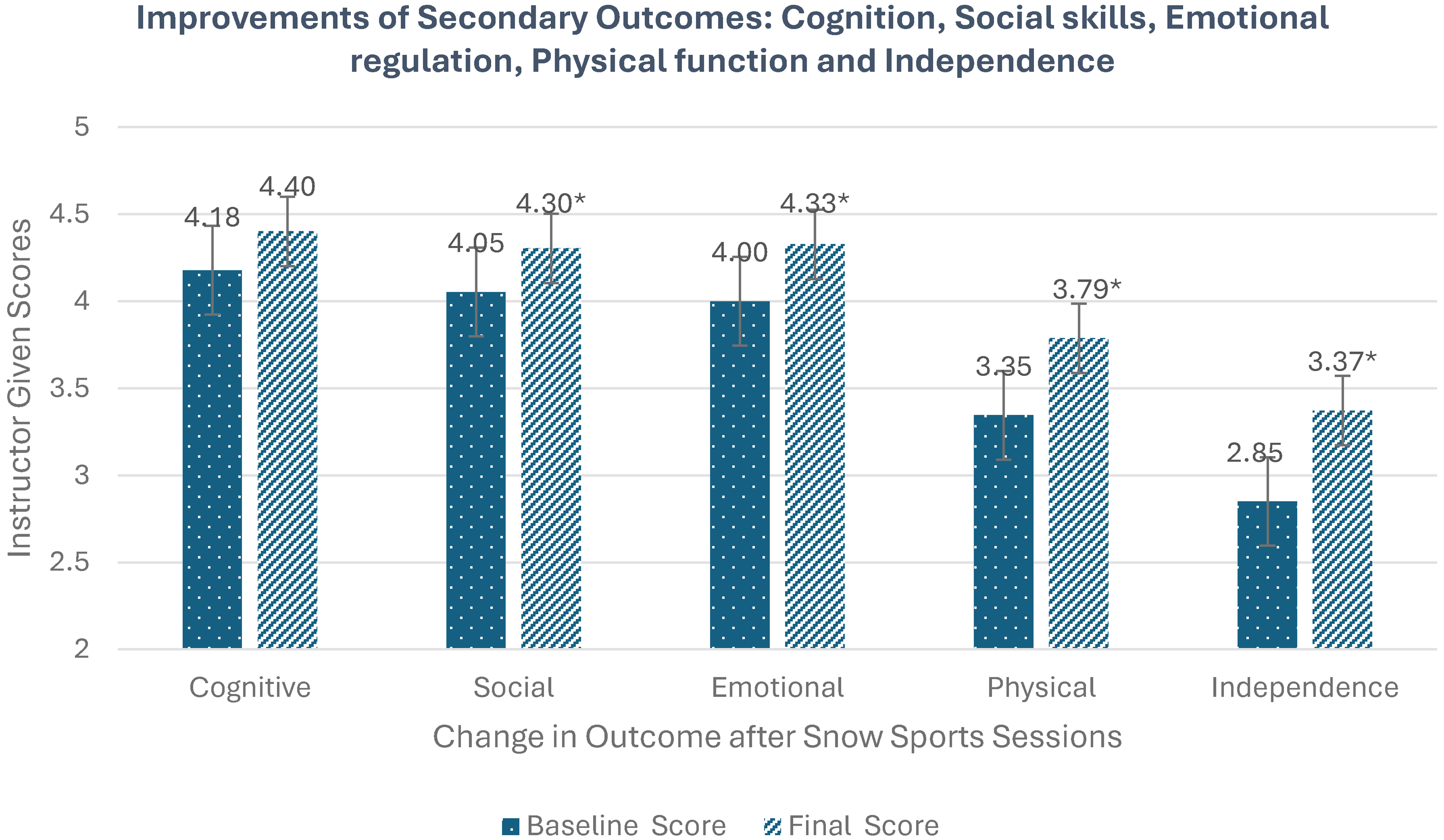
Secondary outcomes of cognitive, social, emotional, physical and independence scores after winter sports sessions. Change in median scores across cognitive, social, emotional, physical and independence domains after participation (*p < 0.05). Bars represent median, while error bars indicate interquartile ranges. Baseline skill dotted. Final skill striped.
Participants were included who were less than 25 years old, attended more than one session, and had fully filled out participant scoring sheets.
Statistical analysis was performed via descriptive statistics and Wilcoxon rank sum test to demonstrate change from initial to final evaluation, using only the first and last sessions. The additional sessions were not considered in analysis due to marked variability between participants.
Results
There were 181 participants screened, and 112 participants met inclusion criteria. Sixty-eight participants were excluded due to missing documentation, or only completing 1 session. There were 73 male and 39 female participants. Sixty-two participants had documented ages at onset of their first snow sports session. Of these 62 participants, the mean age was 16.4 years old, with a median age of 17 years old.
Of the 112 participants, 63 had documented disabilities in their parent-completed athlete information sheet. These amateur athletes had the following diagnoses: attention deficit hyperactivity disorder (2), anxiety (3), autism (11), blindness or visual impairment (37), cerebral palsy (7), down syndrome (3), fragile X syndrome (2), limb difference (2), spinal cord injury (1), spina bifida (4), Tourette syndrome (1), cognitive impairment (4), seizures (2). The most common diagnoses are blindness or vision impairment (37), autism (11), and cerebral palsy (7). Athletes who did not have their formal diagnoses recorded but met the other inclusion criteria, were included in the larger group data collection and analysis.
The snow sports chosen included stand up ski (89 participants), sit ski (16 participants), and snowboard (7 participants). Among all participants, the median number of sessions per participant was 4 (range 2–65 sessions) and median participation duration was 2 years (range 2–10 years). A Wilcoxon-rank sum test demonstrated a statistically significant (p < 0.05) improvement in final skill level compared to baseline (p < 0.0001), with an average increase of 1.2 PSIA-AASI skill levels per participant with an average increase of 0.48 skill levels per year of involvement (Figure 1). There were also demonstratable improvements from initial session to final session scoring across social (p = 0.002), emotional (p = 0.018), physical (p < 0.0001), and independence (p < 0.0001) domains. (Figure 2). The cognitive domain did not reach statistical significance but demonstrated a trend towards improvement (p = 0.07).
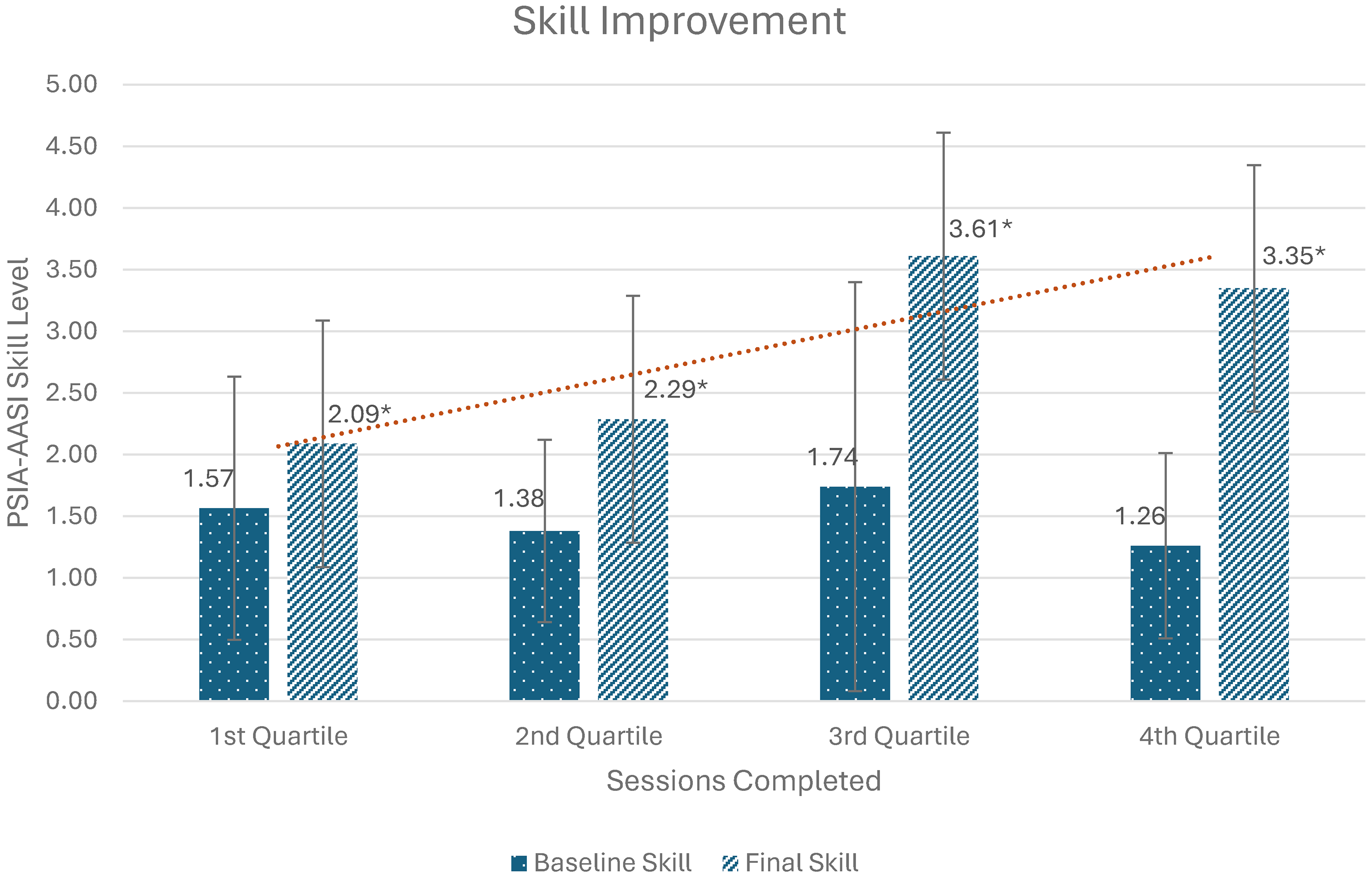
Primary outcome of skill level improvement after winter sports sessions. Illustrates four separate quartiles of sessions completed, in relation to mean skill level improvement (*p < 0.001). Bars represent the mean, while error bars represent standard deviation. Baseline skill dotted. Final skill striped.
Discussion
This is the first report of a community-based adaptive skiing program to analyze objective skill progression and social/emotional development of youth who participated in a “real world” program over 10 years. The findings support and add to the previously published benefits of adaptive skiing interventions. Athletes tended to participate in the program for more than one season allowing analysis of long-term skill progression and retention. Skill level improved in all skiers, regardless of number of sessions, age, or diagnosis. However, there was greater improvement in skill level in those who participated more frequently. Observed statistically significant improvements in longitudinal scores of secondary outcomes of emotional stability, social engagement, physical abilities, and independence are supported by previous published evaluations of shorter interventions.1,3,4,6–8 The retrospective cohort structure of this study provided an ability to analyze self-determined participation over a much longer period compared to previous studies, but a lack of control group makes true causation difficult to determine and an incomplete data set reduced the number of included participants and the ability for sub-group analysis. Limitations that exist within the study include lack of uniformity in the number of sessions, lack of consistency in instructors’ teaching, and subjective instructors’ scores. The adaptive sports program allowed for participants and their families to decide among various degrees of involvement, with total session numbers varying from 2 to 65 across a range of 1 to 10 years. As such, only the first and last sessions were used in the statistical analysis. The adaptive sports program has many skilled instructors that are certified in both abled and adaptive ski instruction. However, it also relies heavily on volunteers. Volunteers range in ski skill levels themselves. 9 Therefore, this variability in the instruction could alter the true skill progress that children are making on the slopes. Despite the observation of statistically significant improvements, it is possible that children who are led by more highly skilled instructors, may experience even greater skill improvements. The scales used for the secondary outcomes are subjective measures. Future studies could ensure instructor consistency or analyze objective skill measures such as time to complete runs, stability, or accuracy of navigation. A future protocol could also be improved by using validated social, cognitive and quality of life outcome scales.
In addition to those limitations, another limitation is within the scale used to determine skill level. Within the ski skill levels (1–9), the biggest change in levels will be seen between levels 1–4. As skiers progress in their abilities, there is an observable plateau at levels 5–6. It becomes naturally difficult to advance to levels 7–9, without more experienced instruction, more sessions on the slopes, and more advanced ski runs (Table 1). Therefore, it is vital to leverage longitudinal analysis with a robust prospective data set in a future expansion study, to better analyze variables such as impact of age, gender, diagnosis, and incremental change.
Conclusion
This study emphasizes the improvements in skill level, social, cognitive, emotional, independence and physical domains and illustrates persistence in these improvements year over year. Evaluating the effectiveness of adaptive sports programs through objective measures provides important information to guide participants’ expectations, assist with evidence-based program development. While there are limitations in the methods and data set, this foundational work highlights the value and direction of a more objective collection in the future. Moreover, this study demonstrates that by creating research partnerships with community organizations, researchers can help guide usage of validated outcomes that allow the programing to be tailored to adaptive athletes’ needs. This formal collaboration is necessary to advance the quality of real-world application of adaptive sports and recreation resources into the future.
Footnotes
Acknowledgments
We would like to acknowledge Midwest Adaptive Sports for their partnership on this project. Specifically, we would like to acknowledge professional ski instructor, Jennifer Eichner, for her engagement, guidance, and collaboration.
Funding
The authors received no financial support for the research, authorship, and/or publication of this article.
Declaration of conflicting interests
Stephanie M. Barton: The author declared no potential conflicts of interest with respect to the research, authorship, and/or publication of this article. Presented poster nationally at AAPM&R 2022 in Baltimore, MD during a “Research Hub - Live Theater Research Spotlight: Pediatric Rehabilitation poster session” October 21, 2022. Presented poster locally at Children's Mercy Hospital Research Days, May 12, 2023. Matthew J. McLaughlin The author declared no potential conflicts of interest with respect to the research, authorship, and/or publication of this article. Mark T. Fisher The author declared no potential conflicts of interest with respect to the research, authorship, and/or publication of this article.