



Abstract
This study examines the rise of robotic technologies in libraries and the essential skills and knowledge required of librarians within the context of Industry 5.0. Guided by four objectives, the study adopted a systematic literature review design using the PRISMA framework. 59 records were retrieved from Scopus, Web of Science, and Google Scholar, and 27 peer-reviewed studies published between 2020 and 2025 were included for narrative analysis. The findings show that libraries are increasingly integrating both physical and software-based robotic systems, including shelf-reading robots, automated storage and retrieval systems, humanoid service robots, chatbots, virtual assistants, and AI-driven intelligent systems. The review reveals that librarians require a hybrid competency profile combining technical and digital proficiency, AI literacy, ethical awareness, collaborative ability, and continuous professional development. Preparedness levels vary across contexts and are influenced by infrastructure, funding, institutional support, and training opportunities. Financial constraints, technical compatibility challenges, ethical concerns, and workforce anxieties remain significant barriers. The study concludes that robotics in libraries is an emerging yet operational area that requires deliberate curriculum reform, sustained institutional investment, and clear policy direction to support effective human–robot collaboration and sustainable service delivery in Industry 5.0 environments.
Introduction
The growing convergence of robotics, artificial intelligence, and human-centred technological design is reshaping professional practices across sectors, including libraries. Within the context of Industry 5.0, the focus has shifted from automation-driven systems to environments where human expertise and intelligent machines interact in more complex and collaborative ways. This shift has significant implications for library services, organizational structures, and professional roles, as libraries increasingly integrate intelligent technologies into core operations such as information service delivery, user support, and knowledge management. 1 Consequently, librarians are required to develop competencies that extend beyond traditional professional skills to include technological, analytical, and adaptive capacities that support effective engagement with robotic and intelligent systems.
Recent scholarship has examined the evolving competencies of librarians in technologically mediated environments. Studies indicate that librarians must acquire advanced technological and digital skills to effectively utilize contemporary information technology tools. 2 Research has also explored the transformative potential of artificial intelligence in academic libraries, while identifying institutional and professional challenges associated with its adoption. 3 Analyses of emerging trends in library services further suggest that librarians are expected to develop diverse competencies in response to technological and organizational changes. 4 Earlier discussions of the implications of the Fourth Industrial Revolution have similarly demonstrated that technological innovation continues to reshape library practice and professional expectations. 5
Despite these scholarly contributions, existing research has not sufficiently examined robotics as a distinct technological force within the framework of Industry 5.0. Much of the literature focuses on digital transformation, information technology skills, or artificial intelligence, with limited attention to the specific implications of robotic systems for librarianship. Furthermore, a substantial proportion of prior studies adopt conceptual or review-based approaches, providing limited empirical evidence on the concrete skills and knowledge librarians require in environments where robotic technologies are integrated into library operations. In developing contexts, particularly in Africa, investigations into robotics in libraries remain limited, and where such studies exist, they often address technological change in general terms rather than examining robotics and human–machine interaction in a systematic manner.
This situation presents a critical challenge for contemporary library practice and professional development. As libraries increasingly adopt robotic and intelligent systems, the absence of empirically grounded knowledge about the competencies required of librarians may hinder effective technological integration and reduce the quality and responsiveness of library services. It may also widen the gap between technological innovation and professional capacity, thereby constraining the ability of librarians to function effectively within technologically advanced information environments. Without clear evidence on the skills and knowledge required of librarians in Industry 5.0, library institutions, educators, and policymakers lack a robust foundation for designing relevant training programmes, curricular reforms, and professional development strategies.
This study, therefore, examines the rise of robots in libraries and identifies the essential skills and knowledge required of librarians in Industry 5.0. Unlike earlier studies that primarily address digital competencies or artificial intelligence, this research focuses explicitly on robotics and human–technology interaction within library environments. By addressing conceptual, contextual, and empirical gaps in existing scholarship, the study contributes to a deeper understanding of technology-driven librarianship and provides evidence that is relevant to library practice, education, and policy development in the era of Industry 5.0.
In so doing, the following questions were formulated to guide the study: 1. To identify the types of robotic technologies currently adopted in library service delivery within the context of Industry 5.0. 2. To examine the skills required by librarians to effectively operate and collaborate with robotic systems. 3. To assess the level of preparedness of librarians for working alongside robotic technologies in the evolving library environment. 4. To explore the challenges associated with the integration of robots in libraries
Methodology
Research Design
This study adopted a systematic literature review approach guided by the Preferred Reporting Items for Systematic Reviews and Meta-Analyses (PRISMA) framework. The study followed the systematic literature review method because it enables the synthesis of scattered evidence and supports a clear understanding of current issues in library and information science, as seen in the works of Ayinde et al.
6
and Lee et al.
7
The PRISMA model provides a structured and transparent method for identifying, screening, and evaluating research evidence. PRISMA guided the stages of identification, screening, eligibility assessment, and inclusion. This structured approach strengthened the integrity and transparency of the review and supported a focused examination of studies that address the rise of robotics in libraries and the essential skills and knowledge required of librarians within the context of Industry 5.0 (Figure 1). Procedure for inclusion and exclusion.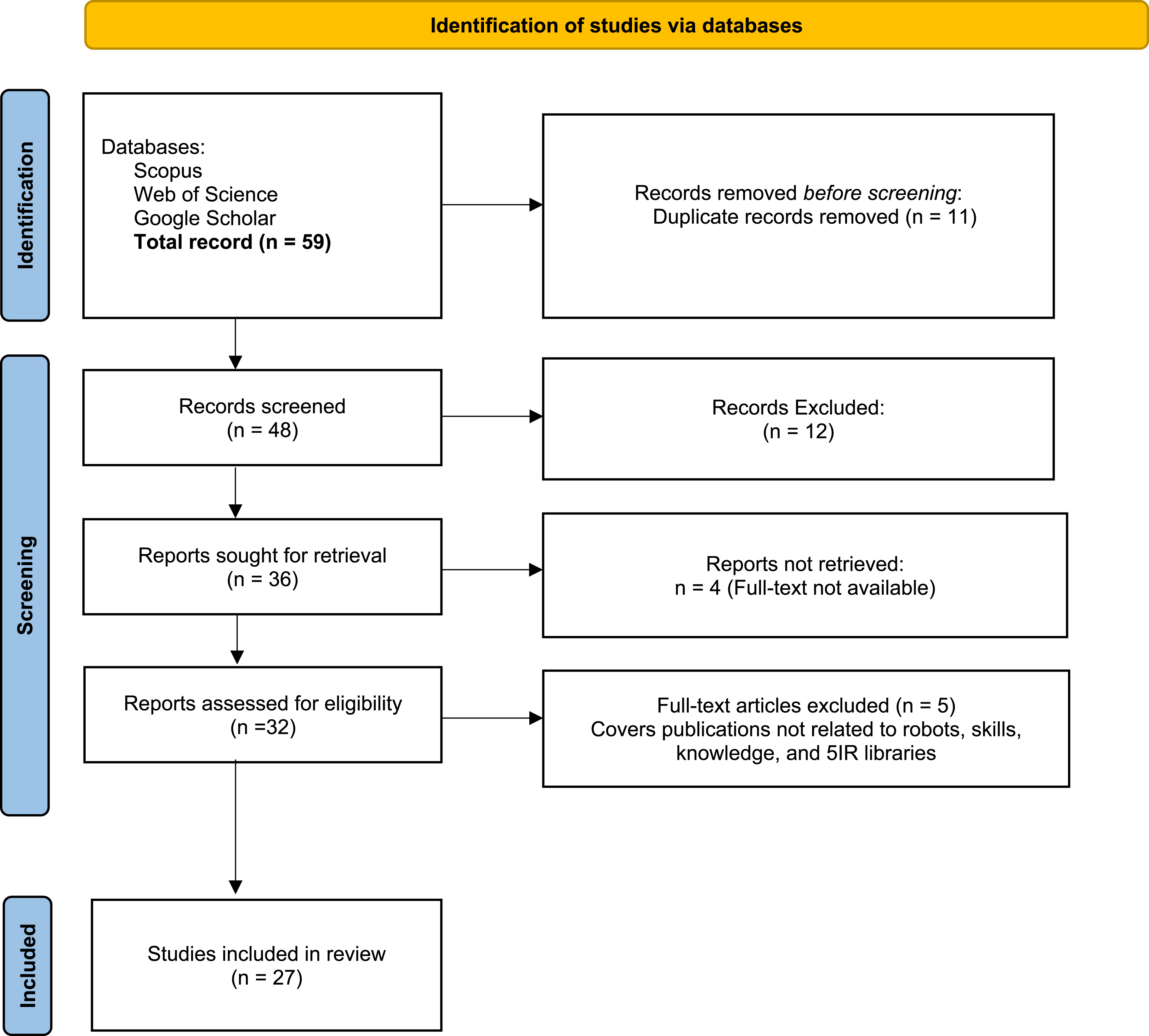
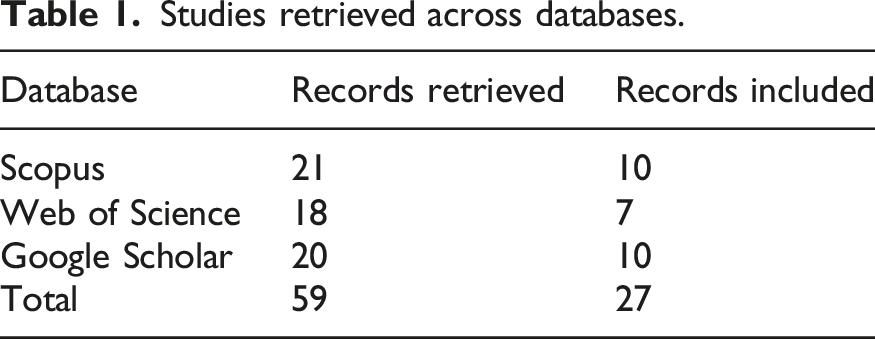
Selection of information resources databases
Studies retrieved across databases.
Search terms and search strategy
The identification of search terms was guided by the core conceptual components of the study, namely, robotics, Industry 5.0, libraries, librarians, and professional competencies. An exploratory search was first conducted to identify commonly used terminologies in existing literature, after which keywords were refined through iterative testing to ensure conceptual precision and adequate coverage. The primary search terms included robotics, robots, Industry 5.0, libraries, librarians, skills, competencies, knowledge, artificial intelligence, and emerging technologies. These terms were combined using Boolean operators to construct comprehensive search strings. Truncation and phrase searching were applied where appropriate to capture variations of key terms. The final Boolean search string was formulated as follows: (“robot*” OR “robotics” OR “artificial intelligence” OR “intelligent systems”) AND (“library” OR “libraries” OR “librarian*”) AND (“skills” OR “competenc*” OR “knowledge” OR “professional development”) AND (“Industry 5.0” OR “emerging technologies” OR “digital transformation”). This search string was adapted slightly across databases to accommodate differences in search functionalities while maintaining conceptual consistency. The search was conducted between 10 September 2025 and 30 October 2025.
Inclusion and exclusion criteria
To ensure relevance and analytical rigour, explicit inclusion and exclusion criteria were applied throughout the selection process. Studies were included if they focused on robotics, artificial intelligence, or intelligent systems in library contexts, addressed the skills, competencies, or knowledge requirements of librarians or information professionals, were published in peer-reviewed journals or book chapters/conference proceedings, were written in English, and were published between 2020 and 2025.
Studies were excluded if they did not relate to libraries or librarianship, focused on robotics or artificial intelligence in unrelated disciplines without implications for library practice, constituted non-scholarly publications such as editorials or opinion pieces, were duplicates, or lacked substantive discussion of professional competencies or technological implications for librarians. These criteria ensured that only studies directly relevant to the research objectives were retained.
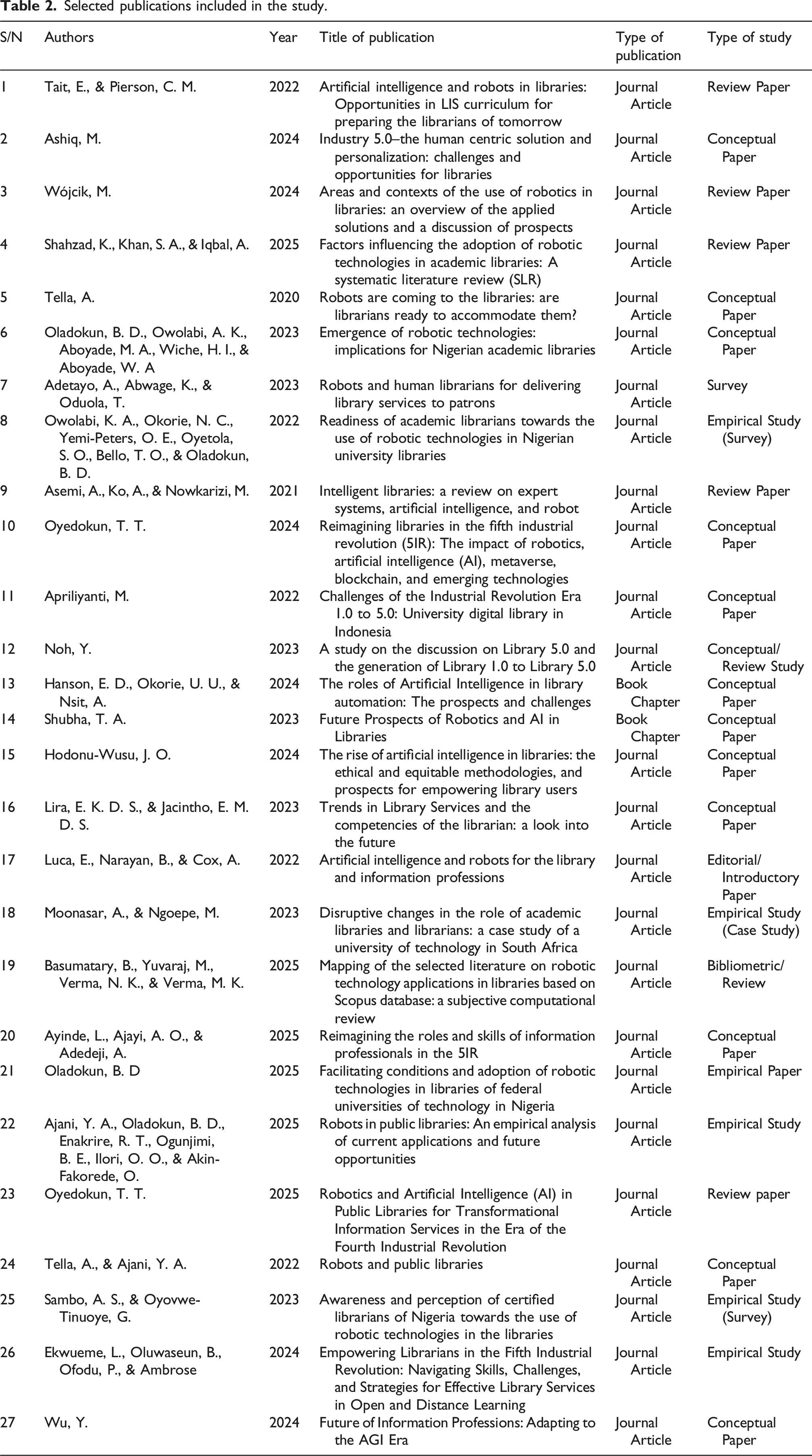
Data collection and screening
Selected publications included in the study.
Quality appraisal
All eligible articles were appraised using the Liu and Liu 8 checklist, which examines methodological soundness, clarity of reporting, and relevance of findings. Only studies that met the minimum quality requirements were included. Any differences in judgement between the researchers were resolved through discussion to ensure consistent application of the criteria. A total of 27 articles met all requirements and were included in the final synthesis. The flow of identification, screening, eligibility assessment, and inclusion was documented using the PRISMA diagram recommended by Faulkner and Reiter. 9
Data analysis
The final set of articles was subjected to narrative analysis. This involved extracting information related to study objectives. The extracted content was organized and interpreted to identify recurring ideas and patterns. Narrative analysis was appropriate because it allowed the study to integrate diverse findings and present a coherent explanation of the evidence on the subject matter.
Results
Types of robotic technologies currently adopted in library service delivery in Industry 5.0
The findings indicate that the types of robotic technologies currently adopted in library service delivery within the context of Industry 5.0 fall into identifiable technological categories. Shelf-reading robots are consistently reported across multiple studies as a key form of robotic adoption in libraries. These include RFID-enabled and barcode-integrated robotic systems used for collection scanning and inventory control.10–13 Automated storage and retrieval systems (ASRS) are also identified as robotic-integrated systems within library environments. 10 Research on librarian robots further highlights ongoing development in gripping technologies and localization mechanisms associated with shelf-management robotics. 12
Humanoid robots and interactive service robots are also identified as adopted technologies within public and academic libraries. Studies specifically reference humanoid robots in relation to reference and user-facing services.13,14 Studies also confirm their deployment or consideration for front-desk and engagement-oriented functions.15–17 Telepresence robots are additionally mentioned as relevant robotic forms within library contexts. 14
Chatbots and virtual assistants emerge prominently across the literature as AI-driven robotic technologies embedded in digital library services. Studies report the use of chatbots integrated into library websites and messaging systems.10,18,19,13 Voice-activated systems and virtual assistants are likewise identified as robotic-enabled service tools in university libraries.17,18 These conversational AI systems are consistently categorized within robotics discourse in Library and Information Science research.14,13 In addition, AI-integrated intelligent systems are further reported as part of robotic adoption within Industry 5.0 libraries. Expert systems that mimic librarian decision-making processes are identified in LIS research. 12 Machine learning technologies used for automated clustering, classification, weeding, and collection discovery are documented as AI-enabled automation tools within library operations.18–23
Drones are identified within the spectrum of robotic technologies relevant to libraries.14,24 Robotics is further discussed within a technological ecosystem that includes the Internet of Things (IoT), blockchain, immersive technologies, and makerspace innovations associated with Library 5.0.24,20,25 The literature also documents that robotics remains a relatively underrepresented primary topic within LIS scholarship, despite identifiable examples of application in practice.26,27 A bibliometric review further shows that the majority of studies on robotic technologies in libraries concentrate on applications and implementation strategies. 28
Skills required by librarians to effectively operate and collaborate with robotic systems
Across the reviewed studies, the skills required by librarians to effectively operate and collaborate with robotic systems ranged from technical to professional development skills. Technical and digital competencies are frequently reported as essential. These include general digital skills and the ability to function in technology-driven environments,29,30 AI literacy and understanding of AGI-driven systems, 22 and competence in managing AI-based applications such as cataloguing systems, metadata management, recommendation systems, and data analytics tools.19,18,20 Familiarity with emerging technologies within the Industry 5.0 ecosystem, including AI, IoT, blockchain, drones, and virtual assistants, is also identified.24,22,20,21
Operational and system-management skills specific to robotics are documented in relation to training and preparedness for deploying and maintaining robotic technologies.17,31,32 Competence related to robotic applications such as shelf-reading systems and human–robot interaction mechanisms is reflected in librarian robot research.12,28 In addition, collaborative skills for working with intelligent systems are emphasized, including human–AGI collaboration abilities and adaptability in shared human–machine environments.23,29,33,14 Soft skills, upskilling, reskilling, and megaskilling are similarly identified as necessary for operating within 5IR contexts.30,25
Ethical and governance-related skills are strongly represented. These include awareness of privacy, data protection, bias, transparency, fairness, explainable AI, trustworthy AI, and human-in-the-loop approaches.19,24,17,23,20 Ethical considerations linked to robotic and AI integration in library services are repeatedly documented.19,34 Finally, data reveals that continuous learning and professional development are identified as necessary to sustain robotic integration. Training programmes, retraining initiatives, workshops, and awareness-building activities are recommended to strengthen librarians’ competence.29,19,31,35,32
Level of knowledge and preparedness of librarians for working alongside robotic technologies
The findings indicate that librarians’ level of preparedness for working alongside robotic technologies in the evolving library environment is influenced by knowledge, awareness, infrastructure, training, and institutional support. Empirical evidence shows mixed levels of preparedness. A study reports that library staff demonstrated a very high level of preparedness and strong positive perceptions toward robotics, although facilitating conditions such as infrastructure and policy support were only average. 32 In contrast, findings from Nigerian university libraries indicate low readiness for adopting robotic technologies, with inadequate infrastructure and limited preparatory measures. 31 Librarians are reported to be averagely aware of robotic technologies, with anxiety about job retrenchment influencing their disposition. 35 Surveyed librarians, however, affirm possession of collaborative and digital skills necessary for implementing Fifth Industrial Revolution technologies, although they acknowledge existing challenges. 29 Students perceive robots as necessary for library services, yet express preference for human librarians, suggesting transitional preparedness in practice. 15
Knowledge and awareness levels are reported as critical determinants of preparedness. Limited formal integration of AI and robotics into LIS curricula is identified, indicating constrained academic preparation. 27 Robotics is described as rarely emphasized as a main topic in LIS literature, suggesting limited professional discourse exposure. 26 A bibliometric review reveals that most research concentrates on applications and implementation strategies rather than professional readiness, reflecting an emerging but still developing knowledge base. 28 Studies on AI integration emphasize the need for improved understanding of AI technologies and their implications, reinforcing gaps in preparedness.19,34
Training and continuous professional development are repeatedly identified as necessary for strengthening preparedness. Librarians are reported to require training to operate and maintain robotic systems effectively. 17 Recommendations include continuous learning, retraining, workshops, and conferences to acquire necessary competencies.29,19,25 Calls for educating librarians about the benefits of robotics and dispelling fears of job loss are documented.31,33 The importance of upskilling, reskilling, and megaskilling in the Fifth Industrial Revolution is emphasized. 30 The need to update educational curricula and promote human–AGI collaboration competencies is also highlighted. 23
Institutional and environmental factors are reported as influencing preparedness levels. Studies identify gaps in infrastructure, funding, compatibility of systems, and policy frameworks as barriers to full readiness.17,32,31 Ethical and governance considerations, including privacy, fairness, and transparency, are highlighted as areas requiring structured preparedness.19,20,34 Broader Industry 5.0 transformations incorporating AI, robotics, blockchain, IoT, immersive technologies, and personalization systems suggest expanding preparedness requirements within evolving library models.20–22,24
Other literature situates robotics as an emerging but not yet fully mainstream component of library practice, implying transitional preparedness across contexts.12–14,16,18 While early adopters demonstrate practical engagement with robotic systems, 13 other analyses indicate that robotics remains underrepresented in formal LIS structures.26,27
Challenges associated with the integration of robots in libraries
The reviewed literature identifies financial constraints as one of the most consistently reported challenges. High costs of acquiring and maintaining robotic systems are emphasized.17,32 Inadequate funding and insufficient facilitating conditions are also reported as barriers to adoption.31,32,35 Poor power supply and infrastructural limitations are specifically identified in certain contexts. 31
Technical and implementation challenges are clearly documented. Compatibility issues between robots and existing library systems are reported. 17 Research on librarian robots identifies concerns relating to gripping technology, localization, and human–robot interaction. 12 The complexity of robotics as a field and its limited treatment as a primary topic in LIS literature are also noted. 26 A bibliometric review indicates that while applications are increasing, further research is required for smooth implementation and management. 28 Limited curricular coverage of AI and robotics within LIS programmes is similarly identified. 27
Ethical concerns are strongly represented. Privacy risks linked to robots equipped with sensors and data-collection capabilities are highlighted. 17 Issues of bias, transparency, fairness, accountability, and explainability in AI-driven systems are emphasized.17,23,34 Concerns about data security and user confidentiality are also reported.17,20
Workforce-related and perceptual challenges are repeatedly identified. Fear of job displacement and employee retrenchment is documented among librarians.33,35,31,17 Resistance to change and anxiety toward robotic technologies are reported.32,35 Students’ preference for human librarians over robots, despite recognizing their usefulness, reflects user-acceptance concerns. 15
Skill and preparedness gaps are also presented as challenges. The need for staff training to operate and maintain robotic systems is explicitly stated. 17 Continuous learning, retraining, and professional development are recommended to address competency gaps.19,25,29 Calls for upskilling and reskilling in the Fifth Industrial Revolution context further indicate existing readiness gaps. 6 Policy and strategic planning deficiencies are likewise reported.31,32 Finally, it was noted that studies that discuss broader Industry 5.0 transformation issues,13,16,18,20–22,24,36 primarily frame technological change and emerging technologies, but they do not explicitly present these as direct empirical challenges of robotics integration. Therefore, they are not treated here as primary evidence of robotics-specific challenges.
Discussion
The findings of this review indicate that robotics in libraries is evolving from conceptual discussion to practical implementation across different contexts. Evidence of shelf-reading robots, automated storage and retrieval systems, humanoid service robots, chatbots, virtual assistants, and AI-driven expert systems shows that libraries are integrating both physical and software-based robotic applications.10,14,16,18 The dominance of conversational agents and AI-embedded tools compared with fully autonomous physical robots suggests that adoption is occurring gradually, with libraries often beginning with digital automation before investing in more complex mechanical systems. This pattern reflects a pragmatic approach in which institutions balance innovation with financial and infrastructural realities.
The competencies identified across the reviewed studies reflect the technical and social dimensions of robotics integration. Librarians are expected to demonstrate AI literacy, digital proficiency, data management skills, and operational understanding of robotic systems.17,19,23 At the same time, ethical awareness, governance competence, and collaborative capacity are consistently emphasized.19,30 This indicates that robotics adoption is not merely a technical upgrade but a redefinition of professional responsibility in environments where human judgement must guide intelligent systems. Continuous learning emerges as a necessary condition for sustained relevance, reinforcing the idea that competence in Industry 5.0 libraries is dynamic rather than static.
Preparedness levels vary considerably. While some studies report high levels of positive perception and willingness to engage with robotic systems,13,16 others reveal low infrastructural readiness, limited institutional support, and anxiety about job displacement.31,35 This contrast suggests that readiness is shaped less by attitude and more by facilitating conditions such as funding, policy direction, and access to training. Financial constraints, system compatibility issues, ethical risks, and workforce concerns remain significant barriers.19,30,33 The visibility and cost of robotic systems appear to intensify these challenges compared with software-based technologies.
In relation to existing scholarship, the findings support earlier research that documents the growing role of artificial intelligence and digital transformation in libraries.20,24 However, this review clarifies that robotics introduces distinct operational and interactional demands not fully addressed in general AI-focused studies. Research on librarian robots and shelf-management systems points to technical issues such as localization, gripping mechanisms, and human–robot interaction that extend beyond conventional digital skills.12,28 Furthermore, bibliometric and review studies suggest that robotics remains less explored as a primary focus within Library and Information Science, despite increasing application-oriented research.26,28 The present synthesis, therefore, consolidates fragmented discussions and positions robotics as a defined and emerging area of professional concern.
The findings of this study have strong implications for practice, education, and policy in librarianship. In practice, libraries must pair technological investment with structured staff development and ethical oversight to ensure effective human–robot collaboration and service quality. In education, Library and Information Science programmes should integrate robotics, AI governance, and human–machine interaction into curricula to reduce the gap between professional preparation and workplace realities. At the policy level, coherent frameworks addressing funding, infrastructure, privacy, accountability, and continuous professional development are essential for sustainable adoption. Generally, robotics should be viewed as augmenting professional expertise rather than replacing it, requiring deliberate institutional support and ongoing capacity building to realize its benefits within Industry 5.0 library environments.
Conclusion
This study examined the rise of robotic technologies in libraries and the essential skills and knowledge required of librarians within the context of Industry 5.0 through a systematic review of 27 peer-reviewed studies. The findings show that libraries are increasingly adopting both physical and software-based robotic systems, including shelf-reading robots, automated storage and retrieval systems, humanoid service robots, chatbots, virtual assistants, and AI-driven intelligent systems. Adoption is occurring gradually, with stronger emphasis on AI-embedded digital tools than on fully autonomous physical robots, reflecting institutional efforts to balance innovation with cost, infrastructure, and readiness considerations. The review further establishes that effective engagement with robotic technologies requires librarians to possess a combination of technical competencies, AI literacy, ethical awareness, collaborative ability, and commitment to continuous professional development. Preparedness levels remain uneven across contexts and are strongly influenced by facilitating conditions such as funding, infrastructure, training opportunities, and policy support, rather than professional attitudes alone. Financial constraints, ethical concerns, technical compatibility issues, and workforce-related anxieties continue to shape the pace and nature of robotics integration in libraries.
Despite its contributions, this study has limitations that should be acknowledged. The review was restricted to English language publications indexed in selected databases and published between 2020 and 2025, which may have excluded relevant studies from other linguistic or regional contexts. The predominance of conceptual and review-based studies within the analysed sample also limits the availability of robust empirical evidence on long term impacts of robotics adoption. In addition, variations in how studies conceptualize robotics and related technologies may have influenced the synthesis of findings.
Future research should therefore prioritize empirical and longitudinal studies that examine the practical effects of robotic technologies on library service quality, user experience, and professional roles. Comparative studies across regions and library types would further clarify how contextual factors shape adoption and preparedness. There is also a need for research that evaluates specific training models, curricular interventions, and policy frameworks designed to support human–robot collaboration in libraries. Addressing these areas will strengthen the evidence base and support more informed decision-making as libraries continue to navigate the demands and opportunities of Industry 5.0.
Footnotes
Acknowledgements
We sincerely thank the Editor for the time, effort, and guidance provided in coordinating the review process and for the valuable direction offered throughout the revision. We are also deeply grateful to the anonymous reviewers for their careful reading of the manuscript and for their insightful, constructive, and detailed comments. Their thoughtful suggestions have significantly improved the clarity, methodological rigour, and overall quality of this study.

Funding
The authors received no financial support for the research, authorship, and/or publication of this article.
Declaration of conflicting interests
The authors declared no potential conflicts of interest with respect to the research, authorship, and/or publication of this article.
Declaration of generative AI and AI-assisted technologies in the writing process
During the preparation of this manuscript, the authors used Grammarly AI to improve the language and readability of the text. After using this tool, the authors reviewed and edited the content as needed and take full responsibility for the content of the publication.