




Abstract
This study aims to develop a model for the acceptance of robots as co-workers from the perspective of hotel employees and uses empirical model testing to validate the findings. Mixed-methods research was conducted by employing a sequential exploratory strategy, whereas qualitative research was conducted using interpretative phenomenological analysis (IPA). The key informants were executives, HR managers, reception managers, and some staff of three hotels in Thailand. Five main themes were uncovered from the IPA: human, robot, organization, human–robot collaboration (HRC), and robot acceptance. Relationships between the themes were established and were promoted as the premise for an initial robot acceptance model. Thereafter, the survey questionnaire was drafted using the instrumental development approach. The model is a good fit with the empirical data. Human, robot, and organizational factors significantly affect robot acceptance and HRC. Meanwhile, HRC plays a mediator role in the relationship of human, robot, and organizational factors with robot acceptance, but in a negative direction. This implies that the respondents generally accept robots. However, the level of acceptance decreases when HRC is involved.
Introduction
Tourism development has driven the rapid expansion of the hotel industry and has spurred a search for innovative sources of competitive advantage. 1 Robot adoption has become an appealing and popular choice for the hospitality sector as service robots are being widely employed by the industry.2–6 In the hotel context, robots can perform various guest services 7 and function as porters, receptionists, front desk operators, and cleaners. 8 Some robots can communicate and welcome guests in different languages and can thus be used at hotel check-ins, whereas others can function as chefs at the hotel restaurants. 9 Robot adoption entails numerous advantages, such as improved customer service, enhanced hotel productivity, and achievement of competitive advantages.6,10–12
However, robots may be perceived as a threat with the possibility of their adoption leading to unemployment. 13 Further, human employees will inevitably oppose the installation of service robots as their adoption would necessitate modifications to the organization’s established processes. 2 Thus, this resistance to change is a powerful social factor that must not be underestimated.14,15
User acceptance is the key to a successful service robot adoption. 16 Acceptance has been described as a combination of attitudinal, intentional, and behavioral acceptance. 17 Therefore, a crucial concern of the human–robot collaboration (HRC) is that robots must be accepted by the employees with whom they work with.18,19 Identifying potential factors that affect robot acceptance can increase user acceptance levels by ensuring that the predictive variables are considered when robots are introduced.
In the Thailand context, automation and robotics are one of the initiatives in the Eastern Economic Corridor (EEC). The EEC plays an important role as a regulatory sandbox and increases the country’s competitiveness. The promotion of tourism industries is also included in the EEC’s development plan. Therefore, there exists a potential of robot adoption in the hotel industry in this region. However, robot adoption has not yet been introduced in Thailand’s hotel industry. In line with the novelty of the research phenomenon, empirical data capturing the robot adoption in the hotel industry at the EEC must be investigated. Research findings on the employee perspective are crucial and will help establish development plans for robot adoption in the hotel industry. Robot acceptability must be enhanced by using empirical data to minimize the risk of trial and error in robot adoption.
The main objectives of this study are listed as follows:
1) To explore hotel employees’ opinion toward robot acceptance
2) To develop and validate the acceptance of the robot model through empirical testing
In this paper, literature review and hypotheses development are presented in the next section. Then, research methodology is explained, followed by research results and discussion. Finally, the paper ends with a conclusion and recommendation on how to apply the research findings.
Literature review
Factors influencing robot acceptance.

The literature review indicates that humans,5,21,24–27 robots,2,28,32,33,37–39 and the organization2,41,44 are independent variables that influence robot acceptance. Thus, hypotheses were proposed as follows:
Human–robot collaboration results from human and robot interaction and depends on organizational management. Moreover, HRC affects robot acceptance.21,45,46 Thus, hypotheses concerning HRC were added in the proposed model as follows:
Instead of focusing on a single factor, this study conducts a multidimensional analysis by proposing a model of robot acceptance in a holistic view of human, robot, and organizational dimensions. Human–robot collaboration is also addressed in the initial proposed model, as shown in Figure 1. Initial model of robot acceptance.
Research methodology
In this study, mixed-method research with sequential exploratory approaches was conducted. This research design aims at minimizing the limitations of employing a single type of method. The convergence across qualitative and quantitative methods will benefit the study considering that the result from one method can help develop or inform the other.
47
As shown in Figure 2, a qualitative method was used in this study to investigate the opinions of stakeholders on robot adoption in hotels by allowing key informants to interact with robots. However, only three hotels were studied with a limited number of key informants and thus the question of generalizability exists. Therefore, the quantitative method was employed and the opinion of hotel employees in broader context was surveyed to validate the qualitative findings and enhance the generalizability of the findings. Research design: Mixed-methods research with a sequential exploratory strategy.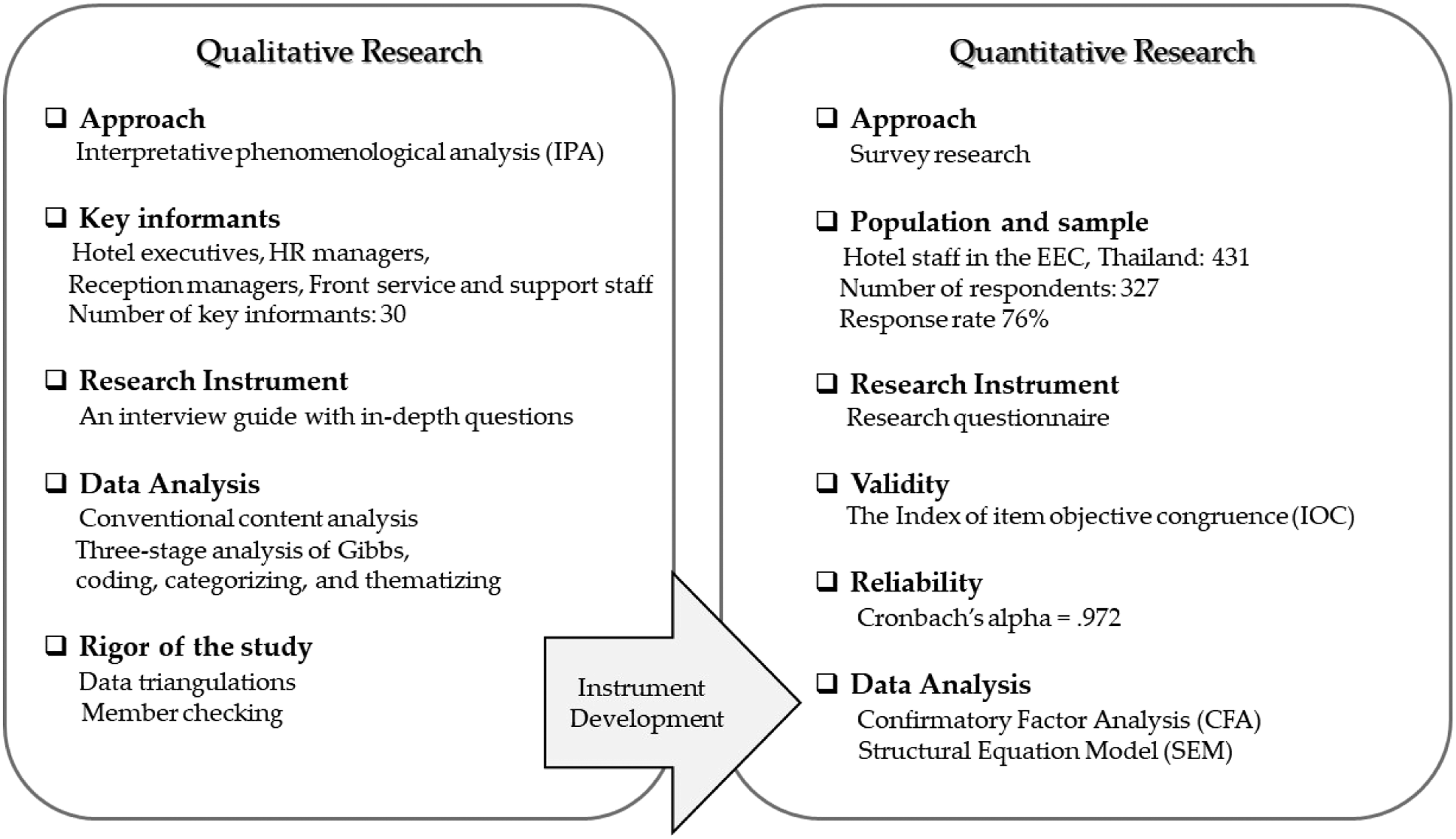
Qualitative research method
First, the interpretative phenomenological analysis (IPA) approach was employed. In the IPA, key respondents can express themselves and narrate their experiences without fearing distortion or persecution. 48 The key respondents of this study were executives, HR managers, reception managers, and some hotel staff from Thailand’s EEC. Varied target groups provided valuable insights for developing fundamental inferences from the research findings. 49 To allow the key respondents to obtain a real robot adoption experience (a crucial criterion of IPA), a navigation robot was rented to work with, at three hotels in three provinces of the EEC, for the duration of a week each.
An interview guide designed using in-depth questions based on Patton’s guide, 50 was considered as the research instrument. For content validity, five experts representing the hotel industry and robotics validated the interview guide prior to its use. After each interview session, the content was analyzed for each phenomenon in the study. Conventional content analysis, in which the coding categories were derived directly from the interview text data, 51 was used.
Data were then analyzed following Gibbs, 52 three-stage analysis method, which includes coding, categorizing, and thematizing. Data analysis started with repeated reading of all data to make sense of the information. 53 The texts were then condensed while preserving the core meaning. 51 Subsequently, a code was developed using names that closely described the condensed meaning unit. 54 Thereafter, codes were sorted into categories based on how they were related and linked. These emergent categories were used to organize and group codes into meaningful clusters. 55 Finally, categories can be grouped into or connected with themes, which comprised analytical statements to identify underlying patterns and commonalities to answer the research questions.
Interviewee perspectives were compared and examined for consistency to enhance interpretative validity. Member checking was performed by returning the results to some key respondents to recheck the accuracy of their responses. This study was approved by the Research Ethical Committee of Burapha University.
Strategy of mixed-methods research
In mixed-methods research, data analyses correlate with the research strategy that has been chosen for the procedure. In this study, a sequential exploratory strategy was employed. It then addressed “instrument development.” This approach has three stages. First, themes and specific statements were obtained from the participants. This marks the initial qualitative data collection drive. Second, these statements and themes were used as specific items to create scales for a survey instrument. Finally, the survey instrument that was created from the items was validated using a large sample that is representative of the population. 47
Quantitative research method
In the quantitative stage, hotel employees in the EEC region were taken as the target population. A sample size of 431 was determined, using the G*Power program (effect size = 0.30, alpha error probability = 0.05, power of test = 0.80, and df = 90). Through instrumental development in the sequential exploratory approaches, and with support from literature reviews, the constructs were obtained based on the IPA findings. Key themes from the qualitative findings were employed as the latent variables in the model testing. In generating questionnaire items, the categories and codes in each theme were modified as observable variables.
A five-point Likert scale was adopted (1 = strongly disagree, 5 = strongly agree) for the questionnaire items. The scales were examined by five experts to test the content validity using the IOC approach. The reliability of the questionnaire was tested to estimate Cronbach’s Alpha coefficient by piloting the questionnaire with another group of 30 samples before data collection from the sample group.
Before testing the model, the exploratory factor analysis was conducted. The common method variance (CMV) was introduced by using Harman’s one-factor test to minimize the possibility of bias from using a single method of data collection. If the common latent factor explains more than 50% of the variance, then common method bias may be present. 56 The factor loading or associations between latent and observed variables should be above 0.30. Eigenvalue is a measure of how much of the common variance of the observed variables a factor explains; only components with eigenvalues greater than 1 should be retained. 57
Confirmatory factor analysis (CFA) was used to test the construct validity of factors in each model variable. If the estimated values of the factor loadings were above the minimum level of 0.50, indicator validity was achieved. 58 Additionally, the test scores of composite reliability (CR > 0.70) and average variance extracted (AVE >0.50) were calculated to test construct reliability. 59 The statistics used for measuring congruence levels, which indicate goodness-of-fit, were as follows: Chi-square (0 ≤χ2 ≤ 2), p-value (0.05 < p ≤ 1.00), relative Chi-square (0≤ χ2/df ≤ 2), goodness-of-fit index (0.90 ≤ GFI ≤ 1.00), adjusted goodness-of-fit index (0.90 ≤ AGFI ≤ 1.00), comparative fit index (0.90 ≤ CFI ≤ 1.00), standard root mean square residual (0 ≤ RMSEA ≤ 0.05), and root mean square error of approximation (0 ≤ RMSEA ≤ 0.05).60,61 The model was analyzed to determine the presence of a mediator by considering the path coefficient of the overall influence. A path coefficient higher than 0.20 was regarded as a high value, 62 implying that either the suspected factor could be real, or a latent factor exists in the relationship between the causal and outcome factors. Mediators between the independent and dependent variables were then analyzed for indirect influence. If a variable’s indirect influence was not found to be statistically significant and the path coefficient reduced to 0, it was not regarded as a mediator. Conversely, if the indirect influence was found to be significant and the path coefficient reduced but did not fall to 0, it was regarded as a full mediator. 63
Research findings
According to the research objectives and methods, the findings can be presented in two parts—qualitative and quantitative. Commencing with the qualitative analysis, an initial model of robot acceptance was proposed. Thereafter, the proposed model was validated by surveying the opinions of hotel employees on a larger scale in accordance with the quantitative approach.
Qualitative research findings
The key informants included people in management positions, such as executives, HR managers, reception managers, and staff members, such as HR officers, receptionists, bellhops, and waiters. Data saturation occurred after 30 interviews, beyond which only previously discovered data were generated or the data no longer altered. Key informants in varied positions shared the same opinion about working with robots. The reason may be that robots used in this study only performed navigation on the short route nearby the hotel lobby.
From the content analysis, five main themes emerged: human, robot, organization, HRC, and robot acceptance.
64
In the human theme, the study found positive and negative perceptions about robots. Some respondents experienced novel feelings of excitement, interest, or surprise during their interactions with robots. Others were skeptical and fearful. In the robot theme, several advantages of robots were uncovered, such as robots’ capacity for work, their usefulness, and attractive appearance. However, the obvious lack of human sensitivity in interaction and limited movement were considered as disadvantages. According to opinions on organizational factors, robot adoption would advance the hotel’s image, and the current form of robot adoption did not affect the hotel’s HR process. The main hindrance to robot adoption was the physical layout of the hotel, which occasionally obstructed the robot navigation route because of stairs and closed doors. This made HRC a necessity clarifying the role between robots and humans and proving that robots would only support the work of hotel staff members. Thus, the hotel staff accepted robots as their colleague and were not threatened by them. The relationship between the findings was established, as shown in Figure 3. Acceptance of robots from the employee perspective.
The IPA result in Figure 3 aligned with the initial model in Figure 1. Considering that HRC is a novel phenomenon in the Thai hotel industry, the researcher discovered in in-depth interviews that hotel employees perceived robot acceptance differently when HRC was involved. Employees who involved in HRC tend to better understand the HRC context than those who did not. HRC may then play a mediating role between independent variables and robot acceptance. This resulted in adding one more working hypothesis, i.e. H8: HRC partially mediates the effect of humans, robots, and organizational factors on robot acceptance. Adding H8 did not alter the initial model. The mediator role of HRC was then investigated.
Quantitative research findings
After the questionnaire was generated, validity and reliability tests were performed to ensure the superiority of the questionnaire. The result of the IOC score ranking ranged from 0.8 to 1.0, which was more than 0.5; the reliability value of the overall questionnaire was 0.972.
During the COVID-19 pandemic, online questionnaires through Google forms were sent to the hotel associations in each province. The questionnaire link was then further shared with the member hotels. Finally, 327 questionnaires were returned, with acceptable response rate of 75.9%. For general population surveys, a response rate of 70% and above is acceptable. 58
When testing the CMV, Harman’s single-factor score for the total variance was 46.55, which is less than 50%; it was suggested that the common method bias did not impact the data. All factor loadings were above 0.30. The eigenvalue in every latent variable indicated a two-component matrix, except in organizational factors, where three component groups were found. From the testing, the latent and observable variables were defined as follows: Human factor: Human experience (HExp) and human perception (HPec) Robot factor: Robot capability (RCap) and robot appearance (RApp) Organizational factor: Organizational context (OCon), physical layout (OPhy), and HRM (OHRM) HRC: Human role (HRCH) and robot role (HRCR) Acceptance of robots: No resistance (ANrs) and intention to use (AInt)
The means and standard deviations of all indicators ranged from moderate to high levels. They were the highest for robot (Mean = 3.467, SD = 0.880) and HRC (Mean = 3.432, SD = 0.674), followed by organization (Mean =3.297, SD = 0.850), robot acceptance (Mean = 2.941, SD = 0.857), and human (Mean = 2.849, SD = 0.673). The correlation coefficients for the relationship among the five variables in 10 pairs ranged from 0.441 to 0.808, indicating a low to high level of relationship. These relationships did not show multicollinearity among the latent variables considering that multicollinearity between each pair of variables should be over 0.90; therefore, relationships among the variables were compliant with basic statistical requirements.
Summary of the validity and reliability analyses.

The hypotheses were tested using CFA from the AMOS analysis. As depicted in Figure 4 and Table 3, χ2/df is 0.862, which is smaller than 2. The GFI value of 0.992, AGFI value of 0.969, NFI value of 0.995, and CFI value of 1.000 were higher than the prescribed value of 0.900. The RMSEA value was 0.000, which was within the acceptable range of 0.05; for this model, p-value is 0.860, which was more than 0.05. With these indexes corresponding to the standards, the model was considered a good fit. Path analysis of the structural model. Goodness-of-fit indexes.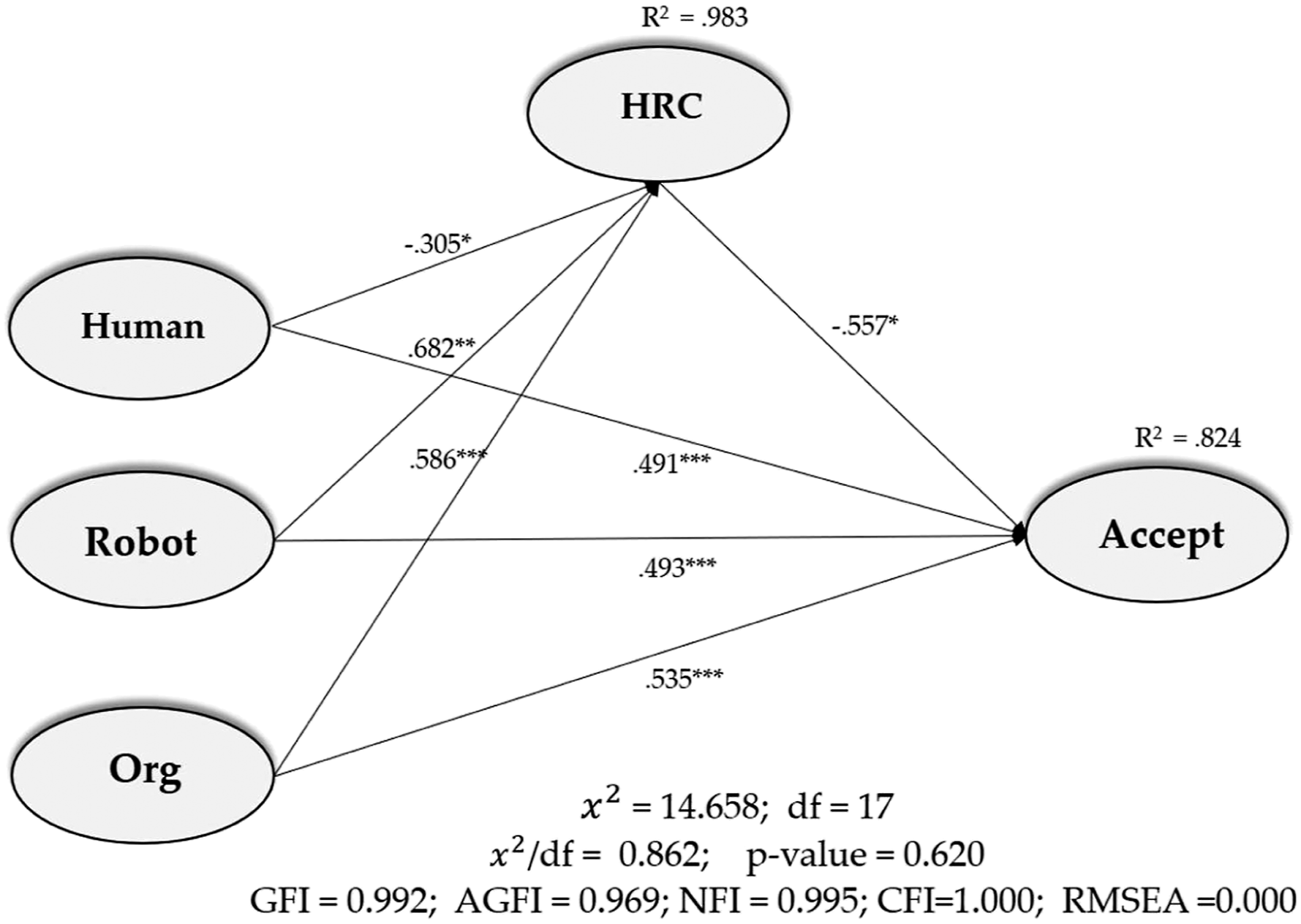

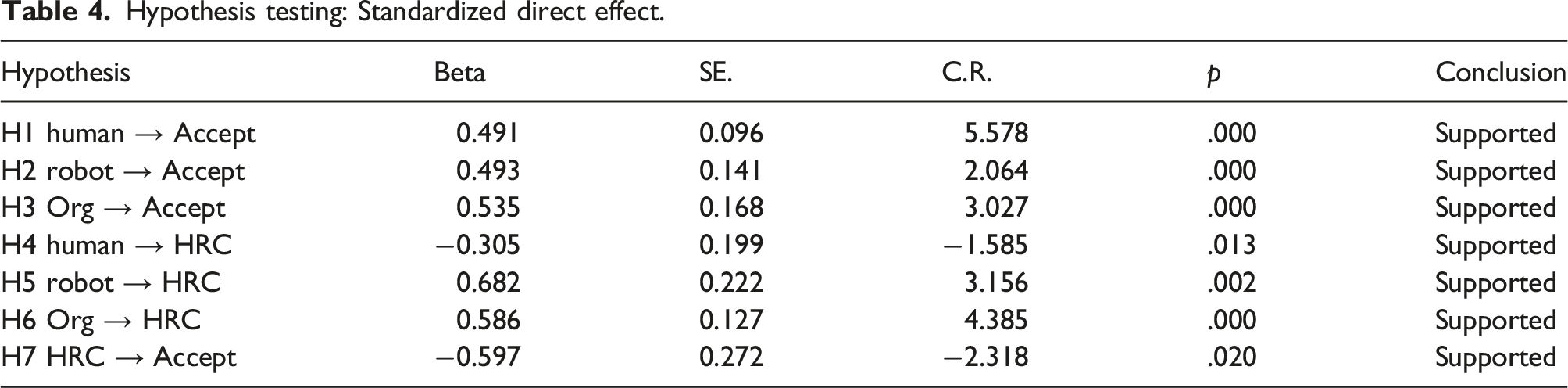
Hypothesis testing: Standardized direct effect.
Mediating effects of HRC between human, robot, and organizational factors on robot acceptance.
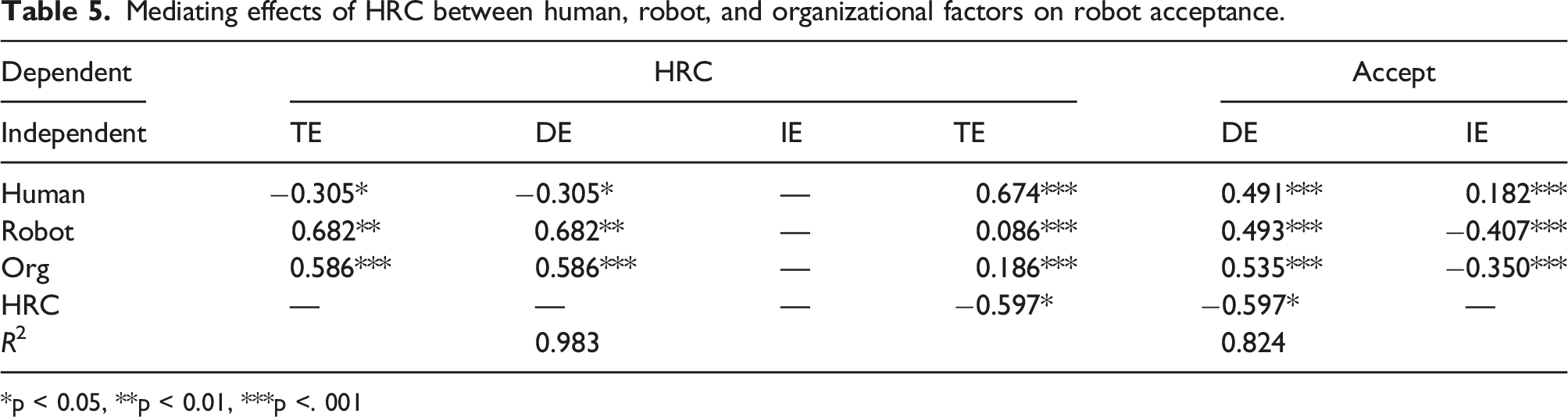
*p < 0.05, **p < 0.01, ***p <. 001
Discussion
This study validated several findings of previous studies. Additionally, through the use of mixed-methods research methodology, insightful findings from the qualitative and quantitative approaches were uncovered. Focusing on robot acceptance, both the phases reflected robot acceptance, but at different levels. In the IPA, hotel staff welcomed and accepted the robot as their colleague. However, when the opinions of the hotel staff were surveyed, different results emerged. The survey revealed a moderate level of robot acceptance. Similarly, in the HRC aspect, this model of robot acceptance found a negative relationship of humans on HRC and HRC on robot acceptance, which implied that hotel employees did not favor HRC. Contrastingly, the IPA findings showed a positive relationship between humans and robots in HRC. This may be due to the differences in the backgrounds of respondents. In the IPA study, hotel staff gained direct experience of working with a robot, whereas the survey respondents did not. Therefore, this study reaffirms the premise that user experience is an important criterion affecting robot acceptance. 21
The study findings support that of TAM and UTAUT. Individual perceptions on ease of use and usefulness of robots were present.17,23 The IPA study established perceptions of anxiety and gratification among hotel employees because of the robot. Moreover, perceptions were significantly altered by the direct experience of working with a robot. The novelty effect was another noteworthy issue regarding the human factor in the IPA study. However, novelty and its effects typically subside after some time.24–27 When the interactions have become repetitive, the outcomes (including employee attitude toward the robot) may begin to change. Thus, one of the reasons that the hotel staff accepted the robot in the IPA study could be the novelty effect.
The findings support prior research28,30,32 on the robot factor, indicating that robot capability, interaction, and appearance influence the acceptability of robots. Although robot capability in the IPA study was limited (as it only navigated a short distance within the hotel lobby), the hotel staff accepted the robots. Social interaction with robots was considered as a disadvantage in the IPA study. The study established the desirability of active interaction, as suggested in several previous studies.37–39 When the findings of the IPA were synchronized with the questionnaire of this study, results confirmed that the respondents expected robots to have a consistent capacity for work, an attractive appearance, and good social interaction skills.
The organizational factor affected acceptance of the robot, especially in the context of the physical layout of the hotel. The robot is a product of advanced technology. Many hotels were established before this technology arrived. The findings in both phases of this study confirmed that the hotel’s physical layout was a significant barrier. The multi-level and layered design of the building impeded the robot’s movement. In addition, hotel doors remained closed for air conditioning and the robots could not walk through freely. An organizations’ physical environment was found to directly affect robot acceptance.41,42 This attribute was significant for this study, as it presented difficulties in selecting hotels for the IPA study. Many hotels were bypassed because their physical layouts were an impediment. Nonetheless, this study strengthens the argument that robot adoption can boost hotel perceptions. Similar to previous studies, 43 the implications of the findings for organizational management and HRM suggest that hotel staff should be prepared to collaborate with the robots in the workplace.
Finally, although H8 expected a positive effect of HRC on the acceptance of robots, the result was negative. Generally, the higher the level of HRC, the lower the acceptance of robots. The staff may have feared that robots would replace them. Resistance to robot adoption may also arise from the situation created by the COVID-19 pandemic. During the pandemic, many hotels closed temporarily. Some hotel employees were not paid for their work or were paid lower salaries. Moreover, it was thought that the job loss could be permanent or compounded by the robot adoption. Therefore, a higher rate of robot deployment was linked with a greater risk of unemployment. Thus, HRC resulted in a negative influence on the acceptance of robots.
Theoretical implications
This study attempted a multidimensional analysis based on human, robot, and organizational factors, thereby facilitating a broad scenario of the robot acceptance phenomenon in the hotel workplace. The study findings obtained for each dimension contributed to a better understanding of the topic. Moreover, the mixed-methods research was beneficial in facilitating a thorough discussion of findings. The findings from the first phase added value to those from the second phase.
The theories of technology of acceptance are applicable for robot adoption in the workplace. At the individual level, human perception is the dominant influencing factor for robot acceptance in the existing literature,17,22,23 and as reiterated by this study. Moreover, the findings highlight the association between individual experiences5,21 and individual perception.17,22,23 Researchers interested in studying the acceptance of robots should integrate users’ perception and experience in their studies.
This study investigated the relationship between organization management and the acceptance of robots. Overall, change management is vital to minimize change resistance. Management allows people to reconcile themselves to the introduction of robots in the workplace, as robot adoption will inevitably affect HRM.41,42,44 This study finds that training in HRC is imperative. However, in the case of long-term robot adoption, policies on manpower planning, recruitment and selection, and work division should be redesigned. Thus, further research on appropriate change management and HRM should be undertaken.
Practical Implications
Robot adoption in Thai hotels is a novel concept that has yet to be implemented. The findings of this empirical study can provide a useful framework for decision-making of hoteliers, particularly in Thailand and other areas that have not yet initiated the process of robot adoption, to enhance robot acceptability and to minimize the risk of trial and error.
Hoteliers should encourage their staff to perceive robots positively. 45 Educating hotel staff to understand that robots will support their work41,42 and not replace them will help them perceive robots positively, as demonstrated by the IPA study. Hoteliers should allow their staff to gain first-hand experience in working with robots by demonstrating and explaining how robots function. Many exhibitions and conferences are organized to showcase robots as their main attractions. Hoteliers can take such opportunities to help their staff gain direct experience with robots. Alternatively, they can engage robot companies to demonstrate how robots can support their staff. These suggestions for encouraging positive perceptions by hotel staff and gaining the direct experience of interaction with robots will lead to better robot acceptance in the workplace.
Organizational management is extremely crucial in HRC. A good start for robot adoption is to introduce HRC as a pilot project. To reduce employee resistance to HRC,2,43 change management would also be required41,42 and must include an element that targets at minimizing employee resistance. The HRC change agent team should be addressed to enhance employee participation. Personnel who handle the change well and cooperate must also be rewarded. Regarding the physical layout of the hotel premises, reconstruction or alteration may be necessary.41,42 Where this is not possible, hoteliers can consider other types of robots instead of navigator robots, such as those used in this study. These can include communication robots, chef robots, delivery robots, entertainment robots, housekeeping robots, guide robots, or security robots.
Research limitations
The novelty of robot service in the Thai hotel industry was a limiting factor for this study. It limited opportunities for practical research on robot application. This study employed a navigator robot, thus limiting the generalizability of the findings. Further analysis is required to extend the research to other types of robots. In addition, the COVID-19 pandemic imposed limitations on this study. The hotel industry has changed substantially post lockdown. Some hotels were temporarily closed, others continued to operate in limited capacity, and some staff worked from home. 64 This introduced difficulties in the distribution of the research questionnaire. Moreover, people were worried about the virus and their employment status. Thus, data collection took nearly 5 months.
Conclusions
Robots can provide hotels an opportunity to enhance their competitive advantage. Many hotels worldwide have adopted this advanced technology. Humans and robots have their own strengths and must work together as colleagues. Collaboration between human staff and robots is crucial for a successful robot adoption in the workplace.
Human–robot collaboration is a novel phenomenon. Thus, the perception that robots are a threat to human employment persists. The success of robot adoption depends on individual acceptance and users’ ability to control the robots. Hence, hotel employees must be equipped with sufficient robot knowledge to facilitate robot acceptance in the workplace. The factors affecting robot acceptance are human, robot, and organizational factors. Ultimately, HRC is a vital component of this relationship. Therefore, these factors should be considered while managing the process of change.
Footnotes
Declaration of conflicting interests
The author(s) declared no potential conflicts of interest with respect to the research, authorship, and/or publication of this article.
Funding
The author(s) disclosed receipt of the following financial support for the research, authorship, and/or publication of this article: This work was supported by the Thailand Research Fund and Burapha University, grant number RSA6280029.
