




Abstract
Background
As the role of physical activity in breast cancer management gains increasing recognition, understanding the effects of aerobic exercise on patients’ quality of life and biological markers has emerged as a critical area of research to inform clinical practices and improve patient outcomes.
Objective
This study aims to investigate the impact of low-intensity resistance exercise training on serum tumor biomarkers and quality of life in women with breast cancer, providing evidence for its potential role as an adjunct therapy in improving clinical outcomes and patient well-being.
Methods
This study was carried out on 70 women between the ages of 18 and 65, who were included in the study while receiving chemotherapy treatment. The subject was divided into low-intensity resistance exercise (Group I) and control (Group II). Demographic characteristics, quality of life, and serum tumor biomarkers were evaluated. Participants in group I underwent a 12-week exercise programme of low-intensity resistance exercises three times a week (three metabolic equivalents, approximately 30 min/session).
Results
The quality of life has been found to be significantly higher in the low-intensity resistance exercise group (p < 0.05). The serum tumor biomarker levels of CEA, CA15-3, and CA19-9 decreased across all participants. However, the reduction in serum tumor biomarker levels was found to be more pronounced in Group 1 (p < 0.05).
Conclusions
Low-intensity resistance exercise has demonstrated a positive effect on the quality of life in women with breast cancer. Within the framework of oncological rehabilitation, aerobic exercise regimens may be preferred due to their role in promoting improvements in serum tumor biomarker levels and contributing to enhanced quality of life.
Keywords
Introduction
Breast cancer is the most common cancer and the second leading cause of death from cancer among women. 1 Due to its increasing occurrence and inadequate treatment outcomes, breast cancer remains a significant medical, social, and economic problem in the modern world.
Surgery, chemotherapy, radiation, and hormone therapy are used alone or in combination to treat breast cancer. Cancer treatment has several harmful side effects that reduce the patient's quality of life. 2 Side effects such as lymphedema, 3 peripheral neuropathy, 4 sedentary lifestyle, 5 decrease in aerobic fitness and muscle strength, fatigue, 6 weight gain and changes in body structure, decrease in bone mineral density, 7 high inflammatory profile, 8 immunosuppression, 9 changes in body image perception, 10 anxiety and depression, 11 have been stated in the literature. Physical inactivity in cancer patients is one of the leading causes of disease development. 12 These side effects due to treatment cause a decrease in patients’ quality of life. Exercise exerts its physiological effects in breast cancer primarily through the regulation of cytokines and myokines. Regular exercise for breast-cancer patients is becoming a part of treatment due to its positive effects on minimizing the side effects of treatment and improving the quality of life of patients. 13 In the ‘Diet and Physical Activity Guidelines for Cancer Prevention’ published by the American Cancer Society in 2020, moderate to vigorous physical activity is emphasised for cancer prevention. 14
Resistance exercise is known to contribute to healing fatigue, functional capacity, cognitive status, depression, and musculoskeletal protection in breast cancer. 19 However, research that examines the link between serum tumor biomarkers and oncological rehabilitation and fitness training was not found in the literature. . We aimed to investigate the effects of low-intensity resistance exercise training on serum tumor biomarkers and quality of life, including physical, emotional, and social aspects in women undergoing breast cancer treatment. It was also aimed topotential of low-intensity resistance exercise as a safe and feasible adjunct therapy in breast cancer care.
Materials and methods

CONSORT flowchart of the participants of the study.
Participants’ demographic characteristics and quality of life were assessed. Partici-pants’ quality of life was evaluated using the European Organization for Research and Treatment of Cancer Core Quality of Life Questionnaire (EORTC QOL-C30). The purpose of the EORTC QOL-C30 survey is to measure cancer patients’ physical, psychological, and social factors. The scale consists of five functional scales (physical, responsibility, cognitive, emotional, and social), three symptom scales (fatigue, pain, and nausea/vomiting), and one global health status scale. The remaining six single items assess symptoms such as dyspnoea, sleep disturbance, anorexia, constipation, diarrheal, and financial difficulties. It is comprised of 30 questions in total. 20
Analysis of Serum tumor biomarkers levels
Serum samples of all participants were taken twice, pre and post treatment. Serum tumor markers; carcinoembryonic antigen (CEA), cancer antigen 19–9 (CA19-9) and cancer antigen 15–3 (CA15-3) levels were performed on a UniCel™ DxI 800 Immunoassay System (Beckman Coulter, USA) using a double sided chemiluminescence immunoenzymatic method. Reagent handling, instrument operation, and specimen testing were done according to the manufacturer's guidelines. Units are ng/mL for CEA and U/mL for CA 15-3, and CA 19-9.
Procedure for low-intensity resistance training
The chemotherapy followed a predetermined hospital procedure and lasted three weeks with four consecutive courses. Specific medicines and their doses were rigorously defined in this program as per the international guideline recommendations by the oncologist.
For Group I, participants engaged in body-weight resistance exercises conducted twice a week over a
12-week period. Patients were instructed to document their exercise and chemotherapy sessions on a 12-week tracker, which was then reviewed on a weekly basis. Conversely, for Group II (the control group), only the cancer symptoms were observed, and the participants’ quality of life was assessed. Each exercise program commenced with a 5-min segment dedicated to warm-up and breathing exercises. A suite of 14 varied low-intensity resistance exercises was available for participants to choose from, encompassing:
Supine Position: Bilateral hip flexion, straight leg raises, and bridge exercise. Side Lying Position: Hip abduction. Prone Position: Trunk extension. Sitting Position: Bilateral shoulder elevation, bilateral shoulder girth, and scapular adduction. Standing Position: Shoulder flexion, shoulder abduction, 90° flexion of the hip and knee, and a half squat.
These exercises harnessed the participants’ body weight as resistance. To culminate each session, a 5-min cool-down phase was included. As for the repetition structure:
Weeks 1–4: 10–15 repetitions. Weeks 5–8: 15–20 repetitions. Weeks 9–12: 20–30 repetitions.
The exercises were modified based on the patient's comfort and tolerance. The fatigue perception level was examined using the Modified Borg Scale. Exercise prescription criteria based on ACSM recommendations for healthy adults were used in the current study to determine whether participation in low-intensity resistance exercise was sufficient to achieve health benefits. According to these criteria, low-intensity resistance exercise should be performed at an intensity of 3–4 on an RPE scale from 1 ‘no effort’ to 10 ‘maximal effort’ using the Rating of Perceived Exertion (RPE) scale, at a frequency of at least two days per week, using 3 sets of 8–12 repetitions of a programme of 8–10 exercises involving all major muscle groups. 21 Notably, both the evaluation and the training were supervised by the same physiotherapist. No adverse events occurred during the exercise sessions.
Statistical analysis
This study adopted the sample size determination approach by the G*Power program (Version 3.0.10, created by Franz Foul at Universität Kiel, Germany) to determine the sample size for our investigation. The desired sample size for each group was chosen at 21 participants based on power analysis results, with a significance level of =0.05 and power of =0.20. However, considering clinical characteristics such as mortality (exitus) status and the presence of metastasis, it was planned to include 40 participants in the treatment group and 40 participants in the control group.
Data analysis of this research was performed using the SPSS 21.0 software. We assessed the normality of data distribution through both visual tools (histograms and probability plots) and analytical methods, primarily the Shapiro-Wilks test. Continuous data are represented as mean ± standard deviation, while categorical data frequencies are depicted as n (%). Therefore, for numeric comparisons between the two groups, the Mann-Whitney U test was utilized. However, in situations where categorical data between groups required comparison, the Chi-Square Test was employed. For within-group comparisons (pre-treatment vs. post-treatment), paired analyses were conducted using the Wilcoxon signed-rank test due to non-normal distribution of the data. Results were reported as z-values with associated p-values. For between-group comparisons (Group-I vs. Group-II), independent t-tests (Welch's t-test) were applied to evaluate differences in post-treatment values of tumor markers. The test was selected to account for unequal variances between groups. Hence, for all statistical tests, a p-value threshold of less than 0.05 was considered significant.
Results
Data from Group I and Group II were compared to observe the effects of low-intensity resistance exercise training on serum tumor biomarkers and quality of life in women with breast cancer.
The participant's ages varied from 18 to 65, with an average of. 49.53 ± 9.12. Table 1 provides descriptive data from both Group I and Group II subjects, including age, BMI, and afflicted extremity. According to preliminary research, both groups were statistically equivalent regarding these descriptive parameters (p > 0.05).
Demographic profile of participants.

Examining quality of life
General well-being was assessed using the subheading physical function, role function, cognitive status, emotional and social status, and identical values obtained in both groups prior to therapy (p > 0.05). Group I women improved more in physical function, role function, cognitive status, and social status following therapy (p < 0.05). And the outcomes of general well-being and emotional status were similarly in all women (p > 0.05, Table 2)
Comparison of quality of life between groups * p = 0.05; Mann Whitney U test.

When the findings of the participant's quality of life before and after treatment were examined, it was discovered that the results of all sub-headings increased considerably in both groups following the exercise intervention.
Evaluation of Serum tumor biomarkers
The serum concentrations of the three predominant serum tumor biomarkers associated with breast cancer were assessed both before and after the treatment sessions. Serum tumor biomarker levels decreased in both groups during the post-treatment period. However, post-treatment analyses revealed that the decline in the values of CEA, CA15-3, and CA19-9 was notably more well defined in Group I women than in Group II(p < 0.05), (Tables 3 and 4).
Comparison of the serum tumor biomarkers between pre-treatment and post-treatment.

*Wilcoxon signed-rank test.
The difference of serum tumor biomarker between groups.
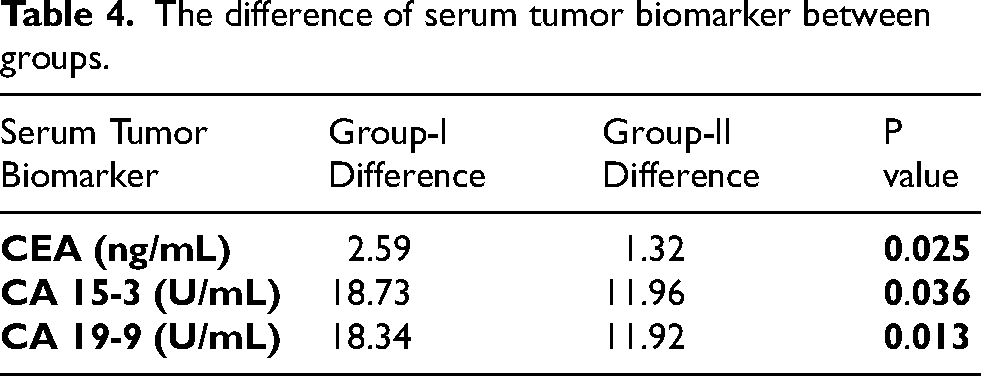
Post-treatment CEA content in the blood serum of participants in Group I decreased by 49.33%, whereas it decreased by 26.94% in Group II. Similarly, post-treatment, the CA15-3 concentration in blood serum decreased by 55.14% in Group I and 36.73% in Group II. Furthermore, following therapy, the CA19-9 marker decreased by 50.78% in Group I and 33.39% in Group II (Figure 2).

Difference of Serum tumor biomarkers with diagram.
Discussion
The primary goal of this study was to determine how low-intensity resistance exercise impacts the quality of life and serum tumor biomarkers in women diagnosed with breast cancer. During the study, participants underwent 12 weeks of low-intensity resistance exercises while undergoing chemotherapy. Our study is the first to investigate the effects of low-intensity exercise on serum tumor biomarkers, making a significant contribution to the literature. It provides a novel perspective on the role of low-intensity exercises inIn studies examining serum tumor biomarkers, the limited duration of interventions has been highlighted as a notable gap in the literature. Addressing this gap, our study involved women with breast cancer participating in a 12-week low-intensity exercise program, yielding highly promising serum tumor biomarker outcomes oncological rehabilitation and their impact on serum tumor biomarkers.
Existing literature indicates that the cancer and cancer-treatment processes may have detrimental effects on the quality of life of women with breast cancer. 22 The positive effects of aerobic exercise on the quality of life in cancer patients have been well-documented. 23 Our study further explored the contributions of low-intensity aerobic exercises to various dimensions of quality of life. Significant improvements were observed in subcategories such as physical function, role function, cognitive function, and social well-being among women with breast cancer. These findings emphasize that low-intensity aerobic exercises are not only safe but also effective interventions in oncological rehabilitation, underscoring the need to integrate such programs into standard care protocols
It has been hypothesized that the effect of exercise on the quality of life in breast cancer patients undergoing chemotherapy might be associated with depression at the start of the treatment. 24 A systematic review by Zhang et al., focusing on the influence of exercise on the quality of life in breast cancer patients, confirmed that resistance exercise is safe for these patients and positively impacts their quality of life. 25
Consistent with other studies, our findings suggest that individuals who regularly participate in a low-intensity resistance exercise program experience an enhanced quality of life during the chemotherapy process.
In a study conducted by Porika and colleagues on serum tumor markers, the evaluation of CA15.3 and CEA values showed sensitivities and specificities of 35.3% and 18.3% and 95.6% and 62.7%, respectively and their specificities were 95.6% and 62.7%. Monitoring cancer symptoms is essential across all stages of breast cancer, encompassing metastasis prediction, treatment, diagnosis, and screening. 26 In the early stages of breast cancer, elevated blood levels are present in about 10% of patients, and this number rises to approximately 70% in advanced stages. Successful treatments typically lead to a decline in CA 15.3 levels. 27 Elevated CA 15-3 (e.g., 150 U/ml) and/or CEA (e.g., 120 ng/ml) levels in individuals believed to have localized disease may hint at the potential for undiagnosed metastatic disease. 15
Recent developments in molecular biology and molecularly targeted therapies, along with some notable advancements in breast cancer screening techniques and cancer treatments, have improved our understanding of how breast cancer develops and made it possible to develop innovative, safe, and highly effective treatment plans. 28 It's well-documented that serum tumor biomarkers undergo significant variations in relation to the chemotherapy treatment process. However, existing literature lacks studies elucidating the relationship between exercise and serum tumor biomarkers. Which were analysed the effect of low-intensity resistance exercises administered by a physiotherapist during chemotherapy on cancer symptoms, detected reductions in CEA, CA15-3, and CA19-9 serum values. We believe that in this respect, our study introduces a novel perspective and enriches the academic literature.
Researchers suggest that regular exercise in patients with advanced cancer enhances activity levels and energy expenditure without exacerbating fatigue. Additionally, exercise induces hormonal variations by modulating body mass index and fat percentage. On one hand, CA15-3 is a protein produced by various cell types, particularly breast cancer cells; on the other hand, exercise positively influences the tumor microenvironment by improving the systemic pro-inflammatory profile and regulating the serum concentrations of growth markers associated with tumorigenesis. 29 The findings of our study support the existing literature. It was observed that the reduction in serum tumor biomarker levels was more pronounced in women who performed low-intensity exercise. The role of exercise in oncologic rehabilitation processes is known. However, there is a need for studies that examine serum tumor biomarkers in detail, include large sample groups, compare different exercise methods and focus on long-term results.
The considerable post-treatment variance in cancer symptoms values between the groups, compared to pre-treatment, suggests potential psychosocial implications. Given the well-documented positive impacts of exercise on motivation and general health, more comprehensive studies are essential to better understand this relationship.
The findings of our study, in the context of oncological rehabilitation, indicate that low-intensity resistance exercises can potentially ameliorate serum tumor biomarkers, which is encouraging news for physiotherapists. We anticipate that our findings will provide guidance to healthcare professionals in the realm of oncological rehabilitation.
Modern breast cancer treatment involves targeted therapies, hormonal therapy, radiation therapy, and surgery. We are optimistic that exercise will be integrated into these established treatment strategies in the future.
Conclusions
In conclusion, it was determined that low-intensity exercise interventions improved serum tumor biomarker levels in patients diagnosed with breast cancer. In addition, it was observed that the rehabilitation program applied for 12 weeks under the supervision of a physiotherapist contributed to a significant increase in the quality of life of the patients. It is thought that this study will make a unique contribution to the literature in terms of addressing long-term exercise programs in individuals with breast cancer, examining the effects on serum tumor biomarkers in detail and evaluating quality of life with its sub-dimensions.
Oncological rehabilitation is a field that requires a multidisciplinary and multifaceted approach, and the belief that exercise programs, in addition to medical treatments, contribute significantly to the success of cancer treatment and that ongoing exercise in remission and survival processes supports these processes is strengthening. In this context, it is of great importance for physiotherapists to play an active role in oncologic rehabilitation teams and to increase the number of oncologic rehabilitation units.
Limitations
This study has several limitations. The relatively recent adoption of the multidisciplinary approach in oncological rehabilitation and the absence of an oncological rehabilitation unit in the hospital where the study was conducted represent significant constraints. Furthermore, the limited number of studies investigating the effects of exercise on cancer-related symptoms poses challenges for comparative analysis with existing literature. Additionally, patients were doubtful about participating in the study and their reluctance to allocate time for exercise due to fatigue complaints further restricted the scope and implementation of the study.Additionally, longitudinal and periodic monitoring of changes in serum tumor biomarker levels could have yielded more robust and conclusive insights into the impact of exercise.
The manuscript received unanimous approval from all contributors.
Footnotes
Interpretation or analysis of data
YY and DK.
Preparation of the manuscript
The manuscript's initial draft was prepared by DK, NAF,KU and RCY.
Revision for important intellectual content
TD, HYB, KU, and YY.
Supervision
TD, YY.

Funding
The authors received no financial support for the research, authorship, and/or publication of this article.
Conflicting interests
The authors declared no potential conflicts of interest with respect to the research, authorship, and/or publication of this article.
Data availability
Data associated with the research is accessible.